
Entity SEO: Teaching Machines Who You Are
Ask Google who founded a famous company and it does not search for the words "who founded" — it resolves the company to a node in its Knowledge Graph, follows the founder relationship, and answers. Ask ChatGPT to recommend tools in your category and it does not scan the live web alphabetically — it draws on a compressed representation of everything it has read, in which brands exist as clusters of associations: what they do, who uses them, what they are good at, what they sit next to. In both cases the unit of understanding is not the keyword. It is the entity.
This is the analysis most SEO programs have not caught up with. Teams still organise their entire operation around strings — keyword lists, keyword difficulty, keyword rankings — while the systems deciding their visibility increasingly operate on things: people, organisations, products, places, and concepts, connected by relationships. The gap between those two world-views is where a lot of "we publish great content but AI engines never mention us" frustration lives. Machines cannot recommend what they cannot resolve. If the systems that mediate discovery have only a fuzzy idea of who you are, what you make, and what you are an authority on, then every article you publish is fighting with one hand tied.
Entity SEO is the discipline of fixing that — deliberately teaching machines who you are. This article analyses how machine understanding of entities actually works, why it has quietly become a precondition for AI-era visibility, and what a rigorous entity-building program looks like in practice.
Entity SEO means making your brand, people, and products unambiguous "things" that machines can identify and connect. It combines a definitive entity home page, consistent naming everywhere, Organization and Person schema with sameAs links, and external corroboration — so search engines and AI models can confidently say who you are, what you do, and what you are an authority on.
From strings to things: a short history of the shift
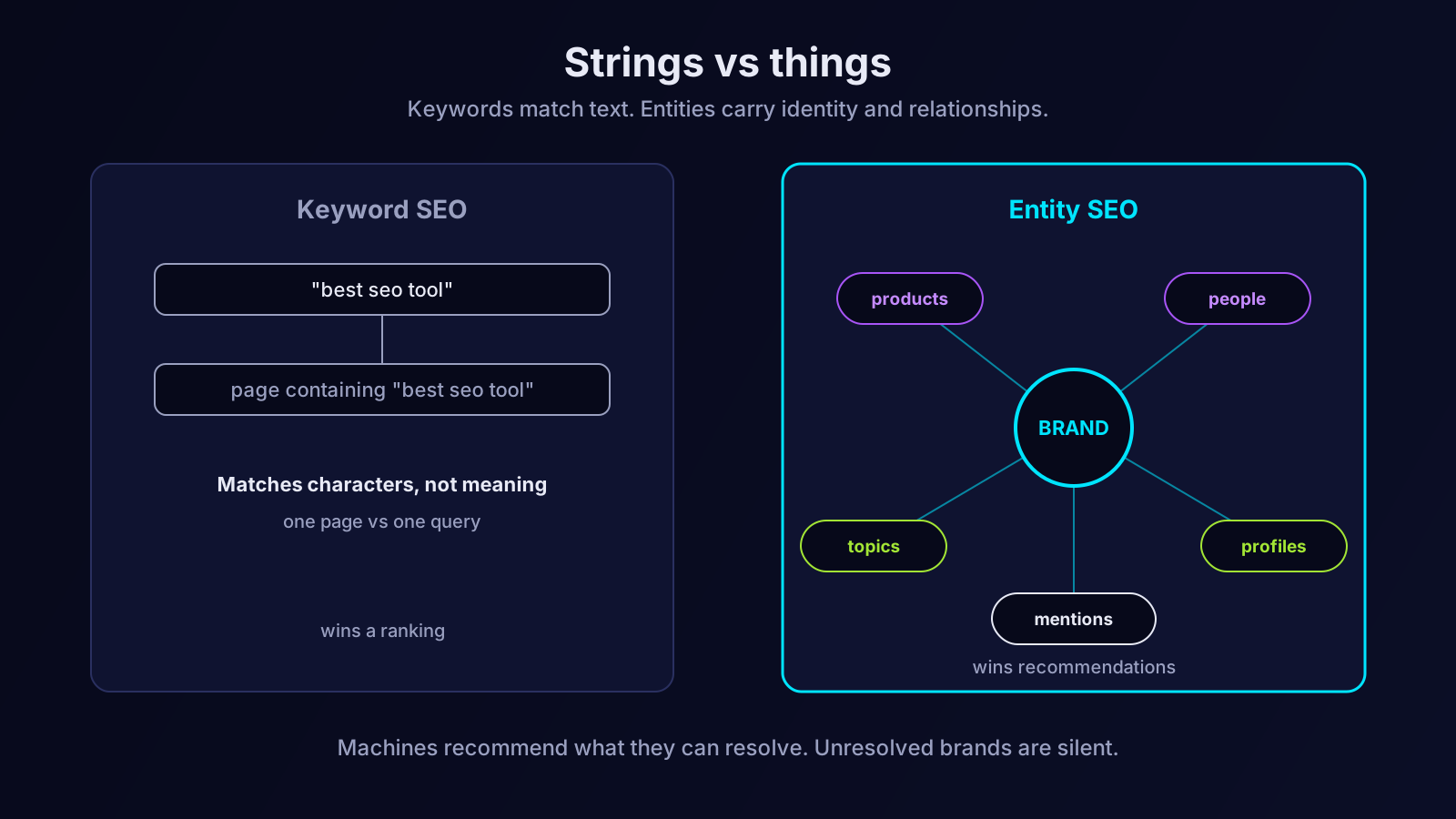
The phrase that named this transition came from Google itself. When the company launched the Knowledge Graph in 2012, it described the goal as moving from "strings to things" — from matching the characters in a query against the characters in documents, to understanding that "jaguar" might mean an animal, a car brand, or an operating system version, and that each of those is a distinct thing with properties and relationships. The Knowledge Graph began as a structured database of entities — seeded by sources like Wikipedia and Wikidata, extended by extraction from the broader web — and it has been compounding ever since: powering knowledge panels, disambiguating queries, and feeding the systems built on top.
Two later developments turned this from an interesting infrastructure project into the centre of gravity for visibility. The first was the steady improvement of natural language understanding inside ranking itself — systems that interpret queries and documents semantically, where entities and their relationships are the skeleton of meaning. The second, and the one that changes the strategic picture, is the rise of large language models as discovery interfaces. An LLM does not store the web; it stores a compression of it. In that compression, your brand is not a URL — it is a region of associations shaped by every context in which your name appeared in the training data and in whatever live retrieval the system performs. When someone asks an AI assistant "what's the best tool for X" or "is BrandY trustworthy," the answer is generated from that learned representation plus retrieved evidence. Both halves are entity-shaped.
The analytical point: keywords describe demand, but entities describe identity. Keyword optimisation positions a page against a query. Entity optimisation positions an organisation against the world-model of every machine that has read about it. The first wins you a ranking; the second determines whether you are even a candidate to be recommended, cited, or trusted — in classic search features like knowledge panels, and in every AI answer where your category comes up.
Why entities now decide AI-era visibility
Consider what actually happens when an answer engine handles a commercial or informational query where your business could plausibly appear. The system needs to do several things that are entity operations, not keyword operations.
It needs to resolve mentions: recognising that "Orova," "orova.vn," and "the Orova platform" are one thing and not three. It needs to attribute: connecting a useful article to the organisation and author behind it, so credibility can flow from the entity to the content and back. It needs to relate: knowing your product belongs to a category, competes with certain alternatives, serves certain customers, and is the subject of certain opinions. And it needs to verify: checking that claims about the entity are corroborated by more than the entity itself. Every one of these operations fails gracefully into the same outcome — silence. The system does not return an error when it cannot resolve you; it simply builds its answer from entities it can resolve. Your competitor with a cleaner entity footprint is not better than you; they are merely legible, and legibility is the ticket price.
There is a second-order effect worth analysing, because it compounds. Entities are how credibility transfers between systems. The E-E-A-T evidence we examined in our piece on E-E-A-T in the AI era — authorship, expertise, trust signals — only accumulates if the machine can attach each piece of evidence to a stable identity. Ten brilliant articles by an author whose name appears in ten inconsistent forms produce ten orphaned data points; the same articles attached to one resolvable Person entity produce a track record. Entity consistency is the bookkeeping layer of reputation: without it, nothing you earn ever lands in your account.
And a third: entity understanding is what lets unlinked mentions count. In a link-centric model, a journalist mentioning your brand without linking was worth approximately nothing. In an entity-centric model, every mention in a crawlable, trainable corpus is a co-occurrence that shapes how machines understand you — what topics you appear alongside, what sentiment surrounds you, which competitors you are compared with. The web has been voting for entities all along; only now is the franchise extended beyond hyperlinks.
The anatomy of a machine-recognisable entity
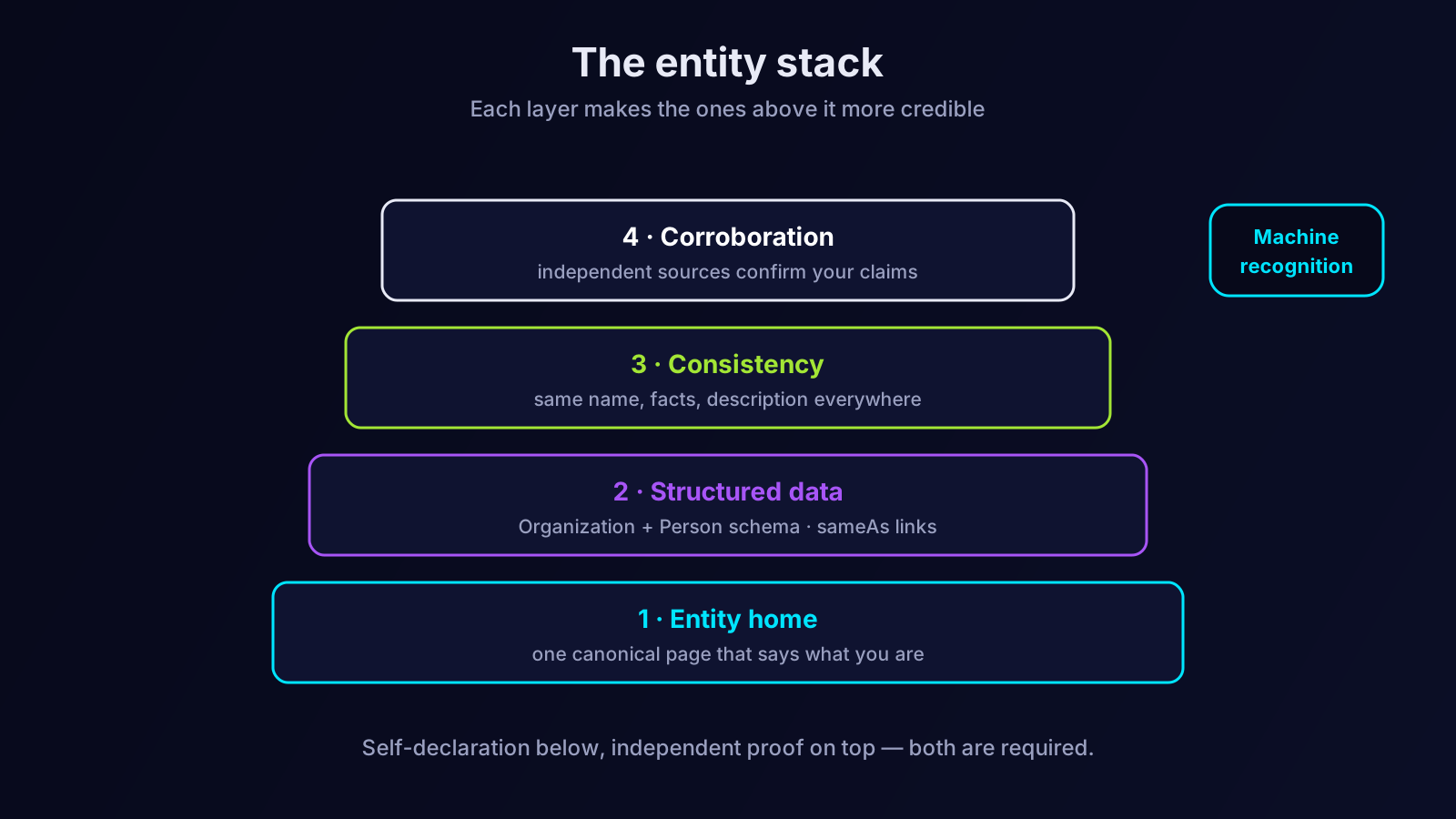
So what does it take, structurally, for machines to "know who you are"? Reverse-engineering knowledge panels, AI answer behaviour, and the public mechanics of knowledge graphs suggests four load-bearing components. Treat them as a stack: each layer makes the ones above it more credible.
1. A definitive entity home
Every entity needs one canonical page that the rest of the web's evidence can converge on — the page a machine treats as the authoritative statement of what the entity is. For an organisation this is usually the homepage or about page; for a person, their author or profile page; for a product, its main product page. The entity home should state, in plain prose and near the top, exactly what the entity is in the form machines need: name, category, what it does, who it serves, where it operates. This sounds insultingly basic until you audit real sites and find homepages that lead with a slogan ("Unlock tomorrow, today") and never actually say what the company does in resolvable terms. Poetic vagueness is an entity-resolution bug.
2. Structured data that declares identity
Schema markup is how you hand machines your entity description in their native format. The core moves: Organization schema on the entity home with name, url, logo, description, foundingDate, contact details, and — critically — sameAs pointing to your profiles on external platforms (LinkedIn, X, YouTube, GitHub, Wikidata if you have an item, and whatever directories matter in your industry). Person schema for key people, with their own sameAs arrays and knowsAbout for topical authority. Product schema where relevant. The sameAs property deserves special emphasis because it performs the exact operation entity SEO is about: it asserts, machine-readably, that this thing here and that profile there are the same thing. It is the disambiguation property. Our guide to winning rich results with structured data covers implementation mechanics; the entity lens just changes the why — you are not chasing a rich snippet, you are building an identity record.
3. Ruthless consistency of facts
Machines reconcile your identity across hundreds of sources, and every inconsistency adds noise to the reconciliation. The discipline is unglamorous: one canonical form of your brand name used everywhere; identical descriptions (or at least non-contradictory ones) across your site, social profiles, and directories; consistent founding dates, locations, and personnel; old profiles updated or retired rather than left to drift. Local SEO practitioners have known this for years as NAP consistency — name, address, phone — because Google's local entity resolution visibly punishes mismatches. The same logic now applies to every organisation, local or not. Think of it as maintaining a single source of truth about yourself and then propagating it, rather than letting a dozen interns across five years each describe the company from memory.
4. External corroboration
Everything above is self-declaration, and self-declaration alone is weak evidence — anyone can publish schema saying they are the leading provider of anything. The layer that converts declaration into established fact is corroboration from sources you do not control: industry publications writing about you, directories and review platforms listing you, Wikipedia or Wikidata entries where genuinely warranted (do not astroturf this; the editing communities are better at detecting promotion than any algorithm), podcast and conference appearances, customers and partners mentioning you in their own material. Knowledge graphs historically privilege exactly these independent structured sources, and language models weight repeated cross-source patterns far more heavily than any single document. Corroboration is slow and partly outside your control — which is precisely why it is defensible once earned.
Connecting the entity to its topics
Identity alone answers "who are you"; visibility also requires "what are you an authority on." The connective tissue here is the relationship between your entity and the topic entities you publish about, and it is built from two materials.
The first is content architecture. A coherent body of work on a defined topic — pillar pages, supporting articles, dense internal linking — teaches machines that your entity and that topic belong together. This is the entity-level reading of why topic clusters beat standalone posts: a cluster is not just a UX pattern, it is a repeated, structured co-occurrence of your entity with a topic entity, which is exactly the signal knowledge systems learn associations from. Random acts of content — one post on productivity, one on tax law, one on your office dog — produce an entity that is associated with nothing in particular. Focused depth produces an entity that machines can confidently attach to a subject, which is the precondition for being retrieved when that subject comes up. The selection mechanics in our AI Overviews ranking guide show where that attachment pays off.
The second material is explicit declaration: the knowsAbout property on Person and Organization schema, author pages that name specialities, about pages that define your domain. These do not substitute for the corpus evidence, but they label it — they tell the machine which associations you intend, so the learned ones have a scaffold to organise around.
Knowledge graphs and language models learn you differently
One analytical subtlety matters for prioritisation: the two kinds of machine that need to know who you are learn in different ways, on different timescales, and your program should feed both.
Knowledge graphs are curated and incremental. They privilege structured, verifiable sources — official sites with valid schema, Wikidata, established directories, government and registry data — and they update continuously as those sources change. Feeding the graph is therefore a precision exercise: get the canonical facts right in the places graphs ingest from, and corrections propagate in weeks. This is the fast, controllable half of entity SEO, and it is where schema, sameAs, and consistency work pay off most directly.
Language models are statistical and lagging. A model's pre-trained picture of you reflects the corpus as it stood at training time, weighted by repetition and context, and you cannot patch it directly — you can only influence the next training run and the retrieval layer bolted onto the model at answer time. Feeding the models is therefore a volume-and-repetition exercise: the more independent, consistent contexts in which your entity appears associated with your topics, the stronger and more accurate the learned representation becomes. Retrieval-augmented systems like Perplexity and ChatGPT Search soften the lag by reading live pages, which means your entity home and schema get a second chance to correct the record at query time — but only if the static picture is not so wrong that you never get retrieved at all.
The practical synthesis: schema and consistency fix the graph this quarter; mentions and corroboration fix the models over years. Programs that do only the first wonder why ChatGPT still describes them wrongly; programs that do only the second wonder why they have no knowledge panel. You need both lanes running.
Auditing your entity: the diagnostic
Before building, measure. The useful property of entity SEO is that the systems you are optimising for will tell you what they currently believe, if you ask.
Search your brand name in Google. Is there a knowledge panel? Is it accurate and complete? Does Google ask "did you mean" toward someone else's name? Search your key people. Search your brand plus your category — does Google connect them?
Interrogate the language models. Ask ChatGPT, Gemini, and Perplexity: "What is [brand]?" "What is [brand] known for?" "What are alternatives to [brand]?" "Who founded [brand]?" Record the answers verbatim, quarterly. Wrong answers are diagnostic gold: they show you exactly which facts the corpus has failed to establish. Hallucinated answers — confident inventions — usually mean the corpus is so thin the model is interpolating from your name alone.
Audit your self-description. Collect every place you describe yourselves — homepage, about page, schema, LinkedIn, directories, press boilerplate — into one document. The contradictions you find are the contradictions machines find.
Check your structured data. Validate that Organization and Person schema exist, parse, agree with the visible page, and carry populated sameAs arrays that point to live, current profiles.
This audit typically takes a day and produces the entire backlog. Most organisations discover the same pattern: their content is far stronger than their entity, which means they have been earning credibility into an account that does not quite exist.
A 90-day entity program
For teams who want the audit converted into a plan, here is the sequencing that works in practice. Weeks 1–2: run the full diagnostic above; write the canonical fact sheet — one paragraph and one structured list that define the entity, signed off by whoever owns the brand. Weeks 3–4: rewrite the entity home so the first screen states what you are in resolvable terms; deploy Organization and Person schema generated from the fact sheet; fix the top-ten internal pages that describe the company inconsistently. Weeks 5–8: propagate outward — update every social profile, directory listing, and press boilerplate to match the fact sheet; retire or redirect dead profiles; create or correct the Wikidata item if your organisation genuinely meets the bar. Weeks 9–13: start the corroboration engine — pitch two guest contributions or expert-commentary placements, book one podcast or event appearance, and set up the quarterly LLM interrogation as a recurring ritual with the answers logged in a shared document. None of these steps is hard; the program fails only when it is nobody's job. Give it an owner and a recurring hour, and by the end of the quarter the machines' answers about you will already read differently.
Common failure modes
A few patterns recur often enough to flag explicitly. Schema maximalism: stuffing markup with aspirational claims ("award-winning," inflated knowsAbout lists spanning forty topics) that no external source corroborates — declaration without corroboration is noise, and contradicted declaration is worse; it is the same evidence-over-claims principle that governs what Google actually rewards with E-E-A-T. Rebrand amnesia: changing names or domains without systematically updating the external record, leaving machines with two half-entities instead of one whole one; entity equity transfers slowly, and only if you actively reconcile the old identity to the new. The Wikipedia shortcut: paying someone to force an article into existence — it gets deleted, the deletion log is public, and the attempt damages exactly the trust you were trying to manufacture. Set-and-forget: treating the entity as a 2026 project rather than an ongoing ledger; people leave, products rename, facts drift, and an entity record that contradicts reality decays back into ambiguity.
The analytical bottom line
Strings got us thirty years of search. Things will get us the next thirty. The shift is not hype-cycle cosmetics; it is a structural change in what the discovery layer of the internet operates on, and it quietly reorders what SEO work is worth doing. Content remains necessary — entities without content are empty nodes — but content without entity is increasingly anonymous donation to the answer engines: useful to everyone, attributed to no one. The organisations that will be recommended, cited, and trusted by machines are the ones that treated their own identity as a product: defined once, declared in structured form, kept consistent everywhere, and corroborated by a footprint no competitor can copy-paste. Teaching machines who you are is no longer a technical nicety. It is the registration fee for existing in the AI-mediated market.
The maintenance half of that work — schema that stays valid, descriptions that stay synchronised, quarterly checks on what AI engines actually say about you — is exactly the kind of vigilance that slips when humans are busy, which is why Orova builds entity and structured-data auditing into its continuous site monitoring rather than leaving it to whoever remembers next quarter.
Let an AI Agent handle your SEO
Orova plans, writes, optimizes, and tracks rankings on its own — you just read the results.
Try it free