
Bottom-of-Funnel Content: The Articles That Pay the Bills
Walk into most SaaS marketing teams and ask which articles they are proudest of, and you will hear about the big think-pieces — the trend reports, the contrarian takes, the long essays that earned a wave of social shares and a flattering mention in someone's newsletter. Ask the same team which articles actually produced revenue last quarter, and the room goes quiet. The honest answer is usually a small, unglamorous cluster of pages nobody talks about at the all-hands: the comparison page, the pricing explainer, the "how to migrate from X" walkthrough, the use-case page for one specific job. Bottom-of-funnel content. The articles that pay the bills.
This is the case for taking that cluster seriously — for treating bottom-of-funnel content not as an afterthought you write once the "real" content calendar is full, but as the load-bearing wall of a SaaS content program. It is the content that converts, the content competitors under-invest in, and the content that turns a blog from a cost centre into a revenue line. If you only read your analytics one way this year, read it to find these pages.
What "bottom of funnel" actually means
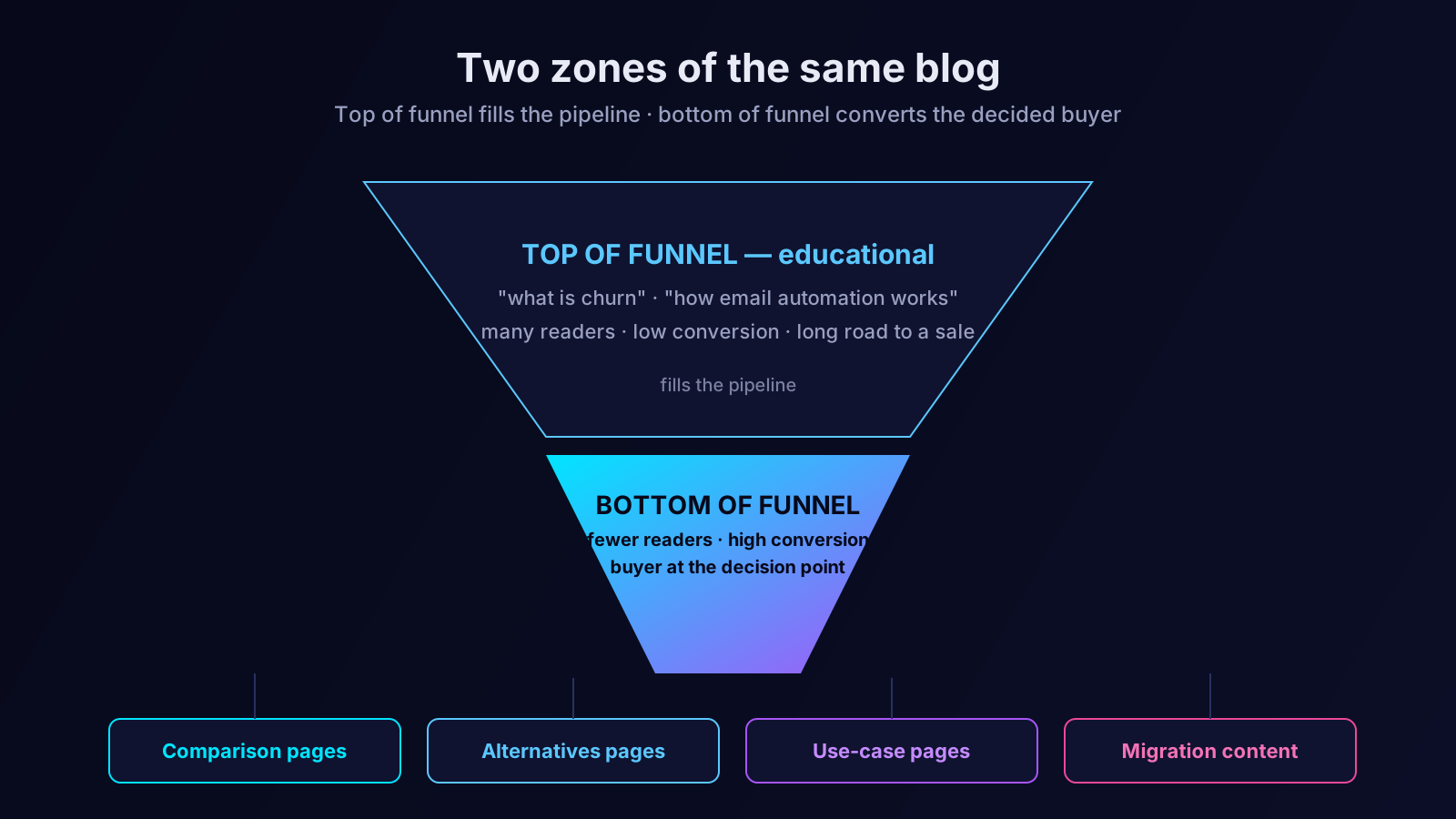
The marketing funnel gets drawn a hundred ways, but for content the useful distinction is simple: how close is the reader to a buying decision when they type their query? Top-of-funnel readers are learning a subject. They searched "what is customer churn" or "how does email automation work." They may not have a budget, a timeline, or even a clear problem yet. They are valuable — they fill the top of your pipeline — but they are months from a purchase.
Bottom-of-funnel readers are different in kind, not just degree. They have a problem, they know it, they have decided to solve it with software, and they are now comparing their options. Their queries give them away: "[your product] vs [competitor]," "[product category] pricing," "best [category] software for [specific situation]," "how to migrate from [incumbent tool]," "[product] alternatives." Every one of those searches is a person standing at the cash register with their wallet half-open. They are not asking whether to buy. They are asking what to buy. That is the audience bottom-of-funnel content serves, and serving it well is worth more than almost anything else a content team does.
Why these pages convert when others don't
The conversion gap between top and bottom of funnel is not small, and it is not mysterious. It comes down to three things.
The first is intent. A reader on a comparison page has already decided to spend money. The only open question is where. You are not persuading them to care about the category — they already do. You are helping them choose, and a meaningful share of the people you help will choose you. A top-of-funnel reader, by contrast, has to travel a long road before any purchase enters the picture, and most of them fall off it. Same traffic number, completely different revenue per visit.
The second is timing. Bottom-of-funnel content reaches people at the exact moment of decision. Content marketing has always struggled with timing — you publish a great guide, someone reads it, and then nothing happens for six months because they were not ready. A comparison page does not have that problem. The reader is ready now. The page meets them at the decision, not months before it.
The third is specificity. Bottom-of-funnel pages answer narrow, concrete questions, and narrow concrete questions are answered by narrow concrete pages — which means a clear, confident call to action does not feel like an interruption. On a use-case page about "applicant tracking for staffing agencies," a button that says "see how Orova handles agency hiring" is not a jarring sales pitch. It is the obvious next step the reader was already looking for. The CTA fits because the page and the reader's need are tightly aligned.
The four bottom-of-funnel page types
Bottom-of-funnel content is not one format. It is a small family of page types, each serving a slightly different decision-stage query. A complete program builds all four.
Comparison pages
The "X vs Y" page. Someone has narrowed their choice to two or three tools and wants them set side by side. These pages capture some of the highest-intent traffic on the internet — nobody searches "Tool A vs Tool B" idly. The hard part is doing them honestly; a comparison page that is transparently rigged in your favour destroys the trust it was supposed to build. Done with genuine fairness, though, a comparison page is one of the highest-converting assets a SaaS company can own.
Alternatives pages
The "[competitor] alternatives" page. The reader is using, or considering, a specific competitor and actively looking for other options — which means they are either unhappy or unconvinced. That is a warm audience by definition. An alternatives page lists the real options in the category (yours among them, presented fairly) and helps the reader think through which fits their situation. It captures demand a competitor created and you simply have to be visible for.
Use-case pages
The page that answers "does this product solve my specific problem?" Generic product pages describe features; use-case pages describe outcomes for one specific kind of buyer or one specific job. "Project management for marketing agencies." "Invoicing for freelance designers." They convert because they let a reader see themselves in the page — and a reader who sees their exact situation reflected back is far closer to a yes.
Migration and switching content
The "how to switch from [incumbent] to [you]" page. Switching cost is one of the biggest reasons deals stall — the reader wants your product but dreads the move. Migration content attacks that fear directly by showing the switch is manageable: what gets imported, how long it takes, what breaks and what doesn't. It does double duty as both a ranking asset and a sales objection-handler.
Why competitors leave this content on the table
If bottom-of-funnel content converts so reliably, why doesn't everyone flood the space? Because it is uncomfortable to write, and discomfort is a real moat.
Comparison and alternatives pages mean writing about competitors by name — and many companies are nervous about it. They worry about giving rivals attention, about looking petty, about getting the facts wrong. So they avoid the format entirely, and the comparison queries for their own category get answered by affiliate sites, review aggregators, or, worse, the competitor. The discomfort is exactly why the opportunity persists. A company willing to write a genuinely fair comparison page owns a query its rivals are too anxious to touch.
Bottom-of-funnel content is also less fun to produce. It does not win awards or rack up shares. A use-case page about invoicing for freelance designers will never trend. So teams chasing visible wins drift toward think-pieces and trend reports, and the quiet revenue pages get postponed quarter after quarter. The teams that win at SaaS SEO are simply the ones disciplined enough to do the unglamorous work. (Our piece on why a SaaS blog can have traffic but no signups traces this exact mismatch between effort and revenue.)
Bottom-of-funnel content still has to be good content
One warning, because the commercial framing invites a mistake. Bottom-of-funnel does not mean thin, salesy, or dishonest. The opposite, in fact. These pages face the most skeptical readers you will ever write for — people actively comparing options, primed to spot bias, one rigged claim away from closing the tab. A comparison page that obviously favours you, an alternatives page that buries every rival's strengths, a use-case page that promises outcomes the product cannot deliver — each of these converts worse than honest content, because the reader's skepticism is the dominant force on the page.
The bottom-of-funnel pages that win are the ones a reader trusts. They acknowledge where a competitor is genuinely stronger. They are specific about who the product is not for. They give the reader enough real information to make a confident decision — and confidence, not pressure, is what converts at the bottom of the funnel. Treat these pages as your most rigorous, most honest content, not your most aggressive.
How to build the cluster, in order
A practical sequence for a team starting from a thin or non-existent bottom-of-funnel cluster looks like this.
Start by mining your own data. Open Search Console and look for any comparison, alternatives, pricing, or "how to switch" queries you already get impressions for — even ranking on page three for "[your product] vs [competitor]" tells you the demand exists and you have a head start. Then list your real competitors and the incumbent tools your buyers tend to switch from; each one is a comparison page and probably an alternatives page. Then list the distinct jobs your product does and the distinct buyer types it serves; each meaningful combination is a use-case page. Finally, write a migration page for every incumbent that shows up repeatedly in your sales calls as the thing being replaced.
Sequence by intent strength. The single most valuable page is usually your own branded comparison — "[your product] vs [biggest competitor]" — because that query is searched by people already considering you. Build that first, build it impeccably honest, and move outward to the broader category comparisons and use-case pages from there. For the wider structure these pages slot into, our guide to topic clusters shows how bottom-of-funnel pages anchor the decision stage of a cluster.
How bottom-of-funnel content interacts with the rest of the funnel
It would be a mistake to read this article as an argument for replacing top-of-funnel content with bottom-of-funnel content. The two are not rivals; they are stages of one machine, and the machine only works when both stages are healthy.
Top-of-funnel content does a job that bottom-of-funnel content cannot: it creates awareness. The educational guide that explains a problem, the explainer that names a concept, the article that helps someone realise they have a need at all — that content brings people into your orbit who did not know your category existed. Without it, there is nobody for the bottom of the funnel to convert. A SaaS site that publishes only comparison and use-case pages is competing for a fixed pool of buyers who are already searching for the category; it captures demand but never creates any.
Bottom-of-funnel content does the job top-of-funnel content cannot: it closes. The reader your educational content brought in months ago, who has been quietly aware of you, eventually reaches the decision stage — and when they search "[your product] vs [competitor]" or "[your category] for [their situation]," the bottom-of-funnel page is what meets them. The two stages hand off to each other across time. The guide plants; the comparison page harvests.
This is why the correct prescription is rebalancing, not replacement. Most SaaS blogs are not failing because they have too much top-of-funnel content. They are failing because the bottom-of-funnel stage is nearly empty, so the awareness their educational content generates has nowhere to convert. The buyer becomes aware, becomes interested, reaches the decision — and finds no page built for that moment, so they convert on a competitor's comparison page instead. Fixing that is not about writing fewer guides. It is about finally building the decision-stage pages the guides have been feeding all along. A linked structure helps here too — our guide to internal linking covers how to route readers from educational pages toward the decision-stage pages when they are ready.
How to know your bottom-of-funnel content is working
Because bottom-of-funnel content is judged on revenue rather than reach, it needs to be measured differently from the rest of the blog — and measuring it wrong is a common way good bottom-of-funnel work gets killed before it matures.
The wrong measure is raw traffic. A comparison page or a use-case page will, almost always, attract fewer visitors than a broad educational article, because the query it targets is narrower. Judged on traffic alone, every bottom-of-funnel page looks like an underperformer, and a team that ranks its content by pageviews will quietly conclude these pages are not worth the effort. That conclusion is exactly backwards.
The right measures are conversion-oriented: how many trials, demos, or signups can be traced to the page; how those readers move through to becoming paying customers; how the page performs per visitor rather than in absolute volume. A use-case page that attracts a modest number of readers but converts a meaningful share of them is doing its job far better than an educational article with ten times the traffic and a fraction of the conversion rate. Look at revenue per page, not visits per page, and the bottom-of-funnel cluster reveals itself as the most efficient content on the site.
There is also a longer signal worth watching: assisted conversions. A comparison page might not be the last thing a buyer reads before signing up, but it might be the page that resolved their final doubt. Attribution for SaaS is genuinely messy — conversions take weeks or months and touch many pages — so do not expect a clean single-page story. But over time, the pattern is clear enough: the decision-stage cluster, taken as a whole, sits close to the revenue, and giving it the patience to mature is one of the better content investments a SaaS company can make.
The revenue math, plainly
Here is the argument in its simplest form. A top-of-funnel article might attract many readers, a small fraction of whom will, eventually, after a long journey, become customers. A bottom-of-funnel page attracts fewer readers, but a much larger fraction of them are ready to buy now. For a SaaS company, where one customer can be worth thousands over their lifetime, the page that converts a decided buyer is worth far more than the page that informs a casual learner — even when the casual learner page wins on raw traffic.
This does not mean abandoning top-of-funnel content. You need it; it fills the pipeline that bottom-of-funnel content later closes. It means correcting a common imbalance. Most SaaS blogs are heavily weighted toward the top of the funnel because that content is easier and more enjoyable to produce, and dangerously thin at the bottom because that content is uncomfortable and unglamorous. Rebalancing toward the decision stage is one of the highest-return moves a content team can make.
Where an SEO AI agent fits
Building a complete bottom-of-funnel cluster — every comparison, every alternatives page, every use-case combination, every migration guide — is a real volume of structured work, and it is the kind of work that competes for time with the more enjoyable top-of-funnel projects and usually loses. That is exactly where an SEO AI agent earns its place. Orova can map your competitive landscape into a full list of needed comparison and alternatives pages, identify the use-case combinations worth a dedicated page, surface the decision-stage queries you already rank for in Search Console, and draft the cluster so your team reviews and sharpens rather than starting from a blank page. The judgement — which competitors to name, how to be honest, what the product genuinely does best — stays with you. The agent removes the volume of work that keeps these revenue pages stuck on the someday list. Bottom-of-funnel content pays the bills. The only real question is whether you will let an honest, well-built cluster of it start paying yours.
Let an AI Agent handle your SEO
Orova plans, writes, optimizes, and tracks rankings on its own — you just read the results.
Try it free