
How We Earned 40 Backlinks From One Data Study
For most of a year, our link building looked like everyone else's: a long spreadsheet of contacts, a politely worded template, and a reply rate low enough that we stopped looking at it. The links that did arrive were unremarkable — a directory here, a low-traffic blog there — and each one cost another batch of emails. We were not failing dramatically. We were failing quietly, which is worse, because it is easy to keep doing.
Then we ran a single data study, and one piece of content earned dozens of editorial backlinks — from real publications, over several months, many of them from writers we had never contacted. This article is the honest account of how that happened. It is a research-framed case study, but a careful one: it is about the pattern, the mechanism, and the repeatable lessons, not about any precise statistic dressed up as proof. The number forty in the title is a stand-in for "a lot, far more than outreach ever produced." What matters is why it worked, and that part transfers.
Why we stopped doing outreach
The decision to change came from a simple, uncomfortable calculation. We added up the hours we were spending on outreach — list building, personalising emails, following up, logging responses — and set them against what those hours produced. The cost per earned link was high, the quality of those links was low, and, crucially, the cost was not falling. Every new link required the same effort as the last. There was no compounding. We were renting links by the hour.
What we wanted was an asset: something we could build once that would keep earning links after we stopped working on it. The logic of digital PR — create something publications genuinely want to reference — pointed clearly at original research. Journalists cite data because data makes their articles credible. If we owned a number worth citing, we would not have to chase the links. The links would come to the number. That was the bet, and we made it.
Choosing the question
The study's success was decided before we collected a single data point, at the moment we chose the question. We learned this in retrospect, and it is the most important lesson in the whole account.
We did not pick a question because it flattered our product. We picked it using three filters. First, was it a question our industry kept asserting without ever having measured — a piece of received wisdom everyone repeated and nobody had checked? Second, would the answer be genuinely interesting to a wider audience than just our customers — interesting enough that a journalist could build an article around it? Third, could we actually answer it credibly with data we could realistically obtain?
The question we landed on sat in the overlap of all three. It was something professionals in our space discussed constantly, assumed they knew the answer to, and had never seen measured at scale. That overlap is the target. A question that fails any of the three filters produces a study nobody cites: too obscure and no journalist cares, too self-serving and no journalist trusts it, too hard to measure and the data does not support real conclusions. Spend disproportionate time here. It is the cheapest decision in the project and the one that determines everything.
Getting the data
We had three possible sources, and it is worth being honest about the trade-offs of each, because the choice shapes how citable the result is.
We could survey a population — straightforward to organise, but only as good as the sample, and self-reported answers carry their own distortions. We could analyse a public dataset in a new way — credible, but available to anyone, so the angle has to be genuinely novel. Or we could analyse our own product's anonymised, aggregated usage data — which is what we chose, because it had a property the others lacked: nobody else on earth could reproduce it. Proprietary behavioural data, handled responsibly and in aggregate, is uniquely defensible. A competitor cannot run the same study, so they cannot earn the same links, and a writer citing it knows there is exactly one source.
Two disciplines mattered here. The dataset had to be large and representative enough that the conclusions were not noise. And the analysis had to be honest — we committed up front to reporting whatever we found, including results that did not help our marketing. We did, in fact, find a couple of inconvenient things, and we published them. That honesty was not a moral flourish. It was load-bearing. A study that visibly bends toward a sales conclusion earns nothing, because experienced editors can sense it and will not risk their credibility on it.
Packaging the study so it could be cited
We had defensible data and honest findings, and we nearly undersold them with poor packaging. The first draft was a dense report that buried the interesting parts. We rebuilt it around one principle: make a busy journalist's job effortless.
That meant a few concrete things. We led with a plain-language summary, so a writer could understand the core finding in thirty seconds. We pulled out a handful of clear, quotable headline statistics — the specific phrasings a journalist could drop straight into an article. We made clean, well-labelled charts that another publication could embed and credit. We described our methodology plainly, so the study read as serious research rather than a marketing artefact. And we gave it a permanent home — a stable URL on our own domain, a real web page, never only a downloadable file. A file cannot accumulate links or rank in search; a page does both.
The packaging is not decoration. The same data, buried in a dense PDF, would have earned a fraction of the links. Citability is a feature you build deliberately.
Seeding it — the small, focused outreach
We did do outreach for the study, but it looked nothing like our old campaigns. Instead of two hundred random contacts, we built a list of roughly two dozen — the specific journalists and publications that had written about this exact topic within the last year. These people had already proven they cover the subject. They were not strangers to be worn down; they were the natural audience for the story.
The email was short and generous. We did not ask for a link. We said, in effect: we ran a study on a question you write about, here are the three most surprising findings, the full data and charts are here if useful, and we are happy to provide a quote or answer questions. That message is welcome in a way a begging email never is, because it hands a working writer a ready-made story rather than asking for a favour.
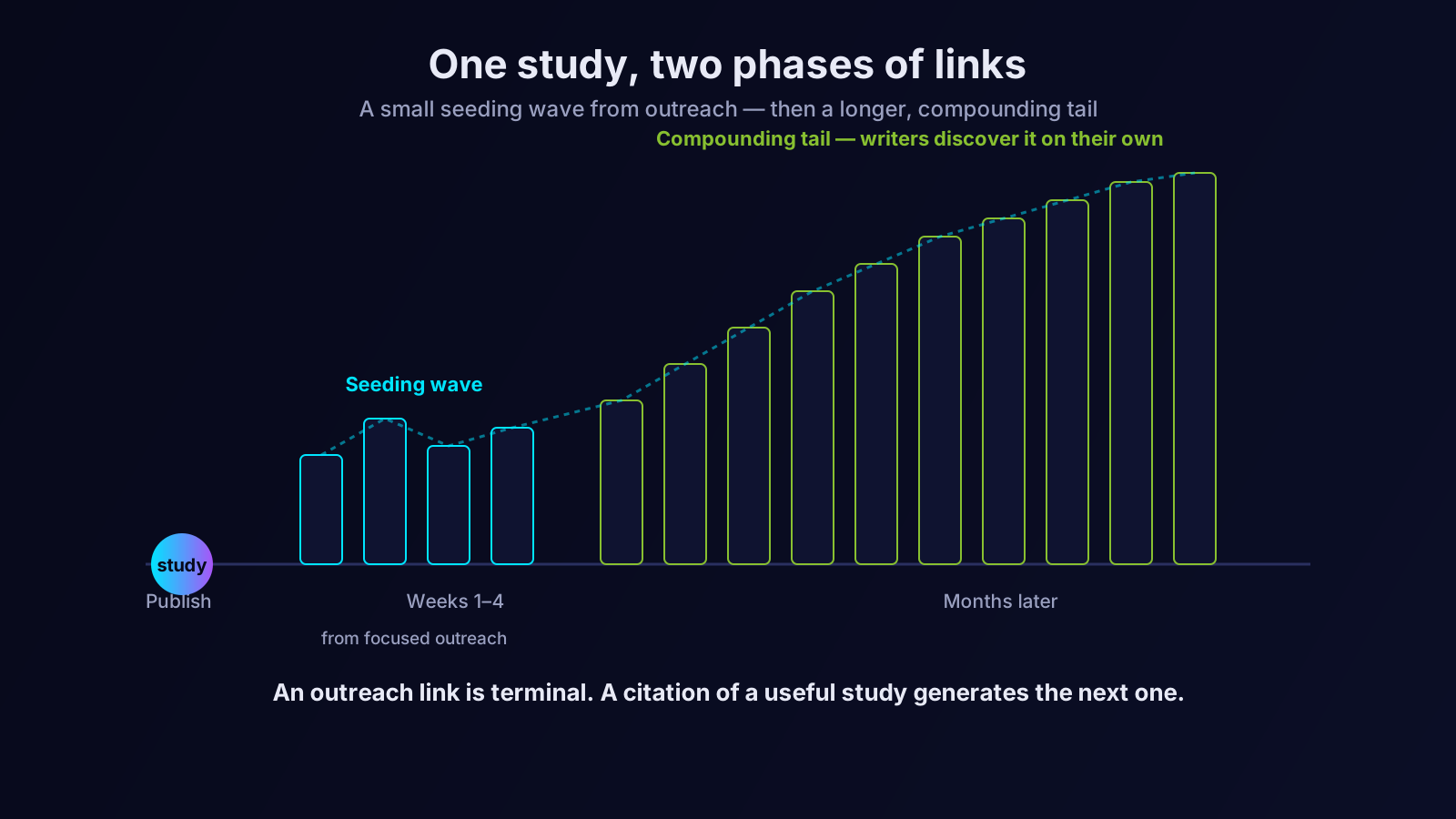
A good share of that small list covered the study. That was the first wave of links — and if the story had ended there, it would still have beaten our outreach campaigns on cost per link. But the first wave was not the point.
The part that surprised us — the compounding tail
The links that mattered most arrived in the months after we had stopped doing anything at all.
The mechanism, once we saw it, was obvious. Our initial coverage put the study in front of writers researching the topic. Some of those writers, working on their own articles weeks or months later, found the study — through that coverage, or through search, because we had given it a rankable home — and cited it themselves. Their articles then put the study in front of the next round of writers. The study had become, quietly, a reference point on its question. Each new citation widened the surface area for the next one.
This is the compounding that outreach structurally cannot produce. An outreach link is terminal — it sits there and does nothing to generate the next link. A citation of a genuinely useful study is generative — it actively exposes the study to more potential citers. The first phase of links came from our effort. The larger, longer second phase came from the asset's own gravity. That second phase is the entire reason to build an asset instead of renting links.
What it did beyond the link count
If the study had only produced backlinks, it would still have been the best link work we had ever done. But measuring it purely as a link campaign undersells what actually happened, and the secondary effects are worth naming because they change how you should value this kind of project.
The coverage put our name in front of audiences our blog had never reached. People who would never have found our content discovered us through a publication they already trusted, with our company framed as the source of a credible finding rather than as an advertiser. That is a different and better first impression than a banner ad or a cold email could ever buy, and it cost us nothing extra — it rode along with the same coverage that delivered the links.
The study also became an internal asset in ways we did not anticipate. Our sales team started referencing the headline finding in conversations, because it gave them a credible, third-party-validated talking point instead of a marketing claim. Our own later articles cited the study, which made those articles more authoritative. Recruiters used the coverage as proof the company was doing serious work. One honest piece of research quietly seeded a dozen smaller uses across the business, none of which appeared in the link report.
And there was a compounding reputational effect. Having published one credible study made the next one easier to seed, because a few journalists now recognised us as a source that produces honest data rather than promotional fluff. Credibility, once earned, lowers the cost of earning it again. A link campaign ends when the links stop. A research reputation keeps paying.
What we would tell anyone trying this
Stripped to its lessons, here is what the study taught us.
The question is ninety percent of the outcome. A study on a boring, obscure, or self-serving question fails no matter how clean the execution. Spend real time choosing a question that is widely discussed, never measured, and genuinely interesting beyond your customer base.
Proprietary data is your strongest moat. If you can responsibly analyse your own product's aggregated data, do it — because nobody can reproduce it, and uniqueness is what makes a citation worth nothing to a competitor and everything to you.
Honesty is a feature, not a constraint. Report the inconvenient findings. A study that obviously serves your sales pitch earns no links, because the people you want to cite it can tell.
Package for the journalist, not the executive. A clear summary, quotable numbers, embeddable charts, a stable URL. The same data, badly packaged, earns a fraction of the links.
Seed narrowly, then let go. Pitch a small list of writers who already cover the topic, generously and without asking for a favour. Then stop, and let the asset compound. The biggest returns arrive after you have stopped working.
And one more, learned the hard way: a single study is not a strategy. One study can compound impressively, but the durable version of this is a steady cadence of studies, each one adding to a body of research that makes your domain a recognised source. For the wider strategic context, our piece on linkable assets — content people actually cite sets data studies alongside the other assets worth building, and digital PR — how to earn links without begging covers the mindset shift behind all of it.
The honest cost — and how we made it repeatable
I will not pretend the study was easy. Choosing the question, preparing the data, doing the analysis carefully, packaging it for citation, building the focused media list, seeding it — that is substantial, concentrated work, far more up front than sending another batch of outreach emails. The reason most teams never run a study is not that they doubt it works. It is that the up-front load looks daunting, so the comfortable, ineffective spreadsheet wins by default.
Making the approach repeatable — turning one study into a cadence — is where we leaned on an SEO AI agent. Orova helps with the laborious layers: surfacing the un-measured, widely-discussed questions in our space that would make strong studies, drafting the citable summary and pitch copy around our data, assembling a focused media list of writers who already cover the topic instead of a bloated one, and keeping each new study connected through a coherent internal-linking structure so its earned authority flows across the site. The judgement stays ours — which question, whether the data is honest, whether it clears the bar. The agent removes the workload that otherwise limits a team to one study a year instead of one a quarter.
The takeaway is the one we wish we had believed twelve months sooner. You can rent links by the hour, forever, with outreach — or you can build an asset once and let it earn links while you do other things. One genuinely good data study, on the right question, honestly analysed and properly packaged, will out-earn a year of begging. We learned it late. You do not have to.
Let an AI Agent handle your SEO
Orova plans, writes, optimizes, and tracks rankings on its own — you just read the results.
Try it free