
Guest Posting Isn't Dead — It Just Grew Up

Every so often the SEO internet declares guest posting dead. It is a comforting ritual, like declaring email dead, or the office dead, or — depending on the decade — rock and roll dead. And every time, the declaration is a little bit true and mostly wrong, which is the most annoying kind of true. Guest posting is not dead. It is just no longer fourteen years old, and it has stopped sending you those emails.
You know the emails. "Dear Sir/Madam, I am Content Outreach Specialist. I have read your amazing blog article and I love it very much. I would like to write a guest post for your amazing blog about one of these topics: [insert seven topics that have nothing to do with your blog, one of which is about CBD]." That guest posting — the one wearing a backwards cap and asking to crash on your couch — is, mercifully, dying. But guest posting itself has grown up, got a real job, and become something genuinely useful. This article is about the adult version, and how to do it without embarrassing yourself.
The teenager we are all relieved to see leave
Let us hold a small, unsentimental funeral for guest posting's adolescence, because understanding what died makes it obvious what survived.
The teenage version had a worldview, and the worldview was this: a guest post is a delivery mechanism for a backlink, and the article wrapped around the link is a regrettable formality, like the packaging on a parcel. The goal was to place a link in an article on a website — any website with a pulse and a domain rating above a number — and the article itself was assembled as cheaply as possible to make that happen. Six hundred words. Generic to the point of vapour. Stuffed with a link to a casino if the editor was not paying attention.
This worked, briefly, because search engines had not yet learned to tell the difference between a link inside a real article on a relevant site and a link inside a content-shaped object on a site that would publish a phone book if you paid it. Then they learned. And the entire teenage model — networks of low-quality blogs publishing low-quality articles to pass low-quality links around — became not just ineffective but actively dangerous, the SEO equivalent of a tattoo you got at seventeen and now explain in job interviews.
So when people say guest posting is dead, this is the corpse they are pointing at. And they are right about the corpse. They are just wrong that it was the whole person.
What grew up instead
Adult guest posting kept the basic shape — you write an article, it appears on someone else's publication, your name and a link come with it — and inverted the priorities completely.
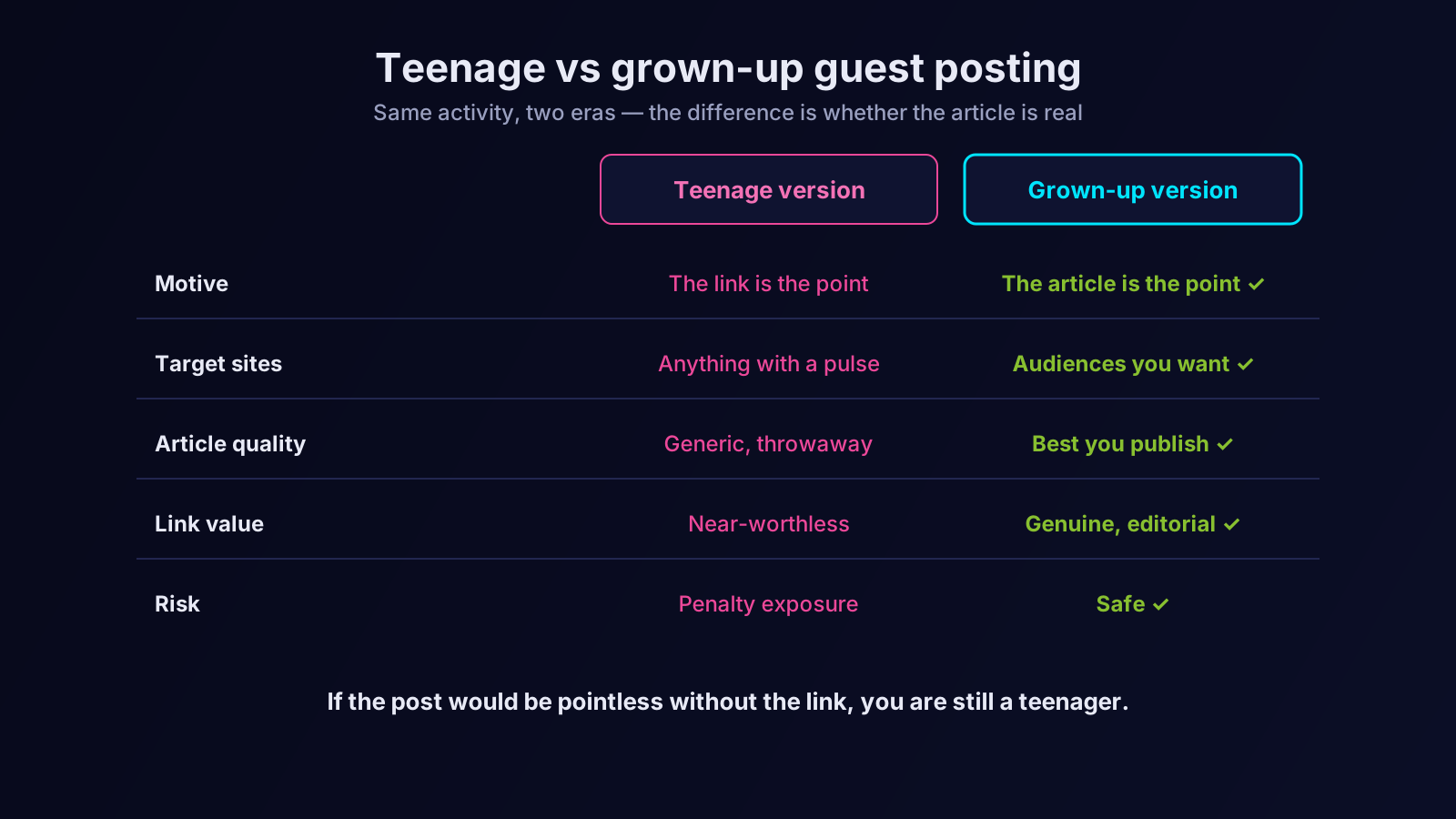
The teenager thought: the link is the point, the article is the cost. The adult thinks: the article is the point, the link is a courtesy that comes with authorship. That sounds like a motivational poster, but it is actually a precise operational difference, and it changes every decision downstream. When the article is the point, you only pitch publications whose readers you genuinely want to reach. You only write about things you genuinely know. You make the article good enough that it would be worth publishing even if the link were removed. The link still comes — bylines come with links, that is how attribution works — but it arrives as a side effect of having contributed something real, rather than as the smuggled cargo of something fake.
Here is the simple, slightly uncomfortable test. If your guest post would be pointless to write in a world where the link did not exist, you are still doing teenage guest posting. If it would be worth writing anyway — because it reaches an audience you want, builds your reputation, and says something you actually believe — then you have grown up. The link is the same link either way. The difference is entirely in whether the thing around it is real.
Why the adult version is worth your time
"Fine," says the part of you that liked the spreadsheet, "but if it is this much work, is it worth it?" Reasonable question. Here is the case.
A grown-up guest post on a respected, relevant publication does several jobs at once, and the link is only one of them. It puts your expertise in front of a new, relevant audience — people who do not read your blog but read this publication, and who now associate your name with a useful idea. It builds genuine authority for the individual author, which matters in a search landscape that increasingly cares whether real, identifiable experts stand behind content. It produces a credibility artefact — "as featured in" is a sentence your sales page and your team's bios can use. And yes, it earns a link, an editorially placed link on a relevant site, which is exactly the kind search engines are built to value.
The teenage version delivered one job — a link — and did it badly and dangerously. The adult version delivers four jobs and does the link part safely as well. The work is higher, the count is lower, and the return per piece is incomparably better. You are trading a hundred worthless placements for five that genuinely move things. That is not a worse deal. That is the deal finally making sense.
How to guest post like an adult
Enough theory. Here is the grown-up process, step by step, with the teenager's mistakes labelled so you can avoid relapsing.
Choose publications by audience, not by domain rating. The teenager sorted a list of sites by a single authority metric and pitched from the top. The adult asks one question first: do I actually want this publication's readers to know who I am? Relevance and audience fit come before the authority number. A link from a smaller publication your exact buyers read is worth more than a link from a larger one they have never opened.
Pitch an idea, not yourself. The teenage pitch was about the teenager — "I would like to write for you, here are some topics." The adult pitch is about the editor's readers — "your audience has been discussing X; here is a specific, sharp angle on it that I have not seen covered, and I am the person to write it because of this concrete experience." You are not asking for a slot. You are offering a story, the way a good digital PR pitch always does.
Write the best thing you will publish this month. Not your B-team content. Not the article you would not run on your own blog. The grown-up move is to give the host publication something genuinely excellent — because the article reaches a new audience, carries your name, and is a credibility artefact you will point at for years. Treating a guest post as throwaway is the clearest sign the teenager is still driving.
Let the link be natural and modest. One contextual link to a genuinely relevant resource on your site — usually in the body, where it actually helps the reader, plus the byline link the publication gives every author. Not five links. Not a link to your pricing page jammed into the second sentence. The teenager maximised links per article; the adult places the one or two that genuinely serve the reader and lets the byline do the rest.
Build the relationship, not just the placement. The teenager hit a site once and moved on. The adult who writes one genuinely good piece for an editor becomes a known, trusted contributor — which means the next pitch is welcome, and the one after that. A real relationship with a handful of editors is worth more than one-off placements on a hundred strangers.
The objection: "this doesn't scale"
Someone always says it. "Grown-up guest posting is great, but I can place one teenage post a day and only one adult post a month. The teenager scales. The adult doesn't."
This objection is the teenager talking, and it has the maths exactly backwards. It is counting placements as if every placement were worth the same. They are not remotely worth the same. A hundred teenage posts deliver a hundred near-worthless links, a measurable risk of a penalty, and zero brand value — a portfolio with a real chance of negative total return. Five adult posts deliver five genuine links, real audience reach, real author authority, and a "featured in" line, with no penalty risk at all.
"Scale" is only a virtue when the thing scaling is worth something. Scaling worthless placements does not produce value; it produces a larger pile of worthlessness and a bigger liability. The grown-up does not want to scale guest posting. The grown-up wants guest posting to be effective, accepts that effective means fewer, and spends the freed-up time on a study or a linkable asset instead. Quantity was always the teenager's substitute for not knowing how to be worth reading.
Where guest posting sits in a grown-up link strategy
Adult guest posting is not the whole of link earning, and it should not pretend to be. It sits comfortably alongside the other grown-up tactics — original data studies, linkable assets, expert commentary, well-judged newsjacking — as one channel among several. Its particular strengths are author authority and audience reach; its limitation is that it is the one earned-link tactic where you write the article yourself, which means it scales least and should therefore be reserved for the publications that genuinely matter.
A healthy link profile is a mix. Guest posting handles "put our experts in front of the right audiences." Linkable assets and data studies handle "earn links passively and at volume." Treat guest posting as a precise instrument rather than a volume play, and it does its specific job well. Our piece on digital PR — how to earn links without begging places it in the full picture, and linkable assets — content people actually cite covers the tactics that do scale.
Where an AI agent helps the grown-up version
Grown-up guest posting has an honest cost: it is slower and more thoughtful than the teenage version. Finding the publications whose audience genuinely matters, researching what their readers actually discuss so the pitch is sharp, shaping an angle that has not been done to death, keeping track of which editors you have a real relationship with — all of that is careful, ongoing work. It is also, not coincidentally, the work that gets skipped when teams relapse into the spreadsheet.
An SEO AI agent takes the drudgery without taking the judgement. Orova can build a relevance-first shortlist of publications that genuinely reach your buyers rather than a list sorted by a single authority number, surface the topics those publications' audiences are actively discussing so your pitch lands on a real gap, draft strong outline options for the contributed article, and keep the contextual link in each piece pointed at the right resource on your site through a coherent internal-linking plan. The expertise in the article still has to be yours — that is the entire point of the grown-up version. The agent just clears away the research and logistics that otherwise tempt people back into being fourteen.
So the next time someone announces that guest posting is dead, you can nod, because the version they are burying genuinely deserves it. Then go and do the grown-up version: fewer posts, on publications you respect, written as well as anything on your own blog, with one honest link that helps the reader. It is not dead. It just stopped sending you that email about CBD.
Let an AI Agent handle your SEO
Orova plans, writes, optimizes, and tracks rankings on its own — you just read the results.
Try it free