
How to Build an Internal Linking System That Scales
Most internal linking advice stops at "add relevant links between your pages." That is true, and it is also useless once a site grows past a few dozen pages. A site with thirty pages can be linked by feel — you remember everything you have published, you can hold the whole structure in your head, and ad-hoc linking works fine. A site with three hundred or three thousand pages cannot be linked by feel. Nobody remembers it all. Ad-hoc linking produces a tangle: some pages over-linked, many under-linked, anchor text inconsistent, orphans accumulating in the corners.
What you need at scale is not better instincts. It is a system — a defined, repeatable set of rules and routines that produces a coherent link structure no matter how large the site gets and no matter who is doing the work. This article lays out that system, component by component. It is the difference between linking that depends on memory and linking that depends on a process.
Start with the structure: the cluster model
A linking system needs an underlying shape to link along. Linking pages at random, even relevantly, does not build a structure — it builds a web with no logic. The shape that scales is the topic cluster.
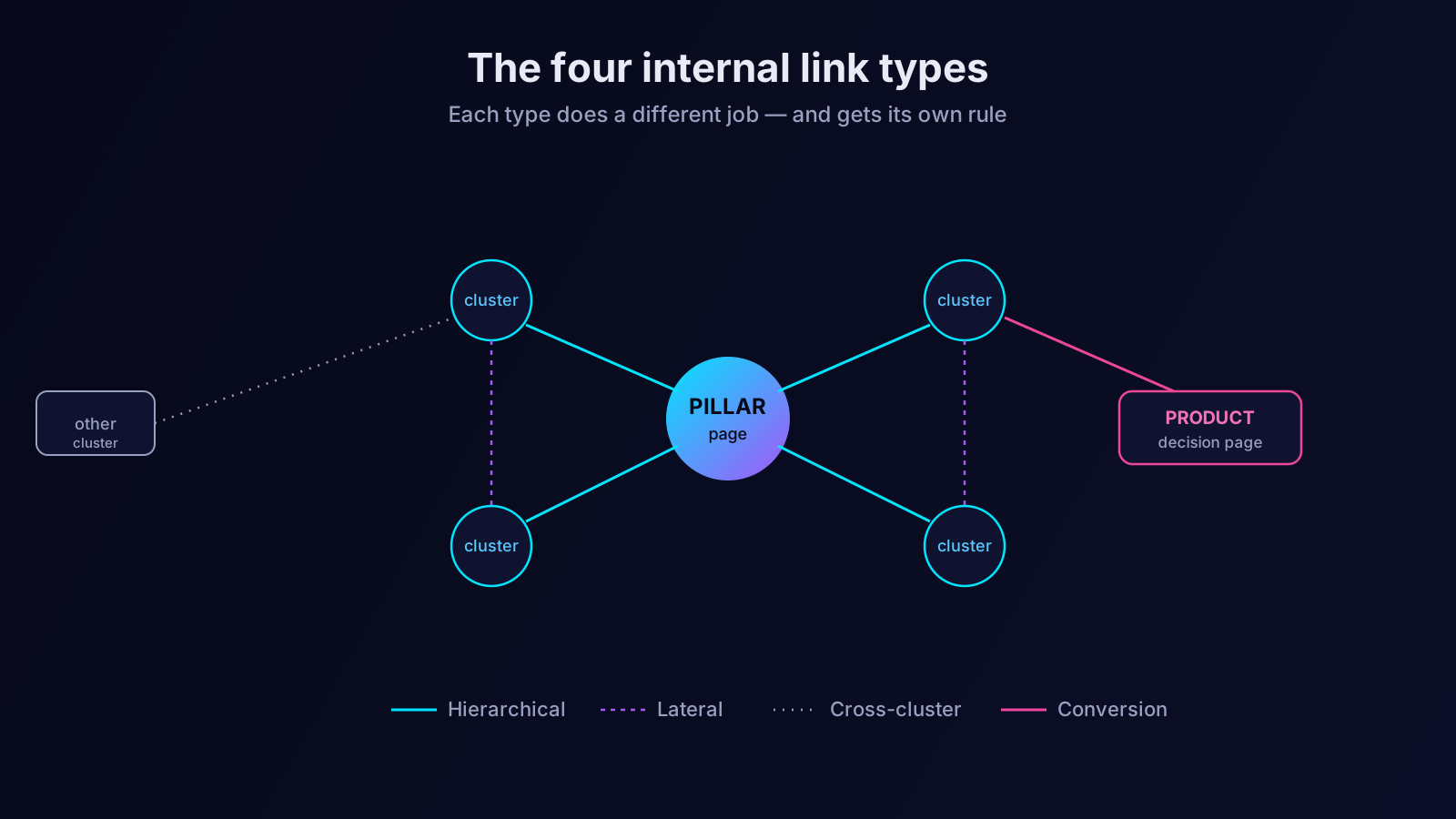
In the cluster model, your content is organised into groups, each covering one subject. Each group has a pillar page — a broad, foundational page on the subject — and a set of cluster pages, each covering one specific aspect of it. The linking rules then follow the shape: every cluster page links up to its pillar; the pillar links down to its cluster pages; and cluster pages within the same group link across to each other where relevant. Links between different clusters happen too, but they are the exception, made deliberately, not the default.
This matters because it converts internal linking from an open-ended question ("what should this page link to?") into a bounded one ("what should this page in this cluster link to?"). The structure tells you most of the answer before you start. If your content is not yet organised into clusters, that is the prerequisite step — our guide to structuring content into topic clusters covers how to build that foundation. Without it, no linking system will hold together, because there is nothing for it to hold onto.
Define your link types
A scalable system distinguishes between kinds of internal links, because different links do different jobs and need different rules. There are four types worth naming.
Hierarchical links are the up-and-down links of the cluster: cluster page to pillar, pillar to cluster page. These are structural and largely automatic — once a page joins a cluster, its hierarchical links are determined. They establish the skeleton.
Lateral links are sideways links between sibling pages in the same cluster. A page on "how to set up an SPF record" links to a sibling on "how to set up DKIM" because a reader doing one will likely want the other. These are editorial — chosen for genuine reader relevance — but bounded, because the candidate pages are just the siblings in the cluster.
Cross-cluster links connect pages in different clusters where a real topical bridge exists. These are the rarest and most deliberate. They should be made only when the connection is genuine, never to hit a link quota, because random cross-cluster links blur the topical boundaries the structure is meant to keep crisp.
Conversion links point from informational content toward commercial or product pages. These follow intent rather than topic — a teaching page links to the relevant decision page where a reader who has learned enough might want to act. They need their own rule because they answer a different question: not "what is related?" but "where should an interested reader go next?"
Naming these four types is not pedantry. It lets you write a separate, simple rule for each instead of trying to govern all internal linking with one vague principle. A system is a set of specific rules, and you cannot write specific rules until you have named the things they govern.
Set link budget rules per page
At scale, you need norms for how many internal links a page carries and receives — not rigid limits, but defaults that keep the graph balanced.
For links out of a page: a typical article should carry enough internal links to genuinely help a reader navigate — roughly a handful to a dozen, depending on length — without becoming a link dump. A page so dense with links that every other phrase is blue helps no one; the links stop being signposts and become noise. The rule is "link where it genuinely helps the reader, and stop there."
For links into a page: this is the metric that actually decides ranking outcomes, and the one a system must watch. Every important page should receive a healthy number of internal links from relevant pages. The system's job is to flag pages falling below that floor — the under-linked pages — and the orphans receiving none at all. You are not aiming for every page to have identical inbound counts; you are aiming for no page to be starved.
These budgets are guidelines, not laws. But having them written down means decisions get made against a standard instead of by mood, and that consistency is exactly what "system" means.
Write anchor text rules
Anchor text — the visible, clickable words of a link — is a signal, and at scale it needs rules, because inconsistent anchors confuse both readers and search engines.
The core rule: anchor text should be descriptive. It should tell the reader, and the search engine, what the linked page is about before the click. "Our guide to keyword research" is a good anchor. "Click here" and "read more" are bad anchors — they describe nothing and waste the signal entirely.
The second rule: vary the anchors, within reason. The same page will be linked from many places, and using the identical anchor every single time looks mechanical. Natural variation — different but still descriptive phrasings — is healthier than robotic repetition. The third rule: the anchor must fit the sentence. A link is part of prose, and an anchor that has been jammed in to carry a keyword, breaking the sentence's grammar or flow, is worse than a slightly less optimal but natural one. Readers come first; the signal follows.
Write these three rules down and anyone adding links to the site — staff or otherwise — produces consistent, useful anchors. Leave them unwritten and you get a slow drift into "click here" and exact-match repetition.
Build the publishing routine
A system is not just rules; it is routines that apply the rules at the right moments. The most important routine fires at publication, and it has two halves that teams reliably get half-right.
The first half is forward linking: the new page must link out to relevant existing pages. Most teams remember this half, because it happens naturally while writing.
The second half is backward linking, and this is the half that gets skipped: relevant existing pages must be updated to link to the new page. A new page that nothing links to is born an orphan. It does not matter how good it is — structurally, it is starting from nothing. So the publishing routine must include a step: identify the existing pages that should reference the new one, and edit them. This step is non-negotiable, and because it is the easiest step to forget, it must be written into the checklist explicitly. "New page published" is not done. "New page published, and the pages that should point to it now do" is done.
Build the maintenance routine
Publishing routines keep new pages integrated. They do nothing for the pages already on the site, which is why a scalable system also needs a maintenance routine — a recurring audit, run on a fixed cadence, perhaps quarterly.
The audit asks a fixed set of questions. Which pages are now orphaned? Which pages have fallen below the inbound-link floor? Are there pages so overloaded with outbound links that the links have lost their value? Have important new pages failed to accumulate links since they launched? Are there old anchors that are vague or wrong? Each question produces a list, and each list produces a batch of fixes.
The point of fixing the cadence is that it removes the decision. Internal linking maintenance never feels urgent, so if it is left to "when we get to it," it never gets gotten to. Put it on the calendar and it happens whether or not it feels urgent — which is the entire purpose of a routine.
Handle the new-page-into-old-cluster problem
One situation tests a linking system more than any other, and it is worth treating as its own component because the generic rules do not fully cover it: what happens when you publish a new page into a cluster that already exists.
The forward links are easy — the new page links up to its pillar and across to its established siblings, all of which already exist and are easy to find. The hard part is the backward direction. The pillar page must be updated to link down to the new cluster page, or the new page is missing the single most important inbound link a cluster page can have. And some of the existing sibling pages should be updated to link across to the newcomer, because if they discuss a topic the new page now covers in depth, the right move is to send readers there rather than leave a thin aside.
A system handles this with a specific sub-routine triggered whenever a page joins an existing cluster: revisit the pillar and add the downward link; review every sibling and add a lateral link from each one that genuinely should reference the new page. Skip this and a predictable failure mode appears — clusters where the older pages are densely interlinked and the recent additions hang off the edge, half-connected. The cluster looks healthy if you only inspect its founding members and reveals its weakness the moment you check its newest ones. Naming this case as its own routine is what stops that drift.
Decide what to do with weak and outdated pages
A linking system is not only about adding links. It must also have a rule for the pages that should not be receiving them, because feeding links to the wrong pages quietly undermines the whole structure.
Every site of any age accumulates pages that have aged badly: thin posts from the early days, content made redundant by something better you published later, pages on topics you no longer pursue. A linking system needs a position on these. The position is that you do not pour internal links into pages you would not want a reader — or a search engine — to judge your site by. Routing authority and attention toward a weak page tells search engines to take that page seriously, which is the opposite of what you want.
So the system's audit should flag not only under-linked pages but also well-linked weak pages — pages receiving internal links they do not deserve. Each one gets a decision: improve it until it earns the links, consolidate it into a stronger page on the same topic, or retire it and redirect appropriately. The linking system and the content-quality process are connected here, and a mature system acknowledges the connection rather than blindly maximising link counts everywhere. A link is an endorsement. Endorse deliberately.
Document it so it survives people
A system that lives only in one person's head is not a system; it is that person. When they leave, or get busy, it collapses. So the final component is documentation: the cluster structure, the four link types and their rules, the link budgets, the anchor text rules, the publishing checklist, the audit cadence — written down in one place a new team member could read and then run.
This is what separates a system from a habit. A habit is personal and fragile. A system is documented, transferable, and survives turnover. If you cannot hand your internal linking approach to a new hire as a document, you do not yet have a system — you have a person doing their best, and that does not scale.
Where the system meets its limit — and what to do
Here is the honest catch. Everything above is sound, and on a large site it is also genuinely hard to execute by hand. Mapping the full link graph, finding every orphan, checking every page against its inbound floor, identifying which existing pages should link to each new one, keeping anchors consistent across thousands of links — the system is correct, but the manual labour of running it at scale is enormous, and that is precisely why most teams have rules they do not actually follow.
This is the gap an SEO AI agent closes. The system does not change — the cluster model, the link types, the budgets, the routines all stay exactly as described. What changes is who does the relentless mechanical part. An agent can hold the entire link graph in view at once, flag every orphan and under-linked page the moment it appears, suggest relevant lateral and conversion links with appropriate anchors, and surface the backward-linking opportunities every time you publish — turning a system you aspire to follow into one you actually run. Orova applies a defined linking system continuously across a site of any size, so the structure stays coherent as the site grows instead of degrading the moment it outgrows one person's memory. Design the system first. Then let something tireless run it.
Let an AI Agent handle your SEO
Orova plans, writes, optimizes, and tracks rankings on its own — you just read the results.
Try it free