
Performance Max Asset Groups: How to Structure Them So AI Can Optimize
Open any Performance Max campaign that has been running for three months and look at the asset group report. If you see a single asset group named "All Products" stuffed with forty headlines, eight images, two videos, and an audience signal list that includes "people interested in marketing" alongside "people interested in plumbing," you already know why the campaign plateaued. The bidding algorithm did not fail. It did exactly what you asked: it averaged.
Performance Max removed almost every lever advertisers used to spend a decade learning. There are no keyword bids, no placement exclusions worth mentioning, no device modifiers, no manual ad rotation. What is left is structure, and structure is now the single most underrated input into how well the machine learns. Asset groups are the new ad groups. How you draw the lines between them determines whether Google's models, and any AI layer you put on top, receive a clean signal or a muddy one.
This article is about that line-drawing. Specifically, the one-theme-per-asset-group rule, the difference between audience signals and the targeting you think they are, and why granular, themed structure produces optimization signals that both Smart Bidding and an autonomous agent can actually read and act on. If you want the conceptual foundation first, our companion piece on what Performance Max actually is under the hood covers the channel mix and the black-box problem in more depth. Here we go one level deeper, into the carpentry.
Why asset group structure is the only structure you have left
In a traditional Search campaign, you express intent through dozens of controls. You bid more on high-converting keywords, exclude irrelevant queries with negatives, schedule ads for business hours, and split ad groups so that the ad copy matches the search term. Each of those controls is a way of telling the algorithm, "treat this slice of traffic differently from that slice."
Performance Max collapses most of those controls into the asset group. An asset group is a bundle of creative assets (headlines, descriptions, long headlines, images, logos, videos) plus an audience signal, all pointed at a set of conversion goals and, optionally, a set of products via a listing group. When Google decides whether to show your ad on YouTube, in Discover, on the Search partner network, in Gmail, on Maps, or in Shopping, it pulls the relevant assets from the asset group and assembles a creative on the fly.
The critical consequence: every asset group is a learning unit. The algorithm builds a model of "who responds to this bundle of messaging and visuals" at the asset group level. If you put two unrelated themes in one group, you have asked the model to find a single audience that responds to both. That audience usually does not exist, so the model settles for the lowest common denominator, the cheapest clicks it can find that technically satisfy the goal. That is how Performance Max ends up spending sixty percent of its budget on brand search and the Gmail placement while you wonder where your incrementality went.
What "theme" actually means
A theme is a coherent answer to three questions at once:
- What are we selling? A product line, a service category, a specific use case, a seasonal collection.
- Who is it for? A definable customer segment with shared intent or shared problem.
- What is the message? The promise, the hook, the proof points that make this group's headlines and images hang together.
When all three line up, you have a theme. "Running shoes for marathon trainers" is a theme: a product line, a clear segment, and a message about distance and durability. "Footwear" is not a theme. It is a department. The test is simple. If you cannot write five headlines and pick three images that would all feel at home in the same ad, you do not have one theme. You have several pretending to be one.
The one-theme-per-asset-group rule
The rule is exactly what it sounds like, and the discipline is in the enforcement. One theme per asset group means that everything inside the group, every headline, every long headline, every image, and the audience signal, points at the same idea. The payoff is concentration. The algorithm gets a tight, internally consistent bundle of signals and can quickly learn which surfaces and which users convert for that specific theme.
Consider a home services company offering three things: emergency plumbing repair, scheduled HVAC maintenance, and bathroom remodeling. These share a roof and a phone number, but nothing else. Emergency plumbing is high-urgency, mobile-heavy, often searched at 11 p.m. with a burst pipe in the background. HVAC maintenance is a planned, seasonal, comparison-shopped decision. Bathroom remodeling is a months-long consideration cycle with Pinterest boards and spouse approval.
Stuff them into one "All Services" asset group and the algorithm averages three completely different conversion behaviors into one mushy model. Split them into three themed asset groups and each one develops its own profile. The emergency group learns to favor mobile and immediate-intent placements. The remodeling group learns to tolerate a longer path and lean into image-rich surfaces like Discover and YouTube. The maintenance group learns the seasonal rhythm. Same campaign, same budget, three clean learning units instead of one blurred one.
How many asset groups, and how granular
The honest answer is "as granular as your data can support, and no more." Each asset group needs enough conversions to learn. If you split so finely that a group gets two conversions a week, you have starved it. A reasonable working floor is roughly fifteen conversions per asset group per month before the model has anything solid to build on; below that you are mostly funding exploration.
This creates a natural tension. Granularity gives cleaner signals; volume gives the model fuel. The way to resolve it is to let your conversion volume set the ceiling on how many groups you run. A campaign generating 300 conversions a month can comfortably support five or six themed asset groups. A campaign generating 40 conversions a month should run one or two, and split further only as volume grows. Structure is not a one-time decision. It is something you revisit as the account scales.
A common mistake is to copy the granularity of an old Search account directly into Performance Max. In Search you might have run forty tightly themed ad groups because keyword bidding rewarded that precision and each group could survive on a trickle of clicks. Performance Max does not work that way. Conversions, not clicks, are the currency of learning, and conversions are scarcer. Resist the urge to recreate forty asset groups out of habit. Start with the smallest number of genuinely distinct themes your data supports, prove that each one earns its keep, and only then divide further. Premature granularity is the most common way well-intentioned advertisers sabotage their own Performance Max launches.
A practical sequence for building one
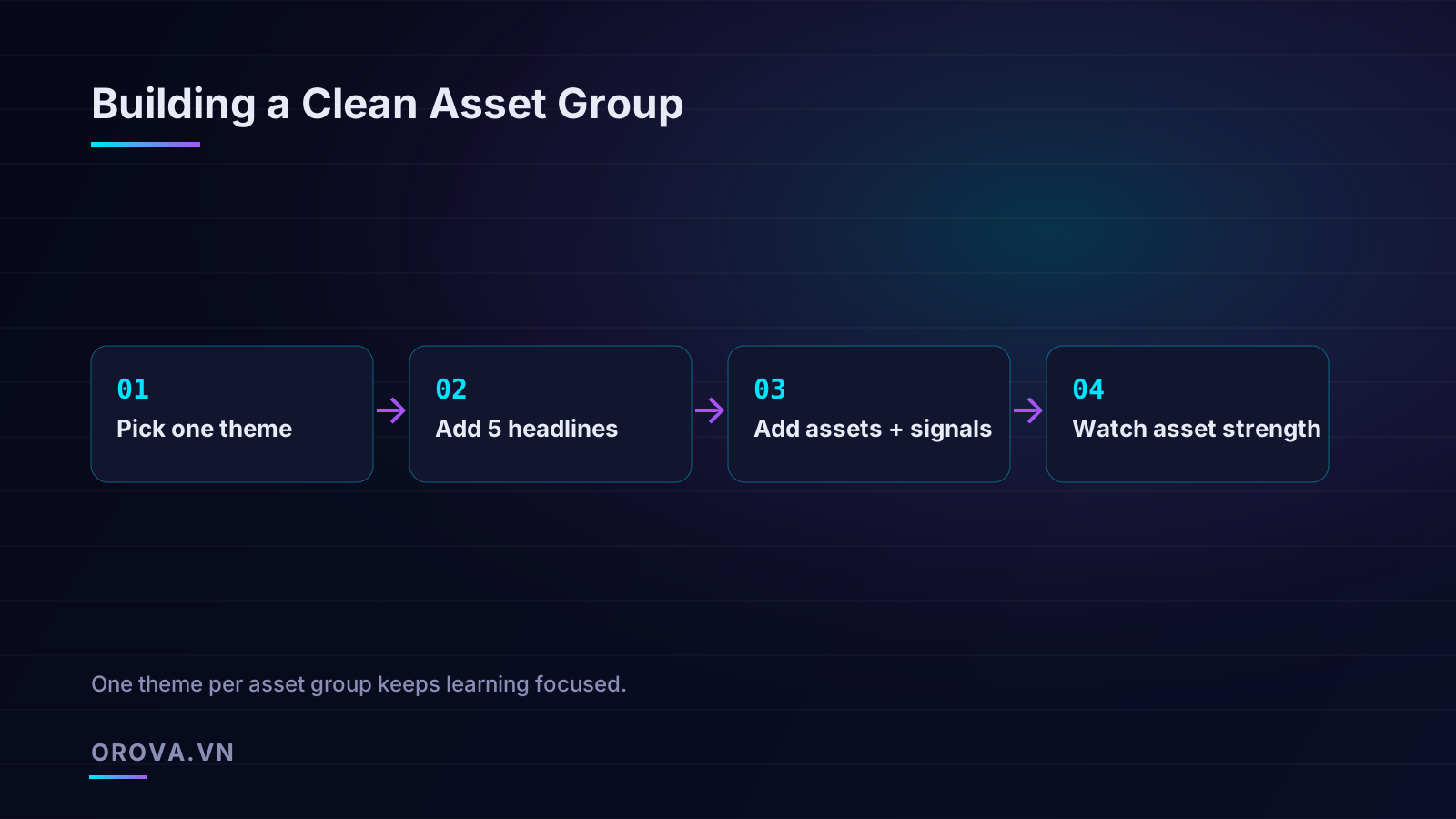
When you build a new asset group, work in this order. It mirrors the flow in the figure above and keeps you honest about coherence:
- Pick one theme. Write it down as a single sentence: "Marathon training shoes for runners logging 30+ miles a week." If you cannot say it in one sentence, stop and split.
- Write five headlines that all serve that theme. Not five generic headlines that could apply to any product. Five that a marathon trainer would recognize as written for them. Performance Max lets you add up to fifteen headlines; start with the five strongest and expand once the group has traction.
- Add the rest of the assets and the audience signal. Long headlines, descriptions, images that match the theme's mood, and a video if you have one. Then attach an audience signal built from data that describes this exact segment.
- Watch asset strength and reporting. Google grades the group's asset strength (Poor, Good, Excellent). Aim for at least Good, but treat asset strength as a coverage check, not a performance score. It tells you whether you have enough variety, not whether the variety converts.
Audience signals are not targeting (and confusing them costs you money)
This is the single most common misunderstanding in Performance Max, and it directly damages structure decisions. An audience signal is not a targeting setting. It is a suggestion. You are telling Google, "here is who I think converts; start your search here." Google uses that signal to accelerate the learning phase, then expands beyond it the moment it finds other people who convert. It will spend outside your signal whenever the model believes doing so improves results against your goal.
In a Search campaign, an audience layered as "targeting" excludes everyone outside it. In Performance Max, the same audience as a signal excludes no one. If you treat the signal as a fence, you will be baffled when your "high-net-worth homeowners" asset group shows your ad to renters. The fence was never there. You drew a starting line and called it a wall.
The mental model that works: an audience signal is the first place the algorithm looks, not the only place it is allowed to look. Build it to be a precise description of your best customer, then expect the model to wander and judge it on results, not on who it reached.
What to put in a signal
Because the signal is a seed, quality beats breadth. The strongest seeds, roughly in order of usefulness:
- Your own customer data. A Customer Match list of actual buyers is the highest-fidelity description of who converts. It teaches the model your real customer profile rather than your guess at it.
- High-intent first-party segments. Cart abandoners, repeat visitors to a specific product category, people who started but did not finish a quote. These are behavioral, theme-specific, and far stronger than demographic guesses.
- Custom segments built from search and URL behavior. People searching for terms or visiting sites that match the theme. This is where you encode intent that lines up with the asset group's message.
- In-market and affinity audiences, as a last resort. Useful when you have no first-party data, but the broadest and least specific. Use them to bootstrap, then replace them as you accumulate your own data.
Here is the structural point: the signal should match the theme. The emergency plumbing asset group's signal should be people who search for emergency plumbing and people who have called for urgent repairs, not your full customer list. The remodeling group's signal should describe remodeling intent. When each themed group carries a theme-matched signal, the model gets a consistent story (these assets, this message, this seed audience) and learns faster. When you reuse one generic signal across every group, you have undermined the very granularity you built the groups to achieve.
Why clean structure feeds clearer signals to an AI agent
Everything above improves how Google's native bidding learns. It does something just as important for any AI layer you run on top of the campaign, including autonomous agents that read your data and act on it. Those systems are only as good as the granularity of the signal they can observe, and asset group structure is what determines that granularity.
Think about what an optimization agent actually does. It reads performance data on a regular cadence, attributes outcomes to controllable units, forms a hypothesis about what to change, and then executes a change: shift budget, adjust a target, pause an underperformer, swap an asset. Every one of those steps depends on being able to tell two things apart. If your campaign is one catch-all asset group, the agent sees one blended number. It cannot tell whether emergency plumbing is carrying the campaign while remodeling drains it, because both live in the same bucket. The most it can do is nudge the campaign-level budget up or down, which is barely optimization at all.
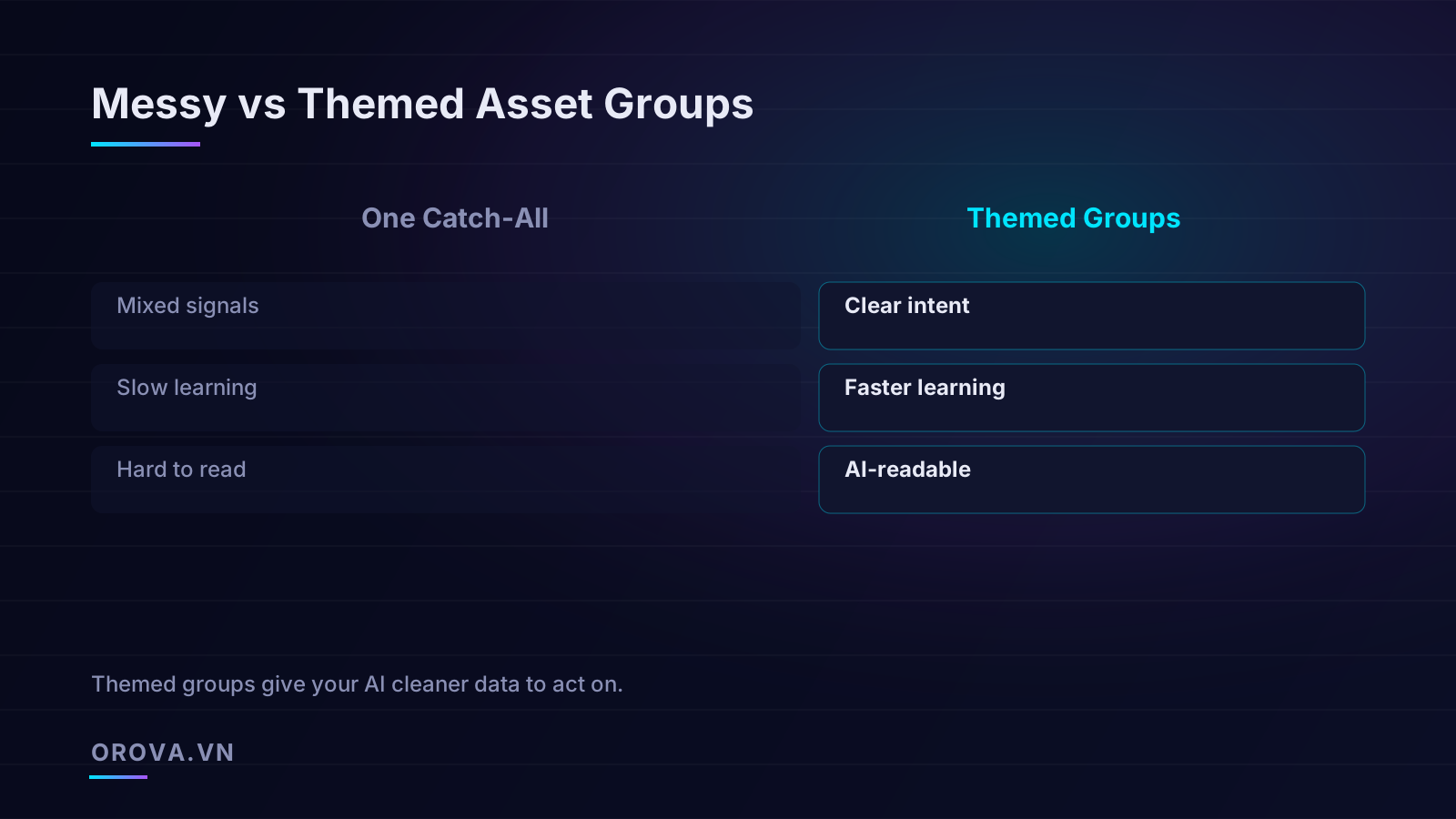
Now give that same agent five themed asset groups. Suddenly it can see that the remodeling group has a cost per acquisition forty percent above target while the maintenance group is twenty percent under. That is an attributable, actionable difference. The agent can recommend trimming the remodeling group's reach, reallocating toward maintenance, flagging the remodeling creative for refresh, and it can show you why, with numbers tied to a unit you recognize. Granular structure does not just help the agent act; it makes the agent's reasoning legible to you, which is what makes you comfortable approving its moves.
The readability principle
There is a useful way to phrase the goal: structure your campaign so that a smart analyst, human or machine, looking at the report cold, could tell you what is working and what is not within five minutes. If the report is one row, no one can. If the report is five themed rows with distinct profiles, anyone can.
This readability compounds over time. A clean structure produces a clean history. Six months of themed asset group data is a rich training set, full of contrasts the model and the agent can learn from. Six months of catch-all data is one long flat line that teaches almost nothing. The decision you make about structure today determines the quality of the data you will be optimizing against next quarter.
What clean structure does not fix
Structure is necessary, not sufficient. A few honest caveats so you do not over-promise yourself:
- Bad conversion tracking poisons everything. If your conversion actions are mislabeled, deduplicated wrong, or counting form views as leads, no structure will save you. Fix measurement first. Themed groups optimizing toward a broken goal just learn the wrong thing faster.
- Too many tiny groups starve learning. Granularity past the point your conversion volume supports is counterproductive. Splitting is a privilege you earn with volume.
- Creative quality still matters. A perfectly themed group with weak headlines and stock images will lose to a slightly messier group with sharp creative. Structure routes attention; creative earns it.
- Reporting is still limited. Performance Max remains less transparent than Search at the placement and search-term level. Themed structure mitigates this by letting you infer performance from group-level outcomes, but it does not give you full visibility.
A worked example, end to end
Let me make this concrete with a mid-sized ecommerce retailer selling outdoor gear. They generate about 600 conversions a month, enough to support real granularity. The wrong move is one "Outdoor Gear" asset group with the entire catalog. The right move is to draw themes that map to distinct customer intents and seasonal rhythms.
They land on five asset groups:
- Backpacking & multi-day hiking. Theme: serious hikers planning trips. Headlines about pack weight, capacity, and durability. Signal: Customer Match of past tent and pack buyers, plus a custom segment of people researching trail routes.
- Trail running. Theme: runners who want light, fast gear. Different message, different segment, different images entirely. Signal: in-market for running shoes plus site visitors to the running category.
- Camping & family outdoors. Theme: families buying for a weekend, not an expedition. Comfort and ease, not minimalism. Signal: past camping buyers, broader and more value-oriented.
- Winter & cold-weather. Theme: seasonal, insulation-focused. Built to scale up in autumn and idle in spring without dragging the other groups' models.
- Brand & loyalty. Theme: existing customers and brand searchers. Signal: full customer list and recent site visitors. Kept separate precisely so it does not inflate the prospecting groups' numbers.
Each group gets its own theme-matched headlines, images, and audience signal. Within a month, the reporting tells a story. Trail running has the lowest cost per acquisition and clear headroom. Winter is dormant, as expected. The brand group is, predictably, the cheapest, which is exactly why isolating it matters: had it been blended into the prospecting groups, it would have made them look efficient while hiding the fact that the genuinely incremental groups needed more budget and better creative.
Now an optimization agent reading this account daily has something to work with. It can recommend shifting spend from a saturated trail-running group toward backpacking where there is unmet demand, flag the winter group to ramp as the season turns, and quietly cap the brand group so it does not absorb budget that belongs in prospecting. None of those moves are possible against a single catch-all group. The structure is what unlocks the optimization.
A short checklist before you launch
- Can you describe each asset group's theme in one sentence? If not, split it.
- Would all five headlines in a group feel at home in the same ad? If not, you have mixed themes.
- Does each group's audience signal describe that group's specific customer, or did you reuse a generic seed everywhere?
- Does each group have enough projected conversion volume (roughly fifteen-plus a month) to learn? If not, consolidate.
- Is your brand and loyalty traffic isolated from prospecting so it does not flatter your numbers?
- Is asset strength at least Good, with enough creative variety per surface?
- Could a stranger read your asset group report and explain what is working in five minutes?
If you can answer yes to all seven, you have built a Performance Max campaign that gives both Google's bidding and any AI layer on top of it the clean, themed, attributable signal they need to actually optimize, instead of a single averaged number that only knows how to find cheap clicks.
The takeaway
Performance Max took away your levers and handed you one in return: structure. The asset group is your last expressive control, and one-theme-per-asset-group is the rule that turns it from a creative dumping ground into a precision instrument. Match each theme to a specific customer, seed it with a signal that describes that customer, keep the groups granular enough to be distinct but fat enough to learn, and isolate the traffic (like brand) that would otherwise distort the picture. Do that, and you stop fighting the black box. You start feeding it the cleanest possible diet, which is the only thing it has ever really needed from you.
If you would rather have those daily structure-and-budget decisions made for you, Orova Ads is an AI agent that manages paid campaigns across Google, Meta, and TikTok: it reads your asset group and campaign data every day, spots the differences themed structure makes visible, and recommends and executes the moves (budget shifts, bid targets, pausing losers, refining audiences) with your approval and a full audit log behind every change. Build the structure once; let the agent work it daily.
Let an AI Agent handle your SEO
Orova plans, writes, optimizes, and tracks rankings on its own — you just read the results.
Try it free