
How to Calculate SEO ROI: From Rankings to Revenue
Here is an uncomfortable question to ask of your own SEO program: if your best keyword dropped three positions tomorrow, could you put a number on what it would cost the business? If the honest answer is no — and for most teams it is — then your SEO is operating in a kind of fog. You are producing rankings, traffic, and content, but you cannot say what any of it is worth. And a function that cannot say what it is worth is a function that, sooner or later, gets cut.
This article makes a direct, commercial case: the most valuable thing you can do for your SEO program is not to win another ranking. It is to build the connection between what SEO produces and what the business earns — to get from rankings to revenue. Teams that build that connection get more budget, more trust, and more freedom. Teams that do not spend their careers defending an activity nobody can value. Here is how to make the connection, and why it is worth the effort.
How to Calculate SEO ROI
SEO ROI is the return you get from what you invest in search. The formula is simple; getting honest inputs is the hard part.
The formula: (value generated − cost) ÷ cost. Spend 100 million over a year, generate 400 million in attributable revenue, ROI is 300%.
Getting the cost right means including everything: salaries or agency fees, tools, content production, and developer time. Most calculations understate this by leaving out internal hours.
Getting the value right is harder. Use closed revenue where you can track it. Where you cannot, use the cost of buying the same traffic through ads — imperfect but defensible, and it gives leadership a number they already understand.
The timing problem: costs land immediately, returns arrive six to twelve months later. Comparing this quarter's spend with this quarter's revenue always makes SEO look terrible. Compare cohorts instead — work done in Q1 against revenue in Q3 and Q4.
The rest of this article covers connecting rankings to actual revenue rather than proxies.
The problem: SEO speaks a language the business does not
The core issue is a translation gap. SEO produces a particular kind of output — positions, impressions, sessions, click-through rates — and the business runs on a completely different kind: revenue, customers, pipeline, cost of acquisition, payback period. These two vocabularies do not automatically connect, and when they do not, SEO becomes literally incomprehensible to the people who fund it.
Picture the budget meeting. The SEO team presents: rankings up, traffic up, several new page-one positions. The finance-minded executive listens and thinks a single thought — "that is nice, but what did it earn us?" — and the SEO team cannot answer. Not because the work was bad, but because they never built the bridge from their metrics to the executive's. In that silence, SEO gets categorised as a cost with fuzzy benefits. And costs with fuzzy benefits are exactly what gets trimmed when the quarter is tight.
The teams that thrive are not necessarily the ones with the best rankings. They are the ones who closed the translation gap — who can stand in that meeting and say, in the executive's own language, what SEO produced. That capability is worth more than any single ranking, because it protects and grows every ranking you will ever build. Building it is the highest-return project available to most SEO teams, and the rest of this article is the practical case for doing it.
The value chain: how a ranking becomes revenue
To connect rankings to revenue you first have to see the chain that links them, because revenue does not come from rankings directly — it comes through a sequence of steps, each of which can be measured.
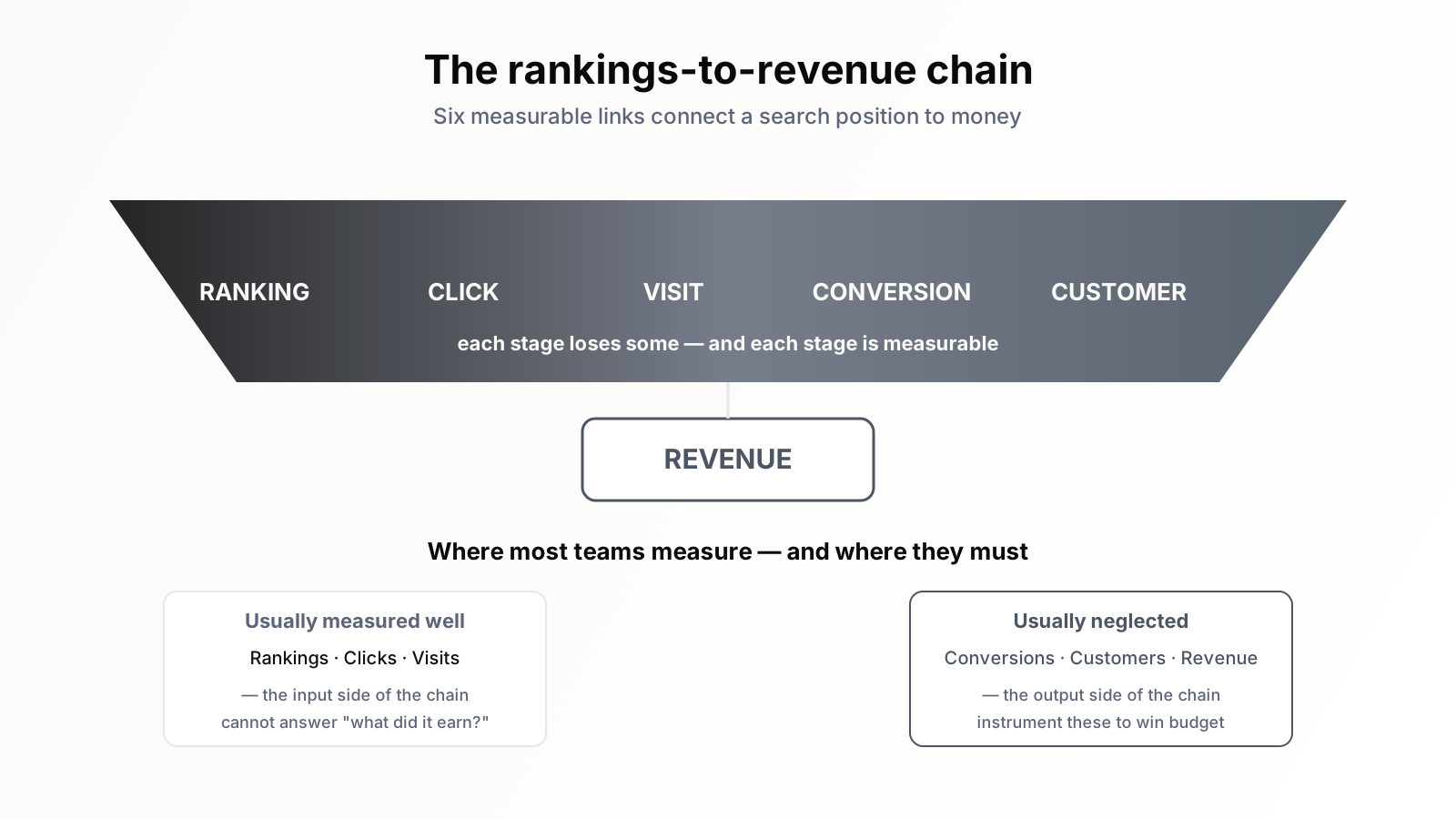
The chain runs like this. A ranking earns visibility for a query. Visibility earns a click, at a rate that depends on the position and the result's appeal. The click becomes a visit to a page on your site. The visit, if the page is relevant and persuasive, becomes a conversion — a sign-up, a trial, a lead, a demo request. The conversion enters your funnel and, at some rate, becomes a customer. And the customer, over their lifetime, produces revenue.
Ranking, click, visit, conversion, customer, revenue. Six links. The entire project of connecting SEO to the bottom line is the project of making every link in that chain visible and measurable, so that movement at the ranking end can be traced all the way to movement at the revenue end. Most SEO teams measure the first two links obsessively and the last four barely at all — which is exactly why they cannot answer the executive's question. The good news is that the chain is finite and concrete. You do not need perfect attribution. You need each link instrumented well enough that the connection is credible.
Step one: instrument conversions from organic search
The single most important and most neglected link is conversion. Most SEO teams can tell you their traffic precisely and their conversions barely at all — and conversion is the link where SEO stops being a traffic channel and starts being a growth channel.
So the first concrete step is to make organic conversions visible. Define what a conversion is for your business — trial start, sign-up, demo booked, qualified lead — and set up tracking that attributes those actions to the organic search channel. This is a setup task, and it is the single highest-leverage piece of measurement work an SEO team can do. The moment it is in place, your reporting changes character entirely. You stop saying "organic traffic grew" and start saying "organic search produced this many trial sign-ups" — and one of those sentences is a business statement and the other is not.
Ideally, push the instrumentation one link further: connect organic conversions to your CRM or sales data so you can see how many of those organic-sourced sign-ups became paying customers. That connection is what lets you reach all the way to revenue. But even stopping at conversions is a transformation. It moves SEO from reporting an input the business does not care about to reporting an output the business is measured on.
Step two: assign value to a conversion
Once you can count organic conversions, the next step is to attach a value to one, so that conversions can be expressed as money.
You do not need precision to start — you need a defensible estimate. If you know, roughly, what fraction of trial sign-ups become paying customers, and roughly what an average customer is worth over their lifetime, you can multiply through to a rough value per sign-up. A sign-up is worth (chance it becomes a customer) × (value of a customer). Even a conservative, clearly-labelled estimate is enormously more useful than no number at all, because it converts "we produced 200 organic sign-ups" into "we produced 200 organic sign-ups, worth roughly this much to the business."
That second sentence is the one that wins budget meetings. It is stated in the currency the business runs on. Be transparent that it is an estimate, show the assumptions, and refine them as real data accumulates — an honest estimate openly labelled builds more trust than a falsely precise figure or, worse, no figure and a request to take the value on faith. The point of this step is simply to get SEO's output denominated in money. Once it is, every subsequent conversation gets easier.
Step three: tie value back to specific rankings and pages
With conversions counted and valued, you can now do the thing that makes SEO strategy genuinely commercial: trace value back along the chain to specific pages and the rankings that feed them.
Which pages produce the organic conversions? Which keywords and rankings drive traffic to those pages? Answer those, and your ranking data transforms. A ranking is no longer just a position — it is a position attached to a page attached to a flow of conversions attached to an estimated revenue contribution. Now the question "what would it cost us if this keyword dropped three positions?" finally has an answer, because you can see the conversions and value that ranking feeds.
This is also what makes prioritisation rational. Instead of chasing rankings by difficulty or by volume, you can chase them by their connection to value. The keyword that feeds your highest-converting page deserves more attention than the keyword with triple the search volume but no commercial page behind it. Rankings tied to revenue tell you exactly where to spend effort — and that is a strategic capability ordinary rank tracking simply cannot give you. As we argue in why "ranking #1" is not a business goal, a ranking only matters in proportion to the value behind it.
Step four: report SEO in the business's language
The previous steps build the capability. This step is about using it — changing how you communicate so the connection you built actually lands with the people who fund the work.
Rewrite your reporting around outcomes. Lead with conversions from organic search and their estimated value. Lead with the trend in those numbers over time. Lead with cost per organic conversion compared to other channels. The rankings and traffic do not disappear — they move into a supporting role, explaining why the outcome numbers moved, as leading indicators rather than headlines.
An executive reading that kind of report comes away with a clear, fundable picture: SEO is producing this much measurable value, the value is trending in this direction, and it is being produced at this cost relative to alternatives. That is a report that does not just survive the budget meeting — it makes the case for more budget, because it has demonstrated, in the business's own currency, that more investment buys more value. A report full of positions and impressions cannot do that, however good the underlying work. Structuring this kind of report well is its own discipline — our guide to building an SEO dashboard people will read covers the presentation side.
What this unlocks: the commercial payoff
It is worth being explicit about what a team gains by doing all this, because the work is real and the payoff should justify it. It does.
The first gain is budget security. A function whose value is visible and denominated in money is far harder to cut than one whose value is fuzzy. When the quarter tightens, the SEO that can show its revenue contribution is defended; the SEO that can only show rankings is questioned.
The second gain is growth. Once you can show that a dollar invested in SEO returns more than a dollar in value, the argument for more investment makes itself. You stop fighting to keep your budget and start making the case to expand it — backed by evidence the business actually credits.
The third gain is better strategy. When you can see which rankings and pages drive value, you stop spreading effort evenly and start concentrating it where it pays. The whole program becomes sharper, because it is finally steered by the right signal.
And the fourth gain is credibility. The SEO team that talks in revenue is treated as a business contributor and brought into commercial conversations. The team that talks only in rankings is treated as a technical service and kept at arm's length. Credibility compounds — it earns you a seat at the table where the decisions that affect SEO get made.
The honest caveats — and why they are not excuses
This work has genuine difficulties, and pretending otherwise would undercut the argument. SEO attribution is messy: organic search rarely acts alone, and a customer's path often touches several channels. Conversions take time, sometimes many months, so the revenue from this quarter's rankings may not show up until much later. And lifetime value, the basis for conversion value, is itself an estimate.
These are real. But they are reasons to do the work carefully and transparently — not reasons to skip it. An imperfect, honestly-labelled connection from rankings to revenue is vastly more valuable than no connection at all. The executive does not expect SEO attribution to be flawless; no channel's is. They expect a credible, good-faith effort to show the channel's value in business terms. The teams that provide that — caveats and all — win. The teams that hide behind the difficulty as a reason to keep reporting only rankings lose, slowly, every budget cycle. The messiness is the price of admission to the conversation, not an exemption from it.
Where an AI agent fits
Connecting rankings to revenue is the right project, and it is also a sustained one. It means keeping conversion tracking healthy, keeping rankings mapped to the pages and conversions they feed, refreshing value estimates as real data arrives, and producing outcome-framed reports every cycle without the connection quietly degrading. It is ongoing measurement infrastructure, and infrastructure needs maintaining.
That sustained connecting and reporting work is exactly where an SEO AI agent earns its place. Orova can keep your search, analytics, and conversion data linked — tracing the chain from keyword to page to conversion — maintain the mapping as your site changes, and generate consistent revenue-framed reporting on a schedule. The commercial judgement stays yours: what a conversion is worth, which outcomes matter, how to read the trends. The agent keeps the bridge from rankings to revenue standing, so SEO never slips back into the fog of unmeasurable activity.
Stop selling rankings. Start showing revenue. Build the chain from a search position to a paying customer, report it in the language the business actually speaks, and SEO stops being a cost that has to defend itself — and becomes a growth channel that gets to ask for more.
Related reading: SEO in 2026: The Complete Guide (From Zero, No Jargon)
Let Orova SEO handle the repetitive part
Keyword research, drafting, refreshing old posts and rank tracking — running automatically on your own site.
Explore Orova SEO