
The SaaS SEO Funnel: TOFU, MOFU, BOFU Without the Buzzwords
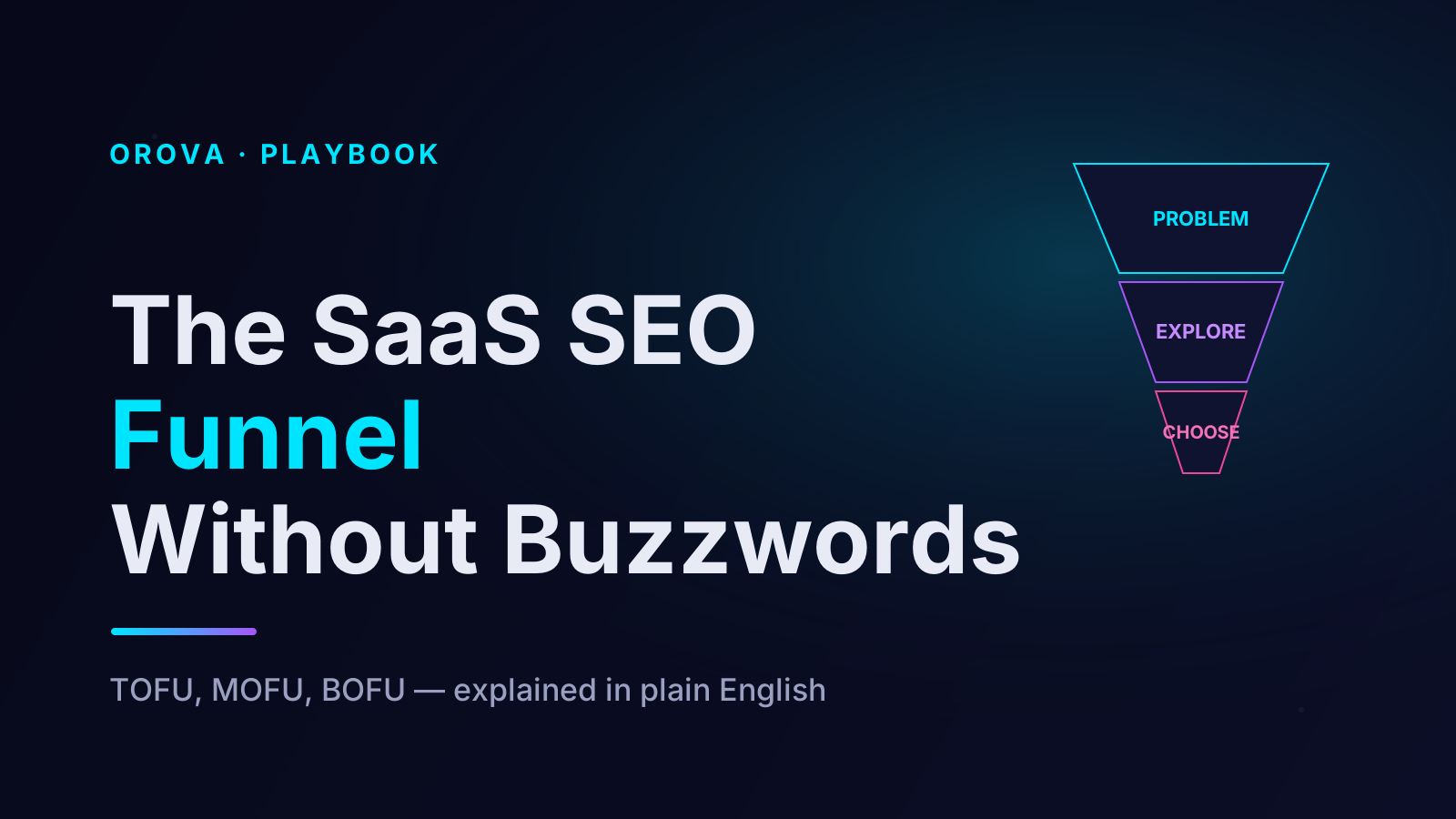
TOFU, MOFU, BOFU. Three abbreviations that have been repeated so often they have stopped meaning anything. They get drawn as a triangle on a slide, everyone nods, and then the content team goes back to writing whatever it was going to write anyway. The buzzwords have crowded out the idea, and the idea is genuinely useful: a SaaS buyer does not arrive ready to purchase, they travel toward that decision through distinct stages, and your content has to meet them at each one.
This is a working guide to the SaaS SEO funnel with the jargon stripped out. We will replace the three abbreviations with plain descriptions of what a buyer is actually doing, define what content each stage needs, explain how to keep the stages in healthy proportion, and show how to link them so the funnel works as a connected system rather than three disconnected piles of articles. By the end you should be able to look at any article you publish and say exactly which job it does.
The funnel is a description of the buyer, not your content
Start with the most common mistake: treating the funnel as a filing system for content. It is not. The funnel describes the buyer's changing state of mind as they move toward a purchase. Content stages exist only because buyer stages exist. Get that order right and everything else follows; get it backwards and you end up sorting articles into boxes that do not correspond to anything a real person experiences.
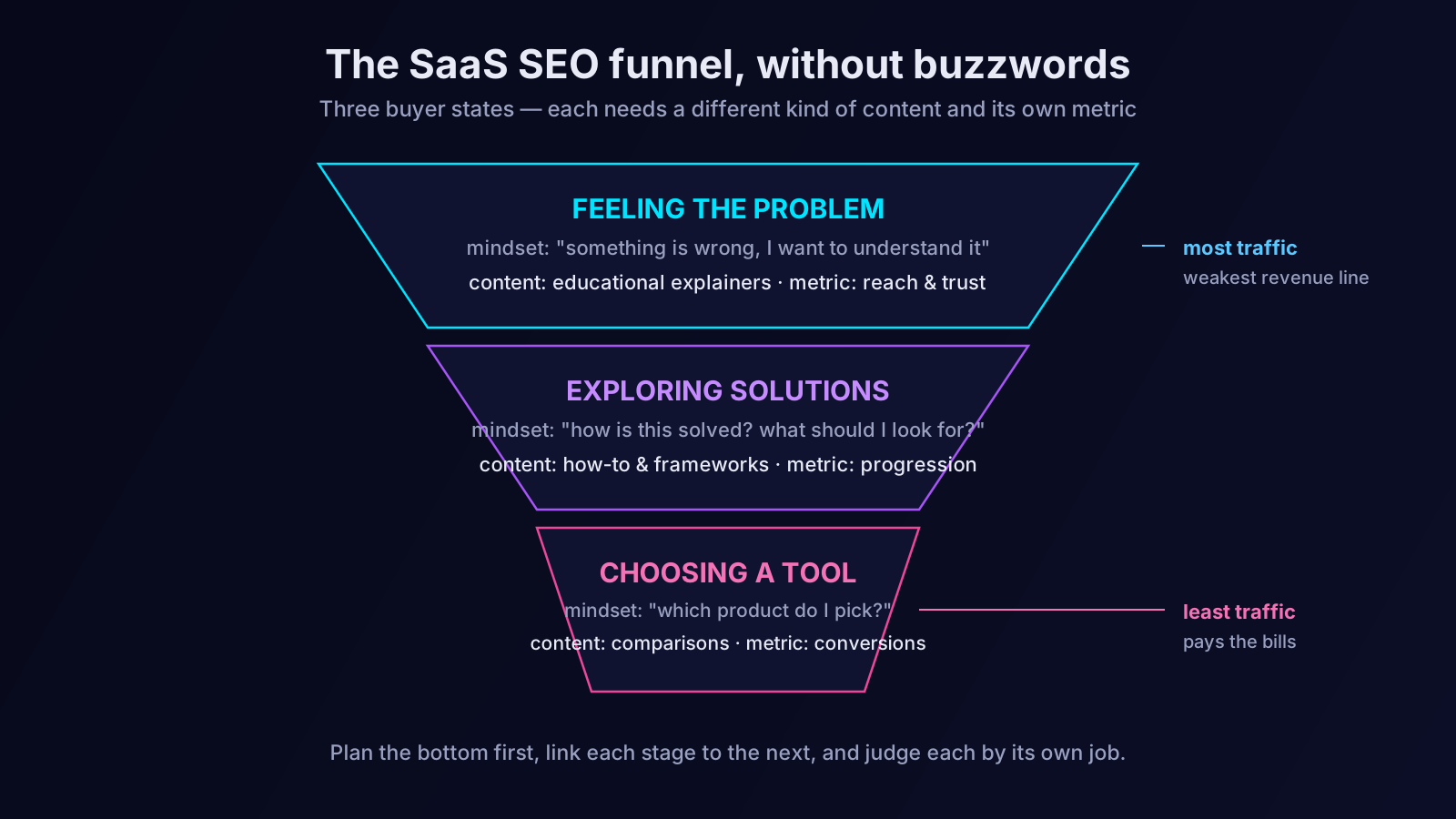
A SaaS buyer moves through three broad states. First, they become aware that they have a problem, but they are not yet thinking about software — they are just feeling a pain and looking to understand it. Second, they accept that the problem is worth solving and begin exploring approaches and categories of solution, including, eventually, the idea that a tool might help. Third, they have decided a tool is the answer and are now comparing specific products to choose one. Three states: feeling the problem, exploring solutions, choosing a tool. Those are the only three things the funnel describes. The abbreviations are just shorthand for them.
Stage one: content for someone feeling the problem
At the top of the funnel — the "feeling the problem" stage — your reader has a pain but no vocabulary for it and no intention to buy anything. They are searching to understand. A software team lead notices releases keep slipping and searches "why do projects keep missing deadlines." A founder watches customers leave and searches "why do customers stop using a product." These are people at the very start of the journey.
Content for this stage is educational and genuinely generous. It explains the problem, its causes, its consequences, and the broad shape of how it gets addressed. Its goal is not to sell — it is to be the most helpful answer to a problem-stage question, to earn trust, and to make your brand the one that explained the issue clearly. A hard product pitch here is jarring and counterproductive; the reader is not deciding anything yet, and being sold to at this moment feels like an interruption.
Two things to be clear-eyed about. Top-of-funnel content draws the most traffic, because problem-stage questions are the most-searched — which is why undirected blogs drift here. And top-of-funnel content has the weakest direct line to revenue, because these readers are months from a decision. Both facts are fine. Top-of-funnel content is doing a real job — building awareness and trust at scale — as long as you remember that the job is awareness, not conversion, and measure it accordingly.
Stage two: content for someone exploring solutions
The middle of the funnel — "exploring solutions" — is the stage teams neglect most, and it is the stage where buying intent genuinely begins. The reader now accepts the problem is worth solving and is actively investigating how. They are comparing approaches, learning what a category of tool does, and working out what a good solution looks like. The team lead who searched "why do projects miss deadlines" now searches "how to track project progress across a team" or "what does project management software actually do."
Content for this stage teaches the solution. How-to guides that walk through solving the problem properly. Explainers on what a category of software does and when it is worth adopting. Framework and methodology pieces. Articles that help a reader build evaluation criteria — what to look for, what matters, what to ignore. This is also the stage where your product can first appear honestly: an article teaching how to solve the problem can legitimately show how your tool does it, because the reader is now genuinely interested in solutions and your product is one. Middle-of-funnel content draws less traffic than top but converts far better, because these readers are closer to a decision and actively want what you are explaining. This is the most underrated real estate in SaaS SEO.
Stage three: content for someone choosing a tool
The bottom of the funnel — "choosing a tool" — is where readers have decided that software is the answer and are now comparing specific products to pick one. Their searches are unmistakable: "[your category] software," "best [category] tools," "[competitor] alternative," "[competitor A] vs [competitor B]," "[your product] pricing," "[your product] for [specific use case]."
Content for this stage is direct, commercial, and unembarrassed. Comparison pages — your product against an alternative, honestly. "Best [category] tools" pieces. Alternative pages for competitors people are evaluating. Use-case pages showing your product applied to a specific situation. Pricing-related and evaluation content. These pages can and should talk about your product plainly, because the reader has explicitly asked for exactly this — they are choosing, and they want help choosing.
Bottom-of-funnel content draws the least traffic of the three stages — the population of people actively choosing a tool in your exact category is small — and converts dramatically better than anything above it, because these readers are at the moment of decision. A handful of strong bottom-of-funnel pages frequently out-earns a hundred top-of-funnel articles. This is the content that most directly pays the bills, and it is, predictably, the content undirected blogs have the least of.
The proportion problem — and how to fix it
Knowing the three stages is not enough; you have to keep them in healthy proportion, and this is where most SaaS blogs fail. Left undirected, a content engine fills almost entirely with top-of-funnel articles. They are the easiest to think of, the easiest to write, and the ones that win the most traffic, so they crowd everything else out. The result is a blog that is perhaps eighty percent problem-stage content, with the middle and bottom — the stages where buying actually happens — barely represented.
The fix is to treat funnel balance as a deliberate constraint on your content plan rather than an outcome you hope for. Before a quarter starts, decide roughly how the planned articles split across the three stages, and make sure the middle and bottom get a real, protected allocation — not the leftovers. A useful instinct is to plan the bottom of the funnel first: identify every decision-stage query where your product is genuinely a strong answer — every competitor alternative, every comparison, every use case — and commit those pages, because the list is finite and high-value. Then plan the middle to feed them. Then let the top fill the remaining capacity. This inverts the natural drift. Instead of the funnel filling top-down and starving the bottom, you secure the bottom first and let the top take what is left. You will almost always end up with fewer top-of-funnel articles than an undirected plan would have produced — and a far healthier funnel.
The funnel only works when the stages connect
Three well-stocked stages still underperform if they are three islands. The funnel is a journey, and a journey needs paths between its points. Those paths are internal links, used deliberately to walk a reader from where they are toward where they are going.
A top-of-funnel article explaining a problem should link onward to the middle-of-funnel articles that teach how to solve it. A middle-of-funnel how-to should link onward to the bottom-of-funnel pages that help choose a tool. The direction of linking follows the direction of the journey: each stage hands the reader forward to the next. Without this, a reader can finish a problem-stage article fully convinced the problem matters and have no signposted route to the content that would move them toward solving it — and they leave. With it, your content actively escorts people down the funnel rather than just hoping they find their own way. (Our guides to internal linking strategy and topic clusters cover the mechanics of building these paths at scale.)
Measure each stage by its own job
A final discipline: the three stages do different jobs, so they must be measured by different metrics. Judging them all by the same yardstick is how good content gets killed and weak content gets praised.
Measure top-of-funnel content by reach and trust signals — traffic, new visitors, brand-related search growth, engagement. Its job is awareness, so judge it on awareness. Do not judge it on direct conversions; it will fail that test by design, and you will wrongly conclude it is not working. Measure middle-of-funnel content by engagement and progression — email signups, returning visits, movement onward to bottom-of-funnel pages, assisted conversions. Its job is to move people forward, so measure forward motion. Measure bottom-of-funnel content by conversion outcomes directly — trials, demos, signups, paid conversions traceable to the page. Its job is to convert, so hold it to conversion. Apply one blanket metric across all three and you guarantee a wrong verdict: traffic makes weak top-of-funnel content look like a triumph and strong bottom-of-funnel content look like a failure. Each stage, its own job, its own metric.
The three mistakes that quietly break the funnel
Even teams that understand the three stages tend to break the funnel in the same three ways. Naming them makes them easier to catch in your own program.
The first mistake is misjudging a reader's stage and writing the wrong content for it. A team decides "comparison pages are valuable" — true — and starts writing comparison content for every keyword, including problem-stage ones. A reader who searched a problem-stage question and lands on a hard product comparison feels sold to before they have decided anything, and bounces. The reverse happens too: a reader at the decision stage, searching "[competitor] alternative," lands on a gentle educational explainer that refuses to mention products, and leaves unhelped. The content type has to match the reader's actual stage, not the stage you wish they were at. The query tells you the stage; respect what it tells you.
The second mistake is treating the stages as rigid silos. The funnel is a useful model, but real buyers do not move through it in a tidy single file. Someone can search a decision-stage query on day one because a colleague already recommended a category, then drop back to a problem-stage question a week later to understand a detail. A reader can enter at any stage. The practical consequence: every stage of content should still offer a sensible next step in both directions — a decision-stage page can link back to an explainer for a reader who needs to fill a gap, and a problem-stage page leads forward. Build the funnel as a connected map a reader can move around, not a one-way chute they must enter at the top.
The third mistake is abandoning the middle. We have said the middle of the funnel is neglected; the specific failure mode is worth isolating. Teams build top-of-funnel content because it is easy and draws traffic, and they eventually build some bottom-of-funnel content because the revenue link is obvious. What gets skipped is the middle — the solution-teaching, framework, and evaluation content that carries a reader from "I have a problem" to "I am ready to choose." Skip the middle and you have two disconnected ends: a large top that attracts strangers and a small bottom that converts the already-decided, with nothing bridging them. The middle is the bridge. Without it, the funnel is not a funnel — it is two unrelated piles.
How to apply the funnel to a real content plan
The funnel is only useful if it changes what you actually plan to write, so here is how to put it to work on a concrete quarter of content.
Begin every keyword you are considering with one question: which buyer state does the person searching this occupy? Read the query honestly. "What is [problem]" and "why does [problem] happen" are problem-stage. "How to [solve problem]" and "what does [category] software do" are solution-stage. "[Category] software," "best [category] tools," "[competitor] alternative," and "[product] pricing" are decision-stage. Tag every candidate keyword with its stage before you do anything else with it. That single tag is what makes the rest of the planning possible.
Then plan in reverse, bottom-up. List every decision-stage query where your product is a genuinely strong answer — the comparisons, the alternatives, the use cases, the category terms — and commit those pages first, because the list is finite and each page sits closest to revenue. Next, plan the solution-stage middle: the how-to and framework content that teaches the solutions your decision pages then help readers choose between, deliberately covering enough ground that the middle is a real bridge rather than a token. Finally, let problem-stage content fill the remaining capacity, choosing the problem topics most relevant to your buyers rather than simply the highest-volume ones.
The output of this exercise is a content plan with a deliberate, defensible shape across all three stages — usually with noticeably fewer top-of-funnel articles than an instinct-driven plan would have produced, and a middle and bottom that are properly stocked for the first time. That shape is the whole point. A plan that looks balanced across the three buyer states is a plan built to convert, not just to attract.
Where an SEO AI agent fits
Running the funnel properly is not conceptually hard — it is operationally relentless. Every article has to be tagged to a stage, the plan has to be kept in proportion, the linking paths between stages have to be built and maintained, and each stage has to be reported against its own metric. That is a lot of structured discipline to sustain across hundreds of articles, and it is exactly the discipline that erodes first under deadline pressure.
This is where an SEO AI agent helps. Orova can classify every keyword and article by funnel stage, show you the real proportion of your plan across the three stages and flag when the middle or bottom is being starved, suggest the internal links that connect each stage to the next, and report each stage against the metric that suits its job. The thinking in this article — the three buyer states, the inverted planning, the connected paths — stays yours. The agent keeps the funnel honest, so the structure you designed on a slide is the structure that actually exists in your published content. Strip away the buzzwords and the funnel is simply this: meet the buyer where they are, and walk with them to where they are going.
Let an AI Agent handle your SEO
Orova plans, writes, optimizes, and tracks rankings on its own — you just read the results.
Try it free