
"SEO Is Free Traffic" — The Most Expensive Sentence in Marketing
There is a sentence that has done more quiet damage to more marketing budgets than almost any other. It sounds reasonable. It sounds, in fact, like good news. It gets repeated in pitches, in board meetings, in the heads of founders deciding where to put their money. The sentence is: "SEO is free traffic." It is wrong, it is expensive, and the cost of believing it is rarely paid by the person who said it. This article is built around that sentence and a handful of others — the aphorisms that shape how organisations think about the economics of search — because the way you talk about SEO determines how you fund it, and how you fund it determines whether it works.
"SEO is free traffic"
Start with the headline offender. The reason "SEO is free traffic" is so seductive is that it contains a sliver of truth wrapped around a costly error.
The sliver of truth: when an organic visitor clicks through to your site, you do not pay a platform for that click. There is no per-click invoice the way there is with paid search. In that narrow, transactional sense, the click itself is unbilled.
The costly error: the click is unbilled, but the ranking that produced it was extraordinarily expensive. That ranking was bought with months of strategy, content production, technical work, link earning, and the loaded cost of the people who did all of it. You did not pay for the click because you already paid, heavily, for the position that generates the clicks. As the better version of the saying goes: SEO is not free traffic; it is prepaid traffic.
The danger of the "free" framing is precise and predictable. If leadership believes traffic is free, they will underfund the work that produces it, then be baffled when the free thing fails to appear. You cannot underinvest in a prepaid asset and still receive the delivery. The word "free" sets the budget to a number that guarantees the outcome will disappoint — which is exactly how the most optimistic sentence in marketing becomes the most expensive one.
"It pays for itself eventually"
The companion to "SEO is free" is "it pays for itself eventually." This one is more dangerous because it is partly true, and partly true is harder to argue with than simply false.
SEO content genuinely is an asset. A page that ranks keeps returning value long after it was paid for, and over a long enough horizon a good programme does pay back many times over. That part is real, and it is the strongest thing about SEO economics.
The trap is the word "eventually." Eventually is not a plan; it is a hope with no date attached. "It pays for itself eventually" gives leadership permission to never look closely — to fund the programme on faith and then, when an impatient quarter arrives, cut it on the same faithless basis, because nothing was ever specified. The better sentence replaces the vague promise with a measurable one: SEO is an asset that compounds on a schedule you can forecast — so forecast it. Show the leading indicators, show the expected curve, attach the dates. "Eventually" is what you say when you have not done the work of forecasting. It invites exactly the impatience that kills programmes right before they would have paid out.
"We can always just turn it off"
Here is a sentence that reveals a deep misunderstanding of what SEO is. When budgets tighten, someone says "we can pause SEO for a couple of quarters and turn it back on later." They are treating SEO like a paid campaign — a tap you close and reopen.
But SEO is not a tap; it is a garden. Paid traffic stops the day you stop paying, and resumes the day you resume, because you are renting attention in real time. SEO traffic does not stop the day you stop working — it decays slowly, as rankings erode, as competitors publish past you, as content goes stale. And it does not resume the day you restart — it has to be rebuilt, often from a worse position than you left, because the ground you abandoned was taken.
The accurate sentence: you cannot turn SEO off and on; you can only let it grow or let it wither. A pause is not a pause. It is a slow loss of an asset followed by an expensive recovery. The "turn it off" framing makes a destructive decision sound like a reversible one — which is precisely what makes it expensive.
"Organic is cheaper than paid"
This one is repeated so often it is treated as settled fact. It deserves a harder look, because it is true only under conditions that are usually left unstated.
Organic can indeed end up cheaper than paid on a cost-per-acquisition basis — but only if the programme actually works, only once it has matured past the ramp-up period, and only when you count the full cost of producing it, not just the absence of click fees. A failed SEO programme is not cheaper than paid. It is infinitely more expensive per result, because it produced cost and no results at all. Paid traffic, whatever its drawbacks, at least delivers in proportion to spend.
The honest sentence: mature, successful SEO is cheaper than paid; failing or immature SEO is more expensive than anything. "Organic is cheaper" used as a blanket truth lets people skip the conditions — the maturity, the full-cost accounting, the requirement that it work at all — and those conditions are the entire substance of the comparison.
"Just write more content"
When an SEO programme underperforms, a common reflex is the sentence "we just need to publish more." It frames the problem as a volume problem and the solution as a throughput problem.
It is usually wrong, and it is expensive because it scales the spending without fixing the cause. If content is not ranking, the problem is rarely that there is too little of it. It is more often that it targets keywords the site cannot win, or it misreads search intent, or it lacks the depth to compete, or it is not connected into a structure search engines reward. Publishing more of the same content produces more of the same non-result, at higher cost.
The better sentence: publish more of what is working, and figure out why the rest is not. "Just write more" is expensive because it treats a quality-and-strategy problem as a quantity problem, and quantity is the most costly variable to scale. For the diagnosis that should come first, see our guide to turning keywords into a content plan.
"We'll do SEO once we have time"
This sentence is expensive in a way the others are not — it costs nothing now and everything later. "We'll do SEO once we have time" defers the start of a channel whose defining feature is a long lag between effort and result.
Because SEO compounds, the cost of a delayed start is not linear; it is the loss of all the compounding that the delayed months would have begun. Starting six months later does not cost six months. It costs six months plus every month of growth those six months would have seeded — and it cedes that ground to whoever did start. The accurate sentence: the most expensive SEO decision is the one to start later. "Once we have time" feels prudent and is in fact the costliest deferral in the whole channel.
Why the words matter more than they seem
It is tempting to dismiss all of this as semantics. It is not. The sentences an organisation uses about SEO are not descriptions of how it funds SEO — they are instructions for how it funds SEO.
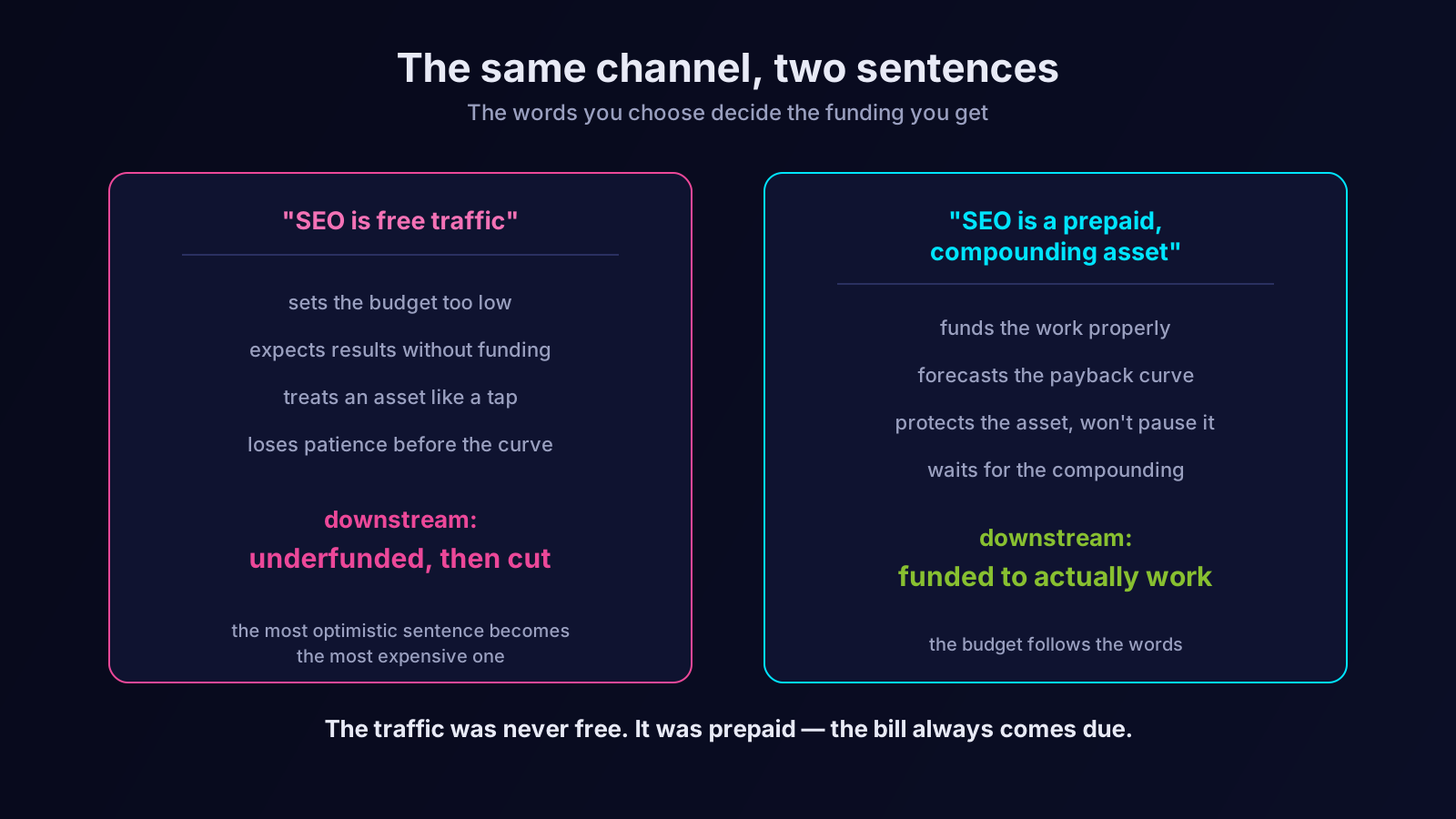
"Free traffic" is an instruction to underfund. "Pays for itself eventually" is an instruction not to forecast and then to lose patience. "Turn it off" is an instruction to treat an asset like a tap. "Just write more" is an instruction to scale cost without diagnosis. Each sentence sounds harmless and quietly programs an expensive decision. Replacing them with accurate sentences — prepaid, compounding on a schedule, an asset that withers if abandoned, a quality problem before a quantity one — is not pedantry. It is changing the instructions, and the instructions are what determine whether the budget is set to a number that can succeed. See our piece on topic clusters for how the right framing turns into the right structure.
"The intern can handle SEO"
Here is a sentence that costs money precisely because it sounds like saving money. "SEO is just writing some blog posts — the intern can handle it" treats the channel as low-skill, junior-appropriate work, and assigns it accordingly.
The error is in mistaking the visible part of SEO for the whole of it. Yes, content gets written, and writing can be taught. But the decisions that determine whether a programme works — which keywords are winnable for this specific site, how search intent should shape each page, how content should be structured into clusters, how technical issues should be prioritised, how to read the data and adjust — are senior judgement calls. Hand them to someone without the experience to make them, and you get a stream of competently written pages aimed at the wrong targets, which is the most expensive output of all: real cost, real effort, no result.
The accurate sentence: SEO execution can be junior; SEO strategy cannot. "The intern can handle SEO" is expensive because it underprices the part of the work — judgement — that actually decides the outcome, and a programme run entirely on junior judgement will spend a real budget producing pages that never had a chance.
"Our competitors aren't really doing SEO"
This sentence is comforting and frequently false, and its cost is the cost of acting on a wrong map. A team glances at a couple of competitors, sees no obvious blog, and concludes the category is open — so SEO can wait, or be done lightly.
The problem is that "doing SEO" is mostly invisible from the outside. You cannot see a competitor's keyword strategy, their internal linking, their technical health, their backlink earning, or the patient cluster they have been building for two years. By the time a competitor's SEO is obvious from the outside — when they are visibly everywhere in the results — it is because they started long ago and the compounding has become impossible to miss. The absence of an obvious blog is not evidence that the category is open; it is evidence of nothing at all.
The honest sentence: you cannot see whether competitors are doing SEO — you can only see whether they have already won. Assuming the field is empty because it looks empty is how organisations arrive late to a category that was being quietly contested the whole time.
The sentence to replace them all
If every expensive sentence had to be retired and replaced with one accurate one, it would be this: SEO is the cost of building an asset that pays out later and longer than anything you rent.
Every clause is doing work. "Cost" — it is not free, it must be funded properly. "Building an asset" — it is capital, not expense, and you would not abandon a half-built asset. "Pays out later" — the lag is real, forecast it, do not lose nerve before the curve turns. "And longer" — once it pays, it keeps paying with no further spend, which no rented channel does. "Than anything you rent" — the comparison to paid is real, but it favours SEO only when SEO has been allowed to mature.
Say that sentence in the budget meeting instead of "SEO is free traffic," and the entire downstream chain of decisions changes — the funding level, the patience, the willingness to forecast, the reluctance to abandon. The words come first. The budget follows the words. The results follow the budget.
Where an AI agent helps
The reason the expensive sentences survive is that the accurate ones demand evidence. To say "compounding on a schedule you can forecast," you need the leading indicators and the curve. To say "publish more of what is working," you need to know what is working. To resist "turn it off," you need to show the decay an abandoned programme suffers. That evidence is real, ongoing analytical work — and when it is missing, the comfortable false sentence fills the vacuum.
This is where an SEO AI agent earns its keep. Orova keeps the evidence assembled and current — tracking the leading indicators that let you forecast the payback curve, showing which content is producing results and which is not, and monitoring the rankings that prove an asset is growing rather than withering. With the evidence in hand, you can speak the accurate sentences in the room where the budget is set — and the accurate sentences are what get the channel funded the way it needs to be.
"SEO is free traffic" will keep getting said, because it is short and it sounds like good news. But now you know what it costs to believe it. The traffic was never free. It was prepaid — and the bill always comes due, one way or another. The only choice is whether you pay it deliberately, as an investment in an asset, or accidentally, as the price of a sentence that was wrong all along.
Let an AI Agent handle your SEO
Orova plans, writes, optimizes, and tracks rankings on its own — you just read the results.
Try it free