
Should You Translate Content or Rewrite It? The Honest Answer
Ask most teams how they will handle content for a new market and you will get one of two answers, both delivered as policy rather than as a decision. One camp says "we'll translate everything" — it is fast, it is cheap, and the existing blog already exists. The other camp says "translation never works, we'll rewrite everything from scratch" — it is thorough, it respects the market, and it sounds appropriately serious. Both camps are wrong, and they are wrong in the same way: they have replaced a per-article judgment with a blanket policy, because a blanket policy is easier to defend in a meeting than a series of individual calls.
This article is a critique of both defaults. The honest answer to "translate or rewrite?" is not one or the other. It is "it depends, and you have to decide article by article" — which is a less satisfying answer, but it is the only one that produces good content in a new market without setting your budget on fire. Let me make the case against each easy default in turn, and then offer the actual decision framework.
The case against "translate everything"
The translate-everything camp is seduced by efficiency, and the efficiency is real — until you look at what gets translated.
Some content survives translation intact. A technical explanation of how a feature works, a definition of a concept, a neutral how-to — these are largely market-agnostic. Their value is in information that is true regardless of where the reader sits, and translating that information faithfully preserves the value. For this kind of content, translate-everything is correct.
But a great deal of content is not market-agnostic, and the translate-everything policy treats it as if it were. Consider an opinionated article built around examples from your home market, framings that assume a reader who shares your country's business context, references to local regulations, case studies from companies in your region, cultural touchstones, a tone calibrated to your domestic audience's expectations. Translate that literally and you get a grammatically perfect article that is subtly, persistently wrong for the new market. The examples mean nothing. The regulatory references are inapplicable. The framing assumes a context the reader does not share. The tone may be too formal or too casual for local norms. None of this shows up as an "error" — the translation is accurate — but the article reads as foreign, lands flat, and underperforms.
The translate-everything policy, in other words, is correct for a subset of your content and quietly damaging for the rest. Its supporters see only the subset it works for, because the failures are not loud — a translated opinion piece does not crash, it just does not perform, and a non-performing page is easy to overlook among many.
The case against "rewrite everything"
The rewrite-everything camp has the opposite problem. It is correct about the limits of translation and then over-corrects into waste.
Rewriting every article from scratch for every market treats market-neutral content as if it were market-specific. The technical explainer of how a feature works does not need rewriting for France; its substance is the same in every country. Rewriting it anyway means paying — in time, in money, in writer effort — to recreate content you already had in a perfectly translatable form. Do that across an entire blog and across multiple markets and the cost is enormous, and a large fraction of it bought you nothing, because the rewritten version of a market-neutral article is not meaningfully better than a good translation of it.
Worse, rewrite-everything does not scale. The whole appeal of expanding into new markets is leverage — reusing the work you have already done. A policy that throws away that leverage and starts every market from a blank page makes international expansion so expensive that most teams can only afford one or two markets, when a smarter policy would have let them enter five. Rewrite-everything is not the thorough, serious choice it presents itself as. It is the choice that confuses effort with quality and prices you out of your own expansion.
The honest answer: decide per article
If both blanket policies fail, the alternative is the one neither camp wants, because it requires thought: decide for each article, or each clear category of article, whether it should be translated or rewritten.
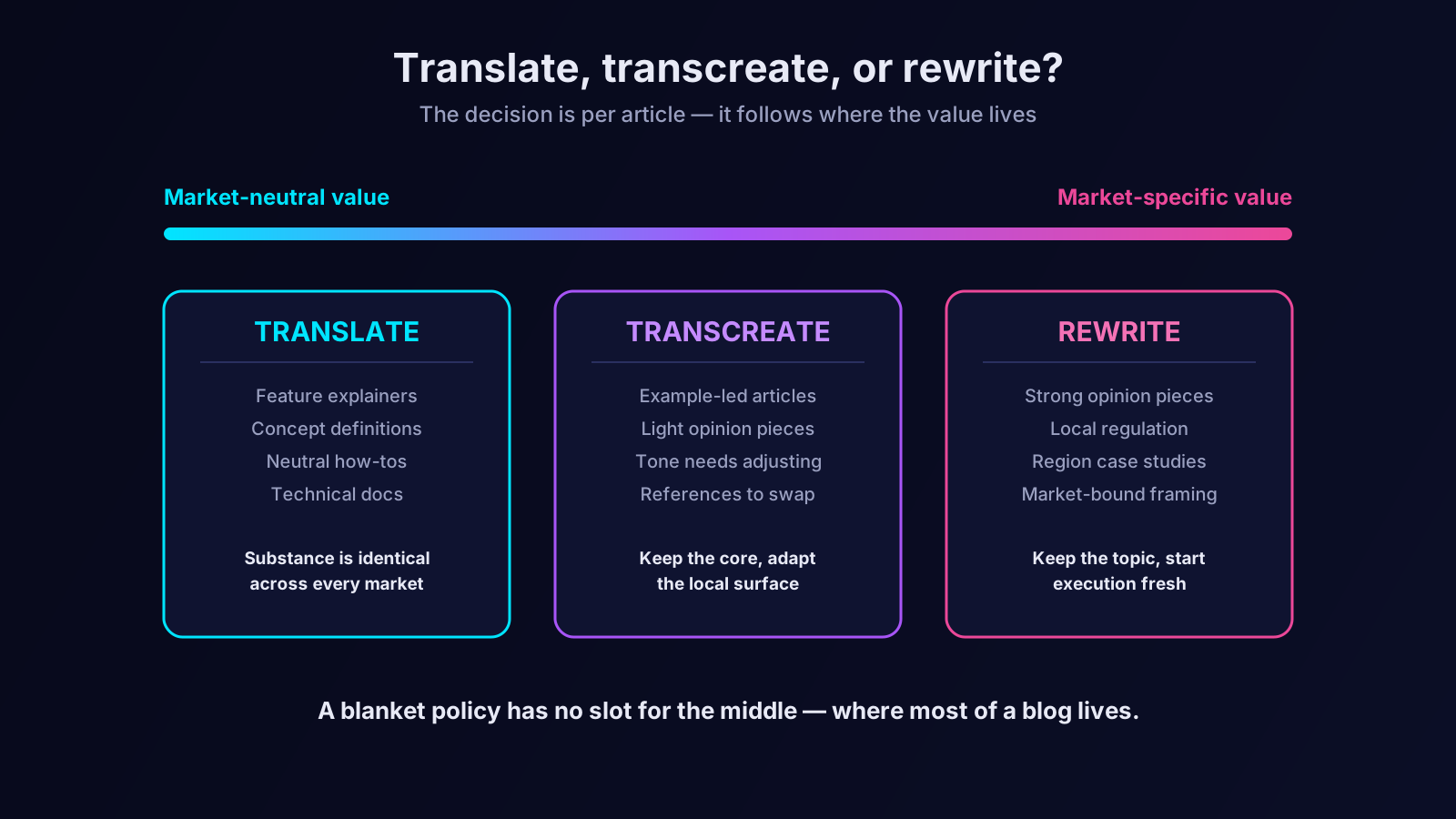
The decision rests on a single question: where does this article's value live? If the value is in information that is true regardless of market — how something works, what something means, how to do a market-neutral task — the article should be translated, because translation preserves exactly that value at a fraction of the cost. If the value is in framing, examples, opinion, cultural context, or anything calibrated to a specific market, the article should be rewritten, because translation strips the localisation that made it valuable and leaves a foreign-feeling husk.
Most blogs, examined honestly, split into both categories. A reference section of technical explainers leans heavily toward translate. A section of strategic, opinionated, example-rich articles leans heavily toward rewrite. And a middle band needs the in-between option both camps forget exists: transcreation — translating the core but adapting the examples, the references, the tone, and the framing as you go. Transcreation is more than translation and less than a full rewrite, and it is the right answer for the large middle of most blogs: articles whose information is sound but whose surface needs localising.
A working framework
To make the per-article decision practical rather than agonising, sort your content into three buckets.
Translate. Market-neutral information. Technical documentation, feature explanations, concept definitions, neutral step-by-step guides. The substance is identical across markets; faithful translation preserves it. Native review still checks that the vocabulary matches how the market actually searches and speaks — translation is the floor, not the ceiling — but no rewriting is needed.
Transcreate. Content whose information is sound but whose surface is local. Articles with examples, light opinion, references that need swapping, a tone that needs adjusting. Keep the structure and the core argument; replace the home-market specifics with local ones. This is the largest bucket for most blogs and the one blanket policies have no slot for.
Rewrite. Content whose value is fundamentally market-specific. Strongly opinionated pieces premised on your home market, articles about local regulation, case studies that should feature local companies, anything where the framing itself must change. Here you keep the topic and start the execution fresh.
Sorting a blog into these three buckets takes a few hours and saves a fortune. It ensures you never pay to rewrite a feature explainer and never embarrass yourself by literally translating an opinion piece full of references no one in the new market recognises. It replaces a policy with a judgment, and the judgment is not even hard once the question — where does the value live? — is clear.
Why the blanket policies persist anyway
If the per-article approach is so obviously better, why do the blanket policies survive? Because they are easier to manage, not easier to get right. "Translate everything" is one instruction to a vendor. "Rewrite everything" is one instruction to a team. "Decide per article" requires someone to actually look at each article and think — and at the scale of a real blog across several markets, that thinking is a meaningful amount of work, and there is always pressure to replace work with a policy.
That is the honest tension. The right approach is more work to administer than either wrong one. So the practical question becomes not "which policy?" but "how do we make the per-article judgment cheap enough to actually do?" — because if the correct method is too laborious, teams will quietly default back to a blanket policy and absorb the cost in underperforming pages.
The hidden cost both camps ignore: drift over time
There is a problem neither blanket policy talks about, because both treat localisation as a one-time event: content drifts. Your home-market blog is not frozen. You update articles, correct them, refresh them, add new sections, retire old ones. The moment your domestic content changes, every translated, transcreated, or rewritten version of it is one step out of date.
Translate-everything makes this worse than it looks. Because translation feels mechanical, teams assume the translated versions will "just stay current," and they do not — a translation is a snapshot of the source at the moment it was made, and it ages the instant the source moves. Rewrite-everything has the same problem in a more expensive form: a rewritten market version has effectively forked from the original, and now you are maintaining two divergent articles instead of one.
The honest framework has to account for this. When you classify an article as translate, transcreate, or rewrite, you are also implicitly choosing how hard it will be to keep its market versions in sync later. A translated article is cheap to re-sync — re-translate the changed section. A transcreated article needs a human to decide whether the local adaptation still holds. A rewritten article has genuinely forked and must be maintained as its own thing. None of this is a reason to avoid rewriting where rewriting is right; it is a reason to not rewrite where translation would have done, because every unnecessary rewrite is also an unnecessary maintenance burden forever. Drift is the cost that turns a one-time policy decision into a recurring one.
How to actually run the sort
Saying "decide per article" is easy; doing it across a blog of hundreds of posts is the part that makes teams retreat. So here is a practical way to run the sort without it consuming a month.
Do not start article by article. Start by category. Most blogs already cluster into recognisable types — a documentation or explainer section, a strategy or opinion section, a news or announcement section, a case-study section. For each category, ask the value question once: where does this category's value live? That single pass assigns a default — translate, transcreate, or rewrite — to most of your content in an afternoon, because articles within a category usually share the same character.
Then do the article-level pass only on the exceptions. Within a category whose default is "translate," look for the individual posts that are unusually opinionated or example-heavy and bump them to transcreate. Within a "rewrite" category, look for the rare post that is actually market-neutral and demote it to translate. You are not examining every article from scratch; you are setting category defaults and then correcting the outliers. That is a few hours of work, not a month, and it produces a classification that is genuinely per-article in its result without being per-article in its effort. The reason teams default to a blanket policy is that they imagine the alternative is examining hundreds of posts individually. It is not. It is four category decisions and a short list of exceptions.
Why this matters for ranking, not just quality
One last point, because it is easy to file this under "quality" and miss the SEO stakes. Content that reads as foreign in a market does not just feel slightly off to readers. It underperforms in search, because it competes against local content that sounds native, uses the market's real search vocabulary, and references the things that market cares about. A literally translated opinion piece is fighting local competitors with one hand tied — and see our guide to international SEO for how much the rest of the structure compounds that. The translate-or-rewrite decision is not a tidiness preference. It is a ranking decision, made one article at a time.
Where an AI agent fits
The honest answer — decide per article — is correct and laborious, and the labour is precisely why teams retreat to a blanket policy. Classifying a whole blog into translate, transcreate, and rewrite buckets, then executing each appropriately across several markets and languages, is a large block of structured, repetitive work, and structured repetitive work at volume is what stalls international content programs.
This is where an SEO AI agent changes the economics. Orova works natively across multiple languages and can help with the whole pipeline the per-article method requires — assessing where an article's value lives, translating market-neutral pieces, transcreating the middle band by adapting examples and tone, and drafting fresh versions of genuinely market-specific content. It makes the correct method cheap enough that teams stop defaulting to a wrong policy out of fatigue. A native reviewer still confirms each market version reads right — that judgment stays human. The agent removes the volume that made the honest answer feel unaffordable. Stop choosing a blanket policy because the right method is too much work. Make the right method the affordable one.
Let an AI Agent handle your SEO
Orova plans, writes, optimizes, and tracks rankings on its own — you just read the results.
Try it free