
View-Through Conversions: Useful Signal or Vanity Metric?
A media buyer I worked with once celebrated a 4.2x return on a brand awareness campaign. The dashboard looked spotless. Then someone asked a deceptively simple question: how many of those conversions came from people who actually clicked an ad? The answer was 18 percent. The other 82 percent were view-through conversions — credited to ads that were merely served, never clicked, often while the person was scrolling past a YouTube pre-roll or glancing at a Display banner they did not consciously register. The campaign had not generated 4.2x. It had been awarded credit for sales that were already going to happen.
View-through conversions are one of the most misunderstood numbers in digital advertising. They are not a scam, and they are not worthless. Used carefully, they reveal the genuine upper-funnel value of impression-based media that click metrics will never capture. Used carelessly, they let a channel take credit for revenue it had little to do with, inflate your reported efficiency, and quietly steer budget toward placements that look productive only because the attribution rules are generous. The difference between those two outcomes is not the metric itself. It is whether you treat a view-through conversion as a confirmed win or as a hypothesis that still needs to be tested.
This article walks through exactly what view-through credit counts, why the same conversion can be claimed by three platforms at once, how view-through value can be wildly overstated, and the one method — a holdout test — that tells you whether the value is real or borrowed. Along the way I will show how an automated system can separate click-driven results from view-credited ones so you stop scaling the wrong thing.
What a view-through conversion actually counts
A click-through conversion is straightforward: someone sees your ad, clicks it, lands on your site, and converts within an attribution window. The causal chain is at least plausible. The ad interrupted the person, they chose to engage, and a conversion followed.
A view-through conversion removes the click entirely. The mechanism is this: your ad is served and recorded as an impression. The ad server drops a cookie or logs a device identifier. The person does not click. Later — sometimes minutes later, sometimes days later, depending on the view-through window — that same person converts through some other path. They type your URL directly, click a brand search ad, respond to an email, or find you through organic search. The ad platform matches the converting user back to the recorded impression and claims the conversion as a view-through.
The critical phrase is "some other path." A view-through conversion is, by definition, a conversion that happened without the ad being clicked. The platform is asserting that the impression influenced the eventual purchase. That assertion might be true. The banner might have planted a brand memory that nudged the person to search for you a day later. Or the assertion might be pure coincidence — the person was always going to buy, and your impression just happened to land in their cookie history first.
The windows that decide everything
Every view-through number is downstream of a window setting, and these defaults vary enormously across platforms:
- Google Display and YouTube: a default view-through window historically up to 30 days, though many advertisers tighten it. A 30-day window means an impression served on the 1st can claim a conversion on the 30th.
- Meta: the view-through window for impressions is typically 1 day, far more conservative than Google's default. Meta also separates 1-day-view from 1-day-click and 7-day-click in its attribution settings.
- TikTok: offers view-through windows that you configure, with shorter defaults that reflect the platform's fast-scrolling consumption pattern.
The window is not a technicality. It is the single biggest lever on how much credit view-through generates. Stretch the window from 1 day to 30 days and you will multiply your view-through conversion count, because over 30 days a large share of your audience will convert for reasons that have nothing to do with the impression. The longer the window, the more coincidence masquerades as influence.
The default attribution window is a marketing decision disguised as a configuration setting. Whoever picked 30 days decided, on your behalf, how generous to be with credit.
Why this matters more for some objectives than others
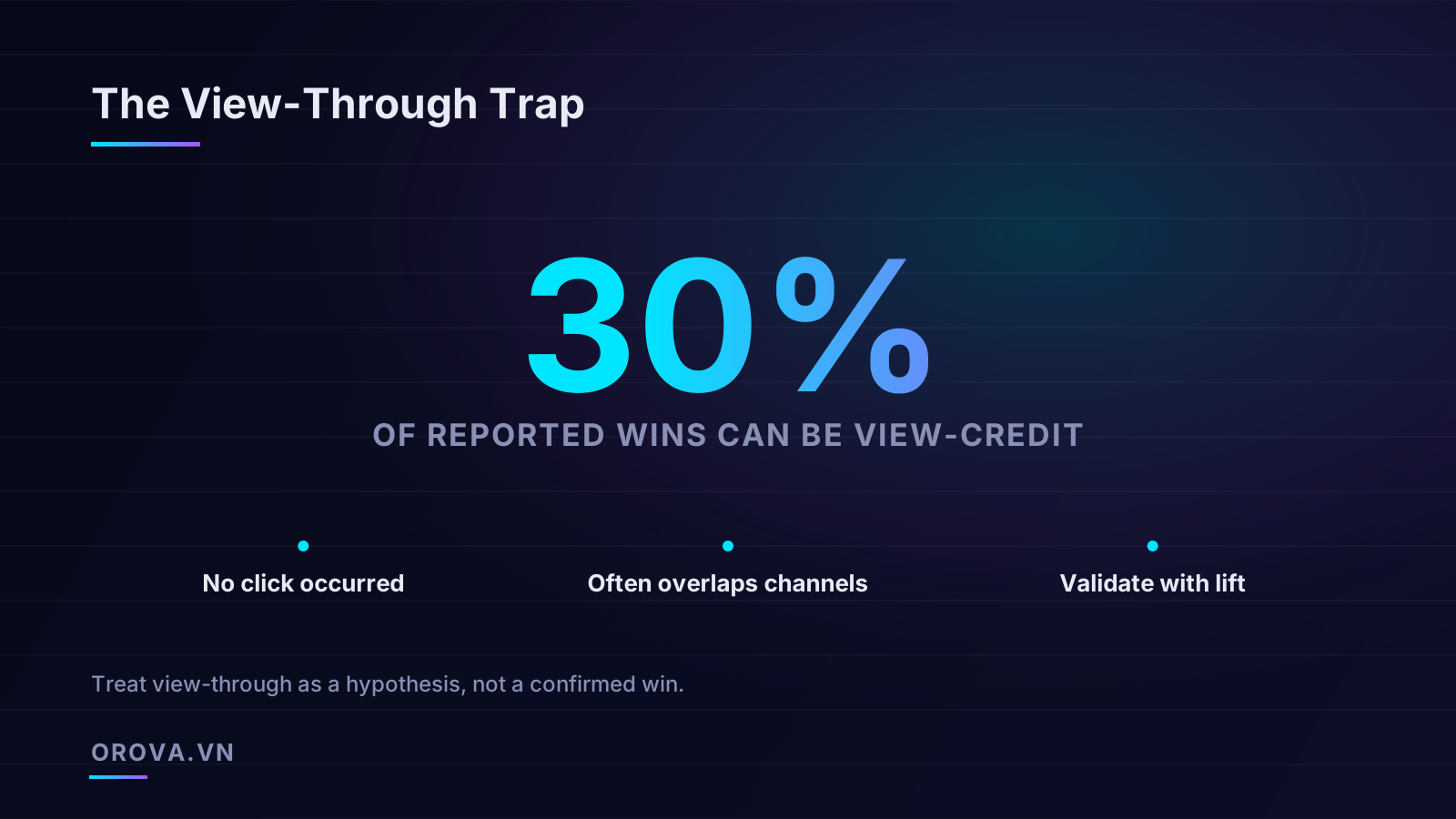
For bottom-funnel campaigns — branded search, retargeting carts, high-intent shopping — view-through credit is small and largely irrelevant because those users were already clicking. The danger zone is exactly the campaigns advertisers find hardest to measure: prospecting, awareness, broad-reach video, and Display. These campaigns produce few clicks by design, so view-through becomes the dominant source of their reported conversions. The metric that is least trustworthy ends up carrying the most weight precisely where you have the least independent evidence.
The double-counting problem nobody puts on a slide
Here is the structural flaw that turns view-through from a useful signal into a budgeting hazard. Each advertising platform measures conversions in its own walled garden, and each one counts conversions it believes it influenced — including view-through. There is no referee sitting above them reconciling the claims.
Imagine a single customer's journey to a 1,000,000 VND purchase over one week:
- Monday: sees a TikTok video ad, does not click.
- Wednesday: sees a Meta carousel in their feed, does not click.
- Thursday: gets served a Google Display banner, does not click.
- Saturday: searches your brand name on Google, clicks the organic result, and buys.
Now total the conversions across your three platform dashboards. TikTok claims one view-through conversion worth 1,000,000 VND. Meta claims one view-through conversion worth 1,000,000 VND. Google Display claims one view-through conversion worth 1,000,000 VND. Three platforms, three claims, three full-credit conversions — for one purchase that actually came through unpaid organic search. Your dashboards collectively report 3,000,000 VND of ad-driven revenue from a sale that generated 1,000,000 VND, and the channel that closed it (organic) gets nothing.
If you sum platform-reported conversions to evaluate performance — and most reporting decks do exactly that — your aggregate view-through revenue is inflated by the degree of audience overlap between your channels. The more your channels reach the same people (which is common, since you target similar audiences), the worse the double counting becomes. This is not a bug in any one platform. It is the inevitable result of letting every channel grade its own homework with no shared denominator.
Why platform-reported ROAS lies upward
The practical consequence is that the return-on-ad-spend you read off each platform is biased high, and biased high by an amount you cannot see from inside the platform. Google's reported ROAS includes view-through conversions Meta also claimed. Meta's includes ones TikTok also claimed. Each number is internally consistent and collectively impossible. When you then optimize budget toward the channel with the "best" ROAS, you may simply be rewarding the channel with the most aggressive view-through window and the largest audience overlap, not the channel doing the most real work.
This is also why clean, deduplicated conversion data matters before you trust any view-through figure at all. If your conversion tracking is firing twice, leaking, or mismatched across platforms, view-through attribution compounds the mess. It is worth getting the foundation right first; the relationship between clean conversion data as a prerequisite for trustworthy measurement and reliable view-through interpretation is direct. Garbage conversion events in, inflated view-through out.
How to tell real view-through value from borrowed credit
So how do you know whether a view-through conversion represents genuine incremental influence or a coincidence the platform happily claimed? You cannot know from the attribution report. Attribution describes correlation between an impression and a later conversion. It does not, and structurally cannot, prove that the impression caused the conversion. The only way to answer a causal question is with a causal test.
Step one: isolate the view-through conversions
Before you can validate anything, separate the metrics. Most platforms let you break conversions into click-through and view-through columns; if they do not surface it by default, configure your reporting to show both. The goal is to know, for every campaign, what share of its reported conversions came from clicks versus views. A retargeting campaign at 95 percent click-through behaves completely differently from a Display prospecting campaign at 85 percent view-through. They should never be judged by the same blended number.
This single step changes decisions. A campaign showing a 3x blended ROAS might be a 6x ROAS on clicks and near-zero on views, or it might be the reverse. You cannot manage what you have averaged into invisibility.
Step two: check the overlap
Estimate how much your channels are reaching the same people. If your TikTok, Meta, and Google audiences are heavily overlapping — same age brackets, same interests, same geos, same retargeting pools — assume your summed view-through conversions are substantially double counted. High overlap is a red flag that your aggregate numbers are fiction. Some platforms provide audience overlap tools; even a rough estimate beats assuming the channels are independent.
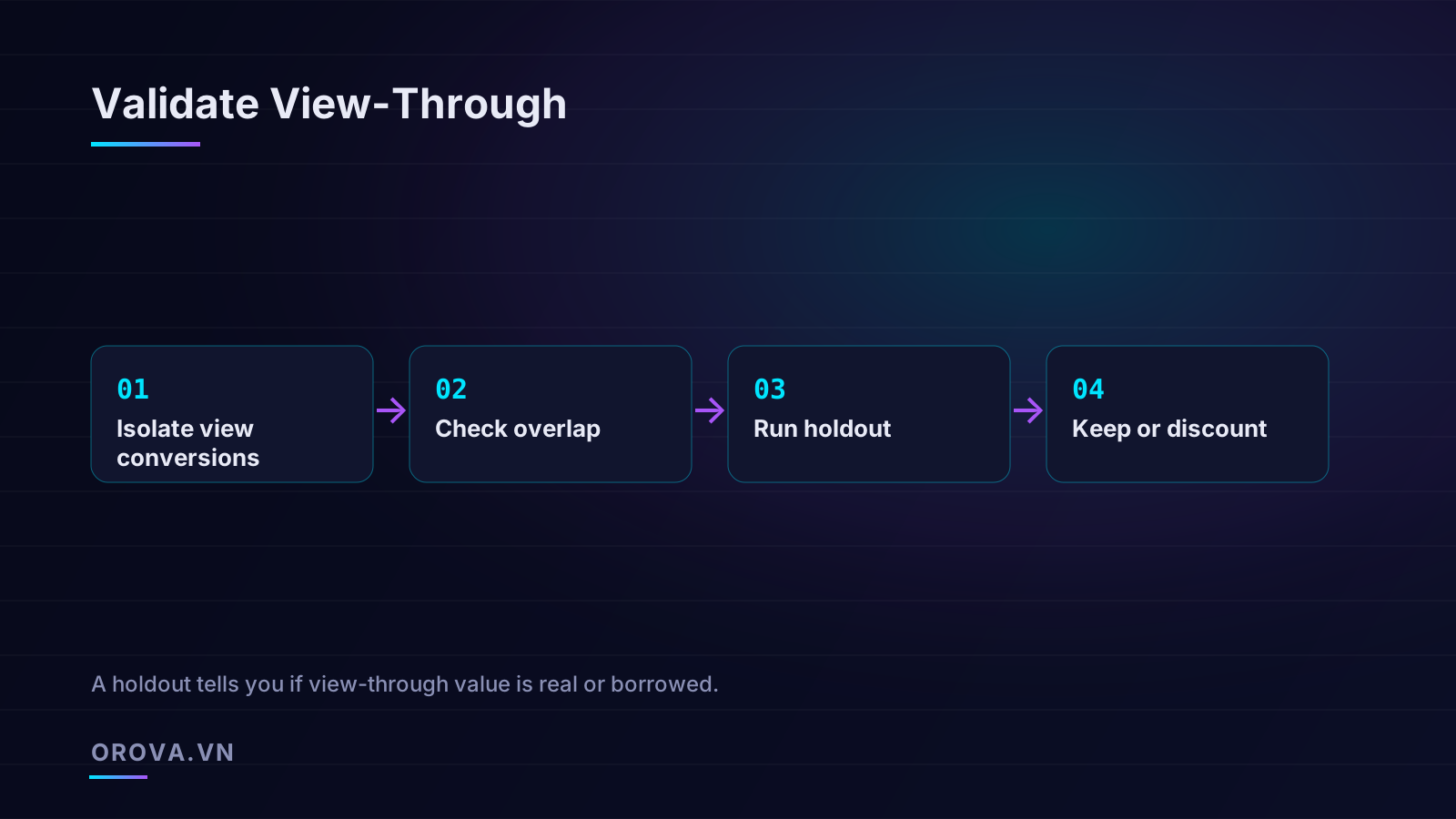
Step three: run a holdout
This is the step that actually settles the question, and it is the one most advertisers skip because it requires deliberately not advertising to some people. A holdout (or geo-lift, or ghost-bidding) test works like a clinical trial:
- Split your audience. Randomly hold out a control group that will not see the campaign in question — say 10 to 20 percent of your eligible audience or a set of matched geographic regions.
- Run the campaign to the treatment group only. The control group lives in a world where the campaign does not exist.
- Compare total conversions between the two groups. Not view-through conversions — total conversions from all sources, because you want the real-world delta.
- The difference is your incremental lift. If the treatment group converts 8 percent more than the control group, that 8 percent is what the campaign genuinely caused. Everything beyond it that the platform claimed was credit it borrowed from conversions that would have happened anyway.
The first time most advertisers run a holdout on a view-heavy campaign, the result is humbling. A campaign reporting hundreds of view-through conversions frequently shows incremental lift far below its claimed number — sometimes a fraction of it. Occasionally the lift is genuinely strong, which is the good news: it proves the upper-funnel media is doing real work, and now you can scale it with confidence instead of faith. Either way, you have replaced a guess with evidence.
Step four: keep or discount
Once you have a lift figure, apply it. If a campaign's holdout shows that only 40 percent of its view-through credit is incremental, do not throw the campaign away — discount its view-through conversions by 60 percent and re-evaluate. This gives you an honest effective ROAS you can compare across channels on equal footing. The campaigns that survive this discounting are the ones worth scaling. The ones that collapse to near-zero incremental value are the ones quietly draining budget while looking productive.
Attribution tells you who was nearby when the conversion happened. Incrementality tells you who actually caused it. Only one of those is a reason to spend more money.
Common mistakes that keep advertisers fooled
Even teams that understand view-through in theory fall into predictable traps in practice. A few worth naming:
Summing across platforms without dedup
The most common and most expensive error. Pulling each platform's conversion total into one spreadsheet and adding them produces a number that overstates reality by the overlap factor. If you must report a blended figure, anchor it to a single source of truth — your own backend, your CRM, your payment system — and reconcile platform claims against actual orders, not against each other.
Leaving default windows untouched
A 30-day view-through window is a choice, even if you never made it consciously. For most businesses, an impression from 30 days ago has negligible influence on today's purchase. Shortening view-through windows to something defensible — often 1 day for impressions — instantly strips out a large chunk of coincidental credit and makes your numbers more honest, even before you run a single test.
Judging prospecting by last-click and awareness by view-through
Many teams unintentionally apply the most flattering attribution model to each campaign. Bottom-funnel campaigns get judged on last-click (which favors them) and top-funnel campaigns get judged on view-through (which favors them). The result is that every campaign looks good and nothing can be cut. Pick one consistent framework, validate it with lift, and apply it uniformly.
Confusing reach with influence
Serving more impressions to people who were already going to convert will reliably increase your view-through conversion count without increasing a single real sale. This is the doom loop of view-through optimization: the metric rewards saturating your most-likely buyers with impressions, which inflates view-through credit while contributing nothing incremental. If your view-through numbers climb but your total revenue does not, you have found the loop.
A worked example: discounting view-through to an honest number
Abstractions are easy to nod along to and hard to act on, so here is a concrete walkthrough using round numbers. Suppose you run a Display prospecting campaign for one month at a spend of 50,000,000 VND. The platform reports 200 conversions and a 6x ROAS, which on paper makes it your best-performing channel. You are tempted to double the budget.
First, isolate the columns. Of those 200 conversions, 30 are click-through and 170 are view-through. So 85 percent of this campaign's reported success rests entirely on impressions nobody clicked. That alone should slow you down, but it does not yet tell you the view-through credit is wrong — only that it is unverified.
Second, check overlap. This campaign targets 25-to-44-year-olds in your top three cities — the same audience your Meta and TikTok campaigns also target heavily. Overlap is high, which means a meaningful share of those 170 view-through conversions are almost certainly being claimed simultaneously by your other platforms. Your summed dashboard ROAS across channels is therefore fiction.
Third, run the holdout. You hold back 15 percent of the eligible audience as a control group for four weeks and compare total backend orders between treatment and control. The treatment group converts 12 percent more than control. Applied to the campaign's reach, that 12 percent lift translates to roughly 70 genuinely incremental conversions — not the 200 reported, and not even the 170 view-through claimed.
Fourth, keep or discount. The campaign caused about 70 conversions, not 200. Its honest, incrementality-adjusted ROAS is closer to 2.1x than the headline 6x. That is the number you should compare against your other channels — and it is still positive, so you do not kill the campaign. But you certainly do not double its budget on the strength of a 6x figure that was two-thirds borrowed credit. The same logic, applied across every campaign, reorders your entire spend toward what actually drives sales.
When view-through is genuinely worth trusting
It would be a mistake to leave this article with the impression that view-through is always inflation to be stripped out. There are conditions under which view-through value is real, important, and dangerous to ignore. Recognizing them keeps you from over-correcting into a last-click world that starves your upper funnel.
When your holdout confirms it
The clearest case is the one above, run in reverse: a view-heavy campaign whose holdout shows strong incremental lift. If a Display or video campaign reports mostly view-through conversions and a holdout proves that pausing it measurably reduces total backend revenue, then the view-through credit is pointing at something real. The impressions are influencing purchases through paths the click data never sees. Scale it — you have earned the confidence.
When the buying cycle is long
For considered purchases — software, financial products, high-ticket goods — buyers genuinely research over days or weeks and rarely convert on first contact. In these categories, an impression that builds familiarity weeks before a click-driven conversion may have done real work that a 1-day window would erase entirely. Here a longer view-through window can be defensible, provided you have validated it with lift rather than assumed it.
When click tracking is degraded
As privacy changes erode click-based identifiers, some legitimate click-through conversions get reclassified or lost, and view-through modeling partially fills the gap. In a world of consent banners, blocked cookies, and aggregated reporting, dismissing all view-through as noise can mean dismissing the only signal you have about whole segments of your audience. The answer is still validation — but the bar for ignoring view-through entirely has gone up, not down.
Where automation actually helps
The analysis above is correct and also exhausting to do by hand, every week, across three platforms, for dozens of campaigns. Isolating view-through columns, estimating overlap, tracking holdout results, applying discount factors, and then re-ranking campaigns on incremental ROAS is the kind of disciplined, repetitive work that humans do well once and then quietly stop doing by week three. This is exactly where software earns its place.
A well-built optimization layer reads each platform's data daily and keeps the click-driven and view-credited results in separate buckets rather than blending them into one misleading average. It can flag campaigns whose conversions are dominated by view-through and therefore deserve a holdout before any budget increase. It can watch for the doom-loop signature — view-through rising while total backend revenue stays flat — and surface it instead of cheerfully reporting growth. And critically, it can apply your validated lift discounts automatically, so the ROAS you act on is the incremental one, not the inflated platform number.
None of that removes human judgment about whether a given lift result is large enough to justify scaling. The right division of labor is the machine doing the relentless daily separation, overlap checking, and discount math, while a person decides what the evidence means and whether to push budget. That is the model worth aiming for: not blind automation that scales whatever the platform praises, but a system that does the tedious measurement honestly and hands you a clean, deduplicated, incrementality-aware view of which campaigns are actually working.
The bottom line
View-through conversions are neither a vanity metric to be ignored nor a confirmed win to be celebrated. They are a hypothesis: the platform's claim that an unseen, unclicked impression influenced a later sale. That hypothesis is sometimes true and worth a great deal — genuine upper-funnel media value is real and click metrics miss it entirely. But it is also frequently false, inflated by long windows, multiplied by cross-platform double counting, and rewarded by optimization that confuses reach with influence.
The discipline that protects your budget is small and repeatable: isolate view-through from click conversions, assume overlap inflates your totals, validate the value with a holdout, and then either keep the credit or discount it to what the lift test proves. Do that, and view-through becomes a useful signal about your top of funnel. Skip it, and view-through becomes the most expensive flattery in your account.
If you would rather not run this separation and validation by hand every week, this is the kind of work Orova Ads is built to do — an AI agent that manages paid ads across Google, Meta, and TikTok, reads your data daily, keeps click-driven and view-credited results apart, recommends and executes optimizations on budget, bids, on/off states, and audiences, and does it all with human-in-the-loop approval and a full audit log so you stay in control of every change.
Let an AI Agent handle your SEO
Orova plans, writes, optimizes, and tracks rankings on its own — you just read the results.
Try it free