
Ad Testing Framework: How to Find Winning Creative Faster
If you run ads, you know the feeling: you launch a batch of creatives, a few of them do well, and then someone asks "why did those win?" — and you genuinely cannot answer. Was it the hook? The image? The offer? You do not know, so next quarter you are back to guessing again, burning budget on hunches instead of building on what already worked.
This happens because most teams test everything at once. New headline, new image, new audience, new landing page — all changed in the same test. When an ad wins, you cannot tell which change caused it, so the win teaches you nothing you can reuse. That is not a talent problem or a budget problem. It is a process problem: without a proper creative testing framework — a consistent, repeatable way to compare ads so the result actually means something — every test is just an expensive coin flip, and the cost of guessing is not trivial; according to the ANA Programmatic Transparency Study, roughly a quarter of programmatic ad spend is wasted on inefficient buying and invalid impressions.
This article shows you how to fix that without hiring anyone or spending more. By the end, you will know exactly what to change and what to hold constant in each test, in what order to test it, and how to turn one-off wins into a pipeline that keeps producing better ads over time. You will also see a full worked example, so you can copy the process directly into your own account.
Why most creative testing quietly fails
Before getting to the framework, it helps to name the specific ways testing goes wrong, because you will recognize at least two of them in your own account.
The everything-at-once test
This is the most common failure and the most expensive. A team launches "Variant A" and "Variant B," but the variants differ in headline, image, format, copy length, and CTA button. If B wins, you have learned that some unknown combination of five changes performed better. You cannot carry any of those choices into the next ad with confidence, because you do not know which one mattered. You have to re-discover everything next time. This is why some teams feel like they are testing constantly but their baseline performance never improves: they are not accumulating any reusable lessons.
The call-it-too-early test
You launch two ads, one gets 4 conversions and the other gets 1 after a day, and you declare a winner. With those numbers, the "winner" could easily flip if you ran it another three days. Early results are dominated by chance, by which ad happened to get shown to the cheap, high-intent users first, and by the platform's own exploration phase. Killing the loser here is gambling, not testing.
The never-call-it test
The opposite mistake. The team is so afraid of a false positive that they leave four mediocre variants running for a month "to be sure," bleeding budget into ads they already suspect are weak. Indecision is also a decision, and it has a real cost measured in wasted impressions.
The unfair-fight test
Two ads launch, but one gets 80% of the budget because the platform decided early it liked that one. Now the underfunded ad never gets enough volume to prove itself, and you conclude it was worse when really it was just starved. Budget allocation mechanics quietly corrupt a huge share of "tests."
Every one of these problems is solved by the same four-part discipline. Let's build it.
The four pillars of a clean creative test
A defensible creative test rests on four decisions you make before launch, not after. Skip any one of them and the result becomes hard to trust. The flow is simple enough to put on a sticky note: isolate one variable, allocate a fair test budget, run until you hit confidence, then promote or kill on a pre-written rule.
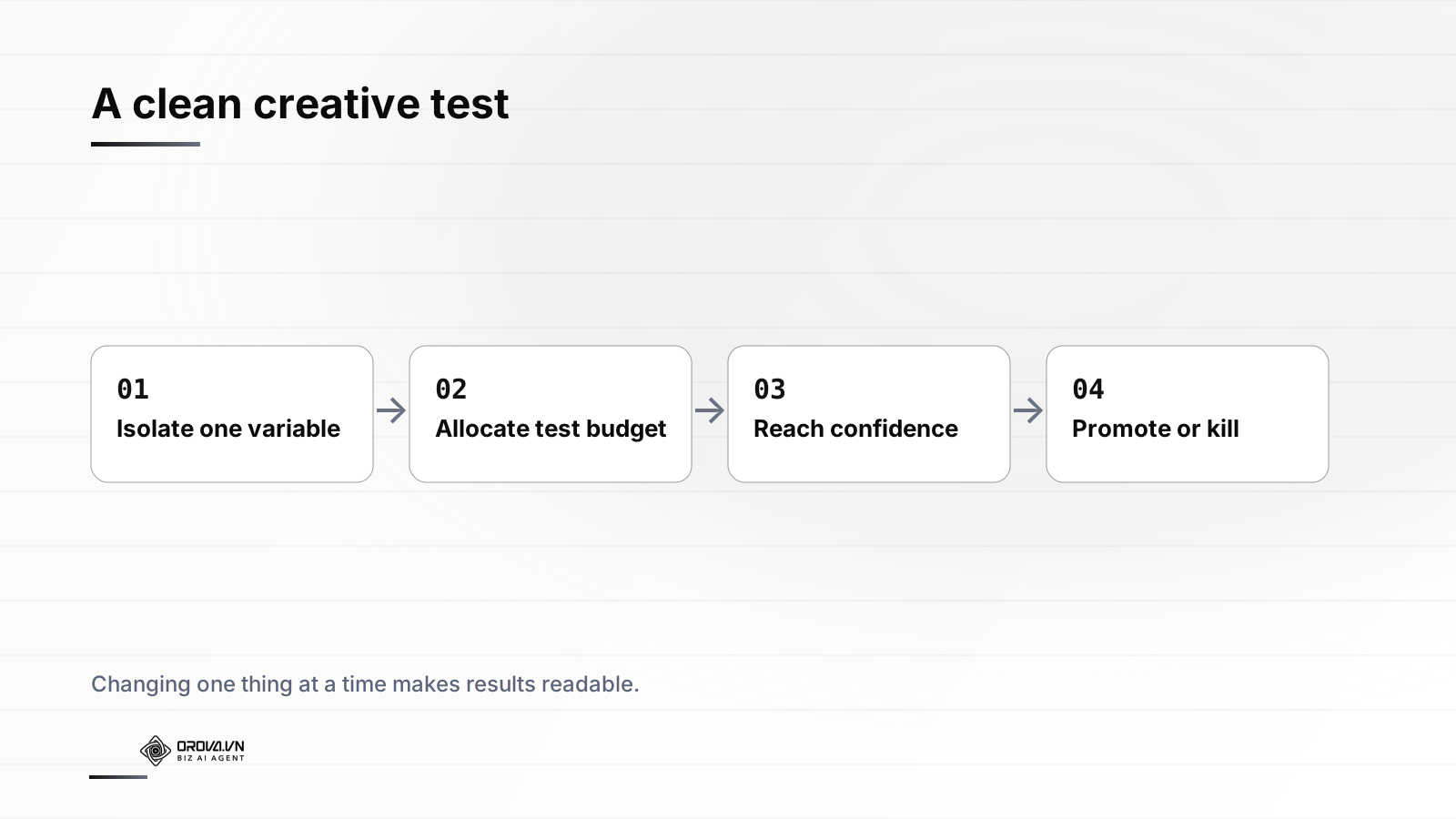
Pillar 1: Isolate one variable
The single most powerful rule in creative testing is to change exactly one thing between the control and the challenger. If you are testing a new hook, keep the visual, the format, the offer, the copy, and the CTA identical. The only difference is the first three seconds or the headline. Then, and only then, a result is interpretable: if the challenger wins, the hook caused it.
This feels slow. You will be tempted to "save time" by testing a hook change and a new image together. Resist it. The illusion of speed costs you the actual goal of testing, which is a transferable lesson. A clean win on a hook tells you something you can reuse across dozens of future ads. A muddy win on a bundle of changes tells you nothing reusable, so you pay the full discovery cost again next quarter.
There is a practical exception worth naming: when you are at the very start and have no baseline at all, it is fine to run a wide, exploratory batch of wildly different concepts to find a rough direction. That is concept discovery, not testing, and you should treat its results as hypotheses, not conclusions. Once you have a direction, you switch into disciplined single-variable mode to refine it.
Pillar 2: Allocate a fair, finite test budget
Two questions matter here: how much, and how is it split. On "how much," the honest answer is tied to your conversion economics. A useful rule of thumb is that a single creative needs enough budget to generate roughly 50 to 100 of your primary conversion event before you can read it with any seriousness. If your target cost per acquisition is $20, that is roughly $1,000 to $2,000 of spend per variant to get a clean read on a conversion-optimized test. If you are optimizing for a cheaper event like a landing-page click, the dollar figure drops sharply because each data point is cheaper.
On "how is it split," you have to actively prevent the platform from starving one variant. Two reliable approaches:
- Separate ad sets / ad groups with equal budgets. Put each variant in its own ad set with the same daily budget so the platform cannot rob Peter to pay Paul. This costs a little efficiency because you lose some of the algorithm's optimization, but it buys you a clean experiment.
- Use the platform's native experiment tool. Meta's A/B test feature and Google's experiments split the audience randomly rather than the budget, which is statistically cleaner than eyeballing two ads in one campaign. Use these whenever the decision is important enough to justify the setup.
Whatever you choose, write the test budget down as a hard cap before you launch. "We will spend up to $1,500 per variant or 14 days, whichever comes first." A finite budget converts an open-ended bleed into a contained experiment.
Pillar 3: Reach statistical confidence before you decide
This is where most marketers' eyes glaze over, so let me make it concrete and practical rather than academic. You do not need a statistics degree. You need to internalize three ideas.
First, sample size beats elapsed time. "We ran it for a week" is not a stopping condition. "Each variant got 80 conversions" is. Small numbers swing wildly; large numbers settle down. A 30% difference on 10 conversions per side is almost meaningless. The same 30% difference on 150 conversions per side is probably real.
Second, look for a meaningful gap, not a tiny one. If after enough volume your variants are within roughly 10% of each other on the metric you care about, treat that as a tie and pick the winner on a secondary reason (cheaper to produce, more on-brand, easier to iterate). Chasing a 3% "win" is usually chasing noise, and the cost of being wrong is low anyway.
Third, use a significance calculator and respect it. Free A/B significance calculators exist everywhere. Plug in impressions or spend and conversions for each variant; if the tool reports below about 90–95% confidence, you do not have a result yet — you have a lead. The discipline of actually typing the numbers into a calculator before declaring victory will save you from more bad calls than any other single habit.
The fastest way to slow down your creative program is to keep acting on results that were never real. False winners get promoted, scaled, and built upon, and then quietly underperform — so you waste the scaling budget too.
One caution specific to creative: even a genuine winner has a shelf life. A hook that crushes today will decay as your audience sees it repeatedly. That is the link between testing and the broader problem of ad fatigue and frequency burnout — your testing pipeline is not just a way to find winners, it is the engine that keeps replacing them before they wear out. A test result is a snapshot, not a permanent law.
Pillar 4: Promote or kill on a pre-written rule
The final pillar removes you, the emotional human, from the decision at the moment when you are least objective. Before launch, you write the exact condition for promotion and the exact condition for killing. For example:
- Promote if the challenger beats control on cost per acquisition by more than 15% at 90%+ confidence after at least 80 conversions per side.
- Kill if the challenger is more than 20% worse on CPA after 50 conversions, or if it has spent the full test budget without reaching the promotion bar.
- Extend once (one defined extension only) if the result is inconclusive but trending, then force a decision at the end of the extension.
The point of writing this down in advance is that "I have a feeling this one is about to turn around" is exactly the thought that keeps losing ads alive. A pre-committed kill rule is the difference between a budget and a bonfire. Decide the rules when you are calm, then obey them when you are tempted.
What to test, and in what order
Single-variable discipline raises an obvious question: with a hundred things you could change, which do you test first? Order matters enormously, because testing things in the wrong sequence wastes volume on low-impact tweaks while the high-impact levers sit untouched.
The general principle: test the elements with the biggest performance swing first, then move to finer details once the big rocks are settled. In paid social and search creative, the elements roughly sort by impact like this.
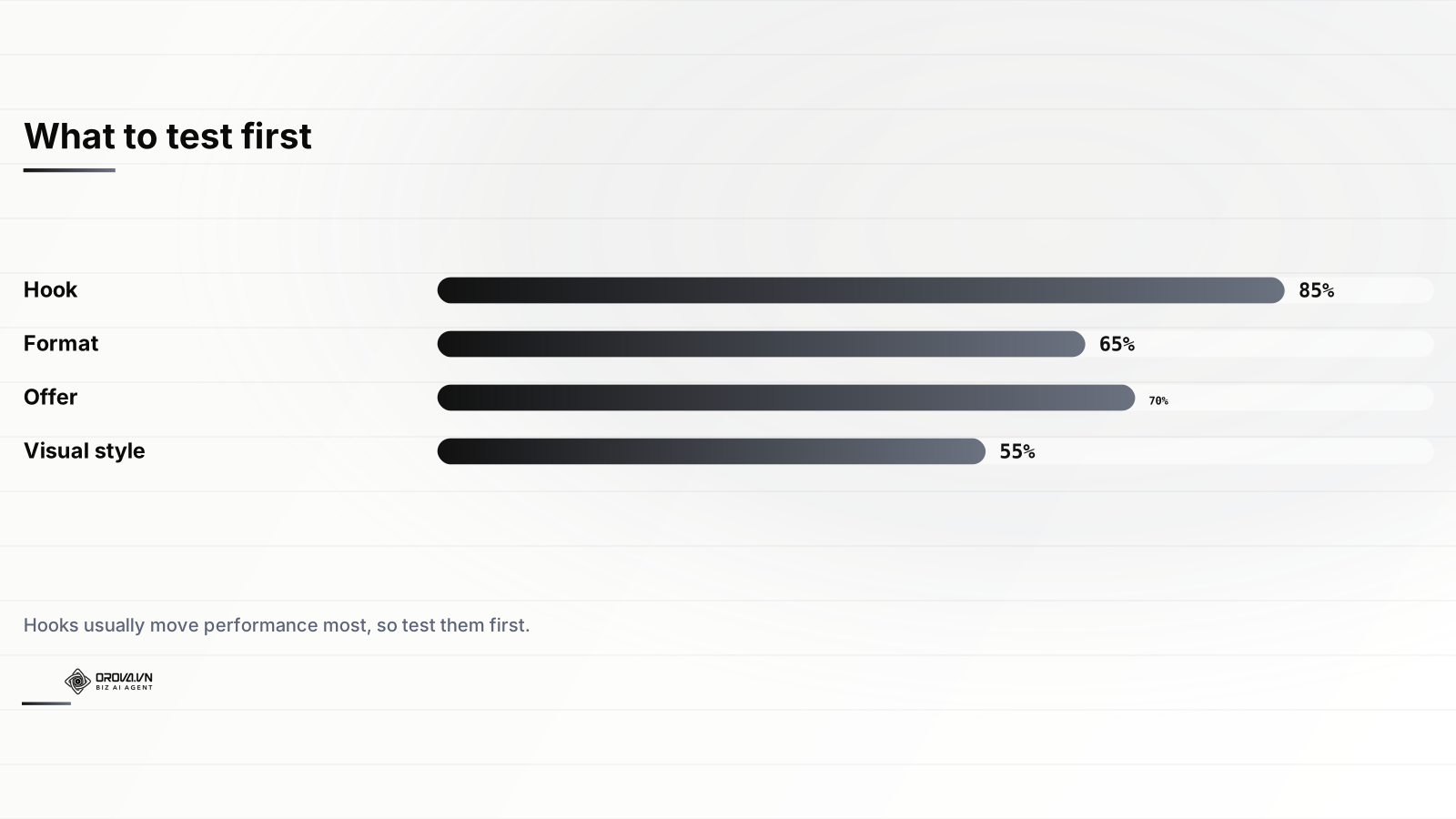
1. The hook (highest leverage)
The hook — the first frame of a video, the headline of a static, the opening line of copy — decides whether anyone consumes the rest of the ad at all. On platforms where the first 3 seconds determine the majority of drop-off, a better hook can lift performance more than any other single change. This is why it sits at the top of the queue. Test angles, not just words: a problem-first hook ("Still doing X by hand?") versus a curiosity hook versus a proof hook ("We cut CPA 40% — here's the ad that did it"). When you find a hook angle that works, it becomes a reusable template you can refill endlessly.
2. The offer
What you are promising often beats how you say it. "Free trial" versus "20% off first order" versus "free shipping" can swing conversion rate dramatically because it changes the actual deal, not just the presentation. Offer tests are sometimes constrained by what the business will allow, but when you have room to test them, they punch well above their weight. Just be careful to isolate: change the offer text and keep everything else fixed.
3. The format
Static image versus short-form video versus carousel versus UGC-style talking head. Format interacts heavily with placement and platform — what wins on TikTok often differs from what wins in a Facebook feed. Format is high-impact but more expensive to test because producing a video variant costs more than swapping a headline, so test it deliberately rather than constantly.
4. Visual style and finer details
Color treatment, font, background, the specific image, CTA button wording, copy length. These matter, but their swings are usually smaller, so they belong later in the queue once the bigger levers are locked. Spending your scarce test volume on button-color tests while your hook is mediocre is a classic misallocation.
A practical way to use this ordering: maintain a prioritized testing backlog, just like a product team maintains a feature backlog. Each item is a hypothesis ("a problem-first hook will beat our current curiosity hook"), tagged by which lever it touches and its expected impact. You pull from the top, run a clean single-variable test, record the result, and feed the learning back in. Over a quarter this turns into a genuine knowledge base about what your specific audience responds to — an asset competitors cannot copy.
From single tests to a creative-velocity pipeline
A single clean test is good. A system that produces clean tests continuously is what actually wins, because creative is the lever with the most remaining upside in mature ad accounts. Once targeting and bidding are largely automated by the platforms, the creative is the main thing you still control — and it decays, so you must keep refreshing it. This is the concept of creative velocity: the steady rate at which you ship, test, and retire ads.
The loop that compounds
Tie the four pillars together into a repeating loop:
- Generate a batch of variants from your backlog, each a single-variable change against a known control.
- Test each with a fair, finite budget and a pre-written kill rule.
- Decide at confidence: promote winners into the scaling pool, kill losers.
- Learn: record why the winner won (which lever, which angle) in a shared library.
- Refill the backlog with new hypotheses derived from what you just learned, plus fresh variants of winners that are starting to fatigue.
The magic is in step 4 and 5. When you record that "problem-first hooks beat curiosity hooks for our audience," your next batch of variants starts from a better baseline. Your win rate climbs over time instead of resetting every quarter. The brand from the opening story went from a 2% "find a real winner" rate to roughly 1 in 5 tests producing a promotable ad — not because their designers got more talented, but because each test fed the next.
Common pipeline mistakes to avoid
- Testing without a control. Every batch needs a current champion to beat. A test with no baseline can only tell you which new thing is best among new things, not whether any of them beats what you already run.
- Ignoring production cost in the math. A winner that costs $3,000 to produce and beats the control by 5% may not be worth promoting over a cheap variant that ties it. Factor production economics into "promote or kill."
- Letting the library rot. A learnings doc nobody reads is worthless. Make reviewing past results part of the briefing process for new creative, so lessons actually shape what gets made.
- Confusing fatigue with a bad creative. When a long-running winner starts to slip, the fix is often a fresh variant of the same angle, not abandoning the angle entirely. Distinguish "this idea is dead" from "this execution is tired."
A worked example, start to finish
Let's walk a single hypothesis through the whole framework so the abstraction becomes concrete. Suppose you sell a scheduling app, your current best ad uses a curiosity hook ("The calendar trick nobody told you about"), and your target CPA is $25.
Hypothesis: a problem-first hook ("Still double-booking yourself every week?") will lower CPA because it speaks to a felt pain.
Isolate: the new ad is identical to the control in every way — same video footage after the first frame, same offer, same CTA, same copy — except the opening line and first frame. One variable.
Budget: target CPA is $25 and you want about 70 conversions per side to read it, so you cap the test at roughly $1,750 per variant. You run each in its own ad set with equal $125/day budgets so neither starves, capped at 14 days.
Confidence: after 9 days, control sits at $26 CPA on 68 conversions; the challenger sits at $21 CPA on 74 conversions. You drop the numbers into a significance calculator and get 96% confidence. That clears your bar.
Decide: your pre-written rule was "promote if challenger beats control by 15%+ at 90%+ confidence with 60+ conversions per side." A move from $26 to $21 is a 19% improvement at 96% confidence — promote.
Learn and refill: you log "problem-first hook beat curiosity hook, –19% CPA, scheduling pain angle." Your next batch tests three more problem-first angles (the framework just told you the lever works) and a fresh visual variant of the new champion to extend its life before fatigue sets in. The win didn't just earn you one good ad; it pointed your entire next round in a higher-probability direction.
Notice how unremarkable each individual decision was. No genius required — just four disciplines applied in order. That is the entire point. Good creative testing is not about being clever in the moment; it is about removing the moments where you get to be clever and replacing them with rules you wrote when you were thinking straight.
Where this gets hard at scale
The framework is simple to describe and genuinely hard to run by hand across multiple platforms and dozens of live tests. The friction is real: someone has to check each test daily, do the significance math, remember the kill rules, catch when a "winner" starts fatiguing, and keep the learnings library current — across Google, Meta, and TikTok at once, each with different mechanics. This is exactly the kind of disciplined, repetitive, data-heavy work that humans do inconsistently when they are busy, which is to say always.
It is also precisely the work that automation is good at: read the numbers every day, flag the tests that have reached confidence, surface the ones that hit their kill threshold, and execute the budget and on/off changes once a human signs off. The judgment about what to test stays human; the bookkeeping and the timely execution do not have to.
If TikTok is part of the mix, TikTok Creative Hooks: The First Three Seconds That Decide Your CPA covers why the opening frames carry more weight there than anywhere else.
If you want that discipline enforced automatically across every channel, Orova Ads is an AI agent that manages your paid ads across Google, Meta, and TikTok — it reads your account data daily, spots the tests that have reached confidence and the ones bleeding budget, recommends the budget, bid, on/off, and audience moves, and executes them with your approval and a full audit log. You keep the creative judgment and the final say; it keeps the framework running every single day. See how Orova Ads turns your testing framework into a system that actually runs itself.
Stop guessing, start compounding
The framework itself is not complicated, but running it by hand is where teams fall apart. Someone has to plan each test, make sure only one thing changes, track results in a spreadsheet, remember what was already tried, and repeat that discipline every single week — and most people quietly give up after a few rounds because it is tedious, not because it does not work.
Orova Ads exists to take that manual grind off your plate, handling the structure and tracking of your creative tests automatically so your team can focus on the ideas instead of the bookkeeping. If the process in this article sounds right but you do not want to run it by hand, it is worth a look — see how Orova Ads can do this for you.
Related reading: Ad Creative Testing: A Repeatable Strategy That Works
Read next: Dynamic & Responsive Ad Creative: How AI Assembles Ads
Orova Ads optimises campaigns for you
Connect Google, Meta and TikTok in one place. AI reads the numbers, proposes changes and executes under the rules you set.
Explore Orova Ads