
"Best [Category] Tools" Lists — Should You Be On Them or Write Them?
!["Best [Category] Tools" Lists — Should You Be On Them or Write Them?](https://orova.vn/uploads/blog/4c80d17e53de41f1858bee72284a0fc9.svg)
There is a particular kind of search result that every SaaS founder has stared at with a mixture of envy and irritation: the listicle. "The 12 Best Project Management Tools for 2026." "Top 9 Email Marketing Platforms, Compared." "The 15 Best CRMs for Small Business." These pages sit at the top of high-intent commercial searches, they get clicked by buyers with budgets, and — here is the irritating part — your product is usually either missing from them or buried at number eleven.
So the question every SaaS marketer eventually asks: should we be fighting to get on these lists, or should we be writing them ourselves? The answer, as with most good questions, is "both, but for different reasons" — and the clearest way into it is through a set of aphorisms that practitioners keep rediscovering. This article is built around them.
"You don't rank for 'best [category] tools.' You appear on the pages that do."
Start with the hard truth. The query "best project management software" is one of the most commercially valuable searches in the category, and you are almost certainly not going to rank your own homepage or product page for it. Search engines treat that query as a request for a roundup — a list of options — not a request for one company's sales pitch. The results are dominated by listicles published by review sites, media outlets, and other vendors.
This reframes the goal. You are not trying to rank for the "best tools" query with your own page. You are trying to appear on the pages that already rank for it. The distinction matters because it changes the work. Ranking is an SEO project. Appearing is a different discipline — partly outreach, partly product quality, partly being the kind of company that gets noticed. The buyer searching "best [category] tools" will read a list. Your job is to be on it.
"Getting on a list is a product problem disguised as a marketing problem."
Marketers often treat list inclusion as an outreach task: find the listicles, email the authors, ask to be added. Outreach helps, and we will come to it. But the deeper truth is that getting onto the lists that matter is mostly downstream of the product being genuinely good and genuinely visible.
Independent reviewers and journalists build "best of" lists by surveying the category — looking at what people use, what gets discussed, what shows up in their research. A product that is well-built, well-reviewed by actual users, and present in the conversation tends to surface in that research. A product that is invisible — few reviews, little word of mouth, no presence — does not, no matter how many outreach emails go out. So the foundational work of getting on lists is unglamorous: build something genuinely good, collect honest user reviews on the platforms reviewers consult, and become part of the category conversation. The outreach email is the last five percent. The first ninety-five percent is being worth listing.
"The list you write ranks slower but it's yours forever."
Now the other side. Should you write your own "best [category] tools" listicle — one that, naturally, includes your own product?
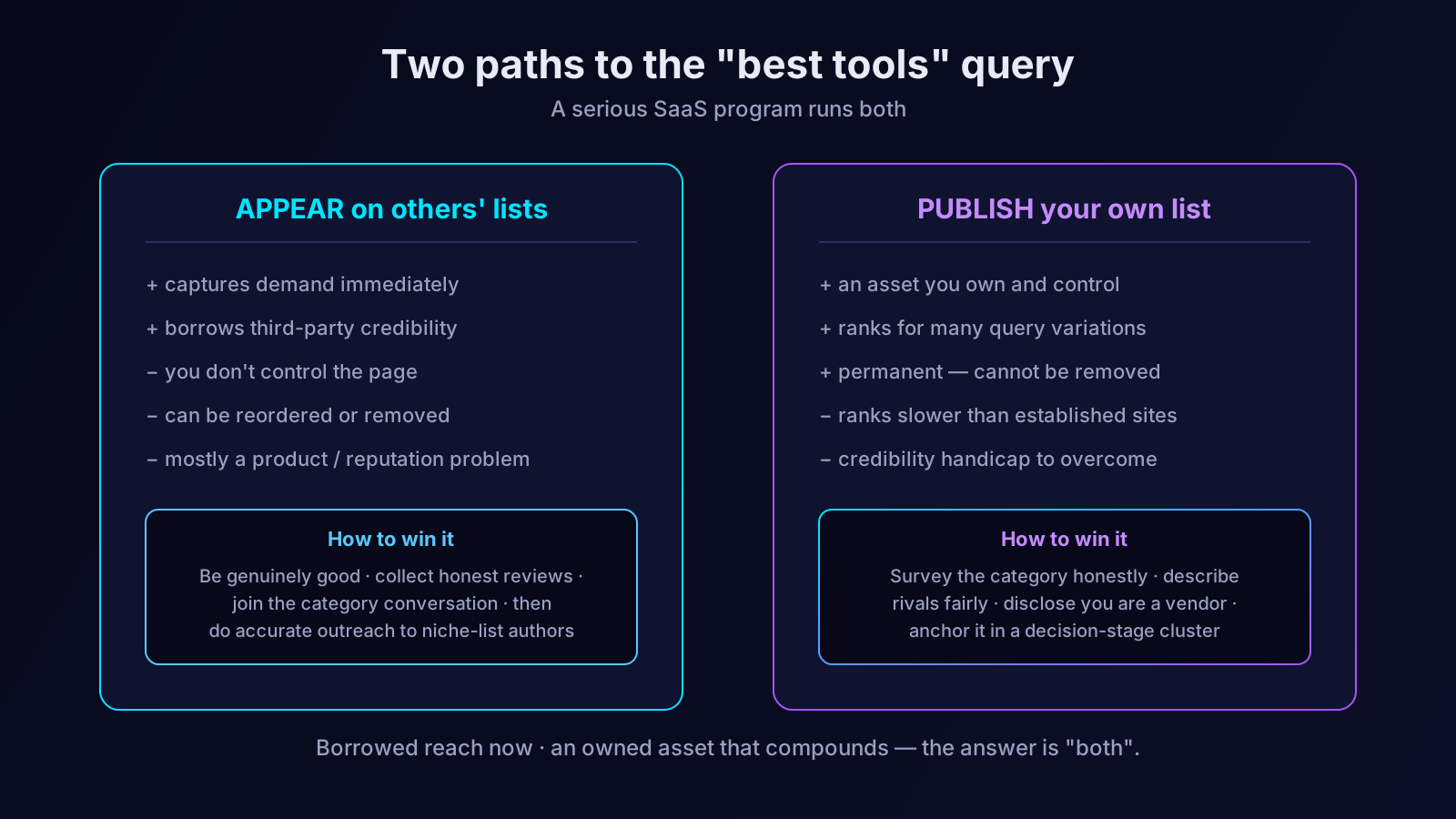
Yes, with eyes open. A vendor-published listicle has a credibility handicap: readers know the publisher sells one of the tools. But it also has a decisive advantage — it is an asset you own and control completely. You decide what it says, you keep it updated, you optimise it, and it can rank for the valuable "best [category]" query and its many variations. A spot on someone else's list can be removed, reordered, or buried at any time, at the author's whim. Your own list cannot.
It ranks slower, because a new vendor page has to earn its position against established review sites. But over time, a genuinely useful, genuinely fair vendor listicle can rank and hold — and unlike a borrowed spot on a third-party list, it is permanent and yours. The two strategies are not in competition. Appearing on others' lists captures demand now; owning your own list builds an asset that compounds.
"A 'best of' list that puts you first fools no one — and that's the point."
If you write your own listicle, the single decision that determines whether it works is honesty — and the honesty has to be visible.
A reader arriving at "The 12 Best CRMs," published by a CRM company, that ranks that very company at number one with glowing prose and damns every competitor with faint praise — that reader closes the tab. They came for a roundup and found an advertisement. The page may rank for a while, but it converts almost no one, because decision-stage readers have finely tuned bias detectors.
The vendor listicle that works does the opposite. It genuinely surveys the category. It describes competitors fairly, including their real strengths. It does not rank itself first by default — it ranks tools honestly against stated criteria and lets its own product land where it genuinely lands, while being upfront that the publisher is one of the listed vendors. Paradoxically, a vendor list that treats competitors fairly converts better for the vendor, because the reader trusts it — and a trusted recommendation, even from an interested party, persuades. "Fools no one" is the goal: the reader should finish the page knowing exactly who published it and trusting it anyway.
"Be the obvious answer for one niche, not option eleven for everyone."
A strategic aphorism for the company that keeps landing at number eleven on the big general lists. The general "best [category] tools" lists are crowded and dominated by the biggest names. Fighting for a middling spot on every one of them is exhausting and low-yield.
The better move is to narrow. Instead of trying to be option eleven on "best project management tools," aim to be the obvious, top-of-mind answer on "best project management tools for marketing agencies" or "best project management tools for remote teams." The niche lists are less crowded, the buyers are more qualified, and being number one or two on a relevant niche list converts far better than being number eleven on a general one. This applies whether you are seeking inclusion or writing your own — a niche-focused list you publish ranks faster and serves a sharper audience. (Our piece on why long-tail keywords convert better explains the same logic for search terms generally.)
"The list page is a destination; the cluster around it is the road."
A "best [category] tools" page, whether yours or one you appear on, does not work in isolation. It is a destination, and destinations need roads leading to them.
If you publish your own listicle, it should sit inside a content cluster: comparison pages for individual tool pairs, use-case pages, category explainers, all linking sensibly to and from the list. The list becomes the commercial hub of a decision-stage cluster, and the cluster's internal links and topical depth are part of what lets the list rank. A listicle published as a lone page, with nothing around it, is far weaker than the same listicle anchored in a cluster. Our guide to topic clusters shows how to build that supporting structure, and our piece on internal linking covers wiring the cluster together.
"You can't email your way onto a list you don't deserve to be on."
For the appear-on-others'-lists side, a closing aphorism about outreach. Outreach to listicle authors is a legitimate tactic — politely letting a reviewer know your product exists, offering accurate information, correcting outdated entries about you. But outreach has a ceiling, and the ceiling is desert.
An author updating a "best tools" list will add a product that genuinely belongs — one that is good, reviewed, relevant to the list's angle. No volume of emails persuades a serious reviewer to add a product that does not fit or is not good enough; doing so would damage their list's credibility, which is the only thing their list has. So outreach works as a nudge for products that deserve inclusion and fails for products that do not. The lesson loops back to the second aphorism: inclusion is mostly a product-and-reputation problem. Outreach surfaces a deserving product to a reviewer who had not noticed it. It cannot manufacture deservingness.
"A list without a method is just a ranking of opinions."
If you do publish your own "best [category] tools" page, one decision separates a credible list from a forgettable one: whether the list has a stated method.
A weak listicle simply presents tools in an order, with no explanation of why one ranks above another. The reader has no way to tell whether the ranking reflects genuine evaluation or the author's mood that afternoon. A strong listicle states its criteria up front — what was assessed, how, and why those criteria matter for this category — and then evaluates every tool against the same stated yardstick. The reader can see the reasoning, disagree with a weighting if they like, and still trust the page, because the method is visible.
A stated method also disciplines the author. Once you have committed, in writing, to evaluating every tool on the same criteria, it becomes much harder to quietly tilt the list toward your own product — the method holds you accountable to your own reader. This is doubly important for a vendor-published list, where the reader is already watching for bias. A transparent method is the strongest possible answer to that suspicion: not "trust us," but "here is exactly how we judged this, apply it yourself."
"The list is a snapshot; the category keeps moving."
A final aphorism, this one about maintenance — the part of listicle strategy almost everyone neglects.
A "best [category] tools" list is accurate on the day it is published and begins decaying immediately afterward. Tools change their pricing. New tools enter the category and deserve consideration. Listed tools add the features that were their weakness or lose the advantages that were their strength. Some tools are acquired, rebranded, or shut down entirely. A listicle published two years ago and never touched is now a document full of quiet inaccuracies — and readers, and search engines, can tell.
This is why a listicle should be treated as a maintained asset, not a finished article. The strongest "best tools" pages — the ones that hold their rankings for years — are the ones that are genuinely kept current: reviewed on a schedule, updated when the category shifts, dated honestly so readers know how fresh the assessment is. A listicle you publish and abandon will be overtaken by one that someone else keeps alive. If you are going to own the page, own the upkeep too. (Our piece on turning keywords into a content plan covers building review cycles into a content program.)
The combined strategy, stated plainly
Pull the aphorisms together and the strategy is clear. Do both, deliberately.
To appear on others' lists: make the product genuinely good, gather honest user reviews where reviewers look, become part of the category conversation, and then — and only then — do polite, accurate outreach to relevant list authors. Focus that effort on niche lists where you can be a top answer rather than general lists where you are buried.
To own your own list: publish a genuinely fair "best [category] tools" page — and niche variations of it — that surveys the category honestly, describes competitors accurately, discloses that you are one of the vendors, and earns trust by being useful rather than self-serving. Anchor it in a decision-stage content cluster so it has the topical support to rank and hold.
The first strategy captures demand on borrowed terms, starting now. The second builds a permanent, owned asset that compounds. A serious SaaS content program runs both, because they answer the same high-value question — what should I buy? — from two directions.
Where an SEO AI agent fits
Running both strategies well is a lot of moving parts: finding every "best [category]" listicle you could appear on, identifying the niche list angles worth owning, drafting your own honest listicle and its variations, and building the decision-stage cluster that supports them. That breadth of structured work is where an SEO AI agent earns its place. Orova can map the "best tools" queries and listicles across your category, surface the niche angles where you could realistically be a top answer, draft your owned listicle and its supporting comparison and use-case pages, and wire the cluster's internal links so the list page has the support to rank. The honesty — describing competitors fairly, disclosing your stake, ranking tools by genuine merit — stays a human decision. The agent removes the volume of mapping and drafting that keeps most SaaS companies stuck at number eleven on someone else's list. Be on the lists you deserve to be on, and write the honest one you can own. An SEO AI agent makes running both at once a realistic plan rather than a someday wish.
Let an AI Agent handle your SEO
Orova plans, writes, optimizes, and tracks rankings on its own — you just read the results.
Try it free