
Your Landing Page Is Where SEO Traffic Goes to Die
There is a ritual in content marketing that nobody questions. The team checks the rankings dashboard on Monday morning, sees a target keyword move from position eight to position three, and celebrates. Screenshots are posted in the company chat. Someone says "great work, team." And then everyone goes back to producing more content to rank for more keywords, because that is what the process says to do next. What almost nobody does is open the page that just started receiving all that traffic and ask the only question that pays the bills: what happens to the people who land here?
The honest answer, for most sites, is: nothing. They arrive, they skim, they leave. The average landing page converts somewhere between two and five percent of its visitors into any kind of measurable action, and the average blog post converts well under one percent. Which means that for every hundred people your hard-won ranking delivers, somewhere between ninety-five and ninety-nine walk away having done nothing you can use. The SEO industry has built an entire discipline, an entire economy of tools and audits and agencies, around the first half of the journey — getting the click — and has collectively shrugged at the second half, where the click either becomes a customer or becomes a rounding error.
This article is a critique of that shrug. Because the dirty secret of most "traffic problems" is that they are not traffic problems at all. They are arrival problems. The traffic showed up. The page killed it.
Most SEO traffic fails to convert not because the traffic is bad, but because the landing page mismatches the searcher's intent, offers no obvious next step, loads slowly, and shows no proof it deserves trust. Fixing the page that receives the click usually returns more revenue than winning the next ranking — at a fraction of the effort.
The autopsy: where the visitors actually go
Run this exercise on your own site before you read further, because the numbers will make the rest of this article personal. Open your analytics, take your five highest-traffic organic landing pages, and for each one write down three figures: sessions in the last ninety days, engagement rate, and conversions attributed to that page as the landing page — signups, demo requests, purchases, whatever your business counts. If you have set up GA4 properly for SEO work, this takes ten minutes.
Now do the arithmetic. A page with twelve thousand sessions a quarter and forty conversions is converting at 0.33 percent. That is not a content marketing success with room for improvement. That is a page where 11,960 people — people who actively searched for a topic you serve, clicked your result over nine competitors, and gave you their attention — left with nothing and gave you nothing. Multiply that by every ranking page on your site and you start to see the real size of the leak. Most companies are sitting on more recoverable revenue inside their existing traffic than inside any keyword they have not won yet.
The critique writes itself: we celebrate the twelve thousand and ignore the 0.33. Rankings are visible, shareable, and chartable. Conversion-per-landing-page is buried three reports deep and implicates more than one team. So the dashboard culture optimises what is easy to see, and the leak stays invisible. Let us name the specific ways the page does the killing.
Sin one: the page answers a different question than the one that was asked
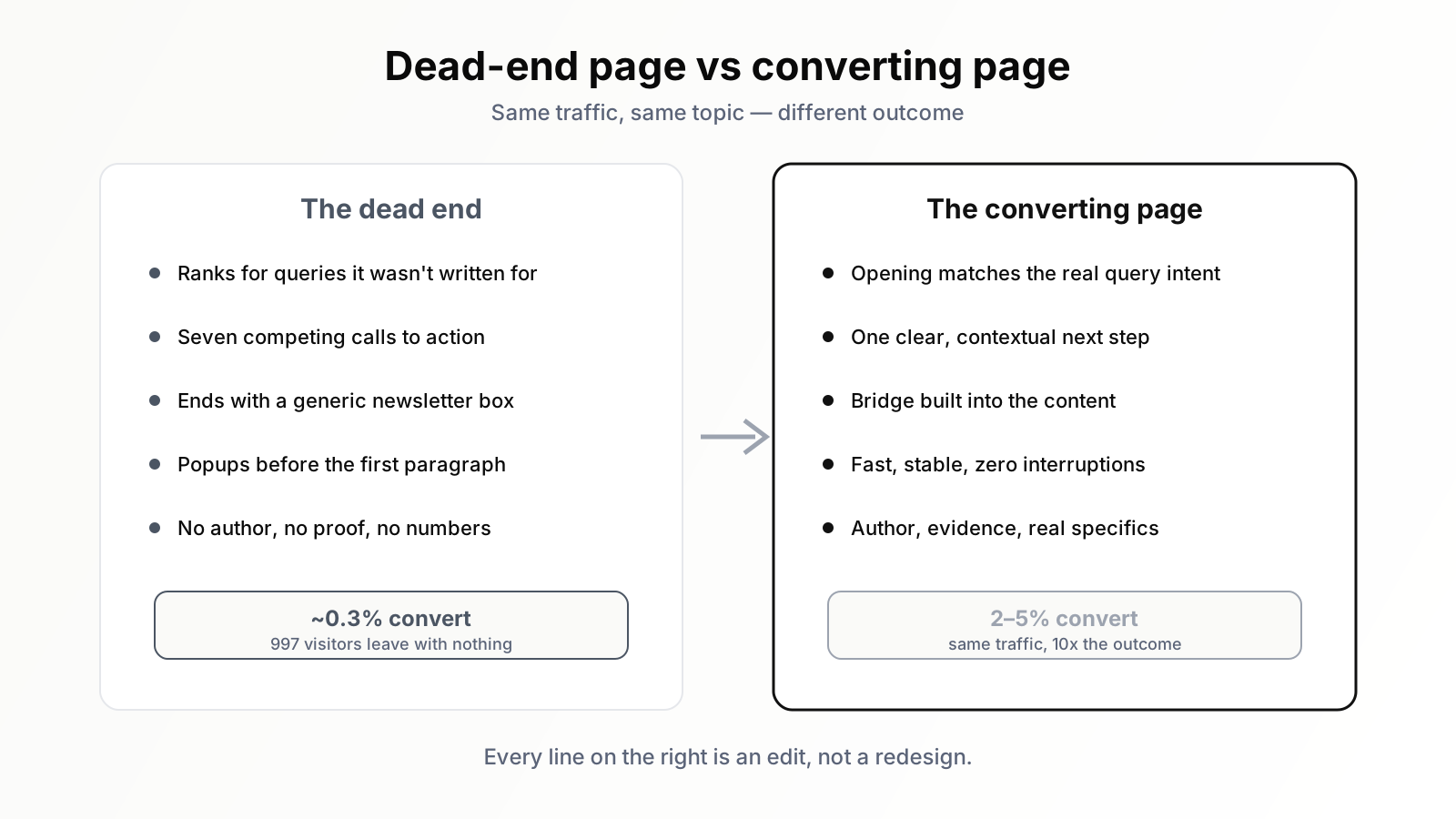
Intent mismatch is the most common cause of death and the least diagnosed. A page ranks for a query it was never really written for — this happens constantly, because Google matches pages to queries in ways you do not fully control — and the searcher arrives expecting one thing and finds another.
The classic version: someone searches a comparison query, something with "vs" or "best" or "alternatives" in it, and lands on your product page that simply describes your product. They wanted a comparison; you gave them a brochure. They go back to the results in four seconds. Or the reverse: someone searches a how-to query, lands on a thin category page stuffed with product links, finds no actual instructions, and bounces. In both cases the ranking is real, the traffic is real, and the page is structurally incapable of converting it, because it is the wrong page for the question.
The diagnosis is mechanical, not mystical. In Search Console, look at the actual queries each landing page receives — not the keyword you targeted, the queries it actually gets. Classify them by intent: is the searcher trying to learn, compare, or buy? Then look at the page and ask whether its content and its call to action match that intent. A page receiving "learn" queries should teach first and ask gently. A page receiving "compare" queries needs an honest comparison on it. A page receiving "buy" queries should get out of its own way and make the purchase path enormous. When the queries and the page disagree, no amount of button-colour testing will save you.
Sin two: the page answers the question, then shrugs
The second killer is subtler because the page looks good. The article is genuinely helpful. The visitor reads it, gets their answer, feels mildly grateful — and then reaches the bottom and finds nothing. Maybe a generic "subscribe to our newsletter" box. Maybe three "related posts" chosen by an algorithm that thinks related means "published the same month." The page did its informational job and then simply ended, like a salesperson who delivers a perfect pitch and walks out without leaving a card.
Every page on your site needs a defined next step — one specific action that a satisfied reader of this specific page would plausibly take next. Not five actions. Not a sidebar of options. One. For a tutorial, the next step might be a template or checklist that operationalises the tutorial. For a problem-definition article, it is the solution page. For a comparison, it is a trial. The next step has to be a continuation of the thought the visitor was already having, not an interruption of it. We have written before about how value can exist even without a click — but when you do earn the click, wasting it is unforgivable.
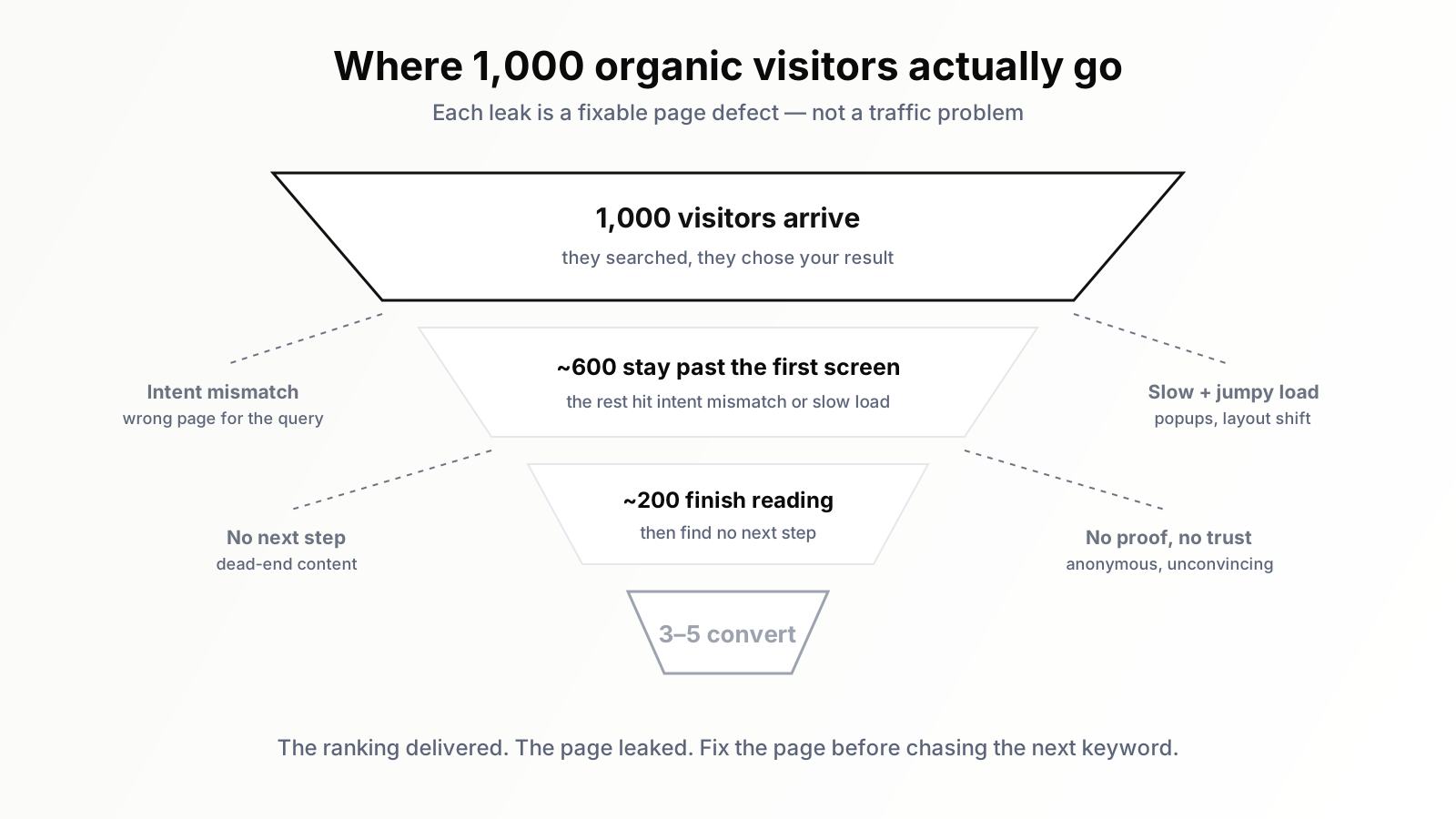
Dead-end pages are an organisational failure dressed up as a content failure. The writer was briefed to "cover the topic," not to move a reader. The brief never contained the sentence "the reader of this page should next do X." So nobody wrote toward X, and the page dutifully goes nowhere. Fixing it does not require rewriting the article; it requires deciding, for every page that earns traffic, what the page is for — and then building the bridge. Our own experiments with this, described in the test where one CTA tripled signups, found that the bridge matters more than almost anything else on the page.
Sin three: one page trying to serve every visitor at once
Open a typical SaaS landing page and count the calls to action. Book a demo. Start a free trial. Download the whitepaper. Subscribe to the newsletter. Talk to sales. Watch the video. Follow us on LinkedIn. The page is hedging — it does not know who is visiting, so it offers everything to everyone and commits to no one. The visitor, faced with seven doors, opens none of them. Choice paralysis is not a metaphor; pages with a single clear primary action consistently outperform pages with competing actions, and every additional option dilutes the rest.
The hedge happens because the page is trying to compress a funnel into a screen. Early-stage visitors need education and a low-commitment step. Late-stage visitors need pricing and a buy button. Cramming both audiences onto one page produces a page that is mediocre for both. The fix is segmentation by intent at the page level: let your informational pages do informational work with low-friction next steps, let your commercial pages sell hard, and stop asking one URL to be your entire customer journey. Your rankings already segment your audience for you — different queries land on different pages. Respect that segmentation instead of funnelling everyone toward the same homepage-shaped compromise.
Sin four: the page is slow, jumpy, and rude
Some pages kill traffic before a single word is read. The visitor taps the result on a phone, on a mediocre connection, and waits. Three seconds. Four. The hero image is still loading. Then the layout lurches as an ad slot inflates, and the paragraph they started reading jumps off-screen. Then the cookie banner arrives. Then the newsletter popup. Then the chat widget bounces into the corner with a fake notification sound. By the time the page is actually usable, the visitor has paid an attention tax that your content now has to refund before it can earn anything new.
None of this is news — Core Web Vitals have been a public ranking consideration for years, and Largest Contentful Paint under two and a half seconds is a well-known target. The critique is not that teams do not know; it is that speed work is permanently someone else's job. Marketing owns the popup, growth owns the chat widget, ads owns the ad slots, engineering owns the framework, and nobody owns the cumulative experience of a first-time visitor on a phone. Audit your top landing pages on a real mid-range phone over cellular, not on an office machine over fibre. Watch what your visitor actually endures. Then count the interstitials and ask which of them earns more than it costs. The answer for most is: none of them do.
Sin five: the page gives no reason to be believed
A first-time organic visitor does not know you. They did not click your brand; they clicked an answer to their question. The page therefore carries the entire burden of establishing that you are real, competent, and safe to transact with — and most pages carry none of it. No author with a face and credentials. No customer evidence. No numbers. No specifics about who is behind the product. Just confident copy floating in a void, which sophisticated visitors have learned to discount at roughly one hundred percent.
Trust is built with the same signals search engines themselves look for — the experience, expertise, authority and trust framework that Google explicitly rewards exists because it mirrors what human readers check. Show who wrote the page and why they are qualified. Show real customers, real outcomes, real numbers where you have them — and resist the temptation to invent any, because manufactured proof reads as exactly what it is. Put your pricing where people can find it. Make your company page say something a human would say. None of this is conversion-rate trickery; it is the minimum price of being believed by a stranger, and the page that does not pay it does not convert strangers.
The double standard that proves the point
Here is the tell that exposes how unseriously organic arrivals are treated: look at how the same company handles paid traffic. When the ads team launches a campaign, nobody would dream of pointing the ad at a random blog post. A dedicated landing page is built. The headline is matched to the ad copy, message match is checked, the form is argued over field by field, the page is A/B tested, and cost per conversion is reported weekly to people who can end careers. Every click costs money, so every click is treated like money.
Organic clicks get none of this ceremony — because they feel free. They are not free. Each one was paid for in content production, in editing, in link earning, in months of waiting for rankings to mature. The cost was simply paid upfront and in salaries rather than per-click and on an invoice, which makes it invisible to the part of the brain that guards budgets. If your organic landing pages received one tenth of the conversion scrutiny your paid landing pages receive, the leak described in this article would not survive a quarter. The fact that one kind of visitor gets a purpose-built page and the other gets "whatever ranked" is not a strategy. It is an accounting illusion.
The objections you will hear
Raise this internally and three objections arrive on schedule. First: "blog traffic isn't supposed to convert, it's brand awareness." Sometimes true — but awareness is a claim that should be tested, not a blanket amnesty for every underperforming URL, and a page can build awareness and offer a next step at the same time. Second: "we don't want to be pushy." Nobody is proposing popups; a single relevant, honest next step is a service to the reader, not an assault. Third: "we'll get to it after the next content sprint." That is the trap in one sentence — the next sprint produces more pages with the same defect, growing the leak you have not fixed. Volume is not a cure for a conversion problem. It is a multiplier on it.
Why nobody fixes this
If the leak is this large and this measurable, why does it persist on most sites? Because of how teams are shaped. SEO teams are paid for rankings and traffic; their dashboards end at the session. CRO, where it exists at all, is a separate function that runs button tests on the homepage and the checkout, and rarely touches the long tail of organic landing pages where most sessions actually arrive. The blog belongs to content, the templates belong to engineering, the popups belong to growth. The landing experience — the single most economically important moment in the whole pipeline — is an orphan.
The result is a pipeline where each team optimises its own segment to the detriment of the whole. Content produces more pages because pages are its output. SEO wins more rankings because rankings are its metric. Growth adds more capture widgets because captures are its KPI. And the visitor, who experiences all of it at once as a slow, pushy, dead-end page, leaves. Everyone hit their numbers. The company got nothing.
The structural fix is to give every significant landing page an owner and a conversion number. Not a vague "engagement" goal — a number: this page exists to produce trial signups, and it currently produces 0.4 per hundred sessions. Once a page has a number, the number can be bad, and once the number can be bad, someone will fix it. Pages without numbers are never bad; they are just "top of funnel," the phrase teams use to excuse pages from having a job.
The repair sequence: thirty days, no redesign
Here is the part where critique turns into a to-do list, because complaining without a fix is a blog-post-shaped dead end of its own. You do not need a site redesign. You need a month of disciplined triage.
Week one: find the bodies
Build the table described earlier — top twenty organic landing pages, sessions, engagement rate, landing-page conversions. Pull each page's real queries from Search Console and tag the dominant intent. Sort by sessions multiplied by conversion gap. The pages at the top of that sort are your repair queue. Resist the urge to fix the page you like least; fix the page where the math is biggest.
Week two: fix intent and the next step
For each page in the queue, answer two questions in writing. One: does this page match the intent of the queries it receives, and if not, what section or restructure would make it match? Two: what is the single next step a satisfied visitor of this page should take? Then make the smallest edit that implements both — usually a rewritten opening that meets the query head-on, plus one purpose-built, contextual call to action that replaces the generic one. The opening matters more than teams think: the first screen decides whether anything else gets read, a subject deep enough that we gave it its own five-second test.
Week three: remove friction and add proof
Run your queue pages through a real-device speed check and strip what fails the cost-benefit test — oversized heroes, autoplay anything, the second and third popup. If the next step involves a form, cut it to the fields you genuinely use; forms are such a reliable killer that they deserve their own indictment. Then add proof to every page that asks for anything: author, evidence, numbers, specifics.
Week four: instrument and baseline
Set up per-page conversion reporting so the work compounds. Landing page as dimension, conversions as metric, checked monthly with the same seriousness as rankings. The first month's numbers are your baseline; the goal is not a heroic one-time lift but a permanent habit of treating arrival as half the job.
The standard you should hold
A ranking is not an outcome. A session is not an outcome. They are expensive raw material, and a page that wastes them is not "top of funnel" — it is broken, in the specific, fixable ways listed above. The teams that internalise this stop asking "how do we get more traffic?" as a reflex and start asking the harder, better question: "are we worth the traffic we already get?" Usually the honest answer is "not yet," and usually the path from not-yet to yes is shorter than the path to the next ranking.
The mechanical parts of this — mapping queries to landing pages, classifying intent, spotting the pages where traffic and conversions diverge, and tracking whether your repairs moved the number — are exactly the kind of structured, repetitive analysis that does not need a human doing it by hand every month. An SEO agent like Orova can watch the query-to-page map continuously and flag the mismatches while you spend your judgment on the fixes only a human can make: what to promise, what to prove, and what to ask for. The traffic is already coming. Stop letting the page be the place it goes to die.
Run your business with AI Agents
Orova is the always-on Biz AI Agent — it plans, runs, and optimizes the work for you. Save time, unlock productivity.
Try it free