
Why AI Search Changes How Search Engine Rank Monitoring Works
If your search engine rank monitoring routine still means checking a handful of keyword positions once a week and calling it done, you have probably noticed something unsettling lately: the numbers can look fine while your actual traffic quietly drops. That is because a growing share of searches never produce a "position one, two, three" at all — an AI Overview or a chatbot answer sits on top, pulling from a small set of sources, and your page is either in that set or it does not exist for that query. According to sparktoro, AI Overviews now appear on more than 20% of Google searches, which means a meaningful chunk of the queries you track are already playing by a different set of rules than the ones your dashboard assumes.
The old way of tracking rank was built for a world where every search returned ten blue links and a real person scrolled through them. That world assumed the game was to climb a ladder. But when an answer engine picks a handful of sources and writes its own summary, climbing the ladder does not matter if the machine never considers you trustworthy enough to quote in the first place — and no rank tracker tells you why you were left out.
This article walks you through why that selection process happens, what signals make a machine trust one source over another, and what you can actually check and fix on your own site — no coding, no guesswork — so your monitoring routine catches problems the old dashboards miss.
What E-E-A-T actually is — and what it is not
Start with the boring but essential precision, because half the bad advice in this space comes from skipping it. E-E-A-T comes from Google's Search Quality Rater Guidelines — the document Google gives to the thousands of human raters who evaluate search result quality. The framework began as E-A-T; the second E, Experience, was added in December 2022, when Google decided that first-hand experience deserved its own letter. The guidelines instruct raters to assess whether content demonstrates experience, expertise, authoritativeness, and trustworthiness, with trust described as the most important member of the family — the one the other three exist to support.
Here is what E-E-A-T is not: it is not a ranking factor in the literal sense. There is no E-E-A-T score in Google's index, no field you can optimize directly. Rater evaluations do not change the ranking of the specific pages they rate. What raters do is benchmark — their judgments tell Google's engineers whether algorithm changes are surfacing the kind of content the guidelines describe as good. The algorithm is then built and tuned from hundreds of real signals that, in aggregate, approximate the judgment a thoughtful rater would make. We covered this distinction at length in our earlier piece on what Google actually rewards with E-E-A-T, and it remains the single most misunderstood point in the topic.
So when SEOs say "improve your E-E-A-T," what they should mean is: improve the observable, machine-readable evidence that your content was made by someone with real experience and expertise, published by an entity with real authority, on a site that behaves in trustworthy ways. The evidence is the thing. A credential that exists only in your head does not exist for the algorithm.
That was already true in classic search. What the AI era changes is the stakes, the mechanism, and the audience for that evidence — and each of those changes deserves its own examination.
The shift from ranking to selection
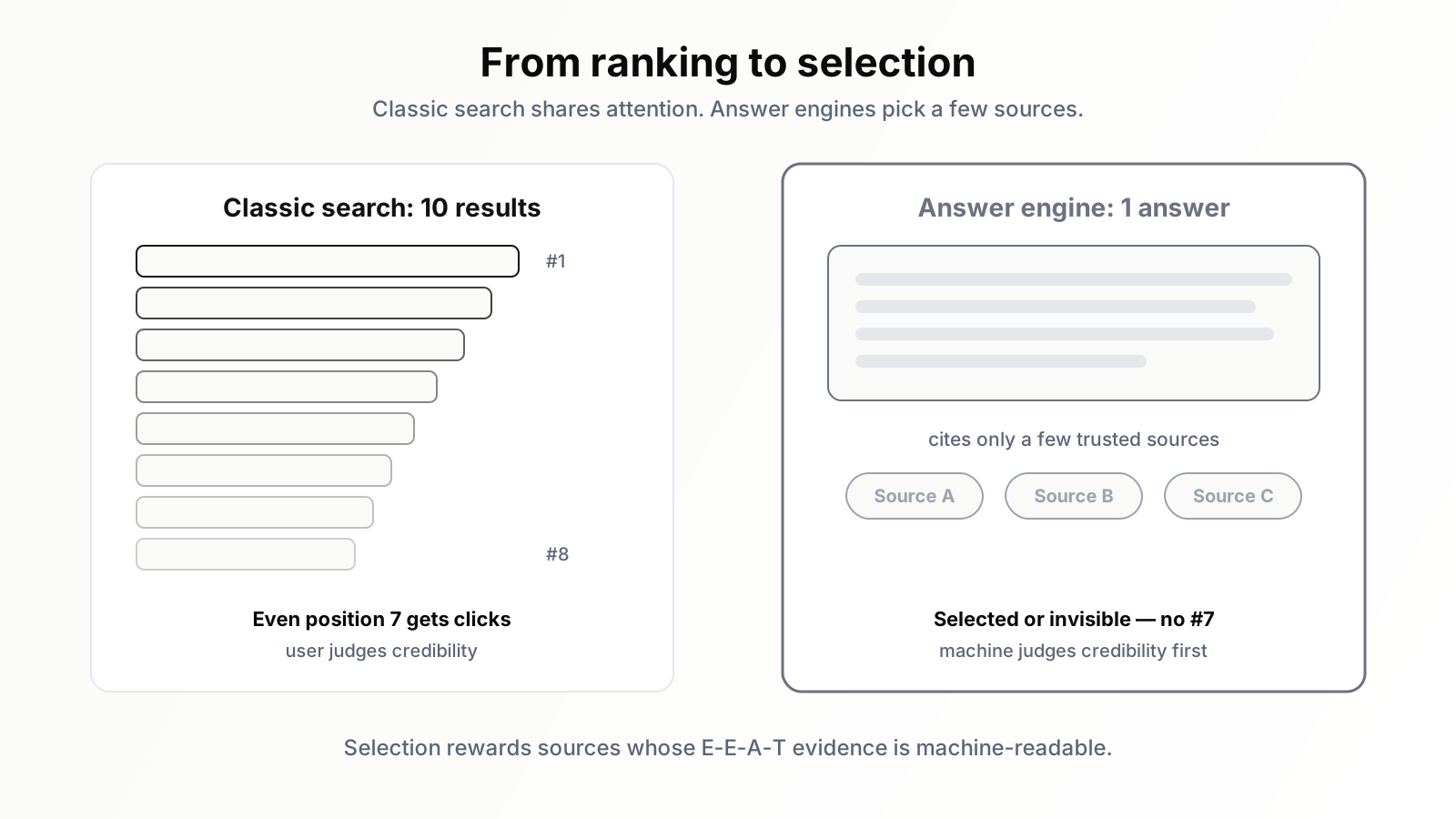
Classic search was a ranking problem. Google ordered ten or so results by estimated relevance and quality, the user scanned the list, and credibility was partly the user's job: you looked at the domain, recognised a brand or didn't, clicked, judged, maybe bounced and clicked the next one. A mediocre source in position seven still got some clicks, because ranking distributes attention across the whole list, however unevenly.
Answer engines are a selection problem, and selection is brutally binary. When Google assembles an AI Overview, its systems retrieve a set of candidate documents, ground a generated answer in some of them, and cite a small handful. When Perplexity answers a question, it lists its sources inline — typically a few, not dozens. When ChatGPT Search composes a response, it links the pages it leaned on. In every case, a compression happens: an enormous candidate pool collapses into a single synthesized answer supported by a short list of citations. You are either in that list or you are nowhere. There is no position seven.
This compression changes the economics of credibility. A system that shows ten links shares responsibility with the user; a system that states an answer in its own voice owns the answer. If an AI Overview confidently repeats a wrong claim about a medical dosage or a tax rule, the failure is Google's in a way that a bad position-six result never was. The engineering response to that exposure is predictable and observable: weight the selection process toward sources that are easy to verify, consistent with consensus, and attributable to identifiable, credible authors and organisations. Every incentive in the answer-engine business model pushes toward conservative sourcing — toward content whose trustworthiness can be established by a machine, at retrieval time, without a human in the loop.
That last phrase is the heart of this article. In classic search, your credibility could be partly implicit, because a human would eventually look at your page and form an impression. In AI search, credibility has to be legible to software. The question "who wrote this" is now being asked by a retrieval pipeline, and the pipeline can only work with what you have made explicit.
How machines actually evaluate "who wrote this"
It is worth being honest about what we know and what we infer. No answer engine publishes its source-selection criteria, and anyone who tells you they have the exact recipe is selling something. But the observable behaviour of these systems, Google's public statements, and the mechanics of retrieval-augmented generation let us reason carefully about the layers involved.
The first layer is the classic one: retrieval. AI Overviews are built on top of Google's ordinary search infrastructure — Google has said plainly that its AI features draw on core ranking systems. That means everything that made pages rank in classic search still gates entry to the candidate pool. Helpful-content signals, link-based authority, and the quality systems tuned against rater judgments all still apply. If your site was invisible in classic search, no amount of AI-specific optimisation rescues you; this is why the fundamentals in our complete guide to ranking in AI Overviews start with ordinary ranking hygiene.
The second layer is attribution analysis. Modern systems can extract and reconcile structured and unstructured claims about authorship: the byline on the page, the author property in your Article schema, the Person entity that byline links to, the author page describing that person, and the external profiles that corroborate them. When these align — the byline names a person, the schema confirms it, the author page exists and is substantive, the LinkedIn profile or conference bio matches — a machine can resolve the content to a real, consistent identity. When they conflict or are absent, the content is, from the machine's perspective, anonymous. Anonymous is not disqualifying for every query, but for any topic where being wrong has consequences, anonymous is a competitive disadvantage against every rival who is not.
The third layer is corroboration across the corpus. Language models and knowledge graphs both encode, in different ways, how often and in what contexts an entity is mentioned across the web. An author who is cited by industry publications, quoted in articles on other domains, listed as a speaker, or referenced in discussions accumulates a footprint that exists independently of their own site. This is the entity dimension of E-E-A-T, and it is large enough that we have given it its own article — Entity SEO: teaching machines who you are — but the summary is: machines triangulate. A claim of expertise made only on your own domain is one data point; the same claim echoed by unrelated sources is a pattern.
The fourth layer is content-level evidence. Systems that evaluate text at the scale of modern language models are demonstrably sensitive to specificity. Content that includes concrete details — numbers with units, named tools and versions, described procedures, observed outcomes, edge cases — reads differently from content that paraphrases the consensus at a comfortable altitude. This matters for the Experience letter especially: "we ran this migration and the crawl rate dropped 40% for nine days before recovering" carries information that "migrations can temporarily affect crawling" does not. The first sentence could only be written by someone who did the thing. Machines cannot verify your experience directly, but they can detect its textual fingerprints, and the systems that select sources for synthesized answers have every incentive to prefer text that carries them.
The four letters, re-read for the AI era
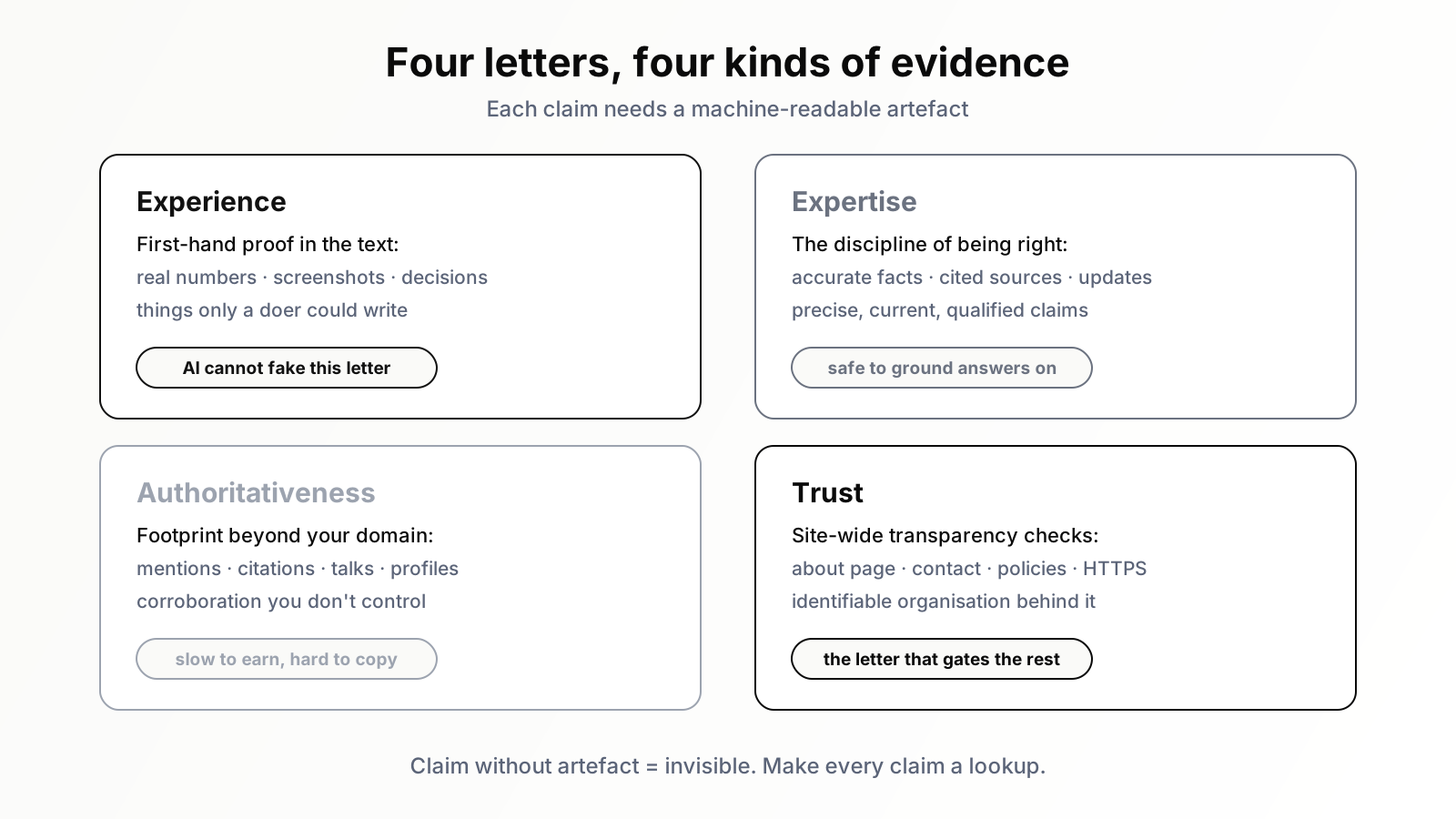
With that machinery in mind, walk through the four letters again — not as abstract virtues but as categories of evidence, each with an AI-era twist.
Experience: the only letter AI cannot fake
Experience was added to the framework precisely as generated and aggregated content began flooding the web, and in the AI era it has become the most strategically important letter. Here is the asymmetry: a language model can produce competent, accurate, well-structured explanations of almost any established topic. What it cannot produce is a new first-hand observation. It cannot run your experiment, migrate your site, interview your customers, or break something in production and document the recovery. First-hand experience is the one input to the content supply that AI does not commoditise — which means it is the one input whose relative value is rising.
Practically: audit your content for sentences that could only have been written by someone who did the work. Screenshots of real dashboards, before-and-after data from your own projects, decisions you made and why, mistakes and their costs. If an article contains none of these, it is competing on synthesis alone — and synthesis is exactly what answer engines now produce themselves, for free, from sources that do offer something more.
Expertise: depth, accuracy, and the cost of being wrong
Expertise in the AI era is less about credentials per se and more about the consistency of being right. Answer engines ground their output against multiple sources; a site whose claims repeatedly conflict with corroborated consensus — wrong definitions, outdated facts, sloppy numbers — is a grounding liability. Conversely, content that is precise, current, carefully qualified, and consistent with verifiable sources is safe to build an answer on. The practical disciplines are unglamorous: fact-check numbers, date your claims, update articles when the facts change, cite primary sources, and say "we don't know" where the evidence is genuinely unsettled. Precision is an expertise signal that machines can actually measure.
Authoritativeness: the footprint beyond your domain
Authority has always been partly external — links were the original off-site vote. The AI-era version is broader: mentions, citations, and co-occurrences, with or without links, feed both knowledge graphs and the training corpora of language models. If your brand or your authors are referenced in industry publications, podcasts, conference programmes, and community discussions, that pattern is absorbed by every system that learns from the web. This is also why getting cited by answer engines compounds: our guide on how to get cited by ChatGPT, Gemini, and Perplexity goes deep on the mechanics, but the strategic point is that each citation is both traffic and a new piece of authority evidence in the corpus.
Trust: the letter that gates the other three
Trust, in the rater guidelines, is the centre of the framework — and it is the most site-wide of the four. It covers accuracy, transparency about who runs the site, clear contact information, honest advertising, secure connections, and the absence of deceptive patterns. For machines, trust signals are largely binary checks: is there an about page, an identifiable organisation, a privacy policy, a way to reach a human, HTTPS, consistent business information? Each one is trivial individually and collectively decisive, because each missing item makes the entity behind the site a little harder to resolve and a little easier to skip in favour of a competitor whose paperwork is in order.
Making E-E-A-T machine-readable: the concrete checklist
Everything above reduces to a working principle: for every claim of credibility your content makes implicitly, create the explicit artefact that lets a machine verify it. Here is the implementation list, in rough priority order for a typical content site.
Put a real person's name on every substantive article. A byline is the root node of the entire authorship graph. "Team" or "Admin" bylines terminate the graph before it starts. If your content is genuinely collaborative, name a lead author and credit contributors — but name someone.
Build genuine author pages and link every byline to them. The author page is where the byline's claim gets its evidence: a specific biography, areas of expertise, relevant history, links to external profiles, and a list of the author's articles. This page is so consistently neglected and so disproportionately valuable that we wrote a separate piece arguing the author page is the most underrated page on your site — the short version is that it is the landing page for every "who is this person" lookup a machine or human ever performs.
Mark up authorship with schema. Use Article (or BlogPosting) schema with the author property pointing to a Person, and give that Person a stable identity: name, url pointing to the author page, sameAs pointing to external profiles, and knowsAbout for topical areas. Add Organization schema for the publisher with logo, sameAs, and contact information. Schema does not create credibility, but it makes the credibility you have unambiguous — it converts an inference into a lookup.
Show your evidence in the content itself. Cite primary sources with outbound links. Include original data, screenshots, and worked examples. Label what is opinion. Add "last updated" dates that are honest — and actually update the content behind them. Reviewed-by credits from qualified people, where the topic warrants it, belong here too.
Establish the publisher entity. A substantive about page that says who you are, what you do, who works there, and why you are qualified to publish on your topics; a contact page with real channels; editorial standards if you have them. These pages are read by raters, cited in Google's own self-assessment questions, and crawled by every AI system building a picture of your organisation.
Cultivate the external footprint deliberately. Guest contributions, podcast appearances, conference talks, expert commentary for journalists, profiles on the platforms relevant to your industry — each one is a corroborating node. This is slow, which is exactly why it defends: a competitor can copy your article in an afternoon, but they cannot copy three years of your author being visibly, verifiably present in the field.
If you can only do three things this month
Lists like the one above have a way of becoming someday-projects, so here is the forced prioritisation. First, fix bylines and author pages for your ten most-trafficked articles — not the whole site, just ten. That single move repairs the authorship graph exactly where machines are most likely to look. Second, add Person and Organization schema sitewide through your template, so the fix propagates automatically to everything published afterwards. Third, take your single best-performing article and rewrite its weakest sections to include first-hand evidence: real numbers, a real screenshot, a real decision you made. Then measure. Sites that do only these three things consistently report that the change shows up first not in rankings but in how AI engines describe them — ask ChatGPT or Perplexity about your brand before and after a quarter of this work, and the difference in specificity and accuracy of the answer is usually visible before any traffic chart moves.
A note on what not to do
The rising value of authorship signals has, predictably, produced a counterfeit market: invented authors with AI-generated headshots, purchased bylines, fake credentials, schema describing people who do not exist. Beyond the ethics, this is strategically foolish in a specific way — fabricated identities have no external corroboration, and corroboration is precisely the layer machines use to weight identity claims. A fake author is a claim with no evidence, detectable by the same triangulation that rewards real ones. Worse, a site caught fabricating its trust signals has converted its most important asset — the presumption of honesty — into a liability across every page. The entire logic of E-E-A-T in the AI era is that verification is getting cheaper for machines; building on fabrication is building on the one ground guaranteed to erode.
Who wrote this, answered
The deepest change the AI era brings to search is not a new algorithm or a new results page — it is a transfer of judgment. Users used to judge sources themselves, one click at a time; increasingly, machines judge sources on their behalf, before the answer is even shown. That transfer makes the question "who wrote this" the central economic question of content: it decides whether your work is raw material for answers or whether it is invisible. The sites that win the next five years will be the ones whose expertise is not just real but legible — named, evidenced, marked up, corroborated, and consistent everywhere a machine might look. None of that requires genius. It requires treating credibility as a publishing discipline rather than an aspiration, and doing the unglamorous work week after week.
It also requires noticing when the evidence drifts — authors leave, pages go stale, schema breaks silently. That ongoing watching is exactly the kind of work an AI agent does better than a calendar reminder: Orova continuously audits your content and structured data, flags the pages where authorship and trust signals are missing or broken, and keeps the credibility layer of your site as current as the content itself.
Stop Guessing, Start Watching the Right Signals
Doing this by hand means someone on your team has to manually search dozens of queries across Google, AI Overviews, and tools like ChatGPT Search or Perplexity, note down whether your site shows up, and repeat that every week just to catch a shift before it costs you traffic. That is hours spent copying and comparing screenshots — hours most business owners do not have.
Orova SEO is built to take that repetitive checking off your plate, tracking how your site shows up across both classic search and AI answer engines so you can see the shift as it happens instead of after the traffic is gone. If that sounds like time you would rather spend running your business, it is worth a look.
Related reading: AI SEO: What It Means and How to Actually Do It
Let Orova SEO handle the repetitive part
Keyword research, drafting, refreshing old posts and rank tracking — running automatically on your own site.
Explore Orova SEO