
The Follow-Up Question Goldmine Hiding in Your Support Inbox
The best content idea I found last year was not in a keyword tool. It was in ticket number 4,312 of our support inbox, three messages deep into a thread, where a customer who had just received a perfectly good answer to their first question typed: "Okay, that makes sense — but then how do I know if it's actually working?" I remember sitting back from the screen, because I realised I had seen some version of that exact follow-up at least thirty times that quarter, and we had never written a single word of content answering it.
We had, of course, written content answering the first question. Everyone does. First questions are the ones keyword tools can see — they get typed into Google, they accumulate search volume, they show up in People Also Ask. So the entire content industry writes first-question content, competes ferociously for it, and stops there. The follow-up question — the thing a real person asks immediately after receiving the first answer — never gets typed into a search box at volume, never registers in a tool, and so never gets written. It lives in support inboxes, sales calls, and onboarding chats, invisible to every competitor you have.
This is the story of what happened when we spent a quarter systematically mining our support inbox for follow-up questions and turning them into content. I will give you the exact process, the mistakes we made, the numbers (our own, generic, no clients exposed), and the reason this approach has suddenly become far more valuable than it was three years ago: AI search engines ask follow-up questions even when humans don't.
Follow-up questions — the questions customers ask after receiving a first answer — are an untapped content source because they never show up in keyword tools. Mine them from support tickets, sales calls, and chat logs, cluster them by theme, and answer each in dedicated sections or articles. They convert better and surface in AI engines' expanded queries.
Why follow-up questions beat first questions
Before the process, the argument. When we audited our inbox, three patterns convinced me follow-ups were the better raw material — and a year later I believe it more, not less.
Follow-ups reveal the real intent. First questions are often a polite disguise. A person asking "what is email deliverability?" rarely wants a definition; the definition is their entry ticket to the thing they actually care about, which arrives in the follow-up: "so why are my emails going to spam?" When you read first question and follow-up together, the follow-up is almost always closer to the commercial moment — the problem they will pay to solve. Content built on follow-ups starts at the buying conversation instead of three steps before it.
Follow-ups have no competition. Every competitor with a keyword tool sees the same first questions you do, which is why there are nine thousand articles answering "what is a CRM". Nobody's tool shows them the question "if we switch CRMs, what happens to all the deals mid-pipeline?" — but our sales team heard it in roughly every third demo. We wrote the only thorough answer to it on the open web. It did not need backlinks or domain heroics to rank; it needed to exist.
Follow-ups are pre-validated. A keyword with search volume tells you strangers ask it. A follow-up that recurs in your inbox tells you your actual customers ask it, at a specific moment in your actual funnel, in their exact words. There is no fresher audience research at any price, and most companies are already paying to generate it — they just let it rot in a ticketing system. The fundamentals of question-driven research are covered in our guide to question keywords as a content goldmine; what I am describing here is the layer of that goldmine that tools cannot reach.
The process we ran, step by step
We did this with one marketer (me), borrowed hours from one support lead, and a spreadsheet that eventually became something more sensible. Here is the honest version, including the parts we got wrong.
Step 1: Export everything that contains a question mark
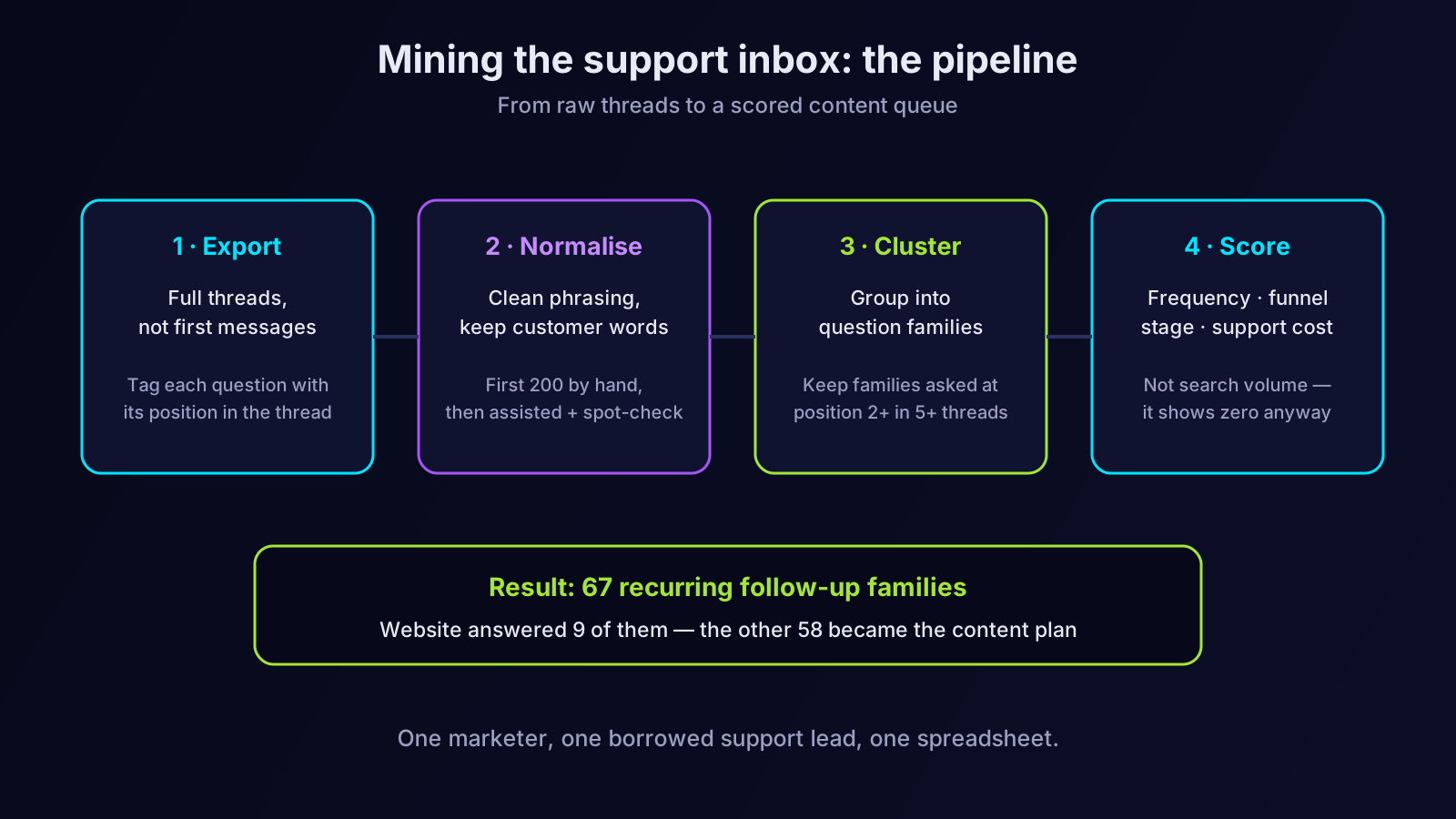
We exported six months of support threads and filtered every customer message containing a question mark or an interrogative opener — in our case that produced a few thousand messages. First mistake, made immediately: I initially exported only the first message of each ticket, because that is what the ticketing system's default view shows. That export was nearly worthless — first messages are first questions, the stuff tools already approximate. The value is in messages two through five of each thread. Re-exported full threads, kept the sequence intact, and tagged each question with its position in the conversation. Position is the whole point: a question at position three is, by definition, a question the customer still had after two rounds of answers.
Step 2: Normalise and deduplicate — by hand at first
Raw customer questions are messy: typos, product jargon, half-sentences, three questions jammed into one message. We rewrote each into a clean canonical phrasing while preserving the customer's framing — "how do I know if it's actually working?" stayed in those words, not "measuring efficacy", because the phrasing itself is data about how people talk. The first two hundred we did manually to develop judgment; after that we used an LLM with a strict prompt to normalise the rest and then spot-checked a sample. If I did it again I would still do the first batch by hand. The manual pass is where you start hearing the voice patterns, and the voice patterns later wrote our headings for us.
Step 3: Cluster into question families
We grouped the normalised questions into families — clusters of phrasings asking the same underlying thing. Several thousand raw questions collapsed into 212 families. Then the cut that mattered: we kept only families where the question appeared at position two or later in at least five separate threads. That left 67 genuine recurring follow-ups. Sixty-seven questions our customers reliably asked after being answered, of which — this was the sobering audit — our website substantively answered nine.
Step 4: Score by funnel heat, not volume
You cannot sort follow-ups by search volume, because most show zero. We scored each family on three things instead: frequency in our inbox, funnel stage (questions from trials and demos outscored questions from long-time customers, because they sat closer to revenue), and answer cost — how much support time the question consumed per month. The top of the resulting list looked nothing like any keyword research we had ever produced. It looked like a map of the exact anxieties standing between our prospects and a purchase.
Step 5: Map each family to a format
The temptation is to spin every question into a blog post. We forced each of the 67 families through a format decision instead. Roughly a third became dedicated articles — questions whose honest answer needed a thousand words or more, like the mid-pipeline migration question. Another third became sections inside existing articles — the follow-up was really an objection or clarification belonging to a first-question page we already had, so we added an answer-first H2 to that page rather than fragmenting the topic. The rest split between product page FAQ blocks (pricing and security follow-ups, which belong at the decision point, not the blog) and a handful we deliberately did not publish because the answer was genuinely account-specific. That restraint matters; publishing thin pages for unanswerable questions is how question content gets a bad name. The page-versus-section logic is the same one we use in writing for conversational queries.
Step 6: Write the answer the support team wishes they could send
Our writing brief for every piece was one sentence: write the link the support agent wishes existed. Concretely that meant opening with the direct answer in 40–60 words — no context-setting preamble, because the asker by definition already has context — then the evidence, the steps, the edge cases, and crucially the next follow-up. Because here is the recursive beauty of the method: your inbox also tells you what people ask after the follow-up. Thread position three is the follow-up to position two. We ended many articles by pre-answering position three, and you can see in the on-page behaviour that readers get there and keep going. Each answer ended with one honest pointer to the related deep-dive, mirroring how a good agent closes a thread.
What happened: the numbers and the surprises
We published the backlog over about fourteen weeks. I will keep the numbers generic but real in shape.
The expected result arrived first: support deflection. Within a quarter, the support team was resolving a meaningful share of the targeted question families with a link plus a sentence instead of a written-from-scratch reply, and several families dropped visibly in new-ticket volume. If the project had produced nothing else, the support hours alone paid for the content. I mention this first because it changed the politics of content in our company: support and sales went from ignoring the blog to feeding it, since they could see their own pain shrinking in it.
The search result was stranger and more interesting. Most of these pages, remember, targeted questions with no measurable search volume. Three months in, Search Console showed the pattern that made me write this article: the pages were earning impressions for hundreds of distinct long question queries we had never targeted — phrasings adjacent to our follow-ups, worded twenty different ways, almost none of which any tool had ever shown us. Individually each was a handful of impressions a month. Collectively the follow-up cohort grew into one of our most consistent sources of qualified organic entrances, with a conversion-to-trial rate roughly double our first-question content. People arriving on a follow-up answer are simply deeper into the problem than people arriving on a definition.
And then the 2026-shaped surprise: AI engines started citing these pages disproportionately. When we spot-checked Google AI Overviews and AI Mode on our topic's head questions, the pages being cited were often not our big first-question guides — they were the follow-up answers. Which, once you understand the mechanics, makes complete sense.
Why AI search made follow-ups stop being optional
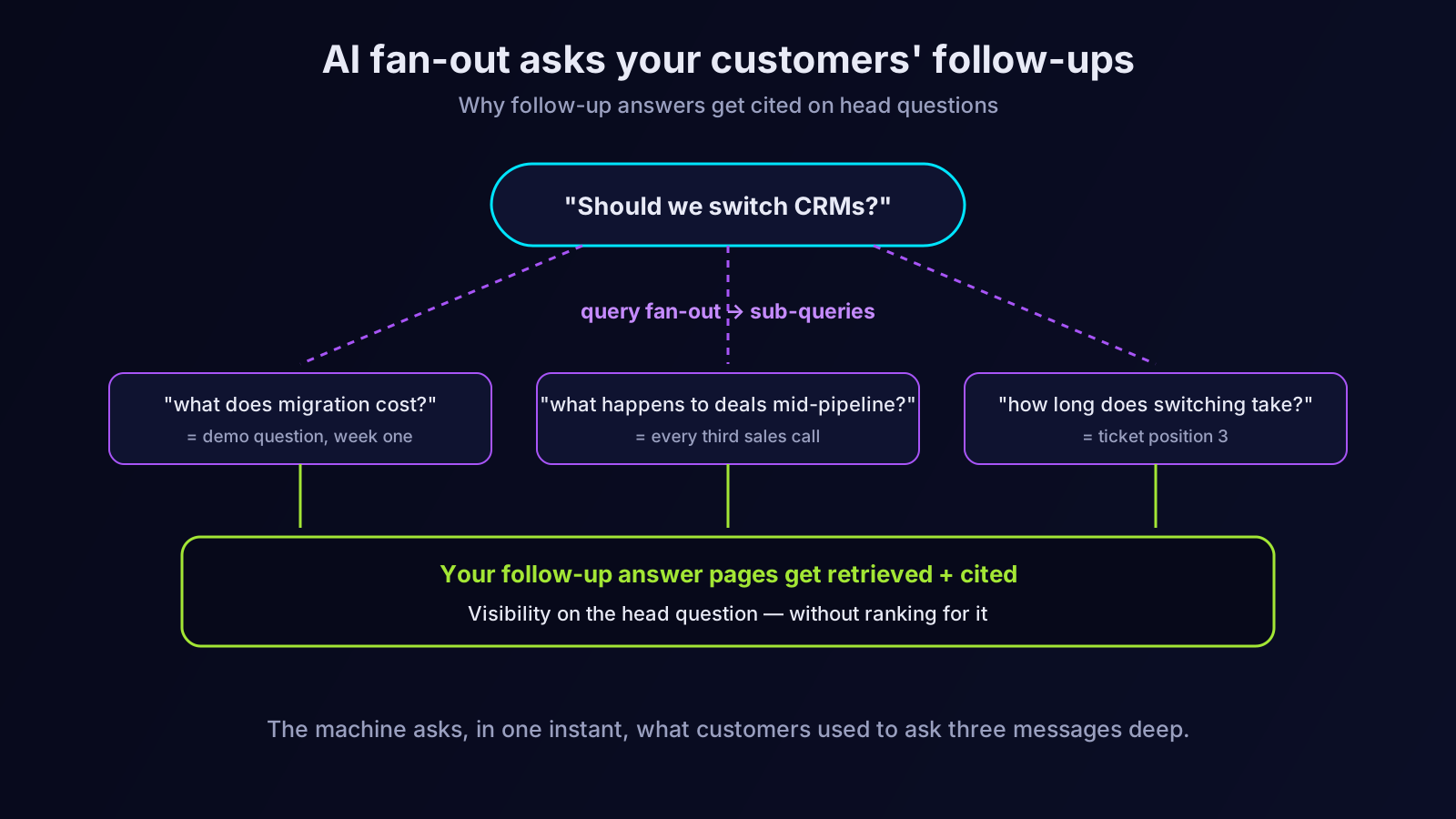
Google's AI Mode and AI Overviews use a technique Google has publicly described as query fan-out: the user's question is expanded into a set of related sub-queries, each retrieved separately, and the answer is synthesised from everything that comes back. Ask "should we switch CRMs?" and the system quietly also asks the sub-questions — what does migration cost, what happens to data mid-transition, how long does it take. Those sub-questions are follow-up questions. The machine is asking, on the user's behalf and in the same instant, the questions your customers used to ask three messages deep in a ticket thread.
That changes the economics of this whole category of content. A follow-up answer used to wait patiently for the rare human who typed it into Google. Now it gets retrieved every time an AI engine fans out the head question it hangs beneath — which means follow-up content participates in the head term's visibility without ranking for the head term. Sites that cover an entire question family, follow-ups included, give the synthesis layer more to select from, and being selected is the new being ranked. The full mechanics of citation selection are in our complete guide to AI Overviews, and the strategic shift is the subject of citations are the new rankings. ChatGPT-style assistants compound the effect: their users literally ask follow-ups in conversation, and the engine retrieves fresh sources per turn. Your follow-up answer is sitting exactly where turn three of that conversation looks.
The mistakes, so you can skip them
Honesty section. Four things I would do differently.
We waited too long to involve sales. Support tickets skew toward existing customers, so our first batch over-represented post-purchase questions. Demo recordings and sales-call notes hold the pre-purchase follow-ups — the objections — and those turned out to be the highest-converting content of the entire project. Start with both sources, not support alone.
We initially published a few thin pages. Early enthusiasm, two-hundred-word answers, separate URL each. They did nothing in search and looked like clutter. Everything improved when we held the line on the format decision in step five: a question only gets its own URL when its answer deserves one.
We forgot to close the loop with the people who gave us the questions. For the first month, support did not know the articles existed. A shared, searchable index of published answers — maintained where agents work, not where marketers work — doubled the internal usage overnight, and agents pasting links became our earliest signal of which answers were actually good.
We measured it like normal content at first. Judging follow-up pages by clicks on their own target query is meaningless when the target query has no volume. The cohort metrics that matter: total distinct question queries earning impressions, support ticket volume per family, conversion rate of entrances, and AI citation spot-checks. On those axes the project was an unambiguous win; on a classic keyword dashboard it would have looked like a failure for the first two months. Zero-click and zero-volume content needs its own scoreboard — a theme we have argued before in zero-click search doesn't mean zero value.
Making it a system instead of a project
The version of this I have described so far was a one-off excavation: six months of history, one big spreadsheet, fourteen weeks of publishing. That gets you the backlog. The compounding value comes from turning the excavation into a pipe, because your customers generate new follow-up questions every week, and the first company to answer a newly-emerging question owns it for years.
What our continuous version looks like now, in case it helps you design yours. Support agents have a one-click tag — literally labelled "good question" — that they apply to any customer message asking something our site cannot answer; that tag is the entire data-entry burden we put on them, and adoption survived because it costs two seconds. Once a month, the tagged questions get normalised and matched against the existing 67 families: most join an existing family and bump its frequency score, and the genuinely new ones open a candidate family. A family crosses the publishing threshold the same way as before — five independent threads — and enters the content queue with its funnel-heat score attached. The monthly triage takes under an hour. It is the highest-yield hour in our content calendar.
Two refinements earned their keep. First, we added a decay review: every published answer gets rechecked twice a year against the current product and the current inbox, because a follow-up answer that has drifted out of date is worse than no answer — support ends up correcting your own blog in tickets, which is as demoralising as it sounds. Second, we started logging which answers agents actually paste, and treating low-paste articles as drafts that failed review by the toughest editors we have. A support agent declining to use your answer is telling you, precisely and for free, that the answer does not match the question as customers ask it.
No support inbox? You still have sources
A fair objection from early-stage companies: "we don't have thousands of tickets." You need recurring questions, not a big ticketing system, and they exist in public even when your inbox is empty. Community threads in your niche — Reddit, Facebook groups, specialist forums — are support inboxes with the lid off; read the comment chains under popular first-question posts and you are reading follow-up questions in the wild, position-tagged by the thread structure itself. Reviews of competitor products carry follow-ups in the form of complaints: "I wish someone had told me X before buying" is a follow-up question wearing a one-star costume. Webinar Q&A, podcast comment sections, and the questions people ask in your own demos — even five demos a month produce a pattern within a quarter. The method is identical: capture the full sequence, keep the asker's wording, cluster, score by closeness to the buying moment. The inbox is the richest vein, but it is the method that is the goldmine.
Your inbox is already full of next quarter's content plan
The meta-lesson I took from this quarter is uncomfortable for someone who spent years inside keyword tools: the most valuable question research my company will ever own is generated daily, for free, by the people we already serve — and the only reason it looked like nothing was that no tool was pointing at it. First questions tell you what strangers wonder. Follow-up questions tell you what almost-customers are stuck on. Only one of those is a goldmine with no other miners in it.
The grind is real — exporting, normalising, clustering, and scoring thousands of messages is exactly the kind of structured drudgery that stalls these projects in week two, and it is the part we eventually handed to automation; an SEO AI agent like Orova can mine the question families out of your search data and content gaps and draft the answer-first sections, leaving your team the judgment calls and the customer's voice. However you resource it, start small and start this week: pull one month of support threads, read every message at position two or later, and count how many of those questions your website can answer today. If your number is anything like our nine out of sixty-seven, you have just found the cheapest content strategy you will ever run.
Let an AI Agent handle your SEO
Orova plans, writes, optimizes, and tracks rankings on its own — you just read the results.
Try it free