
One Video, Five Assets: Video Content for SEO
Every finished video on your channel represents a strange accounting anomaly. The expensive part — the subject-matter expertise, the argument structure, the examples, the rehearsed delivery, the editing decisions about what to cut — has already been paid for. Yet most teams treat the published video as the end of the production line. They post it, share the link twice, and move on to the next expensive thing. The asset that took twenty or thirty hours of cumulative effort gets exactly one distribution surface, on one platform, reaching one audience segment, in one format.
The transcript changes that math. A transcript is not glamorous. It is a wall of imperfect text generated in minutes by speech-to-text software. But economically, it is the single cheapest raw material in content marketing, because every unit of intellectual value inside it was already financed by the video budget. Extracting that value into new formats costs a fraction of producing those formats from scratch — and the formats you can extract happen to be the ones search engines, inboxes, and social feeds each reward separately.
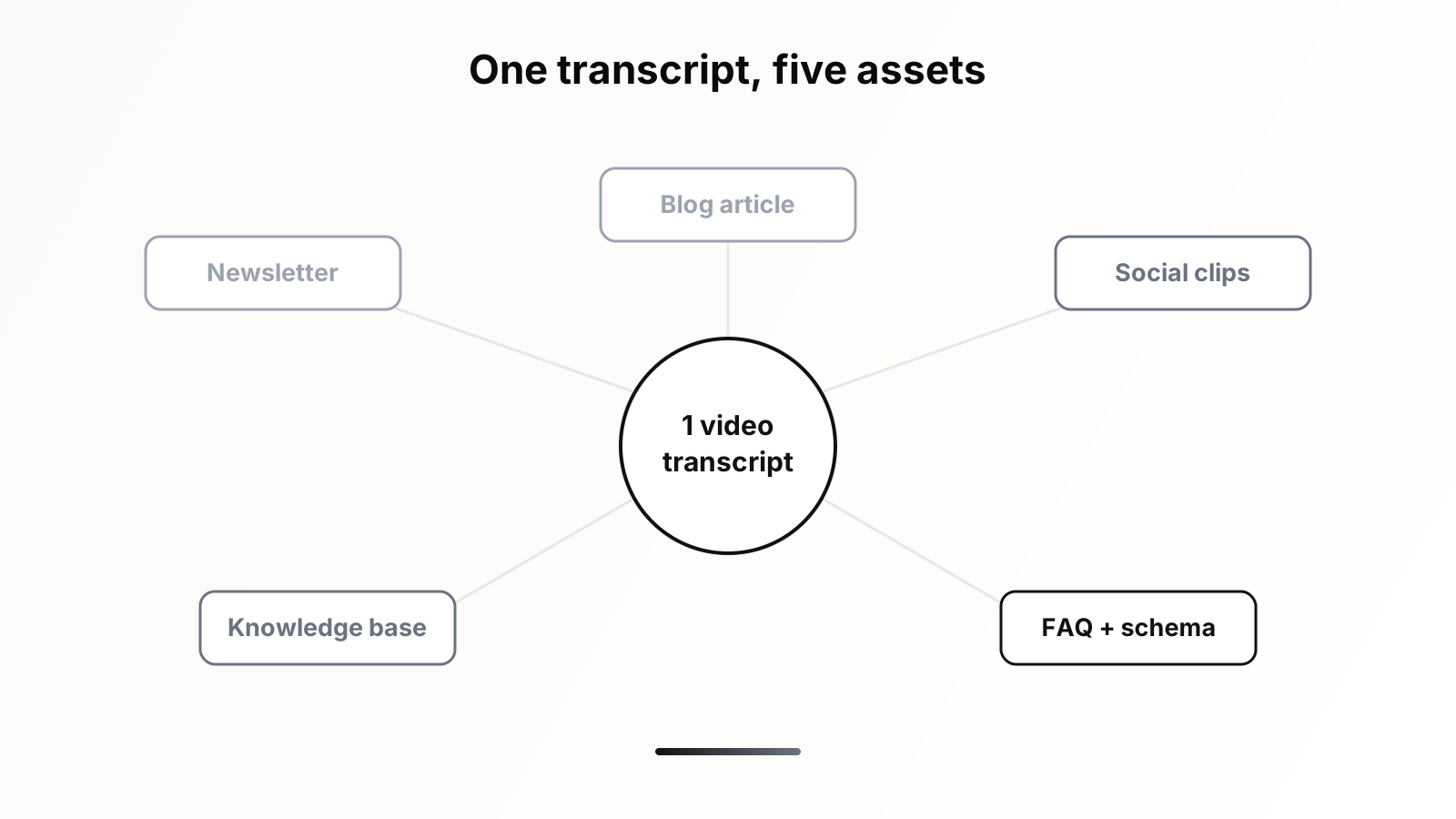
This article is an analysis of that extraction, asset by asset. We will look at five distinct content products you can build from one transcript, what each one actually costs in hours, where its SEO value comes from, where it compounds over time, and — just as importantly — the failure modes that make repurposing programs quietly produce nothing. The thesis is simple: one production, five distributions, and the discipline to edit rather than paste.
Video content repurposing means converting one finished video into multiple standalone content assets — typically an edited SEO article, social posts or clip scripts, a newsletter edition, an FAQ section, and internal documentation — using the transcript as raw material. Because the expertise is already captured, each new asset costs hours instead of the days original production requires.
The Sunk-Cost Asymmetry of Video
Start with the cost structure, because it explains why repurposing is not a nice-to-have but an arbitrage. A reasonably produced 25–30 minute expert video — scripting or outlining, recording, retakes, editing, thumbnails, upload metadata — commonly consumes 15 to 40 hours of combined effort across the people involved. That cost buys you three things that are genuinely hard to manufacture any other way:
- Verified expertise on the record. A practitioner explained something in their own words, with the caveats and edge cases that only practitioners know. Ghostwritten articles routinely lack exactly this texture.
- A tested structure. The video already survived an editorial process. Weak sections were cut. The order of arguments was chosen deliberately. That structure is reusable.
- Concrete examples and numbers. Speakers reach for examples instinctively. Those examples are the hardest part of any written piece to invent at a desk.
Now compare the marginal cost of re-expressing that material. Once a cleaned transcript exists, drafting a blog article from it is an editing job, not an invention job. Writing a newsletter from it is a selection job. Cutting social scripts from it is a curation job. Editing, selecting, and curating are all dramatically cheaper than originating. Where an original 2,000-word expert article might take 8–12 hours including research and review, the same article derived from a transcript typically takes 3–5, because the research interview has effectively already happened — on camera.
The asymmetry has a second face: distribution risk. A single video lives or dies on one algorithm's mood and one audience's scroll behavior. Five derivative assets spread the same intellectual investment across organic search, email, social feeds, on-site support content, and sales enablement. If any one channel underperforms, the production still pays back through the others. In portfolio terms, repurposing converts a concentrated bet into a diversified one at minimal additional cost.
The Transcript: Cheapest Raw Material, Honestly Assessed
The economics only work if you are honest about what a transcript is and is not. It is raw material — closer to crude ore than to finished metal. Treating it as a finished product is the root cause of most failed repurposing programs, so the limitations deserve a clear-eyed look before we count the assets.
What auto-transcription gets right — and where it fails
Modern speech-to-text is good. For a single clear speaker in a quiet room, current engines routinely land in the 90–97 percent word-accuracy range, and a 30-minute video transcribes in minutes for pennies or for free, depending on your tooling. That accuracy figure sounds excellent until you consider what lives in the remaining few percent: precisely the words that matter most. Product names, people's names, industry jargon, acronyms, and numbers are the most frequent casualties, because they are the least statistically predictable tokens in the audio. A transcript that renders a technical term wrong three different ways is worse than useless for publication — it actively signals carelessness.
The practical implication is a mandatory cleanup pass: 20–45 minutes for a half-hour video, done by someone who knows the subject. The pass fixes named entities, breaks the text into rough paragraphs, marks timestamps for strong moments, and flags sections where the speaker rambled or corrected themselves mid-sentence. This is the cheapest 30 minutes in the whole pipeline, and skipping it taxes every downstream asset.
Captions versus an on-page transcript: two different jobs
It is worth separating two artifacts people often conflate. Caption files (SRT or VTT) are timed text uploaded alongside the video. They serve viewers watching muted or with hearing impairments, and they give the platform a clean, machine-readable record of what is said — which helps YouTube understand and index the content of your video rather than guessing from the title and description alone. Uploading corrected captions instead of relying on auto-generated ones is one of the highest-leverage 30-minute tasks in video SEO across both YouTube and Google, and it costs almost nothing once you have already cleaned the transcript.
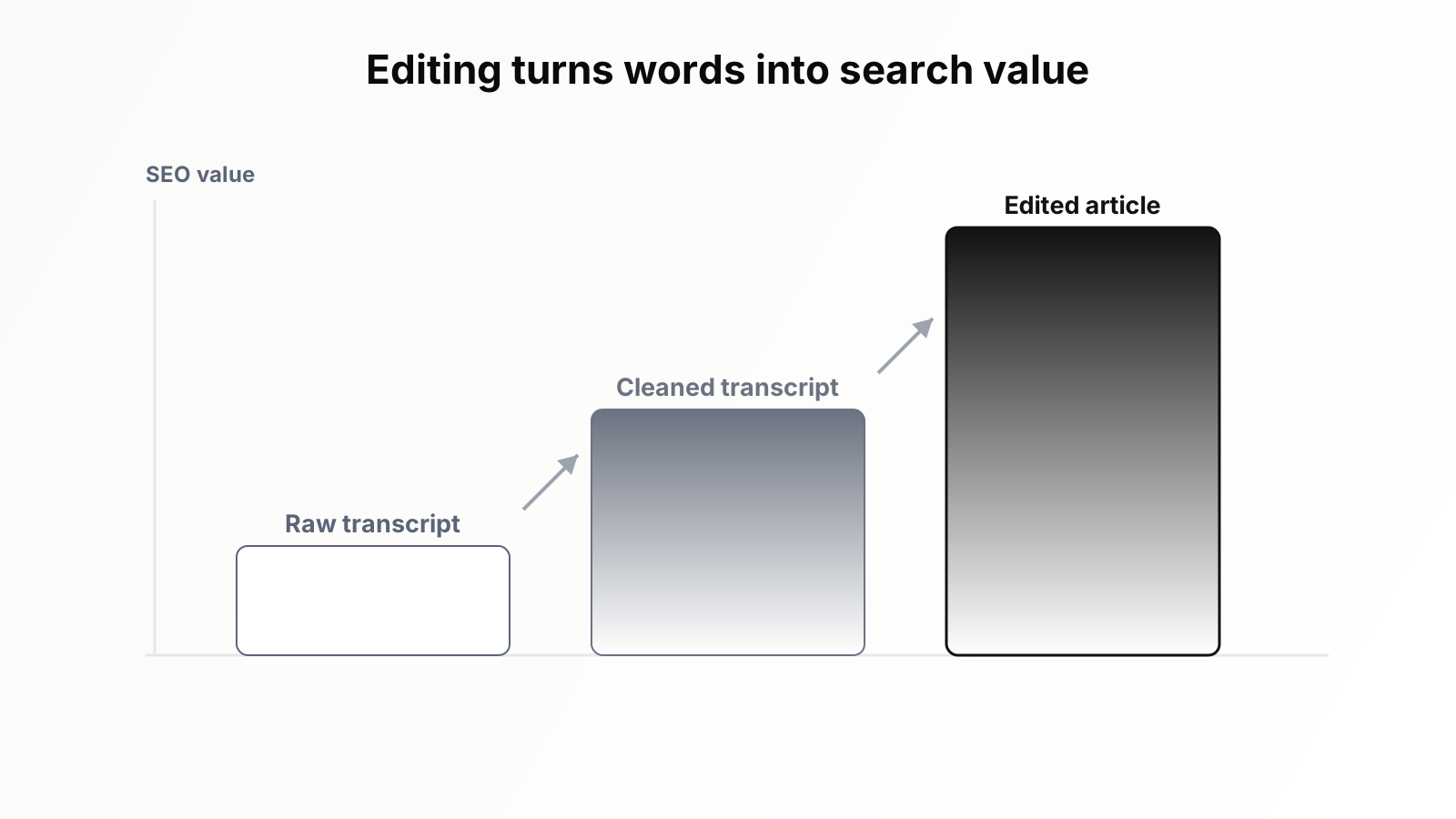
An on-page transcript is a different decision. Pasting the full spoken text under an embedded video on your site is permitted and has genuine accessibility value. But as an SEO play it is usually the weakest available option. Spoken word is structured for ears: long meandering sentences, verbal backtracking, context delivered through tone rather than headings. On a page, that reads as thin, poorly organized content — thousands of words with no heading hierarchy, no internal links, no scannable structure, and no answer-shaped passages for search engines to lift. The honest comparison: a raw transcript page might rank for a few accidental long-tail phrases; an edited article built from the same material can compete for the head terms the video was made about. Same input, radically different output value — which is the entire argument of this piece.
The Five Assets, Ranked by Effort and Compounding Value
With a cleaned transcript in hand, five distinct products become cheap. They are not equally valuable, and they do not compound in the same places, so the analysis below treats each one as a separate investment decision: what it costs, what it returns, and where the return accumulates over time.
Asset 1: The full SEO article — an editing job, not a pasting job
Effort: 3–5 hours. SEO value: highest of the five. Compounds in: organic search, for years.
This is the flagship derivative, and the one where the paste-versus-edit distinction decides everything. Converting the transcript into an article means restructuring, not reformatting. The spoken argument gets a written architecture: an introduction that frames the problem for a reader who has not watched anything, H2 and H3 headings that mirror search intent rather than the speaker's chronology, transitional rambles deleted, repeated points consolidated into one strong passage, and claims backed with the data and links a speaker could only gesture at verbally. Sections the video skimmed can be expanded; sections that worked on camera but die in text — long anecdotal setups, audience banter — get cut without mercy.
The article should also do things the video cannot. It can carry internal links into the rest of your site's cluster, which the video's description only weakly approximates. It can include tables, checklists, and quotable definition paragraphs that earn featured snippets. And it can host the video itself: embedding the source video in the derived article is the natural closing of the loop, and there is decent evidence it helps engagement — our own analysis of adding video embeds to fifteen existing posts showed meaningful dwell-time improvements on the pages where the video genuinely matched the query intent. The page gives the video a second discovery surface; the video gives the page a reason for visitors to stay.
One trade-off deserves naming: the article competes with the video for some queries. In practice this is a feature, not a bug. Google increasingly blends video and text results, and owning both formats for one topic doubles your shelf space rather than splitting one slot. The duplication risk people fear — "won't Google see the same content twice?" — does not apply when the article is genuinely rewritten, because the overlap with the spoken text drops to phrase level, exactly as it would between any two treatments of one topic by the same author.
Asset 2: Social posts and short-clip scripts
Effort: 1–2 hours for a week's worth. SEO value: indirect. Compounds in: audience growth and branded search.
The cleaned, timestamped transcript turns clip selection from an artistic hunt into a reading exercise. You scan for the moments with standalone tension — a contrarian claim, a number that surprises, a before/after, a crisp answer to a question everyone asks — and you mark the timestamps. Each strong moment becomes two things: a cut list for a 30–60 second vertical clip, and a text post that delivers the same idea natively in the feed.
The economic point is that the transcript lets a junior editor or a tool do the finding. Without it, somebody senior re-watches the whole video to locate the good parts, which silently doubles the cost. With it, a 28-minute video reliably yields five to eight postable moments — roughly one per major section, because the video's own structure already concentrated value at section boundaries.
The trade-off to manage is verbatim duplication. A clip can quote the video exactly; a text post should not be the transcript chunk pasted with hashtags. Feeds reward native phrasing — shorter sentences, a hook in line one, the conclusion stated before the reasoning. The idea is recycled; the wording is re-cut for the format. Five minutes of rewriting per post is the entire cost of doing this properly.
SEO value here is indirect but real: clips drive subscribers and branded searches, and branded search volume is one of the cleaner trust signals a domain can accumulate. Just do not measure this asset on organic rankings — it will look like a failure by a metric it was never aimed at.
Asset 3: The newsletter edition
Effort: 1–2 hours. SEO value: none directly. Compounds in: owned audience and return traffic.
The newsletter is the asset teams skip most often, which is odd, because it has the most forgiving format. An email does not need the article's completeness or the clip's punch. It needs one idea, told well, in 300–600 words, with a personal frame: here is what we explored this week, here is the one finding that surprised us, here is where to watch or read the rest.
From a transcript, this is a selection problem. Take the single strongest section — usually the same passage that produced the best clip — and rewrite it as a letter rather than an essay. First person, present tense, one takeaway, two links out (one to the video, one to the article). The email then performs a quiet strategic job the other assets cannot: it pushes the video and the article in their critical first week, when early engagement signals matter most to both YouTube's and Google's initial assessment of the content. The newsletter is the ignition system for the assets that do compound in search.
The cost-benefit is lopsided in your favor precisely because the marginal effort is so low. If you already operate a newsletter, the transcript removes the weekly "what do we even send" tax entirely — the content calendar of your video channel becomes the content calendar of your email program for free.
Asset 4: The FAQ section and question-shaped passages
Effort: 1–2 hours. SEO value: high per word. Compounds in: long-tail search, AI answers, rich results.
Videos accumulate questions the way docks accumulate barnacles: comments, live-chat questions, the questions the speaker poses rhetorically, the questions colleagues asked before recording. These are not invented questions — they are demand signals, phrased in the audience's own words. That makes them more valuable than any keyword tool output, because question keywords are a goldmine precisely when they come from real people rather than from a suggestion dropdown.
The repurposing move is to harvest every genuine question connected to the video and answer each one in 40–80 written words — direct, self-contained, no throat-clearing. Those answers become an FAQ block appended to the derived article, or a standalone FAQ page if the volume justifies it. Two structural bonuses follow. First, question-plus-concise-answer is exactly the passage shape that AI Overviews, ChatGPT Search, and Perplexity prefer to quote, so the FAQ section becomes your highest-density surface for AI citation. Second, marking the block up with FAQPage structured data makes the question-answer pairs machine-explicit; as we covered in our guide to winning rich results with structured data, the markup does not create ranking magic by itself, but it removes ambiguity about what the content is, and eligibility costs you twenty minutes.
Per word invested, this is the highest-yield asset on the list. A 600-word FAQ section regularly outranks 2,000-word posts for the specific long-tail questions it answers, because it matches the query shape exactly. The only real cost is editorial discipline: answer the question actually asked, not the question you wish had been asked.
Asset 5: Internal documentation and lead-magnet material
Effort: 1–3 hours. SEO value: none. Compounds in: sales cycles, onboarding, and team knowledge.
The fifth asset never touches a search engine, which is why it gets forgotten — and why it is frequently the most profitable per hour. When your video explains a process, a methodology, or a set of recommendations, the transcript is already 80 percent of an internal document: a sales-enablement explainer, an onboarding module, a knowledge-base entry your support team links to instead of re-typing the same answer, or a gated checklist that converts readers into leads.
The economics differ from the public assets in one important way: internal and gated material is judged on accuracy and completeness, not on style. That means the cleanup bar is lower and the conversion from transcript is faster. A methodology section spoken in seven minutes becomes a one-page process doc in under an hour. The compounding is also different in kind — it shows up as minutes saved every time a salesperson, support agent, or new hire reaches for the document instead of interrupting an expert. That return is invisible in marketing dashboards and very visible in payroll.
The lead-magnet variant deserves one strategic note: the strongest gated assets are usually the video's most practical fragment — the checklist, the template, the decision matrix — rather than the whole argument. The article gives the reasoning away free and earns search traffic; the gate captures the people who want the tool. The transcript funds both sides of that exchange from one recording.
A Worked Example: One 28-Minute Video, Hour by Hour
Abstract percentages hide the real question — what does a week of this actually look like? Here is a generic but realistic ledger for a 28-minute expert video on a B2B topic, with one marketer driving the process and the original speaker available for an hour of review.
- Auto-transcription: 0.1 hours. Machine pass, near-zero cost. Output: 4,200 messy words.
- Cleanup pass: 0.7 hours. Fix names and jargon, paragraph the text, timestamp eight strong moments, flag two weak sections to exclude from everything downstream.
- Corrected captions: 0.4 hours. Sync the cleaned text back to SRT/VTT and upload, replacing the auto-captions. Accessibility plus platform comprehension for half an hour's work.
- SEO article: 4 hours. Restructure into a 2,100-word piece with new intro, search-intent headings, two data points the speaker only alluded to, internal links into the cluster, and the video embedded. Speaker reviews in 30 minutes.
- Social batch: 1.5 hours. Six timestamped clip selections handed to an editor, plus six rewritten text posts scheduled across two weeks.
- Newsletter: 1 hour. The strongest section rewritten as a 450-word letter, linking to video and article on publish week.
- FAQ block: 1.3 hours. Nine real questions harvested from comments and pre-production notes, answered in 40–80 words each, FAQPage markup added to the article.
- Internal doc: 1 hour. The methodology section converted into a one-page process document for the sales team's shared workspace.
Total: roughly 10 hours of derivative work on top of a production that cost perhaps 25. For 40 percent additional effort, the one distribution became six (counting the improved captions), spanning four channels and two audiences — public and internal. If the article alone performs like a median expert post, it will out-earn its 4-hour cost within months; everything else is margin on top. No individual step is clever. The system is the advantage.
The Marginal-Cost Math, Stated Plainly
The general formula worth internalizing: when the expensive inputs — expertise, structure, examples — are sunk into one production, every additional format pays only its format-conversion cost, not its creation cost. Format conversion runs at 10–25 percent of origination for text assets, and the discount grows with the quality of the source material, because a tightly structured video converts almost mechanically while a rambling one fights you at every step.
This produces a slightly counterintuitive budgeting conclusion: the highest-ROI investment in a repurposing program is often upstream, in the video outline. Ten extra minutes structuring the recording around five clean sections, with the speaker stating each section's takeaway explicitly, can shave hours off every derivative. You are not just scripting a video; you are pre-formatting five assets. Teams that internalize this start writing video outlines that look suspiciously like article outlines — which is exactly the point.
The same math also tells you when not to repurpose. A video with weak material does not become strong by multiplication; it becomes weak in five places, with your brand on each one. If the cleanup pass reveals that the speaker hedged everything, the examples were thin, and the structure wandered, the rational move is to extract only the one or two genuinely strong fragments and skip the rest of the pipeline. Repurposing amplifies quality in both directions, and the discipline to amplify selectively is what separates a content system from a content treadmill.
Failure Modes That Quietly Erase the Gains
Most repurposing programs do not fail loudly. They fail by producing artifacts that technically exist and practically achieve nothing. Three patterns account for the bulk of the waste.
Publishing the raw transcript as the article. The most common shortcut and the most damaging one. A 4,000-word unstructured wall of spoken language is thin content in the way that matters: it answers no query shape, earns no passage rankings, and reads as neglect to the humans who land on it. If the choice is between a raw transcript page and no page, choose no page and keep the corrected captions — they deliver the accessibility and comprehension benefits without putting weak text on your domain.
Verbatim cross-posting. Pasting the identical paragraph onto five platforms feels efficient and performs poorly on all five, because each surface has its own grammar — feeds want hooks, inboxes want intimacy, search wants structure. Worse, audiences that follow you on two channels see the seams, and the impression of an automated content sausage machine costs trust that no individual post earns back. The idea travels; the wording must be re-cut per format. The rewriting overhead is minutes, not hours, and it is not optional.
Repurposing the weak parts out of completeness. Five assets is a ceiling, not a quota. The instinct to extract everything — every section becomes a clip, every aside becomes a post — drags the average quality of your output down to the average quality of the video, instead of holding it at the level of the video's best moments. The timestamped cleanup pass exists precisely to mark what should never leave the transcript. Honor those marks.
A fourth, structural failure deserves a sentence: producing the five assets and never linking them to each other. The article that does not embed the video, the video description that does not link the article, the FAQ that floats on its own URL — each orphaned asset forfeits the cross-referral traffic that makes the portfolio outperform the sum of its parts.
Where Repurposing Fits in a Cluster Strategy
One final analytical point: repurposed assets are disproportionately valuable when they land inside an existing topical structure rather than scattering across your site. The derived article should slot into a cluster as a spoke, linking up to its pillar and sideways to its siblings — the logic we laid out in why topic clusters beat standalone posts applies with extra force here, because a transcript-derived article arrives pre-loaded with the expert depth that makes cluster spokes credible. If your team is still organizing that architecture, the hub-and-spoke model is the cleanest mental frame: the video pillar feeds written spokes, and every spoke routes authority back through the hub.
Seen from this altitude, the transcript is not merely a cost-saving trick. It is the connective tissue between your video program and your search program — the artifact that lets one team's production budget fund the other team's rankings. Companies that treat video and SEO as separate departments leave this arbitrage on the table; companies that route every recording through a transcript pipeline collect it weekly, and the gap compounds.
The playbook, compressed: transcribe everything, clean once, edit ruthlessly, never paste, and let each format speak its native language. The expertise was the expensive part, and you already paid for it. The only remaining question is how many times you intend to collect.
If the bottleneck is the editing hours themselves, this is exactly the category of work an SEO AI agent like Orova is built to absorb — feed it the cleaned transcript as source material and it can draft the restructured article, the brief for your editor, the FAQ answers, and the repurposed variants for each channel, leaving your team the judgment calls: what to cut, what to gate, and which moments deserve the spotlight. One video in, five assets out — with the marginal cost driven closer to zero than the math above even assumes.
Let Orova SEO handle the repetitive part
Keyword research, drafting, refreshing old posts and rank tracking — running automatically on your own site.
Explore Orova SEO