
YouTube Search Engine Optimization: Tags, Titles, Thumbnails

Here is what actually happens. You spend an hour perfecting a video title, agonize over the right words, maybe even research your channel's best-performing phrases. Then you hit upload, YouTube grabs a random frame from the middle of the video where you're mid-sentence with your eyes half closed, and you let it ride as the thumbnail. That single image is the first thing anyone sees in a crowded list of videos, and it is quietly deciding whether your video gets watched at all.
This is the blind spot in most people's youtube search engine optimization efforts: all the attention goes to the title, tags, and description, while the thumbnail — the actual picture that earns the click — gets treated like an afterthought. The problem is not effort, it's where the effort goes. A sharp title next to a lazy, auto-picked image is like writing a great headline and then hiding it behind a blurry photo; nobody stops scrolling long enough to read the headline at all.
This article fixes that imbalance. You'll learn how to think about your thumbnail and title as one matched pair instead of two separate afterthoughts, what actually makes a viewer stop and click versus scroll past, and how to test your choices properly instead of guessing. By the end, you'll have a simple pre-publish checklist so every video gets a fair shot at being watched, not just a well-optimized title nobody sees.
The conceit: two tiny ads, one double standard
Think about what a title tag actually does. It does not rank your page by itself, whatever that one LinkedIn post claimed. It sits in a search results page, surrounded by nine competitors and an AI Overview, and it makes a pitch: click me, I have the thing you want. The page behind it can be a masterpiece of research and craft, but if the title tag mumbles, the masterpiece plays to an empty theater. This is why SEOs front-load keywords, sharpen value propositions, and rewrite titles for pages whose impressions are high but whose clicks are tragic. It is genuinely useful work, the kind we cover in our pillar on ranking videos on YouTube and Google at the same time.
Now look at a YouTube browse feed. Same situation, different costume. A grid of rectangles, each one pitching for a click, each one surrounded by rivals. The thumbnail is doing exactly the job of the title tag, except it gets to use color, faces, composition, and contrast instead of 60 characters of system font. It is the title tag with a bigger budget and, yes, better lighting. The video behind it can be the best tutorial ever recorded; if the thumbnail is a smeared screenshot of a slide deck, the algorithm will quietly file the video under "things nobody wanted" and move on.
The double standard is what makes this funny, in the way that finding your own keys in your own hand is funny. The same marketer who would never ship a page titled "Untitled Document (3)" will happily ship a video whose thumbnail is an accidental frame of the host's chin. The skills transfer almost perfectly. The discipline, somehow, does not.
The impression economy: how YouTube actually decides who eats
To understand why thumbnails matter so much, you need to understand the market they trade in. YouTube's surfaces — home feed, suggested videos, search results, the subscriptions tab — run on impressions. An impression is YouTube holding up your thumbnail to a viewer and asking, silently, "this one?" What happens next decides everything.
Two numbers dominate the conversation. The first is click-through rate on those impressions: of the people who were shown your thumbnail, how many clicked? The second is what happens after the click: how long people actually watch. YouTube wants viewers to have long, satisfying sessions, so it keeps surfacing videos that both attract clicks and reward them. A video that earns clicks and holds attention gets shown to a wider circle of viewers; the wider circle responds; the circle widens again. A video that fails either test gets its impressions throttled, politely but firmly, like a bouncer who has seen your act before.
Notice what this means structurally: the thumbnail is the gatekeeper of the entire distribution loop. Watch time cannot rescue a video nobody clicks, because retention is measured on viewers, and a thumbnail that converts no impressions produces no viewers to retain. Your retention graph can be a flawless plateau, but a plateau with an audience of nine is a private screening, not a strategy.
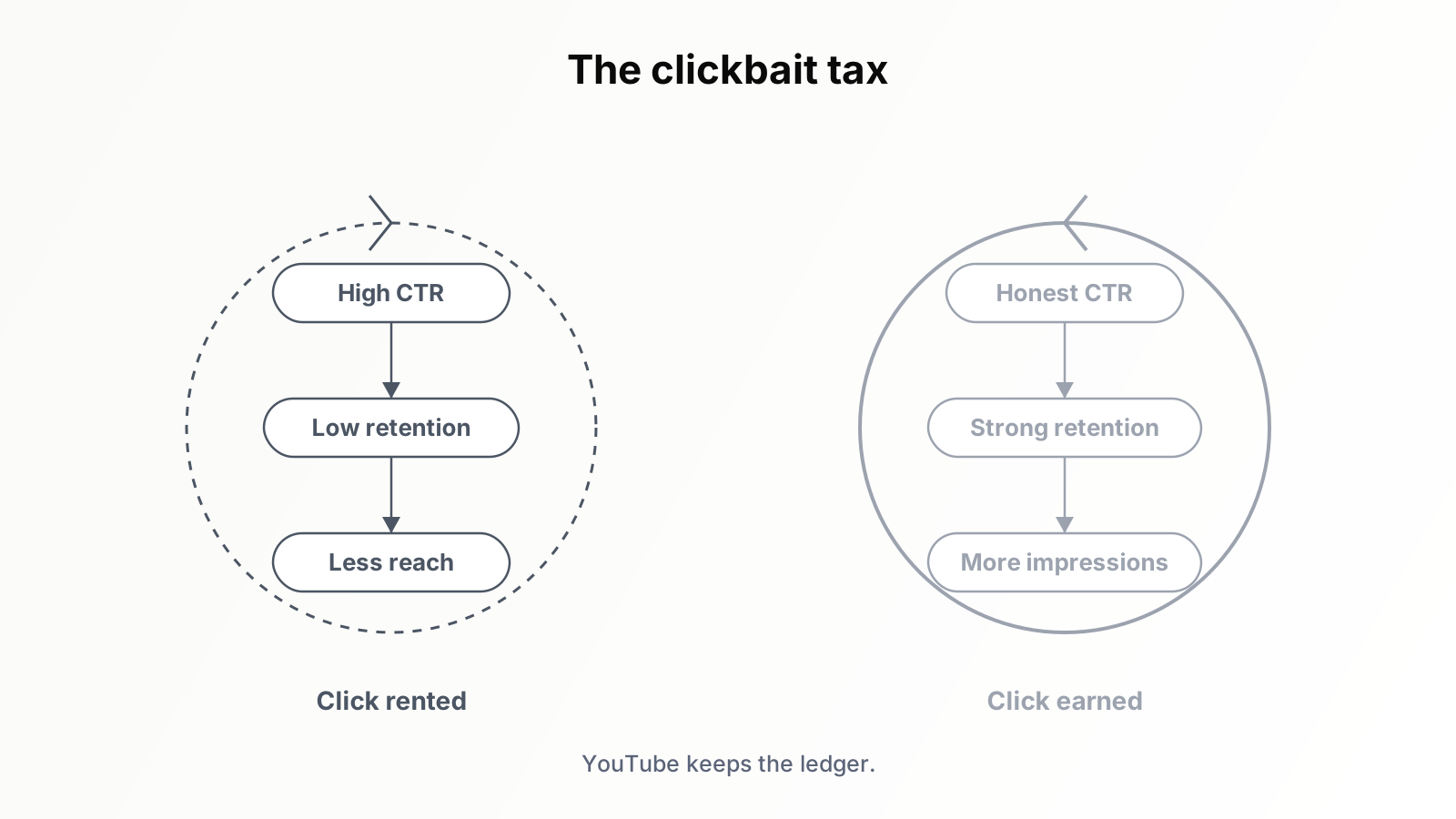
The inverse is also true, and we will spend a whole section on it: a thumbnail that wins clicks it cannot cash gets punished even harder. The impression economy is not a popularity contest; it is a promises market. The thumbnail makes the promise, the video keeps it or breaks it, and YouTube keeps the ledger. SEOs should find this familiar. Google has been running the same court for years: a page that wins the click but bounces the visitor teaches the engine, slowly, that the result did not satisfy. Search engines and YouTube differ in mechanics, but both reward the same boring virtue — say what you will deliver, then deliver it. It is the algorithmic version of the trust signals we describe in what Google actually rewards with E-E-A-T.
One more economic note before we get practical. Impressions are not distributed evenly across your catalog or your lifetime. YouTube tests new videos on small batches of likely viewers and scales up or down based on response. That means the thumbnail's job is heaviest in the first hours and days, when the algorithm is forming its opinion. Shipping a placeholder thumbnail with a plan to "fix it later" is like showing up to a job interview in pajamas with a plan to dress better after you are hired.
Anatomy of a thumbnail that earns the click
Good news: thumbnails that work are not magic, and they are not art school. They follow a small set of principles that hold up across niches, and most of them are about respecting one brutal constraint — the size at which your thumbnail is actually seen.
Design for 168 pixels, not for your monitor
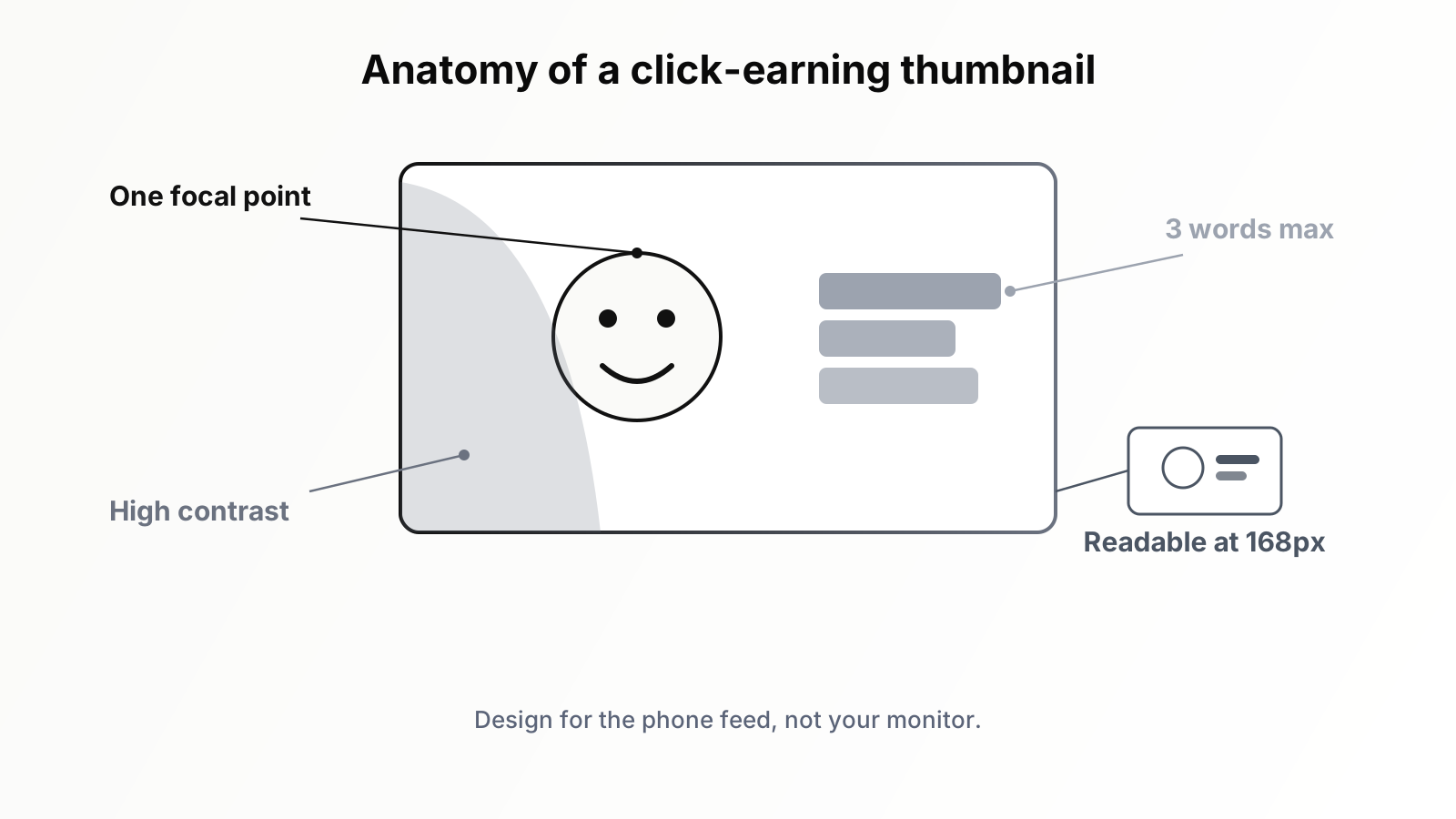
You design your thumbnail on a 27-inch monitor at full size, where it looks like a movie poster. Your viewer sees it on a phone, in a list, at roughly 168 pixels wide, where it looks like a postage stamp viewed across a room. This single mismatch explains most bad thumbnails in existence. The test is simple and humiliating: zoom your thumbnail down to thumb size, hold the phone at arm's length, and ask what survives. If the answer is "a vague rectangle with some confetti on it," start over. Detail that dies at 168 pixels was never really there.
One focal point, because the eye does not do committees
A viewer gives your thumbnail a fraction of a second. In that window, the eye lands on exactly one thing. Your job is to choose that thing on purpose: a face, an object, a before-and-after, a single bold word. The most common failure is the thumbnail designed by consensus — the host's face AND the product AND the logo AND a chart AND an arrow AND the text. Every added element taxes the others. A thumbnail with five focal points has zero focal points; it is a yard sale, and people scroll past yard sales.
Contrast against the place the thumbnail lives
Your thumbnail does not float in space. It sits on YouTube's interface, which is either dark gray or white, surrounded by other thumbnails fighting for the same eyeball. Muddy midtones disappear into both themes. High contrast — bright subject on dark background, dark subject on bright background, a confident outline separating the two — is what makes a rectangle pop out of a grid. This is the visual equivalent of front-loading a title tag: put the differentiation where the eye lands first, not buried in the composition where only you know it exists.
Faces work because humans are prewired, not because gurus said so
Human brains have dedicated machinery for detecting and reading faces; we cannot not look at them. That is why faces dominate thumbnails in nearly every genre. But the machinery reads emotion, not the mere presence of a head. A genuine, specific expression — real curiosity, real delight, real "I cannot believe this worked" — communicates the video's emotional promise instantly. A neutral corporate headshot communicates "this video was approved by legal." Use faces when there is a real emotion to show. Skip them when the object itself is the star; a perfect cinnamon roll needs no host.
Three words maximum, and never the same words as the title
Thumbnail text is a spice, not a meal. At 168 pixels, three big words are readable; six are a squint; fourteen are a legally binding document nobody will sign. If you need a sentence to explain the thumbnail, the image has failed and the text is performing CPR. Worse than too many words is the redundancy crime: pasting the video's title onto the thumbnail. The viewer sees the title directly below the image — repeating it wastes your single most valuable pixel real estate saying something they are already reading. Title and thumbnail are a duo, and duos do not sing the same note. More on that shortly.
Consistency builds a second kind of CTR
The principles above optimize for strangers. But a chunk of your impressions go to people who have seen you before, and for them, recognition is the click trigger. A consistent visual style — recurring colors, a typographic voice, a recognizable framing — turns your thumbnails into a brand mark that fires before conscious thought. The trap on the other side is monotony: if all forty thumbnails on your channel page are the same face with the same expression, the page stops looking like a brand and starts looking like a wanted poster. Consistent style, varied subject. Same handwriting, different sentences.
The cliché tax: red arrows and shocked faces
Once upon a time, a red arrow pointing at a circled detail was a genuine CTR hack. Then everyone did it, and the brain's banner-blindness machinery — the same machinery that learned to unsee display ads — learned to unsee red arrows. The shocked-face-with-open-mouth followed the same arc from innovation to wallpaper. Clichés are not evil; they are expired. They signal "this creator is copying 2019" at a glance. When a visual trope saturates your niche, its absence becomes the contrast. The calm, confident thumbnail in a feed of screaming ones is, ironically, the loudest thing on the page.
The clickbait tax: why rented clicks cost more than they earn
Here is where the impression economy shows its teeth, and where the title-tag analogy gets sharper instead of breaking down. Suppose you build the perfect bait: a thumbnail promising a revelation the video does not contain. It works, in the way that fire alarms work. CTR doubles. You feel like a genius for approximately one analytics refresh.
Then the second number arrives. Viewers click, discover the gap between promise and product, and leave — not at the end, not at the midpoint, but in the first thirty seconds, which is exactly where YouTube watches most closely. Your retention graph develops the silhouette of a cliff with a beach at the bottom. And YouTube does the arithmetic you hoped it would not: this video converts impressions into disappointment. Distribution contracts. The clicks you stole get clawed back, with interest, in impressions you will never be shown.
This is the clickbait tax, and the metaphor that makes it stick is rental versus ownership. A deceptive thumbnail rents the click; the lease terminates the moment the viewer realizes the promise was fiction, and the algorithm collects the penalty. An honest thumbnail earns the click; the viewer stays, the watch-time signal compounds, and the system responds with more impressions. Over any horizon longer than a week, the boring honest thumbnail outperforms the brilliant dishonest one, because the game is iterated and the referee has a perfect memory.
The nuance worth keeping: curiosity is not the crime. The best thumbnails open a genuine gap — they show a result without the method, a question without the answer, a "before" without the "after" — and the video closes that gap satisfyingly. Tension plus resolution is storytelling. Tension without resolution is fraud with production values. The line between them is a one-question audit: does the video deliver the specific thing the thumbnail made the viewer want? If yes, push the curiosity as hard as you like. If no, you are not optimizing CTR; you are taking out a payday loan against your channel.
SEOs already know this lesson from their own side of the fence. A title tag that overpromises wins the SERP click and loses the visitor in eight seconds, and that pattern, repeated, helps neither rankings nor revenue. The web's version of the tax is slower and harder to measure than YouTube's, but it is levied all the same. Both disciplines converge on the same dull, profitable rule: the packaging may exceed the contents in beauty, never in claims.
Title and thumbnail: a duo, not a duet of the same note
On YouTube, the viewer almost always sees the thumbnail and the title together, stacked like a comedy duo. This changes the design problem completely. You are not writing a title and designing an image; you are scripting a two-line joke where the image is the setup and the title is the punchline, or vice versa.
The cardinal sin, worth repeating because half the internet commits it, is redundancy. Thumbnail text "I QUIT" above the title "Why I Quit My Job" wastes the partnership; the viewer learns nothing from the second element they did not get from the first. The fix is complementarity: each element carries information the other lacks. The thumbnail shows the emotion or the result — a face caught between laughing and crying, a server rack on fire — and the title supplies the context: "What 30 Days of AI-Written Content Did to Our Traffic." Together they form a question the viewer can only answer by clicking. Separately, each is merely fine. The duo math is the whole point: a 7/10 thumbnail and a 7/10 title that interlock beat two 9/10 elements that repeat each other.
Division of labor follows naturally. Images are fast and emotional; text is precise and logical. So let the thumbnail carry feeling, stakes, and visual proof, and let the title carry specificity, keywords, and the searchable claim. This also keeps your search visibility intact: YouTube search and Google still read the title's words, so the title is where "youtube thumbnails ctr" or any target phrase earns its keep, exactly like the front-loaded keyword discipline you already apply to pages. The strategy of making one video work across both engines — title for the index, thumbnail for the human — is the core of our guide to video SEO across YouTube and Google, and it is also why videos embedded in articles can lift a page's engagement, as we measured when we added video to 15 posts and tracked dwell time.
A practical drill that costs nothing: before you publish, cover the thumbnail and read the title alone. Then cover the title and look at the thumbnail alone. Each should be incomplete but intriguing. If either one stands fully on its own, the other is unemployed, and unemployed elements should be given new jobs or removed.
Testing properly: Test & compare, or the end of thumbnail astrology
For most of YouTube's history, thumbnail optimization was astrology with extra steps. You changed the thumbnail on day three, traffic moved, and you credited the new image — never the weekend, the news cycle, or the algorithm's mood. Confounded, sequential, vibes-based testing produced a decade of confident nonsense.
That excuse expired. YouTube's built-in thumbnail experiment, "Test & compare," rolled out broadly to creators in 2024 inside YouTube Studio. It lets you upload up to three thumbnail variants for a video; YouTube serves them to comparable slices of the audience at the same time and reports which variant earns the larger share of watch time. After the test, you can apply the winner. Note the scoreboard: watch-time share, not raw CTR. That choice is the platform telling you, in product form, everything the clickbait-tax section said in prose — YouTube does not want the thumbnail that gets the most clicks; it wants the thumbnail that starts the most good viewing sessions. The bait variant can win clicks and still lose the test.
How to use it like an adult rather than a slot machine: test one variable at a time, or accept that you will not know why the winner won. Face versus object. Three words versus none. Warm background versus cool. Write the hypothesis down before the test, because post-hoc explanations are creative writing. Give the test enough impressions to mean something — verdicts from tiny samples are coin flips wearing lab coats — and remember that low-traffic videos may simply never accumulate enough data for confidence, which is itself useful information about where testing is worth the effort. And do not invent capabilities the tool lacks: it tests thumbnails, three variants maximum, judged on watch-time share. Title testing, multi-armed metadata experiments, and other imagined features are not part of it, and anyone selling you a "secret YouTube A/B suite" beyond this is selling you a screenshot.
Keep a log of results across videos. Single tests tell you about a video; a dozen logged tests tell you about your audience, and audience-level patterns — ours click objects over faces, ours ignore text entirely — are the actual treasure. This is the same compounding loop SEOs run with title-tag rewrites on high-impression, low-CTR pages, just with cleaner data and faster verdicts. If you are mining what already works, your own search results pages and tools like the patterns in question-keyword research are the equivalent listening posts on the text side.
Cross-training: what each discipline should steal
If thumbnails and title tags are the same job in different costumes, the two guilds doing those jobs have embarrassingly much to teach each other, and almost no shared meetings in which to do it.
What SEOs should steal from thumbnail makers: emotional honesty about what packaging is. The best YouTube creators iterate on packaging relentlessly because they can watch CTR move; they treat the promise as a craft, sketching thumbnails before they shoot, designing the video around a deliverable image. SEOs, by contrast, often write title tags last, in the CMS, slightly hungover from the content production itself. Imagine writing the title tag first — the promise — and then building the page to over-deliver on it. That is how good videos get made, and it would fix half the limp titles on the internet. Also steal the pair thinking: your title tag and meta description are a duo too, and most meta descriptions are currently singing the title's note again, only flatter.
What thumbnail makers should steal from SEOs: the boring rigor. Search intent as a concept — what was this person actually trying to accomplish when they were shown my rectangle? Front-loading — the focal point is the first three words of your image; spend it on the differentiator. Promise-matching as a measurable discipline rather than a vibe. And repurposing economics: a video is not one asset but a fountain of them, as we lay out in turning one transcript into five assets — and every derived asset needs its own tiny ad, designed with the same care, for the surface it lives on.
The deepest shared lesson is that packaging is not a tax on quality; it is part of the quality. The viewer's experience starts at the impression, not at the play button or the page load. A great video with a terrible thumbnail is not a great product with bad marketing — it is an incomplete product, the way a great page with a mumbling title tag is incomplete. Both guilds get this wrong in the same direction, which is at least democratic.
The checklist: run this before you publish
Print this, tape it next to the upload button, and let it veto your enthusiasm:
- The 168-pixel test: shrink the thumbnail to phone-feed size. Focal point still obvious? Text still legible? If not, simplify until it is.
- One focal point: name the single thing the eye should land on. If you need the word "and" to describe it, cut something.
- Contrast check: view it against both dark and light backgrounds, surrounded by competitors' thumbnails, not in splendid isolation.
- Text budget: three words maximum, zero acceptable, and none of them duplicating the title below.
- Face audit: if a face is present, does it show a real, specific emotion? If it shows "person who was asked to smile," remove or reshoot.
- Duo test: cover each element; title and thumbnail must each be incomplete alone and irresistible together.
- Honesty audit: does the video deliver the exact thing this image promises, early enough that nobody feels rented?
- Cliché scan: red arrows, shocked mouths, exploding heads — would this thumbnail be invisible in your niche's feed because everyone wears the same costume?
- Consistency vs. wallpaper: on your channel page, does this read as your brand without making the grid a wanted poster of one expression?
- Test plan: if the video matters, queue a Test & compare with one variable changed and a written hypothesis. Log the result.
Ten lines, maybe four minutes of work. Compare that with the hours the video took and the meetings the title tag got, and the return on those four minutes starts to look indecent.
Closing: respect the rectangle
The thumbnail is the title tag of YouTube: a tiny, decisive ad in an impression economy where the click is only the down payment and retention pays the mortgage. Everything that makes a title tag good — clarity beating cleverness, the promise matching the contents, front-loading the differentiator, testing instead of guessing — makes a thumbnail good, with the added advantages of color, contrast, and a human face. The discipline transfers completely. All that is missing is the decision to apply it, which costs nothing except admitting that the rectangle deserved meetings too.
And if your objection is that there are only so many hours in a week — fair. That is the part worth automating. Orova, our SEO AI agent, handles the spreadsheet side of packaging: it monitors your pages, tests and rewrites titles and metas, and keeps the content pipeline moving on its own, which frees up genuinely absurd amounts of time. Time you can now spend on the work machines still cannot judge for you — like arguing, passionately and at length, about thumbnail fonts.
Stop guessing, start testing every thumbnail
Doing this properly by hand is the slow part. Writing a good title takes minutes, but designing a thumbnail, checking it against your title, running real comparisons, and repeating that for every video you publish eats up hours you probably don't have — and most channels just skip it, which is exactly why so many good videos get ignored.
Orova SEO is built to take that repetitive load off your plate, handling the testing and optimization work around your titles and thumbnails automatically so you're not stuck redoing the same manual checks video after video. If that sounds like time you'd rather spend making videos instead of spreadsheets, it's worth taking a look.
Let Orova SEO handle the repetitive part
Keyword research, drafting, refreshing old posts and rank tracking — running automatically on your own site.
Explore Orova SEO