
Zero Click Search: What Content Is Actually For Now

For twenty years, the content business ran on a single currency: the click. Publish, rank, get clicked, monetise the visit. Every metric, every job description, every agency retainer, and every content budget in the industry was denominated in that currency. The click was so foundational that we stopped noticing it was an assumption rather than a law of nature — content earns visits, visits create value, therefore content creates value. Remove the middle term and the whole syllogism wobbles.
The middle term is now being removed at scale. Search results answer questions directly through AI Overviews and AI Mode. ChatGPT and Perplexity answer them without a results page at all. Social platforms throttle outbound links. Even the humble featured snippet — the original click thief — looks quaint next to a synthesised, multi-source answer that satisfies the query in place. Independent studies of search behaviour have for years estimated that a large share of searches end without a click to the open web, and the arrival of AI answers has pushed click-through on affected queries down further still. The exact figures vary by study and market; the direction does not.
So this piece asks the uncomfortable question underneath the panic: in an economy where the click is no longer the unit of payment, what is content actually for? Not rhetorically — analytically. What jobs does content still perform, which of those jobs are growing rather than shrinking, and what does a rational content investment look like when you price it honestly in the new currencies? This is the wider economic argument behind our pillar piece, zero-click search doesn't mean zero value.
In the zero-click economy, content's value shifts from generating visits to generating presence: being the source AI systems cite, the name buyers remember and search for directly, and the proof of expertise that converts the smaller number of visitors who still arrive. Clicks become a minority payout; influence, citations, and branded demand become the returns that justify the investment.
How we got here: the click's long decline
It is worth being precise about the history, because the zero-click economy did not arrive with ChatGPT. It arrived in instalments, and each instalment trained us for the next. Knowledge panels began answering factual queries on the results page over a decade ago. Featured snippets lifted answers out of pages and placed them above the ranked results. People Also Ask boxes unfolded entire question trees without a single visit. Weather, sports scores, currency conversion, definitions — category after category of simple informational queries was absorbed into the results page itself. SEOs adapted each time, because each instalment still left a citation, a link, a sliver of attribution that could be optimised.
AI Overviews and answer engines are the same movement reaching its logical conclusion, with two differences of kind rather than degree. First, synthesis: the answer is no longer one source's passage in a box but a composed response drawing on several sources, which means attribution is shared, diluted, and partially invisible. Second, scope: where snippets absorbed simple lookups, AI answers competently absorb mid-complexity questions — comparisons, how-tos, recommendations — which is precisely the territory most commercial content marketing was built on. The detailed mechanics and click-through evidence are covered in AI Overviews are eating your clicks; the economic point here is simpler. Each instalment shrank the share of search demand that pays out in clicks, and the remaining click-paying territory is the hardest-fought.
One more historical observation matters for what follows. At every previous instalment, the publishers who thrived were not the ones who fought the absorption but the ones who repriced fastest — who figured out what the new surface rewarded and restructured to earn it. The zero-click economy punishes nostalgia more than it punishes anything else.
An accounting problem, not just a traffic problem
Frame the situation as an accounting failure and it becomes more tractable. Content has always produced multiple kinds of value: visits, yes, but also brand impressions, trust, sales enablement, link equity, and market education. Under the click economy, we could afford to be lazy accountants — clicks correlated well enough with everything else that measuring clicks alone approximated total value. The correlation has now broken. A piece of content can be read by thousands inside an AI answer, shift buying decisions, and register as zero in analytics. Another piece can pull thousands of low-intent clicks and produce nothing. Click-denominated accounting now systematically misprices the portfolio — and teams that keep using it will defund exactly the assets the new economy rewards.
So the analytical task is to enumerate content's jobs in a world where most consumption happens off your property, and to ask which jobs survive, which grow, and what each pays.
The five jobs content still performs
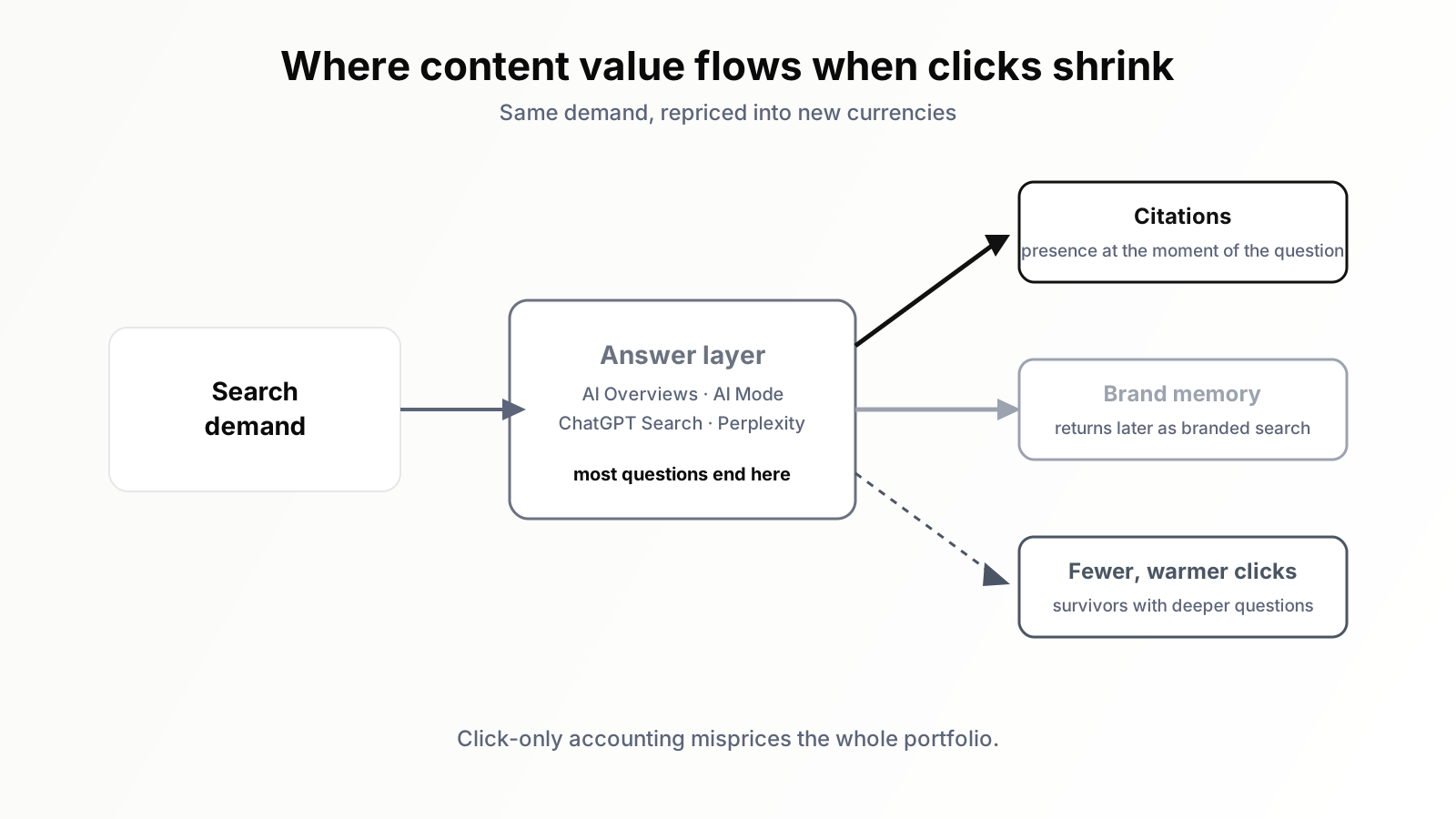
Job one: being the source. AI answers are not conjured from nothing; retrieval-based systems assemble them from content someone published, and they cite a subset of those sources. Citation is the most direct successor to ranking — a visibility slot at the exact moment of the question, awarded to content that is retrievable, extractable, and trusted. It pays in two ways: a thinner-but-warmer stream of referral clicks from users whose questions outgrow the answer box, and name-level exposure that compounds into recognition. The competitive logic of earning these slots is the subject of citations are the new rankings and, tactically, of our complete guide to AI Overviews. The economic point: this job is growing exactly as fast as the click job shrinks, because they are the same demand, repriced.
Job two: manufacturing memory. When a user reads an AI answer in which your brand appears — as a cited source, a named option, a recommended tool — no click occurs, but something economically real does: a memory trace. Repeated across months, those traces become familiarity, and familiarity becomes the branded search, the direct visit, the "I've heard of them" in a buying committee. This was always how most marketing worked; search was the unusual channel in paying out immediately and measurably. Zero-click search behaves like advertising: you pay in content, you are paid in future demand. The measurement implications are large enough that we gave them their own piece — brand search is the new organic KPI.
Job three: converting the survivors. Clicks have not gone to zero; they have gone selective. The visitor who clicks through an AI answer has, by definition, a question deeper than the synthesis could satisfy — they are researching seriously, comparing, or ready to act. Content's third job is to be worth that visit: deep, specific, opinionated, useful beyond what a model can compress into eighty words. The practical consequence inverts a decade of habit. Volume strategies built on shallow coverage of high-frequency questions are the content equivalent of subprime assets — their yield came entirely from clicks, and the clicks are gone. Depth strategies, which always converted better per visit, now also defend better against absorption.
Job four: proving expertise to machines and committees. A body of published work is an evidence base. Human buyers use it that way late in their journey — they binge an archive in a weekend before a demo. Machine systems use it that way continuously: consistent, accurate, attributed coverage of a topic is how a domain comes to be treated as an authority worth retrieving from at all. This job pays nothing per piece and a great deal per archive; it is the reason coherent topical clusters outperform scattered hits even when no individual post seems to "perform."
Job five: feeding owned channels. The final job is the hedge. Every reader converted from rented surfaces — search, social, AI answers — into owned ones — email, community, product — is a reader the next platform shift cannot take away. Content remains the only scalable bait for that conversion. In portfolio terms, owned-audience capture is the put option you buy against further deterioration in every rented channel, and its price has never been more obviously worth paying.
What this does to the funnel
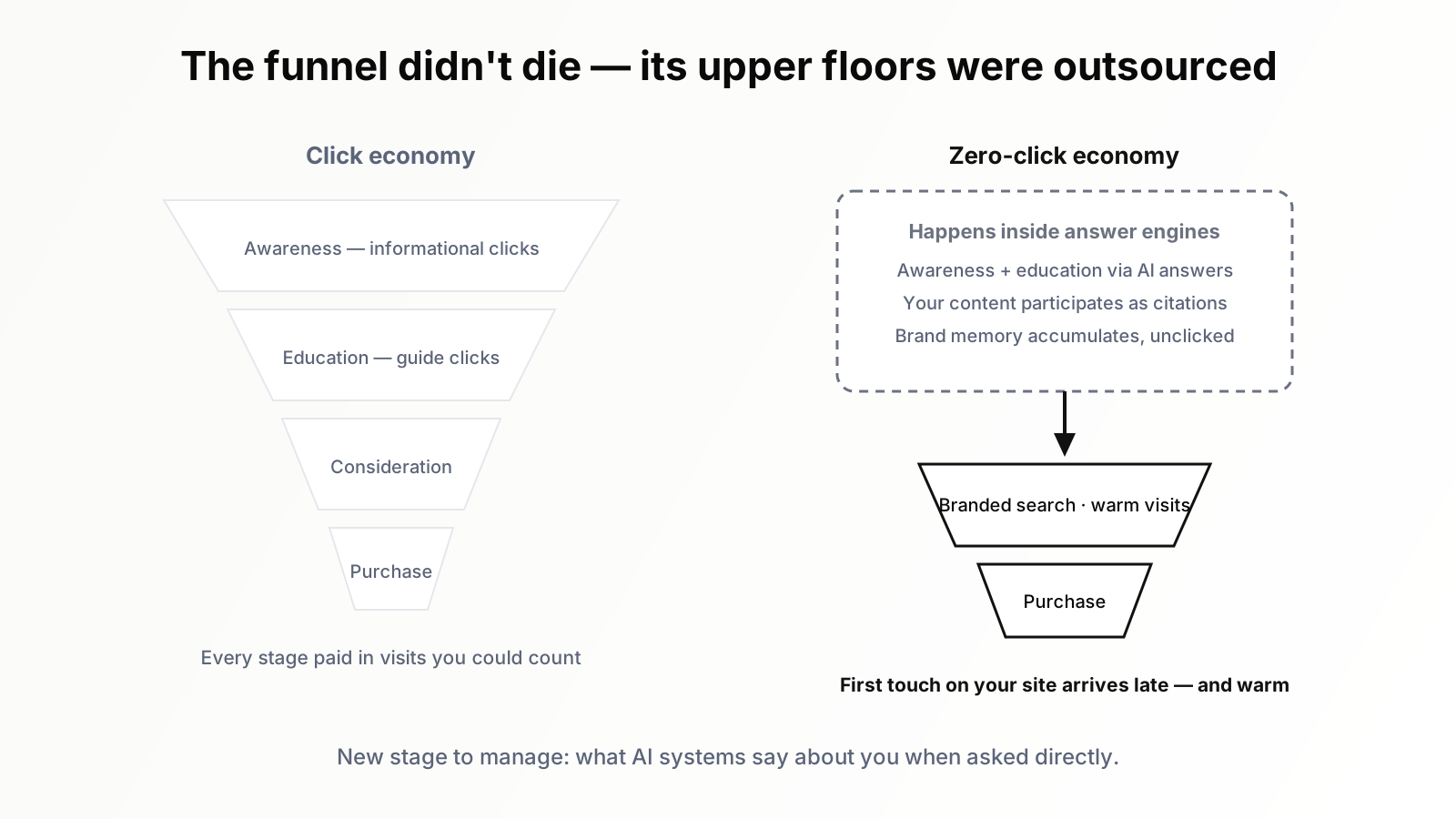
The classic content funnel assumed a staircase of clicks: broad informational visit, retargeting or email capture, consideration content, conversion. The zero-click economy compresses the top of that staircase into surfaces you do not own. The user's awareness phase and much of their education now happen inside answer engines — your content participating anonymously or semi-anonymously via citations — and the first time they touch your property may be remarkably late: a branded search, a pricing page, a comparison query with your name already in it.
This is not the death of the funnel; it is the outsourcing of its upper floors. And it changes the marginal value of content types in ways worth stating bluntly. Top-of-funnel definitional content — "what is X" — still matters, but its payout has moved almost entirely from clicks to citations and memory; produce it to be the source, not to harvest visits, and notice that the impressions-up-clicks-flat pattern in Search Console is this repricing showing up in your data, as we unpacked in the GSC impressions piece. Mid-funnel comparison and evaluation content gains value, because it serves the survivors — the high-intent clickers — and because answer engines lean on it when users ask "X vs Y" and "best tool for Z" questions with names attached. Bottom-funnel content — pricing transparency, documentation, implementation guides — quietly becomes the most defensible asset class: machines cite it as ground truth about your product, and humans who reach it are closest to money.
One genuinely new floor gets added: answer-shaped reputation. What AI systems say about you — when asked directly about your product, your category, your claims — is now a funnel stage, and it is influenced by the entire public record: your content, your reviews, your documentation, what others publish about you. Monitoring and shaping that layer is new work that did not exist five years ago and that classic SEO accounting has no line item for.
Repricing the portfolio: what to produce now
If the five jobs above are the new payout structure, a rational content portfolio rebalances toward what they reward. Four shifts follow directly from the analysis.
From coverage to citability. The marginal blog post that restates known information for a high-volume keyword has lost its economic basis. The marginal asset that earns citations — original data, primary research, definitive how-tos, honest comparisons, clearly attributed expertise — has gained. A team that used to publish twelve adequate posts a month is better served publishing four citable ones and spending the difference on the research that makes them citable. Notably, "citable" and "good for humans" converge almost completely; the formats that retrieval systems extract are explored in our guide to answer-first content, and none of them degrade the human reading experience.
From traffic capture to demand creation. Click-economy content strategy was fundamentally extractive: demand existed, you intercepted it. Zero-click strategy is necessarily generative: you put ideas, names, and framings into circulation — through cited content, through distribution on platforms, through the answer layer — and harvest the demand later as branded search and direct visits. This is a longer loop with worse attribution and higher compounding. Finance has a word for assets like that: equity, as opposed to the click economy's daily-settled cash.
From single-surface to multi-surface accounting. The same article now performs across Google's classic results, AI Overviews, ChatGPT Search, Perplexity, and whatever ships next quarter. Each surface pays differently — clicks here, citations there, memory everywhere — and a piece that looks dead on one surface may be earning steadily on another. Measurement has to follow: citation panels, AI-referral segmentation, branded-demand tracking, alongside the old click reports. Imperfect instruments, but imperfect instruments beat a precise gauge pointed at the wrong thing.
From defensive hoarding to deliberate exposure. A tempting response to absorption is withholding — block the crawlers, gate the content, starve the machines. As a blanket policy this mostly guarantees invisibility while competitors take the citations; as a targeted policy it has real uses for genuinely proprietary assets whose entire value is the information itself. The portfolio answer is granular: expose what earns presence, gate what sells. Most companies have far more of the former than the latter.
Three publishers, three repricings
The aggregate analysis hides how differently the zero-click economy treats different business models, so it is worth running the numbers for three archetypes.
The ad-funded informational site is the model in genuine structural trouble. Its revenue was a direct linear function of pageviews, and pageviews on absorbable queries are what AI answers consume most aggressively. The repricing options are all hard: shift toward content too deep, too current, or too interactive to absorb; convert anonymous readers into subscribers and newsletter audiences while there are still readers to convert; license content or data to the platforms doing the absorbing, where that market exists. What does not work is continuing to publish absorbable content at volume and hoping. For this archetype, the five jobs framework is cold comfort — jobs two through five assume there is something beyond attention to sell.
The B2B SaaS company — the archetype most of our readers inhabit — is, perhaps surprisingly, a net beneficiary if it adapts. Its content was never really monetised by clicks; clicks were a proxy on the way to pipeline. The zero-click economy removes the proxy but leaves the pipeline mechanics intact: buyers still research, still build shortlists, still arrive with names in their heads. A SaaS content program repriced around citations, branded demand, and survivor conversion loses vanity traffic and keeps — often improves — the part that was ever connected to revenue. The catch is internal: the team must re-educate every stakeholder who learned to read the old traffic chart, before that chart's decline triggers a budget cut that destroys the program right as it is working.
The local or service business experiences the mildest version. Its queries — near me, opening hours, quotes, availability — were already heavily absorbed by maps and profile surfaces, and its conversion events (calls, bookings, visits) never depended on blog clicks. For this archetype the zero-click playbook is mostly about structured accuracy: business data, reviews, and service content that machines can quote correctly, because the machine's answer effectively is the storefront now.
The general law across all three: the closer your revenue sat to the click itself, the more violent the repricing; the further downstream your revenue, the more the change is a measurement problem rather than a business-model problem.
Running the transition without burning the budget
For teams making the shift, sequence matters, because the old metric will fall faster than the new ones rise. A workable cadence: spend the first quarter instrumenting — branded-query segmentation in Search Console, AI-referral identification in analytics, a weekly citation panel across your priority questions — so the new value is visible before anyone is asked to believe in it. Spend the second quarter rebalancing production toward citable assets and survivor-grade depth while explicitly sunsetting the shallow-coverage cadence, and say out loud which old numbers will drop as a result. By the third quarter you have two readable trendlines — citations and branded demand — to defend the program with, and a portfolio whose payouts match the surfaces that actually exist. Teams that skip the instrumentation quarter end up arguing for the new strategy with no evidence, against a falling chart. That argument loses.
The honest objections
An analysis this side of cheerleading has to grant the costs. First, the compensation is unequal. Publishers whose business was the click — ad-funded informational sites — are not compensated by brand memory; they are simply poorer, and the open web loses something real when their economics fail. The repricing argument works far better for businesses that sell something beyond attention. Second, attribution gets worse before it gets better: the new payouts are slower and noisier, and teams will have to defend content budgets through a transition where the old metric falls before the new ones visibly rise. Anyone promising a clean dashboard through that valley is selling something. Third, platform risk concentrates. When presence inside answer engines becomes the primary distribution, the engines' policies — about attribution, about crawling, about which sources they trust — become existential variables you do not control. The owned-audience hedge in job five is not optional precisely because of this.
These objections shape the strategy; they do not reverse it. There is no configuration of stubbornness that brings the old click volumes back. The choice available is between being absorbed with attribution or absorbed without it, and between measuring the new value or flying blind while it accrues to competitors.
What content is for
So, the answer to the title question. In the zero-click economy, content is for being findable by machines, memorable to humans, and convincing to the few who arrive. It is the raw material of the answer layer, the advertising you pay for in expertise instead of money, the evidence file for your authority, and the bait for the audience you actually own. None of those jobs is new. What is new is that they are no longer subsidised by a river of easy clicks — they have to be chosen, produced for deliberately, and measured on their own terms.
The teams that struggle over the next few years will be the ones still running click-denominated books on a citation-denominated market. The teams that come out ahead will be the ones that repriced early, rebuilt their measurement around presence and branded demand, and kept publishing the kind of work machines cite and people remember. The bookkeeping for that new economy — tracking citations across engines, segmenting AI referrals, watching branded demand move — is mechanical work that platforms like Orova now automate, which leaves the genuinely human part of the job exactly where it always was: knowing something worth saying, and saying it better than anyone else in the room.
Let Orova SEO handle the repetitive part
Keyword research, drafting, refreshing old posts and rank tracking — running automatically on your own site.
Explore Orova SEO