
AI SEO Tools: Six Jobs Sold as One Category
The phrase AI SEO tools now covers products that do almost nothing alike. One writes articles. One rewrites the pages you already have. One tells you which keywords to target. One audits technical issues. One monitors whether language models mention your brand. They are sold as a category and they solve different problems, which is why so many teams end up with three subscriptions and no improvement.
This article sorts the category into the jobs it actually does, says which of those jobs genuinely benefits from automation and which does not, and describes what happens when you get it wrong — because getting it wrong in SEO leaves artefacts on your domain that outlast the subscription.
What do AI SEO tools actually do?
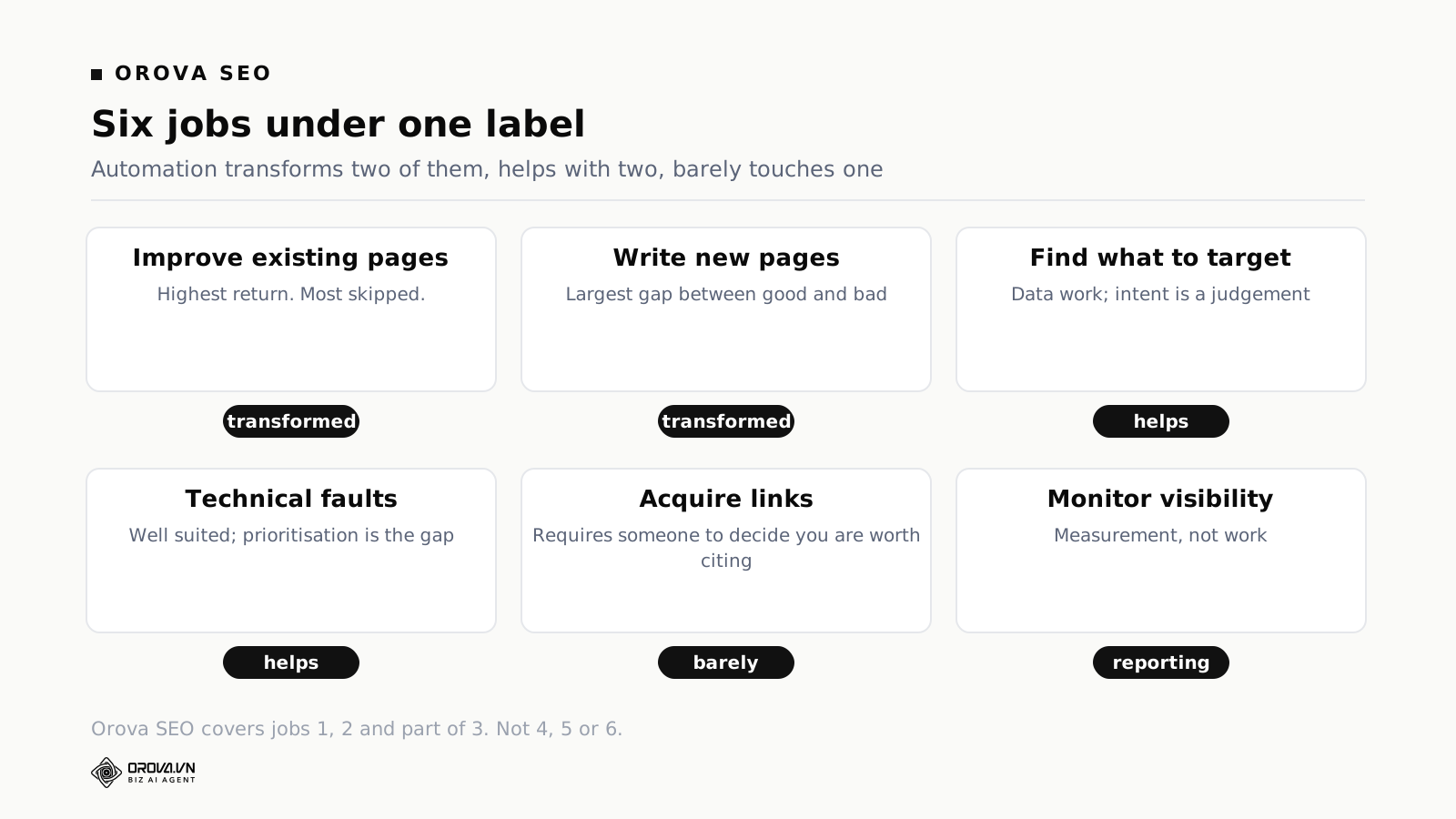
Six distinct jobs: finding what to target, writing new pages, improving pages that already exist, finding technical faults, acquiring links, and monitoring visibility. Automation transforms the second and third, helps with the first and fourth, barely touches the fifth, and is mostly reporting in the sixth. Most products cover two of the six properly and mention the rest.
The six jobs, ranked by what automation actually changes
1. Improving pages you already have
Ranked first because it is the highest-return job and the one most often skipped. Every site of any age has pages that nearly rank — page two, position eleven to twenty — where the topic is right and the execution is thin. Fixing those is cheaper than writing new ones and the results arrive faster, because the page already has history.
It gets skipped because it is unrewarding work. Nobody feels productive editing an old page, and there is no publishing moment. This is exactly why automation helps: the work is repetitive, high-volume, and mechanical enough to batch, and the tools that do it well can process a spreadsheet of URLs rather than one page at a time.
If you buy one thing in this category, buy the thing that does this. It is also the job most likely to be missing from a product that leads with content generation.
2. Writing new pages
The job automation changed most visibly, and the one with the largest gap between good and bad execution. A system that produces a competent, specific, genuinely useful article at volume is a real capability. A system that produces four hundred plausible articles about topics nobody needed is a liability that sits on your domain permanently.
Two features separate them. Whether you can define a brand voice that is actually applied rather than appended as an instruction — because generic output is recognisable and rewriting it is where the saving disappears. And whether the source material can include documents you control, so the writing draws on what your company actually knows rather than only on general knowledge.
3. Finding what to target
Keyword research is data work, and automation helps by processing more of it. What it cannot do is judge intent, which is the part that matters. A term with volume and a term worth writing for are different sets, and the difference is a judgement about who is searching and what they want.
This is where tools produce the most confident nonsense: a list of high-volume terms with no consideration of whether the searcher is a buyer, a student, or someone looking for a definition. Volume without intent produces traffic without outcomes, and traffic without outcomes is the most common way SEO programmes fail while appearing to succeed.
4. Finding technical faults
Crawling a site and listing problems — broken links, missing tags, slow pages, duplicate content, indexing issues. Automation is well suited to this and has been for years; the newer additions are mostly better prioritisation of what to fix first.
The limit is that most technical audits produce hundreds of issues, of which perhaps five matter. A tool that reports everything without ranking it by likely impact has moved the work rather than done it, and the usual outcome is a document that gets filed. Ask to see how a product decides what is urgent.
5. Acquiring links
Automation helps least here and the tools are mostly databases plus outreach sequencing. The reason is structural: getting someone to link to you requires them to decide your page is worth citing, and that decision is not automatable. Automated outreach at volume is also the most likely activity in this list to damage your reputation, because the recipients are the people whose opinion you needed.
6. Monitoring visibility
Rank tracking, and increasingly whether language models mention your brand when answering relevant questions. This is measurement rather than work — useful for knowing whether anything is happening, and not itself an improvement. Worth having, worth paying little for, and worth being sceptical of any product whose main value is the dashboard.
The failure mode specific to SEO automation
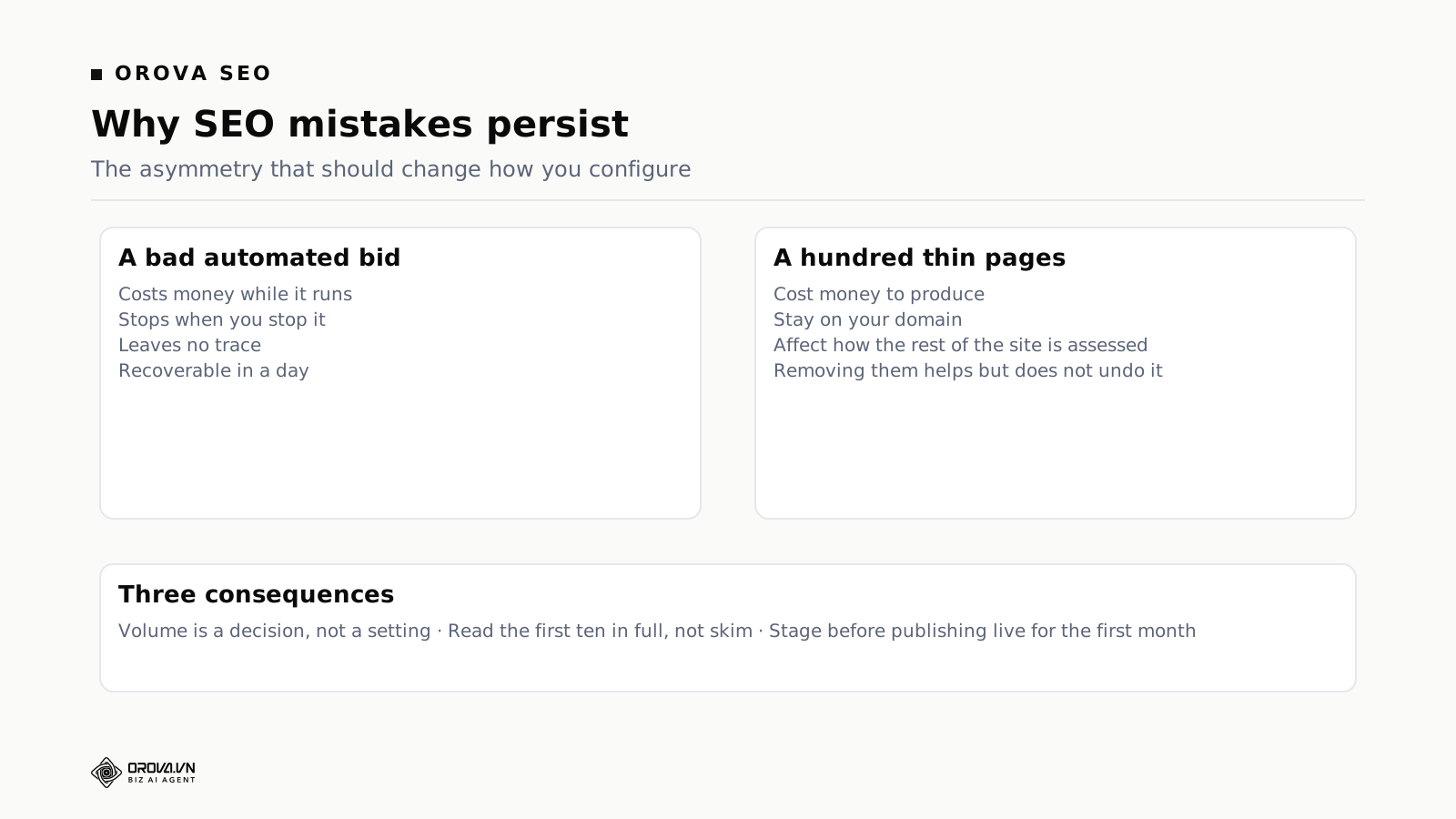
Every automation category has a characteristic risk. In advertising, a bad automated decision costs money and stops when you stop it. In SEO, the mistakes persist.
A hundred thin pages published over a month do not simply fail to rank. They sit on your domain, and search engines assess sites partly as wholes, so a large volume of low-quality material can affect how the rest of the site is treated. Removing them later helps and does not fully undo it — you have spent the effort twice and gained nothing.
This asymmetry has three practical consequences for how you buy and configure.
Volume is a decision, not a setting. A tool that can publish two hundred articles a month will happily publish two hundred that nobody needed. The constraint has to come from you, and the right constraint is topic-by-topic rather than a monthly cap: does a reader searching this need a page that does not exist yet?
A review gate on the first batch is not optional. Read the first ten in full — not skim, read. You are checking for factual invention, for the generic register that signals machine output, and for whether the article answers the question it was written for. Ten articles is an hour and it calibrates everything after.
Publishing directly to a live site deserves more caution than it usually gets. It is the feature that closes the loop and produces the real saving, and it is also the feature that turns a configuration error into a permanent artefact. A staging step for the first month costs almost nothing.
How Orova SEO is built
Orova SEO covers three of the six jobs — writing, improving existing pages, and a research layer — and it is worth being specific about the shape, including what is absent.
Keywords load in bulk from a spreadsheet. There is a template for it, and the list is the input rather than something the tool decides for you. Keywords can be paused, resumed, edited in bulk, or run individually.
Articles are written in a brand voice you define. Voices are created per project and can be more than one, and the voice is a property of the project rather than an instruction appended to each request. Google Drive files can be attached and indexed as source material, so the writing can draw on documents your company controls rather than only on general knowledge.
Publishing goes directly to WordPress or to your own API endpoint. The WordPress connection is a proper target rather than an export, and the API option exists for sites that are not WordPress. This is what closes the loop between deciding to cover a topic and the page existing.
Existing URLs are optimised in bulk, also from a spreadsheet. URLs can be added manually or uploaded, given a purpose, and run individually or all at once, with an automatic mode available. This is the first job in the list above — the highest-return, most-skipped one — and it works on the same batch logic as the writing.
Competitors can be scanned and scored, there is a site health check, and there is an advisor that produces keyword targets you can download. Reports refresh and download.
The policy vocabulary is 8 conditions and 12 actions, from 19 starter templates, and every step consumes 20 quota — so the cost of a batch is known before you run it. Every plan includes every feature; tiers differ only in quota.
What it does not do
It does not build links, and it does not run outreach. It does not crawl your site the way a dedicated technical crawler does — the health check is not a substitute for a proper crawl of a large site. It does not do keyword research in the sense that a dedicated research tool does: there is no backlink index, no competitor keyword database of the kind Ahrefs or Semrush maintain, and no rank tracking history at that depth. If those are your requirement, this is the wrong tool and you should keep the research tool you have.
It also does not decide which topics deserve a page. That judgement — the intent question above — remains yours, and it is the one that determines whether the output is useful or a liability.
Judging output quality before you commit
Content quality is the hardest thing to evaluate from a demo, because a demo shows you the best article the vendor has. Four checks give you a real answer in about ninety minutes.
Pick a topic you know deeply and one you do not. Run both. The topic you know exposes factual invention, over-confident generalisation, and the specific tell of writing that has read about a subject rather than done it. The topic you do not know tells you how the output reads to a stranger — which is how most readers will encounter it.
Read for specificity, not for fluency. Fluency is solved and it is not a differentiator. What separates useful from filler is whether the article contains anything a reader could not have guessed: a number, a mechanism, a named trade-off, a situation where the obvious answer is wrong. Count those per thousand words. Filler has almost none and reads perfectly well.
Check the second half. Output quality frequently degrades after the introduction, because the opening is where the effort concentrates. Read the last third of an article carefully; if it restates the first third in different words, that is what your readers will find too.
Ask it to write about something where you have proprietary knowledge. This tests whether source material is actually used. If a system claims to draw on your documents, give it a document containing a fact available nowhere else and check whether the fact appears, correctly.
Two things not to bother testing: whether it can produce a long article — everything can — and whether it passes an AI detector, which is a proxy metric that correlates with nothing a reader cares about.
The intent judgement that decides everything
Automation makes producing pages cheap, and cheap production makes the topic decision the only decision that matters. Four questions before a keyword goes on the list.
Who is searching this, and what do they want next? "Marketing automation" is searched by students writing essays, by people comparing products, and by practitioners looking for a definition. A page can serve one of those well. Deciding which changes what you write; not deciding produces a page that half-serves three groups.
Would a reader be better off than before? A page that assembles what is already available in five other places is filler even when accurate. The question is whether you can say something specific — from your own data, your own operations, your own mistakes.
Does the term connect to anything you sell? Not directly, necessarily — the top of a funnel is legitimate. But a term with no path to a customer is traffic that costs money and produces nothing, and volume makes it tempting.
Is there already a page on your site for this? The most common self-inflicted wound in automated content is two or three of your own pages competing for the same query. Each one is individually reasonable. Together they split the signal and none of them ranks. Any batch process needs a check against what you already have, and it needs to be a check on the topic rather than on the exact string.
That fourth question deserves emphasis, because it scales badly. Ten articles are easy to keep track of. Four hundred, published over a year by a system, are not — and the overlap accumulates invisibly until someone audits it and finds eleven pages chasing four near-identical phrases.
A sensible first ninety days
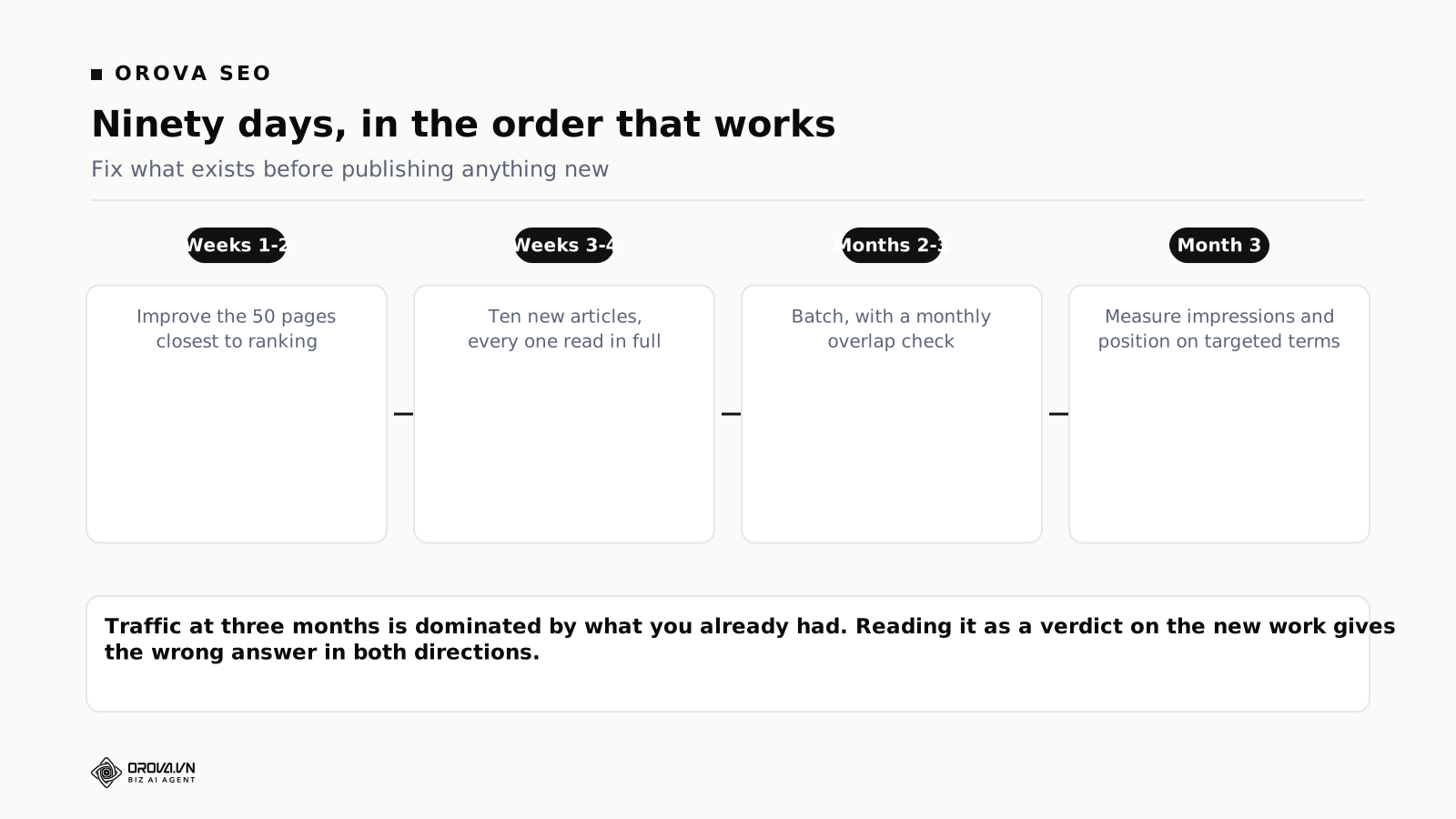
Weeks one and two: fix what exists. Before publishing anything new, take the fifty pages closest to ranking and improve them. This is the highest-return work available, it produces results faster than new content because the pages have history, and it teaches you what the tool's editing quality is like on material you already care about.
Weeks three and four: ten new articles, read in full. Chosen against the four intent questions above. Read every one before it publishes. Note what you had to change; that list is your configuration work.
Months two and three: batch, with a monthly overlap check. Now volume is reasonable, because you know what the output looks like and you have a topic-selection discipline. The overlap check is the new habit: before each batch, verify nothing on the list duplicates what you already published.
Month three: measure the right thing. Not traffic. Impressions and average position on the specific terms you targeted, and whether the improved old pages moved. Traffic at three months is dominated by whatever you already had, and reading it as a verdict on the new work produces the wrong conclusion in both directions.
Optimising an existing page: what actually gets changed
Since this is the job worth buying for, it is worth describing concretely, because "optimise" is doing a lot of work in most product descriptions.
Matching the page to the query it nearly ranks for. Pages drift. An article written for one purpose ends up ranking on page two for something adjacent, and the page never quite answers that adjacent question. The highest-return edit is often adding a section that answers it directly and adjusting the opening to acknowledge it.
Fixing the first hundred words. A large share of older pages open with context-setting that delays the answer. Readers who wanted the answer leave, and the signals that follow from that are not helpful. Moving the answer forward is a small edit with a disproportionate effect.
Adding what the page assumes. Articles written by someone with expertise routinely skip the step that a reader needed. Finding those gaps is the part automated editing does surprisingly well, because it does not share the author's assumptions.
Consolidating rather than editing. Sometimes the right change is merging three weak pages into one good one and redirecting. This is the edit tools handle worst, because it requires a decision about which page survives — and it is frequently the correct answer for a site with years of accumulated content.
Internal links from pages that have authority. Unglamorous, mechanical, and effective. A page nobody links to internally is a page you have decided is unimportant, whatever you intended.
Notice that only the last two are really mechanical. The first three require reading the page against a query and forming a view, which is why the quality difference between products on this job is larger than on generation — and why testing it on your own pages is the check that matters.
Measuring an SEO programme without fooling yourself
Three habits, because this is the area where reporting most often flatters.
Separate branded from unbranded. Searches for your company name grow when anything else in marketing works, and they will make an SEO programme look successful whether or not it is. Every honest SEO report splits them, and reports that do not are usually not hiding it deliberately — they are just using the default view.
Report on the terms you targeted, by name. Not total traffic. You made a list; measure against the list. Total traffic includes everything you were already receiving, and at three months it dominates the numbers so completely that the new work is invisible in it.
Watch position before traffic. Position moves first, then impressions, then clicks, then whatever the visitor was supposed to do. A programme working correctly shows movement in that order over months, and judging it on the last metric at week six produces a cancellation of something that was working.
One number worth keeping alongside: the share of your published pages that receive any search traffic at all. In sites with automated content this number tends to fall quietly as volume rises, and it is the earliest indicator that production has outpaced usefulness. If half your pages have never received a visitor, more pages is not the answer.
When you should not buy anything here
Three situations.
Your site has technical problems that prevent indexing. Content published into a site search engines cannot crawl properly is money spent on pages nobody will find. Fix the crawl first; it is usually a smaller job than it sounds and it is a prerequisite rather than a parallel task.
You have no way to judge quality. If nobody on the team can read an article and say whether it is genuinely useful in your field, automated production will produce plausible material at volume and you will have no mechanism to catch the failures. The judgement is the control system; without it, volume is a risk rather than a benefit.
The visitor has nowhere to go. If the pages that would receive this traffic do not lead anywhere — no clear next step, no offer, nothing to do — then traffic is a cost. Fix the destination before increasing the flow to it, because the alternative is a successful SEO programme with no business result, which is a genuinely common outcome and an expensive one.
What automation does not change about SEO
Four things, and each accounts for a share of the programmes that produce volume and no results.
It does not make a thin topic worth covering. If nobody needs a page on something, a better-written page on it is still unnecessary. The judgement precedes the production, and no tool makes it.
It does not earn links or citations. Pages get referenced because somebody decided they were worth referencing, and that decision responds to genuine usefulness. Volume without anything worth citing produces a large site nobody links to.
It does not fix a site nobody can crawl. Publishing into a site with broken architecture, orphaned pages, or indexing problems produces content that exists and is not found. The technical layer is a prerequisite, not a parallel workstream.
It does not change what happens after the click. Traffic to a page that does not convert is a cost. This is the most common quiet failure: a programme that succeeds on every SEO metric and produces no business result, because nobody looked at what the visitor was supposed to do next.
The pattern across all four is the same. Automation compresses production, and production was never the constraint for most sites — judgement, usefulness, and the destination were. Compressing production while leaving those untouched produces more of what was already not working.
The overlap audit, and how to run one
Since cannibalisation is the characteristic failure of automated content, it is worth having a procedure rather than a vague intention.
Export every page with its primary target. If you never recorded a target per page, that is the first finding — and reconstructing it from the content is the work. Half an hour with a spreadsheet.
Group by topic rather than by exact phrase. This is where naive checks fail. Two pages targeting different strings can be after the same thing, and search engines resolve them as competitors regardless of the strings you had in mind. Group by the question a reader is asking.
For each group with more than one page, pick the survivor. Usually the one with the most history, the most links, or the best content — and often not the newest. Then decide for each of the others: merge into the survivor and redirect, or narrow its focus to a genuinely distinct question.
Do the merging before writing anything new on that topic. Adding a fourth page to a group of three makes the group worse, and automated systems will happily do it because the keyword looked unclaimed.
Run this once before starting automated production, and once a quarter afterwards. In an established site the first run typically finds several groups, and resolving them produces movement without any new content at all — which is a useful thing to discover before committing to a volume programme.
A note on what search is becoming
Worth addressing because it changes the calculation, and because the category's marketing has got ahead of what is known.
Answers are increasingly delivered on the results page or inside a language model, without a click. That is real and it is measurable in falling click-through at stable positions. What it means for a content programme is genuinely uncertain, and anyone claiming otherwise is guessing with confidence.
Two things do seem defensible. Pages that exist to deliver a fact that a model can state in a sentence are worth less than they were, because the click no longer needs to happen. And pages containing something a model cannot reproduce — original data, a specific process, an account of what happened when you tried something — retain their value and possibly gain, because they are what gets cited rather than summarised.
The practical implication for buying is a bias toward capability that helps you say something specific, and away from capability that helps you say the general thing at volume. Which happens to be the same advice as the rest of this article, arrived at from a different direction: the constraint is having something worth publishing, and automation is only valuable to the extent that it removes friction from publishing it.
Buying advice by situation
Rather than a ranking, four situations and what each one should do.
An established site with a few hundred pages and stalled traffic. Buy the optimisation capability, not the generation capability. Your gains are in the pages that already nearly rank, and there are probably fifty of them. Spend three months there before writing anything new.
A new site with almost no content. You need volume and you are the most at risk from the persistence problem, because a new domain with a hundred thin pages starts from a worse position than one with ten good ones. Write fewer, read them all, and prioritise topics where you can say something specific.
An agency producing content for clients. Your requirements are voice management across many brands, and per-client separation of source material and publishing targets. The generation quality matters less than whether you can keep twelve voices distinct without twelve configurations.
A team whose problem is technical rather than editorial. Buy a crawler, not a writer. Products in this category with a "health check" are not substitutes for a proper technical crawl of a large site, and buying a content tool to fix an indexing problem is the most expensive way to not solve it.
Six questions for a demo
- Show me it improving an existing page of mine. Not writing a new one. This is the capability most likely to be thin and the one worth most.
- Define a brand voice and show me two articles in it. Then show me the same topic in a different voice. If they read the same, the voice is decoration.
- Attach a document containing a fact available nowhere else and show me that fact appearing correctly in an article.
- Publish to a staging site, then to a live one. Watch the whole path, including how to stop it.
- Show me what happens when two keywords on my list are near-duplicates. Does the system notice?
- What does a batch of fifty cost, exactly, before I run it? Predictable cost is what makes volume a decision rather than a surprise.
What good looks like after six months
Four signs.
The old pages moved. If the optimisation work was done first and properly, positions on existing pages improved within two to three months. This is the fastest available signal and the one that tells you the tool's editing is real.
You can name the topics you decided not to cover. A team publishing everything the tool suggests has no topic discipline, and the overlap problem is accumulating quietly. A list of rejected topics is evidence of judgement being applied.
Nobody rewrites the output substantially. If every article needs an hour of editing, the saving has evaporated and you have bought a first-draft generator. Either the voice configuration is wrong or the product is not good enough for your standards, and both are worth diagnosing rather than tolerating.
Somebody deleted or consolidated a page. Pruning is a sign of ownership. Sites that only grow accumulate overlap, and the overlap is invisible until it is a hundred pages deep.
A word on images and formatting
Two parts of the publishing loop get overlooked in product comparisons and reliably cause the stalling described above.
Images are the more common culprit. An article without illustration is publishable and worse, and finding or making images is a task that belongs to nobody in most small teams. It is also the step where content queues form: eleven articles written, none published, because each needs a picture. Any evaluation should include what happens about images, even if the answer is that you handle it separately — knowing that in advance is better than discovering it with a backlog.
Formatting is the quieter one. Content arriving as a document still needs to become a page: headings in the right structure, links working, tables rendering, the whole thing looking like the rest of the site. A tool that publishes into your platform handles this; a tool that hands you text does not, and the person who does it is usually the one with least time.
Neither is glamorous and both determine throughput more than generation quality does past a threshold.
What the saving actually is
It is worth being precise about where the time goes, because the expectation is usually wrong in a specific way.
Writing an article was never the whole cost. For a team producing content manually, the sequence is: decide the topic, research it, write it, edit it, find or make images, format it for the site, publish it, and add internal links. Writing is perhaps a third of that, and the parts either side are the ones that make content programmes stall — not because they are hard but because they are boring and fall between roles.
A tool that only writes therefore removes a third and leaves the stalling in place. What changes a team's output is closing the whole loop: topic list in, published page out, with the formatting and publishing handled. That is why direct publishing matters more than generation quality beyond a threshold — a good article that needs someone to format and upload it still waits for that person.
The corollary is where the remaining human time should go. If production is compressed, the freed hours belong in the two places automation cannot reach: deciding what deserves a page, and making sure the page leads somewhere. Teams who reinvest the saving into more volume get more of what was already not working. Teams who reinvest it into topic judgement and destination quality get the compounding version.
None of which is visible in a product comparison, and it is the difference between programmes that work and programmes that produce impressive publishing statistics.
The short version
AI SEO tools cover six different jobs: improving existing pages, writing new ones, finding what to target, technical auditing, link acquisition, and visibility monitoring. Automation transforms the first two, helps with the third and fourth, barely touches the fifth, and is mostly reporting in the sixth.
Buy the first job before the second. Improving pages that nearly rank is the highest-return, most-skipped work, it returns faster because the pages have history, and it is the capability most likely to be missing from a product that leads with generation.
The risk specific to this category is persistence: a bad automated bid stops when you stop it, and a hundred thin pages stay on your domain. So volume is a decision rather than a setting, the first ten articles get read in full, and every batch gets checked against what you already published — because the most common self-inflicted wound is your own pages competing with each other.
And keep the boundary in view. Automation compresses production, and production was rarely the constraint. Judgement about which topics deserve a page, whether the page says anything a reader could not have guessed, and what the visitor is supposed to do next — those remain yours, and they decide whether the output is an asset or a liability.
One caution about the phrase itself, since it is presumably what brought you here, and since it is doing more marketing work than descriptive work. "AI SEO tools" describes how a product works rather than what it does for you, and buying by mechanism rather than by job is how teams end up with three overlapping subscriptions. Name the job first — improving old pages, publishing new ones, finding what to target, fixing crawl faults — and the shortlist writes itself, usually to one or two products rather than the four a comparison article would suggest.
Related reading: why most "alternatives to X" pages get it wrong, the zero-click economy and what content is for now, and use-case pages, an underrated SEO asset. If the job you need is the first one — improving the fifty pages that nearly rank, in bulk from a spreadsheet, publishing straight back into WordPress or your own endpoint — that is what Orova SEO is built around, and you can see it at orova.vn. If what you need is a backlink index or rank tracking at depth, keep the research tool you already have; this does not replace it and is not trying to.
Improve the pages that nearly rank
Orova SEO optimises existing URLs in bulk from a spreadsheet and writes new pages in a brand voice you define, publishing straight into WordPress or your own API endpoint.
See it work