
Automated Resume Screening Tools: Reading vs Matching
AI resume screening tools occupy an awkward position: they promise to solve the most expensive part of hiring, and the category contains both genuinely useful systems and keyword matchers with a new label. From the outside the two are almost indistinguishable, because both produce a ranked list and a number beside each name.
This article is about telling them apart. What the reading problem actually is, what a system has to do to genuinely address it, the specific ways these tools go wrong, and how to test one against your own applications before you trust it with a shortlist.
What do AI resume screening tools actually do?
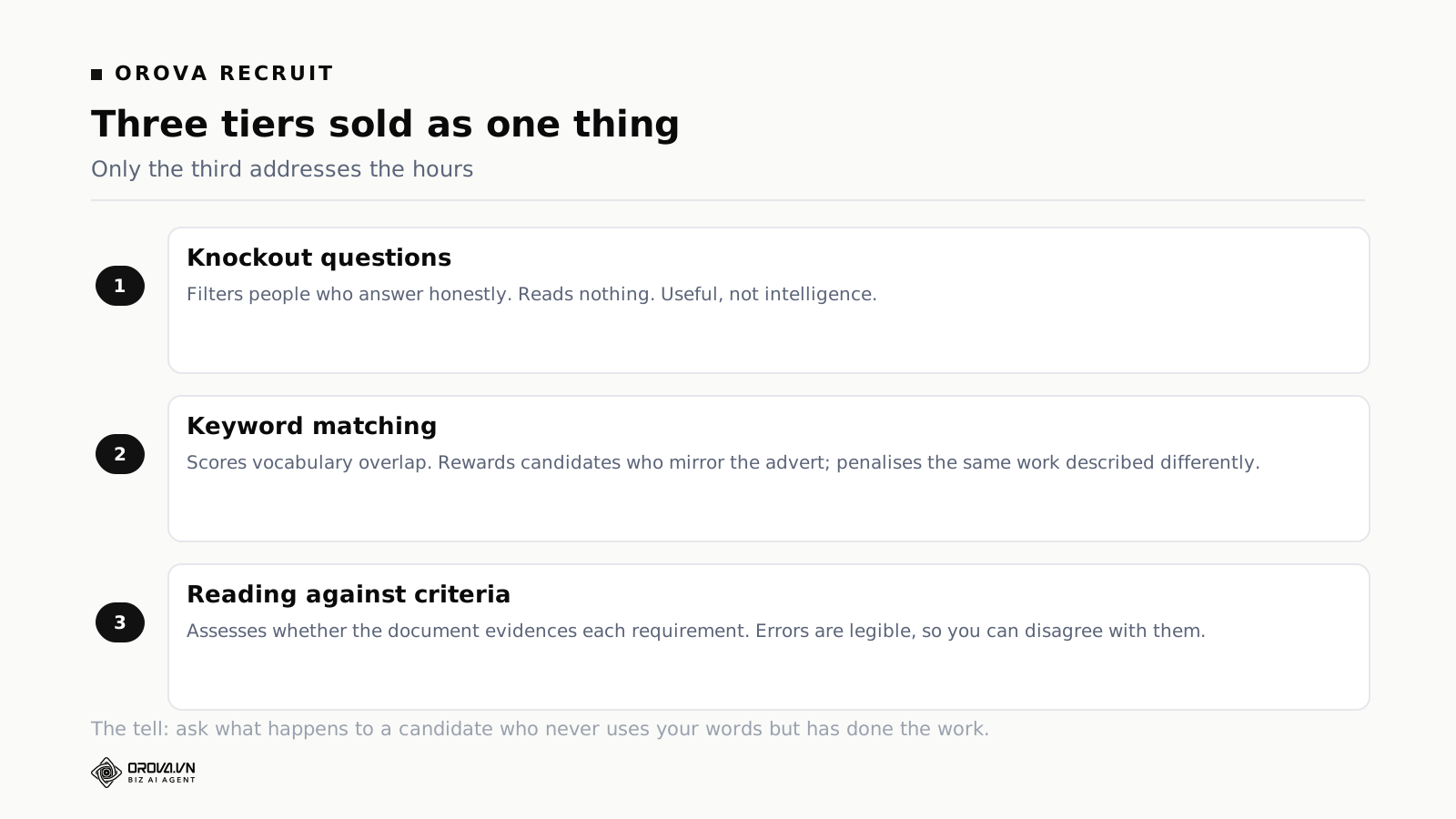
The useful ones read each application against criteria derived from the role and return an outcome with a reason — appears to meet requirement X, no evidence of Y. The rest filter answers to form questions, or score how closely a CV's vocabulary matches the advert. Only the first changes how long reading takes.
The problem being solved, stated properly
A competitively advertised role in a healthy market produces somewhere between one hundred and four hundred applications. At ninety seconds each — fast, and faster than most people manage while being fair — two hundred applications is five hours before anyone has spoken to a human being.
Five hours is the visible cost. The invisible one is worse: the quality of that reading degrades sharply across the pile. The first forty get a careful look. The last forty get the top third of page one. Candidates late in the pile are not being assessed against the role; they are being assessed against the reader's remaining patience.
Every hiring manager knows this happens. Almost nobody builds a process that accounts for it, and the usual accommodation — reading in several sittings — helps with fatigue while introducing a different problem, because standards drift between sessions and the pile is no longer being judged consistently.
So the real ask of a screening tool is not speed. It is consistency: that the two-hundredth application receives the same quality of consideration as the second. A tool that is fast and inconsistent has automated the failure.
The three tiers, and how to tell which you are being sold
Knockout questions
Form questions with disqualifying answers. Right to work, minimum experience, salary band, willingness to relocate. These are useful and they are not screening — they filter people who answer honestly, and they do not read anything. A candidate whose experience is unconventional but relevant is filtered out by a years-of-experience question as effectively as someone unqualified.
Worth having. Not worth paying for as intelligence.
Keyword matching
The CV is compared against the job description and scored on overlap. This is the tier that does real damage, for a reason worth stating precisely: it is wrong in a direction that is invisible to the person reading the output.
Two candidates describe the same work. One uses the vocabulary of your industry, the other uses the vocabulary of the industry they came from. The second scores lower, and nothing in the output indicates why. Meanwhile a candidate who has learned to mirror job adverts — a skill with a large instructional literature behind it — scores high without the underlying capability.
The result is a shortlist selected for phrasing. And because a number was produced, the number carries authority that a human's uncertain impression would not have.
The tell in a demo: ask what happens to a candidate who never uses the words in your job description but has done the work. If the answer involves adding synonyms to a list, you are looking at keyword matching with extra configuration.
Reading against criteria
The system works from criteria — the requirements of the role, stated separately from the advert's phrasing — and assesses whether the document provides evidence for each. The output is not a similarity score but a set of judgements with reasons.
This is the tier worth paying for, and it has its own failure mode: it can be confidently wrong in more sophisticated ways, inferring capability from a job title or missing a requirement that was demonstrated obliquely. The difference is that its errors are legible. A reason you can read is a reason you can disagree with.
What a system has to include to be worth trusting
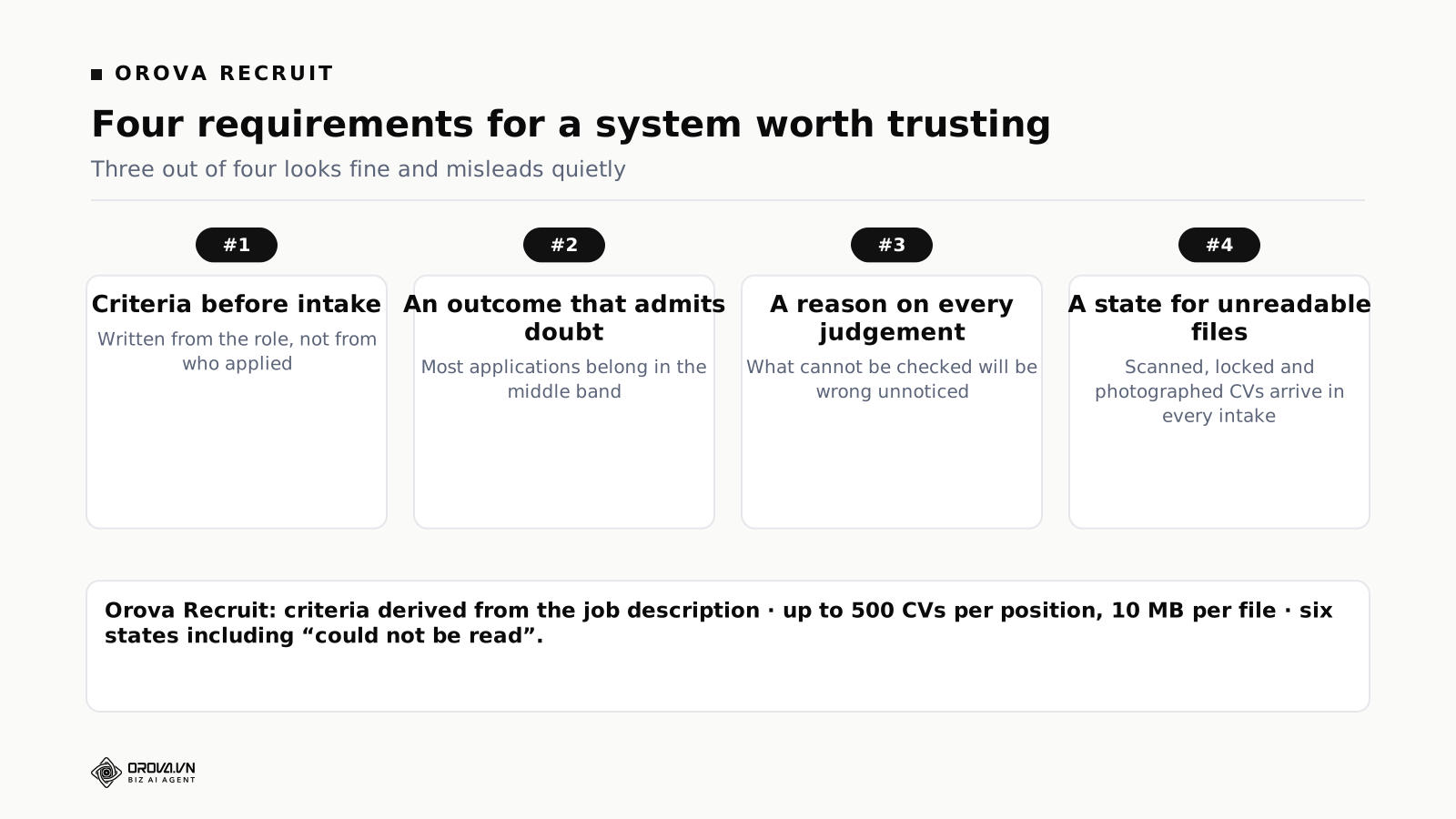
Four requirements. All four, together — three out of four produces a tool that looks fine and misleads quietly.
Criteria that existed before the applications
If criteria are written after reading forty CVs, they are shaped by who applied rather than by the role. Worse, they tend to encode the strongest candidate seen so far, which turns the assessment into a similarity search against one person.
Criteria derived from the job description, before intake, are the only defence. They also make rejection letters writable: "we were looking for hands-on experience with X and your background is stronger in Y" is a sentence that only exists if you decided what you were looking for in advance.
An outcome that admits uncertainty
A binary yes or no on a document is a lie about how much a document tells you. Most applications sit in a middle band — not obviously right, not obviously wrong, worth twenty minutes if the top of the pile thins out. A system that forces those into a binary either wastes interview slots on the wrong people or discards good candidates without anyone noticing.
Three outcomes is the minimum honest set: meets the criteria, worth considering, does not meet. The middle band is where most of the value hides, because that is where a human reading adds something an automated one cannot.
A reason attached to every outcome
A score without an explanation cannot be checked, and anything that cannot be checked will eventually be wrong without anyone noticing. This is not a transparency principle for its own sake — it is the mechanism by which you find out the system has misunderstood a requirement.
Read twenty reasons from a real run and you will learn more about a product than from any demo. You will also find its systematic errors, which every system has: a requirement it consistently reads too literally, a kind of career history it consistently undervalues.
An explicit state for documents that could not be read
Scanned CVs. Password-protected PDFs. Files that are photographs of a printed page. CVs laid out entirely inside a graphic, with the text as pixels. These arrive in every real intake, and they are not correlated with candidate quality — they correlate with what device someone had access to.
A system with nowhere to put them puts them somewhere, and where they usually go is the bottom of the ranking or the rejection pile, silently. Naming the state is the difference between a candidate being assessed and a candidate being lost to a file format. Ask about this specifically; the answer is revealing about how much real intake the product has seen.
How to test one against your own applications
This is the only evaluation that tells you anything, and it takes an afternoon.
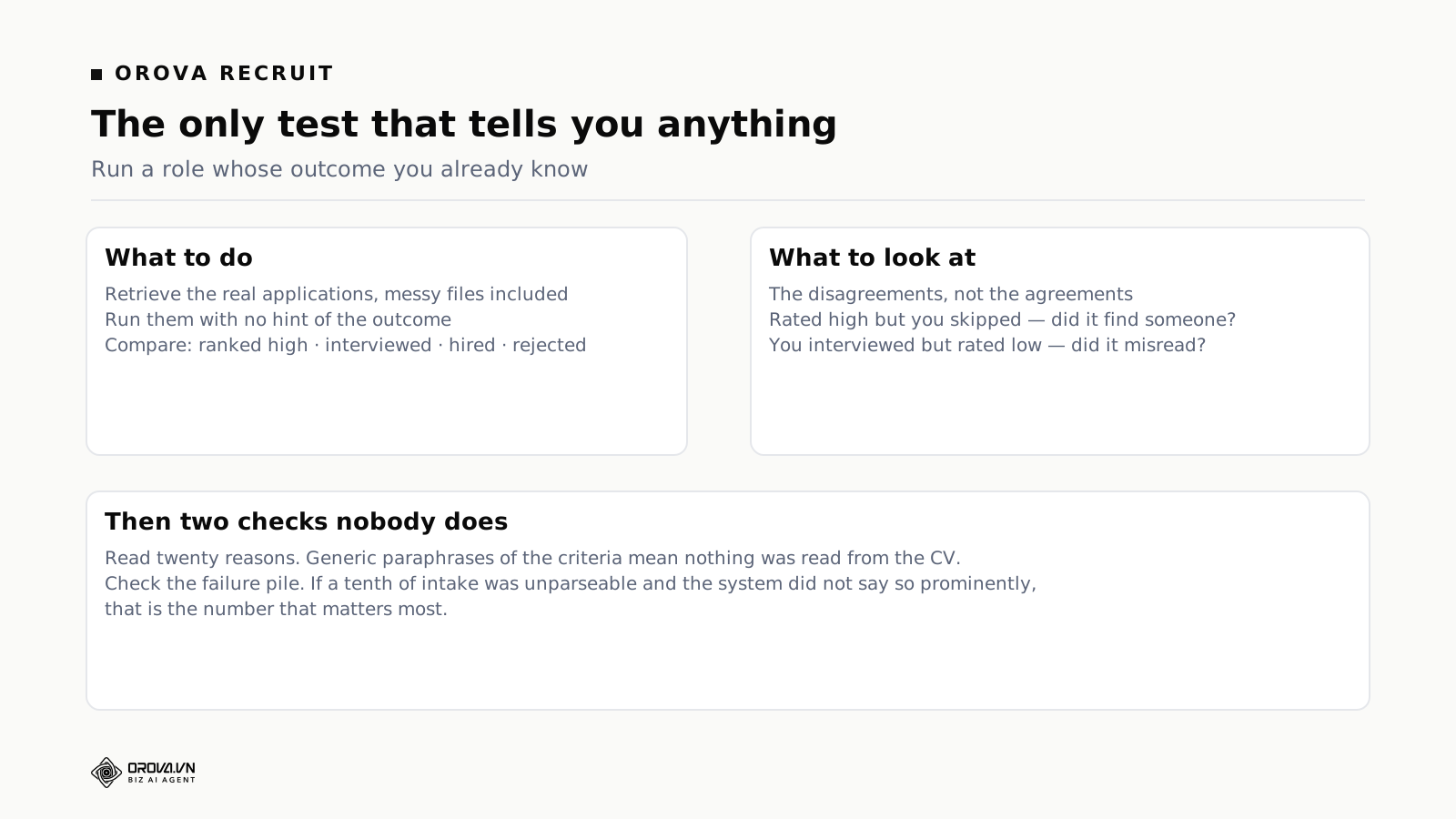
Take a role you have already hired for. One where you know the outcome — who you interviewed, who you hired, and ideally how that hire worked out. Retrieve the actual applications, including the messy files. Not the vendor's sample set, which is curated.
Run them through without telling the system anything about the outcome. Then compare four groups: who the system ranked highly, who you interviewed, who you hired, and who you rejected early.
Look at the disagreements, not the agreements. Agreement tells you little — obvious candidates are obvious to everyone. The informative cases are the ones the system rated highly that you skipped, and the ones you interviewed that it ranked low. For each, work out which of you was right. Sometimes the tool surfaces someone you missed under fatigue, which is the whole promise of the category. Sometimes it has misread a requirement in a way that will repeat.
Then read twenty reasons. Not scores — reasons. Are they specific to the document, or generic paraphrases of the criteria? A reason that could apply to any candidate is a reason that was not read from the CV.
Finally, check the failure pile. How many files could not be parsed, and where did they end up? If a tenth of your intake became unreadable and the system did not say so prominently, that is the number that matters most.
Teams who run this exercise usually make a decision quickly and with confidence, in both directions. Teams who evaluate on feature lists tend to buy on the strength of the demo and discover the systematic errors in month three.
The specific ways these tools go wrong
Six failure modes, all observed rather than theoretical. Knowing them turns a demo into an interrogation.
Rewarding fluency instead of capability
Writing a good CV is a skill, and it is unevenly distributed for reasons unrelated to job performance. Candidates who have been coached, who work in industries with a strong CV culture, or who have simply written many applications produce documents that read better. Any system assessing the document is partly assessing that skill.
This cannot be eliminated — a human reader does the same thing — but it can be reduced by criteria that ask for evidence of specific work rather than for impressive presentation. When testing, look specifically at how the system treats a plainly written CV describing exactly the right experience.
Inferring from job titles
Titles are close to meaningless across companies. A senior engineer at one company is a mid-level engineer at another; a marketing manager runs a team in one place and a spreadsheet in another. Systems that lean on titles produce rankings that reflect the prestige of previous employers, which is a proxy for background rather than ability.
Penalising non-linear careers
Career breaks, industry changes, periods of contract work, and self-employment all produce documents that look irregular. Irregular reads as risky to a system optimising for pattern match, and the penalty is invisible in the output. This is the failure mode with the most serious fairness implications, and the one most worth testing deliberately: put a CV with a two-year gap through and read what the system says about it.
Confident scoring on thin evidence
A one-page CV from a junior candidate contains little information. A good system should express low confidence; many express a precise score anyway, because a number is what the interface expects. Precision without evidence is the most dangerous output in the category, because it looks like the most useful one.
Drifting from the role
The job description changes — the team adds a requirement, drops another — and the criteria stay as they were. Six weeks later the system is screening for a role that no longer exists, and nothing in the interface indicates it. Ask what happens to criteria when the description is edited; the answer should be that they are re-derived rather than preserved.
Being trusted as a decision rather than an ordering
This one is not the tool's fault and it is the most common. The output looks like a ranking, a ranking invites a line, and a line converts an aid to attention into a filter nobody audits. The candidate ranked twenty-second is not worse than the one ranked eighth. They are less legible to an automated reading of a document that both of them wrote under different assumptions about what a CV is for.
How Orova Recruit handles screening
Screening in Orova Recruit is the centre of the hiring module rather than a feature attached to a tracker. Its shape, stated plainly.
Criteria come from the job description. A position is created with a description, and the criteria used for scoring are derived from it rather than typed separately. The description can be drafted in the module and then analysed — which mostly serves to expose requirements phrased so vaguely that no candidate could be scored against them. Edit the description and the criteria are re-derived.
Applications are uploaded in bulk. A position holds up to 500 CVs, with a ceiling of 10 MB per file. That capacity matters because the tool is aimed at exactly the situation this article describes: a role that attracted more applications than anyone can read carefully.
Every application lands in one of six states. Pending and processing while the work happens, then one of four outcomes: meets the criteria, worth considering, does not meet, or could not be read. The middle outcome exists because most applications belong there. The fourth exists because unreadable files exist, and naming them is the difference between a candidate being assessed and a candidate disappearing into a file format.
Results carry reasons, and the same criteria then generate the interview questions for the position — so the conversation is aimed at the things the shortlist was actually built on, rather than at a generic question bank. Questions can be refined and applied across a whole position, which means every candidate faces the same core set.
The chain continues after the interview. Notes can be typed, dictated, or produced from an uploaded audio recording. Review scores candidates, produces a recommendation, records decisions individually or in bulk, and exports to PDF. Contact templates — including AI-drafted ones — carry rules for automatic sending, so a reply goes out whether or not anyone remembered.
What it does not do
It does not post vacancies to job boards or syndicate to aggregators. If your problem is too few applications, screening quality is irrelevant to it. It does not run assessments or coding tests, does not perform background checks, and does not make the decision — the outcome states are an ordering with reasons, not a verdict. And it does not claim to remove bias; structured criteria applied consistently reduce some kinds of variance, which is a smaller and more honest claim than the one usually made in this category.
Using the output well
The difference between teams who get value here and teams who are disappointed is almost entirely in how the output is used.
Read in the order given, but do not stop at a line. The ordering's job is to put your best attention where it is most likely to pay. Its job is not to define the shortlist. Read until you have enough good candidates for your interview capacity, then read another ten.
Handle the middle band with a rule, not with whatever energy is left. A workable rule: the middle band is not opened until the top outcomes have been contacted, and it is opened only if those produce fewer conversations than capacity. That turns the middle band from a source of guilt into a reserve.
Check the disagreements weekly for the first month. Pick three candidates the system rated low and read them yourself. This is calibration, and it is how you learn the systematic errors that every system has. After a month you will know where to trust it and where to look anyway.
Never paste a machine-written reason into a rejection unedited. The reason is accurate input for your decision; it is not a message to a person. A candidate receiving a reason phrased as an assessment of their document will read it as a judgement of them, and the wording that is fine internally lands badly externally.
Setting criteria that a system can actually use
Everything downstream depends on this, and most teams write requirements that no reader — human or otherwise — could score against. Four rules make a description usable.
Write requirements as evidence, not as attributes. "Strong communicator" cannot be found in a document. "Has written documentation or training material for a non-technical audience" can. The test: could you point at a line in a CV that satisfies this? If not, it is a hope rather than a criterion.
Separate must-have from useful. A list of fifteen requirements with no weighting produces a system that treats a missing nice-to-have like a missing essential. Most roles have two or three genuine must-haves; the rest are preferences, and saying so out loud usually shortens the list.
Say what an unconventional route looks like. If self-taught candidates are acceptable, write that. If experience in an adjacent industry counts, name the industries. Left unsaid, both get penalised — not by malice but because the criteria only encode what was written down.
Put a number on the experience only if the number means something. "Five years" is usually a proxy for a capability that could be stated directly. Where the number is real — a regulatory requirement, a certification — keep it. Where it is shorthand, replace it with the thing it stands for, and you will get a wider and better pile.
Half an hour on the description saves more than any configuration inside the tool, and it improves your own reading too. Teams who do this often report that the biggest benefit of buying a screening system was being forced to write down what they wanted.
What this does to your interviews
An effect people do not anticipate: screening well changes the conversations, and mostly for the better.
When the shortlist was assembled against stated criteria, the interview has somewhere to start. Instead of a general conversation that circles the CV, you are checking specific things the document suggested and specific things it left unclear. Candidates notice this and generally prefer it — being asked precise questions about your actual work is a better experience than being asked to talk about yourself for forty minutes.
It also changes what a panel argues about. Without criteria, panel disagreement is about impressions, and impressions are unfalsifiable, so the argument gets settled by whoever is most senior or most certain. With criteria and recorded evidence, the disagreement becomes about whether a particular requirement was met, which is a question that can actually be answered.
The risk to watch for is narrowing. A shortlist assembled tightly against criteria may exclude the candidate who is wrong on paper and right in the room, and every experienced hirer has one of those in their history. The accommodation is simple: interview one or two people from the middle band each round, deliberately, on top of the obvious shortlist. It costs an hour and it is the check that keeps the criteria honest — if the middle-band candidate is regularly the best conversation, the criteria are wrong.
Fairness, stated in practical terms
Automated screening is discussed either as a fairness improvement or a fairness disaster, and both framings skip the mechanism. Worth being concrete about what changes and what does not.
What genuinely improves. Consistency. A human reading two hundred applications applies drifting standards, and the drift correlates with position in the pile rather than with anything about the candidates. A system applies the same criteria to the two-hundredth as to the second. That is a real improvement and it is the strongest argument in the category.
What genuinely gets worse. Errors become systematic. A tired human misreads one application; a misconfigured system misreads every application of a particular shape, every time, in the same direction. Human error is noisy and self-limiting; automated error is consistent and compounds across every role you run.
What does not change at all. The criteria. If the requirements encode a preference for a particular background — a specific degree, continuous employment, experience at recognisable companies — automating the assessment applies that preference more thoroughly, not less. The tool is downstream of the criteria, and the criteria are written by people.
Two habits address most of this. Review the criteria before each role rather than reusing last time's, and read a sample of the rejected pile every round. The second is the check that catches systematic error, and it is the one everybody skips because the rejected pile is by definition the part nobody wants to read.
And be careful with the claim that a system removes bias. What structured criteria applied consistently do is reduce one source of variance. That is worth having. It is not the same as fairness, and a vendor who conflates them is either being careless or is counting on you to.
Reading the output when you disagree with it
The moment that decides whether a screening system helps or harms is small and happens often: you open a candidate the system rated low and think it is wrong. What you do next matters more than any configuration.
The wrong response in both directions is available. Overruling every disagreement means the system is decoration and you are still reading everything, having paid for the privilege. Deferring to it every time means you have outsourced a judgement to a process you have not audited, and the systematic errors — every system has some — will run unchecked across every role.
The workable habit is to treat each disagreement as information about the criteria rather than about the candidate. If the system missed something a human can see, ask whether the criteria captured that thing at all. Usually they did not: the requirement was implicit, obvious to the team, and never written down. Adding it fixes the case in front of you and every future instance of it.
If instead the criteria did capture it and the system still misread, note the pattern. Three or four notes of that kind form a picture — a requirement it reads too literally, a career shape it undervalues — and that picture is what tells you where to look manually. After a couple of roles you will have a short list of blind spots, and checking them takes minutes rather than hours.
Teams who keep that list get most of the benefit and few of the risks. Teams who never write anything down oscillate between trusting the output completely and abandoning it, usually settling on whichever the last bad experience suggested.
Quota, cost, and the thing that actually gets expensive
Pricing in this corner of the market takes three shapes, and each hides a different distortion.
Per user. Punishes involving more people in hiring, which is usually the behaviour you want. It also makes the tool cheap for a single recruiter and expensive for a company where five managers each hire occasionally — roughly backwards relative to who has the reading problem.
Per job or per position. Predictable, and it encourages bundling roles that should be separate. Watch for what happens when a role is reopened after a candidate declines: some products count that as a second position.
Per volume of work done. You pay for applications assessed rather than for access. Orova uses a quota model: every plan includes every feature, tiers differ only in quota, and each step consumes 20 quota. The distortion is that a high-volume hiring month costs more — which is at least aligned, since that is the month the tool saved the most. What the model avoids is putting any part of the process behind a higher tier.
Whichever shape you meet, the cost that actually hurts is none of these. It is a system that requires maintenance nobody has time for: criteria that go stale, templates that drift out of date, a configuration that made sense for last year's roles. In a company without a talent operations function, any tool needing ongoing attention to stay accurate will be accurate for two quarters and misleading afterwards, while continuing to produce confident output. Ask what the system does after six months of nobody touching it, and weight that answer heavily.
When you do not need this
Three cases where the honest answer is no.
You get fewer than thirty applications a role. Read them. Thirty applications is forty-five minutes and you will do it better than any system, because you hold context about the team that no criteria capture. The tool's value scales with the size of the pile, and below a threshold there is nothing to recover.
Your bottleneck is that too few people apply. Screening quality is irrelevant to a pile of six. The fix is distribution, referrals, and an advert that describes the work honestly rather than listing requirements copied from a competitor. Buying screening here converts one problem into two.
Nobody has agreed what the role requires. A system derives criteria from a description, so a vague description produces vague criteria, confidently applied. If two panel members cannot separately write down the same three requirements, fix that first. It takes an afternoon and it is the input everything else depends on.
What to expect in the first two months
Three things happen in a predictable order.
The first role disagrees with you more than you expected. Almost always. Some of the disagreement is the system being wrong; some is it surfacing candidates you would have missed at hour four of reading. Separating those two requires actually reading the disputed CVs, which is work — and it is the work that determines whether you end up trusting the output appropriately or either over- or under-trusting it.
You discover your job descriptions were worse than you thought. Vague requirements produce vague criteria, and seeing them stated explicitly is uncomfortable. Most teams rewrite at least one description in the first month, and that rewrite improves the human reading too.
The middle band turns out to be larger than expected. Teams anticipate a clean split and find that a large share of applications land in "worth considering". That is not a failure of the system; it is an accurate description of what a CV can tell you. The discipline is to have a rule for that band rather than treating it as an unresolved problem each time.
Two things worth doing before you buy anything
Both are free, both take under an hour, and either might change the purchase.
Time your own reading. Take fifty real applications from a past role and read them properly, with a timer running. Most people discover two things: it takes longer than they claim, and their standards visibly shift by the fortieth. That measurement is the size of the problem you are trying to buy your way out of, and it converts an abstract irritation into a number you can weigh against a subscription.
Score them blind, then compare with what you did at the time. Write down an outcome for each of the fifty without looking at who you interviewed. Then compare. The overlap is usually lower than people expect — the same reader, given the same documents on a different day, does not reproduce their own shortlist. That inconsistency is the thing an automated assessment genuinely fixes, and it is a more honest argument for the category than any claim about intelligence.
Teams who run both exercises tend to buy for the right reason and configure with realistic expectations. They also stop describing the goal as "faster", which is the framing that leads to trusting the ranking as a verdict. The goal is consistent, and consistency is what makes the shortlist better rather than merely quicker to produce.
One last caution about vocabulary. Every product in this space now says AI, and the word covers everything from a keyword list with a synonym file to a system that reads a document against stated requirements and explains its reasoning. The word is not a specification. What you are buying is the answer to one narrow question — what happens between the file arriving and the candidate appearing in a list — and that question has a concrete answer that a vendor can demonstrate in four minutes if the answer is good.
The short version
AI resume screening tools come in three tiers wearing one name. Knockout questions filter honest answers. Keyword matching selects for phrasing and is confidently wrong in a way the output does not reveal. Only reading against criteria addresses the actual problem, which is not speed but consistency — that the two-hundredth application receives the same consideration as the second.
A system worth trusting needs criteria written before intake, an outcome that admits uncertainty, a reason attached to each judgement, and an explicit state for files it could not read. Test it by running a role you already hired for and examining the disagreements, then read twenty reasons and check the unparseable pile.
Use the output as an ordering rather than a verdict, keep reading past the line, handle the middle band with a rule, and read some of the rejected pile every round. The tool's errors are systematic where a human's are noisy, which is both its main advantage and the reason it needs auditing.
A closing thought about what this category is really for. The promise usually made is speed, and speed is the least interesting benefit available. What actually improves a hiring outcome is that the candidate who applied late, wrote plainly, and came from an adjacent industry gets read as carefully as the one who applied first with a polished document. A human reading two hundred applications cannot do that reliably, not through carelessness but because attention is a finite resource that degrades in a predictable direction. Consistency is the thing worth buying, and it is worth buying only from a system whose reasoning you can read and argue with.
And do the calibration on a role you have already closed, not on the next live one. Testing on a real hire in progress puts pressure on the exercise that makes people accept the system's view too quickly.
Related reading: hiring bias and evidence-based screening, what actually works with AI in recruitment, and a job description template that doubles as your scorecard. You can see how the screening step works on a real position at orova.vn.
Criteria first, then the pile
Orova Recruit scores applications against criteria derived from your job description, attaches a reason to every outcome, and keeps an explicit state for files it could not read.
Test your CVs