
Hiring Bias: Why Evidence-Based Screening Beats Gut Feel
Here is a test you can run on yourself this afternoon, and it costs nothing but a quiet hour. Pull ten resumes you screened three weeks ago for a role that has since closed. Hide your old notes and cover the yes/no column. Score all ten again from scratch. Then put the two sets side by side. Most people who try this find that two to four of the ten land in a different bucket the second time, and they cannot say why. That gap is where hiring bias actually lives. It is not, for the most part, a moral failure. It is a measurement failure, and measurement failures have fixes.
The reason this matters is that the usual conversation about bias in hiring goes nowhere. Someone runs a workshop, everyone agrees that bias is bad, everyone privately concludes that the problem is other people, and the next Monday forty-three new applications arrive and get read exactly the way they were read before. Moral framing makes people defensive. Defensive people do not change process. And process is the only thing that ever changed a screening outcome.
So here is the short answer to the question in the title. Evidence-based screening beats gut feel because it makes your decisions repeatable, and repeatable decisions can be checked, corrected, compared and defended. Gut feel produces a different answer depending on what you read immediately before, how many files you have already been through, and whether the candidate went to your university. It also produces no record, so nobody, including you, can ever find out where it went wrong.
The rest of this article is in three parts. First, the specific documented mechanisms by which reading a document unevenly turns into deciding unevenly. Second, the practical controls that shrink that unevenness, none of which require a budget. Third, an honest account of what structure does not fix, including the awkward fact that an AI screening tool inherits whatever is wrong with the criteria you handed it. This is the last piece in a series about screening discipline, so the final section pulls the whole thing together into the two or three things worth doing first.
What is hiring bias when you treat it as a measurement problem?
Treated as a measurement problem, hiring bias is the part of a screening decision that comes from the reader rather than the document. It shows up as inconsistency: the same resume scored differently on a different day, in a different order, by a different person. Reduce the inconsistency and you reduce the room bias has to operate.
Two things get bundled under the same word and they behave differently. Daniel Kahneman, Olivier Sibony and Cass Sunstein separate them cleanly in Noise: A Flaw in Human Judgment (2021). Bias is systematic: every reader on your panel drifts in the same direction, so candidates from a certain background consistently score lower. Noise is scatter: readers disagree with each other, and each reader disagrees with their own earlier self, in no particular direction. Both produce wrong hires. Only one of them is easy to talk about at work.
The useful insight is that noise is the easier target and hitting it also hits bias. Bias is hard to see from inside your own head, because a biased judgement feels exactly like a correct one. Noise, by contrast, is trivially visible the moment you measure it: two people score the same candidate, the scores differ by twenty points, and there is nothing to argue about. So you attack the scatter first. And because most of the mechanisms that produce scatter are the same mechanisms that produce systematic drift, tightening the process squeezes both.
There is a second reason to frame it as measurement. It changes the question you ask a colleague. "Are you biased?" invites a fight. "Would you and I score this candidate the same way?" invites a five-minute experiment. One of those questions has an answer you can act on.
It also changes who has to agree with you. You do not need anyone on the team to accept a claim about their own prejudices. You only need them to accept that a hiring process which produces different answers on different days is a process with a defect. Almost nobody argues with that, and once they have agreed to it, every control described below follows as plain engineering rather than as an accusation.
One last framing note. Consistency is not the same thing as correctness. A process can be perfectly repeatable and repeatably wrong, which is what happens when the criteria themselves are the problem. Consistency is a precondition, not a destination. You get it first because without it you cannot tell whether anything else you change made things better or worse.
The six mechanisms that actually do the damage
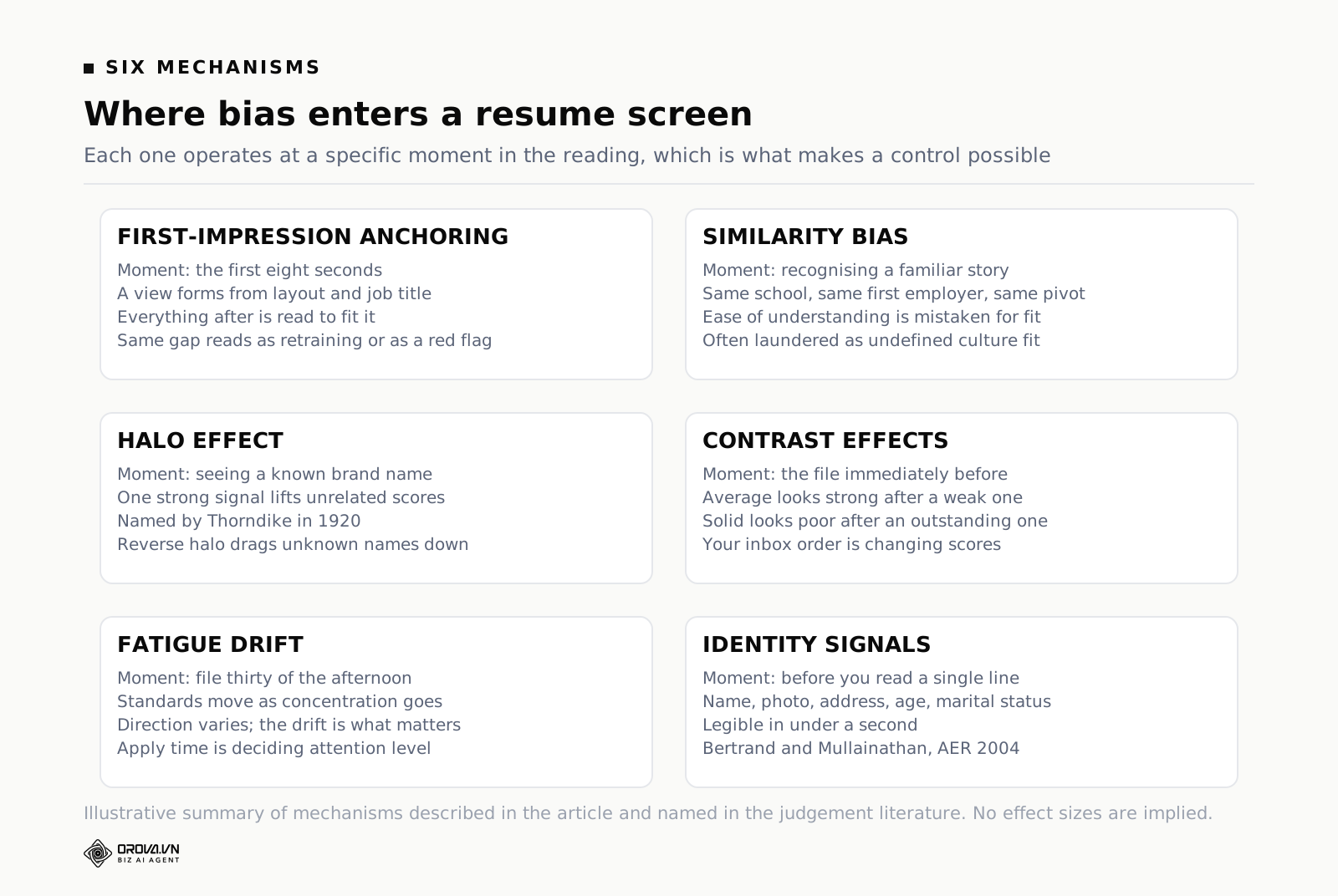
These are not vague tendencies. Each one has a name, a documented pattern in the judgement literature, and a specific moment in your screening day where it operates. Learn to recognise the moment and half the work is done.
First-impression anchoring
You form a view in the first eight seconds — from the layout, the current job title, the top line of the summary — and everything you read afterwards gets interpreted to fit that view. Anchoring is one of the oldest findings in judgement research, going back to Amos Tversky and Daniel Kahneman's 1974 paper in Science on heuristics and biases: an initial value pulls subsequent estimates toward it even when the initial value is arbitrary.
In screening this looks like confirmation shopping. If the anchor was positive, a two-year gap reads as "took time to retrain". If the anchor was negative, the identical gap reads as "unexplained gap". You are not lying to yourself. You are doing what an anchored reader does, which is to weight the evidence that agrees with the first impression more heavily than the evidence that does not.
Similarity bias, or "they remind me of me"
Same university. Same first employer. Same slightly unusual career pivot. Same hobby in the interests line. The candidate is easier to read because their story maps onto a story you already understand, and ease of understanding gets mistaken for quality of fit. This is the mechanism that quietly reproduces whatever your existing team already looks like, one hire at a time, without anyone ever making a decision they would recognise as exclusionary.
It is also the mechanism most often laundered as "culture fit". Culture fit, when it is not defined in advance as specific observable behaviours, is very often a socially acceptable label for similarity. If your definition of it cannot be written down as a criterion with a score and a piece of evidence, it is not a criterion, and it should not be deciding anything.
The halo effect
One strong signal — a prestigious employer, a well-known university, a recognisable product name — lifts every unrelated score on the same file. Edward Thorndike named the halo effect in 1920 after finding that officers rating soldiers gave suspiciously correlated ratings across unrelated attributes. A century later it does the same job on your shortlist. The candidate who spent two years at a famous company gets credit for communication skills, judgement and technical depth that nobody has any evidence about.
The reverse runs just as hard. An unfamiliar employer name, a college you have not heard of, or a company that has since gone bust drags down scores on criteria that have nothing to do with any of it.
Contrast effects
Your score for candidate seven depends on candidate six. Read a genuinely weak file and the merely average one that follows looks strong. Read an outstanding one and the next solid candidate reads as disappointing. The judgement is relative, and the reference point is whoever happened to be immediately before them in an arbitrary queue.
This one is worth dwelling on because it is entirely invisible from the inside and entirely fixable from the outside. Nobody ever thinks "I am marking this person down because the last file was excellent." But the ordering of your inbox is random with respect to candidate quality, and if order changes scores, then part of every score is noise generated by your sorting rule.
Fatigue drift over a long stack
The thirtieth resume of the afternoon does not get the attention the third one got. Standards move as concentration goes. Sometimes they get harsher, because you are looking for reasons to shorten the pile. Sometimes they get looser, because rejecting requires writing a reason and accepting does not. Either way, the position of a candidate in your reading order is affecting their outcome, and position in the reading order is a function of when they happened to click apply.
Related studies in other domains have found decision quality varying with time of day and session length. You do not need to import a specific effect size from another profession to accept the basic point, which you can verify in your own data: score your stack, then check whether the average score of the last third is systematically different from the first third. If it is, the difference is not about the candidates.
Name, photo, address and other signals that carry no job information
A resume commonly carries a name, sometimes a photo, often a home address, a date of birth, a marital status and a nationality. In most roles, none of those predicts anything about performance. All of them are legible to a reader in under a second.
The best known evidence here is Marianne Bertrand and Sendhil Mullainathan's field experiment, published in the American Economic Review in 2004 as "Are Emily and Greg More Employable Than Lakisha and Jamal?". They sent thousands of otherwise equivalent resumes to help-wanted ads in Boston and Chicago, varying only the names. Resumes with white-sounding names received roughly fifty per cent more callbacks. The candidates were identical on paper. The only variable was a signal that carried no job-relevant information at all.
Noise before bias: the consistency test worth running this week
Before you redesign anything, measure the scatter. It takes about ninety minutes and it produces the only argument that reliably persuades a sceptical hiring manager, because the numbers come from your own team rather than from a study about somebody else.
Run it like this. Take one closed role and pull twelve resumes from it, chosen to span the range — some obvious yes, some obvious no, and at least half from the murky middle where the real decisions happen. Strip the old outcomes. Ask two people who screen for that role to score all twelve independently, on whatever criteria you currently use, without conferring. Then ask one of them to re-score the same twelve a week later, in a different order.
You now have three numbers that matter. Between-reader disagreement: how far apart two people are on the same file. Within-reader disagreement: how far one person is from their own earlier self. Order sensitivity: whether the same file scored higher when it followed a weak one.
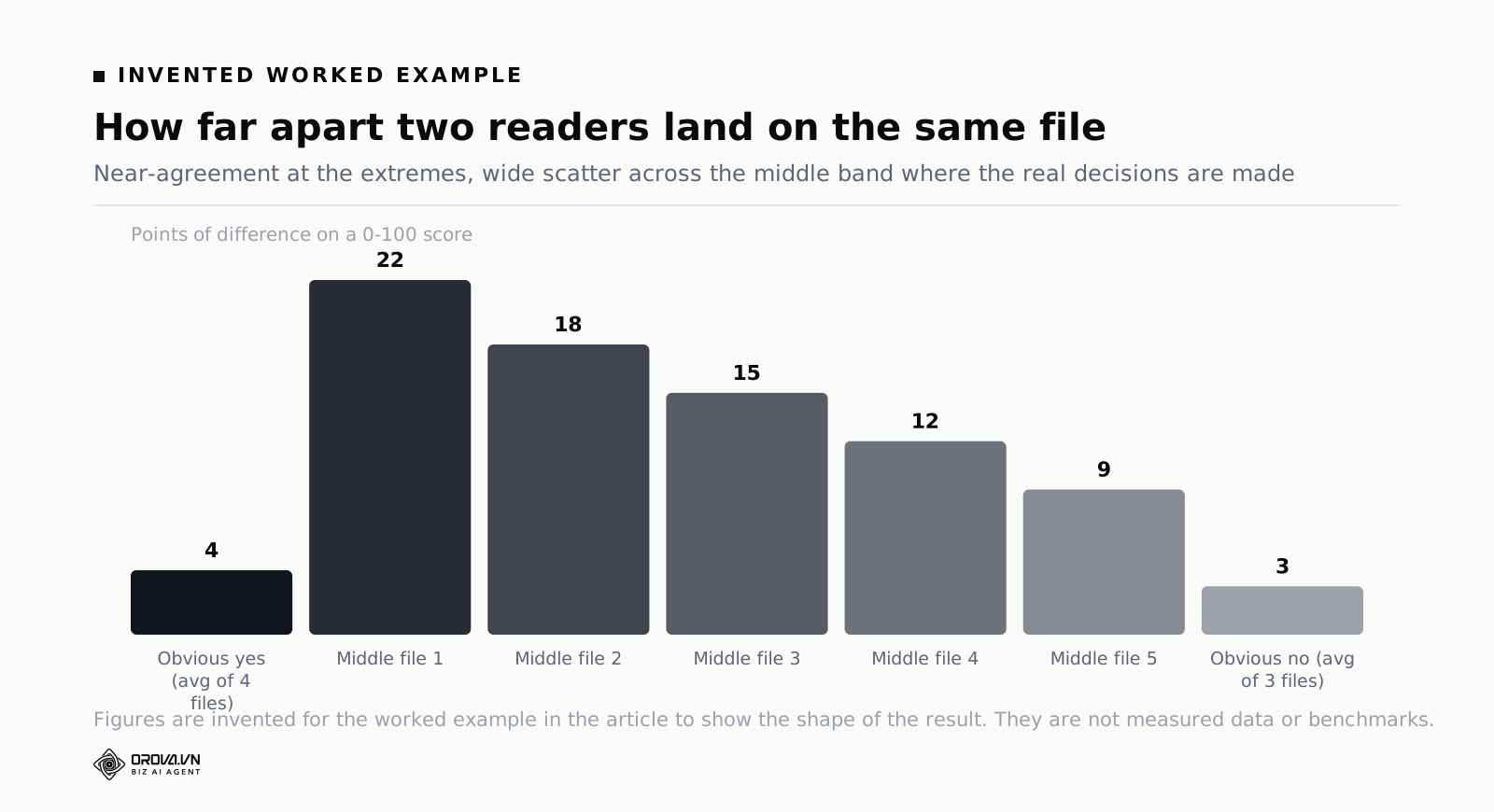
Here is an invented worked example to show the shape of the output. The numbers below are made up to demonstrate the arithmetic, not measured from any real team. Two screeners, twelve resumes, scores out of 100. Reader A and Reader B agree within five points on the four obvious cases at the top and the three obvious cases at the bottom. On the five middle files they differ by 12, 18, 9, 22 and 15 points. When Reader A re-scores a week later, the top and bottom files move by two or three points, and the middle five move by 7, 14, 11, 6 and 19.
Read that carefully, because it contains the whole argument of this article. On candidates where the answer is obvious, your process works fine and structure adds nothing. On candidates where the answer is not obvious — which is where every real hiring decision is made — the score is being generated substantially by the reader rather than by the document. A twenty-point swing on the same file, from the same person, one week apart, is not a judgement. It is a coin flip wearing a number.
Two things to be careful about when you run this. Do not let it become a performance review of the individual screener, or the second round of scores will quietly drift toward the first and you will measure nothing. And do not run it on a role where everyone already knows the outcome, because knowing who got hired contaminates the re-score completely.
Finally, keep the output. A single measurement is a curiosity. The same measurement repeated after you change the process is evidence that the change worked, and it is the only way to know whether the rest of this article was worth the effort on your particular team.
Five controls that reduce bias in hiring, in the order they pay off
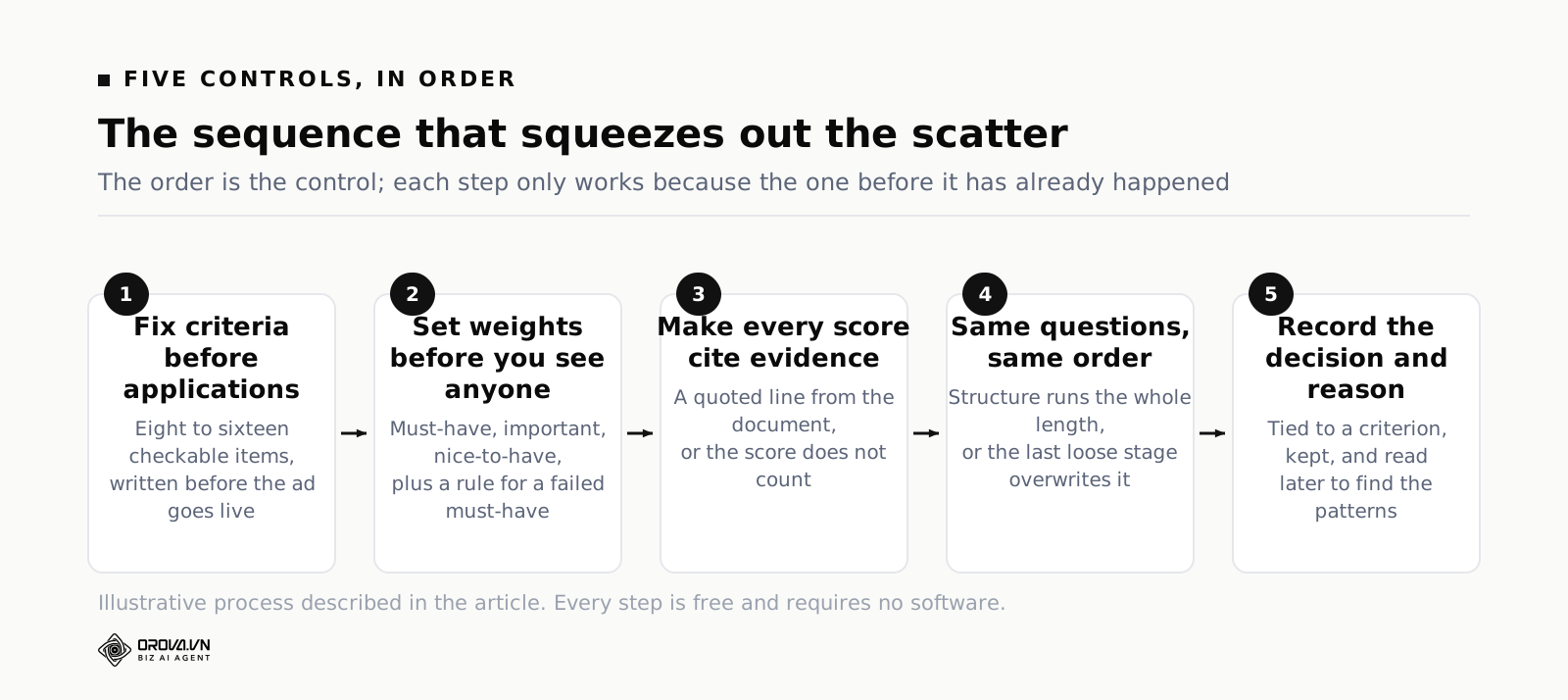
Every one of these is free. None of them requires software, a consultant or a policy document. What they require is doing things in a particular order, and the order is the entire trick.
1. Fix the criteria before the first application arrives
Write down what you are actually looking for, as a list of specific, checkable things, and do it before the ad goes live. Eight to sixteen items is the usual working range for one role. Each one has to be phrased so that two people reading the same resume would agree on whether it is present. "Strong communicator" fails that test. "Has written external-facing documentation or customer-facing copy in a previous role" passes it.
The reason this must happen before applications arrive is not tidiness. It is that criteria written afterwards get written around the candidates you have already seen and liked. Once you have a favourite, every subsequent criterion tends to be a description of that person. The batch article on turning a job Posting Template: Write One, Get a Hiring Scorecard Too works through how to phrase requirements so they convert directly into criteria without a second drafting pass.
2. Set the weights before you see anyone
Not all criteria matter equally, and if you do not decide the relative weights in advance you will decide them retroactively in favour of whoever you already like. Give each criterion a weight, sort them into a small number of bands — must-have, important, nice-to-have — and agree a rule for what a failed must-have does regardless of the total.
That last part carries more weight than people expect. A single hard rule, such as "a must-have scoring below half forces a no matter how good the total is", removes an entire class of argument, because it stops a strong general impression from swallowing a specific missing requirement. The mechanics of weighted totals and how not to break them are covered in the piece on resume Parser vs Resume Screening: Extracting Text Is Not Ju.
3. Require every score to cite evidence from the document
This is the single highest-value control in the list. A score with no quotation attached is an opinion with a number stapled to it. A score that has to point at a line in the file — "led the migration of three services, 2023-2024, per the second bullet under Acme" — is checkable by someone who was not in the room.
Three good things happen at once. You catch scores that were generated from the general vibe of a document rather than its content. You catch the halo effect immediately, because when the evidence line for "communication" turns out to be the employer's name, the problem is visible on the page. And you create a record that lets you explain a rejection nine months later without relying on memory.
4. Ask every candidate the same questions in the same order
Screening consistency is wasted if the interview that follows is a free-form conversation, because the conversation will reintroduce every mechanism you just designed out. Structured interviews have consistently outperformed unstructured ones in the personnel selection literature — Frank Schmidt and John Hunter's 1998 review in Psychological Bulletin is the classic reference, and Paul Sackett and colleagues revised the estimates substantially downward in the Journal of Applied Psychology in 2022 while structured interviews remained among the better-performing methods. The direction of the finding has survived a serious re-analysis. That is worth more than a large number from a single study.
Same questions, same order, notes taken during rather than after, scored against the criteria you already wrote. The batch pieces on deriving interview questions from your own criteria and on behavioral Interview Questions: Asking Is Easy, Scoring Is t cover the mechanics, and the phone screening script shows what the same discipline looks like in fifteen minutes.
5. Record the decision and the reason, every time
Every candidate gets a recorded outcome and a recorded reason tied to a criterion. This feels bureaucratic for about a week and then becomes the most valuable asset in your hiring operation, because it is the only thing that makes patterns visible. Without a record you can only investigate bias by asking people to remember their reasoning, which is precisely the faculty that is unreliable here.
With a record you can ask real questions. Which criterion rejects the most people, and is it doing any work? Do rejections cluster on one screener? Did the candidates rejected on "not enough experience" have less experience, or just less conventionally presented experience? None of those questions are answerable from a pipeline view. The piece on recruiting metrics that matter covers which of these numbers actually change what you do next.
Blind resume screening: what it fixes and what it does not
Blind resume screening means removing identity signals — name, photo, address, date of birth, sometimes university and employer names — before a human reads the file. It is the most cited intervention in this area and it deserves both the credit and the caveats.
The credit comes largely from Claudia Goldin and Cecilia Rouse's 2000 paper in the American Economic Review, "Orchestrating Impartiality", which examined the adoption of screens in symphony orchestra auditions and found that blind auditions were associated with a higher probability that women advanced. It is a genuinely famous result and it did more than anything else to make the idea mainstream. It is also honest to say that the statistical strength of that particular study has been challenged in subsequent commentary, most publicly by the statistician Andrew Gelman. The principle stands on more than one leg; the specific magnitudes from that one paper should be quoted carefully.
The caveat comes from a study that people cite far less often and probably should. Luc Behaghel, Bruno Crépon and Thomas Le Barbanchon published "Unintended Effects of Anonymous Résumés" in the American Economic Journal: Applied Economics in 2015, reporting on a randomised experiment run with the French public employment service. Anonymising resumes did not help minority candidates in that setting and in some comparisons appeared to hurt them, with the authors' interpretation being that recruiters who had been actively compensating for disadvantage could no longer see who to compensate for.
The lesson is not that blind screening is bad. The lesson is that removing information is a blunt instrument whose effect depends on what the people downstream were doing with that information. Blind screening works well when the identity signal was doing nothing but harm. It works less well when it is bolted onto a process that has no criteria underneath, because a reader with no criteria and no name will simply anchor on something else — the layout, the length, the font, the employer.
Practical middle ground, if you want the benefit without the risk. Redact name, photo, address, age and gender markers, which almost never carry job information. Keep employer and institution names but require that any score influenced by them cites a specific achievement rather than the brand. Do the redaction mechanically rather than by asking people to ignore what they can see, because instructing someone to disregard information they have already read does not work. And keep the identity data intact somewhere else, so you can still audit outcomes by group later, which you cannot do if you destroyed the data at intake.
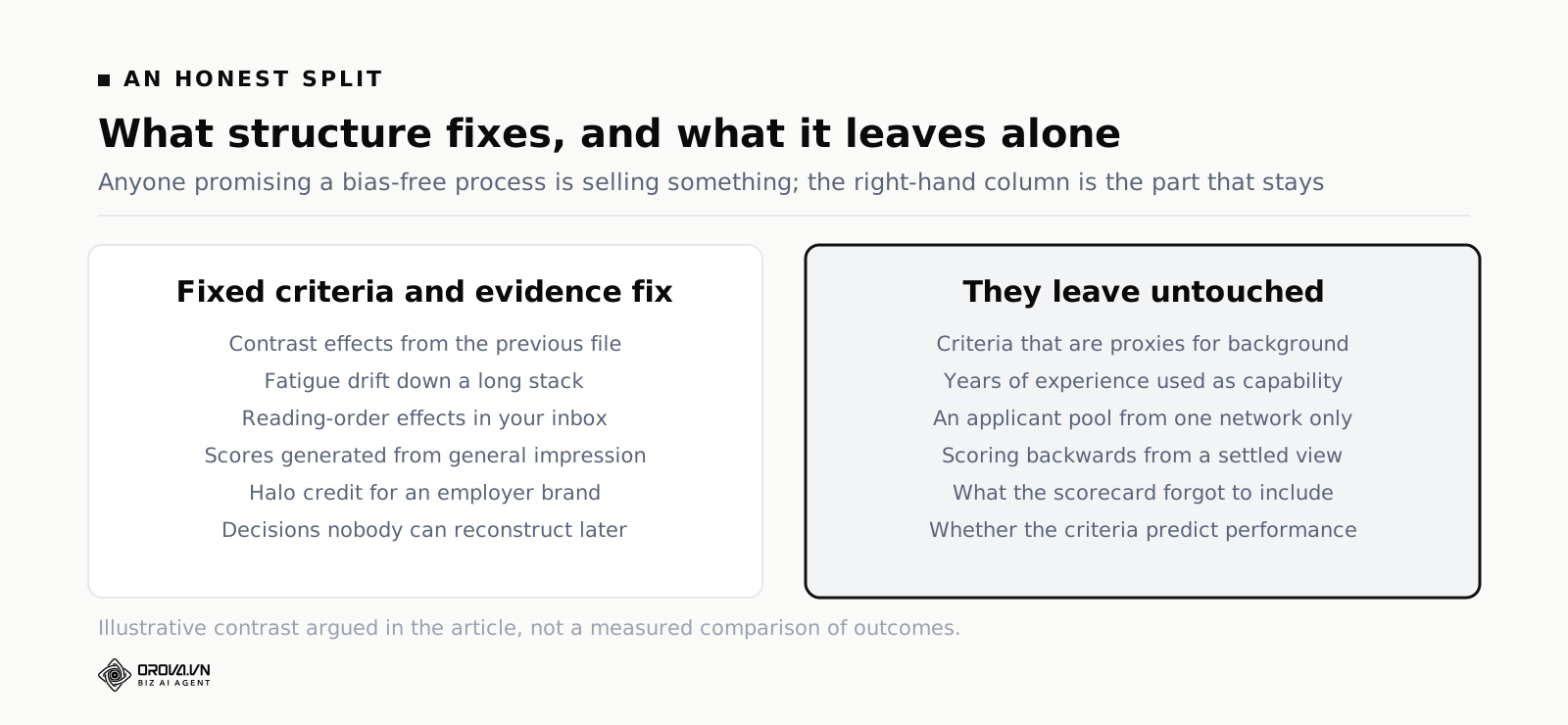
Structure reduces unconscious bias in hiring. It does not delete it.
Anyone who tells you their process is bias-free is selling something. Here is what a structured, evidence-cited, weighted process still cannot do, stated plainly so that you can plan around it rather than be surprised by it.
It cannot fix criteria that are themselves proxies. "Five years of experience" is a proxy for capability, and it systematically disadvantages people who took a career break, retrained late, or built the same skill in a compressed or unconventional way. "Graduated from a top-tier university" is a proxy for ability that correlates heavily with family income. Weighting a bad criterion carefully just applies it consistently. Consistent application of a discriminatory rule is discrimination with better paperwork.
It cannot fix the applicant pool. If your ad reaches one network, criteria will only ever sort within that network. Screening discipline improves the decision given the pool; it does nothing about the pool. That is a sourcing problem, and it is the reason the recruitment CRM Systems vs ATS: Which Problem Are You Actual matters — one of them is a tool for building a pool over time and the other is a tool for processing the pool you already have.
It cannot stop people from scoring backwards from a conclusion. A determined reader who has decided in the first ten seconds can produce evidence-cited scores that justify that decision. Requiring evidence raises the cost of doing so and makes it visible to a second reader, which is a real deterrent, but it is a deterrent rather than a wall. This is exactly why the second reader and the recorded audit trail matter more than the scoring form itself.
And it cannot make the criteria complete. Every scorecard leaves things out. Some of what it leaves out is genuinely predictive. The right response is not to abandon the scorecard for intuition, but to keep a small, explicit, recorded channel for "this candidate is outside the criteria but here is a specific reason to look again" — recorded, so that you can check later whether that channel is being used evenly or has quietly become the route by which similarity bias walks back in.
AI inherits whatever bias is in the criteria you wrote
The standard cautionary example is well documented and worth stating precisely. In October 2018, Reuters reported that Amazon had scrapped an experimental internal recruiting tool after finding it did not rate candidates in a gender-neutral way. The system had been trained on resumes submitted to the company over a ten-year period, a pool that skewed heavily male, and it learned from that pattern. According to the report, it penalised resumes containing the word "women's", as in "women's chess club captain", and downgraded graduates of two all-women's colleges. Amazon told Reuters the tool was never used by recruiters to evaluate candidates.
What that story is usually taken to mean is "AI is biased". What it actually demonstrates is narrower and more useful: a system trained to reproduce past hiring decisions will reproduce the bias in past hiring decisions, faithfully and at scale. The failure was in the target, not the technology. The tool was asked to predict "who would we have hired" rather than "who meets these criteria", and it answered that question correctly.
This is the fork in the road for anyone evaluating screening tools. There are two fundamentally different designs and they carry different risks. One learns from your historical outcomes and predicts future ones; that design imports your history whether or not you want it. The other reads a document against criteria you wrote this week and reports what it found, with a quotation attached; that design imports your criteria, and your criteria are visible, editable and arguable in a way that a learned weight is not. The batch piece on what AI in recruitment genuinely does well goes into where each design holds up.
If you go the second route, insist on four properties and treat any missing one as disqualifying. The criteria must be written and editable by you rather than inferred. Every per-criterion score must come back with a quotation from the source document so you can check it. The overall total must be computed by an explicit weighted formula rather than produced as a number by the model, because a model asked to add up its own scores will not add them up the same way twice. And a failed must-have must be able to override a high total by rule. Those four together are what make an automated screen auditable rather than merely fast — the argument in automate the reading, not the deciding.
Tools built this way exist; Orova Recruit is one of them, turning a job description into weighted criteria you can edit and returning per-criterion scores with the supporting line quoted from the file, with the weighted total computed server-side rather than by the model, and you can see how that works if you want a concrete reference point. The same discipline is carried into the interview stage, where it is needed more: questions carry a written scoring line and a weight, notes are stored line by line with the time and the author, and a question the notes never touch is scored zero and labelled as not asked rather than inferred. The general principle matters more than any particular product: if a screening tool cannot show you the sentence it based a score on, you have not automated your reading, you have outsourced your judgement to something that cannot be questioned. And if you are still deciding whether the bottleneck is even here, the piece on what an applicant tracking system actually does is the place to start, because a tracking problem and a judging problem need different answers.
One more caution specific to AI screening. Consistency is not neutrality. An automated screen applies the same rule to everyone, which removes contrast effects, fatigue drift and reading-order effects at a stroke. It does not remove a criterion that disadvantages a group. If anything it makes that criterion more powerful, because it now applies with perfect uniformity to five hundred files instead of imperfectly to the forty a tired human got through. Consistency amplifies whatever your criteria contain. That is an argument for auditing the criteria, not for going back to gut feel.
What the regulators are asking for
The legal direction of travel is toward documentation and auditability rather than prohibition, which happens to line up with everything above. A short and deliberately non-specific tour, because the details change and this is not legal advice.
In the United States, New York City's Local Law 144 of 2021 governs what it calls automated employment decision tools used for hiring and promotion decisions in the city. In broad terms it requires an annual independent bias audit of such a tool, publication of a summary of the audit results, and notice to candidates that the tool is being used. Enforcement by the city's Department of Consumer and Worker Protection began in July 2023. If you use an automated screen on New York City candidates, read the actual rule text and the department's guidance rather than a summary like this one.
Illinois has had the Artificial Intelligence Video Interview Act in force since 2020, which concerns notice and consent when AI is used to analyse video interviews. And underneath all of it in the US sits a much older instrument: the Uniform Guidelines on Employee Selection Procedures, in force since 1978, and the associated four-fifths rule of thumb, under which a selection rate for one group below four-fifths of the highest group's rate is treated as an indicator of possible adverse impact worth investigating. It is a flag for further inquiry rather than proof of anything, and it predates every piece of software in your stack.
In the European Union, the AI Act — Regulation (EU) 2024/1689, in force since August 2024 — classifies AI systems used in employment and worker management, including those used to filter applications and evaluate candidates, as high-risk under Annex III. High-risk classification brings obligations around risk management, data governance, technical documentation, record-keeping, transparency and human oversight, phasing in across 2026 and 2027. Again: check the current text and your own counsel rather than relying on a paragraph in a blog post.
The practical takeaway does not depend on which jurisdiction you are in. Every one of these regimes assumes you can answer three questions: what criteria did you apply, what did the system output for each candidate, and who reviewed it. A process with fixed criteria, evidence-cited scores and recorded decisions answers all three as a side effect of being a good process. A process based on gut feel cannot answer any of them, and no amount of goodwill will conjure the records after the fact.
Six mistakes that make a fair hiring process unfair again
Writing the criteria after reading the applications
The most common failure and the hardest to spot, because it feels responsible — you are "letting the market inform the spec". What actually happens is that the spec becomes a portrait of the two or three candidates you liked. If the pool genuinely showed you that a requirement was wrong, change it, write down that you changed it and why, and re-score everyone already screened against the new version. Changing criteria mid-stream without re-scoring means your shortlist was built with two different rulers.
Setting a diversity target instead of fixing the criteria
A target tells you where you want to end up. It does not tell you which part of your process is stopping you getting there, and it creates pressure to hit the number at the last stage, which is the least effective and least defensible place to intervene. Fix the criteria, fix the sourcing, measure pass rates by stage, and let the outcome move. If it does not move, you now have an audit trail that tells you which stage is holding it, which is something a target alone will never give you.
Treating years of experience as if it were a capability
"Five years minimum" is easy to check and that is its entire appeal. It filters out career changers, people who took time out for caring responsibilities, and anyone who compressed the same learning into less calendar time. If what you need is specific demonstrated capability, write the capability as the criterion and let evidence of it count regardless of how many years it took to acquire. Keep a duration requirement only where duration is genuinely the thing — for example where the role requires having personally lived through a full annual cycle of something.
Blind screening followed by an unstructured interview
You removed the name from the resume and then had a forty-minute unscripted chat in which you learned the name, saw the face, heard the accent and discovered you both studied in the same city. The structure has to run the whole length of the process or the last unstructured stage will simply overwrite everything the earlier stages achieved. Bias is not removed by the earliest stage; it is removed by the weakest one.
Scoring after the decision instead of before it
The scorecard filled in at the end of the week to document a choice already made is worse than no scorecard, because it produces a paper trail that looks like rigour and contains none. Score during the read. If you cannot score during the read, you are reading too fast, and the fix is fewer files per sitting rather than a tidier form afterwards.
Calibrating on your best hire
"We want more people like Marta" is a reasonable instinct and a terrible criterion, because it collapses into similarity bias with a specific person as the template. What is defensible is decomposing what Marta actually does well into observable, checkable criteria, and then accepting that people who satisfy those criteria may look nothing like her. The whole point of criteria is that they let you recognise a good candidate who does not resemble anyone you have hired before. That is also, in practice, the point of the exercise.
The audit loop: what to review, and how often
Controls decay. A criteria list written in January is being interpreted differently by March unless somebody looks. Here is a review cadence that takes very little time and catches the drift while it is still cheap to correct.
| When | What you check | What triggers action |
|---|---|---|
| Every role, before posting | Criteria list, weights, must-haves, threshold | Any criterion two people would score differently gets rewritten before the ad goes live |
| Every role, after the first ten files | Double-score those ten with a second reader | Wide disagreement on any criterion means that criterion is ambiguous, not that a reader is wrong |
| Every role, at shortlist | Evidence line behind every score on every shortlisted and borderline file | A score with no quotation, or a quotation that does not support it, gets re-scored |
| Monthly | Pass rate by stage; distribution of rejection reasons | One criterion rejecting most of the pool, or rejections clustering on one screener |
| Quarterly | Outcomes by group, where you lawfully hold that data, and by screener | A gap at one specific stage, which tells you where to look rather than that something is wrong somewhere |
| Quarterly | Criteria against how the last two hires actually perform | A heavily weighted criterion that turned out not to predict anything gets down-weighted or removed |
Two notes on the quarterly review. Hold and analyse demographic data only where you are lawfully permitted to, and keep it separate from the screening record so it cannot influence a live decision. And read the group comparison as a pointer to a stage rather than a verdict — the useful output is "the drop happens between phone screen and manager interview", because that is a sentence you can act on next week.
Bias does not stop at the CV: the interview stage
Almost all the effort in reducing hiring bias goes into the screening stage — anonymised CVs, structured criteria, consistent scoring. That effort is well spent, and then it is frequently undone forty minutes into an unstructured interview, where none of those safeguards apply and where far more of the decision is actually made.
The interview is the more biased stage, for structural reasons rather than moral ones.
Four mechanisms specific to interviews
Similarity comfort. Conversations flow more easily with people whose background, vocabulary and reference points resemble ours. Ease is then remembered as competence. This is not conscious preference; it is what "the interview went well" often means.
The first four minutes. A judgement forms early and the rest of the conversation is spent gathering support for it. Interviewers rarely notice this happening, and confident interviewers are not exempt — they are, if anything, more prone to it.
Order effects. The third candidate of the day is scored against the second, not against the criteria. Strong candidates scheduled after weak ones benefit; strong candidates scheduled after other strong ones suffer.
Unequal note quality. The candidate who was recorded in detail looks more substantial at decision time than the candidate summarised in three lines. This is a bias created purely by the interviewer's energy level and it has nothing to do with either candidate.
What actually reduces it
The same core questions for everyone. Personalised questions have real value, but they should sit on top of a shared base set tied to the criteria. Comparison happens on criteria, not on questions.
The same weights as the screening stage. If you reweight what matters between the two stages, you have effectively changed the job description halfway through and given yourself room to justify whichever candidate you liked.
Scoring written down during or immediately after, per question. A single overall impression recorded at the end of the day is the format most vulnerable to every mechanism above.
An honest "not asked" mark. Filling a gap with a middling score is a small dishonesty that lets you reach whichever total you were already leaning toward.
Two independent scorers before comparing notes. When two interviewers discuss first and score afterwards, you get one opinion with two signatures. Score separately, then discuss the disagreements — the disagreements are the informative part.
The audit that catches what you cannot feel
Bias is not visible from inside a single decision; it is visible in the pattern across many. Three checks, each of which takes under an hour per quarter.
First, compare screening scores with interview scores by interviewer. If one interviewer consistently scores far below the paper assessment, either they are seeing something real or they are applying a criterion nobody agreed to. Both are worth a conversation.
Second, look at where in the day your rejections cluster. A pronounced late-afternoon pattern is a scheduling problem, not a candidate-quality one.
Third, reread the evidence lines for two candidates who scored similarly but got different outcomes. If the evidence does not explain the difference, the difference came from somewhere the process does not record — and that is exactly where bias lives.
Questions people ask about hiring bias
Does unconscious bias training work?
The evidence for training changing hiring outcomes is weak, and this is not a fringe view — reviews of the literature have repeatedly found that awareness training shifts attitudes measured immediately afterwards far more reliably than it shifts behaviour measured later. That does not make it worthless as background education. It makes it a poor substitute for process change. If you have a budget and a choice between a workshop and two half-days spent building criteria and running a double-scoring exercise, spend it on the second.
Is blind resume screening always the right call?
No, and the Behaghel, Crépon and Le Barbanchon result described above is the reason to be careful. Blind screening helps most where identity signals are doing nothing but damage and criteria already exist underneath. It helps least where it is used as a substitute for criteria, or where someone downstream was deliberately compensating. Redact the signals that carry no job information, keep the criteria doing the real work, and preserve the demographic data separately so you can still audit outcomes.
Does an AI screen reduce bias or add it?
It reliably removes the mechanisms that come from being a human reading in sequence: contrast effects, fatigue drift, reading-order effects, and inconsistency between one sitting and the next. It does not remove bias in the criteria, and it will apply a flawed criterion with perfect uniformity to every file. Whether your net position improves depends entirely on how good your criteria are and whether every score comes back with checkable evidence.
We hire four people a year. Is any of this proportionate?
Most of it, yes, because the expensive parts scale with headcount and the cheap parts do not. Writing ten criteria and weights before posting takes an hour and you reuse it. Requiring a quoted line behind each score costs seconds per file. The double-scoring exercise costs one afternoon a year at your volume. What you can reasonably skip at four hires a year is the quarterly statistical review, because the numbers will be too small to mean anything — keep the records anyway, so that in three years the review becomes possible. The hiring process steps for small teams piece works through what to keep and what to drop when there is no recruiter.
How do we handle a candidate everyone likes but who scores badly?
Treat it as information about the criteria, not as an exception to them. Ask the specific question: which criterion is missing, and can anyone state a concrete, evidence-backed reason this person will do the job well that the criteria failed to capture? If yes, that reason is a criterion you forgot; add it, re-score everyone against it, and see whether the shortlist changes for others too. If nobody can state such a reason, what you are looking at is a strong general impression, which is precisely the thing this whole article is about.
Will structured screening make us miss unconventional candidates?
The opposite risk is usually the larger one. Unstructured reading rewards legibility — familiar employers, conventional trajectories, resumes that look like the ones you have read before — and the unconventional candidate is the one most likely to be dismissed in eight seconds. Criteria phrased around demonstrated capability rather than around pedigree are the mechanism by which an unconventional candidate gets a fair reading. If your criteria are phrased around pedigree, that is the thing to fix.
What this series has been arguing, and what to do first
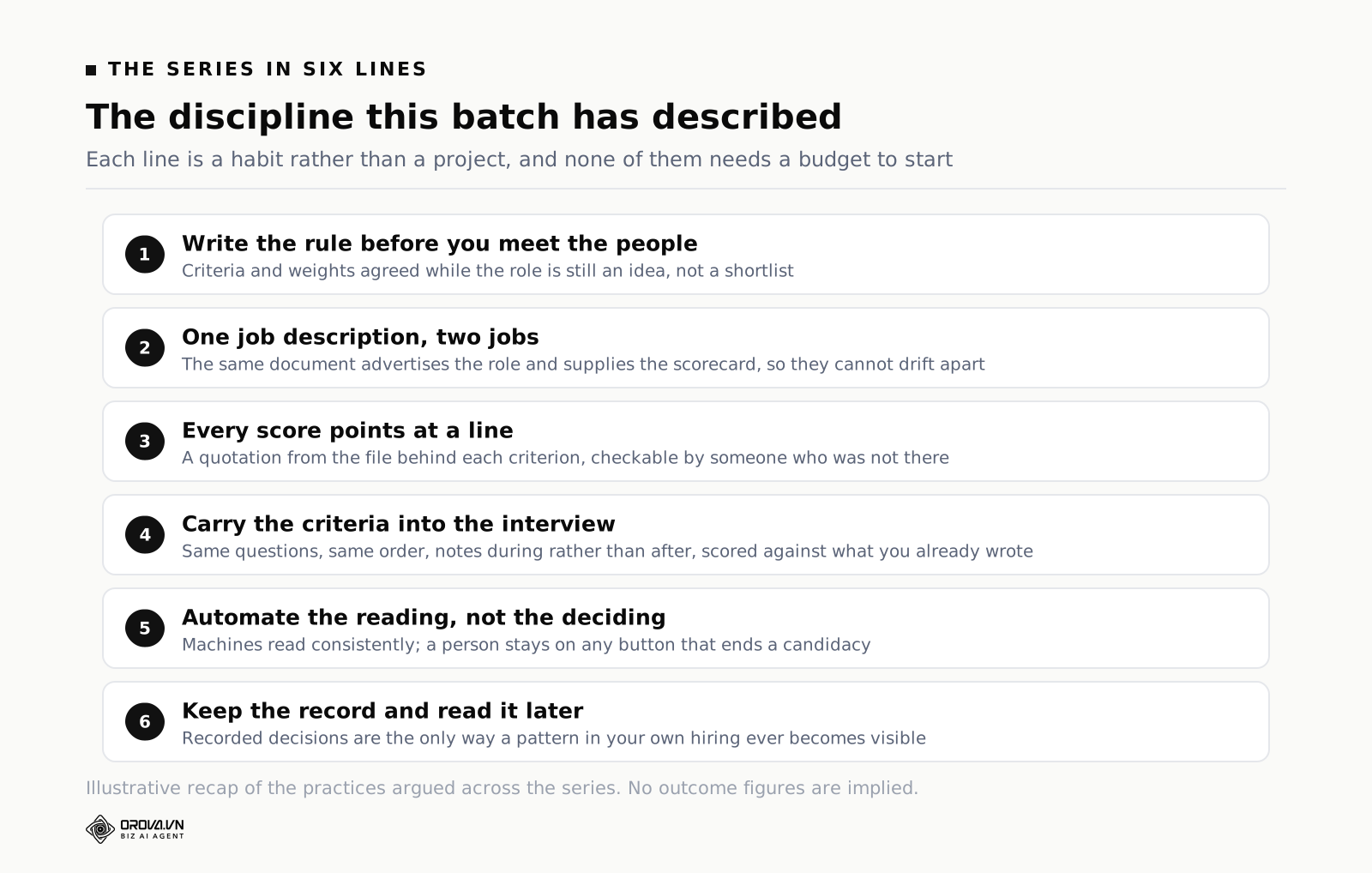
This is the last piece in the batch, so here is the through-line. Every article has been circling the same idea from a different side: hiring gets better when the reading gets consistent, and consistency comes from writing things down before you need them rather than after.
The job Posting Template: Write One, Get a Hiring Scorecard Too was about writing requirements once, in a form that converts straight into criteria, so the ad and the screen cannot drift apart. The screening pieces were about applying those criteria the same way to every file, with a quotation behind every score. The interview pieces were about carrying the same criteria into the conversation instead of starting again from scratch with whatever comes to mind. The tooling pieces were about which category of software solves which bottleneck, and the automation piece was about drawing the line between reading, which machines do consistently, and deciding, which they should not do at all. The metrics piece was about which four numbers tell you where the process is actually stuck.
All of it is the same discipline: decide the rule before you meet the people, apply it identically, write down what you saw, and check afterwards whether the rule was any good.
If you do nothing else, do these three things in this order. This week, before your next role goes live, write the criteria and the weights down and get one other person to agree that each item is unambiguous. Next week, when the first ten applications arrive, score them yourself and have that same person score them independently, then compare — that comparison will tell you more about your process than any audit report. From then on, require a quoted line from the document behind every score, on every file, including the ones you are sure about.
That is it. No budget, no policy document, no workshop. What you will get is not a bias-free process, because there is no such thing. What you will get is a process whose mistakes are visible, which is the only kind of process that can be improved.
Let AI read and score resumes against your JD
Orova Recruit turns your job description into weighted criteria and scores every CV with evidence quoted from the file.
Try it free