
Behavioral Interview Questions: Scoring Is the Hard Part
Two of you interviewed the same candidate on the same morning, using the same sheet. You asked her to describe a time she recovered a project that was running late. She talked for four minutes. You wrote "good — handled it well" and gave her an 8 out of 10. Your colleague wrote "vague, all team-level" and gave her a 4. Neither of you can now reconstruct what she actually said, so the meeting turns into a negotiation between two memories. This is the normal outcome when behavioral interview questions are asked without a scoring method attached, and it happens in careful, well-run companies every week.
Notice what did not fail here. The question was fine. It was specific, it asked about the past, it targeted something the role genuinely needs. Both interviewers listened. The candidate answered in good faith. The failure sits entirely in the gap between hearing an answer and converting it into a number, and that gap is where almost all of the value of structured interviewing leaks out.
The short version: asking is the easy half. Scoring is where the work is, and it needs a written rubric, notes made of the candidate's actual words, and a habit of pushing until you can tell what the person did from what their team did. Do those three things and two interviewers land within a few points of each other on the same answer. Skip them and your structured interview is a pleasant chat with a number stapled to it afterwards.
This article covers the STAR pattern as a scoring grid rather than a question template, how to spot a rehearsed answer, how to separate personal contribution from team contribution, a five-part rubric that converts a spoken answer into a defensible score out of 100, two full worked examples with strong, middling and weak answers scored line by line, the follow-up prompts that expose vagueness, and how to calibrate several interviewers so their numbers mean the same thing.
How do you score behavioral interview questions fairly?
Score behavioral interview questions against a written rubric, not a feeling. Break each answer into situation, task, action and result, then award points for concrete detail, personal ownership, a measurable outcome and honest reflection. Write the candidate's own words in your notes, and total the points within five minutes of the interview ending.
Everything below is an expansion of that paragraph. The rubric is the part most teams are missing, and it is also the cheapest to build: one table, written once per role, used by every interviewer on every candidate.
What a behavioral question is actually trying to do
The premise behind behavioral interviewing is narrow and worth stating plainly, because a lot of bad practice comes from forgetting it. You ask about specific past events on the assumption that what somebody has done before is a better guide to what they will do next than what they say they would do. That is it. There is no claim that the technique reads character, predicts culture fit, or reveals hidden potential.
Two consequences follow directly.
First, the question must be about a real event that actually happened, with a time and a place attached. "How do you handle conflict?" is not a behavioral question. It is an invitation to describe an ideal self, and everybody's ideal self is reasonable and collaborative. "Tell me about the last disagreement you had with someone whose approval you needed" is a behavioral question, because there is a specific Tuesday behind it that either exists or does not.
Second, the answer is data about that event, not about the person in general. A candidate who describes one project well has told you about one project. This matters when you score: you are scoring the quality of the evidence they gave you about a competency, not awarding a grade to their personality. Interviewers who forget this end up scoring likeability, because likeability is the only thing available when you are not tracking evidence.
The third thing, which nobody says out loud, is that behavioral questions are asymmetric. A detailed, specific, self-critical answer is strong evidence that the person did the thing. A vague answer is weak evidence that they did not — plenty of competent people are bad at telling stories about themselves, especially in a second language or under nerves. So a high score is more informative than a low one, and a low score obliges you to probe before you write it down. We will come back to that when we get to follow-ups.
STAR is a scoring grid, not a question format
Most people meet STAR as advice for candidates: structure your answer as Situation, Task, Action, Result. That advice has been given so widely for so long that a large share of the people you interview have rehearsed it. Which means STAR has stopped being a way to make answers better and become, for you, something more useful: a checklist of what a complete answer contains, and therefore a map of what is missing.
Read the four parts as four separate pieces of information you need, each of which fails in its own characteristic way.
Situation — what was going on
You need enough context to judge difficulty. A missed deadline on a two-person internal tool is not the same event as a missed deadline on a client launch with a contractual date. Without the situation you cannot tell whether the action was impressive or routine.
Failure mode: the situation swallows the answer. Some candidates spend three of their four minutes explaining the company, the org chart and the history of the product. This is usually nerves, not evasion. Cut in politely and move them on: "That is enough background — what was your part in it?"
Task — what they were on the hook for
The single most skipped element, and the one that decides how you read everything after it. What was this person specifically responsible for delivering? Were they leading, contributing, advising, or watching? A candidate who says "I was the project manager, the date was mine" has framed everything that follows. A candidate who never states their role is often, quietly, describing something they observed.
Failure mode: task and situation get merged, so ownership stays undefined for the whole story. If you have not heard the task by the end of the first minute, ask for it directly.
Action — what they personally did
This is the part you are actually scoring, and it should be the longest part of a strong answer. You want steps, in order, in the first person singular, with enough operational detail that you can picture the week. Who they spoke to, what they changed, what they decided, what they chose not to do.
Failure mode: the pronoun drifts to "we" and stays there. More on this below, because it is the single biggest scoring problem in behavioral interviews.
Result — how it ended and how they know
Not just the outcome, but the evidence for the outcome. "It went well" is not a result. "We shipped eleven days late instead of the four weeks we were tracking towards, and the client renewed in March" is a result. Failed outcomes are perfectly scoreable, sometimes better than successes: a candidate who describes a project that failed and can say exactly why usually knows more than one who describes an unbroken run of wins.
Failure mode: the story ends at the decision. The candidate describes what they planned and never says what happened. Ask.
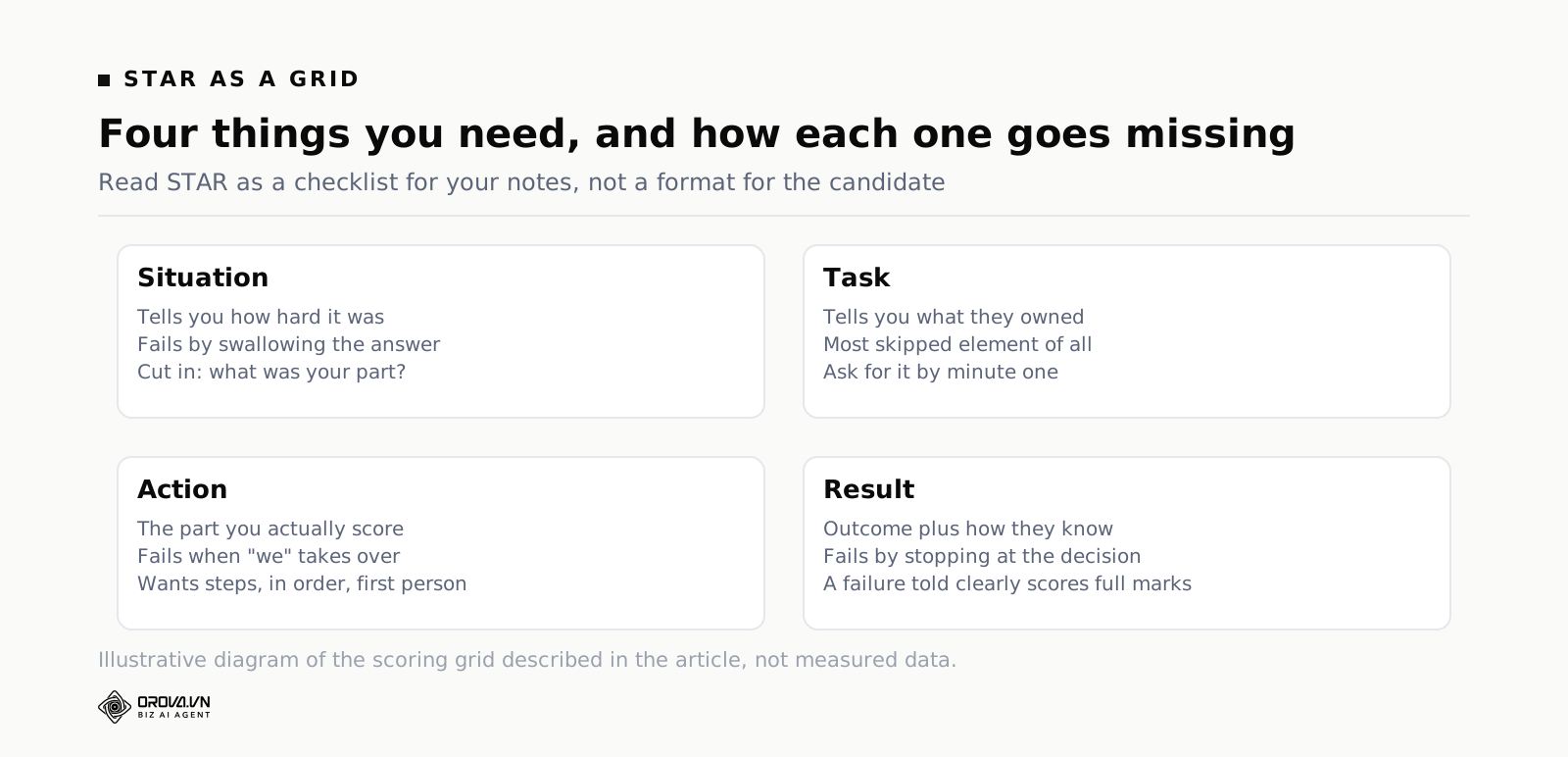
One practical note about star interview questions and the STAR framing generally: do not ask candidates to use it. Saying "please answer in STAR format" turns the interview into a compliance exercise and rewards people who have read interview guides. Use the grid silently in your own notes. If a part is missing, that is your cue to ask a follow-up, and how many follow-ups you needed is itself information worth writing down.
A bank of behavioral interview questions grouped by what they test
Most lists of common behavioral interview questions are sorted by nothing at all — forty questions in a column, all interchangeable. That ordering is what leads teams to ask four questions that all test the same competency and none that test the other three. Group them by the thing they measure and the gaps become obvious.
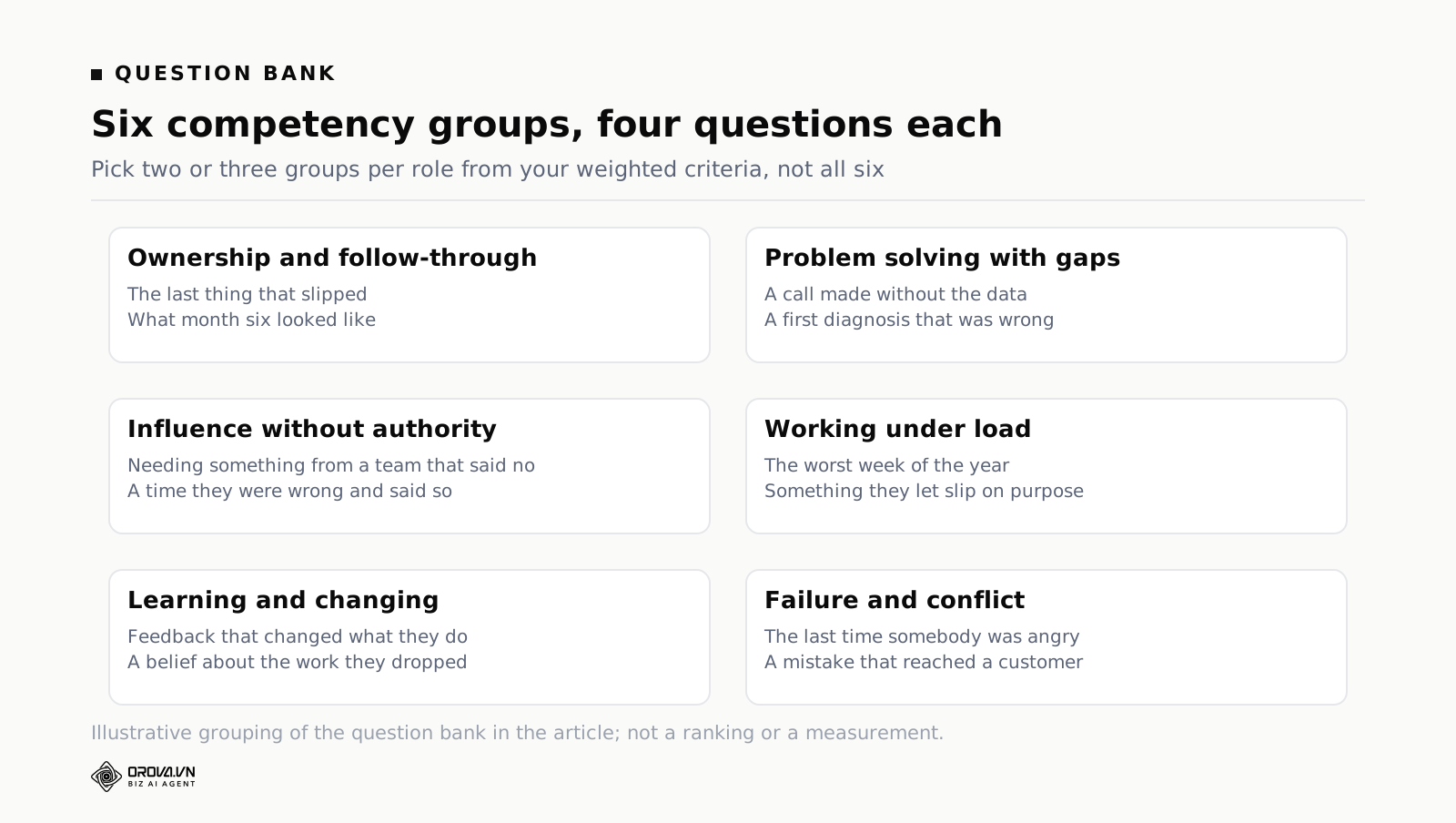
Below are six competency groups with four questions each. Take two or three groups per role, based on your weighted criteria, not all six. Every question uses "the last time" rather than "a time" deliberately: "a time" lets the candidate pick their most-polished story from five years ago, "the last time" gets you something recent and unbuffed.
Ownership and follow-through
Tests whether the person finishes things without being chased, and whether they treat a commitment as theirs after the enthusiasm wears off.
- Tell me about the last thing you were responsible for that slipped. Start from the moment you knew it would.
- Walk me through something you finished that nobody was asking you about.
- Describe the last time you had to tell someone senior that a date was not going to hold. What did you say?
- What is the longest-running thing you have owned, and what did month six look like compared with month one?
Problem solving with incomplete information
Tests method, not intelligence. You are looking for how somebody narrows an unknown, not whether they got a clever answer.
- Tell me about the last time you had to make a call without the data you wanted. What did you use instead?
- Describe a problem where your first diagnosis turned out to be wrong. How did you find out?
- Walk me through the most confusing thing you had to figure out in your last job, from the first hour.
- Tell me about something you decided not to fix. Why?
Influence without authority
Tests whether somebody can get things from people who do not report to them — the competency most quietly required in flat teams and most rarely tested.
- Tell me about the last time you needed something from a team that did not want to give it to you.
- Describe a decision you disagreed with and had to live with. What did you do?
- Walk me through a time you changed somebody's mind. What was the argument that landed?
- Tell me about a time you were wrong in a disagreement and had to say so.
Working under load and prioritising
Tests judgement about what to drop, which is the actual skill. Everybody claims to prioritise; few can name something they consciously let fail.
- Describe your worst week in the last year. What was on your plate and what did you do first?
- Tell me about something you deliberately let slip because something else mattered more. Who did you tell?
- Walk me through how you decided what to work on last Monday morning.
- Describe a time you asked for help. What made you ask, and how long had you been stuck?
Learning and changing approach
Tests whether experience accumulates or just repeats. The signal is specificity about what changed, not enthusiasm for learning.
- Tell me about the last thing you learned because the job required it. How did you go about it?
- Describe something you used to believe about your work that you no longer believe.
- Walk me through a piece of feedback that changed what you do. Who gave it and what did you change?
- Tell me about the last time you were the least experienced person in the room.
Handling failure and conflict with customers or users
Tests behaviour when the situation is unpleasant, which is where most role-relevant differences appear.
- Tell me about the last time somebody was angry with you at work. Start from what they said.
- Describe a mistake of yours that reached a customer. What did you do in the first hour?
- Walk me through a time you had to deliver bad news to someone who had been counting on you.
- Tell me about a commitment you could not keep. How did you handle the conversation?
How you pick which groups apply to a given role is a separate exercise, and one we have already walked through step by step in interview questions to ask candidates, built from your own criteria. The short form: each weighted criterion earns one or two questions, and criteria you can already verify from the CV do not need interview time. This article assumes you have done that and starts at the moment the candidate opens their mouth.
Telling a rehearsed answer from a real one
Rehearsal is not dishonesty. Any sensible candidate has prepared three or four stories and will steer towards them. The problem is not that the story is polished — it is that a polished story is designed to be persuasive rather than informative, and if you score the polish you will systematically prefer people who interview often over people who work well.
There is no reliable tell for lying, and you should not try to develop one; interviewers who believe they can detect deception mostly detect nervousness. What you can reliably detect is whether an answer contains the kind of detail that only comes from having been there.
Signals that an answer is a genuine recollection
- Irrelevant specifics. Real memories carry cargo. The person mentions that the meeting was on a Friday, that the spreadsheet was a mess because someone had merged two versions, that they had to wait until the finance lead got back from leave. Nobody rehearses that.
- Ordinary difficulty. Prepared stories tend to feature dramatic obstacles and clean resolutions. Real work is mostly waiting, chasing and unglamorous negotiation. An answer with boring friction in it is usually real.
- Named other people with their own motives. "Our head of ops thought we were over-engineering it and she was partly right." Rehearsed answers tend to have a cast of extras with no opinions.
- Willingness to say what they did not know at the time. "I thought it was a data problem for about two weeks." Reconstructed stories are told from the perspective of someone who already knows the ending.
- The story survives a change of angle. Ask about the same event from a different direction — what the customer was told, what the first week looked like — and a real memory produces new detail. A rehearsed one produces the same sentences again.
Signals that you are hearing a prepared summary
- Present tense and the conditional. "What I typically do is..." or "I would usually make sure that..." The question was about a specific past event; a generalisation is an answer to a different question. Bring them back once, politely: "Sorry — for this particular one, what did you do?"
- Numbers with no denominator. "Improved efficiency by 40 percent" with no statement of what was measured, before what, over what period. Ask for the baseline. Real numbers survive the question.
- No opposition anywhere in the story. Every meaningful project has someone who disagrees, a constraint that binds, a thing that had to be given up. A frictionless account has had the interesting parts trimmed for time.
- Smoothness that increases under follow-up. Usually detail increases and fluency decreases when you dig into something real. If the second layer is as polished as the first, you are probably hearing the same prepared piece from another angle.
- The candidate is always the protagonist. In real work you sometimes execute somebody else's plan. A career in which every good idea was the candidate's own is a narrative, not a history.
Two cautions on all of this. Detail is culturally and linguistically loaded: someone interviewing in their second language will give you shorter, flatter answers than a native speaker of equal ability, and some cultures treat individual credit-claiming as bad manners. Ask more follow-ups rather than scoring the surface. And a rehearsed answer is not automatically low-scoring — a well-prepared account of real work with real detail is a fine answer. What you are penalising is the absence of evidence, not the presence of preparation.
Separating what they did from what the team did
Here is the highest-yield thirty seconds in the whole interview. When an answer arrives in the first person plural — and most do — you have to convert it into the first person singular before you can score it. Every unresolved "we" is a hole in your evidence.
The reason this matters more than it sounds: "we" is doing two completely different jobs in ordinary speech. Sometimes it means "I did this, and I am being modest about it, because claiming solo credit for team work is obnoxious." Sometimes it means "my team did this and I was present." Those two candidates are miles apart, and they produce identical sentences.
Do not treat "we" as a red flag. Treat it as an unanswered question, and ask it flatly and without any edge in your voice, every time, for every candidate:
"That is helpful. Within that, what was the piece you did yourself?"
Then keep going until you reach one of four levels, and write down which one you reached.
| Level | What the answer establishes | Typical wording | How to score the action |
|---|---|---|---|
| Owned | They were accountable for the outcome and did the core work | "I built the plan and I was the one who had to explain the slip" | Full credit available |
| Contributed | They personally did an identifiable, substantial piece | "I wrote the migration script and ran the two test cycles" | Full credit for that piece only |
| Supported | They helped, on request, inside somebody else's plan | "I helped with the testing when they were short" | Partial credit; note the limitation |
| Present | They were on the team; no personal action ever emerges | "We all pitched in and got it done" | Score the answer, not the project |
Two rules make this fair rather than adversarial. Ask everybody, including the candidates you already like — the failure mode here is asking the hard version only of people you doubt. And stop at three attempts. If after three prompts you still cannot get below the team level, that is your finding: write "asked three times, stayed at team level" and score the action component low. That note is defensible in a debrief in a way that "seemed vague" never is.
One more thing to listen for: attribution of decisions. Even inside a genuine team effort, decisions belong to somebody. "Who decided to cut the scope?" is a clean, non-hostile question that resolves ownership faster than almost anything else. If the answer is always "my manager", you have learned something real about the level the person operated at, which may be perfectly fine for the role you are filling.
The rubric: from a spoken answer to a score out of 100
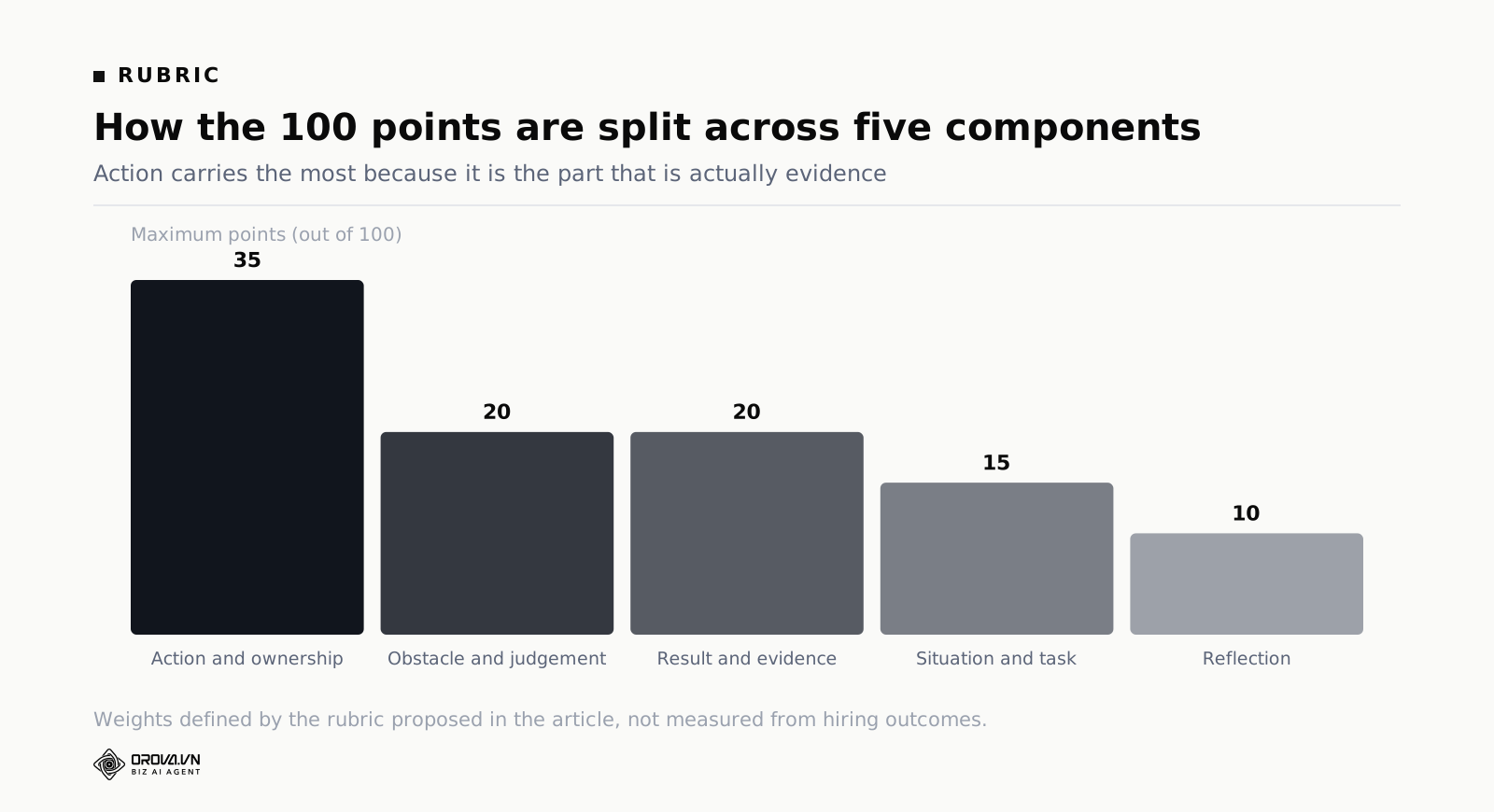
Now the part that closes the gap between your 8 and your colleague's 4. Instead of scoring an answer as a whole, score five components and add them up. The components are always the same; only the definition of a strong answer changes with the criterion.
| Component | Max | What earns the points | What loses them |
|---|---|---|---|
| Situation and task | 15 | A specific event with a date range, real stakes, and a clear statement of what this person was on the hook for | Generic setting; role never stated; five minutes of company background |
| Action and ownership | 35 | Steps in order, in the first person singular, with operational detail you could act on | "We" surviving three prompts; process described instead of actions taken |
| Obstacle and judgement | 20 | A real constraint, a trade-off named, and an explanation of why they chose one path over another | No opposition in the story; obstacles resolved by unexplained effort |
| Result and evidence | 20 | An outcome with a way of knowing — a number, an observable change, a customer response | "It went well"; story stops at the decision; numbers with no baseline |
| Reflection | 10 | A specific thing they would do differently, or a lesson that visibly changed later behaviour | "Nothing, it went fine" about a complicated project; generic self-praise |
Three things about this rubric are deliberate.
Action carries more than a third of the total. That is where the evidence lives. A candidate can describe a magnificent situation and a triumphant result and still score badly, because you never found out what they did.
Reflection is only 10. It is a genuine signal — people who have thought about the work since have specific regrets — but it is also the easiest component to perform. Keep it small so a fluent self-critique cannot carry a hollow answer.
The result component rewards evidence, not success. A failed project described with a clear account of why it failed scores full marks here. This is the line that stops your process from selecting for people who only choose safe work.
Turning the total into a verdict
Scores need bands, or people will argue about the difference between 71 and 74. Use the same bands you use for CV screening so the numbers stay comparable across the whole process.
| Total | Reading | What you do next |
|---|---|---|
| 85–100 | Strong evidence the person has done this | Nothing further needed on this criterion |
| 70–84 | Good evidence with one component thin | Note which component; a later round can top it up |
| 50–69 | Relevant experience, weakly evidenced | Ask a second question on the same competency if it matters |
| 25–49 | Adjacent experience, or the answer never became personal | Fail on a must-have criterion regardless of the overall total |
| 0–24 | No relevant event, or a hypothetical answer to a past-tense question | Record what was missing, in their words |
The rule that does the most work: a must-have criterion scoring below 50 is a fail, whatever the average says. A candidate who is warm, articulate and scores in the eighties on three criteria while scoring 40 on the one thing the job is mostly made of is not a close call. They are a strong candidate for a different role.
Worked example one: a project that slipped
Everything below is invented to show the mechanics. The role, the company, the answers and the numbers are made up. Take the shape, not the specifics.
The role. Operations Lead at a 60-person logistics company. The criterion. "Has personally owned a delivery date and handled it when it moved" — must-have, weight 9.
The question. "Tell me about the last thing you were responsible for that missed its date. Start from the moment you knew it was going to slip."
The strong answer — 91
She describes a warehouse management system rollout at her last company, planned for the second week of March, actually live on the 24th. She was the project owner; the date had been given to two customers in writing. She knew it would slip on a Wednesday in late February when the data migration test came back with about a fifth of the stock records failing validation, mostly older SKUs with inconsistent unit codes. She spent that afternoon working out whether it was a two-day fix or a two-week one, could not tell, and decided to tell the commercial director the next morning rather than wait for certainty — her reasoning being that a customer finding out from their own missed delivery would cost more than an early warning that turned out pessimistic. She proposed going live for one of the two customers on time with a manual workaround for the older SKUs, and moving the second by two weeks. The commercial director pushed back and wanted both moved; they compromised on her plan for the first customer with a named fallback date. She personally rewrote the unit code mapping over four days with one of the developers, ran the migration twice more, and wrote the daily update that went to both customers. Result: first customer live on the original date on the workaround, second live on the 24th, both renewed. Asked what she would do differently, she says the validation test should have run in January and it did not because she had scheduled it after the UAT rather than before, which she now does in the other order.
| Component | Score | Why |
|---|---|---|
| Situation and task | 14 / 15 | Specific event, real stakes, ownership stated without being asked |
| Action and ownership | 32 / 35 | First person throughout, decisions attributed to herself, operational detail |
| Obstacle and judgement | 18 / 20 | Named the trade-off and the internal disagreement, explained the reasoning |
| Result and evidence | 18 / 20 | Dates, both outcomes, including the one that stayed late |
| Reflection | 9 / 10 | A specific process change, not a sentiment |
| Total | 91 | Strong evidence; no further questioning needed on this criterion |
What made this strong is not that the project succeeded — half of it did not. It is that every component of the rubric had something in it, and the details are the kind nobody invents: the fifth of records failing, the older SKUs, the argument with the commercial director.
The middling answer — 58
He describes "a systems project that ran over" at his last company. Asked when, he says last year, probably the autumn. He was part of the project team; asked what he was responsible for, he says he was the operations contact. He knew it would slip when the testing started throwing up problems. Asked what problems, he says data issues, mostly around product codes. Asked what he did, he says the team got together and worked out a plan, they decided to phase the rollout, and he made sure operations were kept informed. Asked what he personally did in that plan, he says he ran the operations side of the testing and handled the communication to the warehouse teams. Asked what the plan was, he says they went live in stages over a few weeks. Result: it went live and it was fine in the end, the customers were happy. Asked how he knows, he says there were no complaints afterwards. Asked what he would do differently, he says they should have started testing earlier.
| Component | Score | Why |
|---|---|---|
| Situation and task | 12 / 15 | Real event, but role stayed fuzzy until asked; "operations contact" is not an accountability |
| Action and ownership | 20 / 35 | Two identifiable personal actions, both real, both extracted rather than offered |
| Obstacle and judgement | 11 / 20 | Obstacle named at one level of detail; no trade-off, no disagreement, no reasoning |
| Result and evidence | 10 / 20 | Outcome given; evidence is the absence of complaints, which is weak but honest |
| Reflection | 5 / 10 | Correct but generic, and it is the team's lesson rather than his |
| Total | 58 | Relevant experience, weakly evidenced; ask a second question on this competency |
This is the answer most likely to be scored wrong, in both directions. An interviewer who liked him hears a competent person being modest and gives him an 80. An interviewer who is tired hears vagueness and gives him a 30. The rubric puts him at 58 and tells you exactly what to do about it: he reached "Contributed" on the ownership ladder, he has real experience of the situation, and you do not yet know whether he can own a date. If this is a must-have criterion, ask a second question before deciding, because a 58 on a must-have will otherwise fail him on evidence you did not try very hard to collect.
The weak answer — 18
She says that in her experience deadlines slip for a few common reasons, usually poor planning or scope changes, and that the important thing is to communicate early and manage stakeholder expectations. Asked for a specific instance, she says it happens quite regularly and gives an example of a launch where "we had to push the date back". Asked when, she says it was a while ago. Asked what her part was, she says she was involved in the planning and helped keep everything on track. Asked what she personally did when the date moved, she says she made sure everyone knew and that the communication was handled properly. Asked what she would do differently, she says she would push for more realistic timelines from the start.
| Component | Score | Why |
|---|---|---|
| Situation and task | 6 / 15 | An event exists but has no date, no stakes and no stated responsibility |
| Action and ownership | 7 / 35 | Three prompts, no first-person action; "helped keep things on track" is not a step |
| Obstacle and judgement | 3 / 20 | General reasons for slippage, no constraint from this event |
| Result and evidence | 2 / 20 | No outcome stated at all |
| Reflection | 0 / 10 | Advice about project management, not a lesson from this project |
| Total | 18 | Fails a must-have; record the missing pieces in her words |
Two things to notice. Nothing in this answer is wrong — everything she says about deadlines is true and sensible, which is why fluent generality is so persuasive at four in the afternoon. And the score is defensible without any judgement about her as a person: three prompts, no personal action, no outcome. That sentence is the whole justification, and it can be written in ten seconds.
Worked example two: getting something from a team that did not want to give it
Same invented company. The criterion. "Can get work from teams that do not report to them" — important, weight 7.
The question. "Walk me through the last time you needed something from a team that did not report to you and did not want to give it to you."
The strong answer — 87
He needed the finance team to change how they closed the month so that stock figures were available on the third working day instead of the seventh, because the warehouse was ordering against week-old numbers. Finance said no twice; their reason was that the earlier close pushed their reconciliation into a week when two people were already committed to the audit. He says his first attempt was a bad one — he escalated to his own director, who raised it in a management meeting, and the finance manager was annoyed and dug in harder. So he changed approach: he asked the finance manager what specifically made the third day impossible, and it turned out only one part of the close was the blocker, an intercompany reconciliation that could be done on estimates and trued up later if someone would agree to sign off the estimate. He wrote a one-page note describing that, took it to the financial controller with the finance manager rather than around her, and got a three-month trial. Result: stock figures moved to day four, not three, which was enough; ordering errors that had been running at "a couple a week, mostly over-ordering" dropped to roughly one a month over the trial, measured from the warehouse's own correction log. Asked what he would do differently: not escalate first, because it cost him about six weeks and made the relationship worse before it got better.
| Component | Score | Why |
|---|---|---|
| Situation and task | 13 / 15 | Concrete need, real resistance, his ownership implied clearly by the actions |
| Action and ownership | 31 / 35 | Sequence in the first person including a failed first attempt |
| Obstacle and judgement | 19 / 20 | Understood the other side's actual constraint and redesigned the ask around it |
| Result and evidence | 16 / 20 | Outcome with a measurement, honestly short of the original target |
| Reflection | 8 / 10 | Names a real cost of his own mistake |
| Total | 87 | Strong evidence of influence without authority |
The unprompted failed first attempt is worth more than the success. Candidates who volunteer the part where they made it worse are usually telling you about something that happened, and are usually people who can be corrected.
The middling answer — 49
She describes needing data from the finance team for a reporting project. They were busy and slow to respond. She followed up several times, explained why it mattered, and eventually built a good relationship with one person there who helped her get what she needed. Asked what the finance team's objection was, she says they were just stretched. Asked what she said that changed things, she says she made sure they understood the business impact and kept it friendly. Asked what she personally did beyond following up, she says she offered to do some of the extraction herself if they gave her access. Asked whether that happened, she says partly, in the end they sent the file. Asked how long it took: a couple of months. Asked what she would do differently: start earlier.
| Component | Score | Why |
|---|---|---|
| Situation and task | 10 / 15 | Real need, but the resistance is described as busyness rather than a position |
| Action and ownership | 17 / 35 | Persistence plus one concrete offer; most of the story is following up |
| Obstacle and judgement | 10 / 20 | Never established what the other side's actual constraint was |
| Result and evidence | 9 / 20 | Got the file; no measure of what it changed |
| Reflection | 3 / 10 | "Start earlier" is the default answer and carries no information |
| Total | 49 | Below the bar on an important criterion; would fail outright if this were a must-have |
The weak answer — 15
He says he has always had good relationships across departments and rarely runs into that problem, because he takes the time to build rapport before he needs anything. Pressed for a specific instance, he describes a general pattern of working with the IT team, who are "always busy", and says the trick is to make your request easy for them. Pressed again for one occasion, he says there was a time he needed a system change and it took a while but it got done in the end. Asked what he did, he says he stayed on top of it. Asked what would he do differently, he says nothing really, it worked out.
| Component | Score | Why |
|---|---|---|
| Situation and task | 5 / 15 | No identifiable occasion after two prompts |
| Action and ownership | 6 / 35 | "Stayed on top of it" is the only action offered |
| Obstacle and judgement | 2 / 20 | Claims the problem does not arise for him, which is itself the answer |
| Result and evidence | 2 / 20 | "It got done" with no timeframe or effect |
| Reflection | 0 / 10 | Nothing to change |
| Total | 15 | No evidence collected; note the three prompts and move on |
Put the six answers side by side and the useful pattern appears. The two strong answers are not more impressive projects — the middling and weak candidates describe similar work. The difference is entirely in how much of it survives contact with a follow-up question. That is what your rubric measures, and it is the only thing you are entitled to measure from a forty-minute conversation.
Follow-up prompts that expose vagueness
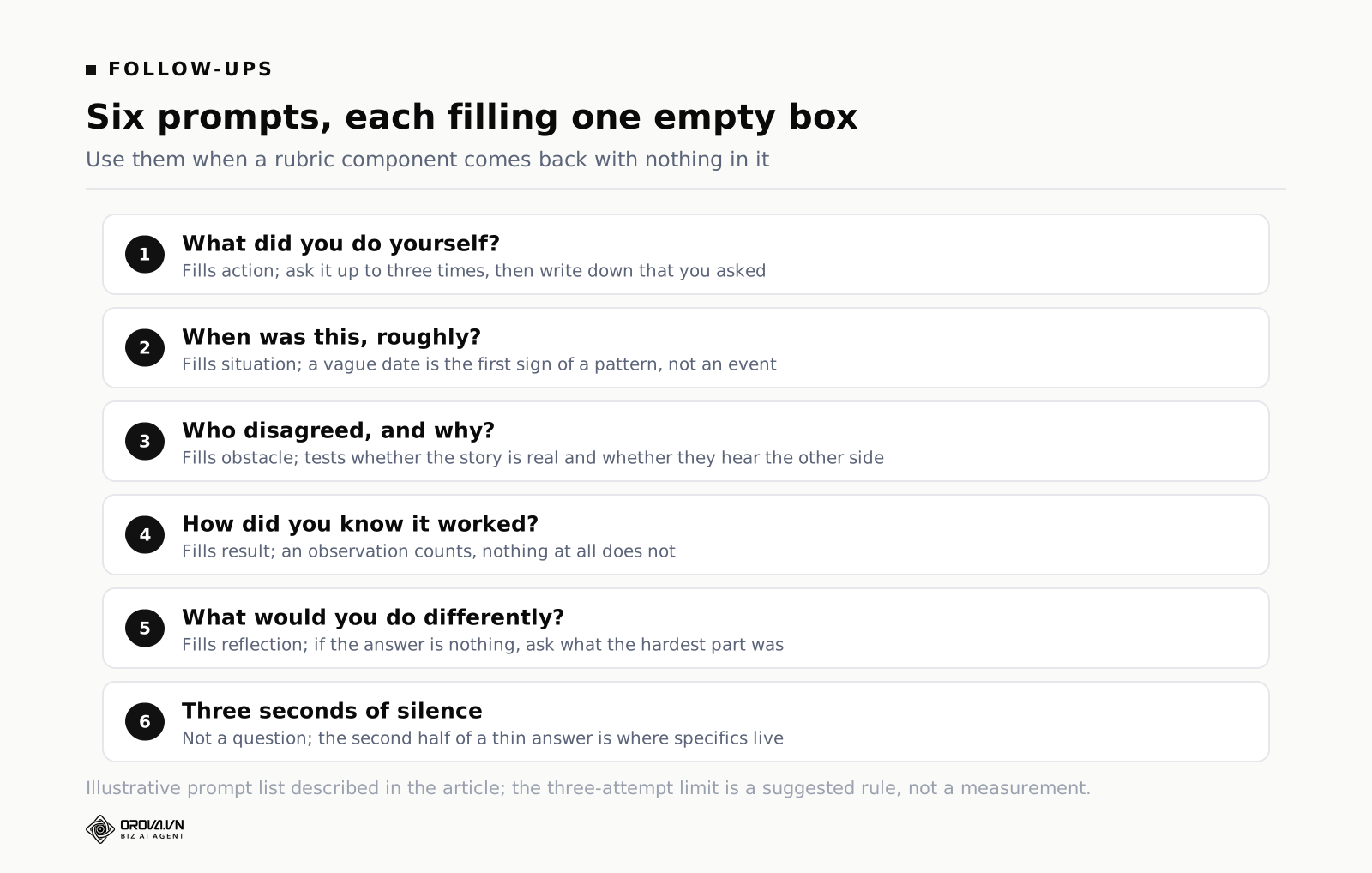
You need very few of these. Six prompts, learned once, aimed specifically at the components of the rubric that came back empty. The trick is not knowing them; it is remembering that a thin answer obliges you to use them before you score, rather than after you have decided.
- "What did you do yourself?" Fills the action component. Ask it every time the pronoun is plural. Ask it up to three times, then stop and write down that you asked three times.
- "When was this, roughly?" Fills situation. A vague answer to a date question is the earliest cheap signal that you are hearing a pattern rather than an event.
- "Who disagreed with you, and what was their argument?" Fills obstacle and judgement. This one is the most efficient question in the set, because it simultaneously tests whether the story is real and whether the person can state an opposing case fairly.
- "How did you know it worked?" Fills result. Accept observations as well as numbers — "the warehouse stopped calling me" is a legitimate answer. What you are refusing to accept is nothing at all.
- "What would you do differently?" Fills reflection. If the answer is "nothing" about something complicated, follow with "what was the hardest part?" — people who will not criticise themselves will sometimes still tell you where the pain was.
- Three seconds of silence. Not a question. After a thin answer, wait instead of moving on. A useful share of the time the candidate keeps talking, and the second half is where the specifics live.
Three habits make these work rather than backfire.
Ask them of everyone, in the same number. The most common way structure collapses in practice is that interviewers probe hard on candidates they doubt and accept the first fluent answer from candidates they like. If your sheet says two follow-ups per question, that is two for everyone, including the person you already want to hire.
Signal that you are collecting, not attacking. "I want to make sure I capture your part properly" costs two seconds and changes the temperature completely. Candidates who feel interrogated give worse information, not better.
Stop at three and score what you have. Not being able to get a specific answer after three attempts is a finding. It is not a reason to keep digging until the candidate says something you can use.
Why you write down their words, not your impression
Ask a room of interviewers what they wrote during the last interview and most will show you conclusions: "strong communicator", "a bit junior", "great culture add", "not convinced". These notes feel efficient. They are the single biggest cause of debriefs that go nowhere, for a reason that is structural rather than a matter of discipline.
A conclusion cannot be re-examined. Once you have written "vague", the evidence that produced that word is gone within a day, and all you can do in the debrief is repeat the word with more conviction. A quote can be re-examined. If your note says "we all pitched in and got it done" — asked 3x for his part, best answer was "I helped keep things on track", then your colleague who scored it higher can look at the same sentence and either change their mind or explain why they read it differently. That is a conversation that can end. "I thought he was vague" and "I thought he was fine" is not.
There is a second reason, which matters more as the company grows. A score with a quote attached is auditable. If a candidate asks why they were rejected, or a manager challenges a decision six months later, or you want to check whether your interviews predict anything at all, quoted evidence is the only thing in the file that still means something. Everything else has decayed into adjectives.
What a usable note looks like
The note sheet is not a blank page. Print one block per criterion with the five rubric components listed, and write into it during the answer. Aim for fragments in their words, not sentences in yours:
Situation: WMS rollout, planned 2nd wk March, live 24th. "Two customers had it in writing."
Task: "I was the project owner, the date was mine."
Action: "about a fifth of stock records failed validation" / told commercial dir next morning, before knowing size of fix / "rewrote the unit code mapping over four days with one of the devs" / wrote the daily customer update
Obstacle: comm dir wanted both dates moved, she argued for one plus a named fallback
Result: cust 1 on time on workaround, cust 2 on 24th, both renewed
Reflection: "validation should have run before UAT, not after — I do it the other way round now"
That is roughly ninety seconds of typing spread over a four-minute answer, and it produces a score anybody can check. Compare it with "very strong, good ownership", which produces an argument.
The five minutes after
Score immediately, before the next candidate. Block five minutes after every interview slot in the calendar and use them for exactly two things: total the five components, and write one sentence per criterion pointing at the quote that justified the number.
Scoring later in the day means scoring by memory and by contrast. The fourth candidate on a Thursday gets compared with the third rather than with the rubric, which is how a decent person interviewed after an exceptional one ends up with a 55 that has nothing to do with their answers. The five-minute rule is unglamorous and it fixes more scoring noise than any other single habit.
Calibration: making two interviewers mean the same thing by 70
A rubric on its own does not guarantee agreement. It guarantees that when you disagree, you can find out where. Calibration is the routine that closes the remaining gap, and it takes about half an hour per role plus ten minutes per debrief.
- Write anchor answers before the first interview. For each criterion, write two short paragraphs: what an 85 sounds like and what a 50 sounds like, in the specific language of this role. This is the single highest-value calibration step, because most disagreement is not about judgement, it is about two people holding different silent definitions of "good". Fifteen minutes, done once, reused every time you open the role.
- Do one dry run together. Before the real interviews, take one answer — from a past candidate, or one of you role-playing — and have every interviewer score it independently against the rubric. Compare. You will find a spread of thirty points on the first attempt and the reasons will be interesting: one person scoring effort, another scoring outcome, a third silently penalising a strong accent. Twenty minutes here saves the whole round.
- Score independently, before anyone speaks. Everyone submits their component scores before the debrief opens. The first person to speak in an unstructured debrief sets an anchor the room then argues around, and seniority makes it worse. This rule costs nothing and removes the largest single source of noise in group decisions.
- Only discuss criteria where you disagree by more than 15 points. Agreement does not need a meeting. Go straight to the gaps, and start each one by reading out the quotes each person wrote down, not the scores. Roughly half of these gaps dissolve immediately because one interviewer simply did not hear the part the other quoted.
- Resolve gaps by evidence, not by averaging. Averaging an 85 and a 40 gives you 62, which describes nobody's assessment and nobody's reasoning. Read both sets of notes and decide which components are actually supported by what the candidate said. If the disagreement survives, the honest resolution is usually a targeted follow-up question in the next round rather than a compromise number.
- Track your own drift across the round. At the end, lay your scores next to each other for all candidates. If one interviewer's average is consistently fifteen points above everyone else's, that is not a difference of opinion, it is a difference of scale, and it can be corrected in one conversation. If somebody scores every candidate between 65 and 75, they are not using the rubric, they are converting an impression into a safe number.
Two structural notes. Keep panels small — three people scoring carefully beats six people scoring casually, and every additional interviewer adds scheduling delay that costs you candidates. And pass scores forward between rounds rather than opinions: telling the hiring manager that criterion 2 scored 58 with the note "stayed at team level after three prompts" tells them exactly where to dig, while telling them "seemed decent" biases them without informing them. That handoff logic is the same one that makes an early screen worth running at all, which we worked through in the phone screening interview script.
Scoring mistakes that survive even a good rubric
Scoring the story instead of the storytelling
An impressive project described badly and a modest project described brilliantly produce very different feelings and should not produce very different scores. What you are measuring is whether this person can show you they did the work. Someone who ran a large programme and cannot describe their part of it has failed to give you evidence — that is a real finding, not an unfair one — but do not confuse it with having run nothing.
Letting one component leak into the others
A vivid result makes the action sound better than it was. A candidate who fumbles the situation gets marked down on reflection ten minutes later. Score the components in order, write the number for each before you hear the next answer, and do not go back and adjust after the total looks wrong to you. If the total consistently looks wrong, fix the rubric between rounds, not during an interview.
The contrast effect
Whoever came before changes what you hear next. This is why the five-minute rule matters and why you should compare candidates against the anchor answers rather than against each other. If you find yourself thinking "better than the last one", that is the moment to reread your own 85 and 50 anchors.
Rewarding difficulty you invented
The situation component is there to let you judge difficulty, and it is easy to over-credit a story that sounds dramatic. A candidate describing a crisis at a well-known company is not automatically stronger than one describing a boring problem at a company you have never heard of. Score the constraint, the decision and the evidence, not the setting.
Treating a low score as a verdict on the person
A 40 on one criterion means you did not collect evidence for that competency in that conversation. It does not mean the person lacks it. That distinction is worth holding onto because it changes what you do next: a 40 on an important-but-not-must-have criterion is a reason to ask a second question in the next round, not a reason to close the file. Only must-have criteria justify an automatic no.
The routine, per role and per round
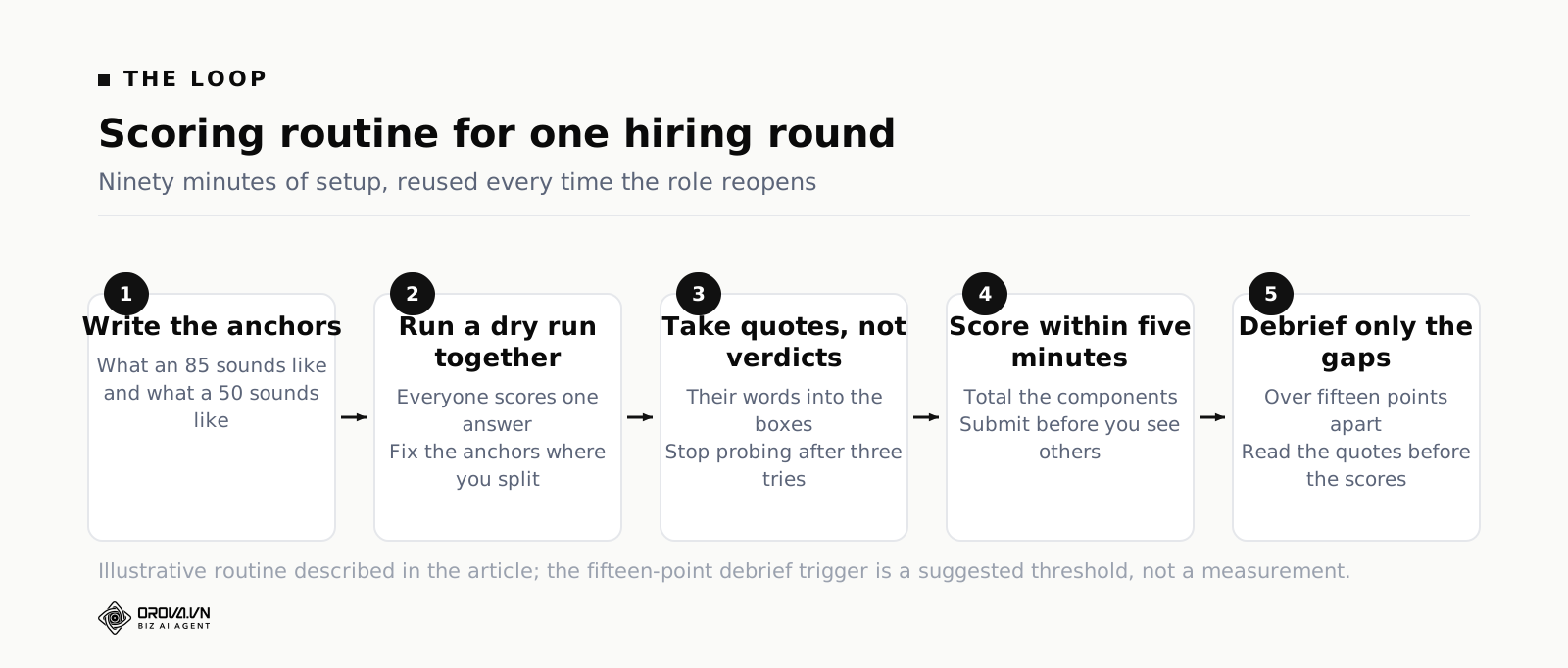
None of this needs software. What it needs is a repeatable order of operations, and about ninety minutes of setup that you reuse every time the role reopens.
- Before the round opens. Pick two or three competency groups from your weighted criteria. Choose one or two questions per criterion from the bank. Write the 85-level and 50-level anchor answers for each. Build the note sheet with the five rubric components printed under each criterion.
- Before the first interview. Run the twenty-minute dry run with everyone who will be scoring. Fix the anchors where you disagreed.
- During each interview. Ask the question, take quotes not conclusions, use follow-ups where a component is empty, stop at three attempts.
- Five minutes after each interview. Score the components, total them, write one line of justification per criterion pointing at a quote. Submit before you see anybody else's.
- At the debrief. Discuss only criteria with gaps over 15 points. Read quotes before scores. Resolve by evidence or by asking a targeted question in the next round.
- When the round closes. Check the spread per question — a question where everybody scores 60 to 70 is separating nobody and needs rewriting. Check interviewer averages for drift. Note which questions produced the quotes you actually used in the decision, and drop the ones that never did.
- After 90 days. Look at the new hire's component scores against how the job is going. A criterion that scored high on someone now struggling is measuring the wrong thing, and the anchors for it need rewriting before the next hire.
Where a tool helps, and where it does not
Scoring an interview is not a job to hand to software. The evidence arrives as speech, the judgement about what counts is yours, and the rubric only works because a human decided what an 85 sounds like for this specific role. A recording or a transcript can help you check a quote you half-caught; it cannot decide what the quote is worth. Be particularly careful with anything that offers to score candidates from video or voice — you would be introducing a measurement you cannot inspect into the one part of the process where inspectability is the whole point.
The place where volume genuinely breaks a human process is earlier, at the stage before anyone gets invited. Writing six questions and five anchor answers takes ninety minutes regardless of how many people applied. Deciding which twelve of two hundred applicants get asked those questions is where consistency quietly collapses, because file 180 gets read differently from file 1 after three hours, and the shortlist you carry into a beautifully calibrated interview process was assembled by two different standards.
That is the specific job Orova Recruit does. You upload the job description as a file or paste the text, and it proposes 8 to 16 criteria sorted into five groups — must-have, important, preferred, basic, flexible — each with a weight from 1 to 10 and a suggested pass threshold, all of which you edit. It then scores each CV from 0 to 100 per criterion with the supporting text quoted from the file, calculates the overall score as a weighted average on the server rather than trusting a total the model adds up, and forces a fail when a must-have scores below 50 no matter how high the average.
It then carries the same discipline into the interview itself. Questions are drafted per candidate from the approved criteria, each with its scoring line and a weight from 1 to 10, so a strong answer on a weight-9 criterion cannot be quietly outweighed by three polished answers on weight-2 ones. Scoring is 0 to 5 per question, converted to a weighted total out of 100. The recording of the interview is treated as the primary source and your typed notes as a hurried secondary one, so a gap in the notes is not read as a bad answer; a question that neither source covers is scored zero and labelled not asked rather than inferred — the behavioural equivalent of the must-have rule above.
The same pattern is then carried into the interview, which is the harder half. Each question in the set holds what to listen for and a weight of its own; notes are captured live, line by line, with the time and the author on each one; and the scoring pass marks every question 0–5 against the rubric with a reason, scoring anything the notes never touch as zero and saying so rather than inferring an answer. The interview total is computed by the server — each score over 5, multiplied by its weight, divided by the sum of the weights, expressed out of 100 — so it lands on the same scale as the CV score and the two can be read side by side. Fixed criteria, a number per criterion, and a quote behind every number, at both stages.
Scoring behavioural answers without relistening to the whole interview
The standard advice — score immediately after the interview, while it is fresh — is correct and almost never followed. Interviews run back to back, the next candidate is already waiting, and scoring gets pushed to the end of the day when four conversations have blurred into one. This section is about making the score survive that reality.
Score the answer, not the interview
The single biggest improvement is to stop producing one overall impression and start producing one number per question. An overall impression is impossible to defend, impossible to compare, and heavily weighted toward whatever happened in the last five minutes. Per-question scores are none of those things, and they have a property that matters more than it sounds: a candidate can be visibly strong on the two heavyweight questions and weak elsewhere, and the arithmetic will surface that instead of averaging it into blandness.
A 0–5 scale everyone reads the same way
A scale only works if the panel agrees on what the numbers mean. One version that transfers across most roles: 0 — not asked, or no answer; 1 — a general answer with no example; 2 — an example, but vague about their own role in it; 3 — a clear example with their own contribution identified; 4 — a clear example with a number or a concrete outcome; 5 — as 4, plus what they learned or would do differently.
Print those six lines at the top of the rubric. They cut the training time for a new interviewer to a single session, and they make two interviewers' scores comparable in a way that adjectives never will.
What to write next to the number
One line, containing something the candidate actually said. The test is simple: if the line would be equally true of any other candidate, it is not evidence. "Said the launch slipped by three weeks, attributed it to their own underestimate of QA time, and described the estimate change they made afterwards" is evidence. "Self-aware" is not.
The rule for questions you never reached
Interviews overrun and questions get cut. The rule that keeps scoring honest is that an unasked question scores zero and is labelled as not asked — never given a middling score for fairness. This does two things. It stops a candidate being credited for something nobody verified. And it creates the right pressure on the interviewer: ask the heavyweight questions first, because the light ones will not save the total.
It also gives you a diagnostic that most teams never collect. If the same three questions are recorded as not asked across most interviews, either the interview is too short for the set or those questions were written for show. Either way it is a finding about your process, available only because the rubric distinguishes "asked and weak" from "never asked".
When to relisten, and when not to
Recordings are useful in exactly two situations: when two interviewers disagree about what was said, and when a candidate is close to the line and one specific answer decides it. They are not useful as a substitute for scoring — a team that plans to "listen back later" ends up neither scoring promptly nor listening back. Record for the exception; score for the rule.
Frequently asked questions
How many behavioral questions fit in one interview?
Three or four in a 45-minute round, with time for two follow-ups each. A good behavioral answer plus its follow-ups runs eight to twelve minutes. Lists of top behavioral interview questions often suggest working through ten or twelve in an hour, which guarantees you collect the rehearsed version of everything and the evidence for nothing. Fewer questions, scored properly, beat more questions skimmed.
What if the candidate has no example for a question?
First check it is not a phrasing problem: reframe once, more concretely, and drop the seniority assumption. "Tell me about leading a team through change" becomes "tell me about the last time the way you worked changed and you had to bring somebody else along with it". If there is genuinely no example, do not accept a hypothetical as a substitute — score what is missing and note it. For an entry-level role, widen the source of the example to study, volunteering or a side project rather than lowering the evidence standard.
Should I share the questions in advance?
Sharing the areas costs you nothing and levels the field for people who have not interviewed in eight years: "we will spend most of the hour on a project that slipped, a disagreement, and a customer problem" is fair to everyone. Sharing exact wording is less useful, because the value is in the follow-ups, and a fully scripted answer just moves the work you have to do further down. Either way your rubric is unaffected — a prepared answer still has to contain actions, obstacles and evidence.
Is it fair to score someone lower for being nervous?
No, and the rubric is what protects you here, because none of the five components rewards fluency. A nervous candidate who gives you steps, a constraint and an outcome in halting sentences scores higher than a smooth one who gives you none of those. Where nerves do cost points is when they stop the evidence appearing at all, and the fix is on your side: slow down, ask the follow-ups, give the person a second run at a question later in the conversation.
Do published lists of behavioral interview questions and answers still work?
The question lists are useful raw material. The model answers are actively harmful to you, because they teach a shape rather than a substance, and a large share of your candidates will have read them. Assume the first answer to any well-known question is the prepared one and treat your follow-ups as the real interview. That is also why "the last time" beats "a time" — it lands outside the rehearsed set.
How do I handle a candidate whose best example is confidential?
Accept the constraint and ask them to anonymise: no client name, no numbers they cannot share, but the same actions, obstacles and evidence in general terms. "I cannot say who the customer was, but the contract was in the low hundreds of thousands and the renewal was six weeks out" is entirely scoreable. A candidate who uses confidentiality to avoid all specifics, including their own actions, is telling you something different, and you can score that as an empty action component without accusing anyone of anything.
Can a single interviewer do this properly?
Yes, and small teams often have no choice. You lose the cross-check, so lean harder on the parts that substitute for it: write the anchor answers before you start, score within five minutes, and reread your notes for all candidates in one sitting at the end of the round to catch your own drift. If you can get one other person to score just the must-have criteria from your notes, take it — even one second reader on the highest-weight criterion catches most of the damage.
What to do before your next interview
Take the question you already plan to ask tomorrow. Write two paragraphs underneath it: what an 85 sounds like and what a 50 sounds like, in the language of your role, with the kind of detail you would expect at each. That is fifteen minutes and it is the difference between a score you can defend and a number you invented after the fact.
Then rebuild your note sheet so it has five labelled boxes per question — situation and task, action and ownership, obstacle and judgement, result and evidence, reflection — and commit to writing fragments of what the candidate says into them rather than what you think of it. Put a five-minute block after each interview in the calendar and total the boxes there.
Do just that much and the next debrief changes character. Instead of your 8 against your colleague's 4, you get an 86 against a 79, both broken into components, both traceable to sentences the candidate actually said. Where you still disagree, you will be able to point at the exact box where you disagree — which is a problem you can finish in five minutes rather than argue about until somebody gives in.
Let AI read and score resumes against your JD
Orova Recruit turns your job description into weighted criteria and scores every CV with evidence quoted from the file.
Try it free