
Surfer SEO Alternative: Which of the Four Limits Did You Hit?
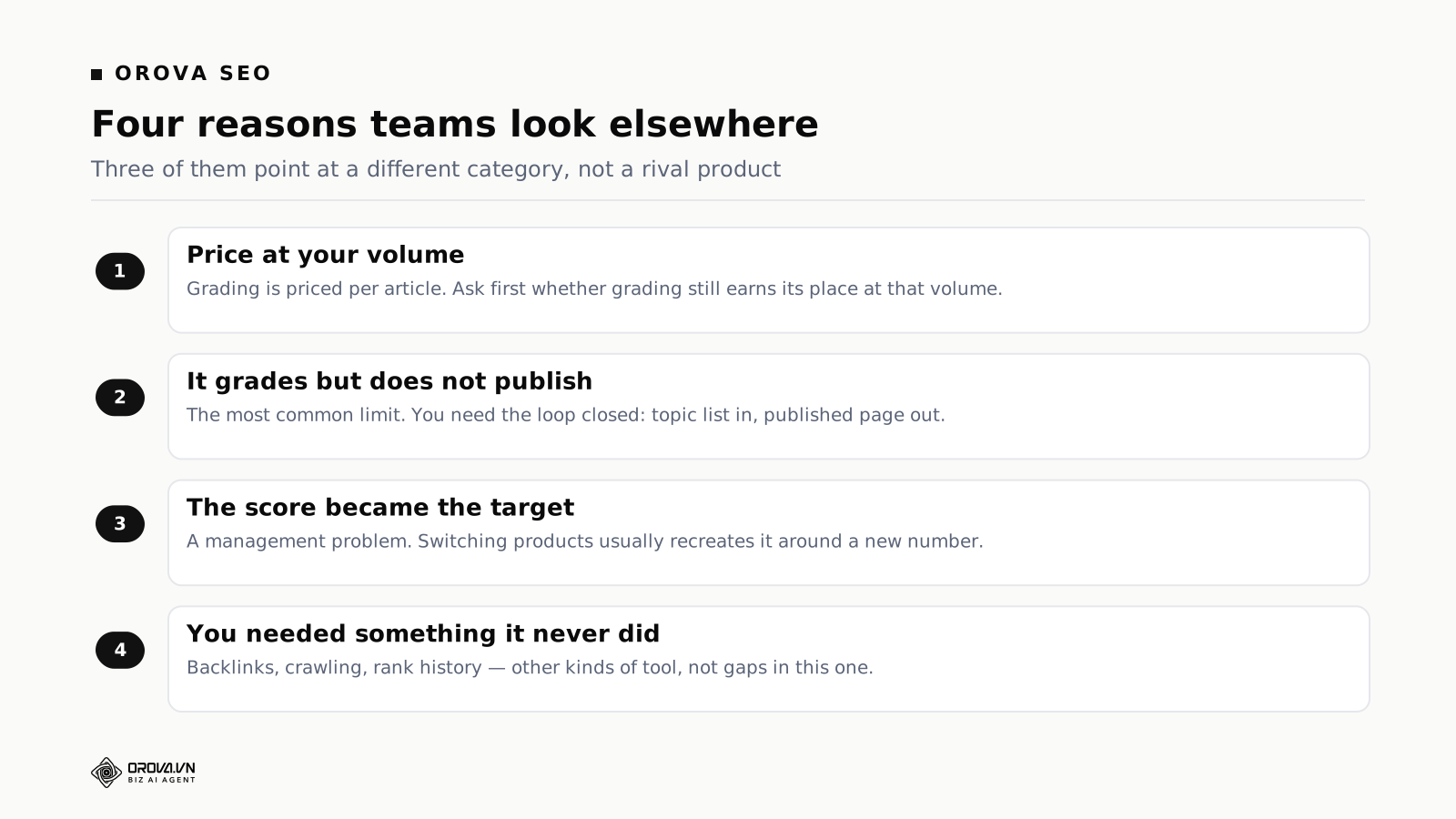
People searching for a Surfer SEO alternative are usually not unhappy with the product. They are running into one of four specific limits — the price at their volume, the fact that it grades rather than publishes, the way a score becomes a target, or a need it was never built for. Which limit you hit determines what you should replace it with, and three of the four point at different categories of tool entirely.
So this is not a list with a winner. It is an attempt to work out which of the four you are experiencing, and what the honest options are for each — including keeping what you have.
What is Surfer SEO, and what counts as a Surfer SEO alternative?
It is a content optimisation tool. You give it a target query, it analyses the pages currently ranking, and it tells you what your draft is missing relative to them — terms to include, structural suggestions, length guidance — expressed as a score you can raise. It also has an outline builder and an editor.
What it is not: a publisher, a research suite with a backlink index, a crawler, or a system that improves your existing pages in bulk. Knowing that boundary explains most of the reasons people go looking elsewhere.
The four limits, and what each one means
Limit one: the price at your volume
Content grading is priced per article or per credit in most products, which is fine at ten articles a month and awkward at a hundred. Teams whose content operation grew hit this first, and it feels like a pricing problem rather than a category problem.
The important question here is whether you still need grading at that volume. Grading is most valuable when a person is writing and needs to know what they overlooked. At high volume, the writing is usually being produced systematically, and what you need is a system that writes to a standard rather than one that grades afterwards. Replacing a grader with a cheaper grader keeps a step in the process that may no longer be earning its place.
Limit two: it grades but does not publish
The most common practical limit. An optimised draft still has to be formatted, illustrated, uploaded and published, and those steps are where content operations stall — not because they are difficult but because they fall between roles and nobody's week has room for them.
A team feeling this limit does not need better grading. They need the loop closed: topic list in, published page out. That is a different category, and it is the one where the time actually goes.
Limit three: the score became the target
This one is rarely stated as the reason and is frequently the real one. A number attracts effort. Within a couple of months writers are working to raise it — adding terms the tool wants, matching a length derived from competitors' averages — and the output converges on a house style that satisfies a heuristic.
The result is pages that clear a bar and say nothing memorable. This is not a criticism of the tool's accuracy; the score does measure something real about topical coverage. It is a criticism of what happens when a proxy becomes an objective, which is a management problem that switching products does not fix. If this is your limit, the answer might be to keep the tool and stop reporting the score.
Limit four: you needed something it never did
Backlink analysis, technical crawling, rank tracking history, competitor keyword discovery at depth. These are not gaps in the product; they are other products. Teams sometimes arrive here after assuming a content tool would grow into a suite, and the fix is buying the right category rather than a rival grader.
The alternatives, sorted by which limit they address
Named honestly, including where each one is worse than what you have.
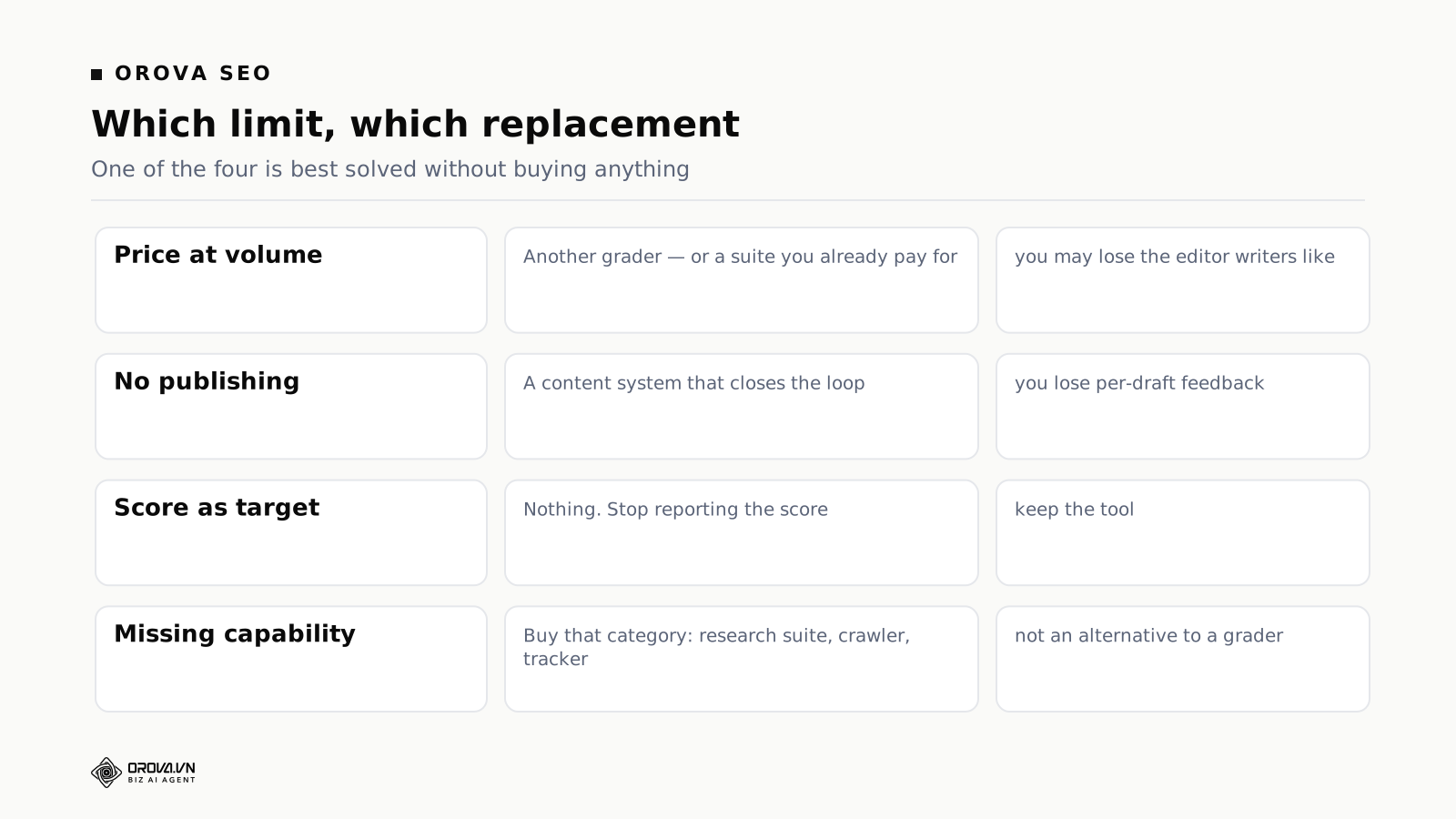
If the limit is price at volume: other graders
Several products do content grading at different price points and with different emphases — some included inside larger research suites you may already pay for, which is worth checking before buying anything, because a grading feature bundled into a suite you own is effectively free.
What you gain: a lower per-article cost. What you lose: usually some quality in the analysis, and often the editor experience, which is the part writers actually notice. If your writers like the current editor, moving them to a worse one to save money is a trade that shows up in output quality before it shows up in the budget.
If the limit is publishing: content systems that close the loop
A different category. These take a topic list and produce published pages — writing, formatting, and publishing into your site — rather than grading a draft someone else wrote.
What you gain: throughput, and the removal of the steps where content queues form. What you lose: the granular per-draft feedback a grader gives a human writer. If a person is still writing every article by hand and wants to know what they missed, a grader is the better tool and a publishing system is solving a problem you do not have.
This is the category Orova SEO sits in, and it is worth being specific about the shape rather than claiming a replacement. Keywords load in bulk from a spreadsheet with a provided template. Articles are written in a brand voice defined per project — more than one voice per project is possible — and can draw on Google Drive files you attach as source material. Publishing goes directly to WordPress or to your own API endpoint. Existing URLs are optimised in bulk from a spreadsheet as well, individually or all at once. There is a competitor scan, a site health check, and an advisor that produces downloadable keyword targets. Each step consumes 20 quota, so a batch's cost is known before it runs, and every plan includes every feature with tiers differing only in quota.
Where it is worse than Surfer, plainly: it does not give a writer per-draft feedback on a document they are composing, and it has no equivalent of the editor experience. If your workflow is a human writing in an editor with live guidance, this is not that, and switching would be a downgrade for that specific job.
If the limit is the score becoming the target: possibly nothing
The honest answer for this limit is often to change how you use what you have rather than to buy something else. Stop reporting the score. Use it as a pre-publish checklist — did we omit something obvious — and remove it from any dashboard or performance conversation.
A proxy becomes an objective the moment it is measured publicly, and no product change prevents that. Teams who switch tools for this reason usually recreate the problem within a quarter around whatever number the new tool produces.
If the limit is a missing capability: buy that category
Backlink indexes and competitor keyword databases come from the large research suites. Technical crawling comes from a crawler, several of which are free at small scale. Rank tracking history comes from a tracker, though Search Console gives you position data for every query you actually appear for at no cost.
None of these is an alternative to a content optimisation tool. They are the other kinds of tool in a toolbox that has about six kinds in it, and the mistake was expecting one product to cover more than two of them.
The comparison nobody makes: grading versus producing
Worth setting out properly, because it is the distinction that decides most of these decisions and it rarely appears in comparison tables.
A grader assumes a human writes. Its value is in the feedback loop: you draft, it tells you what the ranking pages cover that you do not, you revise. This is genuinely useful, and it is most useful for people who know the subject and are prone to skipping what they consider obvious.
A producer assumes volume. Its value is throughput: a list of topics becomes a set of published pages without a person doing each step. The feedback loop is different — you review output and adjust configuration, rather than revising a document.
These suit different operations, and a team can legitimately need both: producing at volume for the long tail, with a human writing and grading the ten pages that carry the most commercial weight. What does not work is using a producer for the ten important pages and expecting a grader's precision, or using a grader at a volume where per-draft attention is not available.
So the first question when replacing a grader is whether you still want grading. Teams whose volume grew often discover the answer is no for most of their output and yes for a small subset — which points at two tools with different jobs rather than one replacement.
How to decide, in one afternoon
Four steps, and the first one settles it for a fair number of teams.
Write down which limit you actually hit. One sentence. If you cannot pick one of the four, the dissatisfaction is probably general and switching will produce a different set of irritations rather than fewer.
Check what you already own. Content grading is bundled into several larger suites. If you pay for a research suite, you may already have a grader and be paying twice for the same job.
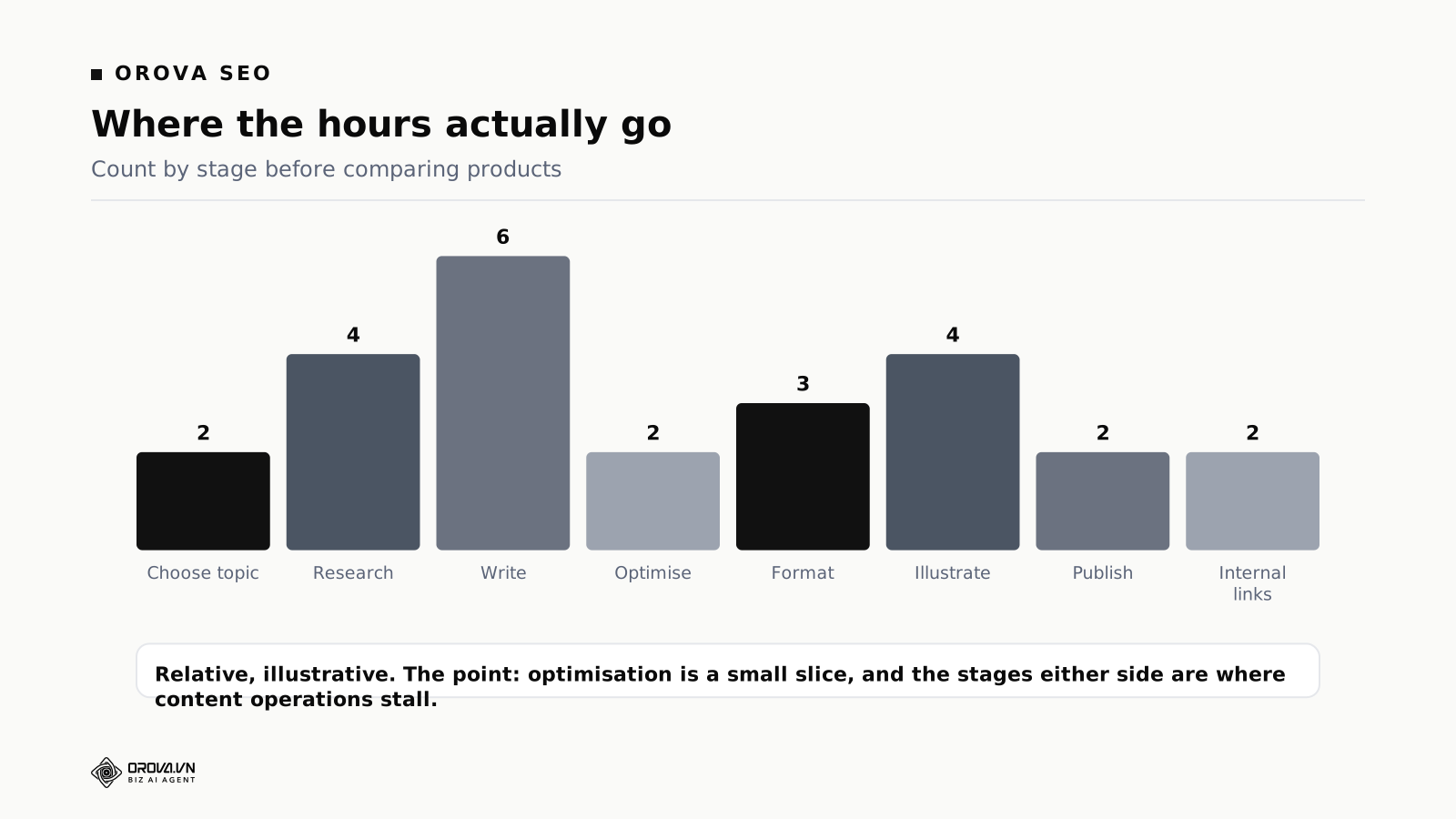
Count where the hours go. Take last month's published articles and estimate the time in each stage: choosing the topic, researching, writing, optimising, formatting, illustrating, publishing, internal linking. Optimising is usually a small slice, and the slices either side are usually larger than anyone expected. That table tells you which category to buy far more reliably than any feature comparison.
Then run one trial, with a specific test. Not an exploration — a test. If the limit was publishing, publish three articles end to end and time it. If the limit was price, price the actual volume. If the limit was a missing capability, check that specific capability against a question you already have.
Teams who do the third step frequently stop there, because the hours table shows that optimisation was never the bottleneck and the real constraint was two steps they had never counted.
What to check before switching anything
Five things that are easy to overlook and expensive to discover afterwards.
Whether your writers like the current editor. Writer experience is the least-discussed variable in this category and the one that determines whether a tool gets used. A technically superior product that writers dislike produces less output than an adequate one they are comfortable in.
What happens to your existing content briefs and outlines. If months of work sits inside the tool, check the export before you decide. Some of this material is genuinely worth carrying and some is not, and it is better to know which before the subscription lapses.
Whether the new thing handles your language and market properly. Content tooling quality varies sharply outside English, and the analysis that underpins grading depends on parsing the ranking pages in that language. Test with your own market's terms, not the vendor's examples.
Who owns the change. A tool switch mid-quarter with nobody responsible for reconfiguring the workflow produces a month of reduced output and a conclusion that the new tool is worse.
Whether you are switching to avoid a conversation. If the real problem is that content is not getting published, or that nobody has decided which topics matter, a new tool postpones the conversation and adds a migration. This is the most common reason a switch disappoints, and it is not a product issue at all.
The case for staying
Worth making, because an article on a vendor's site has an obvious incentive not to and the honest answer is frequently to stay.
If a person writes your important pages by hand and wants live feedback while drafting, a grader is the right category and you already have one that works. If your volume is modest, the price is not the constraint it feels like — compare it against an hour of the writer's time and it usually looks small. And if the tool has been in use long enough that the team's habits are built around it, the switching cost includes those habits, which are worth more than most feature differences.
The situations where switching is clearly right are narrower than the search volume for this query implies: you need publishing rather than grading, or you need a capability in a different category, or the volume has genuinely outgrown per-article pricing and grading is no longer earning its place in your process.
Outside those, the highest-return move is usually to keep the tool, stop treating the score as a target, and spend the attention you were about to spend on evaluation on the two steps either side of optimisation — because for most teams that is where the month actually goes.
What content optimisation actually improves, and what it does not
Since the decision hinges on whether you still need grading, it is worth being precise about what grading does for a page.
It catches omissions. An expert writing about their own field skips what they consider obvious, and what is obvious to them is frequently what the reader came for. A grader comparing your draft against the ranking pages surfaces those gaps mechanically, and this is its most reliable benefit.
It calibrates depth. Knowing that the pages ranking for a query are all substantially longer than your draft is useful information — not because length is a ranking factor in itself, but because it usually indicates the question has more to it than you assumed.
It does not tell you whether the page should exist. A perfectly optimised page on a topic nobody needed is still unnecessary. The topic decision precedes the tool and is not improved by it.
It does not make the page distinctive. Optimising against what already ranks converges toward what already ranks. Everything that makes a page worth citing — original data, a specific process, an account of something you actually did — is invisible to a grader and is the part that produces links and mentions.
It does not affect what happens after the click. A page can score highly, rank, and convert nobody. This is the most common quiet failure in content programmes, and no optimisation tool addresses it.
Read that list and the pattern is that grading improves execution against a known target and does nothing about whether the target was right. Which is fine — that is what it is for — as long as the surrounding judgement exists.
What a content operation looks like at three sizes
The right tool depends less on preference than on the shape of the operation, and three shapes cover most teams.
Four articles a month, written by one person who knows the subject
A grader is exactly right here, and it is worth paying for. The writer has the expertise and lacks the outside view of what a reader coming cold needs, which is precisely the gap grading fills. Publishing four pages a month by hand is not a bottleneck.
The mistake at this size is buying a production system. It solves a throughput problem you do not have and removes the per-draft feedback that was helping.
Twenty to forty articles a month, produced by a small team or freelancers
The awkward middle, and where most searches for an alternative originate. Grading is still useful for the pages that matter commercially and is overhead on the rest. Publishing has become a real bottleneck: articles arrive as documents and sit waiting for someone to format and illustrate them.
Two tools with different jobs is usually the right answer here, and it feels like a failure of consolidation. It is not — the ten pages carrying commercial weight deserve per-draft attention, and the other thirty need throughput.
A hundred or more, produced systematically
Grading per article has stopped making sense, both in price and in process. Nobody is revising individual drafts against a score; the quality control happens at the configuration level — the voice, the source material, the topic selection rules — and at review of samples rather than of everything.
At this size the constraint is almost always the topic decision and the overlap problem. A hundred articles a month accumulates internal competition quickly, and the systems that help are the ones that check a batch against what you already published rather than the ones that grade prose.
The question underneath all of this
There is a more useful question than which tool to use, and it is worth asking before any switch: what is the content for?
If the answer is that it should rank for commercial queries and produce enquiries, then a small number of carefully made pages, aimed at terms with buying intent, updated as the market changes, will outperform volume — and grading plus a human writer is the right setup, at any size of company.
If the answer is that a large surface area of useful pages should exist because your market searches for hundreds of different specific things, then throughput is the constraint and production tooling is the right purchase, with quality controlled at the configuration level.
If the answer is unclear — and it frequently is, because content programmes often start from "we should be doing SEO" — then no tool choice is going to feel right, because the criteria for right do not exist yet. Teams in this position switch tools repeatedly and stay dissatisfied, and the dissatisfaction is about strategy rather than software.
Half an hour writing down what the content is supposed to achieve, and for whom, does more for the tool decision than any comparison — including this article.
Five things to be sceptical of when evaluating
Output quality shown on a topic the vendor chose
Every demo article is the best one available. Run your own topic — ideally one you know deeply, which exposes generic writing immediately — and one you do not, which shows how it reads to a stranger.
Comparisons where the competitor is configured badly
Side-by-side output comparisons are easy to arrange in your own favour. If a vendor shows you their result against a rival's, ask how the rival was configured, and treat the comparison as marketing rather than evidence.
Scores as proof of anything
A tool reporting that its own output scores highly on its own metric has told you nothing. Cross-scoring — running one tool's output through another's grader — is slightly more informative and still measures agreement between heuristics rather than usefulness to a reader.
Claims about detection
Whether output passes an AI detector correlates with nothing a reader or a search engine cares about, and the detectors themselves are unreliable in both directions. It is a metric that exists because it is easy to measure.
Anything about ranking guarantees
No tool controls ranking. A product implying it does is either careless or is counting on you not to notice the difference between producing pages and pages performing.
Migrating without losing a month
If you do switch, the mechanics matter more than they seem.
Run both for one cycle. Not indefinitely — one content cycle. Produce the same batch through both and compare the output and the elapsed time. This is the only comparison that reflects your actual process rather than a demo.
Export the briefs and outlines you want to keep, and be selective. Most accumulated material in these tools is of a specific moment and not worth carrying; the exceptions are usually the briefs for pages you have not written yet.
Do not change the process at the same time. Switching tool and restructuring the workflow simultaneously makes the result unattributable. Keep the process, change the tool, then adjust the process a month later with evidence.
Tell the writers before, not after. They will have opinions about the editor, and those opinions predict adoption. A switch imposed on writers who liked the previous editor produces reduced output that gets blamed on the tool.
Keep the old subscription until the new one has produced a full batch. The overlap costs one month and it is cheap insurance against a migration that stalls halfway.
A worked example of the hours table
Since the hours table is the recommendation this article leans on hardest, here is what filling one in usually reveals. The figures are illustrative; the shape is what recurs.
A team publishing twelve articles a month sits down and estimates, per article: choosing the topic and checking it against what exists, half an hour. Research, an hour. Writing, two hours. Optimising against the grader, half an hour. Formatting for the site, forty minutes. Finding or making images, an hour. Publishing and checking it renders, twenty minutes. Adding internal links from existing pages, twenty minutes.
That totals a little over six hours per article, of which optimisation is half an hour — around eight per cent. The three stages after writing account for more than two hours, a third of the total, and they are the stages nobody's job description mentions.
Two conclusions fall out immediately. First, a cheaper grader saves a fraction of eight per cent, which is not the problem. Second, the stages after writing are where a production system pays, and they are invisible in every feature comparison because they are not glamorous capabilities — they are formatting, images, and uploading.
The third conclusion is less comfortable. Research and writing together are half the total, and no tool removes the judgement in them without changing what the output is. A team that automates those and keeps the manual stages afterwards has automated the interesting part and kept the tedious one, which is the wrong way round and reasonably common.
Fill in your own version with real estimates from last month rather than from memory of how work ought to go. It takes twenty minutes and it will probably point somewhere other than where you were looking.
Two situations we would tell you not to buy from us
Stated explicitly, because an alternatives page that never says this is not worth reading.
You have one writer producing a handful of high-value pages. Keep the grader. What we do — bulk production and bulk optimisation of existing URLs, published straight into a site — is aimed at a throughput problem, and you do not have one. Given to your setup it would remove the live feedback your writer uses and replace it with a batch process they do not need.
Your real gap is research or technical. If what you actually need is a backlink index, competitor keyword discovery at depth, or a proper crawl of a large site, we do not do those things. Keep or buy a research suite and a crawler. A content system bought to fill a research gap is an expensive way to still have the gap.
The situation where the swap makes sense is narrower and specific: a written content plan that is not being executed because the steps after writing have no owner, plus a list of old pages nobody has time to improve. That is a throughput and publishing problem, it is extremely common, and it is what the tool is shaped around.
If that is not your situation, the most useful thing this page can do is send you to the right category instead — and the hours table above is the fastest way to find out which category that is.
If you keep it, use it differently
Four adjustments that get more out of a grader without changing anything you pay for.
Grade before writing, not after. Run the analysis on the target query first and read what the ranking pages cover. Use it as a briefing rather than as a mark. The same information is more useful before a draft exists than as a set of corrections to one.
Only grade the pages that matter. If ten of your forty monthly pages carry the commercial weight, grade those ten properly and let the rest through on a house checklist. This usually reduces cost and improves the ten.
Remove the score from every report. Keep it in the tool where writers see it, and take it out of dashboards, reviews and performance conversations. A number visible to management becomes a target within two months regardless of anyone's intentions.
Add one requirement the tool cannot measure. Every page must contain at least one thing a reader could not have guessed — a number from your own data, a specific process, an account of something you tried. This is the only rule on the list that affects whether the page gets cited, and it is invisible to grading.
Teams who make those four changes frequently stop wanting an alternative, which is an inconvenient conclusion for an article on a software company's site and appears to be true.
The overlap check, since automated volume makes it necessary
One habit belongs with any move toward higher volume, whatever tool you use. Before each batch, check the topic list against what you have already published — by topic, not by exact phrase, because two pages targeting different strings can be after the same thing and search engines will treat them as competitors regardless of what you intended.
It takes ten minutes per batch and it prevents the failure that accumulates invisibly: your own pages competing with each other, splitting the signal, none of them ranking. Ten articles are easy to keep track of; four hundred published over a year by a system are not.
What to expect in the first two months after any switch
Three things happen regardless of which direction you move, and knowing them prevents the usual premature verdict.
Output drops in the first weeks. Any change of tool costs a period of relearning, and the drop gets attributed to the product rather than to the transition. Expect it, and do not evaluate quality during it — the first batch through a new system reflects your unfamiliarity more than the system.
The configuration is wrong at first, in a specific direction. Whatever the new tool's defaults are, they encode assumptions about a different operation than yours. The first month's job is finding which three settings matter for you, and those three are rarely the ones the onboarding emphasised.
The old irritation is replaced rather than removed. Every tool in this category has friction somewhere. Moving from a grader to a production system trades per-draft control for throughput, and within six weeks somebody will miss the control. That is the trade you chose, and it is worth naming out loud when you choose it so that the missing does not read as a mistake.
Evaluate at the end of month two, deliberately and on paper, and specifically on the thing you switched for rather than on the general feeling of the change, using the same measure you used to identify the limit. If the limit was publishing time, time it again. If it was price at volume, price the actual volume. Anything else — general impressions, whether the interface is nicer, whether the writers are happier in the abstract — is not the question you set out to answer, and it is how switches get judged as failures despite having fixed the exact problem they were meant to fix. Write the measure down before you migrate, while you still remember what was wrong.
The short version
People search for a Surfer SEO alternative for one of four reasons, and three of them point at a different category of tool rather than a rival product. If the price at your volume is the limit, first ask whether grading still earns its place at that volume. If publishing is the limit, you need a system that closes the loop from topic list to published page, which is a different category. If the score became a target, the fix is to stop reporting it rather than to buy something else. And if you needed backlinks, crawling or rank history, those are other kinds of tool entirely.
Before switching, count where the hours actually go across the eight stages of producing a page. Optimisation is usually a small slice, and the stages either side — formatting, illustrating, publishing, internal linking — are where content operations stall. That table decides the category more reliably than any feature comparison.
The case for staying is stronger than the search volume suggests. If a person writes your important pages by hand and wants live feedback, you already have the right kind of tool. Grading catches omissions and calibrates depth; it cannot tell you a page should exist, make it distinctive, or fix what happens after the click — and those three are where most content programmes actually fail.
One structural note about pages like this one, since the topic rather invites it and since you will read several of them before deciding. An alternatives page written by a competitor is a marketing document, and that includes this one. The way to read any of them is to check whether the author says clearly where their product is worse, names the situations where you should not buy from them, and points you to a different category when that is the honest answer. If a page does none of those three, the recommendation it arrives at was decided before the analysis started, and the analysis was assembled to reach it. That is worth knowing about every page in this genre, including the ones that agree with you.
Related reading: using AI to write content the right way, content refresh and pruning, and why most "alternatives to X" pages get it wrong. Orova SEO — the publishing-and-bulk-optimising kind, not a grader — is at orova.vn.
If publishing is the limit
Orova SEO is the publishing-and-bulk-optimising kind rather than a grader. If a person writes your important pages by hand and wants live feedback, keep what you have.
See the difference