
Applicant Tracking System for Small Business: An Honest Guide
An applicant tracking system for small business is usually bought in a hurry, on the day a spreadsheet finally breaks. Someone opens the shared sheet to find two people have been editing the same row, a promising candidate has been marked "reviewed" twice and contacted zero times, and the hiring manager is asking why a CV sent eleven days ago has not had a reply. The panic purchase that follows is how most small teams end up with software they use at about a fifth of its capacity.
This guide is written for the team of five to fifty that has to hire without a recruiting department. It is not a ranked list with a gold medal awarded to whoever pays the most. It is an attempt to describe what these systems actually do, which parts of the work they genuinely remove, which parts they quietly hand back to you, and how to tell the difference before you sign anything.
What does an applicant tracking system for small business actually need to do?
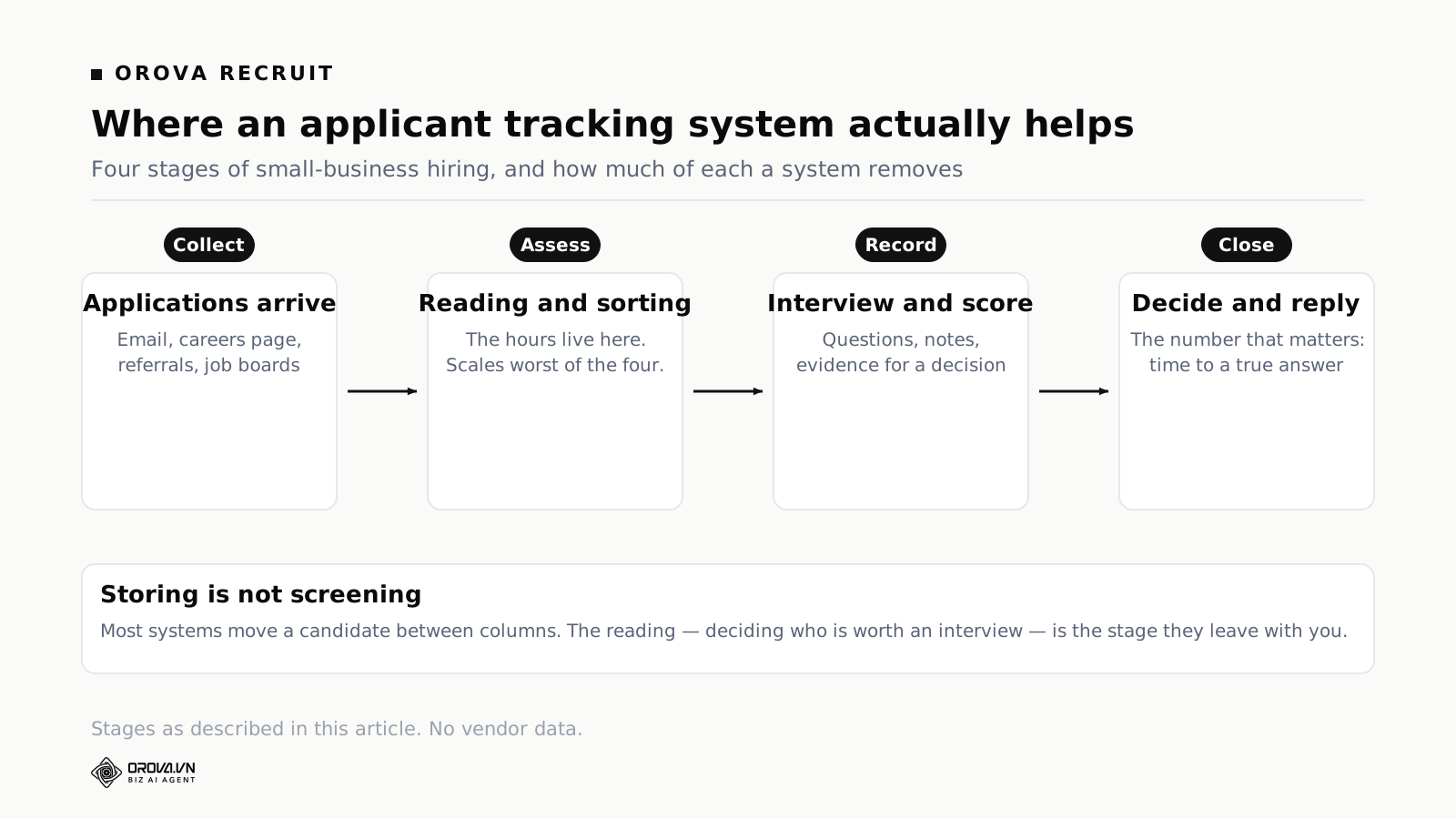
It needs to do four things: collect applications in one place, keep every candidate's status accurate and visible to the whole team, hold the notes and scores that justify a decision, and get people scheduled without a chain of emails. Anything beyond those four is a bonus. Anything short of them is a filing cabinet with a login screen.
That definition is deliberately narrow, because narrow is where small teams get value. A large enterprise buys an ATS to enforce process across dozens of recruiters, satisfy compliance auditors, and feed a workforce planning model. A small team buys one for a much simpler reason: so that nobody has to hold the state of the hiring process in their head.
The distinction matters when you read feature lists. Roughly half the features on an enterprise product exist to solve coordination problems you do not have. Requisition approval chains, recruiter capacity dashboards, offer approval workflows with three levels of sign-off — these are answers to questions a company of twelve people never asks. Paying for them is not the problem. Learning to navigate around them every single day is.
The four jobs, ranked by how much time they actually save
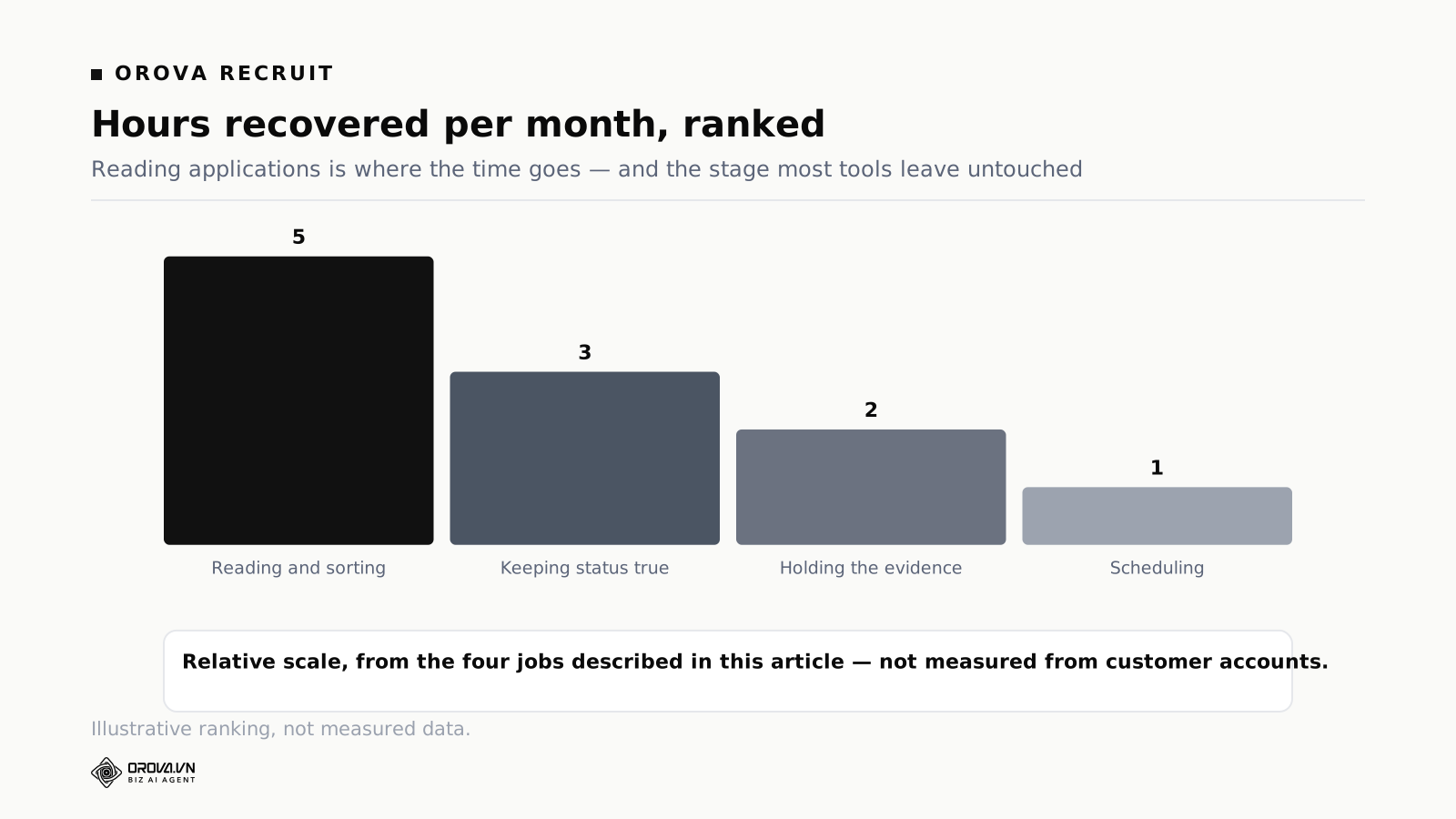
Not all four jobs are worth the same. If you sort them by hours recovered per month, the order surprises most first-time buyers.
1. Reading and sorting applications
This is where the hours go, and it is the job that scales worst. A modestly advertised role in a competitive market can produce two hundred applications in a week. At roughly ninety seconds per CV — which is fast, and faster than most people manage when they are being fair — that is five hours of reading before anyone has spoken to a human being. Do that for three open roles at once and you have consumed most of a working week for whoever drew the short straw.
Worse, the quality of that reading degrades. The first forty CVs get a careful look. The last forty get a glance at the top third of page one. Candidates are not being assessed against the role; they are being assessed against the reader's remaining patience. Every hiring manager knows this happens and almost nobody builds a process that accounts for it.
2. Keeping status accurate across the team
The second job is cheaper in hours but more expensive in reputation. When a candidate's status is wrong, the failure is visible to the candidate. They get contacted twice by different people, or they get told they are still under consideration a fortnight after a decision was made, or they hear nothing at all because each person assumed someone else had replied.
A shared spreadsheet fails at this in a specific way: it records the state, but it does not record who is responsible for the next action. "Reviewed" is not a state that tells anyone what happens next. This is why the single most useful column in any hiring tracker is not the stage — it is the name of the person the ball is currently with.
3. Holding the evidence behind a decision
Three weeks after a round of interviews, ask the panel why candidate B was preferred to candidate D. You will get confident answers that contradict each other. Memory reconstructs a decision to fit the outcome; it does not retrieve the reasoning.
This matters for fairness, and it matters for the far more common situation where the chosen candidate declines and you need to reopen the shortlist. Without written scores against stated criteria, reopening a shortlist means redoing the work.
4. Scheduling
Scheduling is the job people complain about most and the job that costs the fewest hours. It is genuinely annoying — a four-person panel and one candidate can take eight emails to converge on a slot — but it is annoying in short bursts rather than continuously. Buy for the first three jobs. Let scheduling be the tiebreaker between two otherwise equal options.
What "for small business" actually changes
The phrase gets used as a synonym for "cheaper", which is only a third of the story. Three things genuinely change when the buying team is small.
There is nobody to administer the tool. In a company with a talent operations function, someone owns configuration. They build the pipeline stages, maintain the scorecards, fix the integration when it breaks. In a company of twenty, that person is the office manager, or the founder, or nobody. Any system that requires ongoing configuration to stay useful will drift out of date within two quarters and then be quietly abandoned. Setup effort is a recurring cost disguised as a one-off.
Hiring is bursty. A small company hires three people in March and nobody until October. Per-seat pricing punishes this pattern, because you pay for the quiet months at the rate set during the busy ones. Read the contract for what happens between hiring rounds. Some vendors let you scale down monthly; others lock a year at your peak.
The hiring manager is also the interviewer, and often the founder. There is no handoff from recruiter to manager, which removes a whole category of coordination problems — and removes the person whose job it was to keep the process honest. Nobody is going to remind the founder that they promised feedback to fourteen people. The system has to do it, or it does not happen.
The criteria that actually separate one option from another
Most comparison tables list features that every product in the category has. Here is the smaller set of questions where answers genuinely differ, and what a good answer looks like.
| Question | Why it separates products | What a good answer looks like |
|---|---|---|
| How do applications get in? | Some products only ingest through their own hosted careers page. If your applications arrive by email, or through a job board you already use, that is a daily copy-paste tax. | Bulk upload of files, plus a hosted page, plus a way to forward from email. |
| What happens to a CV after upload? | This is the widest gap in the category. Some products store the file. Some extract structured fields. Some assess it against the role. | You should be able to state what "assessed" means, in writing, before you buy. |
| Where do the criteria come from? | If criteria are typed separately from the job description, they drift apart immediately. | Criteria derived from the job description itself, editable afterwards. |
| Can two people disagree on the record? | Single-score systems hide disagreement. Disagreement is the most useful signal a panel produces. | Per-interviewer scores that stay visible, not averaged away. |
| What comes out at the end? | Decisions get shared with people who do not have logins — a co-founder, an advisor, a client. | An exportable document, not a screenshot of a dashboard. |
| What happens to rejected candidates? | Most small-team hiring failures are silence, not bad decisions. | Templates and rules that make replying the default rather than an act of virtue. |
Take that table into a demo and you will get a very different conversation than the one the sales script is designed to produce.
The gap in the middle: storing is not screening
Here is the thing that is rarely said plainly in this category. Most applicant tracking systems are extremely good at moving a candidate from one column to another, and they are largely uninvolved in the decision about whether the candidate should move at all.
The vocabulary hides it. "Screening" in an ATS often means a set of knockout questions on the application form — do you have the right to work here, do you have three years of experience, will you accept the salary band. Those questions filter people who answer honestly. They do not read a CV. The reading is still yours.
Keyword matching is the next tier, and it is worse than no filter in one specific way: it is confidently wrong. A candidate who describes the same work in different words scores low. A candidate who has learned to mirror the job advert scores high. You end up with a shortlist selected for vocabulary rather than capability, and because the tool produced a number, the number gets trusted.
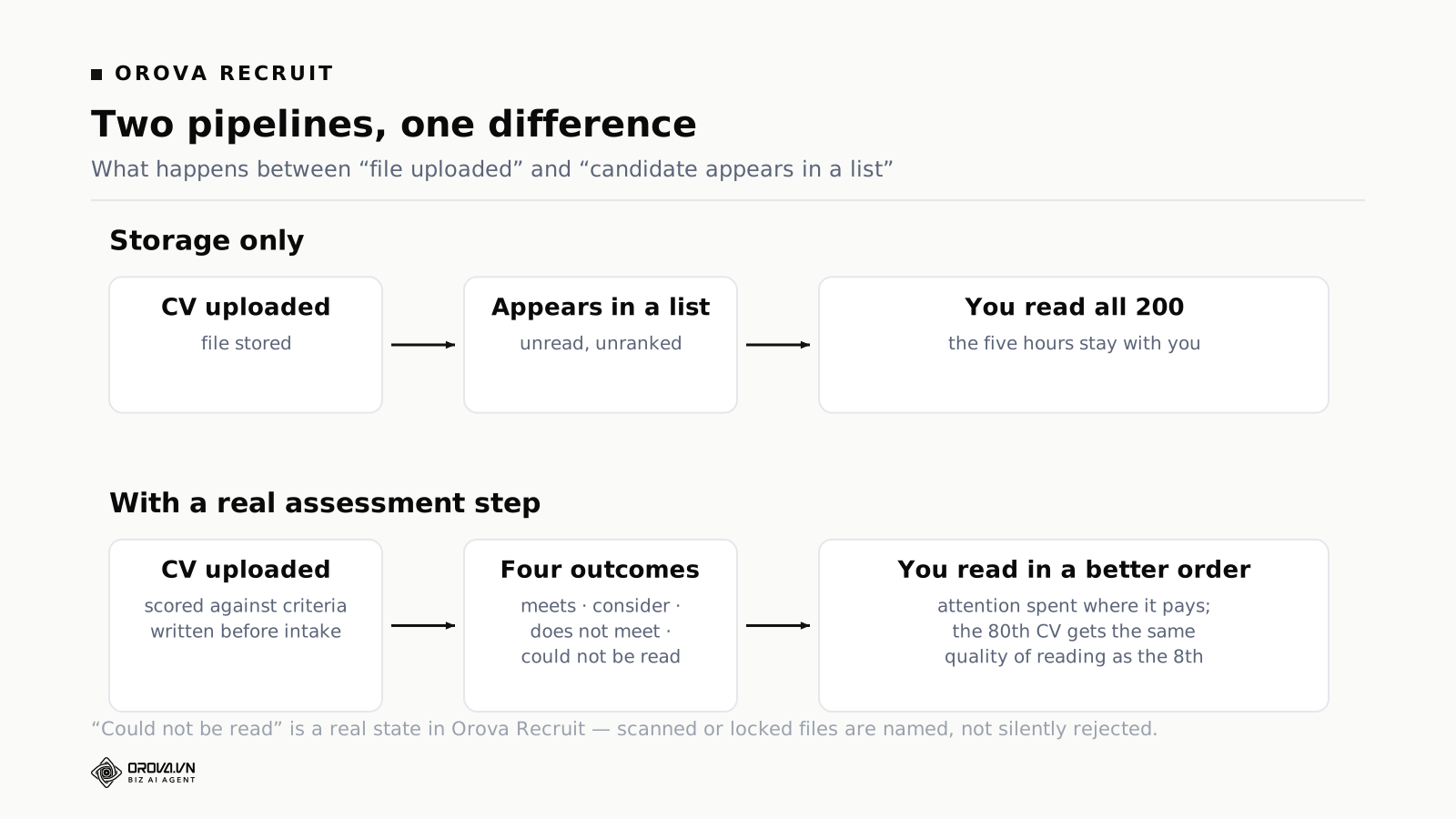
This is the gap that decides whether a system saves you the five hours or hands them back. If a product cannot tell you what it does between "file uploaded" and "candidate appears in a list", assume the answer is "nothing", because that is usually the answer.
What a real assessment step has to include
Three things, and all three have to be present together.
Criteria that exist before the CVs arrive. If you decide what matters after you have read forty applications, you have decided what matters based on who applied. Criteria written from the role, before the first CV, are the only defence against that.
An outcome that admits uncertainty. A binary pass/fail on a CV is a lie about how much a CV tells you. Most applications sit in the middle: not an obvious yes, not an obvious no, worth twenty minutes if the top of the pile thins out. A system that forces those into a binary either wastes your interview slots or discards good people. Three outcomes plus an explicit "could not read this file" is the minimum honest set.
A reason attached to the outcome. A score with no explanation cannot be checked, and anything that cannot be checked will eventually be wrong without anyone noticing. The reason is also what you paste into a rejection email so that it says something true.
How Orova Recruit handles this, and what it does not do
Orova Recruit is the hiring module inside Orova. It is worth being precise about its shape, including the edges, because a guide that ends in an unqualified recommendation is not a guide.
Positions carry their own criteria. A position is created with a job description, and the criteria for scoring are derived from that description rather than typed into a separate form. When the description changes, the criteria are re-derived rather than left stale. The job description itself can be drafted in the module and then analysed — which mostly serves to expose requirements that are stated so vaguely that no candidate could be scored against them.
CVs are uploaded in bulk and assessed against those criteria. A position holds up to 500 CVs, with a 10 MB ceiling per file. Every CV lands in one of six states: pending, processing, then one of đạt (meets the criteria), cân nhắc (worth considering), không đạt (does not meet), or không đọc được — could not be read.
That last state deserves a sentence of its own, because most products do not have it. Scanned CVs, password-protected PDFs, files that are really photographs, CVs written entirely inside a graphic — these exist in every real intake. A system without an unreadable state has to put them somewhere, and where they usually go is the rejection pile, silently. Naming the state is the difference between a candidate being assessed and a candidate being lost to a file format.
Interview questions are generated from the position and can be refined. The questions are not a generic bank; they come from the same criteria the CVs were scored against, which keeps the interview aimed at the things the shortlist was built on. Questions can be applied across a whole position so every candidate faces the same core set — the single cheapest fairness improvement available to a small team.
Interviews can be recorded and transcribed. Notes can be typed, dictated, or produced from an uploaded audio file. This is the feature that changes the interview itself. An interviewer who is typing is not listening, and an interviewer who is not typing is inventing a summary an hour later from three words and a feeling.
Review is where the decision gets made and written down. Candidates are scored, a recommendation is produced, decisions can be recorded one at a time or in bulk, and the result exports to PDF. The export matters more than it sounds: hiring decisions get shared with people who will never log in.
Scheduling covers rooms and slots, and the contact area holds message templates — including AI-drafted ones and image attachments — with rules for automatic sending. The rules exist so that "we always reply to everyone" survives a busy week.
What it does not do
Orova Recruit does not post your vacancy to job boards. It does not syndicate to LinkedIn, Indeed, or any aggregator. If your problem is distribution — not enough applications — this module does not solve it, and no amount of screening intelligence will. Distribution and selection are different problems, and buying a tool for one when you have the other is the most common wasted purchase in this category.
It is also not a human resources information system. It does not run payroll, hold employee records after the hire, or manage performance reviews. It ends at the offer.
A buying checklist that survives contact with a demo
Bring these seven questions. Ask for a demonstration rather than an answer, because the gap between what a product does and what a demo script says it does is widest exactly here.
- Upload thirty real CVs from a real past role and show me the output. Not the vendor's sample data — yours, including the messy files. The sample set is curated; yours is not.
- Show me a candidate the system was unsure about, and why. If everything comes back confident, the confidence is manufactured.
- Change the job description and show me what happens to the criteria. If nothing happens, the criteria will be stale within a month.
- Show me a rejection sent to a candidate. Read the wording. If it is a form letter with a merge field, ask what a candidate learns from it.
- Show me the record of a decision made three weeks ago. Can you tell who preferred whom, and on what grounds?
- Export something. Get a file out of the system and open it outside the product.
- Tell me what happens when we stop hiring for four months. Both to the bill and to the data.
A vendor who handles all seven comfortably is selling a product that has met real hiring. A vendor who redirects three of them to a follow-up call is selling a roadmap.
Five mistakes small teams make with their first system
Buying for the hiring year you wish you had
The demo is impressive because it shows a pipeline with forty candidates moving through six stages across four roles. Your actual next twelve months is two roles, one at a time, with eleven serious candidates between them. Configuring a six-stage pipeline for that produces four stages that are always empty and a process everyone routes around.
Start with three stages: applied, interviewing, decided. Add a stage only when you have felt the absence of it twice. A process that grows from friction fits the company; a process installed from a template fits nobody.
Treating the score as the decision
Any system that assesses CVs produces something that looks like a ranking, and a ranking invites you to draw a line and interview everything above it. That is not what the assessment is for. It is for changing the order in which you read, so your attention is spent where it is most likely to pay, and so the eightieth CV gets the same quality of reading as the eighth.
The candidate ranked twenty-second is not worse than the candidate ranked eighth. They are less legible to an automated reading of a document that both of them wrote under different assumptions about what a CV is for. Keep reading past the line.
Skipping the criteria step because the role is "obvious"
Every role feels obvious to the person who wrote the job description and to nobody else. The test is simple: ask two people on the panel to write down, separately, the three things that would make them say yes. If the lists differ — and they nearly always do — the criteria step is not overhead, it is the entire value.
This is also the step that makes rejections writable. "We were looking for hands-on experience with X and your background is stronger in Y" is a sentence you can only write if you decided what you were looking for beforehand.
Letting the tool own communication without reading what it sends
Automatic replies solve the silence problem and create a new one. A template that was fine for the first role reads as insulting for a senior candidate who spent six hours on a take-home exercise. Rules for automatic sending should be scoped by stage: automatic for the earliest stage where volume is high and the message is genuinely generic, manual for anyone who has met a human being.
Not deciding who owns the pipeline
Software does not remove the need for an owner; it just makes the absence of one visible. One named person should be responsible for the state of each open role being true at the end of each week. Fifteen minutes, once a week. Without it, the tool becomes an accurate record of a process nobody is running.
What the first ninety days should look like
The most reliable rollout is unglamorous and takes about a week of scattered effort.
Week one — one role, real data. Pick a role you have already hired for and whose outcome you know. Load the actual CVs. Run them through. Then compare: does the system's view of the pile resemble your own, in hindsight? Where it disagrees, work out why. This is the only calibration exercise that tells you anything, and almost nobody does it because it feels like work on a problem that is already solved.
Week two — write the criteria for the next real role. Before advertising. Get the panel to agree in writing. Notice how long the disagreement takes to resolve; that argument was going to happen either way, and having it in week two is dramatically cheaper than having it in week seven with two finalists waiting.
Weeks three to eight — run the role, change nothing. Resist configuration. Note the friction instead of fixing it. Most of it turns out to be one-off.
Week nine — one round of changes. Now fix the three things that came up more than twice. You will have a shorter list than you expected, and it will be a different list from the one you would have written on day one.
Thinking about cost without pretending to know your quote
Published pricing in this category is inconsistent enough that any number quoted in an article is wrong by the time it is read. What does not change is the shape of the calculation, which is more useful anyway.
The subscription is rarely the largest cost. The larger costs are the hours spent reading applications, the hours spent coordinating, and the cost of a bad hire — which for a small team is severe, because there is nowhere for a mis-hire to be quietly absorbed.
So the question is not whether the subscription is cheap. It is which of those three costs the system actually reduces. A tool that stores CVs neatly reduces the coordination cost and leaves the reading cost untouched. A tool that reads and assesses reduces the largest of the three. A tool that helps you write criteria and hold a panel to them is the only one that touches the third.
Two questions worth putting a real number against, from your own last hiring round: how many hours went into reading applications, and how many good candidates went cold because a reply took too long? Those two numbers set the ceiling on what any system in this category can be worth to you. If both are small, the honest answer is that a shared folder and a discipline about replying will serve you for another year.
How to read a pile of 200 applications without lying to yourself
Every method in this section works without any software at all. That is the point: if the discipline is missing, the tool will only make the same mistakes faster and with more confidence.
Decide the shape of the shortlist before you start
Not the names — the shape. How many first conversations can the team actually hold in the next fortnight? For most small companies the honest answer is six to eight, because interviews come out of the same hours as the actual work. Write that number down before the first CV, because the number is a constraint on the process, not an output of it.
Teams who skip this end up with a shortlist of fourteen, which becomes a shortlist of fourteen people waiting three weeks for a first call, which becomes four of them accepting other offers. A shortlist longer than your interview capacity is not thoroughness. It is a queue you have not admitted to building.
Read for reasons to continue, not reasons to stop
Reading for disqualifiers is faster and produces a worse shortlist, because disqualifiers are easier to spot in unconventional careers. The candidate who took two years out, changed industry, or worked somewhere nobody recognises accumulates flags quickly. The candidate with a tidy linear path accumulates none, which is not the same as being better.
Reading for reasons to continue is slower per CV and shorter overall, because you stop as soon as you find one. It also produces something you can write down, which the disqualifier method does not: "worth a call because X" is a sentence, whereas "nothing obviously wrong" is not.
Handle the middle band deliberately
The maybes are where the value is, and they are the group most likely to be handled by whoever is least tired. Give them an explicit rule instead. A workable one: the middle band is not reviewed until the clear-yes pile has been contacted, and it is reviewed only if the clear-yes pile produces fewer conversations than your capacity. That rule turns the middle band from a source of guilt into a reserve you draw on when you need it.
Timebox the second pass, not the first
Most advice says spend ninety seconds per CV. Better: spend as long as you need on the first pass but only answer one question — continue, no, or maybe. Save the careful reading for the twenty that survive. Careful reading applied to all two hundred is where the fatigue comes from, and fatigue is what makes the last eighty CVs worse than useless, because they were read badly enough that you now believe you have considered them.
When you do not need one of these yet
A guide that never says "don't buy" is an advert. Three situations where the honest answer is to wait.
You hire fewer than four people a year and get fewer than thirty applications each time. A folder, a spreadsheet with an owner column, and a calendar reminder to reply on Fridays will carry you. The overhead of learning a system exceeds what it saves at this volume, and the system will be unfamiliar again by the time you next open it.
Your actual problem is that not enough people apply. No screening tool improves a pile of six applications. The fix is distribution, referrals, and a job advert that describes the work honestly rather than a list of requirements copied from a competitor. Buying a screening tool here converts a hiring problem into a hiring problem plus a subscription.
You have not agreed what you are hiring for. If the panel cannot state the three things that would make them say yes, no system will resolve that. It will record the disagreement more neatly. Have the argument first; it takes an afternoon and saves a quarter.
The one number worth tracking afterwards
Small teams are told to track time-to-hire, cost-per-hire, source effectiveness, and offer acceptance rate. At two hires a year those numbers have no statistical meaning; you are computing an average over a sample of two and then making decisions with it.
Track one thing instead: the gap between when an application arrives and when the candidate hears something true from a human being. Median, not average, so one forgotten candidate does not distort it.
That single number correlates with almost everything else you care about. When it is short, good candidates stay engaged and your acceptance rate rises. When it stretches past a week, you lose exactly the people who had other options — which is to say the ones you wanted. It is also the number that tells you whether the process has quietly stopped running, because it degrades before anything else visibly breaks.
If a system in this category does one thing for you, it should be to keep that number small. That is a more useful buying criterion than any feature comparison table, this one included.
Moving off the spreadsheet without losing the thread
The migration itself is where a surprising number of first deployments fail, and the failure mode is always the same: the old sheet keeps running alongside the new system for "just this one role", and then forever.
Two sources of truth is worse than one bad source of truth. The bad sheet at least told you where to look. A sheet plus a system means every question has two answers and no way to tell which is current, so people check both, which is slower than checking one, so people stop checking and start asking in chat instead.
The fix is unpopular and works: pick a date, and from that date every new application goes into the system and nowhere else. Do not migrate history. The candidates already in flight finish in the sheet; the sheet gets marked closed when the last one is resolved, and then it is archived somewhere read-only. You will be tempted to import two years of past applicants "in case we want to revisit them". Almost nobody revisits them, and the import is what fills a clean system with stale records nobody trusts.
The one thing worth carrying across is the rejection list — the people you have already told no. Losing that is how someone gets rejected twice for the same role, which is a small thing that reads to the candidate as complete indifference.
What to write down on day one
Three artefacts, none of which live inside the software, and all of which decide whether the software helps:
- Who owns the pipeline being true. One name, not a team.
- What each stage means, in one sentence. Especially the difference between "reviewed" and "decided" — that ambiguity is the single most common cause of candidates falling through.
- The reply commitment. How fast, from which stage, and who writes it. If nobody will commit to a number, the honest version is to say so out loud rather than to promise it in the careers page copy.
These three take twenty minutes and outperform every configuration decision you will make in the tool itself.
A note on the files themselves
Whatever you choose, get your data out once during the trial rather than at the end of the contract. Export the candidate list, open it somewhere else, and check that it contains the notes and the scores rather than only names and stages. Products differ sharply here, and the difference is invisible until the day you want to leave. A system that exports names but keeps the reasoning is holding the part that took you the most work to create.
The short version
An applicant tracking system for small business earns its place when it does four things: collects applications in one place, keeps status true across the team, holds the evidence behind a decision, and gets people scheduled. The widest quality gap between products is in what happens to a CV after upload — storing is not screening, and keyword matching is confidently wrong in a way that is hard to detect from the outside.
Buy for the reading problem if you have one, buy for the coordination problem if that is what hurts, and do not buy a screening tool when your actual problem is that not enough people are applying. Configure less than you think you should, keep reading past the line the ranking draws, and put one named person in charge of the pipeline being true on Fridays.
One last thing worth saying plainly, because it is the sentence most buying guides in this category avoid. The hardest part of hiring well at a small company is not the software and never was. It is finding the discipline to decide what you are looking for before you look, and the nerve to reply honestly to people you are not going to hire. A good system makes both of those easier to sustain during a busy quarter. It cannot supply either of them on your behalf, and any vendor implying otherwise is selling you a story about your own hiring that will not survive its first contact with a real shortlist.
Related reading: what an applicant tracking system actually does, a job description template that doubles as your scorecard, and why most "alternatives to X" pages get it wrong. The full product is at orova.vn.
Screen 500 CVs against your own criteria
Orova Recruit derives criteria from your job description, sorts applications into meets, consider, does not meet, and could not be read — then generates interview questions from the same criteria.
Try a position