
Search Intent: Reading It From Brand Search Volume
Your traffic chart is telling you your content program is failing, and you cannot figure out why the work looks worse every quarter even though the team has not gotten lazier or dumber. Non-branded clicks keep sliding, the meetings get tense, and someone eventually asks whether SEO still works at all — a question that has less to do with your content and more to do with where people are now getting their answers.
The old habit of judging organic performance purely by non-branded clicks made sense when search results were just a list of blue links. That habit is now misleading, because a large share of informational questions get answered directly inside AI tools before anyone reaches your website, so the click never happens even when your content did the work of informing, convincing, or getting mentioned. In fact, 68% of US Google searches in the first four months of 2026 ended without a click, up from 60% in 2024, theo SparkToro. Tracking only clicks means you are measuring a shrinking slice of the picture and missing the part that actually reflects search intent — what people wanted, and whether your brand showed up when they wanted it.
This article shows you where to actually look instead: how brand search — people searching your company or product name — is quietly becoming the clearest proof that your content is being seen, remembered, and trusted, even when it never generates a click. By the end, you will know what counts as brand search, how to track it without guesswork, how to set realistic targets, and how to defend this metric in a room full of skeptics who still want the old chart.
Why branded demand is the metric that survives
Three properties make brand search uniquely suited to the AI search era, and it is worth being precise about each, because the argument is structural rather than fashionable.
First, branded queries resist absorption. When someone searches your company name, the dominant intent is navigational — they want you, your site, your pricing, your login page. An AI Overview can summarise what your product does, but it cannot be your product, and users who search a brand name overwhelmingly click through to the brand. As answer engines absorb informational intent, the share of remaining clicks that are navigational rises mechanically. Branded search is the high ground that stays above the waterline.
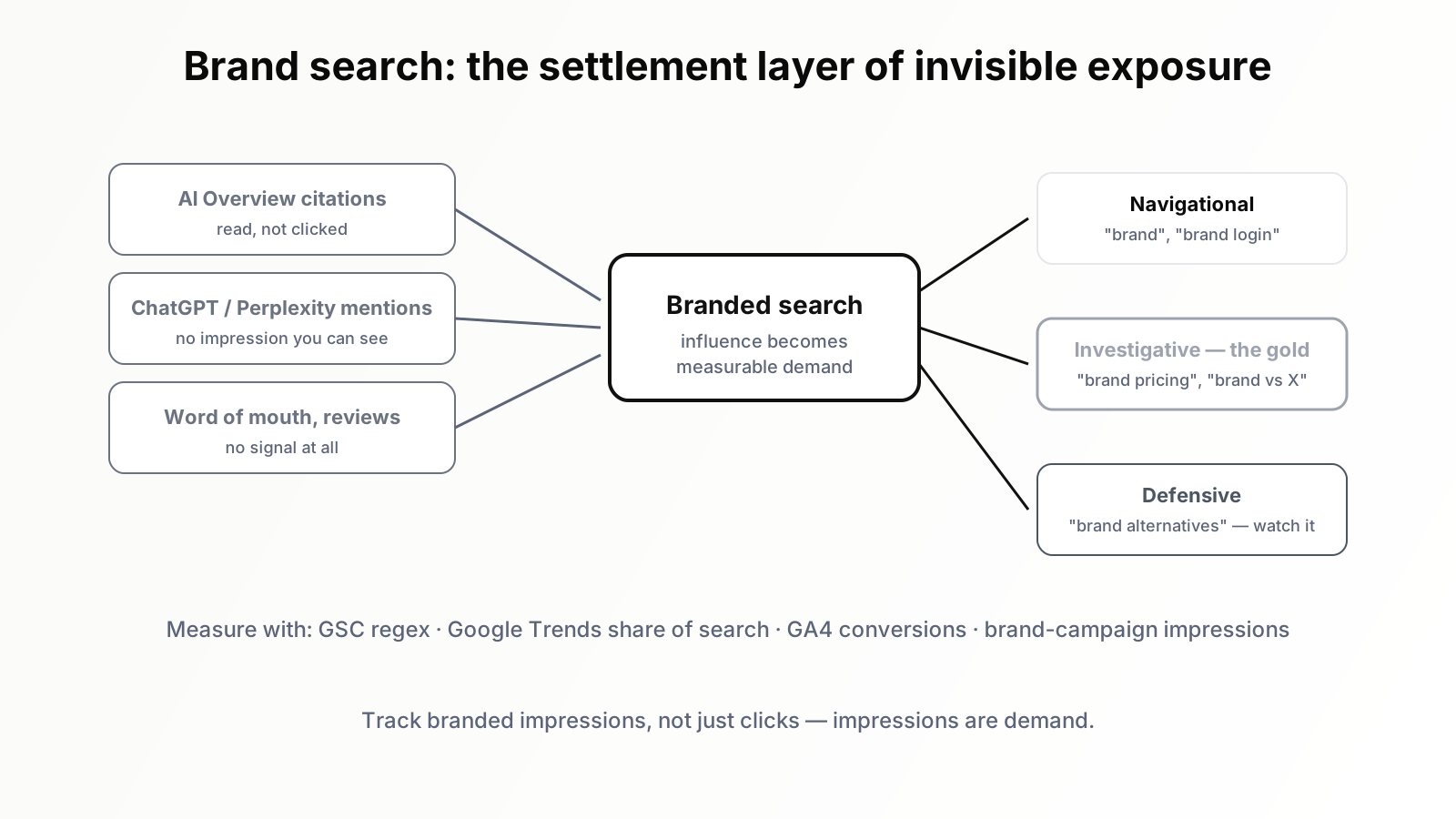
Second, branded queries are the output of every upstream surface you cannot measure directly. A buyer reads an AI Overview citing your guide; no click. A week later they ask ChatGPT to compare tools in your category and your name appears; no click, no impression you can see. A colleague mentions you in Slack; no signal at all. Then they search your name — and for the first time, the accumulated effect of all that invisible exposure registers on an instrument you own. Brand search is the settlement layer of the zero-click economy, the place where unattributable influence gets converted into attributable demand. This is the measurement half of the argument we made in our analysis of the zero-click economy: if content's new payouts are citations and memory, branded demand is where memory cashes out.
Third, branded demand correlates with revenue more tightly than any other organic metric. This was true even before AI search — branded searchers convert at multiples of non-branded visitors, because the hard part of marketing, becoming the chosen option, has already happened by the time someone types your name. A program whose non-branded clicks fall 30% while branded queries grow 40% is very plausibly creating more pipeline than it was a year ago. A team reporting only the first number will get its budget cut for succeeding.
What counts as brand search (and the trap in defining it)
Before measuring anything, define the query set, because sloppy definitions produce flattering or damning numbers at random. Your branded universe includes: the company name and its misspellings; product names and their misspellings; the domain typed as a query; "brand + modifier" combinations (pricing, reviews, login, alternatives, vs competitor); and named features unique to you. Each of these tells you something different, and lumping them together hides the most useful signals.
Segment at minimum into three buckets. Pure navigational ("yourbrand", "yourbrand login") tracks existing-user and late-stage activity — it grows with your customer base as much as your marketing. Investigative branded ("yourbrand pricing", "yourbrand reviews", "yourbrand vs X") is the gold: these are buyers in active evaluation, and growth here is the most direct evidence that upstream exposure is filling the funnel. Defensive branded ("yourbrand alternatives", "yourbrand problems") tracks churn risk and competitor pressure; you want this monitored, not maximised.
The trap: brand terms that collide with common words. Companies named after ordinary nouns will pollute every bucket with irrelevant volume, and no regex fully rescues you. If that is your situation, lean on the combinations ("brand + category", "brand + product") rather than the naked term, and accept that your absolute numbers are indexes rather than counts. Trends in a consistently polluted metric are still meaningful; levels are not.
How to actually measure it
No single tool gives you clean branded demand, so the working setup triangulates four sources, each correcting the others' blind spots.
Search Console is the backbone. Filter performance data with a query regex covering your brand variants and export the complement for non-brand. Two practical notes from doing this repeatedly: build the regex iteratively by reading your actual query report rather than guessing variants — real users misspell your name in ways you will not predict — and lock the regex once it is good, because every revision breaks your trendline comparability. Track branded impressions, not just clicks: impressions count people searching the name even when they click a sitelink, a profile, or a review site instead of you. Branded impressions are the closest thing to "demand" GSC offers. The general discipline of segmenting GSC properly is covered in our piece on reading impressions and clicks separately.
Google Trends provides the long horizon and the competitive frame. GSC only shows demand that reached your property's results; Trends shows relative query interest over years, and lets you plot your brand against competitors on one axis. It is coarse, indexed, and useless for small brands below its volume threshold — but for trend direction and share-of-search analysis it is the only free instrument there is. Share of search — your brand's fraction of total category brand queries — deserves particular attention: it has been shown in multiple industries to track market share, and it converts brand search from a vanity number into a competitive metric.
GA4 closes the loop to behaviour and revenue. Branded organic sessions can be approximated through landing-page and source analysis (homepage and pricing-page organic entrances are heavily branded), and direct traffic — for all its messiness — moves with brand strength; a sustained rise in direct alongside branded queries is corroborating evidence, not coincidence. More importantly, GA4 is where you connect branded entry points to conversions, which is what makes this KPI defensible in a budget meeting. The instrumentation details live in GA4 for SEOs and, for the AI-referral slice specifically, in measuring AI search traffic in GA4.
Paid search data, if you run brand campaigns, is the calibration set. Brand campaign impression volume is a direct, absolute count of brand query demand — use it to sanity-check the GSC trendline, and watch its search-volume trend even in weeks you change nothing about the campaign.
Assemble these into one monthly view: branded impressions (GSC), branded clicks (GSC), investigative-branded share, share of search vs top competitors (Trends), branded/direct conversion volume (GA4). Five numbers. That is the dashboard.
Connecting the KPI to the work: the influence loop
A KPI you cannot influence is a weather report. The reason brand search works as an organic KPI — not just a brand-team metric — is that content and SEO activity demonstrably feed it through a loop you can operate deliberately.
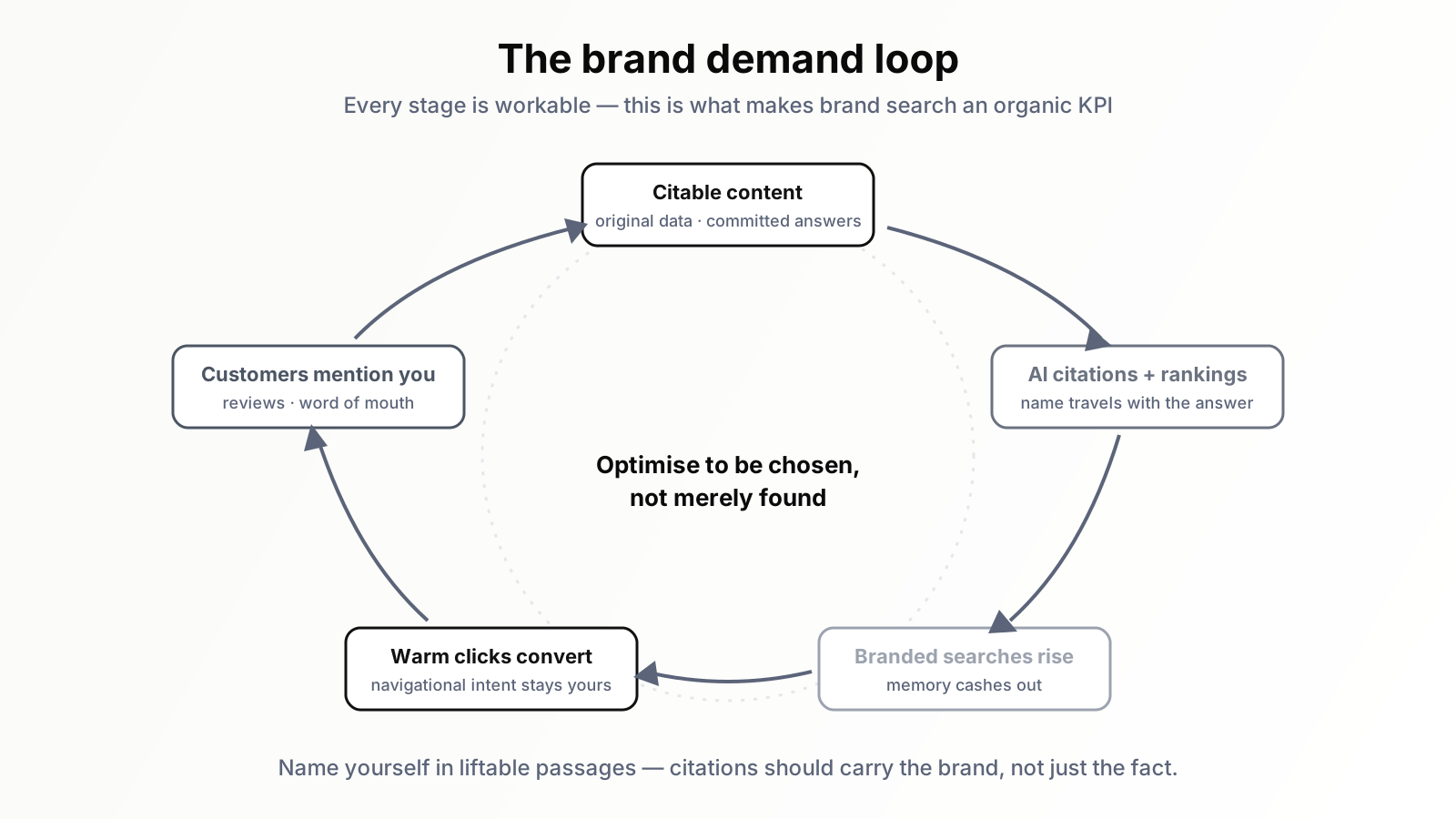
The loop runs: publish citable content → earn presence in AI answers and classic results for non-branded questions → buyers absorb the name alongside the answer → branded queries rise → branded clicks convert → customers generate more mentions, reviews, and word of mouth → which further strengthens both citations and brand volume. Every stage is workable. The citable-content end is the craft covered in the AI Overviews guide and the broader answer-engine playbook; the middle requires that your brand name actually appears in and around your cited content — bylines, methodology notes, "we" statements with the company named — so the citation carries the name, not just the fact. A surprising amount of well-cited content is functionally anonymous: the overview borrows its substance and the reader never registers whose it was. Naming yourself in the passages likely to be lifted is not vanity; it is attribution engineering.
Two further levers move investigative-branded volume specifically. Comparison and alternatives content — yours and others' — places your name into the query vocabulary of category researchers; being present and accurately represented on the pages people read before searching "yourbrand vs X" directly seeds those searches. And consistent entity signals (same name, same descriptions, schema, profiles) make the brand legible to the systems deciding what to say when a user asks an engine about you directly. What the engines say about you, you should be monitoring on a schedule — the methods in our guide to measuring AI visibility apply directly here.
Setting targets without fooling yourself
Brand search makes a poor KPI if you set targets the way teams set traffic targets, because its baseline is entangled with everything else the company does. Three rules keep it honest.
Rule one: normalise against your customer base. Pure navigational volume grows with customers — a growing company's brand searches rise even if marketing does nothing. Either target investigative-branded volume (which leads acquisition rather than lagging it), or express navigational growth net of customer growth. Reporting raw navigational lift as a marketing win is the kind of self-deal that eventually discredits the whole metric.
Rule two: benchmark against share of search, not just your own history. If category demand is rising, flat brand volume is decline; if the category is shrinking, modest growth is excellent. The competitor-relative Trends view turns "we grew 20%" into "we grew 20% while the category grew 35%" — a less pleasant, more useful sentence.
Rule three: expect slow movement, and say so upfront. Brand demand is a stock, not a flow; it accumulates over quarters. The honest commitment to leadership is directional movement over two to four quarters with a clear influence model, not month-over-month wins. Set the expectation at the start, because the alternative — promising fast brand lift — converts a structural advantage (hard to fake) into a political liability (slow to show).
On seasonality and shocks: annotate the timeline relentlessly. Funding news, outages, a competitor's launch, a viral post — all spike or dent brand queries in ways that have nothing to do with the program. A brand-search chart without annotations is a Rorschach test; with annotations it is evidence.
The objections, taken seriously
"Brand search is a brand-team metric, not an SEO metric." This objection assumes the old division of labour, where SEO harvested existing demand and brand created it. The zero-click economy dissolved that boundary: organic content now does its most valuable work on surfaces that pay out in memory rather than visits, which means organic is a demand-creation channel and must be measured as one. The division worth keeping is in the influence model — know which branded movement traces to content citations versus advertising versus PR — not in refusing the metric.
"It's not attributable." Partially true, and worth conceding precisely. You will never draw a clean line from one AI Overview citation to one branded search. What you can do is establish covariation at the program level: citation-panel coverage up, investigative-branded queries up with a lag, in the topics where the citations happen. Run the brand regex segmented by product line and the picture sharpens further. This is the same epistemic standard every brand channel has always lived with — television never had click-through either — and it is sufficient for steering, if not for courtroom proof.
"It can be gamed or polluted." Less than most metrics. You cannot meaningfully buy your own brand searches at scale without it showing in the calibration sources, and competitors have no incentive to inflate your demand. The genuine pollution risks — common-word names, customer-base growth, news shocks — are all addressable with the segmentation and annotation discipline above. Compare this with non-branded clicks, which can be inflated indefinitely by ranking for high-volume queries that never convert, and brand search starts to look like the harder metric to lie with.
"Small brands have no brand volume to measure." True at the very start, and the metric's one real limitation. Below a few hundred monthly branded queries, the noise swamps the trend, and GSC sampling makes weekly views useless. The practical floor: report it monthly, lean on investigative-branded combinations (which appear earlier than you would expect, because evaluators search "newbrand pricing" almost immediately), and treat the first appearance and growth of those combinations as the milestone itself. For an early-stage company, the moment "yourbrand vs incumbent" begins appearing in GSC is more meaningful than any traffic number on the dashboard.
A 90-day implementation plan
Standing this up is a quarter's project for one person at a few hours a week. A sequence that works:
- Weeks 1–2: build and freeze the brand regex. Pull twelve months of GSC queries, read every query containing anything resembling your name, and enumerate the real variants — including the misspellings that will surprise you. Write the regex, validate it against the export, document what it includes, and freeze it. Backfill the branded/non-branded split across the trailing sixteen months so your KPI launches with history instead of a cold start.
- Weeks 3–4: segment the buckets. Split branded queries into navigational, investigative, and defensive sets. Tag the investigative combinations per product line if you have several. Set up the monthly export — scripted via the GSC API if anyone on the team can schedule a script, manual if not; the consistency matters more than the elegance.
- Weeks 5–6: add the external instruments. Configure the Trends comparisons against your top three competitors and record the first share-of-search snapshot. If you run brand campaigns, pull the impression history as your calibration series. In GA4, define the branded-entry view and the conversion join.
- Weeks 7–10: connect the influence model. Map your citation-tracking panel topics to investigative-branded query groups, so that from now on every "citations up in topic X" observation can be checked against "branded queries mentioning product X" two to eight weeks later. This mapping is what elevates the dashboard from description to steering.
- Weeks 11–13: ship the first report and set the baseline targets. Present the three-line chart with sixteen months of history, annotated. Propose targets per the three rules above — investigative-branded growth net of customer growth, benchmarked to share of search, on a two-to-four-quarter horizon.
What brand search does not tell you
A KPI becomes dangerous the moment it is treated as complete, so mark the blind spots. Brand search says nothing about why demand moved — it is a thermometer, not a diagnosis, which is why it must travel with the citation panel and the annotation log. It under-measures audiences who never search at all: buyers who go straight from an AI recommendation to typing your URL, or who convert inside a marketplace or app store, register as direct traffic or nothing. It is silent on sentiment — a scandal and a product launch can produce identical spikes, which is one more argument for keeping the defensive-branded bucket separate and watched. And it cannot arbitrate channel credit: when branded demand rises after a quarter of strong content, strong PR, and a conference, the chart will not tell you which mattered most. Accept these limits openly in your reporting. A team that names its metric's blind spots keeps the metric; a team that oversells it loses the metric and the credibility together.
Reporting it: the chart that replaces the traffic chart
The deliverable that makes this real is a single monthly view with three lines and one table. Line one: non-branded clicks (the old KPI, kept honestly, falling or flat in most categories). Line two: branded impressions. Line three: investigative-branded clicks. The table: share of search versus your top three competitors, quarter over quarter. Presented together, these tell the true story the old chart cannot: where the clicks went, what came back in their place, and whether you are winning the demand that still exists. Pair it with the citation panel from your AI-visibility tracking and you have a complete account of organic performance across both the visible and invisible surfaces — which is, at this point, the only account worth presenting; the pillar argument in zero-click search doesn't mean zero value supplies the narrative frame if your leadership needs the longer version.
The deeper shift is psychological. Treating brand search as the primary organic KPI forces the program to optimise for being chosen, not merely found — for the name that survives the answer, not the click that preceded it. Teams that make the switch consistently report the same side effect: content gets better, because "will this make someone remember and search for us" is a higher bar than "will this rank." The bookkeeping itself — brand regex segmentation, share-of-search pulls, the lagged correlation against citation coverage — is exactly the kind of recurring instrumentation Orova's platform automates for its users, but the KPI decision is yours to make, and the case for making it now is simply that the alternative metric is measuring a world that is ending.
Stop guessing, start tracking brand demand properly
Doing this well by hand takes real effort: pulling brand query data from multiple sources, separating true brand searches from noise, tying spikes back to specific content or PR moments, and rebuilding the report every month so it still means something to your leadership team. Most teams start strong and quietly stop updating the tracker after a few busy weeks, which brings you right back to the old, misleading chart.
Orova SEO is built to take that manual work off your plate — pulling the numbers, organizing them, and keeping the tracking consistent so you always have a current view of brand demand without babysitting a spreadsheet. If this sounds like the kind of reporting headache you would rather not own, feel free to take a look and see if it fits how your team works.
Related reading: Search Intent Meaning in SEO: The 4 Types Explained Simply
Let Orova SEO handle the repetitive part
Keyword research, drafting, refreshing old posts and rank tracking — running automatically on your own site.
Explore Orova SEO