
Google Ads Smart Bidding: When It Works and When It Burns Budget
It is Friday afternoon, the lead generation campaign has been on manual bidding for years, cost per lead has been flat forever, and someone in the morning meeting just said the account is leaving money on the table. So you switch it to Google Ads Smart Bidding, pick a goal, and go home. By Monday the daily budget has been fully spent three days running, you have one extra conversion, and cost per lead has doubled.
The usual reaction is to switch it straight back and decide automated bidding does not work for your business. The second, more common reaction is worse: leave it running and start fiddling with the target every few days, lowering it, raising it, never letting it run long enough to actually learn anything. Either way, nobody has actually figured out why it happened, and the same cycle repeats next quarter.
This article explains what is really going on underneath Smart Bidding, why it can burn through budget in a weekend, and what has to be true about your account before you turn it on. By the end, you will know whether your account is actually ready for it, which conversions it should be chasing, and when sticking with manual bidding is still the smarter call.
What Is Google Ads Smart Bidding?
Google Ads Smart Bidding is the group of automated bid strategies that use auction-time signals to set a separate bid for every individual auction, optimising for conversions or conversion value instead of clicks. It covers Maximise Conversions, Maximise Conversion Value, Target CPA and Target ROAS. Maximise Clicks is automated bidding, but it is not Smart Bidding.
Three ideas inside that definition do the real work, and each one is worth a paragraph.
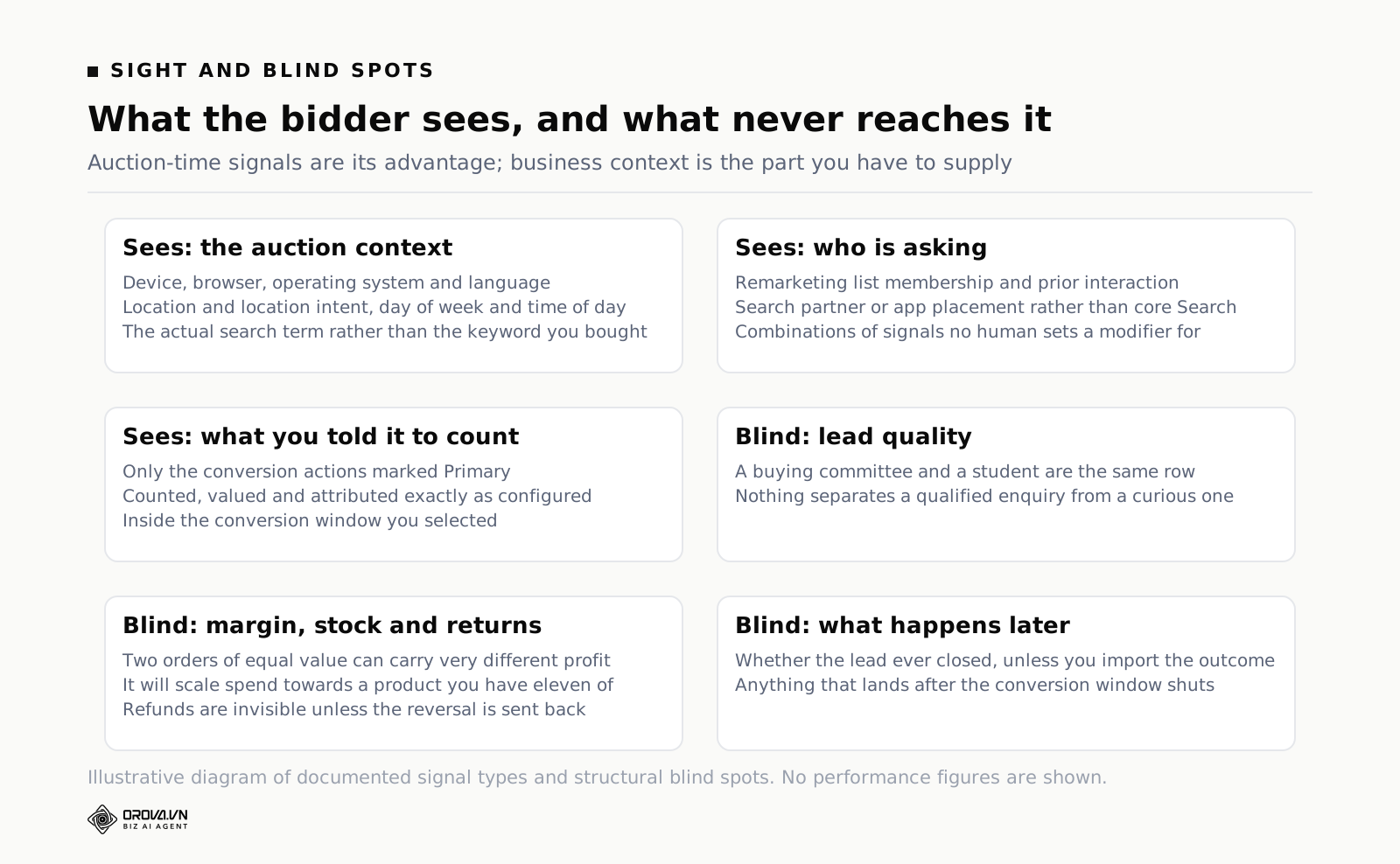
The first is auction-time bidding. A manual bid is one number that applies to every auction your keyword enters, adjusted afterwards by whatever bid modifiers you set up. A Smart Bidding strategy computes a bid at the moment of the auction, using a set of signals about that specific query and that specific person, several of which you cannot see in the interface and cannot set a modifier for. Device, physical location, location intent, day and time, browser, operating system, language, remarketing list membership, the exact search term rather than the keyword, whether the query came from a search partner, and combinations of all of the above. This is the genuine advantage, and it is not a small one. No human sets a different bid for a Tuesday-evening mobile query from a returning visitor in one city than for a desktop query from a first-time visitor in another. The machine does that for every impression.
The second is what it is being pointed at. Smart Bidding does not optimise for revenue, profit, sales-qualified leads or business health. It optimises for the conversion actions you marked as primary, counted the way you configured them to be counted, valued the way you configured them, credited by the attribution model you selected, inside the conversion window you set. Every single one of those is a setting somebody chose, sometimes years ago, sometimes by accident, often before the current person joined.
The third is the family it belongs to. Google Ads automated bidding is a wider category than Smart Bidding. Maximise Clicks tries to buy the most clicks your budget will pay for and never looks at conversions. Target Impression Share buys visibility at a position on the page and also never looks at conversions. Those are automated, and they are useful, and they are not Smart Bidding. Enhanced CPC used to sit in the Smart Bidding list as a half-step between manual and automatic; Google has since retired it for Search and Display, so if you find it still set on an old campaign, treat it as a legacy setting to migrate rather than a strategy to choose. Getting this taxonomy right matters more than it sounds, because a lot of advice about "automated bidding" is really advice about Maximise Clicks, and applying it to Target ROAS produces nonsense.
What Smart Bidding Optimises, and What It Cannot See
Here is the sentence that explains most bad outcomes: the system is extremely good at getting you more of whatever you told it to count, and it has no way of knowing whether that thing is worth having.
Open the Conversions section and read the goal configuration properly before you touch a bid strategy. You are checking four things.
- Which actions are marked Primary. Only primary actions are used for bidding. Secondary actions are recorded for observation and ignored by the bidder. Accounts routinely have a "Contact page view" or "Add to cart" left as primary from an early setup, sitting alongside the real one.
- How each is counted. Every conversion versus one conversion per click. A subscription business counting "every" on a form that people submit twice out of impatience is teaching the model that impatience is valuable.
- What value each carries. No value, a fixed value, or a value passed from the site. Value-based strategies are impossible without this and Maximise Conversions ignores it entirely.
- The conversion window and attribution model. A 30-day window with data-driven attribution and a 7-day window with last click will feed the same bidder two different versions of reality.
Now the harder half. Even with all four set perfectly, there is a list of things Smart Bidding structurally cannot see, because they never arrive in the account:
- Lead quality. A form fill from a buying committee at a large company and a form fill from a student writing a dissertation are the same row in the conversions column.
- Margin. Two orders of identical value, one on a product you make forty percent on and one on a product you make four percent on, look identical to a Target ROAS strategy.
- Returns and refunds. Unless you send the reversal back, the model keeps optimising towards the customer segment that returns the most.
- Stock and capacity. It will happily scale spend towards the product you have eleven units of, or the service line whose delivery team is already at capacity.
- Whether the sale closed. In lead generation this is the whole game, and by default none of it flows back.
- Anything that happens after the conversion window closes. Long sales cycles are invisible by construction.
The practical consequence is a rule you can apply before any migration: fix what you are counting before you change how you bid. A campaign on manual CPC with a badly configured conversion set wastes money slowly and in a shape you recognise. The same campaign on Maximise Conversions wastes it quickly and in a shape that looks like success, because the number in the conversions column goes up.
The Fuel: Conversion Volume, Signal Quality and Patience
Smart Bidding is a statistical process wearing a settings menu. Statistical processes need observations, and a conversion is one observation. Everything about how well a strategy performs traces back to how many it gets and how trustworthy each one is.
How much volume is enough
Google's older help documentation recommended at least 30 conversions in the previous 30 days before moving a campaign to Target CPA, and at least 50 in the previous 30 days for Target ROAS. Those specific minimums were later dropped from the help pages, and the strategies will run on far less than that. Do not read the removal as "volume no longer matters". Read it as an admission that the number was never a switch. It was a rough description of how much evidence the model needs before its bids stop being mostly guesswork, and thin campaigns still behave exactly as you would expect a model with little evidence to behave: erratically, with wide swings in daily cost per conversion and occasional weeks that look like sabotage.
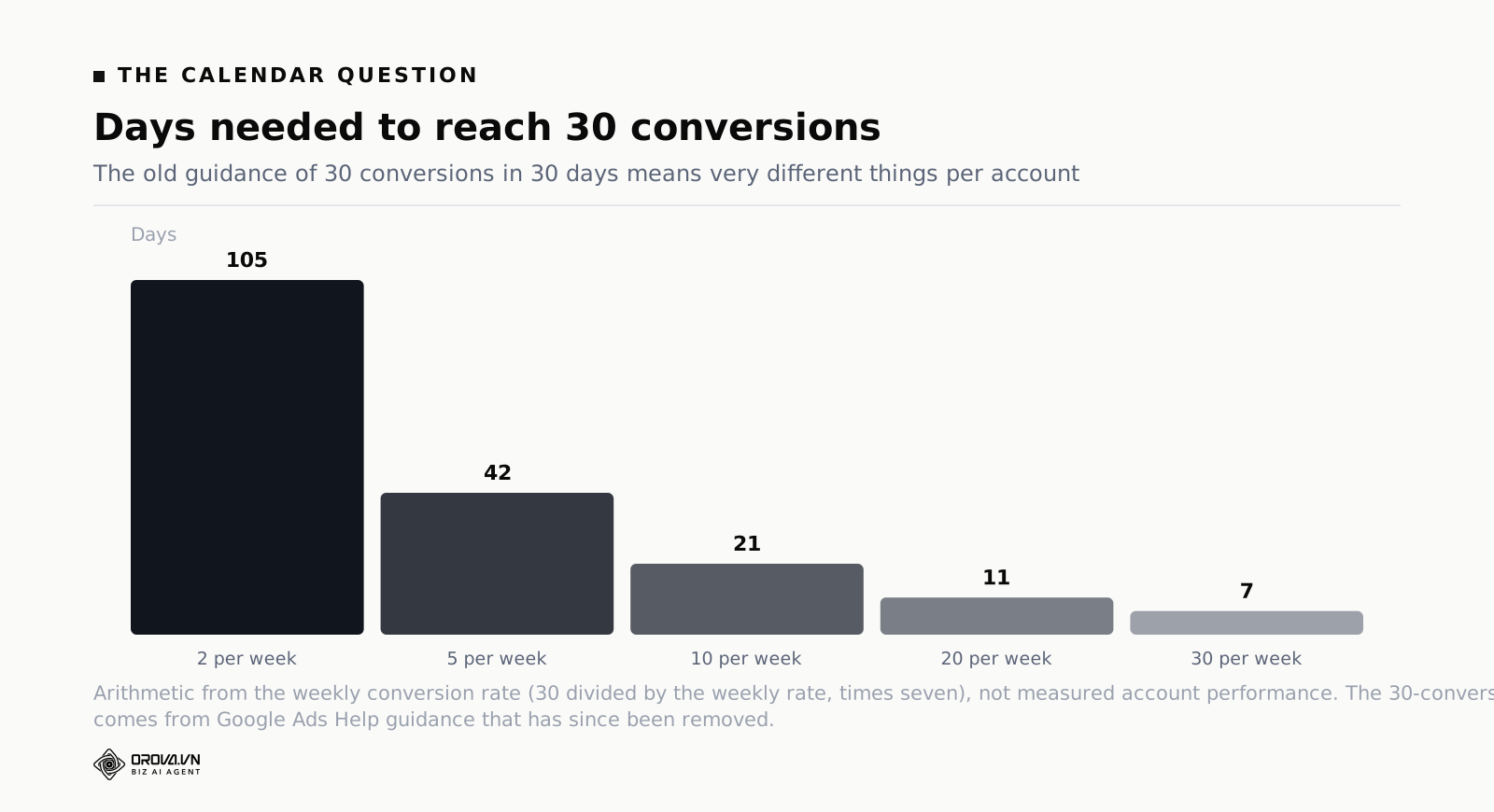
The useful version of that guidance is a calendar question rather than a threshold. Take your current conversion rate per week and work out how long it takes to accumulate thirty. If your campaign produces two conversions a week, thirty conversions is fifteen weeks away, which is longer than most people's patience and long enough that the market has changed underneath the data. That is not an argument against Smart Bidding. It is an argument for either consolidating campaigns so the volume lands in one place, or choosing a strategy that needs less evidence, or optimising for an earlier action in the funnel that happens more often — with the honest acknowledgement that the earlier action is a proxy and proxies drift.
Signal quality, which matters more than volume
Thirty clean conversions beat two hundred dirty ones. The common ways conversion data goes dirty, roughly in order of how often they are found:
- Double counting. The tag fires on the thank-you page and again on a page reload, or both a Google tag and a Google Tag Manager container are installed and firing the same event. The model learns to buy whatever the double-firing traffic looks like.
- Micro-conversions marked primary. Newsletter signups, PDF downloads and chat opens sitting in the same primary set as purchases, with no values. Each one counts as 1.0, exactly like a sale.
- Missing values on a value strategy. Half the orders pass a value and half pass zero, so Target ROAS is being scored on half your revenue.
- Conversion lag longer than the reporting window you look at. If a meaningful share of your conversions land three to fourteen days after the click, then any read on the last seven days understates recent performance and overstates the older period. People lower targets in response to a shortfall that was only ever a delay.
- Offline outcomes never returned. The account optimises to form fills because form fills are all it has ever been shown.
If you only fix one thing before a migration, fix the primary conversion set. It takes fifteen minutes and it changes what every subsequent decision is aimed at.
Budget as fuel, not as a ceiling
A Smart Bidding strategy without a target — plain Maximise Conversions or plain Maximise Conversion Value — is designed to spend the full daily budget. That is not a bug or a greedy setting; it is the literal instruction. "Get me the most conversions available for this budget" presumes the budget is being spent. If your campaign was previously limited by low manual bids and was quietly using two-thirds of its stated budget, switching to Maximise Conversions removes the only cost control that was actually operating. Spend rises to the number in the budget field, which nobody had revisited since the campaign was built.
Smart Bidding Strategies Compared
Every comparison of smart bidding strategies eventually becomes a table, so here is the table first and the argument after it.
| Strategy | What it aims at | What it needs | Suits | Fails when |
|---|---|---|---|---|
| Maximise Clicks | The most clicks the budget will buy | Nothing but a budget; optional max CPC limit | Brand new campaigns with no conversion history; genuinely top-of-funnel traffic goals | Used as a performance strategy; it will find cheap clicks that never convert |
| Maximise Conversions | The most conversions the budget will buy | Working conversion tracking; a budget you are content to spend fully | Getting a campaign out of a cold start; volume goals where cost per action is flexible | The budget was previously unspent, or the primary conversion set is wrong |
| Maximise Conversions with a target CPA | As many conversions as possible around an average cost you name | Steady conversion volume; a defensible cost per action | Lead generation where every lead is worth roughly the same | Lead values vary wildly, or the target is set from hope rather than history |
| Maximise Conversion Value | The most total conversion value the budget will buy | Accurate values on every conversion | Ecommerce where order values differ and you want revenue, not order count | Values are missing, wrong, or all identical (in which case it is Maximise Conversions with extra steps) |
| Maximise Conversion Value with a target ROAS | As much value as possible at an average return you name | Accurate values plus enough conversions to hit the target reliably | Ecommerce with a known margin structure and a real break-even point | Volume is thin, values are noisy, or the target is far above what the account has ever achieved |
| Manual CPC | Whatever your bid says, every time | Somebody to maintain it | Tracking is broken or absent; strict CPC ceilings; very small controlled tests | Used at scale as a substitute for auction-time signals you cannot replicate |
Maximise Clicks: the honest starting line
It belongs in this list only to be excluded from the conversation about performance. Maximise Clicks has one job, does it well, and should be treated as a temporary state while a new campaign accumulates history. Set a maximum CPC limit when you use it, because without one, a campaign can discover a supply of very cheap and completely irrelevant clicks and spend the whole budget there. Its honest use case is a campaign with zero conversion data that needs traffic in order to have any. Its dishonest use case is a report where "clicks up 40%" is the headline.
Maximise Conversions: the cold start engine and the budget trap
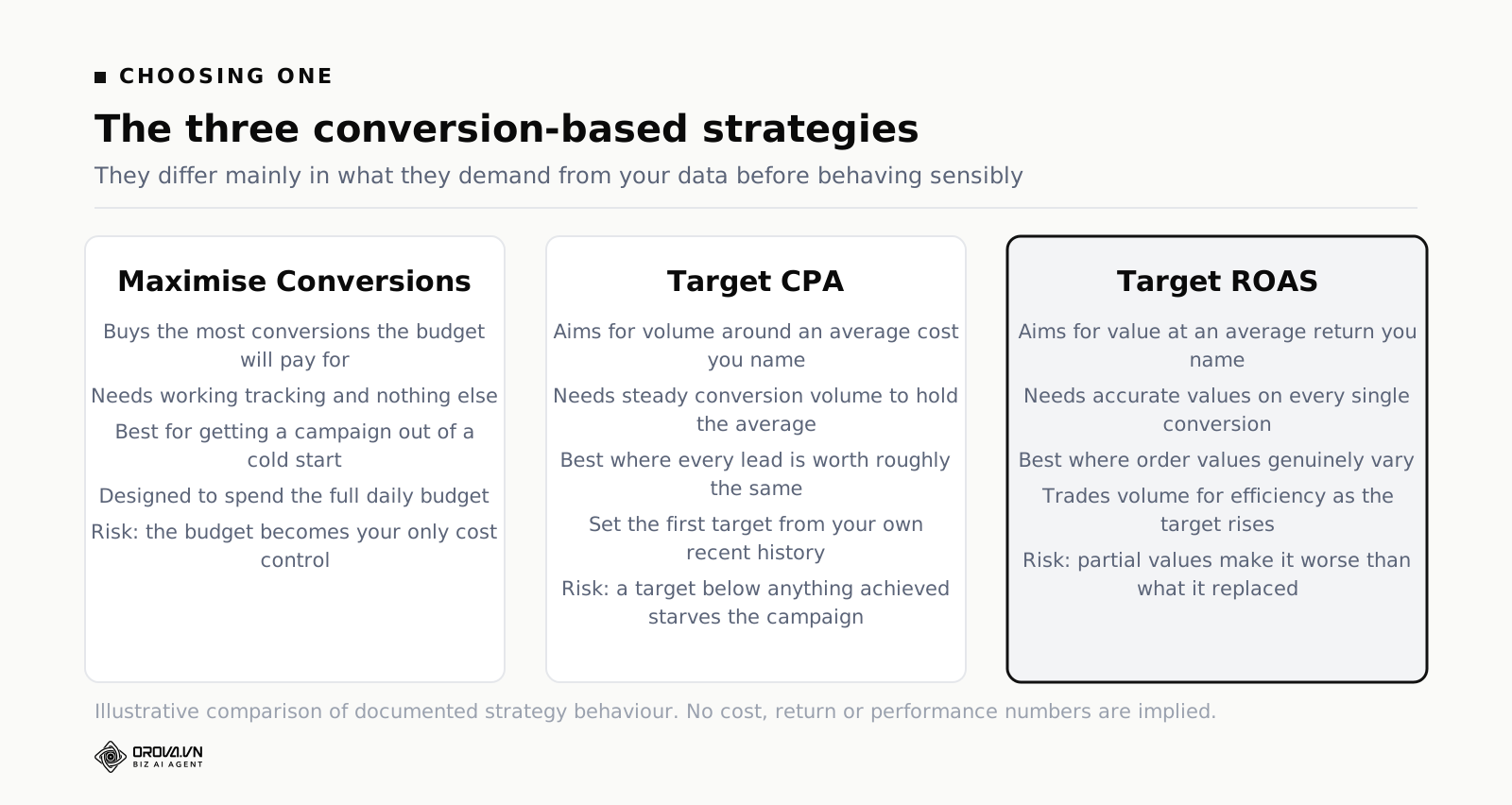
This is the strategy in the Friday story, and it is genuinely the right first step for a lot of campaigns. It needs no target, which means you do not have to guess a number before you have evidence, and it gathers conversions faster than a conservative target would allow. It is the fastest way to get a campaign from "no data" to "enough data to set a sensible target".
The trap is the budget. Because the strategy is instructed to spend, your daily budget becomes the only cost control in the campaign. Before switching, look at your actual average daily spend for the last month, not the budget field. If they differ by more than a little, set the budget to something close to what you have been spending, and only then switch. Otherwise you are running two experiments at once — a new bidder and a spend increase — and when the cost per lead moves you will not know which one did it.
Target CPA: the strategy for uniform outcomes
Formally this is now Maximise Conversions with a target cost per action set, though almost everyone still calls it tCPA. It is the right choice when a conversion is a conversion: a lead generation business where every enquiry has broadly the same chance of becoming similar revenue, a booking, a trial signup, a call.
Set the first target from your own history, not from an aspiration. Take the campaign's actual average cost per conversion over a period long enough to be stable, and start there or slightly above. A target set well below what the account has ever achieved does not force efficiency; it forces the bidder to withdraw from auctions it cannot win at that price, so impressions collapse, volume collapses, and the campaign starves. If you want a lower cost per action, get there by stepping the target down gradually once each level has proven itself, and give each step long enough to be judged.
Maximise Conversion Value and Target ROAS: for when a sale is not just a sale
The moment order values vary meaningfully, counting conversions stops being useful. A strategy that treats a $19 order and a $900 order as one conversion each will happily buy nine hundred small ones. Value-based bidding fixes that, but it inherits a dependency: your conversion values have to be right, on every conversion, all the time. A feed or a tag that passes value on some transactions and zero on others makes the strategy worse than the one it replaced.
Target ROAS additionally needs enough conversions for the average to be stable, because it is being asked to hit a ratio rather than a cost. Ratios are noisier than costs at low volume. As with tCPA, derive the first target from what the account has actually delivered, and understand what a target ROAS actually does: it trades volume for efficiency. A higher target means the system bids only where it expects a high return, which mathematically means fewer auctions and less revenue in total, at better efficiency. Whether that is the right trade depends on your margin structure and whether you are growth-constrained or profit-constrained. The choice between a cost target and a value target has enough moving parts that it deserves its own treatment, and we go through the trade in detail in google Ads Smart Campaigns: How to Set One Up.
The Learning Period, and What Keeps Resetting It
When you change a bid strategy, the campaign enters a learning period. During it, the system is calibrating against your conversion data and its bids are more volatile than they will be later. Google Ads Help describes this as a normal state and advises against judging performance while it is happening. Daily cost per conversion during learning is not a signal. It is the sound of a model working out where the edges are.
How long it takes depends on how fast the campaign accumulates conversions. Google's guidance is generally about a week for Search campaigns with reasonable volume, and longer where conversions are sparse. The practical rule is better expressed as a sum: learning period plus your typical conversion delay. If it takes people ten days to convert after clicking, then a seven-day learning period followed by a seven-day evaluation is measuring a fortnight in which half the results have not arrived yet.
The reason this section exists is not the learning period itself. It is the loop people fall into around it. The account changes a target on day three because the numbers look bad. That restarts learning. Four days later the numbers still look bad — of course they do, learning restarted — so the target changes again. Six weeks later the campaign has never once completed a stable evaluation period, and the conclusion drawn is that Smart Bidding does not work for this account.
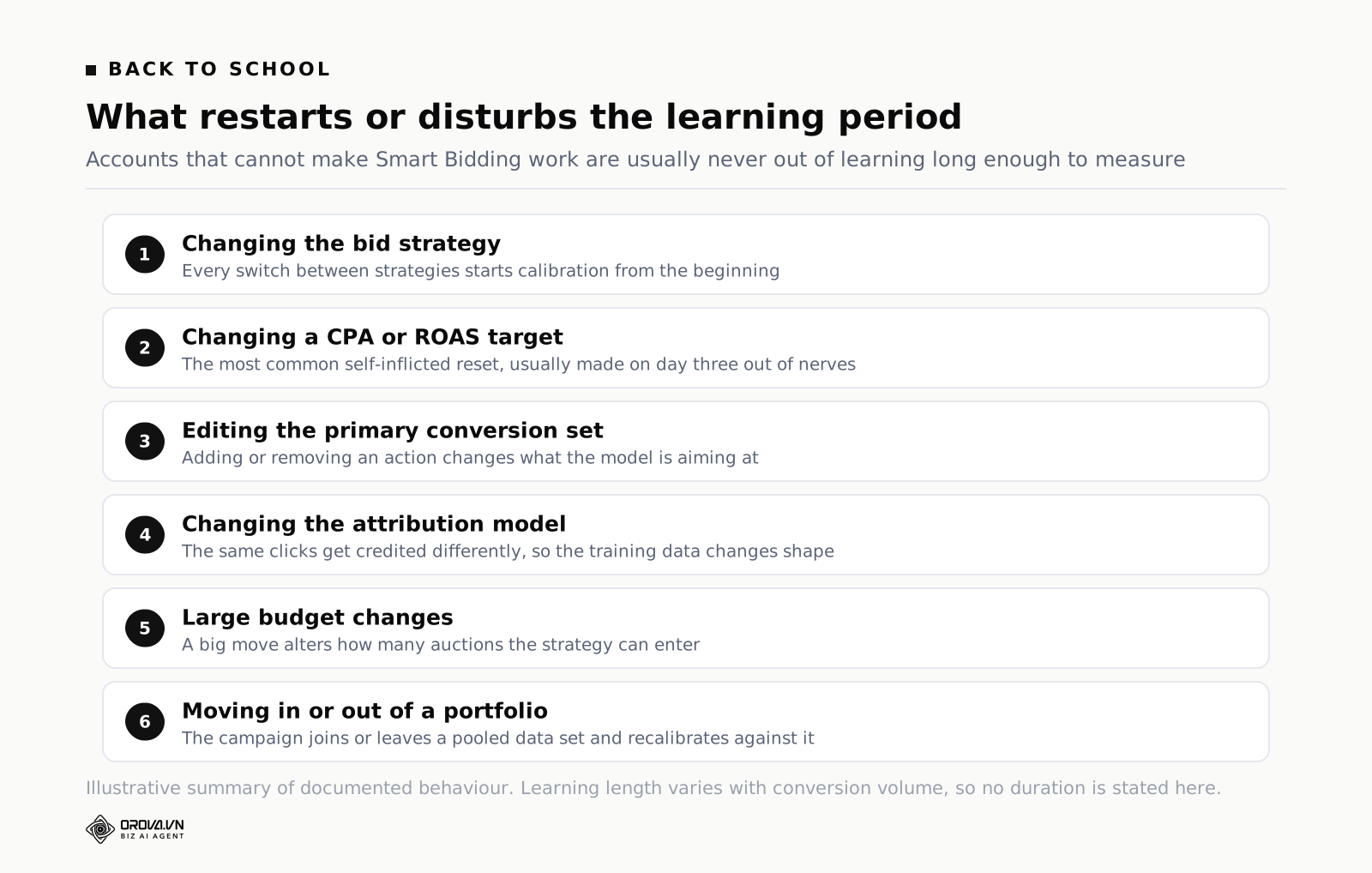
Things that restart or disturb learning include changing the bid strategy itself, changing the target on a tCPA or tROAS strategy, adding or removing conversion actions from the primary set, changing the attribution model, moving a campaign into or out of a portfolio strategy, and large budget changes. Substantial structural edits — adding a pile of keywords, changing match types wholesale, swapping the landing page — do not always trigger a formal learning status, but they change the population the model was trained on, which has the same practical effect.
Two rules cover this. First, one change at a time, then wait. Second, write down what you changed and when, because in three weeks you will not remember whether the target change came before or after the budget increase, and the whole read depends on the order.
Why Google Ads Smart Bidding Burned Budget That Weekend
Back to Friday. Nothing exotic happened. Five ordinary things happened at once, and it is worth separating them because four are fixable and one is not a problem at all.
One: the spend cap disappeared. The low manual bids were doing quiet budget control. Removing them let the campaign spend the full daily budget for the first time in two years.
Two: three days is not a result. The campaign is in learning. The bids are volatile on purpose. Reading Monday's cost per lead is like reading a thermometer while it is still in your hand.
Three: the weekend has a different traffic mix. If the business converts on weekdays, a strategy switched on a Friday spends its first and most influential days on the worst-converting traffic of the week and calibrates against it.
Four: conversion lag. Friday and Saturday clicks that convert on Tuesday are not in Monday's number. The spend is fully recorded; part of the return is not.
Five: the primary conversion set was never checked. If "Contact page view" is in there, the new strategy has been enthusiastically buying page views all weekend.
A worked example, with clearly illustrative numbers to show the shape rather than to claim any benchmark. Say the campaign has a $200 daily budget but, on manual bids, has averaged $120 a day — $3,600 over a 30-day month producing 60 leads, so $60 a lead. You switch to Maximise Conversions. Spend rises to the full $200 a day. Over the same 30 days that is $6,000. Conversions rise, but not proportionally, because the extra spend is buying auctions the old bids were losing: say 72 leads. Cost per lead is now $83. That is a 39% increase in cost per lead and a 20% increase in leads, and whether that trade is good depends entirely on whether an $83 lead is still profitable.
Now the weekend read. Over Friday, Saturday and Sunday the campaign spent $600 instead of the usual $360 and recorded 3 leads instead of the usual 6, because weekends are weak and because two of those leads convert on Tuesday and are not counted yet. Cost per lead over those three days: $200, against $60. That is the "it doubled" moment, and it is more than doubled — and it is almost entirely an artefact of window, seasonality within the week, and lag. The real number was $83, and nobody would have known that on Monday.
The fix list that follows from this is unglamorous: set the budget to what you were actually spending before you switch, switch on a Monday rather than a Friday, check the primary conversion set first, and put a date in the calendar for when you are allowed to look — learning period plus conversion lag, not before.
Seasonality Adjustments and Data Exclusions
Two advanced controls exist for the situations where you know something the model does not. They are useful and they are misused about equally often.
Seasonality adjustments
A seasonality adjustment tells Smart Bidding to expect a change in conversion rate over a date range you specify. The classic legitimate use is a short, sharp promotion: a 48-hour flash sale where you know from previous runs that conversion rate roughly doubles. Without the adjustment the model spends the first day discovering this and the promotion is over by the time it has adapted.
Three constraints on using it well. It is for conversion rate, not traffic volume — if you expect more people rather than a higher conversion rate among the same people, this is the wrong tool. It is for short events; Google's guidance is aimed at brief periods of a few days, not whole seasons, because the model already learns recurring seasonal patterns from your history and stacking an adjustment on top double-counts it. And your estimate should come from a previous comparable event, not from optimism. An adjustment claiming a conversion rate lift that does not materialise makes the bidder pay too much for the whole window.
Data exclusions
A data exclusion tells Smart Bidding to ignore conversion data from a date range entirely. This one is not for promotions. It is for the days when your measurement broke: the tag was removed during a site deploy, the checkout was down, an outage stopped conversions being recorded. Without an exclusion, the model treats those days as genuine evidence that your traffic stopped converting, and it drops bids accordingly for days afterwards.
Use it narrowly and only for measurement faults you can name. Excluding a stretch of days because performance was disappointing is not data hygiene, it is deleting evidence, and it leaves the bidder calibrated on a version of your account that never existed. Also note the blast radius: exclusions apply across the campaigns of the selected type, so an exclusion added for one broken checkout can quietly affect campaigns that were measuring fine.
When Manual Bidding or a Portfolio Still Wins
The honest answer to "when should I use smart bidding" includes cases where you should not, and they are more common than the marketing suggests.
Cases where manual or Maximise Clicks is the right call
- Conversion tracking is absent or known to be broken. There is nothing to optimise towards. Fix measurement first; a conversion-based strategy pointed at faulty data is worse than a bid you control.
- The campaign is too short to learn. A two-week flighted campaign spends most of its life in the learning period and then ends. You never get the benefit, only the volatility.
- Hard CPC ceilings that exist for reasons outside marketing. Some businesses genuinely cannot pay more than a set amount per click, for contractual or regulatory reasons. Campaign-level Smart Bidding gives you no bid cap.
- Tiny, fixed inventory. One product, a handful of keywords, a few clicks a day. There is no signal to learn from and a competent person with a spreadsheet does fine.
- A controlled test where the bid must be a constant. If you are testing landing pages or ad copy and the bidder is simultaneously reallocating spend based on what it observes, you cannot isolate the variable.
Manual bidding also asks a question that automated bidding hides: what is a click actually worth to you at each position? Working through google Ads PPC: How It Works and What You Actually Pay is worth doing even in a fully automated account, because it makes the shape of the volume-versus-cost curve visible rather than implied.
Where portfolio strategies earn their keep
A portfolio bid strategy applies one strategy across several campaigns and, crucially, pools their conversion data. That solves the most common structural problem in a thin account: twelve campaigns each producing three conversions a month, none of them individually able to learn anything, all of them collectively producing thirty-six.
Portfolios also carry controls that campaign-level strategies do not. Maximum and minimum CPC bid limits are available on portfolio strategies, which is the practical answer to the CPC ceiling problem above. A shared spend target can be set across the group. In exchange, you give up per-campaign target control, so the campaigns you group together should genuinely deserve the same target. Grouping a high-margin product line and a loss-leader under one Target ROAS produces a compromise that is wrong for both.
The wider point is that fragmentation is usually a structure problem before it is a bidding problem. If your conversions are scattered across too many campaigns to learn from, no bid strategy will rescue it, and the fix is to consolidate — which is a decision about google Ads Account: Setup, Access and Structure Basics rather than about bidding at all.
A Migration Routine That Does Not Burn a Month
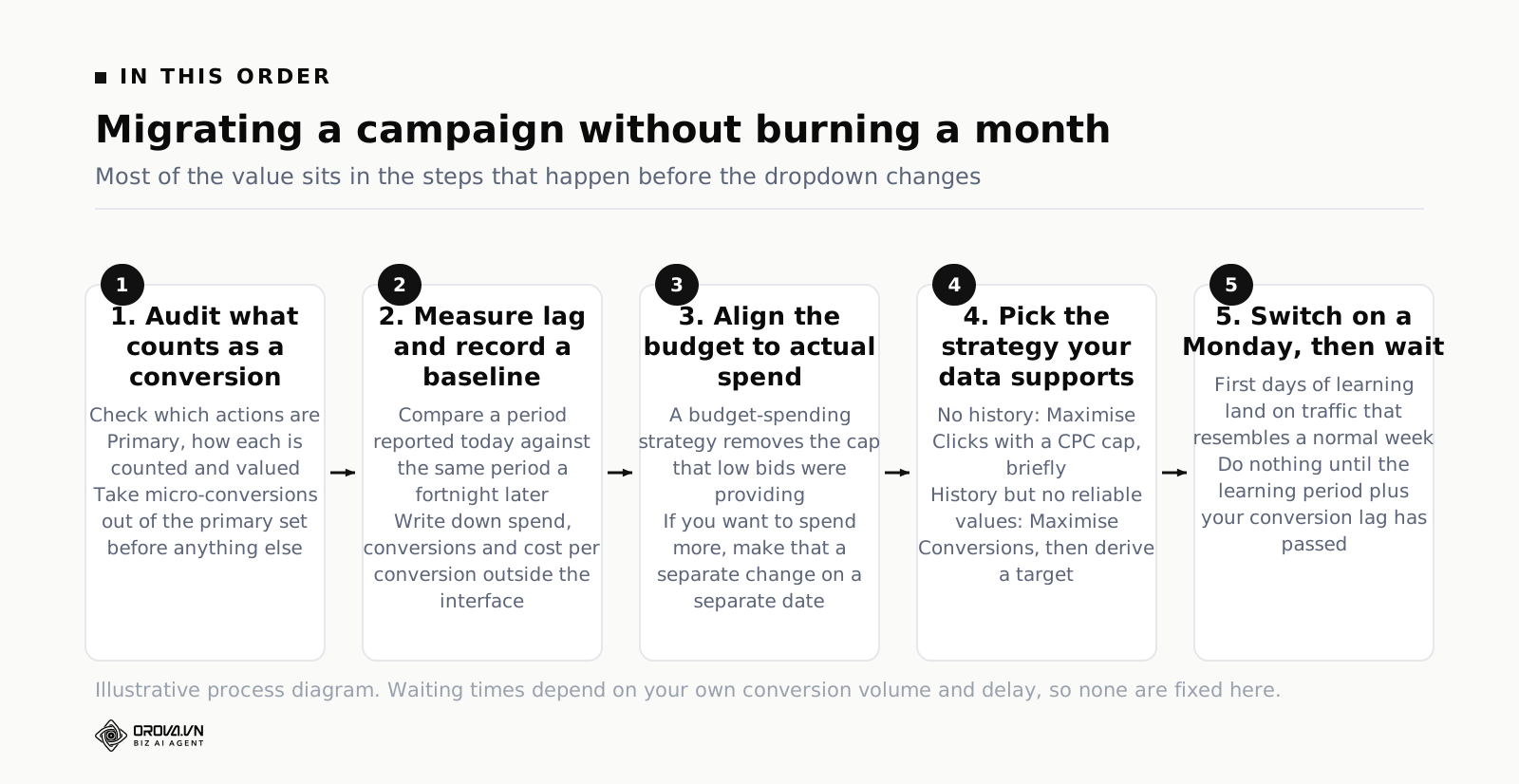
This is the sequence to run when you move a campaign onto a Smart Bidding strategy. It takes longer on paper than switching a dropdown, and it is the difference between a change you can evaluate and a change you can only argue about.
- Audit the conversion set. Check which actions are primary, how each is counted, what value each carries, and the window and attribution model. Remove micro-conversions from the primary set. This is the step that is skipped most often and matters most.
- Measure your conversion lag. Compare conversions attributed to a period as reported today against the same period reported a fortnight later. The gap is your lag, and it sets how long you must wait before reading anything.
- Record the baseline. Average daily spend, conversions, cost per conversion and conversion value over the last 30 days minimum. Write it down outside the interface, because the interface will happily show you a comparison against a period you did not intend.
- Align the budget to reality. Set the daily budget close to what the campaign has actually been spending. If you want to increase spend, do it as a separate change on a separate date.
- Choose the strategy by data, not ambition. No history and no values: Maximise Clicks with a CPC cap, briefly. History but no reliable values: Maximise Conversions, then a target CPA derived from what it delivers. Reliable values and enough volume: Maximise Conversion Value, then a target ROAS derived from what it delivers.
- Switch early in the week, so the first days of learning land on traffic that resembles your normal week.
- Do nothing for the learning period plus your lag. Put the date in the calendar. Resist the target change. The urge will be strong on day three.
- Evaluate over a full period, then move one lever. If the cost per action is acceptable and volume is short, raise the target or the budget — one of them. If the cost is too high, step the target down by a modest amount rather than a dramatic one, and wait again.
Two things to avoid entirely during the first cycle: switching back after a bad week, and changing anything else at the same time. A switch back part-way through learning gives you the cost of the transition with none of the benefit, and it teaches the team a lesson that is not true.
How Far Manual Work Goes, and Where a Tool Helps
Almost everything above is judgement, and judgement should stay with a person. Deciding whether a lead is worth $60 or $83 is a business question. Deciding whether to buy volume or protect efficiency this quarter is a business question. No system should be making those calls for you, and any that offers to should be treated with suspicion.
What breaks is not judgement. It is the calendar and the bookkeeping. The learning period ends on a Thursday when you are in workshops. The date you were supposed to evaluate slides by a week, then two. Nobody logs which target changed on which day, so three months later the account's history is a story told from memory. Meanwhile the same checks have to be repeated across Google, Meta and TikTok, in three interfaces with three different vocabularies.
That gap is roughly what Orova Ads is built for. It syncs campaigns, ad groups, ads and daily metrics from Google Ads, Meta and TikTok into one table, and its rule sets are written as ordinary sentences with data placeholders, each on its own schedule, so the weekly checks happen whether or not anyone remembers. There are 214 optimisation action codes across the three platforms, 101 of them for Google Ads, and each action exists in two forms: an advisory code where the AI recommends and you act, and an execution code where it is allowed to act for you. The default is advisory only, and every suggestion arrives with its reasoning and the numbers behind it, logged in a history you approve or reject. One detail is worth mentioning because it is exactly the kind of thing that quietly ruins bid targets: if an account mixes currencies, Orova blocks the comparison rather than converting, because a wrong exchange rate makes every cost threshold wrong in a way nobody notices. Signing up is free, includes 1,000 quota, and needs no card; there is no percentage taken from ad spend. The reading of the data is still yours. The not-forgetting is not.
Frequently Asked Questions
How long should I wait before judging a Smart Bidding change?
The learning period plus your typical conversion delay, and then a full evaluation window on top. For a campaign with steady volume and a short conversion lag, that is often around three to four weeks before the numbers mean anything. For long sales cycles it is longer. The temptation to intervene peaks around day three, which is precisely when intervening is most expensive, because it resets the clock and you pay for the transition twice.
Do I need conversion values to use Smart Bidding?
Not for Maximise Conversions or Target CPA, which count conversions and ignore values entirely. You do need them, accurately and on every conversion, for Maximise Conversion Value and Target ROAS. Partial values are the dangerous middle case: if some conversions pass a value and some pass zero, a value-based strategy is optimising against a systematically incomplete picture and will drift towards whichever segment happens to be measured.
Will raising my target CPA immediately get me more volume?
It raises the ceiling; it does not create demand. Raising a target lets the bidder compete in auctions it was previously declining, so volume usually increases where there is unmet demand at that price. Where the campaign was already capturing most of the available searches, a higher target mostly buys the same conversions more expensively. Check impression share and lost impression share due to rank before assuming a target change will unlock growth, and expect the change to restart learning either way.
Why did my impressions collapse after I switched to Target ROAS?
Almost always because the target is higher than anything the account has achieved. A target ROAS is an instruction to only bid where that return is expected, so an unreachable target means the bidder declines nearly every auction. The campaign looks broken; it is obeying you precisely. Reset the target to the account's actual recent return, let it stabilise, and then step it up gradually if efficiency is the goal.
Can Smart Bidding work on a small budget?
Budget matters less than conversion count. A small budget producing a steady stream of cheap conversions gives a model plenty to work with; a large budget producing four expensive conversions a month does not. If the conversions are thin, the options are to consolidate campaigns so the data pools in one place, use a portfolio strategy across them, or optimise towards a more frequent earlier action while accepting it is a proxy.
Should I set a target on day one, or start without one?
Start without one unless you have a well-evidenced cost per action from the same campaign in a comparable recent period. A target guessed before you have data does one of two things: too low and the campaign starves, too high and you overpay while believing you set a control. Run Maximise Conversions or Maximise Conversion Value first, let it produce an actual average, and derive the target from that number.
Does Smart Bidding replace negative keywords and search term work?
No, and this is a common and expensive assumption. Smart Bidding decides how much to bid, not what to match. It can learn that a certain type of query rarely converts and bid down on it, but it will still pay for some of that traffic while learning, and it cannot know that a query is commercially irrelevant to you rather than merely low-converting. Search term review and negatives remain a weekly job regardless of bid strategy.
What To Do This Week
Pick the one campaign carrying the most spend. Do not touch the bid strategy yet. Open three things instead: the conversion goal settings, the campaign's actual average daily spend over the last 30 days, and its budget field.
Then answer three questions in writing. Is every action in the primary conversion set something you would happily pay for at the current cost per action? Is the actual daily spend close to the budget, or is a low bid quietly doing the capping? And how many conversions did this campaign record in the last 30 days — enough to learn from, or so few that consolidation is the real project?
If the primary set contains a micro-conversion, that is this week's work and it takes fifteen minutes. If actual spend is well below budget, fix the budget field before any strategy change. If the conversion count is in single digits, the bid strategy is not your bottleneck and no dropdown will change that. And if all three check out, set a date on the calendar for the switch — a Monday — with a second date for when you are allowed to look at the result, and treat everything between those two dates as time you have already agreed not to interfere with.
Getting Smart Bidding Right Without the Guesswork
Doing this properly by hand means watching conversion volume daily, checking whether the right actions are being counted, adjusting targets carefully, and resisting the urge to touch anything during the learning period. It is not complicated work, but it is constant, and one impatient change on a Tuesday can undo weeks of progress.
This is exactly the kind of ongoing monitoring and adjustment that Orova Ads is built to handle automatically, keeping an eye on signal quality and performance so you are not the one staring at the dashboard every morning. If that sounds useful, it is worth taking a look.
Give the machine your rules, not just your budget
Orova Ads lets you write the guard rails in plain language before anything touches spend.
Start for free