
Interview Scheduling Tools: The Days You Get Back
An interview scheduling tool is the least glamorous purchase in hiring software and one of the few whose value shows up within a week. The problem it solves is small, repetitive, and relentless: three interviewers, one candidate, four calendars, and a chain of emails that takes two days to converge on a slot that then moves because someone's client call ran over.
The problem is also easy to underestimate. Nobody records the hours it consumes, because they arrive in five-minute fragments rather than blocks. What does get noticed is the consequence: the strongest candidate accepting somewhere else while your first conversation was still being arranged.
What does an interview scheduling tool actually do?
It removes the negotiation. Instead of proposing times and waiting, you publish availability drawn from real calendars and let the candidate choose. The tool holds the slot, sends the invitation, adds the meeting link or the room, and reminds everyone. What took two days of intermittent email becomes one action by the candidate, usually within a few hours.
That is the whole mechanism, and it is worth being clear that the saving is not primarily in your time — though there is some. The saving is in elapsed time, which is the variable that decides whether good candidates stay in your process.
The number this actually improves
Hiring metrics are usually reported as time-to-hire, which is a long chain of intervals with the arranging hidden inside each link. Break it apart and something becomes obvious.
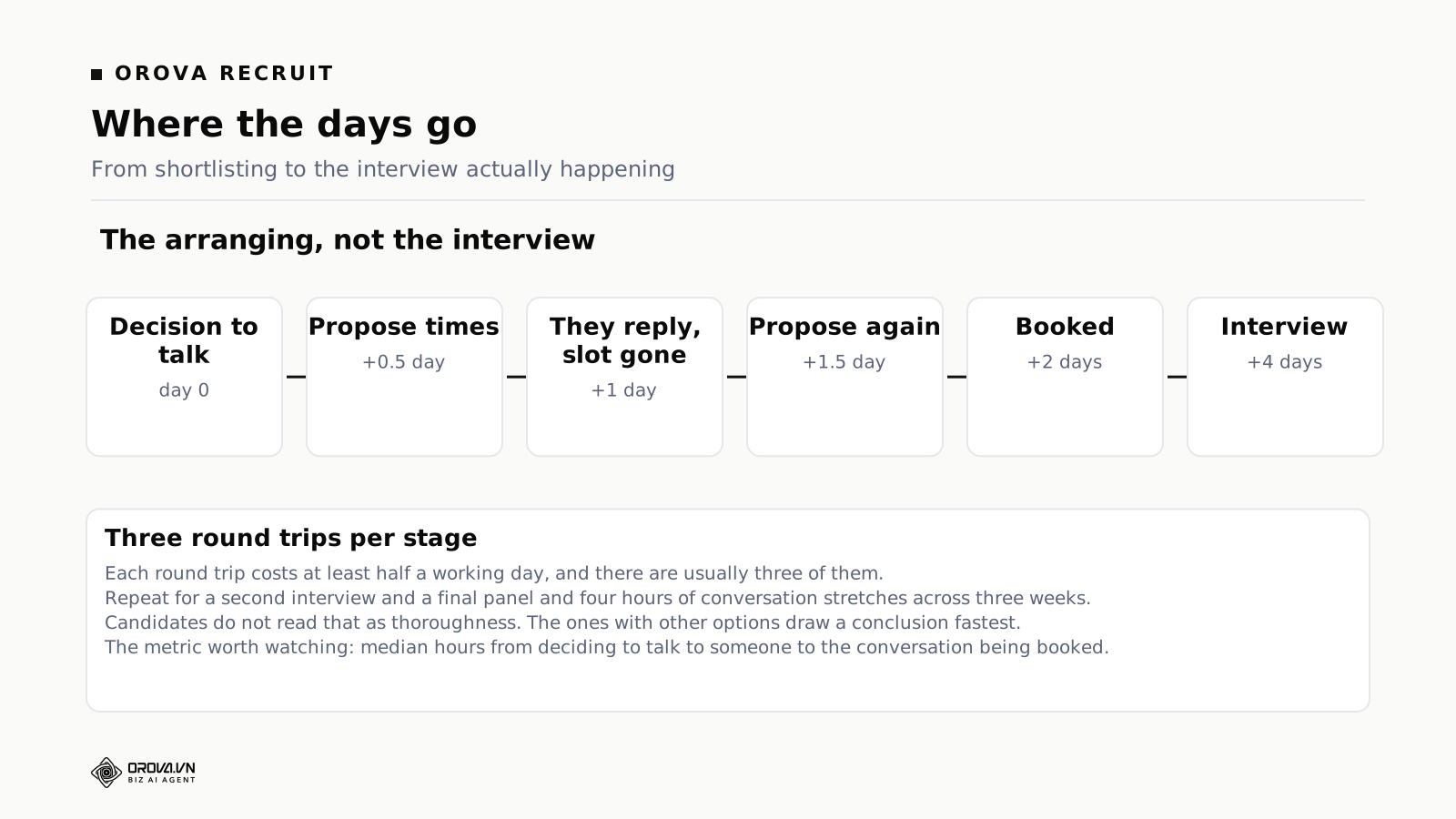
Between shortlisting and the first conversation there is typically a delay measured in days, almost none of it caused by lack of willingness. It is caused by round trips: you propose, they respond, a slot has gone, you propose again. Each round trip costs at least half a working day, and there are usually three of them. Do the same for a second interview and a final panel, and a process that involves perhaps four hours of actual conversation stretches across three weeks.
Candidates do not experience that as thoroughness. They experience it as a signal about how the company operates, and the strongest candidates — the ones with other options — draw the conclusion fastest.
So the metric worth watching is not time-to-hire but the median gap between a decision to talk to someone and the conversation happening. It is the interval most sensitive to tooling, and the one that most reliably predicts whether your offers get accepted.
Why scheduling is harder than it looks
Any developer who has built one of these will tell you the naive version fails immediately, and the reasons are worth knowing because they map onto the features that differentiate products.
Availability is not the same as free time
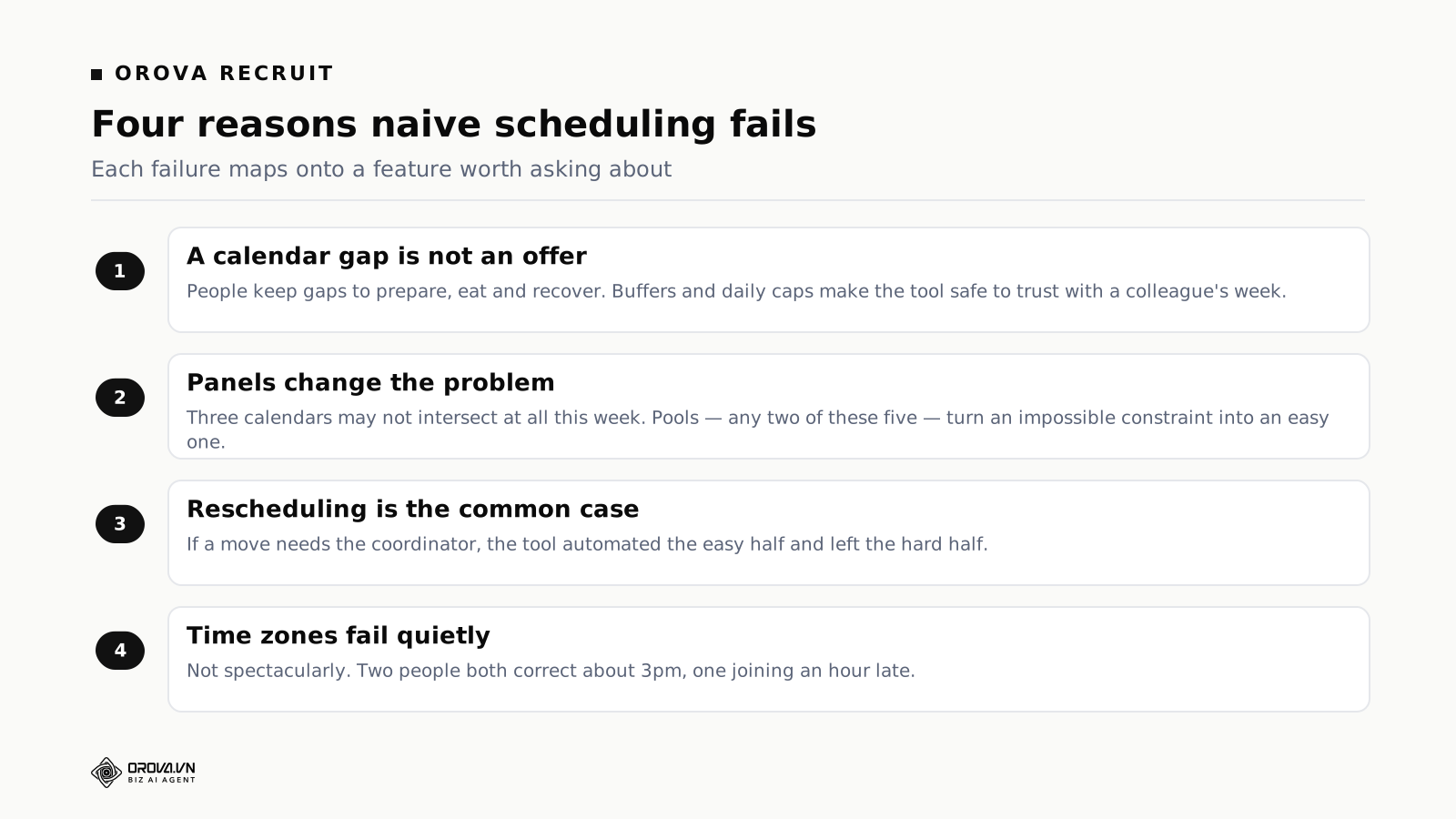
A calendar gap is not an offer of that time. People keep gaps deliberately: to prepare, to eat, to recover between meetings. A tool that treats every gap as bookable will fill someone's day with back-to-back interviews and produce interviewers who are present but useless by the fourth one.
Buffers, daily caps, and blocked windows are not conveniences. They are what makes the tool safe to give real access to a colleague's calendar, and they are what determines whether your interviewers will tolerate it after the first fortnight.
Panels change the problem entirely
One interviewer is trivial: intersect one calendar with a candidate's preferences. Three interviewers who must all attend is a different problem, because the intersection of three calendars in a busy week may be empty, and the honest answer is often "not this week".
Products differ sharply here. Some only handle the single-interviewer case well and degrade into manual coordination for panels. Others handle panels but require every interviewer to be a paid user, which changes the economics for a small team. Some support pools — any two of these five people — which is usually the right model for a small company, because it converts an impossible constraint into an easy one.
Rescheduling is the common case, not the exception
A meaningful share of first interviews move at least once. If rescheduling requires the coordinator to intervene, the tool has automated the easy half and left the hard half. Self-service rescheduling by the candidate, within rules, is the feature that decides whether the coordination load actually falls.
Time zones break things quietly
Not spectacularly, which would be safer. Quietly: an invitation that says 3pm to one person and 3pm to another, both correct in their own zone, one of whom joins an hour late. Any tool that does not display the candidate's zone explicitly during booking will produce this, and it will produce it on the day you are hiring someone remote and least want to look disorganised.
Standalone tool or part of the hiring system?
This is the real decision, and it is usually made by accident.
A standalone scheduling tool is cheap, quick to adopt, and works for any kind of meeting. Its weakness is that it knows nothing about your hiring. It does not know which stage the candidate is at, cannot tell you that four shortlisted people have not been contacted, and produces a booking that then has to be recorded somewhere else. You have automated the calendar and kept the coordination.
Scheduling inside the hiring system knows the candidate, the stage, and the position. Booking a slot advances the candidate; the notes from the conversation attach to the same record; the reminder to reply afterwards exists because the system knows a conversation happened. Its weakness is that it is only as good as the rest of the system, and you cannot use it for anything other than hiring.
For a team that hires occasionally and already lives in a general scheduling tool, standalone is often the right answer and there is no shame in it. For a team where the recurring pain is candidates falling through gaps rather than calendar arithmetic, integrated wins — because the gaps are a coordination problem, and coordination is what integration addresses.
How Orova Recruit handles scheduling, and where it stops
Scheduling in Orova Recruit is one area of the hiring module rather than a separate product, and it is built around two objects: rooms and slots.
Rooms are the places an interview happens — a physical meeting room, or a named virtual space. They are defined once and reused, which prevents the most common small-company scheduling error: two interviews booked into the same room because the calendar for the room lives in somebody's head.
Slots are the windows you are willing to offer. They are created deliberately rather than inferred from every gap in a calendar, which is the conservative choice. It means slightly more setup — you decide when you are available rather than the tool deciding for you — and it means the tool cannot fill someone's Tuesday with five interviews because Tuesday happened to look empty.
Candidates arrive from the same system that screened them. The schedule view draws on the CVs already assessed for the position, so booking is not a separate database of names. The candidate you are scheduling carries their criteria scores and the interview questions generated for that position, which means the person walking into the room has a set of questions aimed at the specific things the shortlist was built on.
Invitations go out through the contact area, which holds message templates — including AI-drafted ones and image attachments — and rules for automatic sending. This is what turns "we always reply" from an intention into a default: the rule sends the message whether or not anyone remembered.
After the conversation, notes attach to the candidate. They can be typed, dictated, or produced from an uploaded audio recording of the interview. That last option changes what the interview is like, because an interviewer who is not typing is an interviewer who is listening. The notes then feed the review stage, where candidates are scored, a recommendation is produced, and the decision is recorded and exportable as a PDF.
What it does not do
It does not read your Google or Outlook calendar and infer availability automatically — slots are declared. If your requirement is a public booking link that anyone can use for any kind of meeting, a general scheduling tool does that better and costs less. It also does not run video conferencing itself; it holds the room definition, not the meeting technology.
And it does not solve the underlying constraint, which is worth saying plainly: if your interviewers genuinely have no time for three weeks, no scheduling tool creates time. It will show you the emptiness faster, which is useful, but the decision to protect interview hours is a management decision, not a software feature.
The rules worth setting before you switch anything on
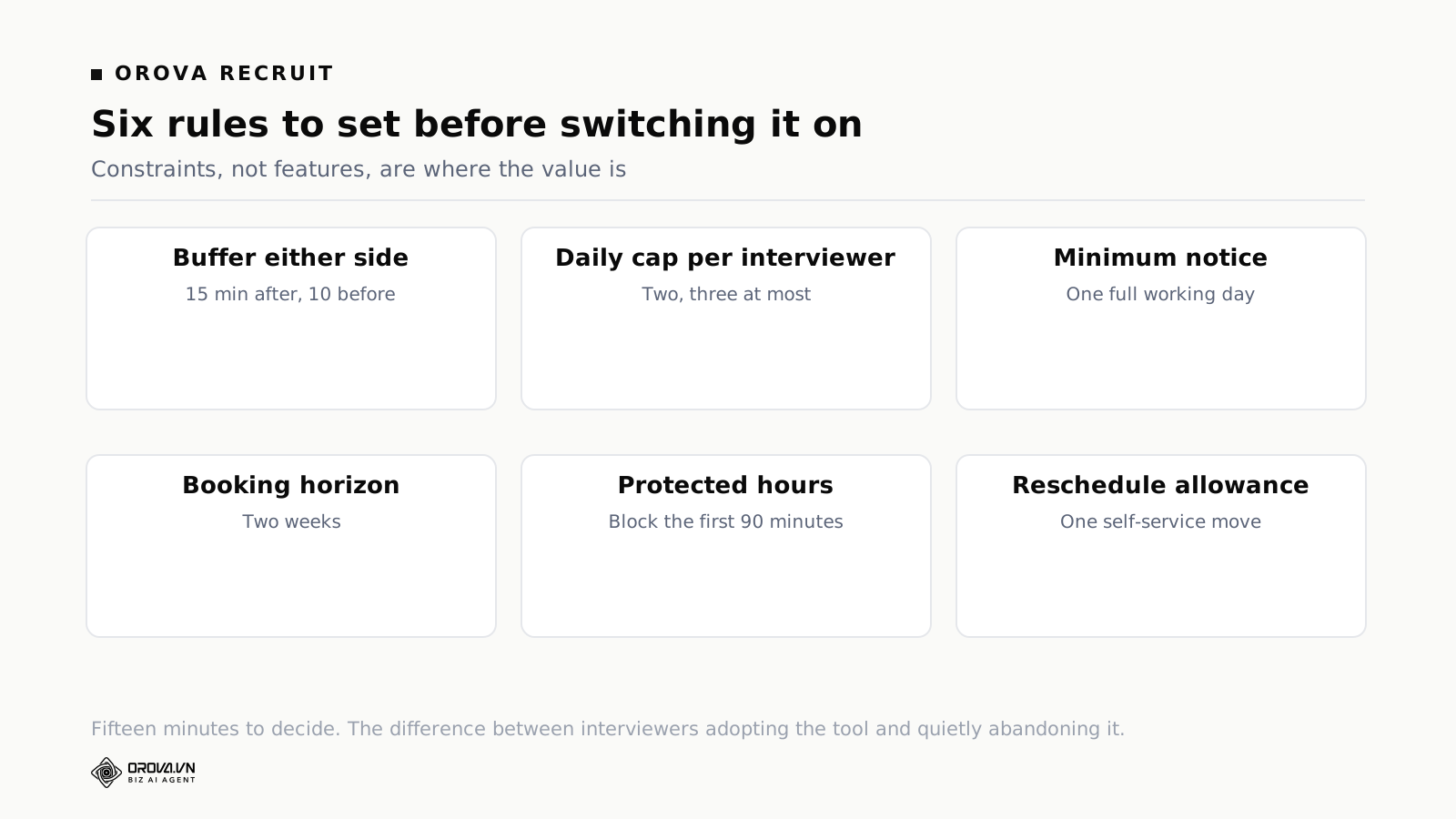
Most of the value in this category comes from constraints rather than features. Six worth deciding in advance.
| Rule | Why | A reasonable default |
|---|---|---|
| Buffer either side | Interviews overrun; notes need writing while fresh | Fifteen minutes after, ten before |
| Daily cap per interviewer | Quality collapses after the third conversation in a day | Two, three at the absolute most |
| Minimum notice | Candidates need to arrange their own day; so do interviewers | At least one full working day |
| Booking horizon | Slots offered too far ahead get taken and then moved | Two weeks |
| Protected hours | Otherwise interviews colonise the hours you think best in | Block the first ninety minutes of the day |
| Reschedule allowance | Self-service once is convenience; unlimited is churn | One self-service move, then a human |
These take fifteen minutes to decide and they are the difference between interviewers who adopt the tool and interviewers who quietly stop offering availability because it ruined a fortnight.
What changes for the candidate
It is easy to evaluate this category purely as internal efficiency and miss that the candidate experiences it more directly than you do.
Booking their own slot is genuinely better for them: it removes the awkwardness of declining three proposed times, and it lets them choose an hour when they can speak freely rather than the first slot they could plausibly accept. Candidates in employment are often interviewing in stolen time, and a system that offers a choice of early mornings and evenings gets better conversations than one that offers Tuesday at 2pm.
But two things degrade the experience, and both are common.
A booking link with no human context. A bare scheduling link, sent with a one-line message, reads as automated processing. The fix costs nothing: two sentences saying who they will meet, what the conversation will cover, and how long it will take. Every product allows this and most templates do not include it.
Slots that are all wrong for them. If every offered window is inside a working day, you have filtered for candidates who can take a personal call at their desk. That is a selection effect nobody intended and it correlates with things you should not be selecting on.
A trial that produces an answer in two weeks
Scheduling is one of the few categories where a short trial is genuinely conclusive, because the loop completes in days rather than months.
Days one and two. Set the six rules above. Do not configure anything else. Define one room and one week of slots.
Days three to seven. Use it for every interview, including the awkward ones — the panel, the candidate in another time zone, the one who needs to move. The happy path proves nothing; the awkward cases are the product.
Days eight to ten. Ask the interviewers, not the coordinator. The coordinator's life improved on day one and will say so. The interviewers are the ones whose calendars were touched, and their answer determines whether this survives a quarter.
Days eleven to fourteen. Measure the one number: median hours from "we want to talk to this person" to "the conversation is booked". Compare it to your memory of the last hiring round. If it has not moved substantially, either the tool is not the constraint or the rules are wrong — and it is worth working out which before concluding anything about the category.
Five ways teams waste this
Automating the invitation and not the reply
Booking becomes instant while the "thanks, we will be in touch" after the interview still depends on someone remembering. The candidate's experience of speed is now inconsistent: efficient up to the conversation, silent afterwards, which reads worse than being slow throughout.
Giving the tool access to a calendar nobody maintains
If interviewers do not block their own focus time, an availability-inferring tool will book into it, and the fault will be attributed to the software. Declared slots avoid this by design; inferred availability requires the calendar to be honest.
Treating a panel as a single event forever
The instinct is to get all interviewers in one session for the candidate's benefit. Sometimes right. Often it delays the whole process by a week to save the candidate one extra conversation, and the candidate would have preferred two shorter sessions this week to one long one next week. Ask them.
Sending the link too early
A scheduling link sent before anyone has decided the candidate is worth interviewing produces bookings you then cancel, which is worse than a slow reply. The link is a commitment; treat it as one.
Measuring bookings instead of elapsed time
Number of interviews scheduled is an activity metric and goes up whenever the tool is used. Median time from decision to conversation is the outcome metric. Only one of them tells you whether anything improved.
A word on candidates who never reply to the link
A share of booking links go unused, and the usual assumption — that the candidate lost interest — is right less often than people think. Links land in spam, arrive during a working day when opening a recruitment email is awkward, or simply get deferred until they are forgotten. A single follow-up two days later recovers a meaningful proportion of them, and it costs nothing because the rule can send it.
What does not work is treating non-response as a signal about the candidate. It selects for inbox habits rather than capability, and it does so invisibly, which makes it the kind of filter nobody notices they have installed.
When you do not need one
If you run fewer than a handful of interviews a quarter, with one interviewer, all internal, the email chain is fine. The overhead of the tool exceeds the saving and you will have forgotten how it works by the next round.
If the bottleneck is that nobody has decided who to interview, scheduling software will make an undecided shortlist bookable rather than making it decided. Fix the deciding first; the arranging is downstream of it.
And if interviewers genuinely cannot find hours, the honest problem is capacity. A tool that surfaces the absence of availability is doing you a service, but the fix is protecting time, which nobody can buy.
What a slow process actually costs
The argument for spending money on scheduling is easier to make once the cost of not doing it is written down, and it has three components that compound.
Candidates withdraw. The people most likely to disappear during a long arranging phase are the ones with alternatives, which is to say the ones you wanted. This is a selection effect running in exactly the wrong direction: a slow process does not filter randomly, it filters out strength. Replacing a withdrawn finalist means reopening a shortlist that has itself gone stale, and the second round is almost always worse than the first.
Interviewers lose the thread. A panel that meets a candidate over three weeks is comparing memories of different ages. The person interviewed on Monday of week one is being judged against a recollection that has had a fortnight to soften, while the candidate seen yesterday is vivid. Compressed scheduling is not only faster; it produces better comparisons, because the comparisons are between fresh impressions rather than between a memory and an impression.
The role stays open. Whatever the vacancy was costing — unshipped work, overtime absorbed by the rest of the team, a customer commitment slipping — it continues at full rate throughout the arranging. This is the largest of the three costs and the one that never appears in a hiring budget, because it lands on a different line of the business.
Add those together and the case for scheduling software rarely comes down to the subscription. It comes down to whether the days can be removed at all, and if they can, whether anyone will maintain the discipline to keep removing them.
What "integrated" should actually mean
Every product in adjacent categories claims integration. The word is worth unpacking, because there are three levels of it and only the third changes your week.
Level one: the calendar knows. The booking appears in a calendar and sends an invitation. This is table stakes and every product does it.
Level two: the record knows. The booking is attached to the candidate's record, so anyone looking at that candidate can see a conversation is scheduled. Most integrated products reach this level.
Level three: the next step knows. Because a conversation happened, the system expects notes; because notes exist, the review stage has something to score; because a decision was recorded, the contact rules know to send something. The chain continues without anyone remembering to advance it.
Level three is where the coordination load actually falls, and it is the level worth testing in a demo. Ask to see what the system does after an interview finishes, unprompted. If the answer is "nothing until someone opens it", you have level two, which is convenient rather than transformative.
Why recording the interview changes the conversation
Notes deserve a section because they interact with scheduling more than people expect: the reason interviews get delayed is often that the previous one has not been written up, and nobody wants to hold a second conversation while the first is still an unprocessed memory.
The mechanics of note-taking during an interview are genuinely bad. An interviewer typing is looking at a screen, missing the pause that meant something, and asking the next scripted question rather than the follow-up the answer invited. An interviewer not typing is relying on recall an hour later, and recall reconstructs rather than retrieves — it produces a summary shaped by the overall impression rather than by what was said.
Recording and transcribing removes the trade-off. The interviewer listens; the record is complete; the write-up becomes editing rather than remembering. Three consequences follow, and the third is the one that matters most.
First, the questions get better in the moment, because attention is available for follow-ups. Second, the evidence for a decision is specific — you can quote rather than characterise, which is what makes a hiring decision defensible three weeks later when the chosen candidate declines and you reopen the shortlist.
Third, and most usefully, the panel can disagree about the same thing. Without a record, two interviewers who reach different conclusions are comparing different memories and the disagreement is unresolvable; it gets settled by seniority. With a record they are comparing interpretations of the same evidence, which is a conversation that can actually reach an answer.
Two cautions. Recording requires the candidate's knowledge and agreement, told plainly at the start rather than buried in a booking confirmation — and a candidate who says no should experience no disadvantage. And a transcript is not a summary: a system that hands you forty minutes of text has moved the work rather than removed it, so what matters is whether it produces something short enough to be read alongside three other candidates.
Eight questions for the demo
- Book a three-person panel, live, in front of me. Not one interviewer.
- Now have the candidate move it. Watch how much of that lands on a coordinator.
- Show me a candidate in a different time zone booking. What do they see, and what does the interviewer see?
- Show me the buffers and the daily cap. Are they per person or global?
- Where does the availability come from? Inferred from a calendar, or declared? Both are defensible; know which you are buying.
- Show me the message the candidate receives. Read it aloud. Does it sound like a person?
- What happens after the interview ends, with nobody touching the system?
- Does every interviewer need a paid seat? This one decides the price for a small team more than the headline figure.
A note on fairness
Scheduling looks neutral and is not, in two specific ways worth being deliberate about.
Offering only working-hours slots selects for people who can take a private call from their desk, which correlates with seniority, office culture, and the kind of job they currently hold. Offering early mornings and evenings widens the pool at no cost to you.
And a fast, automated booking flow advantages candidates who are comfortable with it. Someone who replies to email within an hour books the good slots; someone who checks once a day gets what is left. If the shortlist matters, hold a few slots back rather than letting first-come-first-served quietly re-rank your candidates by responsiveness.
Rolling it out without annoying your colleagues
The technical adoption of a scheduling tool takes an afternoon. The social adoption is the part that fails, and it fails in a predictable way: one interviewer has a bad fortnight, complains, and the team reverts to email while keeping the subscription.
Three moves prevent it.
Let interviewers set their own constraints, and honour them. The instinct of whoever is coordinating is to maximise available slots, because that is what makes their job easy. The instinct of the interviewer is to protect their week. The tool should encode the interviewer's preference, not the coordinator's, because the coordinator will still be using it in a month either way and the interviewer might not be.
Start with the interviews nobody enjoys arranging. Not the important final panel — the high-volume first-stage screens, where the coordination is most repetitive and the stakes of a mis-booking are lowest. Winning there builds the goodwill you need before touching a partner's calendar.
Show the number after two weeks. Median days from decision to conversation, before and after. Adoption arguments run on anecdote otherwise, and anecdote favours whoever had the worst individual experience.
The one thing this cannot fix
Scheduling software compresses the interval between deciding to talk to someone and talking to them. It has no effect whatsoever on the interval before that decision — the days between an application arriving and someone reading it.
For most small teams, that earlier interval is the longer one. Applications accumulate for a week because nobody has four uninterrupted hours to read two hundred CVs. Then the reading happens, a shortlist appears, and scheduling begins. Buying a scheduling tool in that situation shortens the second half of a process whose first half is where the delay lives, and the total improvement is disappointing relative to the expectation.
This is worth diagnosing before buying anything. Take your last hiring round and split the elapsed time into two numbers: application to decision, and decision to conversation. If the first is larger, the constraint is reading, and the tools that help with reading are a different purchase. If the second is larger, scheduling is your bottleneck and this category will pay for itself quickly.
A surprising number of teams have never split the number and are therefore optimising the half they happened to think of first.
What good looks like after a quarter
Three signs the tool has landed properly, none of which are about the software.
Interviewers stop being asked about availability. The question disappears from chat entirely. This is the clearest signal, and it usually arrives in week three or not at all.
The awkward cases go through the system too. When the panel booking, the time-zone case, and the reschedule all happen in the tool rather than reverting to email, adoption is real. A tool used only for easy bookings is a tool that has automated the part that was already fine.
Nobody knows what the median is any more, because it stopped being a problem. Metrics get watched while they hurt. When the number has been small for two months, people stop checking it, which is the correct end state — and a reason to write down the before figure while you still have it, because nobody will be able to reconstruct it later.
If after a quarter interviewers are still being asked for times in chat, the tool is installed rather than adopted, and the fix is a conversation about constraints rather than a different product.
Small-team patterns that work without any tool at all
Some of the improvement available here is procedural, and it is worth taking the free version before paying for the automated one — partly because it works, and partly because a team that has not adopted the discipline will not be rescued by software that encodes it.
Hold standing interview windows. Two fixed hours, twice a week, permanently blocked in every interviewer's calendar for as long as a role is open. Candidates get offered those windows and nothing else. This removes the entire negotiation without any tooling, and it has a second benefit: the windows exist whether or not anyone remembers to protect them, so interviews stop competing with the rest of the week on an ad hoc basis.
Decide in batches. Rather than reading applications as they arrive and deciding one at a time, set a day. Read everything, decide everything, send every booking invitation the same afternoon. Batching makes comparisons better — you are judging candidates against each other rather than against whoever came before — and it converts scheduling from a trickle of individual negotiations into one coordinated action.
Name one owner for the week. Not a committee. One person whose job on Friday is to check that nobody is waiting on you. Fifteen minutes, and it catches the failure that all of this is really about: a candidate sitting in a state nobody is responsible for advancing.
Teams who adopt those three habits typically capture a large share of the available improvement before spending anything. What software adds on top is that the habits survive a busy fortnight, which is precisely when they otherwise lapse — and busy fortnights are when the good candidates are lost.
The honest reading of this category, then, is that it automates a discipline rather than substituting for one. If the discipline is absent, the tool records its absence more neatly. If it is present, the tool keeps it running through the weeks when the person holding it together is on holiday, which over a year is worth considerably more than the hours saved on any individual booking.
Two questions that decide the whole purchase
Strip everything else away and the decision comes down to two answers you can work out in an afternoon.
Which half of your process is slow? Split your last hiring round into application-to-decision and decision-to-conversation. If the first is bigger, this category is not your constraint and buying it will disappoint you. If the second is bigger, it will pay for itself in one round. Almost nobody splits the number, which is why so many teams report that a scheduling tool helped less than they hoped.
Will the awkward cases go through it? The panel, the time zone, the candidate who needs to move twice. If a demo cannot handle all three convincingly, the tool will be used for easy bookings only, and easy bookings were never the problem. The email chain for a single interviewer and a flexible candidate resolves in two messages; it is the three-calendar case that eats a week.
Everything else — the interface, the branding on the booking page, the integrations list — is secondary to those two. A plain tool that handles panels and reschedules cleanly beats a polished one that degrades into manual coordination the moment a second interviewer is involved.
And if the answer to the first question is that reading applications is your bottleneck, say so out loud before the budget is spent. It is a more common answer than the category's marketing suggests, and it points at a different purchase entirely.
The short version
An interview scheduling tool removes the negotiation between shortlisting and talking, and the value shows up in elapsed days rather than saved hours — which matters because elapsed days are what lose you candidates with other options.
The features that separate products are buffers and caps, panel handling, self-service rescheduling, and explicit time zones. The value comes mostly from constraints you set rather than features you buy. Decide whether you want a standalone tool that knows nothing about your hiring or scheduling inside the system that already holds the candidate — and measure one number afterwards: median hours from deciding to talk to someone to the conversation being in a calendar.
A final practical note. Whatever you choose, write down the median gap between decision and conversation from your most recent hiring round before you change anything. It takes ten minutes with your email archive and it is the only baseline you will get, because once the process is faster nobody will be able to reconstruct how slow it used to be — and without the baseline, the question of whether the tool earned its place becomes a matter of impression rather than evidence.
It is a small category with an unglamorous promise, and that is precisely why it tends to deliver: the mechanism is simple, the loop completes in days, and you can tell within a fortnight whether it worked. Very little hiring software can be evaluated that quickly. Take the free version first — standing windows, batched decisions, one owner on Fridays — and then buy the thing that keeps those habits alive during the fortnight when the person holding them together is somewhere else entirely.
Related reading: what an applicant tracking system actually does, a job description template that doubles as your scorecard, and recruiting metrics that matter. The product is at orova.vn.
Book rooms and slots in one place
Orova Recruit schedules from the same system that screened the candidate, generates interview questions from the position's criteria, and records notes by typing, dictation or an uploaded recording.
See scheduling