
AI Ads: The Ultimate 2026 Master Guide to Scaling Google, Meta, and TikTok Campaigns
The digital advertising landscape has undergone a violent transformation. For over a decade, the primary skillset of a top-tier media buyer was operational: manually adjusting bids, hyper-segmenting audiences, A/B testing hundreds of ad sets, and staring at spreadsheets until 2:00 AM to ensure budgets weren't bleeding out.
Then came the iOS 14.5 privacy rollout, the deprecation of third-party cookies, and the fragmentation of user attention across short-form video platforms. Suddenly, the manual levers stopped working. The data became muddy. The costs skyrocketed.
By 2026, the industry has realized that human beings are simply not equipped to process millions of real-time data signals across multiple platforms simultaneously. The solution is no longer hiring more junior media buyers to click buttons. The solution is AI ads.
This comprehensive, 4,000-word master guide will deconstruct exactly what AI advertising means today. We will explore how machine learning has fundamentally rewritten the rules of Google Ads, Meta (Facebook/Instagram), and TikTok. Most importantly, we will introduce the concept of the "Omnichannel AI Media Buyer"—a centralized artificial intelligence that doesn't just report on data, but actively audits, proposes, and executes campaign optimizations across your entire tech stack.
Chapter 1: The Evolution of Media Buying and the Rise of AI Ads
To understand why AI ads are dominating the current ecosystem, we must look at how media buying has evolved.
1.1. The Manual Era (The "Mad Men" of Digital)
In the early days of Facebook and Google Ads, success relied on granular, manual control. Marketers utilized SKAGs (Single Keyword Ad Groups) on Google to force exact match relevancy. On Facebook, they built complex "lookalike" audience stacks, manually adjusting Cost Per Click (CPC) bids based on the time of day. It was a game of brute-force mathematics and aggressive micromanagement.
1.2. The Rule-Based Automation Era
As platforms grew, marketers turned to automated rules to manage scale. If a campaign spent $50 without a purchase, the rule paused it. If Return on Ad Spend (ROAS) exceeded 3.0, the rule increased the budget by 15%. While helpful, these rules were rigidly binary. They lacked context. A rule might pause a campaign on a Tuesday morning just hours before its historical conversion peak on Tuesday night.
1.3. The Algorithmic Shift and Signal Loss
The turning point occurred when privacy regulations (GDPR, CCPA) and Apple's App Tracking Transparency (ATT) restricted the flow of user data. Advertisers lost visibility. To compensate, Google and Meta poured billions into Machine Learning (ML) to build predictive models. They transitioned from deterministic tracking (knowing exactly who clicked and bought) to probabilistic modeling (predicting who is likely to buy based on macro-signals).
1.4. The Era of True AI Ads (2026)
Today, "AI ads" refers to the holistic application of machine learning, predictive analytics, and generative AI to handle the entire lifecycle of an advertising campaign. AI now dictates:
- Bidding: Calculating the exact micro-cent to bid for a specific user at a specific millisecond.
- Targeting: Moving away from defined interests and using the ad creative itself as the targeting mechanism.
- Execution: Third-party AI agents that sit above the ad platforms, managing budgets and scaling strategies autonomously.
Chapter 2: Decoding AI Ads on Google (Mastering the PMax Black Box)
Google has always been an engineering-first company, and its advertising network is the undisputed king of intent-based marketing. In 2026, attempting to run Google Ads without leaning into its AI architecture is a guaranteed way to burn budget.
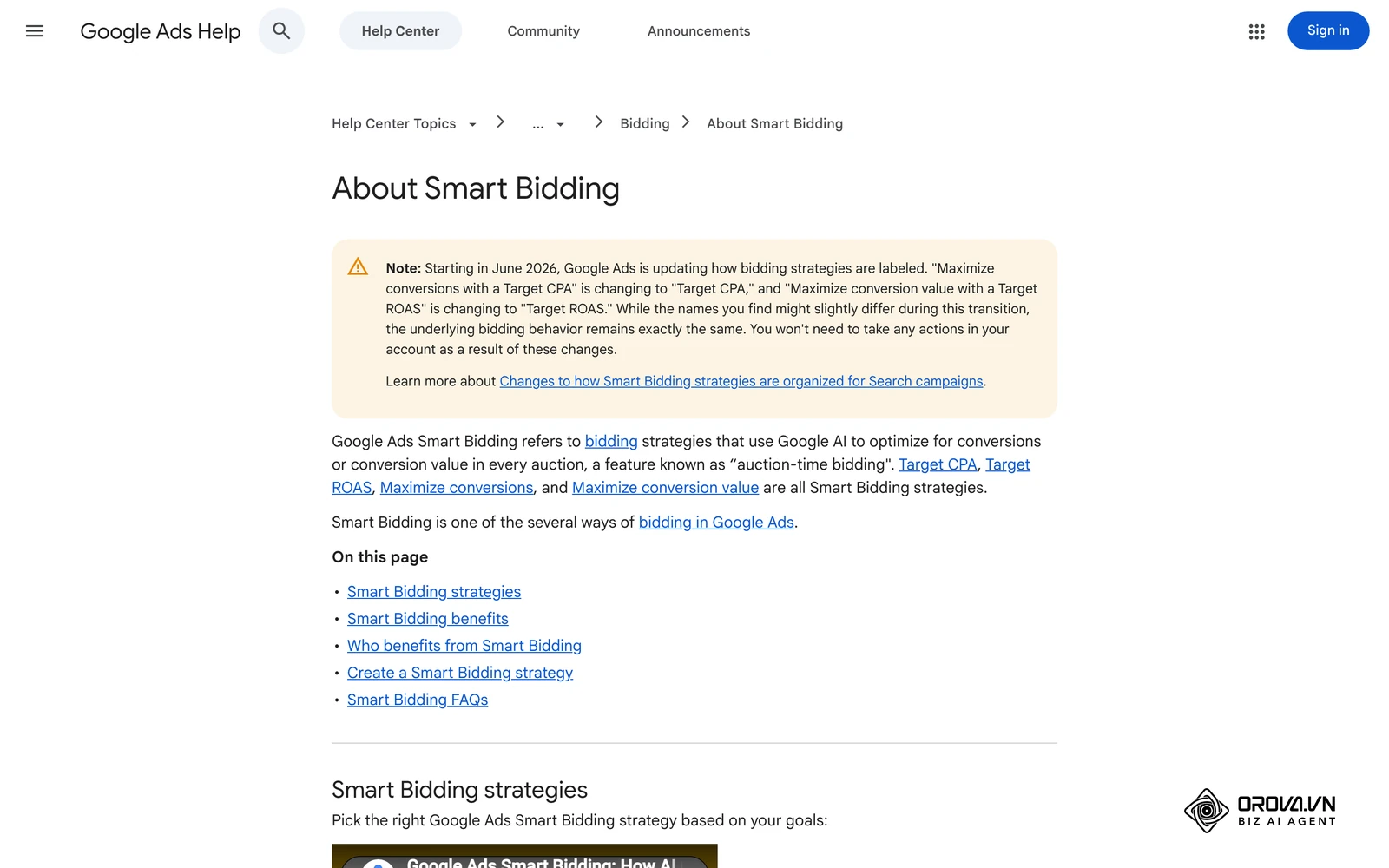
2.1. The Superiority of Smart Bidding
Smart Bidding is Google's suite of AI-driven bid strategies: Target CPA (Cost Per Acquisition), Target ROAS, Maximize Conversions, and Maximize Conversion Value.
Unlike manual bidding, Smart Bidding evaluates "auction-time signals." In the milliseconds between a user typing a search query and the search results loading, Google's AI analyzes:
- The user's exact physical location (down to the neighborhood).
- The device being used and the operating system.
- Historical search behavior and browsing history.
- Time of day, day of the week, and even local weather patterns.
The AI calculates the probability of that specific user converting and adjusts the bid accordingly. A human media buyer cannot make these calculations.
2.2. Performance Max (PMax): The Ultimate AI Campaign
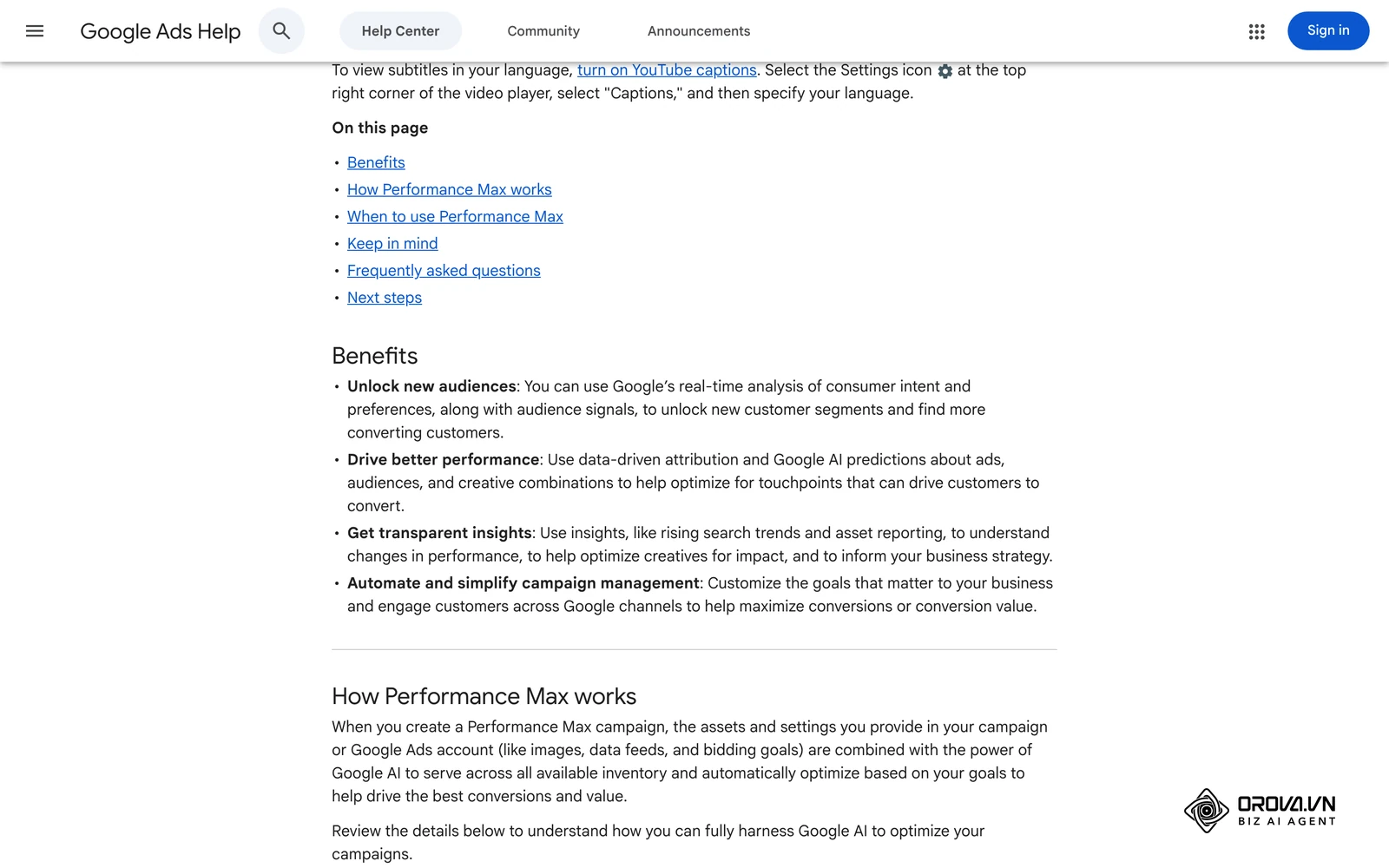
Performance Max is the truest expression of native AI ads on Google. It represents a fundamental shift in control. Instead of building isolated Search, Display, and YouTube campaigns, advertisers provide Google with "Assets":
- Text (Headlines, Descriptions).
- Images (Lifestyle, Product shots).
- Video (Short-form, Long-form).
- Data Signals (Customer lists, custom intent segments).
The PMax AI engine dynamically combines these assets, creating custom ad variations on the fly, and serves them across Google's entire inventory (Search, Display, Discover, Maps, Gmail, YouTube) to find conversions at the lowest possible cost.
2.3. The Problem with PMax: The "Black Box" Dilemma
While PMax is incredibly powerful, it is a notoriously opaque system. Google provides very little data on which specific search terms triggered your ads or which placements drove the most revenue.
This "black box" approach often leads to the AI cannibalizing your brand search terms (taking credit for customers who were already searching for your company name) or wasting budget on low-quality mobile app placements.
To succeed with Google AI ads, you must use negative keyword lists, brand exclusions, and account-level safeguards. This is where external AI management tools become strictly necessary to keep Google's native AI in check.
Chapter 3: Meta’s AI Renaissance (Facebook & Instagram)
If Google's AI captures intent, Meta's AI generates demand. Following the massive data loss of 2021, Meta re-architected its entire ad delivery system around artificial intelligence.
3.1. Advantage+ Shopping Campaigns (ASC)
Advantage+ is Meta's answer to PMax. ASC completely eliminates the need for manual audience targeting. You no longer tell Facebook, "Target women, aged 25-34, who like skincare and Vogue magazine."
Instead, you upload your best creatives, input your budget, and launch. The Meta AI uses its vast probabilistic models to find your buyers.
How it works: The AI analyzes the pixels, text, and audio in your video creative. It understands that a video featuring a hydrating serum appeals to dry-skin sufferers. It then tests the ad on a broad audience, watches who stops scrolling (Hook Rate), who watches for 3 seconds (Hold Rate), and who clicks. It uses those micro-interactions to build a real-time, dynamic target audience. Your creative is the targeting.
3.2. Battling Ad Fatigue with Dynamic Optimization
The lifeblood of Meta ads is creative testing. Because users scroll through feeds rapidly, ad creatives experience "fatigue" quickly. An ad that generates a $15 CPA on Monday might degrade to a $45 CPA by Friday as frequency increases.
AI ad systems are crucial for monitoring this fatigue. By analyzing real-time metrics, AI can predict when an ad is about to burn out. It can automatically shift budget away from the decaying ad and reallocate it to a fresh "challenger" ad, maintaining a stable blended CPA across the account.
Chapter 4: TikTok Ads and the Velocity of Short-Form Video
TikTok is the most volatile and fast-paced advertising platform in existence. The TikTok algorithm favors native, user-generated-style content, and trends move at breakneck speed.
4.1. The Micro-Fluctuation Problem
Because TikTok users consume content so rapidly, ad performance fluctuates wildly hour by hour. A campaign might look highly profitable in the morning, prompting a media buyer to scale the budget. But by mid-afternoon, the CPM (Cost Per Mille) might quadruple due to auction density, turning that profitable campaign into a massive loss.
4.2. Algorithmic Scaling and Automated Kill Switches
Human reaction time is too slow for TikTok. AI ads on TikTok require real-time monitoring systems. If a TikTok ad hits the algorithmic "For You Page" lottery and starts pulling in incredibly cheap conversions, an AI management system will instantly detect the anomaly and increase the budget or duplicate the ad group to force scale before the trend dies. Conversely, if a campaign's CPA spikes above the acceptable threshold, the AI executes an automated "kill switch," pausing the ad instantly to protect the budget.
Chapter 5: The Multi-Channel Nightmare and the Data Silo Crisis
We have established that Google, Meta, and TikTok all possess incredible native AI. However, this creates the ultimate paradox of modern marketing: When every platform uses its own AI to claim credit for a sale, who is actually telling the truth?
Welcome to the Data Silo Crisis.
5.1. The "Trillion Dashboards" Inefficiency
Consider a typical mid-sized e-commerce brand or B2B SaaS company. They are running Google Search for high-intent capture, Meta ASC for demand generation, and TikTok for top-of-funnel brand awareness.
Every morning, the marketing team must log into three distinct Ads Managers. They must download three separate CSV reports, clean the data, normalize the metrics, and stitch them together in a master spreadsheet. This administrative bloat wastes countless hours that should be spent on creative strategy.
5.2. The Attribution War
If a user sees your ad on TikTok, clicks an ad on Facebook two days later, and finally searches for your brand on Google to make a purchase, what happens?
- TikTok takes credit for the view-through conversion.
- Facebook claims the click-through conversion.
- Google claims the search conversion.
Your ad platform dashboards will report three sales, but your Shopify or Stripe account will only show one. This overlapping attribution causes native platform AIs to over-report ROAS, leading businesses to dangerously overspend based on inflated numbers.
5.3. Disconnected Execution
Because the platforms don't communicate, optimizing them requires disconnected, manual execution. If you have a total monthly budget of $100,000, and Meta is currently outperforming Google, a human must manually log into Google, decrease the daily budgets, log into Meta, and increase the daily budgets.
To survive in 2026, businesses need a layer of intelligence that sits above the individual platforms. They need an omnichannel AI.
OROVA ADS applies AI Agent to automate and optimize ad performance on Google, Meta and TikTok. Scale your budget safely, monitor 24/7 and expand your business quickly.
Experience the solution at orova.vn/ads
Chapter 6: Orova Ads — The Autonomous AI Media Buyer
The industry's demand for centralized, automated media buying has led to the development of autonomous AI agents. Leading this charge is Orova Ads—a comprehensive AI media buyer designed to unify, analyze, and execute campaigns across Google, Meta, and TikTok.
Orova Ads is not a simple reporting dashboard; it is an active participant in your marketing workflow. The core premise is simple: Orova consolidates Google Ads (including PMax), Facebook/Instagram, and TikTok into one board, audits your metrics on a schedule, sends data-backed optimization proposals, and upon your approval, executes the actions directly on the native platforms.
Here is a deep technical breakdown of how Orova Ads solves the multi-channel AI advertising crisis:
6.1. One Unified Command Center
The foundation of Orova is its centralized architecture.
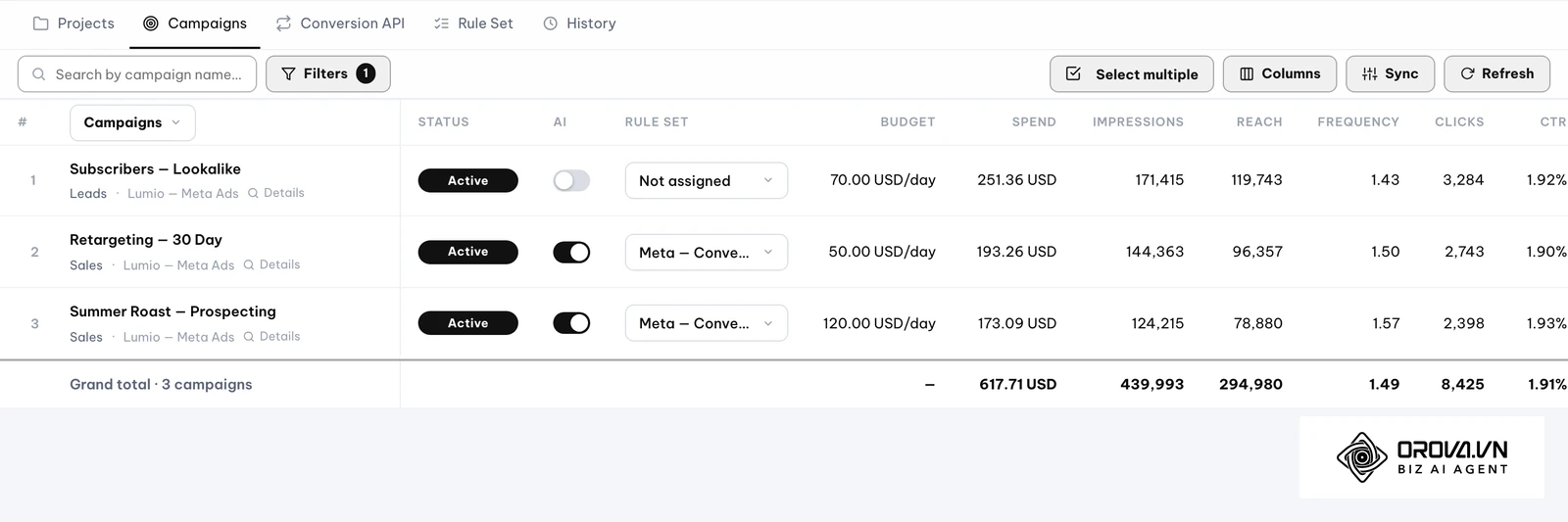
- Normalized Cross-Platform Data: Campaigns from Google, Meta, and TikTok are mapped onto a single, cohesive dashboard. Metrics are translated into a universal language.
- Pre-Configured Essential Columns: The interface is stripped of vanity metrics and pre-loaded with the data that drives business decisions: ROAS, CPA, CTR, CPM, Spend, Impressions, and Conversions.
- Deep Drill-Downs: You can seamlessly navigate from the macro Campaign level down to Ad Sets/Ad Groups, and finally to individual Creatives and Ad variants, regardless of the originating platform.
- Frictionless TikTok Integration: The moment a TikTok Ads account is connected to the workspace, the TikTok data tab populates automatically, requiring zero manual configuration.
6.2. Bank-Grade Security (No Password Sharing)
Historically, agencies and third-party tools required users to hand over their master passwords or add arbitrary emails to their Business Managers. Orova eliminates this security flaw.
- Official OAuth Integration: Users log in natively through the official API portals of Google, Meta, and TikTok.
- Read/Write Consent: Orova is granted secure, tokenized access strictly to the accounts you select. You retain ultimate sovereignty and can revoke API access at any time directly from your ad platform settings.
6.3. The Scheduled AI Advisor (Always On, Never Tired)
Orova acts as a senior media buyer relentlessly auditing your accounts based on parameters you control.
- Custom Audit Cadence: You dictate the schedule. The AI can audit your accounts immediately after every data sync, at specific hourly intervals, or on designated days and times (e.g., every Monday at 8:00 AM).
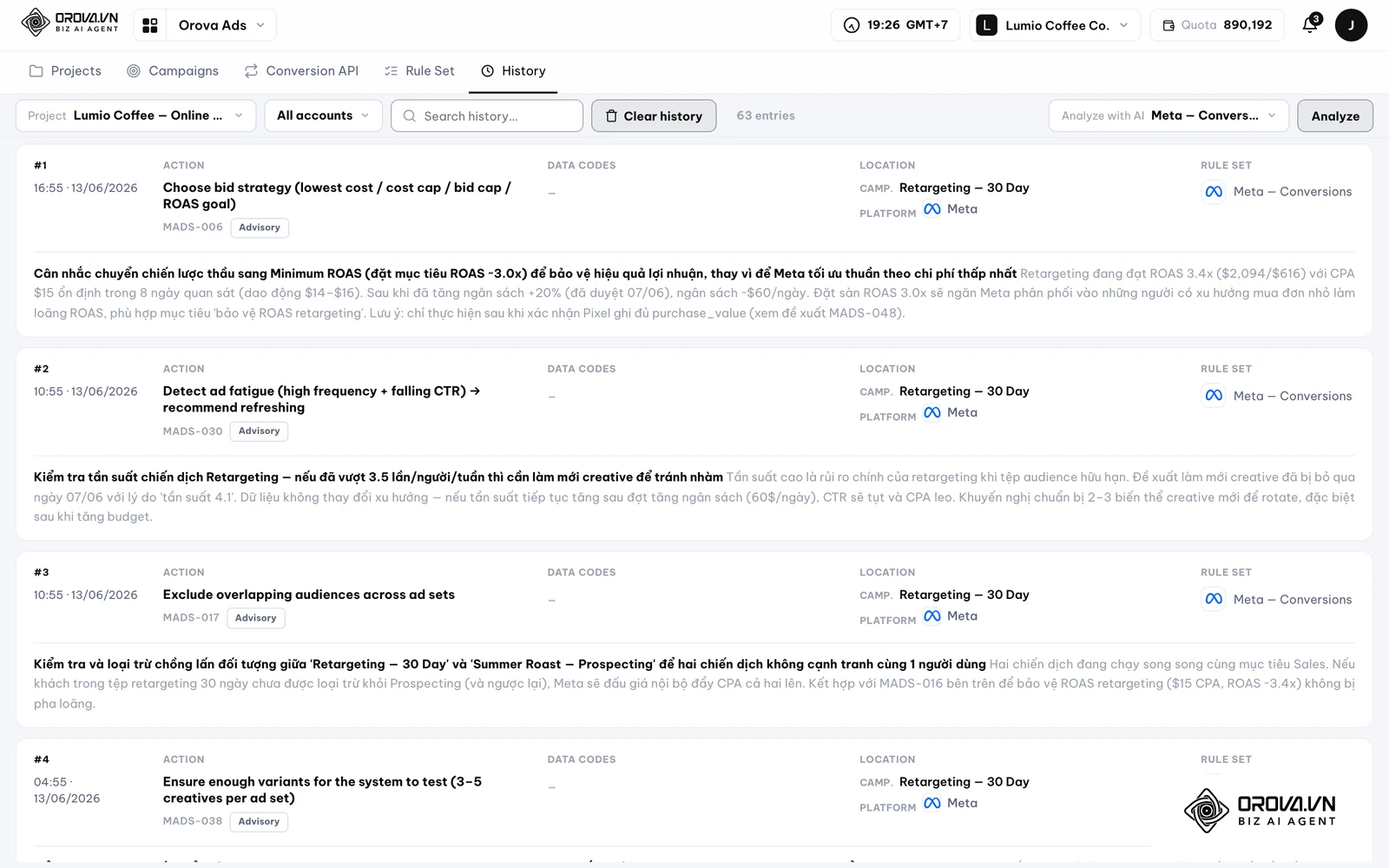
- Contextual Proposals with Hard Evidence: When the AI finds an inefficiency or an opportunity for scale, it doesn't just issue a generic alert. It generates a detailed proposal detailing what to change, which specific campaign is affected, and why the change is necessary, citing the exact historical metrics that justify the decision.
- Smart Proposal Queue: Proposals remain in your dashboard until you explicitly Approve them, Reject them, or until they naturally expire due to shifting market conditions. Furthermore, the AI actively deduplicates alerts; if an issue persists, it merges the data into the existing proposal rather than spamming your feed with new rows.
- Self-Healing Mechanisms: If an API analysis fails due to network latency, the AI automatically retries three times. If it still fails, it flags the issue with a clear red alert on the Proposal page, ensuring total transparency.
6.4. A Library of 200+ Built-In Optimization Actions
Orova is pre-loaded with an immense library of over 200 battle-tested optimization actions. These are not theoretical concepts; they are hard-coded, API-verified actions that run natively on live accounts (currently supporting 47 out of 49 core Google actions, and extensive Meta campaign editing).
These actions cover every aspect of media buying:
- Pacing budgets up or down based on ROAS thresholds.
- Adjusting micro-bids.
- Toggling Campaigns, Ad Sets, or individual Ads on/off.
- Modifying audience targeting and applying exclusions.
- Injecting negative keywords to protect PMax and Search campaigns.
- Technical Alerts: Flagging campaigns where the destination Landing Page is loading too slowly or exhibiting abnormally high bounce rates.
6.5. Three Tiers of AI Autonomy
Every business has a different risk tolerance. Therefore, every single action within Orova can be independently assigned one of three operational modes:
- Advisor Mode: The AI acts strictly as a consultant. It analyzes the data and proposes a change, but takes no action until a human clicks "Approve."
- Hybrid Mode: The AI operates autonomously for low-risk, repetitive tasks (like pausing ads with zero clicks after $50 spend or adding known spam terms to negative keyword lists), but requires human approval for high-stakes decisions like budget scaling.
- Auto Mode: Full delegation. The AI analyzes, decides, and executes instantly based on your predefined constraints.
The Hard Safety Nets: Orova is programmed with immutable laws to protect your brand. It will never automatically add your own brand name as a negative keyword, and it will never turn on a campaign or keyword that a human has intentionally paused.
6.6. Frictionless Execution via Native API
The true power of AI ads is closing the loop between analysis and execution.
- One-Click Deployment: By default, Orova operates as an Advisor. When you review a proposal and click "Approve," the system instantly fires an API call to Google, Meta, or TikTok, executing the change live. You never have to open the clunky native Ads Managers.
- Scheduled Execution: You can approve a proposal today but schedule it to execute later. For example, you can approve a massive budget increase but set it to trigger exactly at 12:00 AM on Black Friday.
6.7. Custom Rules & Natural Language Training
Orova allows you to train the AI to understand the specific unit economics of your business.
- Business Context: You input your industry, your target Customer Acquisition Cost (CPA), your break-even ROAS, and your risk profile.
- Natural Language Rules: You can build sophisticated automation logic using plain English. (e.g., "If an ad spends 3x our target CPA and has zero conversions, pause it immediately and notify me.")
- Custom AI Assistants: Agencies can utilize default "Base Assistants" for standard optimizations, or build bespoke "Project Assistants" tailored to the specific Standard Operating Procedures (SOPs) of individual clients.
6.8. Conversational AI Chat Interface
Moving beyond static dashboards, Orova features an interactive AI assistant intimately connected to your live ad data.
- Real-Time Data Interrogation: You can ask the AI, "Why did our Meta CPA double yesterday?" The AI will parse the account data and reply with specific insights, such as, "Your CPM on the 'Summer Sale' ad set increased by 45%, while the CTR dropped by 1.2%."
- Command-Based Planning: You can give strategic directives in natural language: "We have a $50,000 budget for this month. Divide it optimally across Google and Meta based on last month's performance." The AI will instantly generate a granular, mathematically sound execution plan, draft the specific budget adjustments, and place them in your Proposal queue for one-click approval.
6.9. The Conversions API (CAPI) & Audience Webhook
AI algorithms require pristine data to function. Because browser pixels are increasingly blocked by Safari and ad-blockers, server-side tracking is mandatory. Orova solves this seamlessly.
- Dedicated Webhooks: Every workspace is equipped with a secure, dedicated webhook protected by Layer-2 encryption keys.
- Server-Side Tracking (CAPI): When a legitimate lead or sale occurs in your CRM or on your landing page, that data is pushed to the Orova webhook. Orova cryptographically hashes the customer data (to ensure strict privacy compliance) and pushes it back into Meta via the Conversions API. This feeds the Meta AI the high-quality signal it needs to find more buyers.
- Automated Custom Audiences: Simultaneously, Orova can route this customer data into pre-selected Custom Audiences for retargeting or exclusion.
Note on Security: Orova will never auto-generate rogue pixels or audiences. It only routes data to the specific, existing Pixel IDs and Audience IDs you authorize.
6.10. Complete Audit Transparency
Handing the keys to an AI can be daunting. Orova ensures absolute accountability.
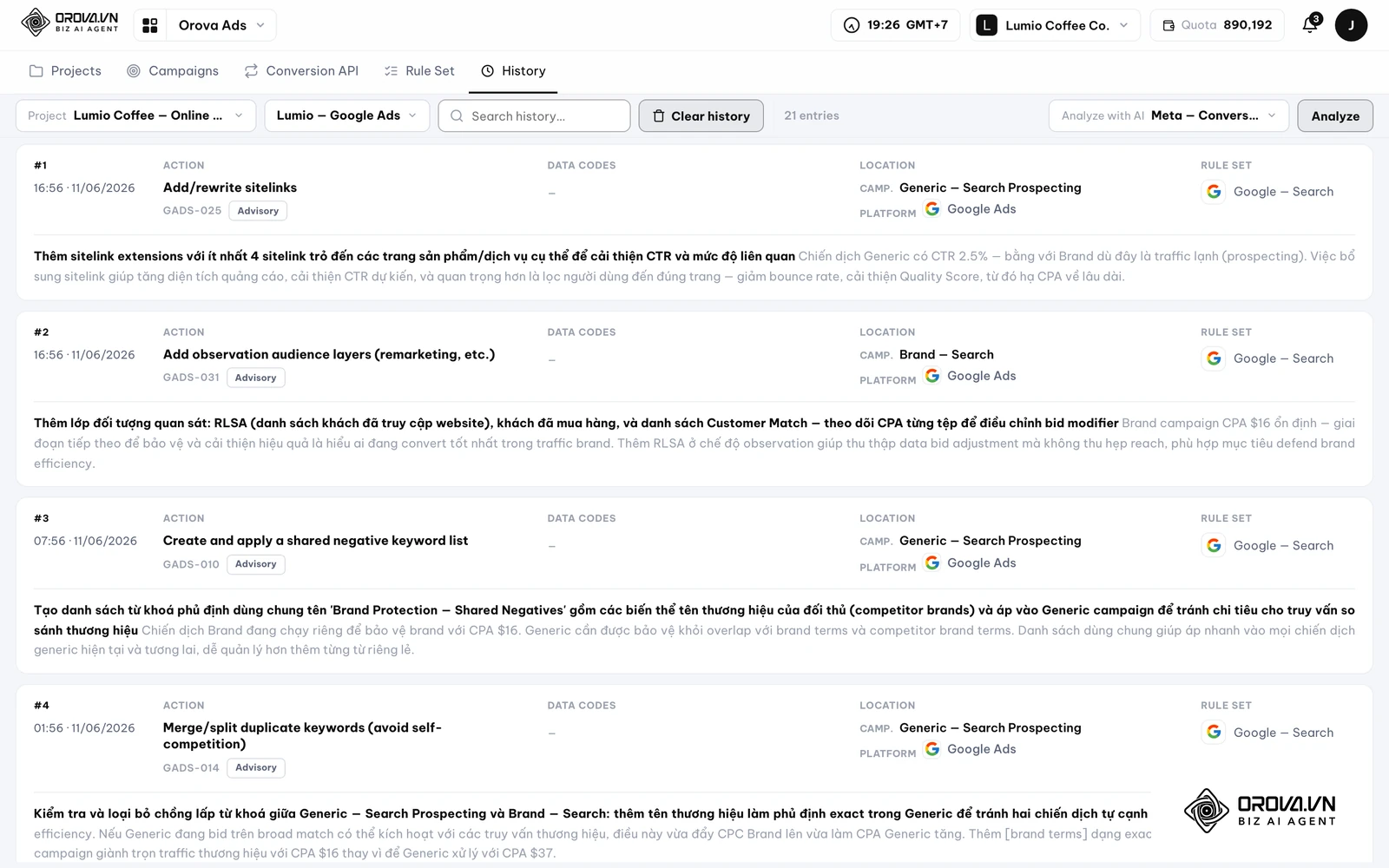
Every single proposal generated, every user who clicked "Approve," the exact timestamp of the API execution, and the success/failure response from the ad platform are permanently logged in a transparent history trail. If a mistake happens, you know exactly how and when it occurred.
6.11. Fair, Quota-Based Pricing
The SaaS advertising industry is notorious for predatory pricing models, often taking a percentage of your total ad spend (which punishes you for scaling) or locking basic features behind exorbitant monthly retainers.
Orova operates on a hyper-transparent Quota System. Each time the AI performs a deep account analysis or executes an action via API, a small fraction of a quota is deducted. You pay strictly for the computational power you consume.
There are no mandatory monthly subscriptions, no percentages taken from your ad budget, and no paywalled features.
To ensure zero friction, new accounts are granted 1,000 free quotas to experience the full power of the AI media buyer, with no credit card required upfront.
Want to scale your budget but afraid of breaking performance? 📉
Integrate OROVA ADS now - an AI Agent that automatically monitors and optimizes Google, Meta, TikTok ads 24/7. Now, expanding and replicating your Performance Ads team is just one click away.
🚀 Try it now at: orova.vn/ads
Boundary Setting: What Orova Ads Does NOT Do
A reliable AI must know its operational boundaries. Orova operates on a strict "Three No's" policy:
- No Landing Page Creation: Orova is a master of traffic acquisition and bid optimization. It does not build websites, write blog posts, or design landing pages.
- No Rogue Spending: The AI will never autonomously launch a brand new campaign and start spending your money without explicit human authorization and predefined budget caps.
- No Brand Strategy Hijacking: The AI is brilliant at finding the cheapest conversions, but it cannot dictate your Unique Selling Proposition (USP) or decide which products you should manufacture. Human creativity and business acumen remain the core drivers of success.
Chapter 7: The Future Workflow of the AI-Enhanced Marketing Team
If an AI media buyer like Orova Ads is handling the bidding, pausing, scaling, and reporting, what exactly does the human marketing team do in 2026?
The introduction of AI ads does not eliminate the marketing department; it elevates it. Teams transition from being "button-pushers" to being "growth architects."
7.1. The Shift to Creative Strategy
Because platforms like Meta and TikTok now use the ad creative itself as the primary targeting mechanism, the highest leverage activity for a marketing team is creative production.
Media buyers transition into "Creative Strategists." They spend their time analyzing the psychology of the consumer, scripting better video hooks, designing thumb-stopping graphics, and analyzing the emotional resonance of the content.
7.2. Deep Data Science and Offer Engineering
With the day-to-day optimization automated, human teams can focus on macro-level business economics.
- Predictive LTV (Lifetime Value): Analyzing which AI-driven campaigns are acquiring customers who make second and third purchases, rather than just focusing on the initial Cost Per Acquisition.
- Offer Optimization: Restructuring pricing tiers, bundling products, and creating compelling promotional offers that the AI can then distribute efficiently.
7.3. Funnel and Conversion Rate Optimization (CRO)
An AI can drive perfectly targeted traffic to your website at a $1.00 Cost Per Click, but if your website has a broken checkout process, the ROAS will be zero. Marketing teams must redirect their focus to the post-click experience: optimizing page load speeds, refining landing page copy, and building seamless email/SMS backend funnels.
Chapter 8: Frequently Asked Questions (FAQ) on AI Advertising
1. Won't the ad platforms penalize me for using a third-party AI tool to manage my accounts?
Absolutely not. Platforms like Orova Ads utilize the official, public APIs provided by Google, Meta, and TikTok. These APIs are explicitly built by the platforms to encourage developers to create advanced management tools. It is 100% compliant and vastly superior to using unauthorized browser extensions or sharing login credentials.
2. Is an AI media buyer only beneficial for enterprise companies spending millions of dollars?
The exact opposite is true. While enterprise companies use AI for sheer scale, small-to-medium businesses (SMBs) benefit immensely because they cannot afford to hire full-time senior media buyers. Furthermore, because Orova utilizes a pay-per-usage quota model rather than a percentage of ad spend, SMBs can access enterprise-grade AI optimization at a fraction of the cost. When budgets are tight, every single dollar must be optimized perfectly—which is exactly what the AI does.
3. I am not a developer or a data scientist. Is setting up AI ads too complicated?
Modern AI tools are built with user-friendly, no-code interfaces. With tools like Orova, you log in using your standard Google or Facebook accounts. The conversational AI chat feature allows you to literally type, "Tell me why my campaign is failing," and the AI will translate complex data science into plain, understandable English. If you can read an email, you can operate an AI media buyer.
4. How does the system protect consumer privacy while using the Conversions API (CAPI)?
Privacy is the cornerstone of modern tracking. When customer data (like an email address from a purchase) is sent through the Orova webhook, it undergoes cryptographic hashing (typically SHA-256) before it ever leaves your server. The ad platforms receive a randomized string of characters that they can match against their own hashed databases, allowing for precise attribution without ever exposing raw, readable consumer data.
5. What happens if the AI makes a mistake and scales a losing campaign?
This is why the "Advisor" and "Hybrid" modes exist. You are not forced to hand over total control on day one. You can configure the AI to only suggest budget increases, requiring your manual click to approve them. Furthermore, you can set hard guardrails (e.g., "Never increase daily budget above $500, regardless of performance"). The AI operates strictly within the financial boundaries you define.
Conclusion: Adapt or Become Obsolete
The transition to AI ads is not a passing trend; it is a permanent infrastructural shift in how digital commerce operates. The sheer volume of data signals required to win an ad auction in 2026 vastly exceeds human cognitive capacity.
Agencies and brands that insist on manually adjusting bids, building isolated silos for Google, Meta, and TikTok, and fighting over attribution spreadsheets will inevitably be out-scaled by competitors utilizing autonomous systems.
By integrating an AI media buyer like Orova Ads, you eliminate the operational bottlenecks of digital marketing. You unite your fragmented data into a single source of truth, automate the tedious execution of daily optimizations, and deploy a relentless, 24/7 advisor that actively protects and scales your budgets. The future of advertising belongs to those who allow the machines to do the math, freeing the human mind to do what it does best: create, strategize, and grow.
Run your business with AI Agents
Orova is the always-on Biz AI Agent — it plans, runs, and optimizes the work for you.
Save time, unlock productivity.