
What is new hire training? A practical guide to ROI, AI prompts and PIPs

New hire training is the structured process that takes a recently hired employee from day one to doing the job well on their own: the role-specific skills, tools and company context they need, taught in a deliberate order and checked along the way.
Imagine hiring a brilliant software engineer, paying a premium salary, and then watching them struggle for six weeks simply because no one documented how to access the staging server or interpret the internal codebase architecture. They spend hours reverse-engineering processes that a simple, structured learning path could have explained in twenty minutes. This scenario plays out daily in companies worldwide. The initial excitement of a new job quickly deteriorates into frustration and imposter syndrome, ultimately leading to early turnover.
The core issue is that many organizations confuse filling out HR paperwork and setting up a Slack account with actual job readiness. True integration requires a deliberate, meticulously engineered system designed to transfer knowledge rapidly and effectively. This guide will dismantle the outdated approaches to new hire training, providing you with AI-driven frameworks, concrete mathematical models to prove your return on investment, and actionable strategies to handle the inevitable challenges of bringing someone new up to speed.
What is New Hire Training?
New hire training is the structured educational process of integrating a recently employed individual into an organization, equipping them with the specific technical skills, practical knowledge, and company context required to perform their daily job effectively. It bridges the critical gap between general HR orientation and full independent role productivity.
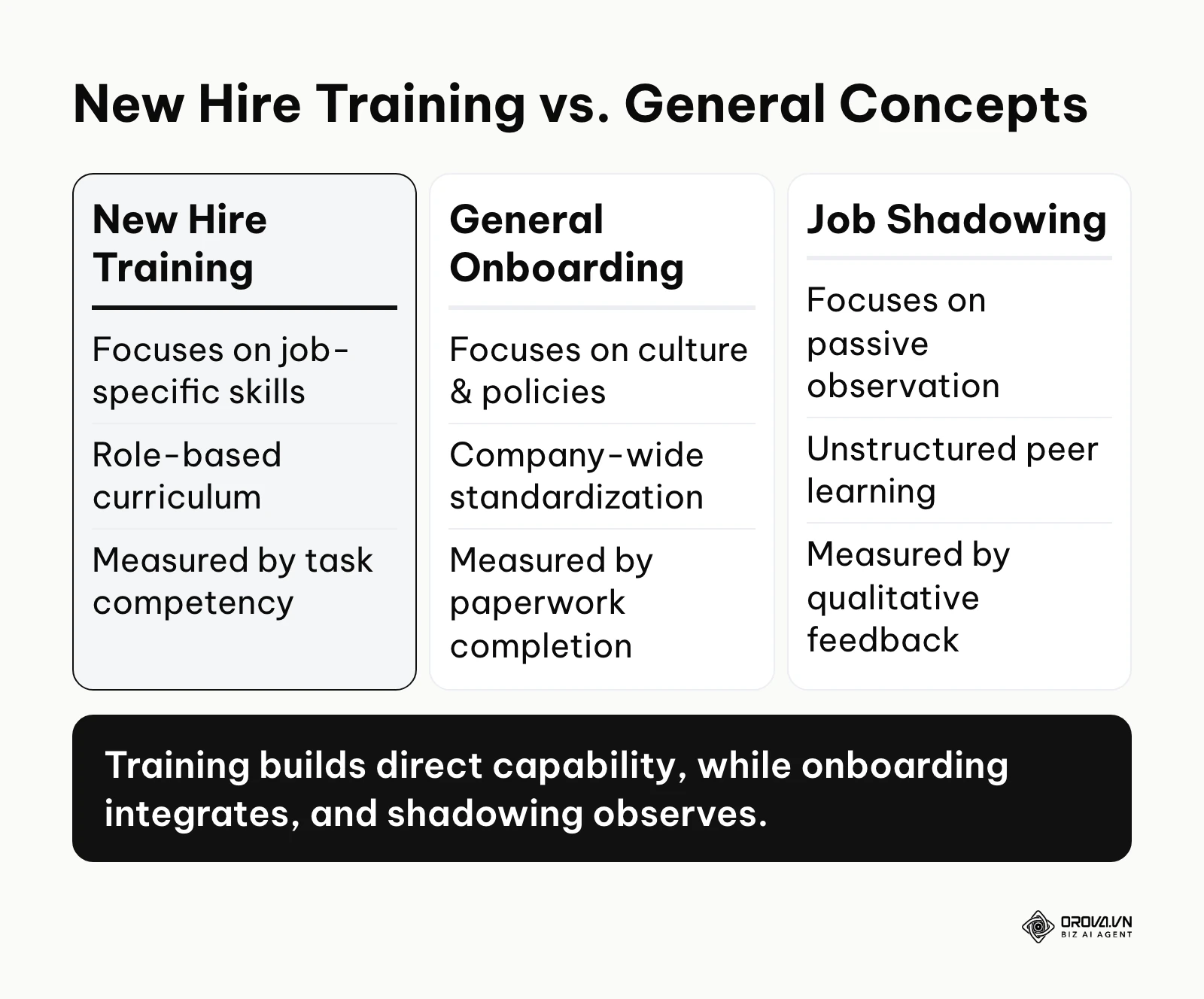
Historically, this concept evolved from the industrial era's apprenticeship models, where workers learned by prolonged observation. Today, the focus has shifted toward rapid, scalable knowledge transfer driven by specialized software and cognitive learning theories. It is crucial to distinguish this intensive process from other related terms that are frequently used interchangeably but serve entirely different functions.
| Concept | Key Differences | Practical Example |
|---|---|---|
| New Hire Training | Focuses on acquiring role-specific competencies and measurable skills required for daily tasks. | A sales rep learning how to use the CRM software and memorize the product pricing matrix. |
| Orientation / Onboarding | Focuses on administrative compliance, cultural assimilation, and broad company policies. | An employee signing tax forms, receiving their laptop, and reading the sexual harassment policy. |
| Job Shadowing | Focuses on passive observation of a veteran employee without necessarily executing the tasks independently. | A junior designer sitting next to a senior designer for a day to watch how they manage client feedback. |
Example scenario: Think of learning to drive. General onboarding is reading the traffic law manual and getting your permit. New hire training is getting behind the wheel with an instructor who teaches you how to parallel park step-by-step and grades your execution.
The Purpose of New Hire Training
New hire training exists to solve a fundamental business problem: the "time-to-productivity" gap. Whenever a company makes a hire, they are making a negative financial investment initially. The employee is drawing a salary while producing less value than they cost. The singular purpose of a training program is to compress this unprofitable period as aggressively as possible without burning the employee out.
In the broader organizational ecosystem, this process sits squarely between talent acquisition and long-term performance management. Once you attract candidates using a robust applicant tracking software, the next critical phase is ensuring they don't leave within the first quarter out of frustration. HR practitioners widely agree that a structured onboarding process helps people stay. If you skip this structured education, you rely entirely on the new hire's ability to self-teach, which inherently leads to inconsistent execution, severe compliance risks, and a culture of disjointed workflows where every employee performs the same task differently.
When not to use new hire training: While comprehensive new hire training is generally crucial, there are specific scenarios where deploying a full-scale program is unnecessary or premature. For instance, when hiring senior C-level executives, their primary need is strategic alignment and cultural integration, not functional skills training; putting them through a standard module wastes their valuable time. Similarly, for short-term freelance contractors hired for a singular, highly specialized task (like a one-off website redesign), deep company training is an inefficient use of resources. In these cases, a brief context-setting meeting or a simple project handover document is sufficient.
The Value and Benefits of New Hire Training
A well-architected program delivers massive value, split distinctly between the overarching organizational benefits and the psychological advantages for the individual worker.
Value for the Business: Financial and Operational
The most pressing value for any business is financial. Unstructured learning is incredibly expensive because it steals time from veteran employees who are forced to answer repetitive questions. By systematizing the knowledge, companies reduce the error rates of new staff, minimize the risk of costly compliance violations, and directly lower the churn rate.
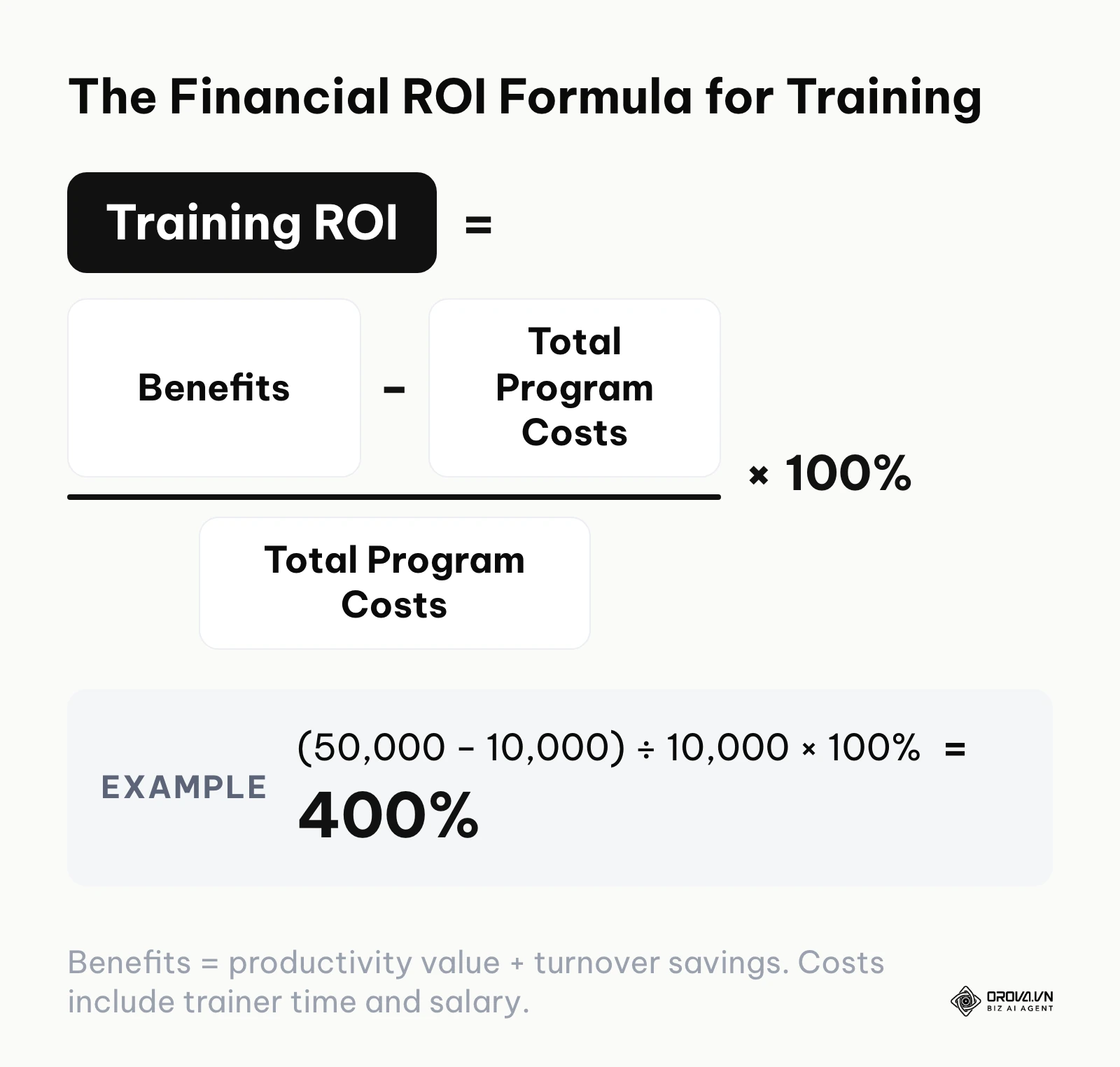
To accurately measure the financial impact (ROI) of a new hire training program, you cannot rely on vanity metrics like "course completion rates." You must calculate the hard financial data. The core formula requires understanding your Total Program Costs, which includes not just software licenses, but the hourly rate of the trainers and the salary of the new hire during the hours they are studying instead of producing. You then weigh this against the financial value of them reaching full productivity weeks earlier than they would have otherwise, plus the saved costs of not having to re-hire if they had quit. The formula is: Training ROI = (Benefits − Total Program Costs) ÷ Total Program Costs × 100%, where Benefits = productivity value + turnover savings. For example, a program that costs 10,000 dollars and returns 50,000 dollars in benefits gives (50,000 − 10,000) ÷ 10,000 × 100% = 400%.
Benefits for the Individual: Confidence and Clarity
For the new employee, the benefits are largely psychological but translate directly into performance.
- Before structured training: The employee feels hesitant to make decisions, constantly fears making a critical mistake, and feels like a burden to their peers when asking for help.
- After structured training: The employee possesses a clear roadmap of expectations, understands the boundaries of their autonomy, and has the confidence to execute tasks independently because they have already practiced them in a safe, simulated environment.
| Benefit Category | Measured By Which Metric | Typical Timeframe to See Results |
|---|---|---|
| Speed to Competency | Reduction in days required to reach 100% of standard output quota. | 30 to 60 days post-hire. |
| Error Reduction | Percentage decrease in rework, QA failures, or customer complaints. | 14 to 30 days post-hire. |
| Employee Retention | Increase in the percentage of employees surviving past the 90-day mark. | 90 to 120 days post-hire. |
Illustrative example: A mid-sized logistics firm was struggling with high warehouse error rates among new staff. They digitized their massive, text-heavy operating manual into short daily quizzes and assigned a dedicated floor buddy to each new hire. The initial hurdle was that older workers resisted using the digital tablet interface for the quizzes. Management fixed this by creating large, physical UI overlays that mapped exactly to the screen, simplifying the interaction. The result showed up within a couple of months: warehouse picking errors fell noticeably, and so did the cost of reversing wrong shipments.
Short on time to build training materials? Orova Training uses AI to draft lessons, slide decks, podcasts in 30 voices, narrated videos with subtitles and flashcards. Assign courses to people or groups, track each learner's progress, and block video seeking and downloads so required content actually gets watched.
How New Hire Training Works: A Step-by-Step Blueprint
Building an effective program is not about throwing together a few slide decks; it is an engineering problem. You are designing a system to input a novice and output a competent professional. This process must be broken down into strict, manageable phases.
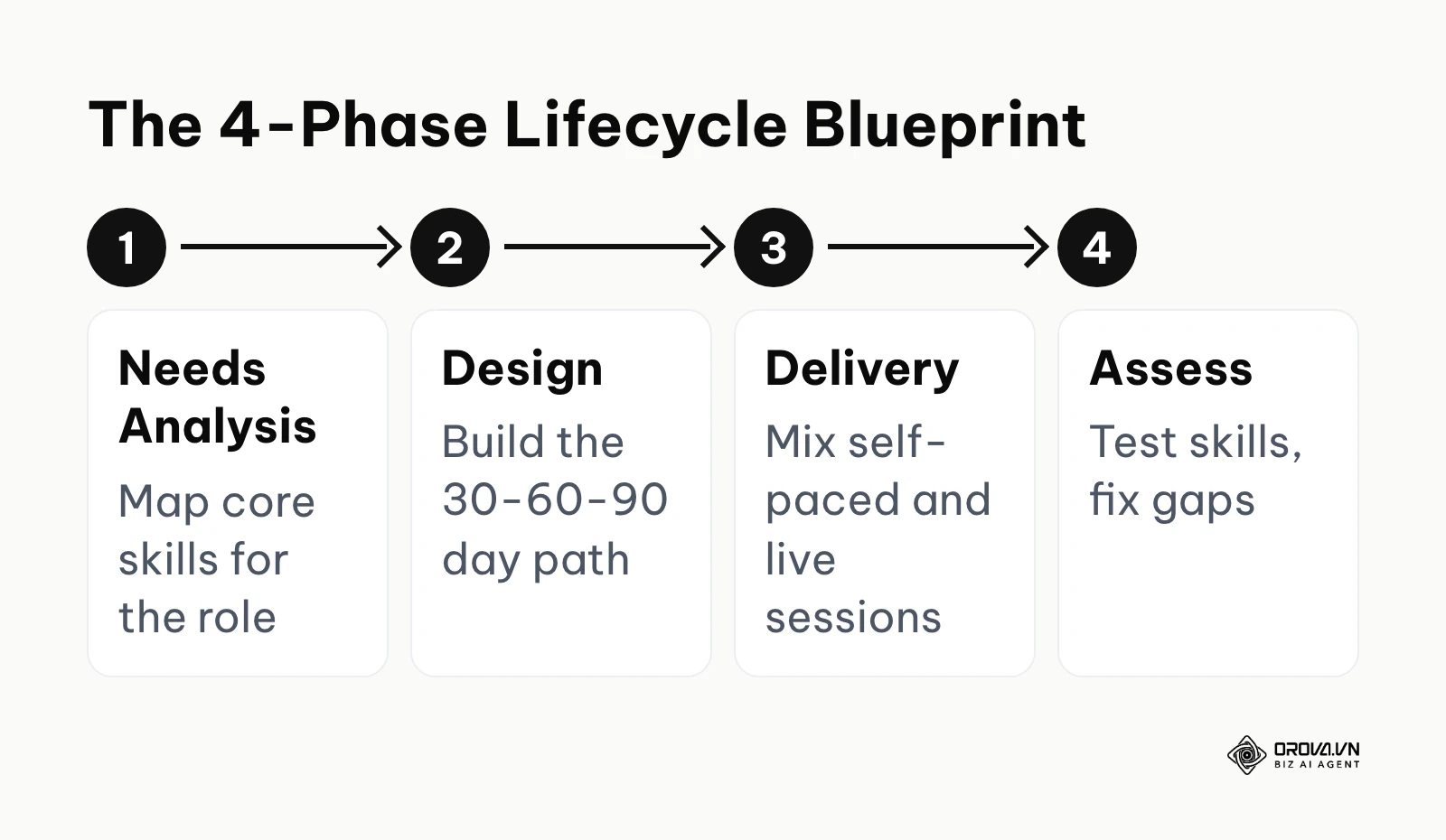
Step 1: Needs Analysis and Role Mapping
Before you write a single word of content, you must define the exact competencies required for the role.
- What to do: Interview the top performers currently in the role. Document their daily workflows, the software they use, and the specific decisions they make. Translate these actions into a list of required skills. For customer-facing roles, include how the company speaks to customers, ideally from a documented brand tone of voice guide.
- Input: Job descriptions, existing standard operating procedures (SOPs), and direct manager interviews.
- Output: A comprehensive competency map detailing exactly what the new hire needs to know by day 30, day 60, and day 90.
- Where it often breaks: HR designs the map without consulting the direct manager, resulting in a curriculum that is theoretically sound but practically useless on the floor.
Step 2: AI-Powered Curriculum Design
This is where the heavy lifting occurs. Instead of spending months drafting documents, modern HR teams leverage AI to generate the foundational curriculum rapidly. However, generic AI outputs are dangerous. You must use highly specific prompts to generate usable assets.
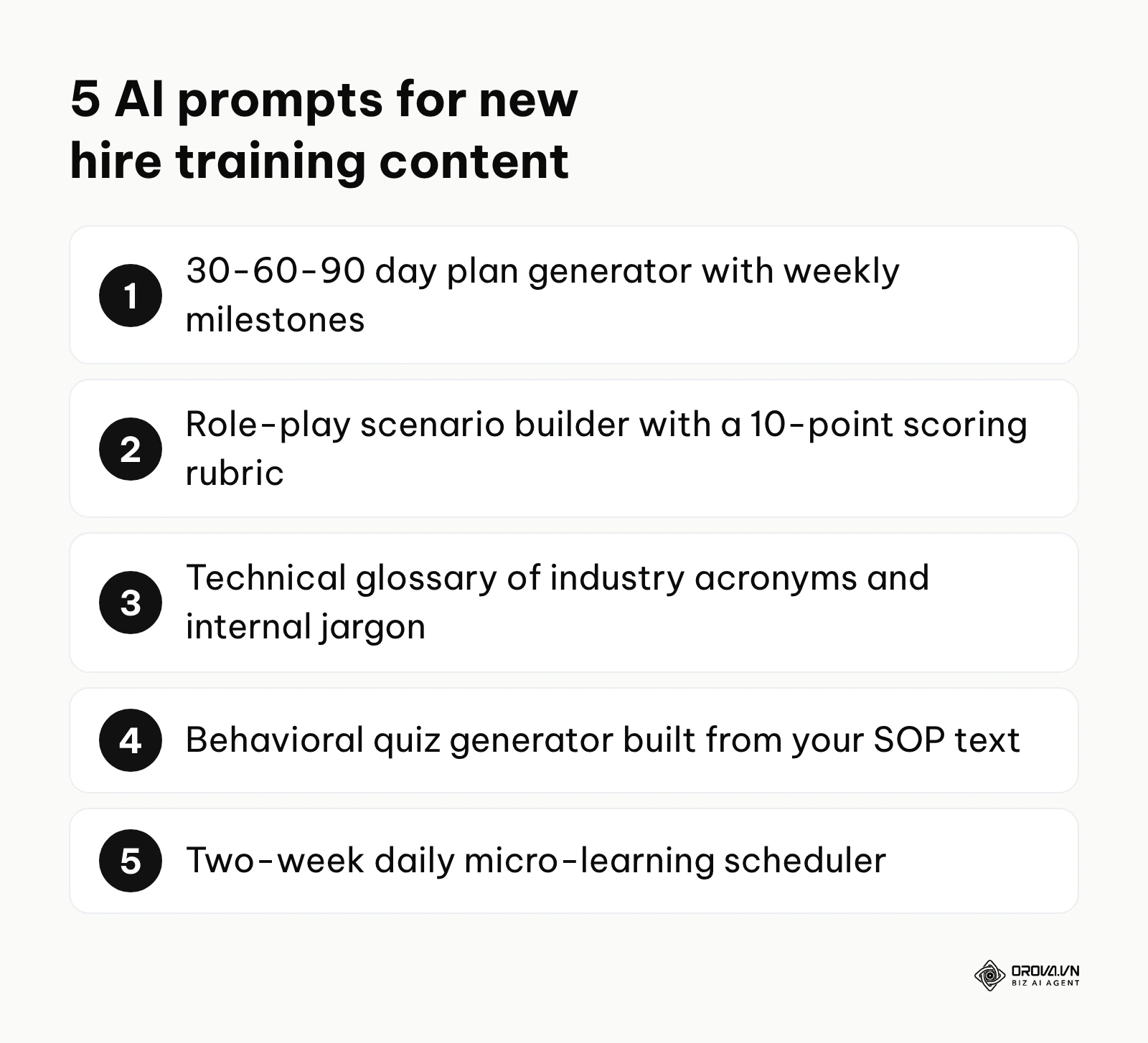
Here are 5 specialized AI prompts you can use immediately to build your assets:
- The 30-60-90 Day Plan Generator: "Act as an expert Instructional Designer. I need a comprehensive 30-60-90 day new hire training plan for a [Job Title] at a [Company Type]. The primary goal is [Specific Business Goal]. Break down the plan into weekly milestones, specifying exact technical skills to master, key internal stakeholders they must meet, and quantifiable metrics for success at each 30-day interval. Output the result in a markdown table."
- The Role-Play Scenario Builder: "Create 3 highly realistic role-play scenarios for a newly hired [Job Title] who is handling [Specific Difficult Situation/Problem]. For each scenario, provide the detailed context, the customer/client's specific emotional persona, the ideal response framework for the employee to use, and a strict scoring rubric out of 10 for the manager to use during the live evaluation."
- The Technical Glossary Creator: "Act as a senior technical trainer. Generate a highly detailed glossary of the top 20 industry-specific acronyms and internal jargon terms a new [Job Title] in the [Industry] sector must know. Explain each term in simple, jargon-free language, provide a real-world conversational example of how it is used in daily office communication, and suggest a cognitive memorization tip for each."
- The Behavioral Quiz Question Generator: "Based on the following standard operating procedure (SOP) text: [Insert Text], generate a 10-question multiple-choice quiz aimed at testing a new hire's practical, situational understanding rather than rote memorization. Ensure the distractors (wrong answers) represent the most common beginner mistakes. Include a detailed answer key with a brief explanation of why the correct answer is right and why the others fail."
- The Daily Micro-Learning Scheduler: "Design a 2-week daily micro-learning schedule for a new [Job Title]. Each day should include a 15-minute specific task, software exploration, or reading assignment focused on [Core Skill]. Structure it so that the concepts build upon each other progressively. Include a quick 2-minute analytical reflection question at the end of each daily assignment to ensure retention."
Step 3: Content Delivery and the Role of LMS
Having the content is useless if the delivery is chaotic. Organizing your training material requires a centralized system. This is where you deploy a dedicated learning management system to host the videos, track progress, and ensure compliance. Standardized content packaging such as SCORM still matters if you want courses to move between systems without being rebuilt.
Illustrative example: A B2B SaaS startup needed to scale its sales team rapidly. They utilized AI to generate complex product feature flashcards, required new reps to submit asynchronous video pitch recordings, and implemented a peer-reviewed scoring system. The initial hurdle was a sluggish feedback loop; senior reps took days to review the videos. The management fixed this by transitioning to a strict, highly specific 10-point grading rubric that allowed reviewers to score a video in under two minutes. The result: new representatives reached their first independent sales quota sooner than the company's previous cohorts.
Step 4: Assessment and The Performance Improvement Plan (PIP)
Training without measurement is just hoping for the best. You must rigorously assess the new hire's competency at specific milestones. But what happens when a new hire continuously fails these assessments after the first 30 days? You cannot simply ignore it or fire them immediately without process.
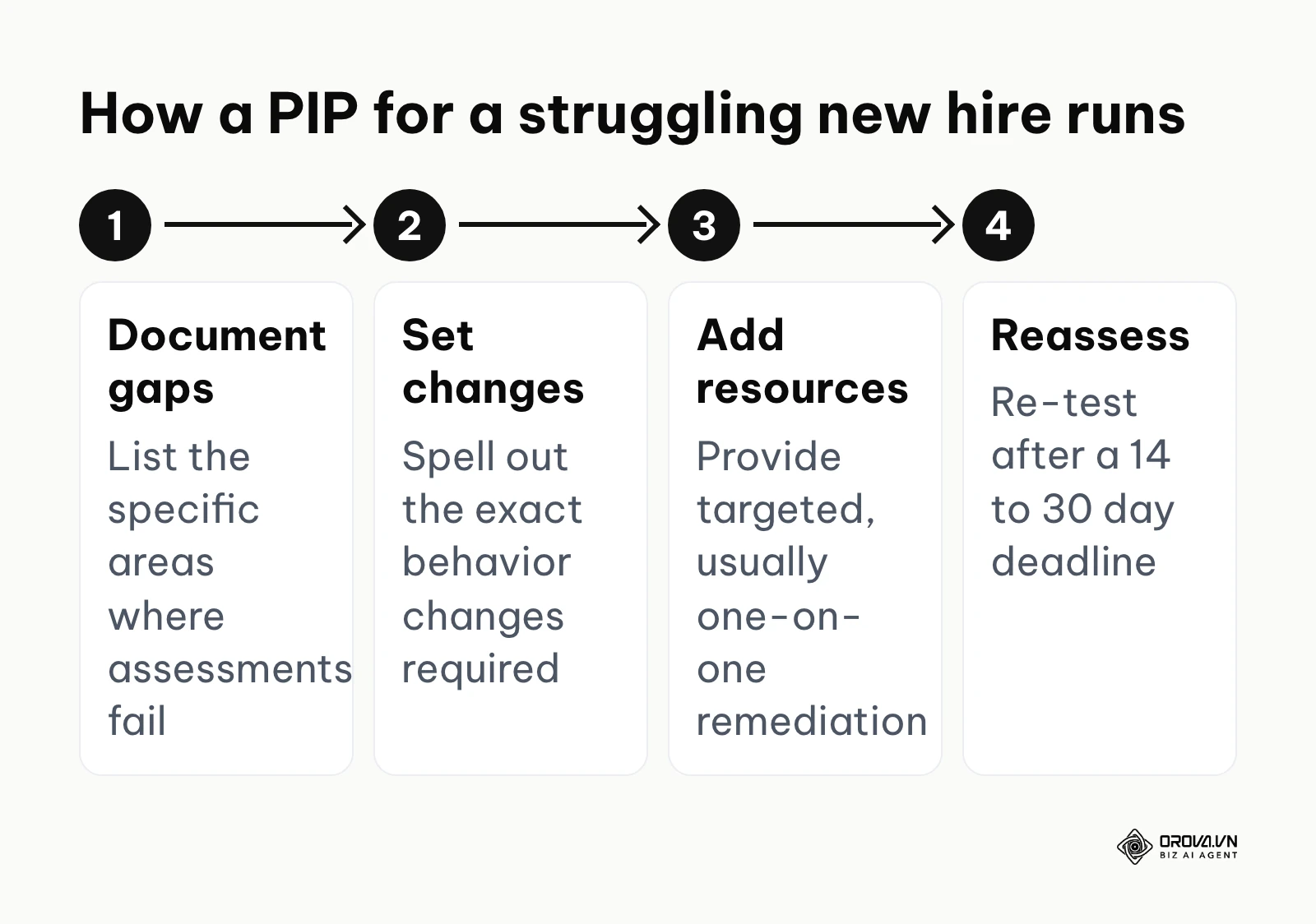
This requires a formal Performance Improvement Plan (PIP). A structured PIP clearly documents the specific areas of failure, outlines exact behavioral changes required, provides additional targeted resources, and sets a strict, usually 14-to-30 day deadline for reassessment.
Illustrative example: A regional retail chain faced crippling cashier turnover in the first month because new hires couldn't master the complex point-of-sale software. They established a formal 14-day PIP for struggling cashiers, deploying targeted, offline software simulations and scheduling weekly performance syncs. The hurdle was that store managers lacked the time for long, hour-long syncs. HR fixed this by restructuring the meetings into highly focused, 10-minute shift stand-ups based on a specific checklist. The result: more of the initially struggling hires stayed past their first quarter, which cut recruitment costs.
Types of New Hire Training Delivery
There is no single correct way to deliver education; the best programs use a blend of methodologies depending on the complexity of the task.
| Training Type | Key Characteristics | Best Suited For |
|---|---|---|
| Synchronous (Live) | Instructor-led, real-time interaction, group discussions. High engagement. | Complex problem-solving, cultural integration, leadership training. |
| Asynchronous (Self-Paced) | Pre-recorded videos, reading materials, automated quizzes. Highly scalable. | Technical software tutorials, compliance regulations, baseline product knowledge. |
| Hybrid (Blended) | Combines self-paced foundational learning with live, practical application sessions. | The majority of modern corporate roles, balancing efficiency with human connection. |
How to Start and Adapt Your Training Strategy
The strategy you deploy must strictly align with your organizational scale. A blanket approach will either overwhelm a small team or prove dangerously inadequate for a large corporation.
For Bootstrapped Startups (Under 20 Employees)
Resource constraints demand scrappiness.
- Focus on Screen Recordings: Do not write lengthy manuals. Use screen recording software to document every digital task as you do it.
- Build a Living FAQ: Create a single, shared document where the new hire must write down every question they have. Answer them directly in the document to build a knowledge base for the next hire.
- Implement the "Shadow and Reverse-Shadow" Method: Have the new hire watch you do a task on day one. On day three, you watch them do it and provide instant feedback.
- Prioritize the First Week: Over-invest your limited time in the first five days to establish extreme clarity on expectations and company survival metrics.
For Mid-Market Companies and Enterprises
Scale requires standardization and rigorous compliance tracking.
- Deploy a Centralized LMS: You must move away from scattered Google Docs into a system that tracks completion rates and quiz scores automatically.
- Standardize the 90-Day Path: Every department (Sales, Engineering, Marketing) must have a uniform architectural template for their 90-day onboarding, even if the specific content differs.
- Automate Compliance Checkpoints: Ensure that critical security and legal training modules are locked, requiring 100% completion before the employee is granted access to live company databases.
- Implement Manager Dashboards: Direct managers need weekly automated reports highlighting exactly where their new hire is falling behind in the curriculum.
For Staffing Agencies and External HR Consultants
Your product is the readiness of the candidate you provide.
- Pre-Training Modules: Require candidates to complete baseline industry knowledge certifications before you even present them to the client.
- Client-Specific Customization: Work with your enterprise clients to extract their proprietary SOPs and build mini-courses tailored strictly to their environment.
- Provide Transition Support: Offer a standardized 30-day check-in framework that the client can use to assess the candidate's integration.
- Leverage Assessment Data: Use the scoring data from your pre-training modules to prove the candidate's competency to hesitant clients.
Common Execution Mistakes:
| Common Mistake | Direct Consequence | How to Avoid It |
|---|---|---|
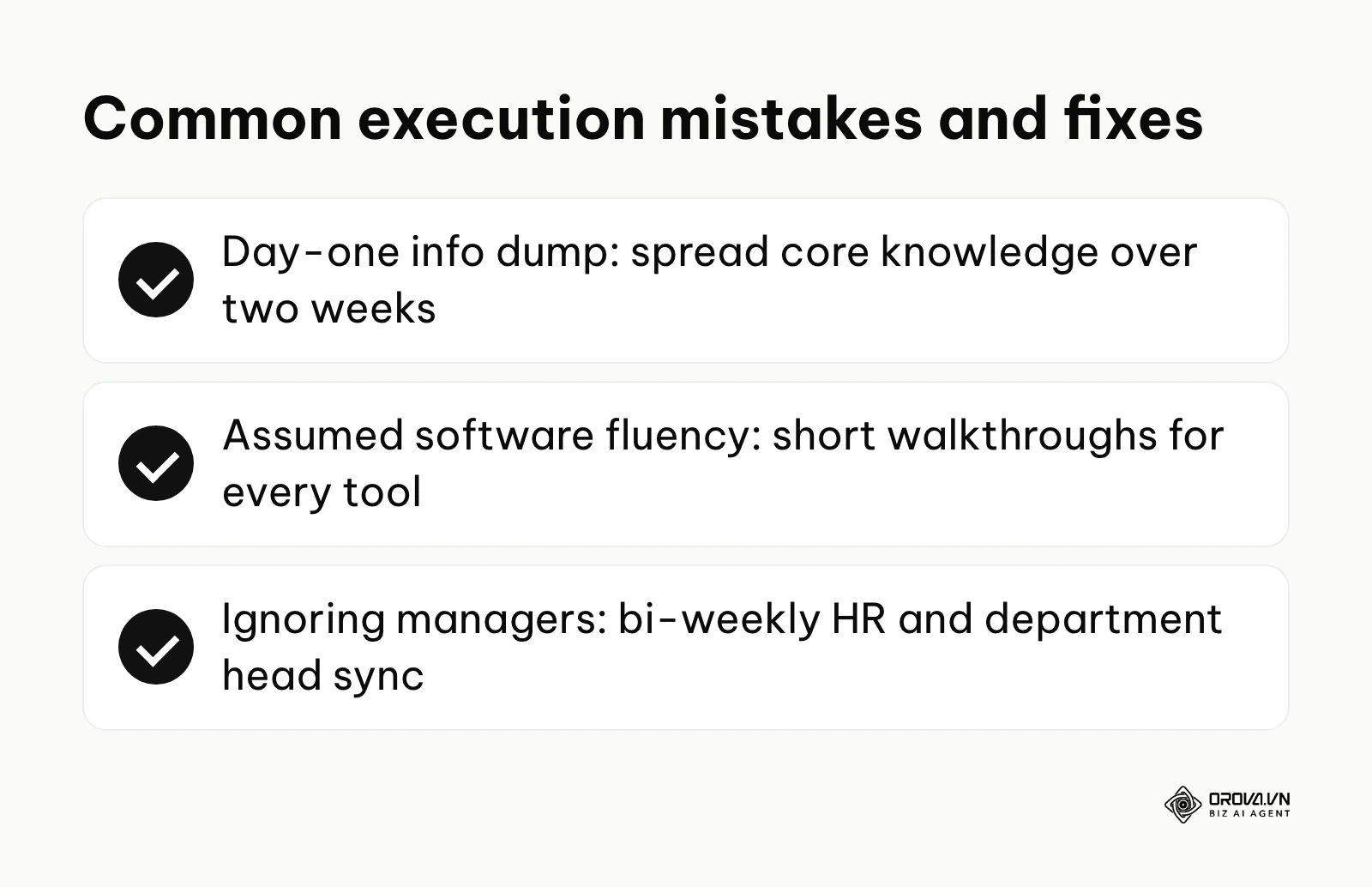
| Information Dumping on Day One | Cognitive overload; the employee retains only a small fraction of the material. | Spread core foundational knowledge aggressively across the first two weeks. |
| Assuming Software Fluency | The employee wastes hours secretly trying to learn basic internal tools like Jira or Slack. | Create specific, mandatory, 5-minute technical walkthroughs for every tool used. |
| Ignoring Direct Manager Input | The HR-designed curriculum becomes completely disconnected from floor realities. | Mandate a bi-weekly sync between HR and department heads to refine the content. |
Stop grading new hire quizzes by hand. Orova Training runs online multiple-choice tests with AI grading you can adjust, live game-style ranking rooms, and certificates awarded on passing with a public verification code and PDF download. Free until July 7, 2027, no card needed.
Where new hire training is heading in the next few years: the author's take
Corporate education is moving away from static documentation toward more dynamic, context-aware systems. These are my opinions, not forecasts: three shifts I think are worth preparing for.
Trend 1: AI-Generated, Hyper-Personalized Micro-Learning Will Replace Static Manuals
We are currently seeing the limits of one-size-fits-all training. My read is that over the next two to three years, long static SOP PDFs will steadily lose ground. I expect AI tools to increasingly generate daily micro-learning modules tailored specifically to the individual's learning speed and baseline knowledge. If an employee struggles with a specific type of math in a CRM module, the system could generate a few extra practice scenarios focused on that weakness. You should begin transitioning your massive documents into highly modular, atomic pieces of content now so they are ready to be ingested by these future AI engines.
Trend 2: Virtual Reality Role-Playing Will Become Accessible to Mid-Sized Firms
Currently, VR training is largely restricted to enterprise-level manufacturing or aviation due to hardware costs. However, as standalone headsets become cheaper, I suspect that mid-market companies will routinely use VR for soft-skills training. Imagine a newly hired manager practicing a difficult termination conversation with an AI-driven avatar in a virtual room before ever facing a real human. I think the emotional realism of this kind of practice could reduce avoidable management mistakes. Organizations should start mapping out their most high-risk conversational scenarios to prepare for this shift.
Trend 3: Predictive Attrition Analytics Will Flag Risks During Week One
Right now, most companies realize a new hire is failing only after a catastrophic mistake or when they resign in month two. I think training software will increasingly analyze the new hire's micro-behaviors—such as how quickly they click through slides, the specific types of questions they fail, and their engagement in gamified rooms—to flag who may be at risk of leaving early. While this raises valid privacy concerns that could delay adoption, the financial incentive for companies to intervene early is too massive to ignore. HR leaders need to start thinking of training platforms not just as content delivery systems, but as early-warning retention radars.
Frequently Asked Questions About New Hire Training
Is new hire training still necessary with AI?
Yes, absolutely. While AI can execute tasks, it cannot contextualize them within your specific company culture, nor can it build the necessary human trust between team members. AI accelerates the creation of the training materials and can act as a 24/7 tutor, but the structural necessity of defining what a new hire must know and ensuring they learn it remains a deeply human, organizational requirement.
How to accurately measure the financial impact (ROI) of a new hire training program?
You must calculate the net financial gain divided by the total costs. First, quantify the cost: add the software licensing fees, the hourly wages of the managers conducting the training, and the new hire's salary during their non-productive training days. Then, quantify the gain: calculate the financial value of the employee reaching full productivity (e.g., hitting sales quota) three weeks faster than the historical average, plus the recruitment costs saved by a demonstrated drop in 90-day turnover. Multiply the result by 100 to get your ROI percentage.
What should the process look like for an employee who continues to fail assessments after the first month?
You must immediately halt standard training and transition them into a formal Performance Improvement Plan (PIP). This is a critical legal and operational juncture. The PIP must isolate the exact skills they are failing, provide a final round of highly targeted, usually one-on-one remediation, and establish a hard deadline (typically 14 to 30 days). If they fail the assessments at the end of the PIP, you must have the organizational discipline to move toward termination, as keeping a chronically underperforming hire damages team morale and drains resources.
What is the difference between orientation and training?
Orientation is about compliance and comfort; it answers questions like "Where is the bathroom?", "How do I enroll in health insurance?", and "What is the company mission?". Training is strictly about capability; it answers the question "How exactly do I execute this specific database query without crashing the system?". Orientation makes them an employee; training makes them a productive worker.
How much should a company spend on training a new employee?
This varies wildly by industry, but the investment should roughly correlate with the complexity of the role and the cost of an error. High-risk roles (like medical device sales or heavy machinery operation) justify a much larger upfront investment. For standard corporate roles, set the budget against what a slow ramp-up or an early resignation would cost you, and count management time as part of it, not only software and content.
Where to Start?
You do not need to build a perfect, fully automated 90-day curriculum overnight. Depending on your current reality, your immediate next step should be highly focused and achievable within a single afternoon.
If you currently have absolutely nothing: Stop worrying about software. Your very first step is to sit down with your top performer in the most frequently hired role and document their "Day 1 to Day 30" critical path. Write down the top five tasks they execute daily and the top three software tools they use. This simple bulleted list becomes the absolute baseline blueprint for your first training module.
If you have existing materials, but they are fragmented and outdated: Conduct a ruthless content audit. Gather every PDF, Google Doc, and hastily recorded Loom video currently scattered across your company drives. Categorize them into "Keep," "Update," and "Delete." You will likely find that a sizable share of your current material is obsolete or confusing, and simply removing the bad content will immediately improve the new hire experience.
If you have a solid program, but you aren't measuring its impact: Implement a mandatory baseline knowledge check. Before a new hire starts their curriculum, give them a practical quiz on the core concepts. Give them the exact same quiz at the end of week two. If the scores aren't drastically improving, your content—not the employee—is likely the problem, and you now have the data required to justify rewriting it.
About the author

Builder of Orova
Nguyễn Đỗ Trọng Ân has 8 years of experience in marketing, including 6 years managing market development across Asia. He builds Orova, a Biz AI Agent that never sleeps: it plans, runs and optimizes work for businesses.
Run your business with AI Agents
Orova is the always-on Biz AI Agent — it plans, runs, and optimizes the work for you.
Save time, unlock productivity.