
What is keyword cannibalization? How to detect, fix, and prevent it

Picture this: you have spent weeks crafting two massive articles targeting the same core topic, expecting them to dominate the search results together. Instead, your organic traffic flatlines. You are experiencing keyword cannibalization. Traditionally, many SEO beginners think that creating more pages about the same topic increases their chances of ranking. They assume Google will just pick the best one or show both. However, this outdated approach often confuses search engines, leading them to rank the weaker page or lower the rankings of both pages simultaneously. This guide will clarify exactly what this phenomenon is, why it harms your website, and provide a comprehensive decision tree to help you resolve it. Whether you are managing a small blog or a massive e-commerce store with hundreds of overlapping product variants, you will learn how to detect, fix, and prevent this issue moving forward.
What is keyword cannibalization?
Keyword cannibalization is an SEO issue that occurs when multiple pages on your website target the exact same search query or intent, forcing them to compete against each other. It is used to identify internal competition that dilutes link equity, separating it from duplicate content which simply copies text.
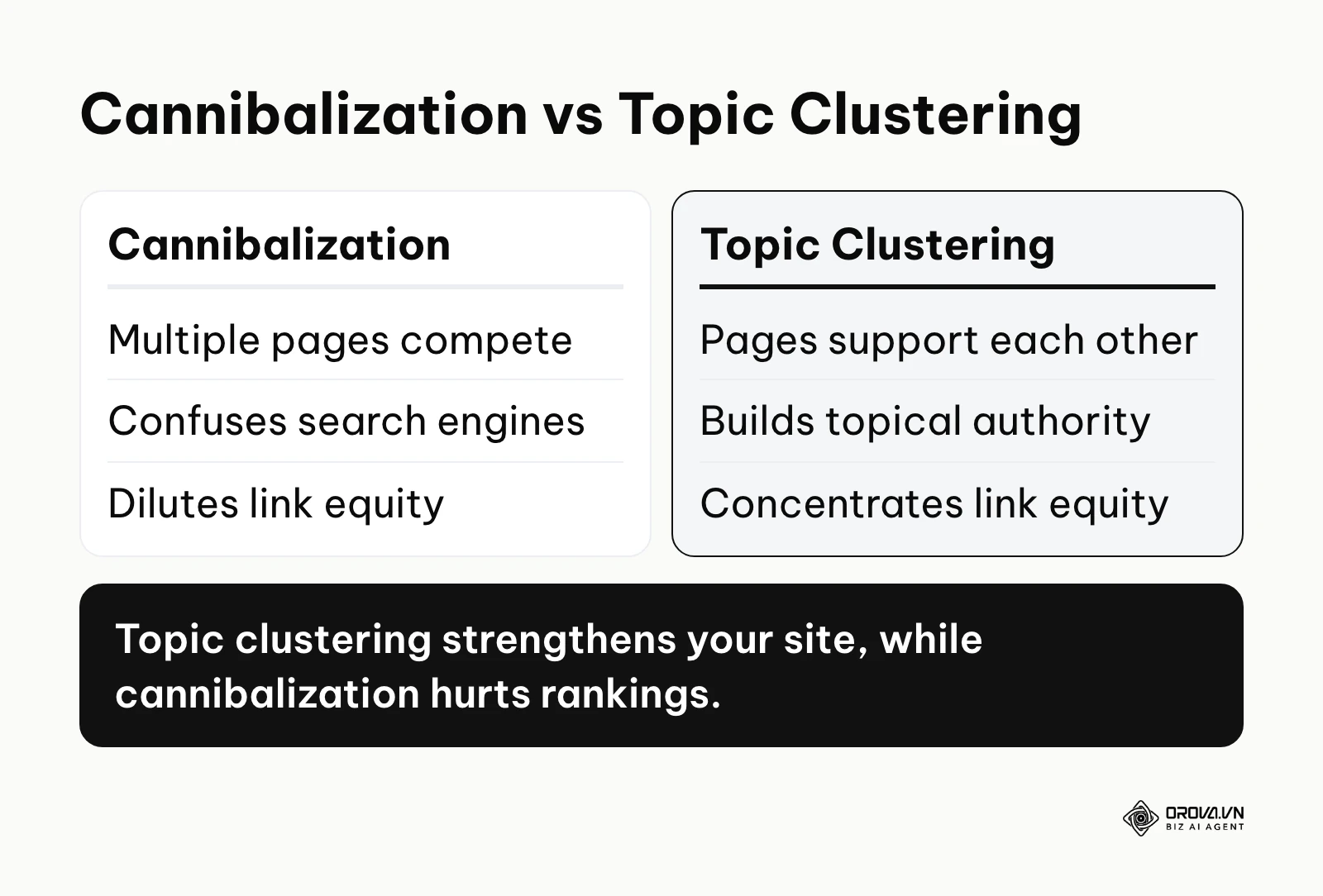
The term "cannibalization" originates from the business concept of corporate cannibalism, a scenario where a company releases a new product that ends up eating into the sales and market share of its older, established products. Translated into the world of search engine optimization, it means your own web pages are "eating" each other's organic traffic. Instead of capturing a larger share of the market, you are splitting your existing share into smaller, less effective pieces.
To understand this fully, we must distinguish it from other common issues that are frequently confused by beginners.
| Concept | Key Difference | Everyday Example |
|---|---|---|
| Keyword Cannibalization | Two unique pages targeting the same intent. | Writing two different blog posts about "how to tie a tie". |
| Duplicate Content | Exact same text copied across multiple pages. | Copying the exact same product description onto five URLs. |
| Keyword Stuffing | Repeating the same word unnaturally on one page. | Writing "best shoes, buy best shoes, best shoes cheap" in a single paragraph. |
A simple everyday example of keyword cannibalization is opening two competing coffee shops right next to each other on the same street. You are not attracting new customers to the neighborhood; you are simply forcing the existing customers to choose between your two doors. In the eyes of search algorithms, presenting two identical doors for the same query makes your entire domain look disorganized and less authoritative. The search engine is forced to guess which page is the primary source of truth, and often, it guesses incorrectly.
The Significance of Keyword Cannibalization in Your Strategy
The primary significance of keyword cannibalization lies in its ability to destroy your crawl budget and dilute your domain authority. It acts as a massive roadblock in your overarching strategy, preventing your highest-value landing pages from ranking effectively.
When you develop a content marketing strategy, the goal is to build clear paths of authority. You want search engines to crawl your site, understand the hierarchy, and assign maximum value to your most important pages. Keyword cannibalization disrupts this lifecycle entirely. It sits right between content creation and ranking realization. You can write the best content in the world, but if another page on your site is dragging it down through internal competition, that content will never reach its potential.
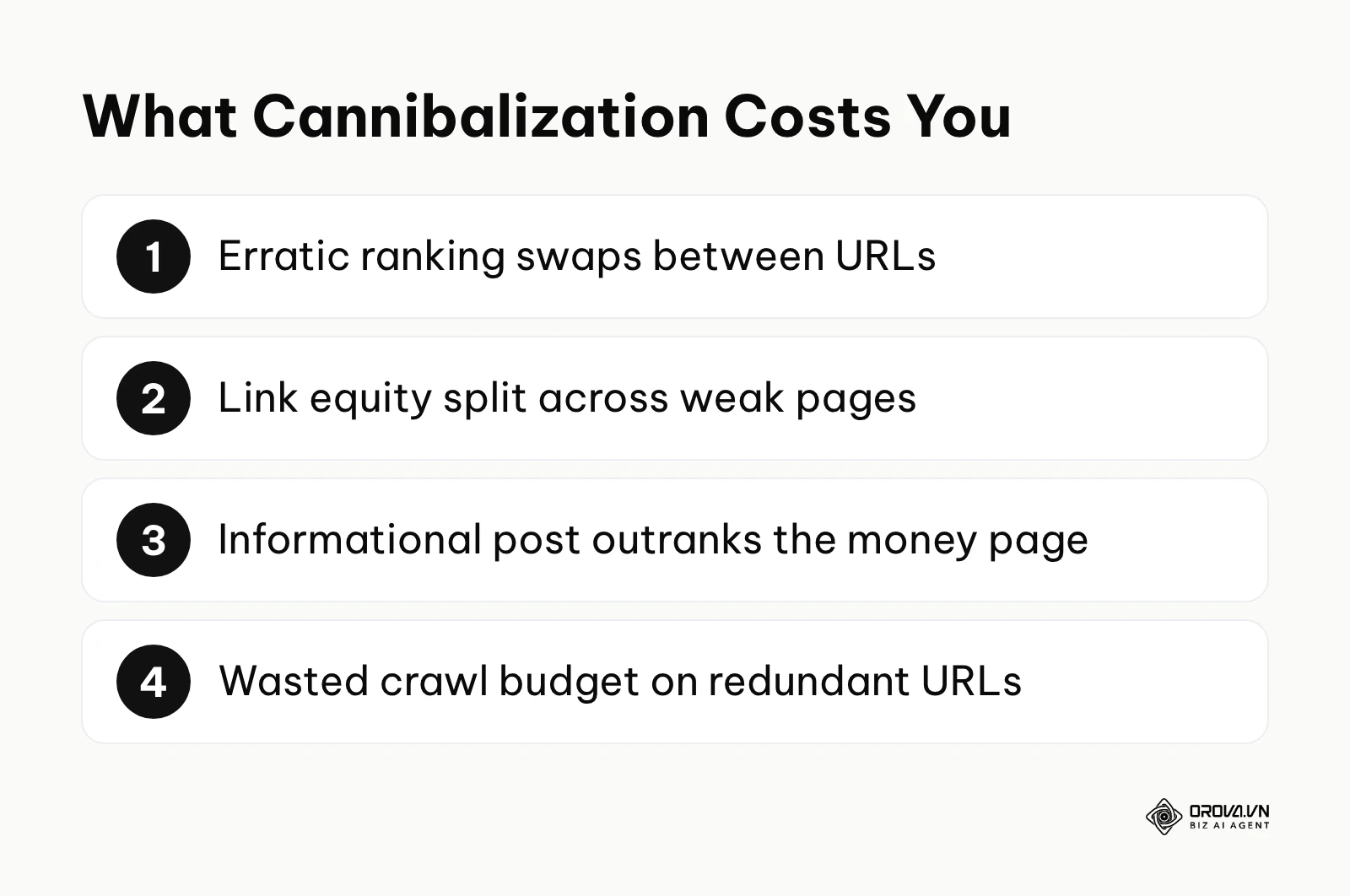
Search engines generally prefer to show a diverse set of helpful results rather than several similar pages from a single domain. If you ignore this issue, the consequences are severe. You will experience erratic ranking fluctuations where URL A ranks on Monday, URL B ranks on Wednesday, and neither ranks on Friday. You will also suffer from diluted link equity, meaning the inbound links pointing to your site are split across two weak pages instead of empowering one dominant page. Furthermore, your conversion rates will plummet because search engines might choose to rank an informational blog post instead of your transactional product page for a buying query.
When you don't need to worry about keyword cannibalization: If your website is entirely new and has less than twenty pages, spending hours auditing for cannibalization is a waste of time. You simply lack the volume of content to create meaningful internal competition. Similarly, if you intentionally dominate a branded search query and Google rewards you by displaying multiple pages from your domain on the first page, this is a strategic advantage, not an error. In these early stages, focus on consistent publishing and broad topic coverage instead of auditing.
Business Value and Professional Benefits of Fixing It
Fixing this issue directly recovers lost revenue and drastically reduces the time your marketing team wastes on redundant tasks. It shifts your focus from internal conflict to external market dominance.
Protecting Revenue and Mitigating Technical Risk
For the business as a whole, resolving keyword cannibalization is one of the fastest ways to recover lost organic revenue without spending a single dollar on new content creation. When you consolidate competing pages, you immediately pool your link equity. This pushes your primary money page higher in the search engine results pages (SERPs). The difference between ranking in position five and position two for a high-volume commercial query can mean a meaningful difference in annual revenue. Furthermore, fixing this issue reduces the risk of thin, overlapping content dragging down how search engines judge your site, ensuring your website remains resilient against future search updates.
Unlocking Efficiency for SEO Practitioners
For the individuals doing the work, cleaning up a cannibalized site brings massive operational clarity. You no longer have to guess which page to update or where to point internal links. Content teams stop wasting hours writing articles that have already been covered, and technical teams stop wasting crawl budget on redundant URLs. It allows you to operate with precision, building new assets that fill actual gaps rather than stepping on your own toes.
Illustrative example: Mid-sized B2B software vendor.
- Context: The company had an unorganized blog with over fifty overlapping posts about "CRM software", written by different authors over four years.
- Steps: The marketing manager audited the URLs and identified the top ten overlapping posts. They merged the best paragraphs from these thin articles into one massive, authoritative pillar page. Finally, they implemented 301 redirects from the nine old URLs to the new master URL.
- Obstacles: The executive team was hesitant, fearing they would lose the small trickle of traffic the old posts were generating. The manager resolved this by presenting analytics data showing those posts only ranked on page three and had zero conversions.
- Results: Within four weeks of consolidation, the new pillar page jumped to position four on the first page, visibly increasing the number of qualified leads entering the sales pipeline.
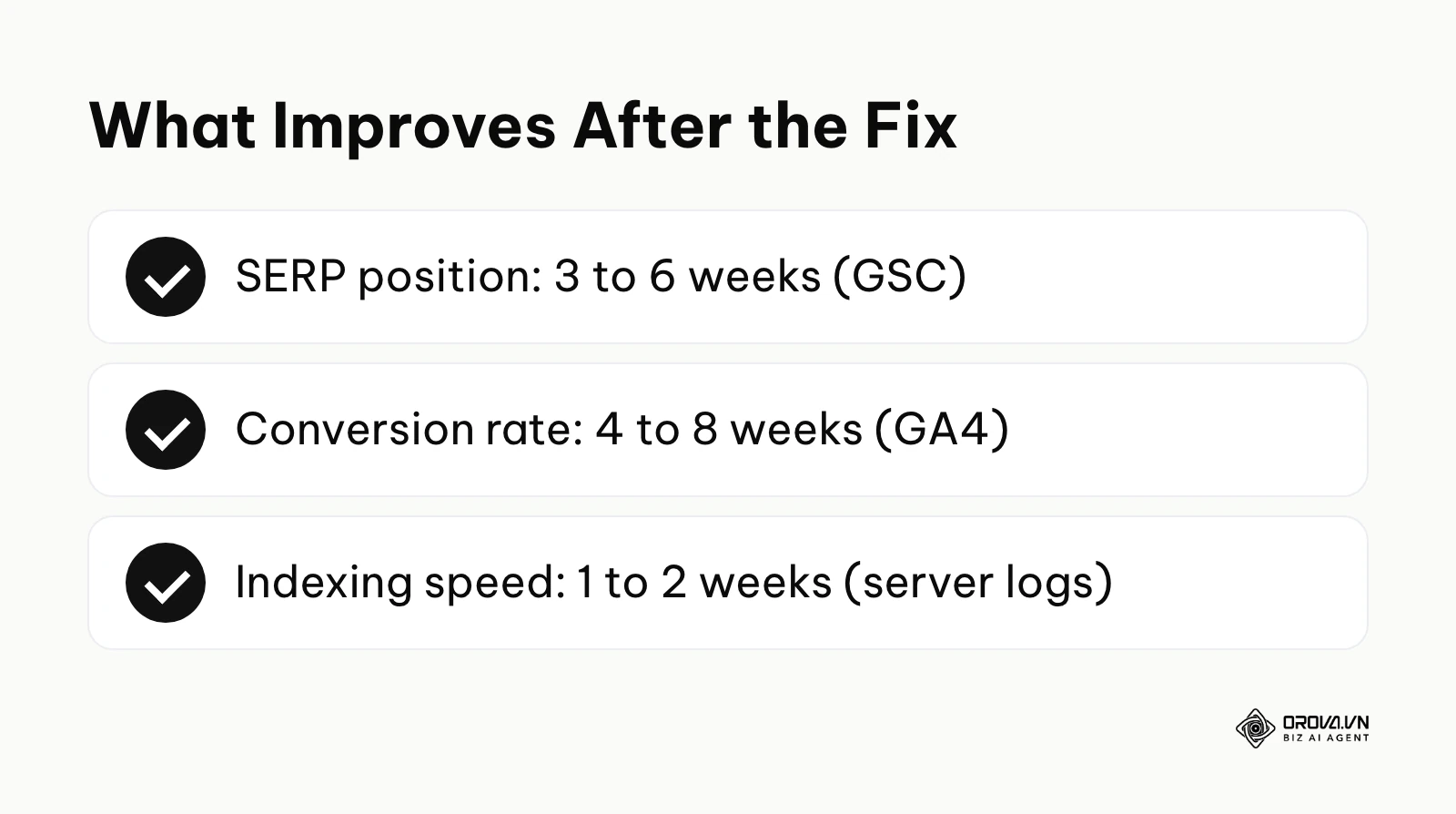
| Benefit | Metric to Measure | Time to See Results |
|---|---|---|
| Regained SERP Dominance | Average Position (GSC) | 3 to 6 weeks |
| Improved Conversion Rate | Goal Completions (GA4) | 4 to 8 weeks |
| Faster Indexing | Crawl Rate (Server Logs) | 1 to 2 weeks |
Discover Orova.vn – a Biz AI Agent platform with OROVA SEO, a complete solution for every website. The system supports search engine optimization from A to Z with features including keyword research, writing new SEO-ready articles, optimizing existing content, rank tracking, plus competitor analysis and in-depth technical analysis. Sign up today to experience OROVA SEO completely free (offer valid through July 7, 2027).
How Keyword Cannibalization Works and How to Fix It
Keyword cannibalization works by splitting search engine signals across multiple pages, and fixing it requires a systematic process of detection, intent analysis, and technical consolidation. You must diagnose the overlap and apply specific routing directives.
The mechanics of this issue are rooted in how search engine crawlers assign value. When a bot crawls your site, it looks at the meta title, headers, internal links, and body content to determine what a page is about. If it finds five pages heavily optimized for the exact same entity, it divides the domain's authority for that entity by five. Fixing this requires a surgical approach to tell the bot exactly which page is the undisputed master version.
Step 1: Identifying the conflict with Google Search Console
Before you can fix anything, you need hard data. The most reliable way to find cannibalization is not by guessing, but by looking at how Google actually treats your pages. Open Google Search Console, navigate to the Performance report, and click on Search results.
Set your date range to the last three or six months to gather a substantial dataset. Add a Query filter set to an exact match and type in the core keyword you suspect is causing issues. Once the chart loads, scroll down to the data table and click on the "Pages" tab. If you see more than one URL listed under this exact query, and both have a significant number of impressions, you have identified internal competition.
If you look at the timeline graph and filter by those specific URLs, you will often see a distinct pattern: URL A gets clicks for a few days, then drops to zero while URL B spikes, and then they swap again. This erratic flipping is the hallmark signature of cannibalization. While a dedicated keyword cannibalization checker tool can speed up this process by crawling your site automatically, GSC provides the absolute truth regarding how your pages are performing in the wild.
Step 2: Automating search intent analysis with AI
Manually reviewing thousands of URLs is an exhausting process prone to human error. To scale this operation, you must leverage artificial intelligence to analyze search intent at mass. By exporting your performance data from Google Search Console, you can feed it into a large language model to identify hidden conflicts.
To execute this properly, you must understand keyword intent at a deep level. AI can instantly categorize your URLs into informational, navigational, commercial, and transactional intents. If two URLs rank for the same query but serve different intents (for example, one is a blog post explaining what a product is, and the other is a sales page selling the product), they are not necessarily cannibalizing each other; they might just be capturing different stages of the buyer's journey.
Here is a sample prompt you can use with ChatGPT or another AI assistant to speed up this analysis:
Act as a senior technical SEO analyst. Review the following list of URLs and their primary ranking keywords, which I have exported from Google Search Console.

Your task is to identify any pairs or groups of URLs that are cannibalizing each other because they serve the exact same user search intent.

For each group identified, provide a brief explanation of why the intent overlaps and recommend a specific technical action (301 Redirect, Canonical Tag, Content Merge, or De-optimization) based on standard SEO best practices.

Here is the data:
[Paste your GSC Export Data Here]
By using this prompt, you turn raw data into a prioritized action plan in seconds, allowing you to focus on execution rather than tedious data sorting.
Step 3: The decision tree for technical resolution
Once you have identified the conflicting pages, you must decide what to do with them. Making the wrong technical choice can result in permanent traffic loss. You must follow a strict decision tree to apply the correct technical directive.
The first question you must ask is: Are both pages necessary for users? If the answer is no (one page is outdated, thin, or redundant), you should delete the weaker page and implement a 301 redirect pointing to the stronger page. A 301 redirect is a permanent routing instruction that tells search engines, "This page has moved permanently, please pass all historical link equity to the new destination."
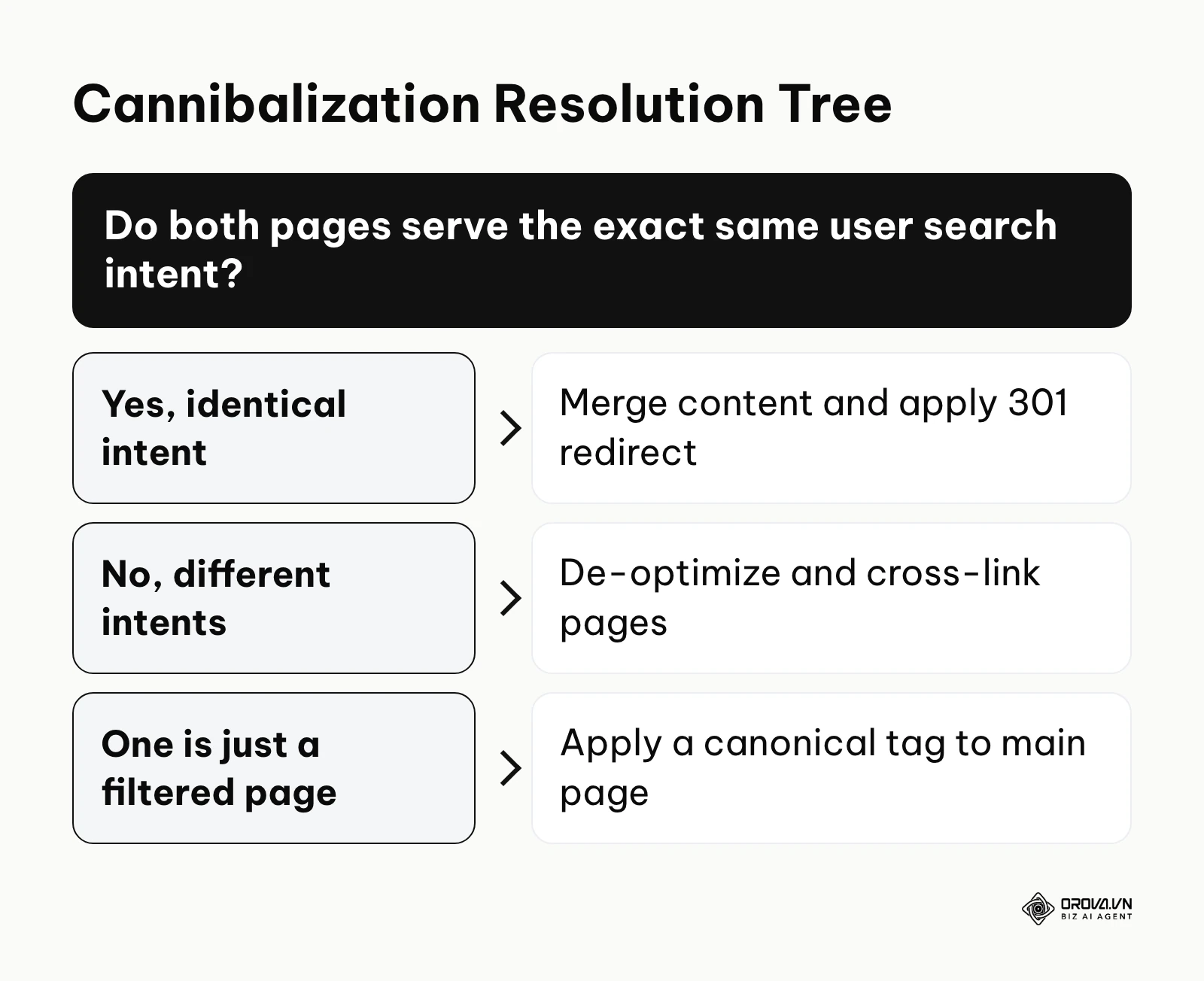
If the answer is yes (both pages provide value to the user), you move to the second question: Do they serve the exact same search intent? If the answer is yes, you should create pillar pages by merging the content of both pages into one comprehensive master guide. After the merge, redirect the old URLs to the new master page.
If they serve different intents, you must de-optimize the weaker page for the overlapping term and heavily optimize it for a specific long-tail variation. You then cross-link the pages, using exact match anchor text to explicitly tell Google which page represents which intent.
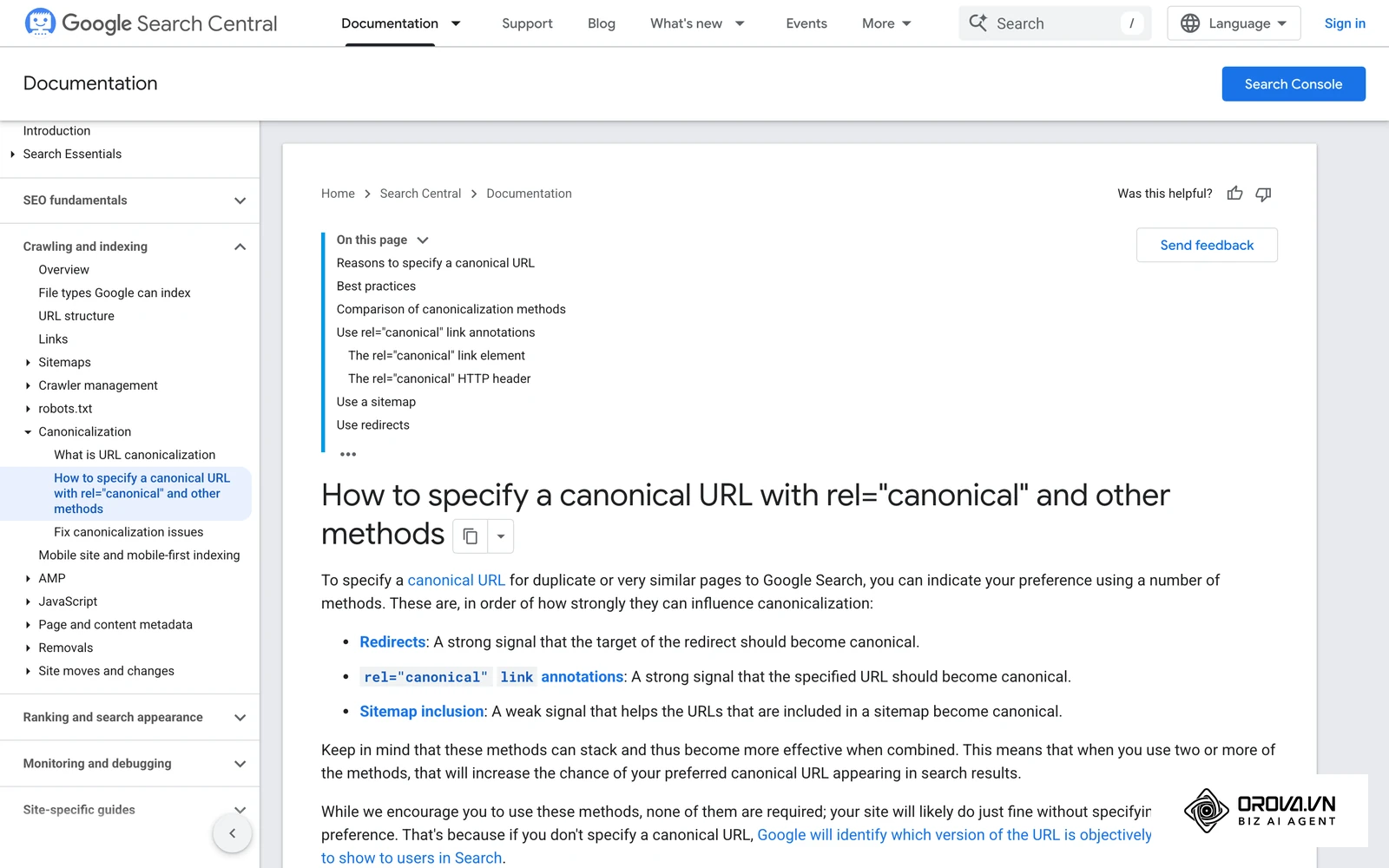
Finally, if the duplication is caused by technical architecture (like a filtered page showing "red shoes"), you must apply a rel="canonical" tag. When configuring these tags, only point a canonical at a page with substantially the same content; search engines may ignore a canonical that points to an entirely different page.
Step 4: E-commerce application: Resolving category and product overlap
E-commerce websites face a unique and highly destructive form of cannibalization: the battle between broad category hubs and specific product pages. This requires a different approach than standard informational blogs.
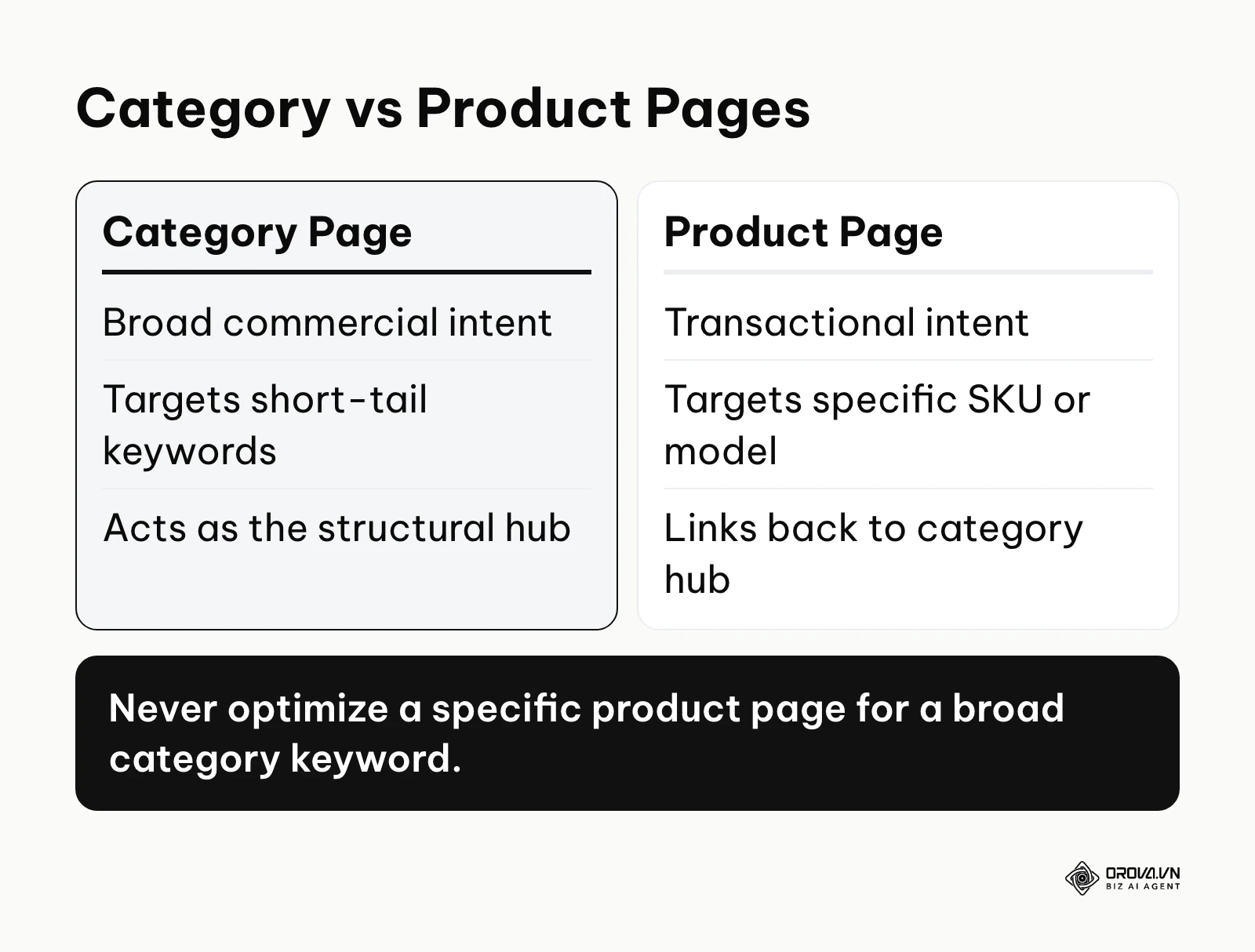
In most e-commerce setups, the category page is designed to rank for broad, high-volume terms (like "Men's running shoes"). It serves a commercial intent, allowing users to browse multiple options. The product page is designed to rank for specific, transactional long-tail terms (like "Nike Air Zoom Pegasus 39 Men's Black"). The cannibalization occurs when the CMS automatically injects the broad category name into the product title, causing the product page to outrank the category hub.
Illustrative example: Large online shoe retailer.
- Context: The company noticed their broad category page for "Men's running shoes" was losing traffic, while a specific product page for a top-selling shoe was ranking for that broad term, resulting in a high bounce rate.
- Steps: The technical SEO team first de-optimized the product page by removing the broad phrase from the H1 and meta title, shifting the focus entirely to the exact SKU. Next, they added a prominent, hard-coded internal link from the product description back to the main category using the exact match anchor text "Men's running shoes".
- Obstacles: The backend CMS automatically generated overlapping title tags based on product hierarchies, which required developer intervention to create a custom override rule.
- Results: Within three weeks, the main category page stabilized at position two for the broad term, capturing high-intent shoppers, while the product page continued to dominate for its specific long-tail variation.
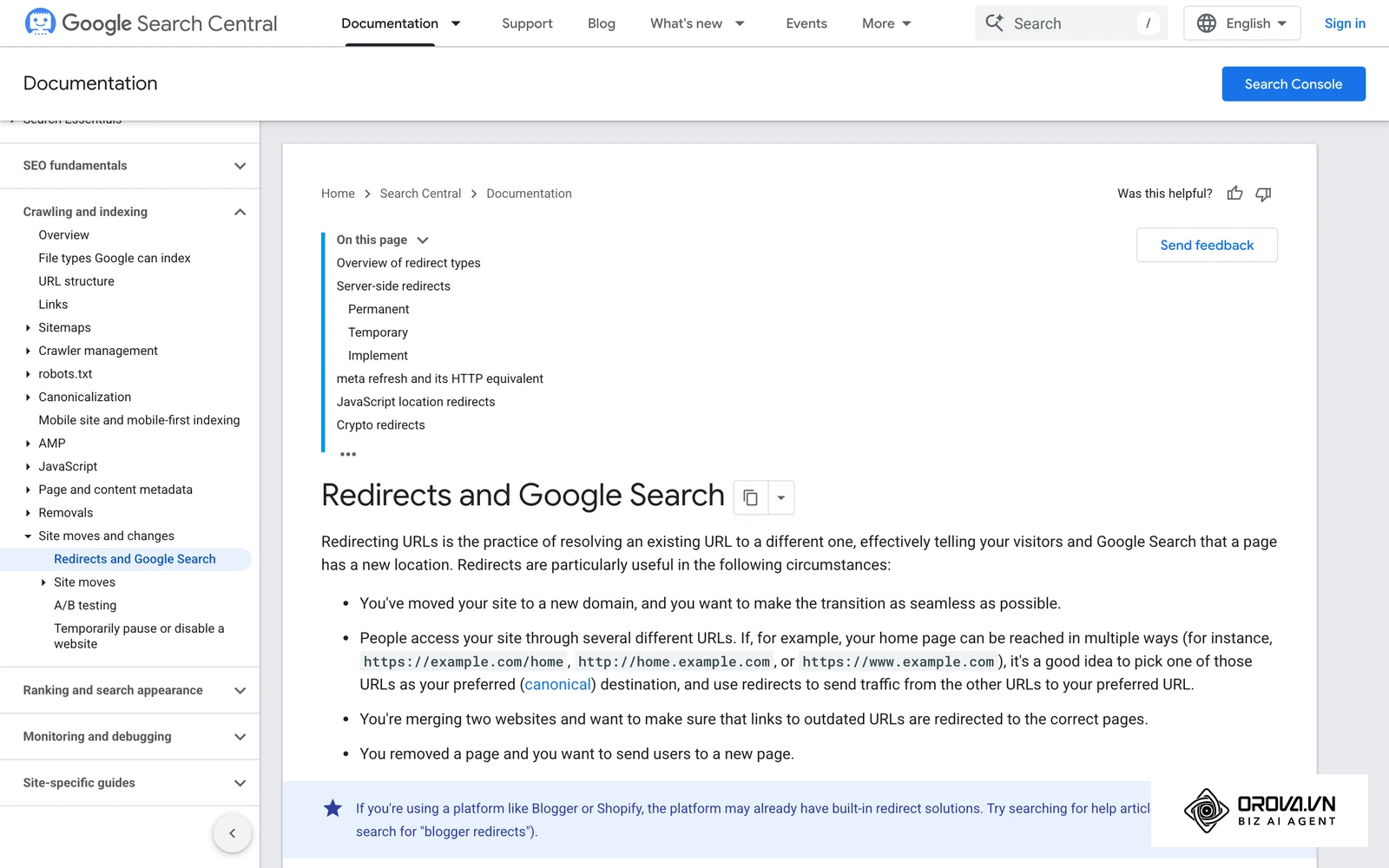
Step 5: Building a prevention system with keyword mapping
Fixing existing errors is only half the battle; the true goal is to ensure you never publish competing content again. This requires implementing a strict keyword mapping system before any writing begins.
A keyword map is a centralized database that assigns specific queries to specific URLs. By consulting this map before approving a new content brief, your editorial team can immediately see if a topic is already covered. If it is, they can choose to update the existing page instead of creating a new one. To find new angles without overlapping, you can utilize the best keyword research tools to discover unique, long-tail questions that your current map does not address.
| URL | Target Query | Search Intent | Action Required |
|---|---|---|---|
| /blog/crm-software | crm software | Informational | Maintain as pillar page |
| /pricing | crm pricing | Transactional | Update meta tags |
| /blog/what-is-crm | what is crm | Informational | Merge into /blog/crm-software |
By maintaining this template, you transition your SEO strategy from reactive cleanup to proactive architecture planning.
How to Start Adapting to a Cannibalization-Free Structure
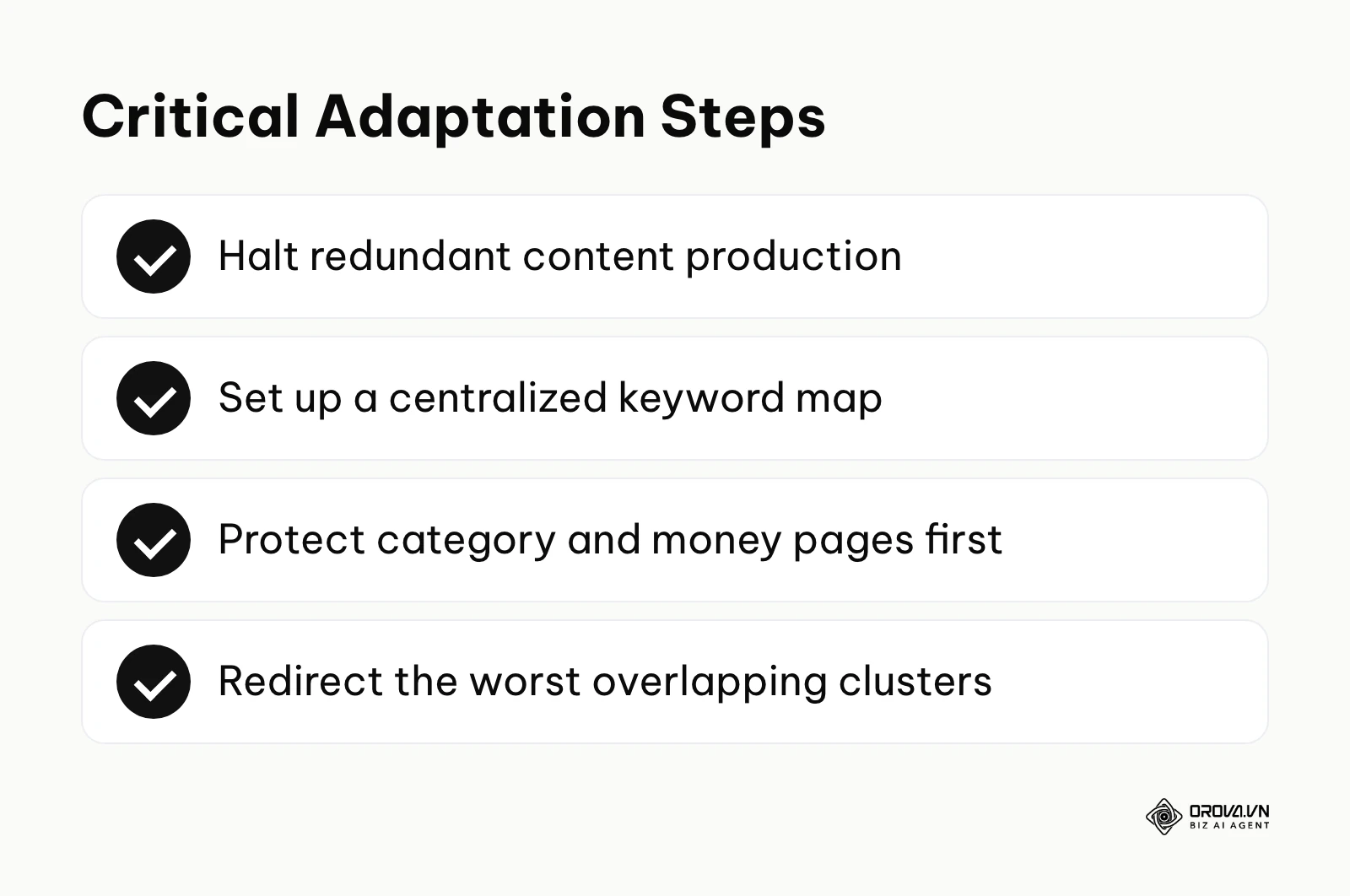
To adapt to a cannibalization-free structure, you must immediately halt redundant content production and establish a centralized tracking system. Different roles require specific operational changes to clean up the existing mess.
Action Plan for Small E-commerce Owners
For a small e-commerce owner, the immediate priority is protecting your category pages. You do not have the luxury of a massive technical team, so you must focus on manual adjustments.
- Identify your top three most profitable category pages.
- Search Google using the site:yourdomain.com "category keyword" operator to see which product pages appear first.
- Edit the titles of any overlapping product pages to focus strictly on the brand and model name, removing the broad category term.
- Add an internal link from those products back to the category page.
Action Plan for In-house SEO Managers
In-house managers face the challenge of scaling fixes across large legacy databases while managing editorial teams. Your focus must be on automated grouping and process governance.
- Export all ranking URLs from Google Search Console and use a script or AI prompt to group them by title similarity.
- Schedule a meeting with the editorial team to establish a strict rule: no new article is approved without checking the keyword map first.
- Begin executing 301 redirects for the most severe overlapping clusters, starting with high-traffic informational posts.
- Set up an automated monthly calendar reminder to conduct competitor keyword research to find fresh topics instead of rehashing old ones.
Illustrative example: In-house SEO manager at a financial media outlet.
- Context: The website had over five thousand articles, with dozens of overlapping pieces about "credit card rewards" published randomly over five years by different authors.
- Steps: The manager exported all URLs from the CMS and grouped the articles by target keyword. They identified the top-performing piece as the pillar and implemented 301 redirects from twenty outdated articles to this main URL.
- Obstacles: Editorial resistance was high, as authors did not want their historical work deleted from the internet. The manager resolved this by archiving the text internally in a hidden Google Drive folder before redirecting the public URLs, satisfying the writers.
- Results: The consolidated pillar page saw a visible traffic increase within a month, and the crawl rate for new daily news articles improved significantly as the server load decreased.
Action Plan for SEO Agencies
Agencies must prove ROI quickly when taking over a cannibalized client site. Your workflow should prioritize high-impact structural fixes that show immediate ranking improvements.
- Run a comprehensive crawl of the client's site to map the current architecture.
- Identify instances where a blog post is outranking a money page for a transactional query.
- Execute immediate canonicalization or de-optimization to restore the money page's visibility.
- Deliver a consolidated keyword map to the client as a core deliverable for future content creation.
| Common Mistake | Consequence | How to Avoid |
|---|---|---|
| Redirecting pages with different intents | Traffic drops because users bounce immediately | Only merge pages that serve the exact same user need |
| Using 302 temporary redirects | Search engines may keep the old URL indexed as the main version | Always use 301 permanent redirects for consolidation |
| Pointing canonicals to unrelated pages | Google ignores the canonical tag entirely | Ensure canonical pages share substantially the same content |
Orova SEO can check your site's technical health and suggest new keywords from Google Search Console and Google Keyword Planner, so new articles can target intents you have not covered yet.
With OROVA.VN and the OROVA SEO module, you put an end to the exhausting days of manual work for good. Instead of struggling for hours to write articles and compile reports, the entire process is now optimized and completed in just 5 minutes.
Where keyword cannibalization is heading in the next few years: the author's take
The signals I see today point toward AI-driven intent clustering and smarter technical diagnostics. Search engines are steadily changing how they interpret competing internal pages.
AI-driven semantic clustering will outweigh exact match monitoring
Today, we already see search engines grouping thousands of long-tail variations into singular intent buckets. I think that in the next two to three years, tracking individual keyword overlap will matter much less than it does now. My read is that algorithms will increasingly evaluate domain-wide topical authority based on broad entity clusters. The traditional keyword cannibalization concept may evolve into something closer to "entity dilution." To prepare, you must stop optimizing for specific strings of text and start mapping your entire editorial calendar around comprehensive, interconnected entities.
Cannibalization alerts are likely to become common CMS features
Currently, we rely on third-party crawlers to identify conflicts after the content is already published and indexed. I expect publishing platforms to add AI checks that warn writers before they publish overlapping content. If a new draft largely repeats the intent of an existing URL, the system could flag it and suggest a content merge before you hit publish. You should prepare your editorial teams now by enforcing strict topical boundaries before a single word is drafted, getting them used to rigid content governance.
AI summaries may blunt the impact of technical fixes
We already see more AI-generated summaries directly on the search results page. I lean towards the idea that search engines will care less about which of your competing pages ranks, and will instead extract the best paragraphs from your competing pages to form a single, unified answer in the SERP. While this sounds convenient, it means you lose control over the user journey. To retain control, you need to consolidate your content manually now, ensuring your best landing pages provide a complete, authoritative experience that AI cannot simply scrape and summarize.
Frequently asked questions about keyword cannibalization
People frequently ask how to identify overlapping intents and what technical steps are required to resolve them safely. Below are the most common questions surrounding this technical SEO challenge.
How long does it take for Google to update rankings and recover traffic?
After you implement a 301 redirect or merge content, it typically takes search engines between two to six weeks to recrawl the affected URLs, process the directives, and update the rankings. The exact timeline depends heavily on your site's overall crawl budget and authority. For massive enterprise sites, changes can be reflected in days, while smaller sites may need to wait over a month to see the consolidated link equity take effect.
Is keyword cannibalization still relevant with AI?
Yes, even as AI algorithms become smarter at understanding context, keyword cannibalization remains a critical issue. AI still relies on clear site architecture and consolidated link equity to determine which page is the most authoritative source of truth. If you split your signals across multiple pages, AI overviews and traditional crawlers alike will struggle to rank your content effectively, often choosing a competitor with a cleaner structure.
When is having two pages ranking for the same keyword actually good?
Having two pages rank for the same query is beneficial when they occupy multiple spots on the first page of search results, effectively pushing your competitors down. This usually happens with highly branded queries (like searching for your exact company name) where Google wants to show your homepage, pricing page, and contact page simultaneously. In these specific scenarios, do not attempt to fix or consolidate the pages, as you are successfully dominating the SERP real estate.
How do you fix cannibalization in e-commerce stores with hundreds of variants?
In e-commerce, the key is strict technical parameter handling. If you have hundreds of identical products that only vary by color or size, you should not let them all index individually unless people search for those specific variations. You must use canonical tags on the variant pages pointing back to the main master product page, or utilize faceted navigation controls to prevent search engines from crawling the dynamic URL parameters entirely.
Where to Start Fixing Your Site?
You should start fixing your site by auditing your highest-value URLs first, depending on your current level of organizational maturity. The very first step varies based on whether you are starting from scratch or cleaning up a massive legacy database.
If you are starting from absolute scratch: Your single first step today is to build a foundational keyword map. Open a blank spreadsheet and list your top ten most important business topics. Next to each topic, assign exactly one definitive URL on your website that should rank for it. Do not write a single new word until this map exists. This one-hour session prevents the issue from ever taking root and forms the basis of a comprehensive SEO checklist for your future writers.
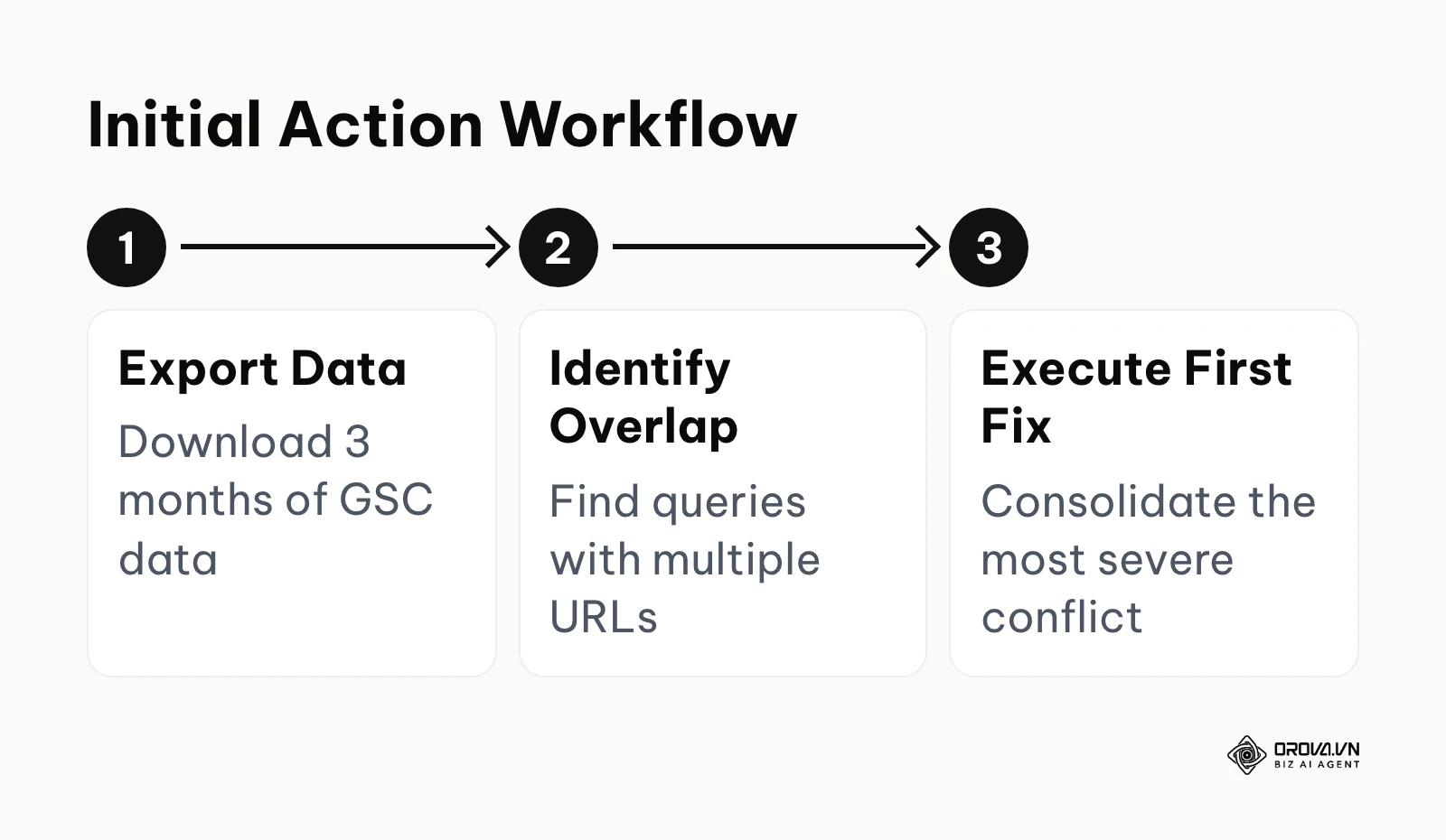
If you have scattered efforts and overlapping content: Your immediate first action is to log into Google Search Console and export your performance data for the last three months. Sort the spreadsheet by your top queries, and use conditional formatting to highlight any query that triggers more than one URL in the results. In one afternoon, you will have a prioritized hit list of the exact pages that are actively cannibalizing your revenue, allowing you to execute targeted redirects.
If you are executing fixes but not measuring results: Stop applying redirects blindly. Your first step today is to set up a dedicated tracking dashboard using your analytics platform. Before you merge or canonicalize your next batch of conflicting pages, annotate the exact date of the change in your analytics tool. This simple, ten-minute documentation step ensures you can definitively prove whether your technical fix actually recovered the lost traffic or if further de-optimization is required.
By taking these deliberate steps today, you can permanently eliminate keyword cannibalization and ensure every piece of content you publish drives genuine, sustainable growth.
About the author

Builder of Orova
Nguyễn Đỗ Trọng Ân has 8 years of experience in marketing, including 6 years managing market development across Asia. He builds Orova, a Biz AI Agent that never sleeps: it plans, runs and optimizes work for businesses.
Run your business with AI Agents
Orova is the always-on Biz AI Agent — it plans, runs, and optimizes the work for you.
Save time, unlock productivity.