
Competitor Keyword Research: A Zero-Budget Strategy to Outrank Rivals

Competitor keyword research means finding the search queries that already send traffic to rival websites, then choosing which of them you can realistically win. Staring at your analytics dashboard while your competitors celebrate record-breaking traffic is a frustrating experience. You know your product is better, your service is faster, and your team is more dedicated. Yet, when potential customers search for solutions online, they find your rivals first. This disparity usually boils down to one critical advantage: they know exactly what your shared audience is typing into the search bar, and they have built their content strategy around it. Historically, leveling this playing field meant investing heavily in enterprise-grade software. The industry standard advice for competitor keyword research has always been to purchase an expensive subscription, plug in a URL, and export a massive list of data. But what if your marketing budget is currently zero? What if you are a small business, a solo founder, or a startup trying to gain traction without burning cash on tools? This comprehensive guide is designed specifically for you. We will tear down the traditional paywalls and explore a deeply strategic, zero-budget framework. You will learn how to find competitor keywords using native platforms, map them strategically to your marketing funnel, and most importantly, understand the nuanced criteria of when you should absolutely walk away from a fight you cannot win.
What is competitor keyword research (and when should you ignore it)?
Competitor keyword research is the systematic process of identifying, analyzing, and ultimately targeting the specific search queries that are driving organic traffic to competing websites within your industry. Instead of brainstorming topics in a vacuum and hoping your audience cares, this methodology allows you to reverse-engineer success. You are essentially using your competitors as free research and development departments. They have already spent the time, money, and effort to discover what resonates with the market. By analyzing their digital footprint, you can uncover high-converting phrases, identify content gaps they have missed, and build a roadmap that is backed by proven data rather than gut feeling. It is a cornerstone of modern digital marketing, acting as a compass that directs your content creation efforts toward guaranteed demand.
However, it is equally crucial to recognize when this powerful tactic should be temporarily ignored. If your website was launched last week, possessing a Domain Rating near zero and lacking foundational content, obsessing over the keywords of a ten-year-old industry giant is a recipe for despair. Attempting to compete for highly competitive head terms without established topical authority will only result in wasted resources. Furthermore, you should ignore this strategy if your primary business model relies entirely on disruptive innovation where search demand does not yet exist. If you have invented a completely new category of software, your potential customers do not know what keywords to search for yet. In such rare scenarios, your focus must be on demand generation and brand awareness, not capturing existing, mature search intent. For the vast majority of businesses, though, understanding the competitive landscape is non-negotiable.
Preparation: What you need before finding competitor keywords
Diving into data extraction without a structured environment will lead to overwhelming spreadsheets and zero actionable insights. Before we execute the zero-budget workflow, you must assemble a foundational toolkit. The beauty of this approach is that every asset required is completely free and accessible to anyone with a Google account. Proper preparation ensures that when you do uncover valuable data, you have the systems in place to process, analyze, and deploy it efficiently.
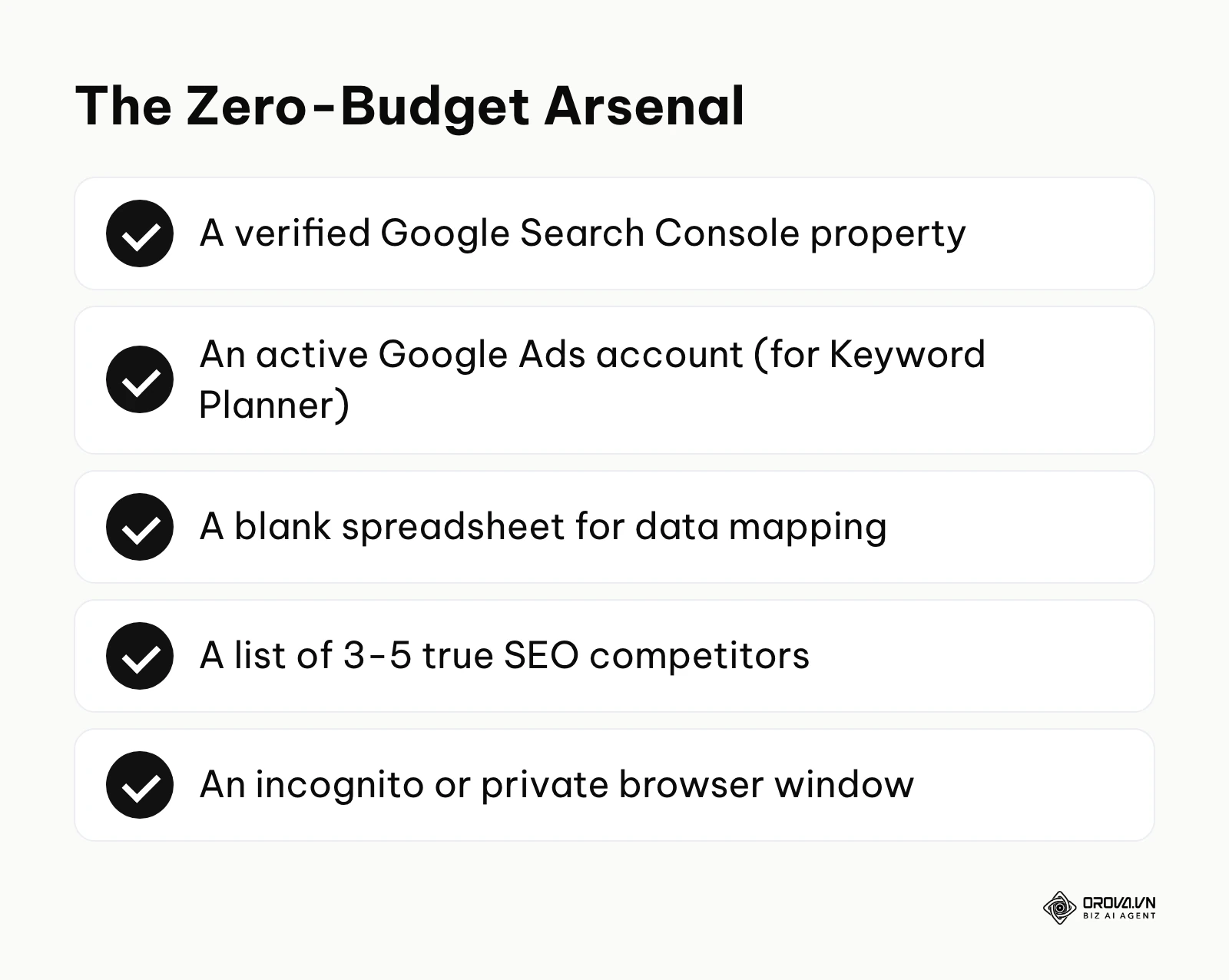
| Necessary Asset | Where to acquire it | Time needed to set up |
|---|---|---|
| Verified Google Search Console | Google Search Central website | 15 - 30 minutes |
| Active Google Ads Account | Google Ads platform (requires no spend) | 10 - 15 minutes |
| Competitor Keyword Analysis Template | Google Sheets or Microsoft Excel | 20 - 30 minutes |
| List of True SEO Competitors | Manual Google Search analysis | 45 - 60 minutes |
| Incognito/Private Browser | Built into Chrome, Safari, Firefox | 1 minute |
Let's break down why these specific assets are non-negotiable. First, Google Search Console is your baseline. You cannot effectively measure the gap between you and your competitors if you do not have a crystalline understanding of your current standing. Google's own SEO Starter Guide encourages site owners to think about the words their audience uses to search, and GSC shows you which of those words already bring your site impressions. Second, a Google Ads account grants you access to the Google Keyword Planner. While often dismissed by SEOs who prefer paid third-party suites, this tool provides direct, first-party data straight from the search engine itself. You do not need to run an active advertising campaign to use it for organic research; you simply need an account.
The competitor keyword analysis template is perhaps the most critical organizational tool. Raw data is useless without context. You need a spreadsheet configured with columns for the Keyword, Search Volume, Search Intent, Funnel Stage (TOFU/MOFU/BOFU), the Competitor's URL ranking for it, and your proposed angle to beat them. Finally, the list of competitors must be accurate. A common pitfall is listing offline business rivals who have terrible digital presences. Your SEO competitors are the websites that consistently appear on page one for the topics you want to own, regardless of whether they sell a competing product or are just informational publishers.
The zero-budget workflow: 6 steps to find competitor keywords
This is the core engine of our strategy. By strictly adhering to these six steps, you can extract thousands of dollars worth of competitive intelligence without ever entering a credit card number. This workflow requires patience, manual labor, and critical thinking, but the depth of understanding you will gain about your niche will far surpass what a simple automated tool export can provide.
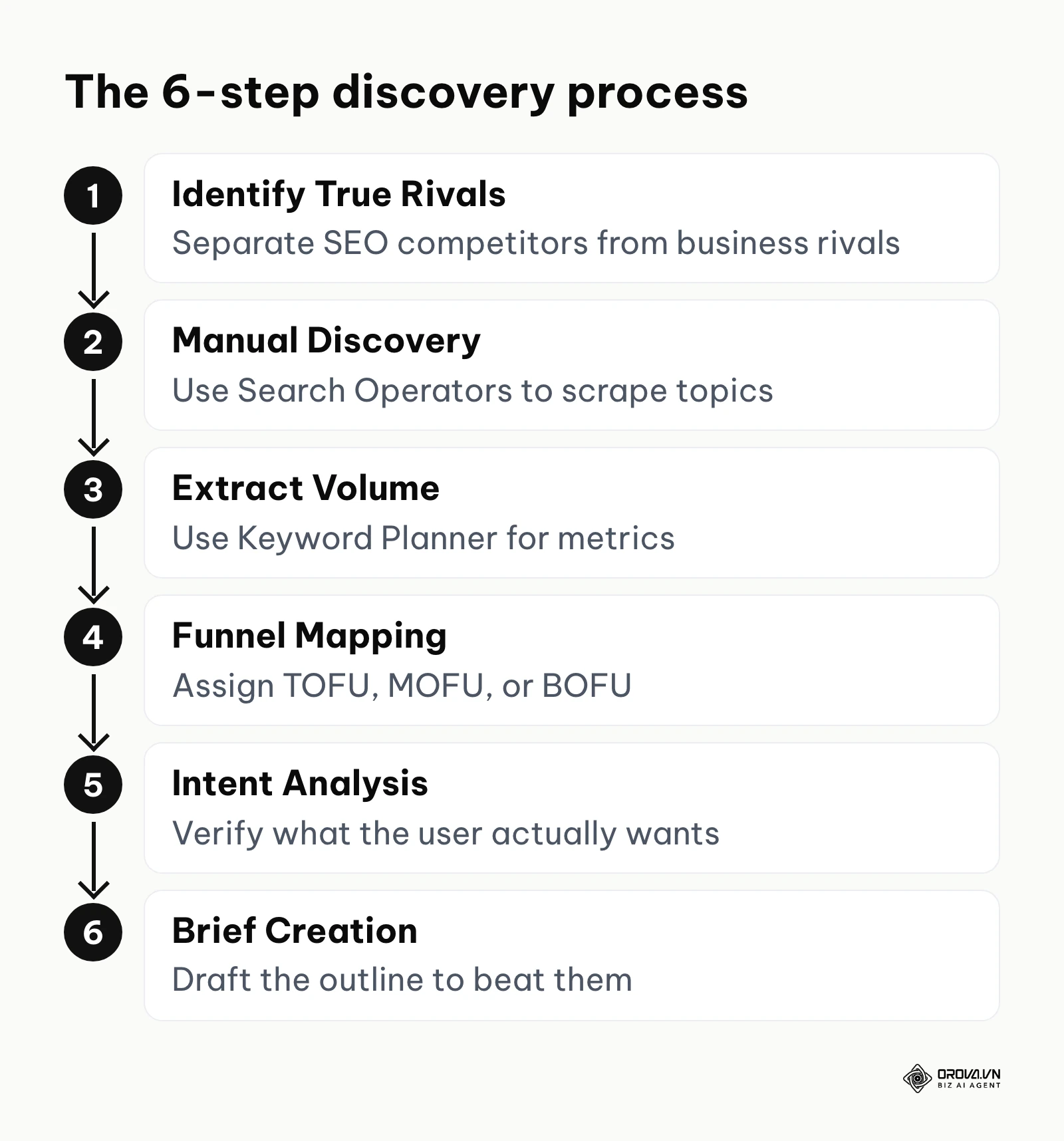
Step 1: Identify your true SEO competitors
The most foundational error in competitor keyword research is targeting the wrong websites. Your offline business rivals—the companies you compete with for local contracts or physical shelf space—might have a completely non-existent organic search strategy. If you analyze their websites, you will find nothing but branded terms and thin content. Your true SEO competitors are the entities occupying the digital real estate you desire. They are the blogs, magazines, aggregators, and competing businesses that rank on page one of Google for your industry's core topics.
How to do it: Open an incognito browser window to prevent your past search history from heavily influencing the results. Type in 5 to 10 broad, descriptive phrases that perfectly summarize what your business offers. If you sell accounting software, search for "best accounting software for small business," "how to do bookkeeping," and "cloud accounting benefits." Ignore the sponsored ad slots at the top. Look at the organic results. Write down the domains that consistently appear across multiple different searches. These are your targets.
Signs of success: You should compile a list of 3 to 5 domains that have a massive, visible footprint in your specific niche. They should have active blogs, resource centers, and well-structured product pages.
Common mistakes: Including absolute giants like Wikipedia, Amazon, or Forbes in your list. While they might rank for your terms, their domain authority is so astronomically high that trying to analyze their entire keyword profile is useless. Focus on niche-specific competitors who are closer to your size or one tier above.
Step 2: Use Google search operators for manual discovery
Once you have your list of true SEO competitors, it is time to mine their websites for topics. Without paid tools, we rely on Google's advanced search operators. These are specialized commands that force the search engine to filter its index in highly specific ways, allowing you to essentially scrape a competitor's content strategy directly from the search bar.
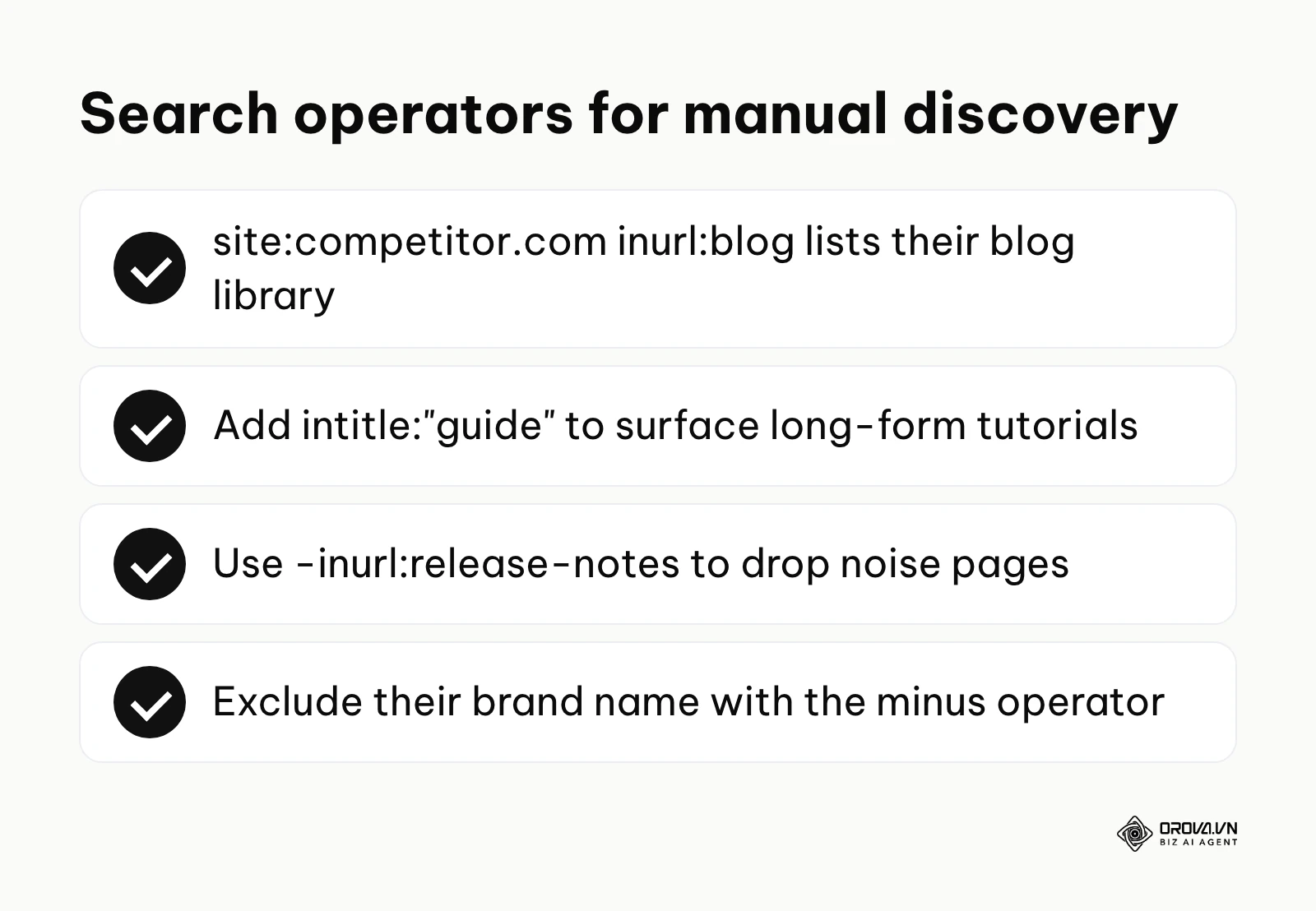
How to do it: The most powerful combination is the site: operator combined with the inurl: or intitle: operators. Go to Google and type: site:competitor.com inurl:blog. This command forces Google to show you every single indexed page on that competitor's domain that contains the word "blog" in the URL structure. You are now looking at their entire content library. To narrow it down, use: site:competitor.com intitle:"guide" OR intitle:"how to". This reveals their most comprehensive, educational content. Scroll through these results and manually extract the core topics they are writing about into your spreadsheet.
Signs of success: You begin finding highly specific, niche topics that you had not previously considered. You start seeing patterns in their content architecture—perhaps they have an entire cluster of articles dedicated to one specific feature of their product.
Common mistakes: Failing to filter out their branded keywords. Competitors will naturally write a lot about their own features and company news. You must mentally (or by using the - operator, like -competitorbrand) filter these out, as you cannot realistically rank for another company's trademarked name.
Illustrative example:
- Context: A small B2B SaaS startup (team of 3) developing an inventory management tool was struggling to find niche topics. They had no budget for premium SEO software.
- Steps: The founder used the operator site:competitor.com inurl:blog intitle:"guide". They extracted the top 30 URLs from the search results. They noticed the competitor had extensive guides on warehouse layout but almost nothing on barcode scanning integrations.
- Hurdle and fix: Initially, the search results were cluttered with the competitor's release notes, diluting the research. The founder fixed this by modifying the search to site:competitor.com inurl:blog -inurl:release-notes.
- Visible result: They discovered 15 untapped topics specifically related to barcode scanning workflows. By writing targeted guides on these exact gaps, they secured 50 qualified, high-intent leads within a single month without spending a dime on ads or paid platforms.
Step 3: Extract search volume with free competitor keyword research tools
Finding the topics your competitor writes about is only half the battle. A competitor might have written a 3000-word guide on a keyword that literally zero people search for every month. To avoid wasting your time, you must validate these stolen topics with actual search volume data. This is where the Google Keyword Planner becomes your best friend among free competitor keyword research tools.
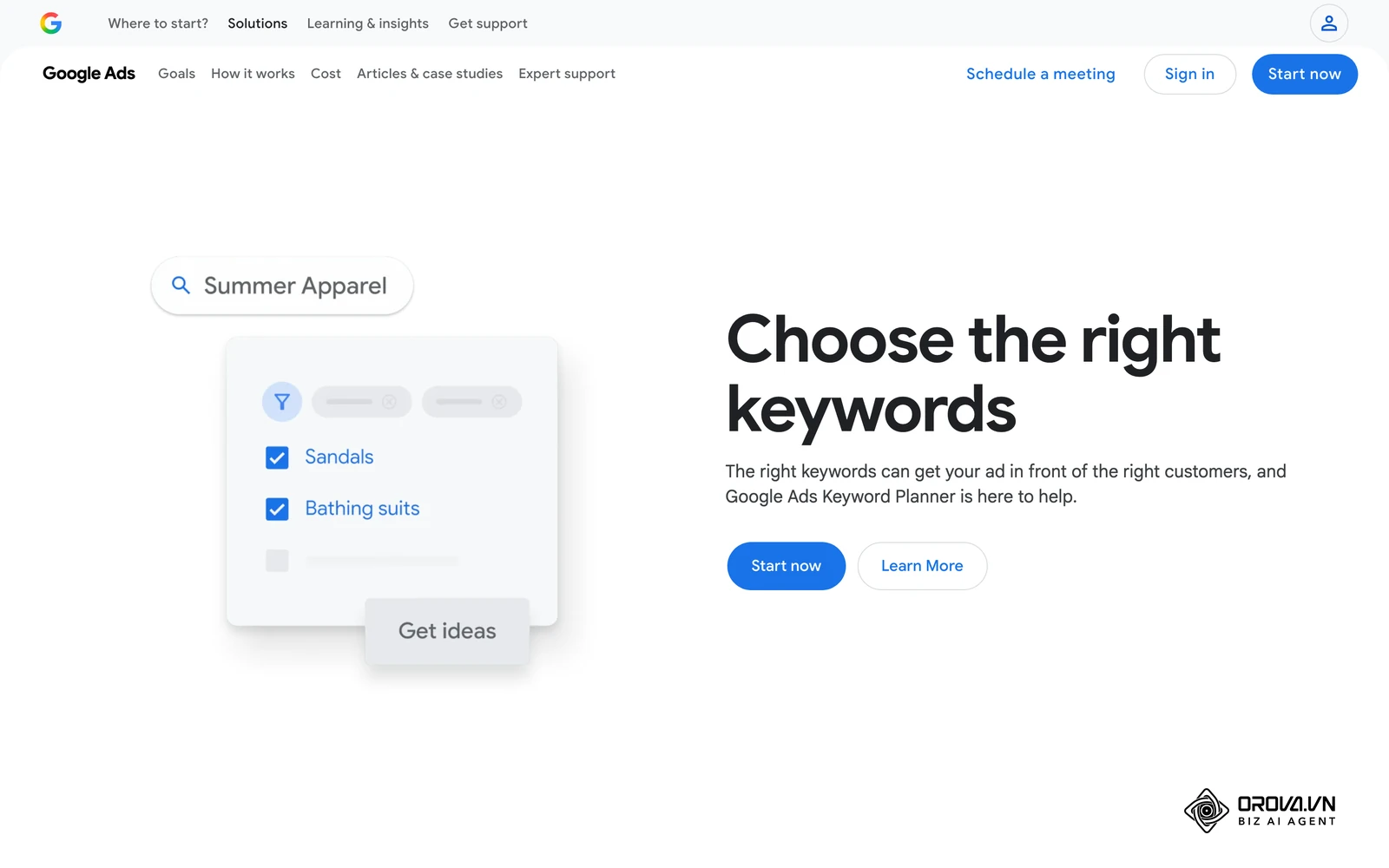
How to do it: Log into your Google Ads account and navigate to the Keyword Planner tool. Select the option to "Discover new keywords." Here, you have two choices. You can either paste the specific phrases you extracted during your manual discovery in Step 2, or, for an even faster method, you can paste the exact URL of your competitor's article into the "Start with a website" tab. Google will scan their page and spit out the keywords it believes that page is relevant for, complete with average monthly search volumes and competition levels. Export this data into a CSV file and merge it with your master spreadsheet.
Signs of success: You successfully populate your spreadsheet with numeric values representing the average monthly searches for each topic. You begin to see which of your competitor's topics are high-traffic goldmines and which are barren wastelands.
Common mistakes: Taking the exact search volume numbers as absolute gospel. Google Keyword Planner often provides grouped data or broad ranges (e.g., 100 - 1K) if you are not running active ad campaigns. Use these numbers as directional indicators of relative popularity, not exact traffic guarantees.
Step 4: Map keywords to the marketing funnel
This is the step where raw data transforms into actionable business strategy. A list of thousands of keywords is useless if you do not understand where the user is in their buying journey. You must utilize a robust competitor keyword analysis template to categorize every single phrase you intend to target into the marketing funnel: Top of Funnel (TOFU), Middle of Funnel (MOFU), and Bottom of Funnel (BOFU).
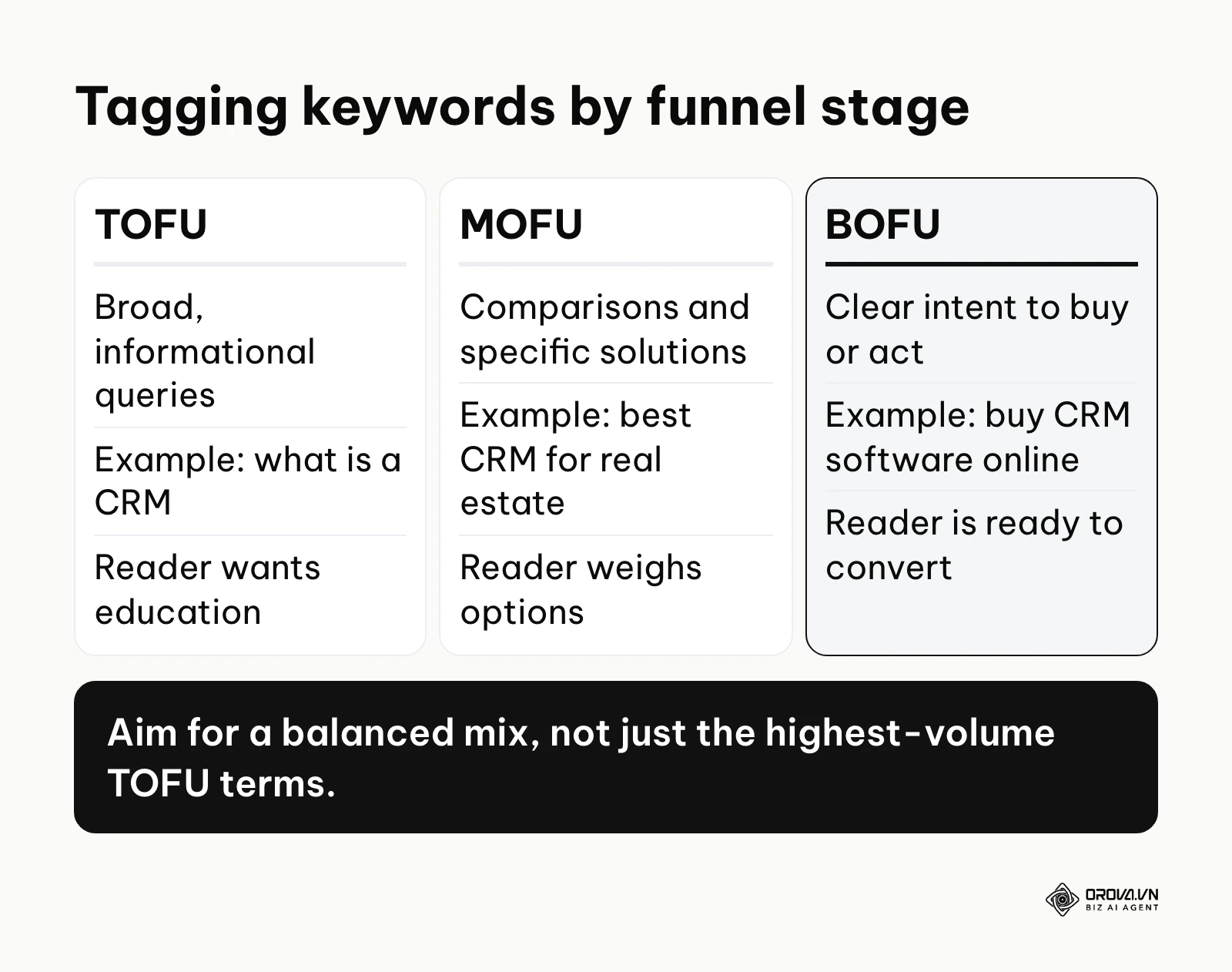
How to do it: Review each keyword on your list. If the keyword is purely informational and broad (e.g., "what is a CRM"), tag it as TOFU. These users are looking for education, not a product. If the keyword involves comparisons or specific solutions (e.g., "best CRM for real estate"), tag it as MOFU. If the keyword indicates a clear intent to purchase or act immediately (e.g., "Salesforce pricing" or "buy CRM software online"), tag it as BOFU. Your goal should be to steal a balanced portfolio of keywords from your competitors, ensuring you have content that attracts broad awareness, nurtures consideration, and drives final conversions.
Signs of success: Your spreadsheet is neatly color-coded, showing a clear distribution of intent. You can visually see if your strategy is too heavy on top-of-funnel fluff or if you are aggressively targeting bottom-of-funnel buyers.
Common mistakes: Obsessing only over TOFU keywords because they have the highest search volumes. A keyword with 10,000 searches a month that generates zero sales is vastly inferior to a BOFU keyword with 50 searches a month that generates 5 high-ticket clients.
Illustrative example:
- Context: An e-commerce store selling premium organic coffee was trying to build their organic traffic. They had exported over 500 keywords from a leading competitor's site.
- Steps: The marketing manager meticulously classified them into TOFU ("health benefits of organic coffee") and BOFU ("buy fair trade Ethiopian coffee beans online").
- Hurdle and fix: They initially spent all their resources writing massive guides for high-volume TOFU terms, resulting in a traffic spike but completely stagnant sales. They realized the error in their resource allocation and immediately shifted 80% of their writing effort to the low-volume, high-intent MOFU and BOFU terms they had identified.
- Visible result: While overall blog traffic grew slower in the following quarter, the website's organic conversion rate increased dramatically from a baseline of 0.5% to a sustained 2.1%, directly proving the financial value of rigorous funnel mapping.
Step 5: Analyze the search intent behind the data
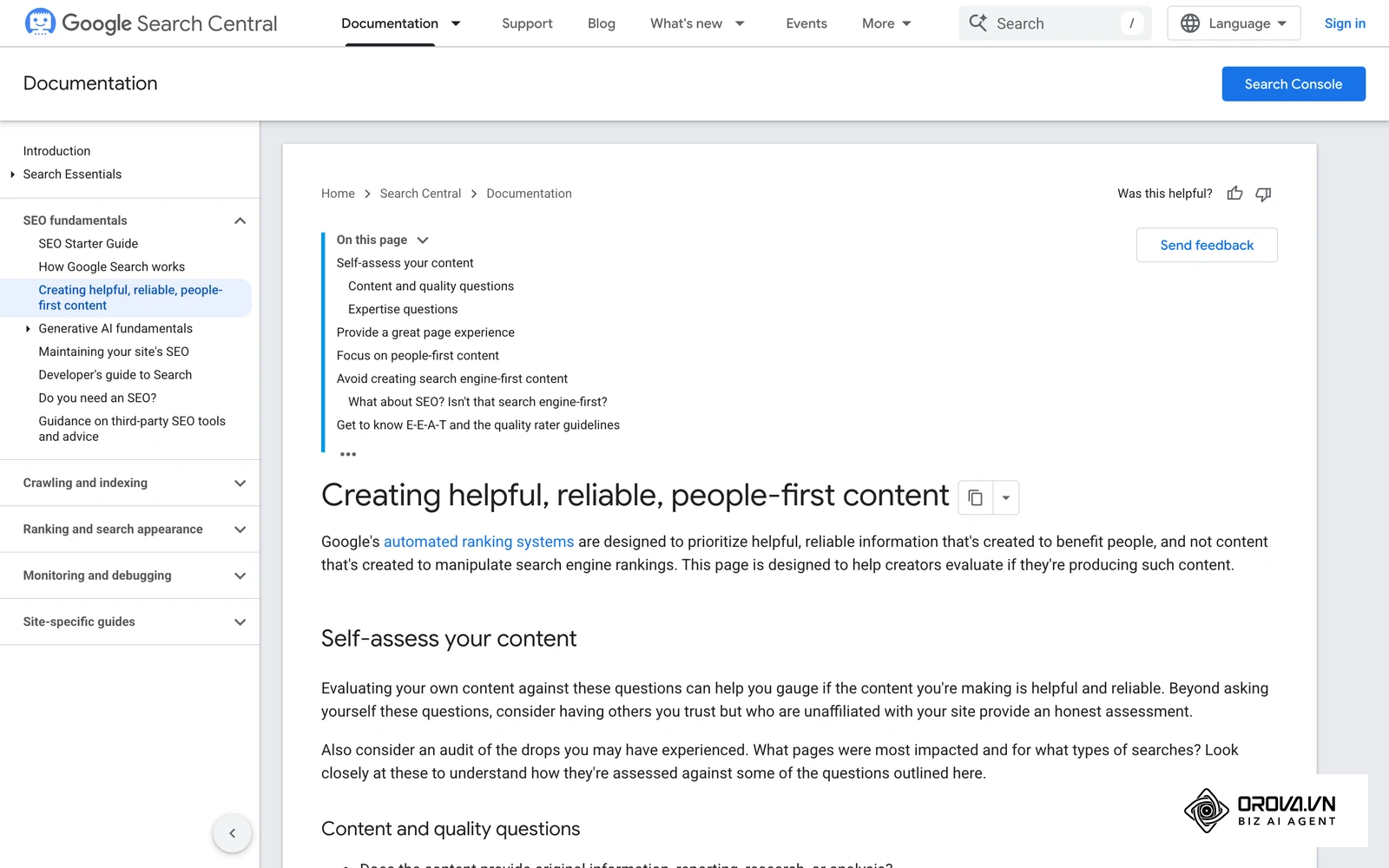
Google's public Search Quality Rater Guidelines put heavy weight on whether a page meets the searcher's needs, not just whether it repeats the exact words of the query. You have found a competitor's keyword, you know it has volume, and you know where it sits in the funnel. Now, you must look at the actual Google Search Engine Results Page (SERP) to see what format of content Google is rewarding.
How to do it: Take your target keyword and search for it on Google (again, in incognito mode). Look critically at the top 5 organic results. Are they long-form blog posts? Are they e-commerce product category pages? Are they interactive tools or calculators? Are they video tutorials? If you want to outrank your competitor, you must provide the type of content that Google has determined the user wants. If the entire page one consists of listicles ("Top 10 ways to..."), writing a dense, academic essay on the topic will almost certainly fail, regardless of how well-written it is.
Signs of success: You clearly identify a pattern in the SERPs. You can confidently state, "For this keyword, Google expects a highly visual, step-by-step tutorial with a downloadable template."
Common mistakes: Assuming that because your competitor wrote a blog post for a keyword, a blog post is the right format. Sometimes, competitors rank purely on domain authority despite having the wrong format. If you notice a misalignment between their content type and the user's likely intent, you have found a massive vulnerability to exploit.
Step 6: Create the content brief based on the keyword gap
The final step in the zero-budget workflow is taking everything you have learned and drafting a blueprint for content that is demonstrably superior to your competitor's offering. The goal is not to write the exact same article, but to create something that renders their article obsolete. This requires deep analysis of the "keyword gap"—the information they omitted, the questions they left unanswered, and the formatting they neglected.
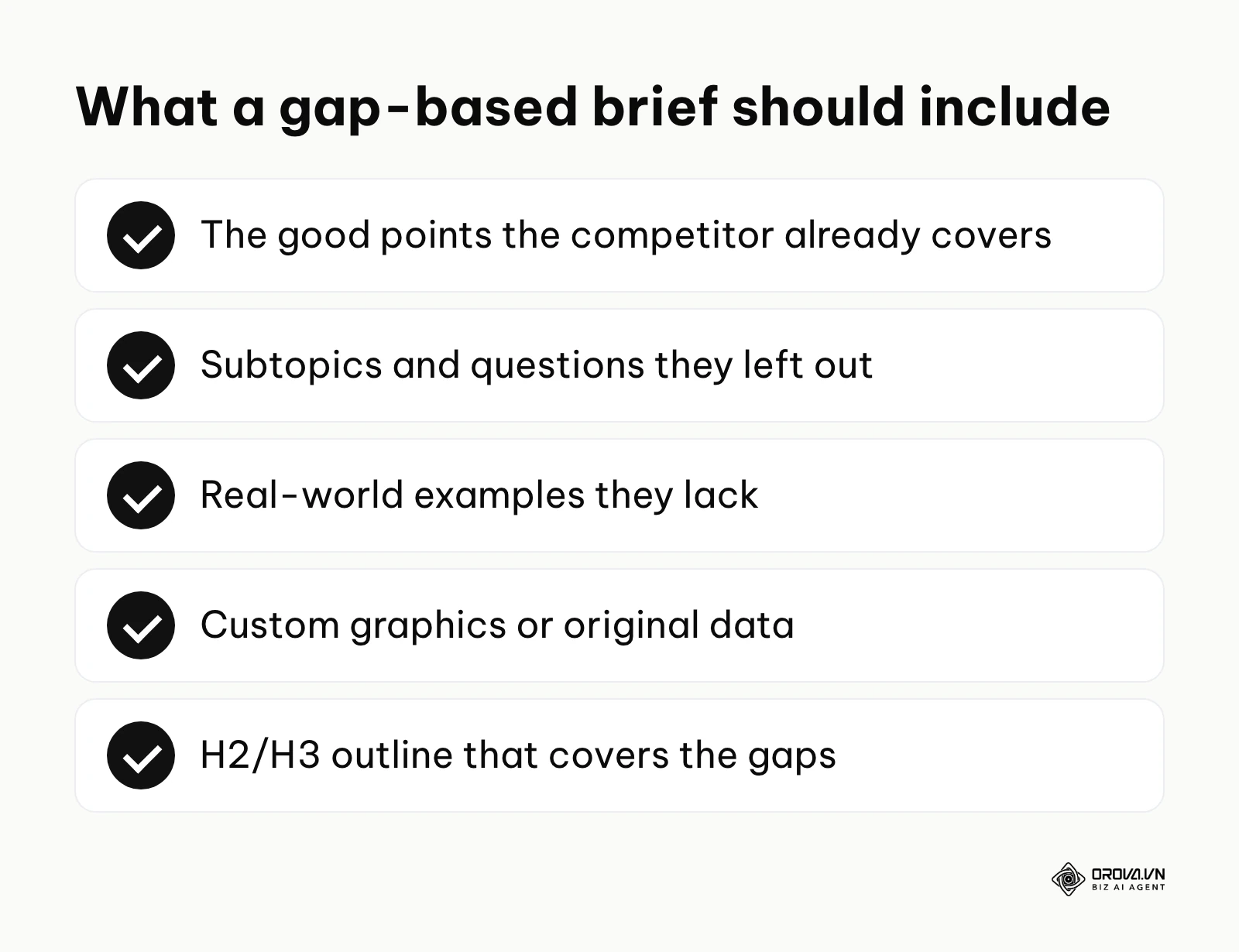
How to do it: This is where competitor site analysis gets granular. Open your competitor's article side-by-side with a blank document. Read their content critically. What are they missing? Do they lack real-world examples? Is their advice outdated? Are their images generic stock photos? Build your outline by incorporating all the good points they made, but then add the critical missing pieces. Structure your headings (H2s and H3s) to cover subtopics they ignored. Plan to include custom graphics, original data, or expert quotes that they do not possess. Your brief should be a roadmap to creating the definitive, ultimate resource on that specific topic.
Signs of success: Before you even write the first paragraph, you have a comprehensive outline that is visibly longer, more detailed, and more helpful than the competitor's existing page-one asset.
Common mistakes: Engaging in "skyscraper" content that is simply longer but not better. Adding 1000 words of fluffy filler text to a competitor's 2000-word article will not trick Google. The added depth must be genuinely valuable, insightful, and directly relevant to the user's query.
Discover Orova.vn – a Biz AI Agent platform with OROVA SEO, a complete solution for every website. The system supports search engine optimization from A to Z with features including keyword research, writing new SEO-ready articles, optimizing existing content, rank tracking, plus competitor analysis and in-depth technical analysis. Sign up today to experience OROVA SEO completely free (offer valid through July 7, 2027).
Deep analysis: How to fight high-DR competitors (and when to walk away)
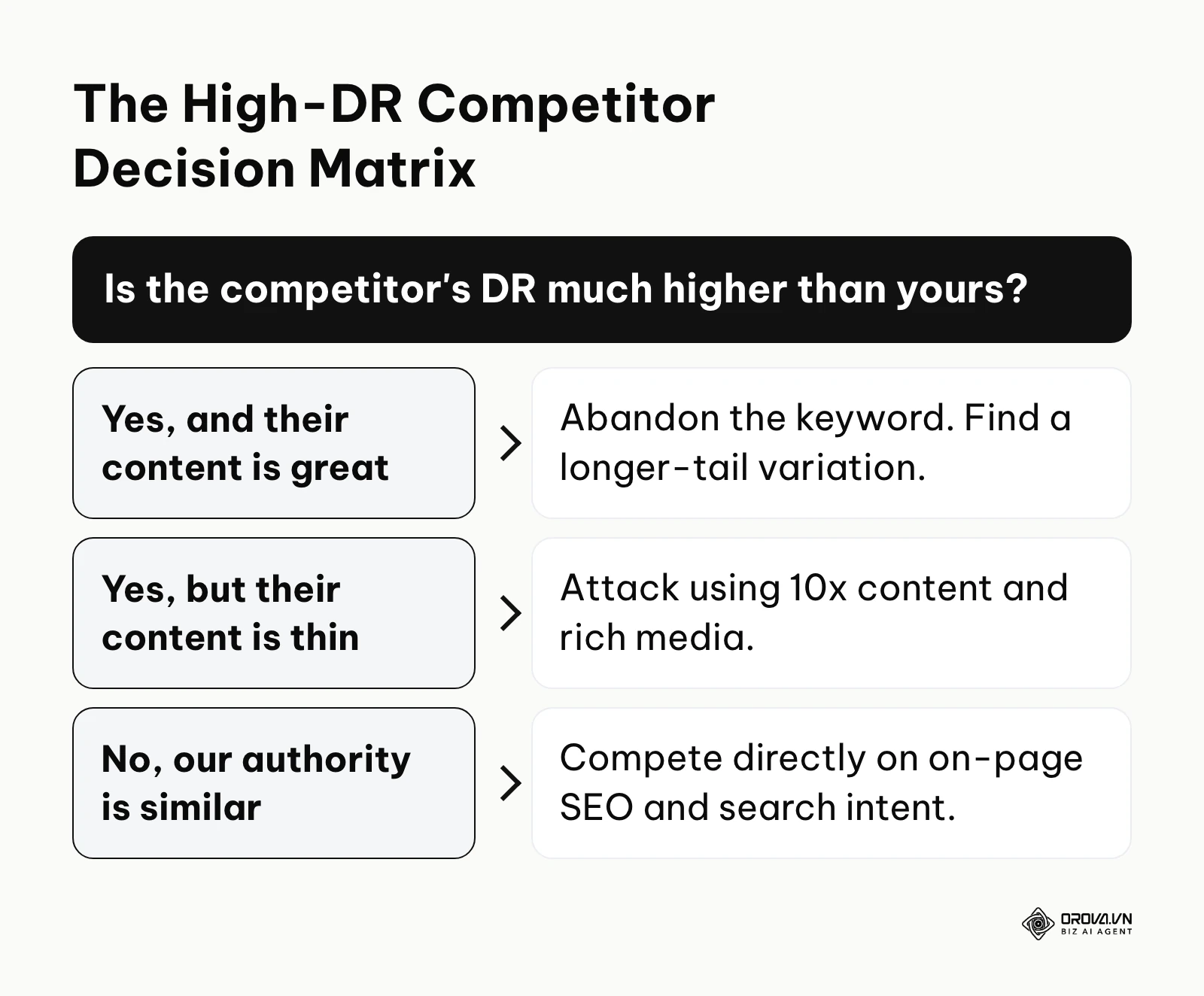
The most demoralizing moment when you learn how to find competitor keywords is discovering the perfect topic, validating its volume, mapping its intent, and then realizing the top 3 spots are occupied by Hubspot, Forbes, and Wikipedia. Domain Rating (DR) or Domain Authority (DA) are third-party metrics used to estimate a website's overall strength, primarily based on its backlink profile. When a low-DR website attempts to attack a high-DR behemoth head-on for a competitive keyword, it is usually a slaughter. However, this does not mean high-DR competitors are invincible. It requires a shift from conventional warfare to guerrilla SEO tactics.
The "David vs Goliath" strategy: Guerrilla tactics
The "David vs Goliath" strategy relies on extreme specialization. High-DR websites often suffer from content bloat and genericism. They write broad, overarching guides that cover a topic generally but lack deep, granular expertise. Your advantage as a smaller, more agile website is depth. You must identify the long-tail variations of their keywords—highly specific, multi-word phrases—that they have only briefly mentioned in passing. By dedicating an entire, incredibly detailed 10x content piece to a subtopic they barely covered, you signal to Google that for this specific, narrow query, you are the definitive expert, regardless of your overall site authority. This is the essence of on-page SEO mastery—out-optimizing the giants where they are lazy.
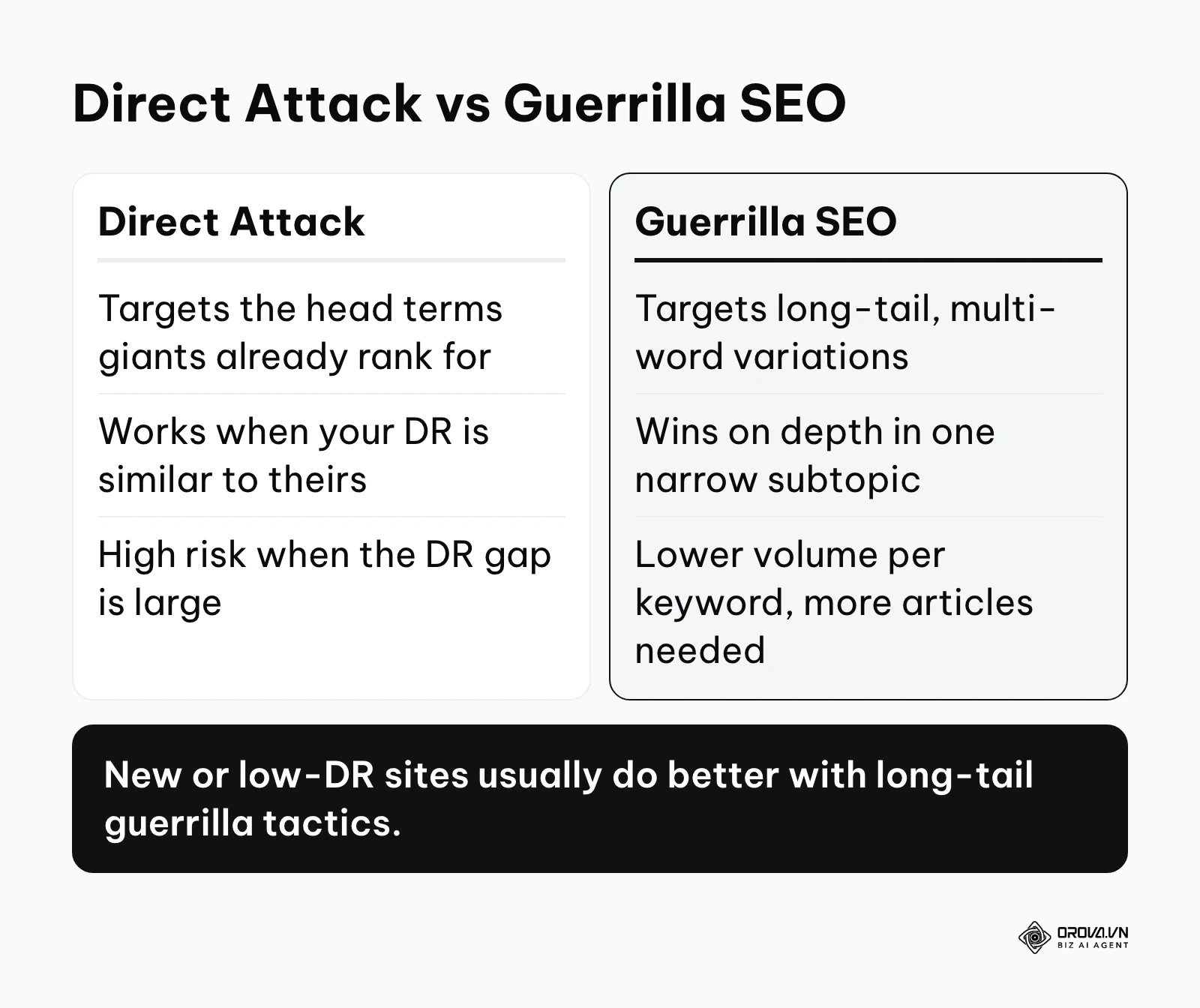
This requires a rigorous evaluation process before you commit resources to writing.
5-Step checklist to decide if you should compete against high DR
- Analyze their content depth: Is their article a thin, generic 500-word overview, or is it a masterful, interactive 4000-word guide? If it is thin, they are vulnerable, relying solely on domain authority rather than topical relevance.
- Check the exact title match: Does their page title exactly match the search query, or are they ranking based on partial relevance? If they don't have the exact keyword in their title or H1, you can win through better on-page alignment.
- Evaluate the user experience: Is their page cluttered with aggressive pop-ups, slow to load, or difficult to read on mobile? Page experience is part of what Google's ranking systems consider, and readers leave cluttered pages quickly. A cleaner, faster page can help close a DR deficit.
- Look for the "People Also Ask" gap: Check the SERP for the PAA box. Did the high-DR competitor actually answer these specific questions in their text? If not, structure your article to directly answer them thoroughly.
- Assess your internal linking capability: Can you point 5 to 10 highly relevant, authoritative internal links from your own existing content to this new piece? Strong internal architecture passes link equity and helps compensate for a lack of external backlinks.
When NOT to pursue a competitor's keyword
Knowing when to retreat is as important as knowing how to attack. There are strict exclusion criteria where targeting a competitor's keyword is detrimental to your strategy.
First, categorically exclude all competitor brand terms if your intent is conversion. Ranking for a competitor's brand name (e.g., "Mailchimp login") is a vanity metric; the user is explicitly looking for their software, not an alternative. The only exception is creating a dedicated "YourBrand vs CompetitorBrand" comparison page, which targets a very specific MOFU intent.
Second, walk away if the search intent drastically misaligns with your business model. If a competitor ranks for "free CRM templates in Excel," but you sell an enterprise CRM priced at several hundred dollars per month, capturing that traffic is pointless. The people searching for free Excel templates have zero budget and will bounce immediately when they see your pricing page.
Third, abandon the keyword if the barrier to entry requires engineering resources you do not have. If the top 3 results are all complex, interactive calculators or free software tools, writing a blog post will not work. Google has determined the user wants a tool, not text. Unless you can build a better tool, concede the keyword and move on.
| Strategy | When it fits | Weakness |
|---|---|---|
| Direct Head-on Attack | Your site has similar or higher DR; competitor content is outdated or poorly optimized. | Extremely high risk of failure if DR deficit is too large; requires massive resource investment. |
| Guerrilla Long-tail Tactics | Your site is new (low DR); competitor content is broad and lacks deep, granular expertise. | Search volume per keyword is much lower; requires creating a larger volume of hyper-specific articles. |
| The "Vs" Comparison Page | Users are actively comparing alternatives in the consideration phase (MOFU). | Can appear biased; requires delicate copywriting to remain objective while highlighting your strengths. |
Illustrative example:
- Context: A newly launched personal finance blog (DR 5) wanted to compete against major personal finance publishers with very high DR for the topic of saving money.
- Steps: They found the keyword "how to save for a house". Instead of writing a generic listicle to fight head-on, they employed guerrilla tactics. They created a 10x content piece featuring a custom-coded, interactive local real estate tax calculator specifically for first-time buyers in Texas.
- Hurdle and fix: After two months, the page was stuck on page 3. The founder realized it lacked topical authority signals to bridge the DR gap. They fixed this by publishing 5 smaller, supporting articles about Texas real estate laws and internally linking them all directly to the main calculator page.
- Visible result: The deep, specialized content combined with strong internal linking propelled the page to position 8 on page 1 within four months, capturing steady daily traffic that generic high-DR competitors simply couldn't touch with broad content.
Measuring the impact of your stolen keywords
Executing competitor keyword research is only the first phase; measuring the tangible impact of your efforts is what justifies the investment. Without rigorous tracking, you are operating blindly, unable to determine if your guerrilla tactics are succeeding or if your content is languishing in the depths of the search index. You must monitor a combination of leading indicators (which show early signs of movement) and lagging indicators (which prove actual business value).
The primary arena for this measurement is, once again, Google Search Console. After publishing your superior content, you should regularly monitor the "Performance" report. Do not expect immediate page-one rankings. Instead, look for impressions. If your page begins generating hundreds of impressions for your target keyword within the first few weeks, even if it is on page 4, it is a massive leading indicator of success. It means Google has indexed your page, understood its relevance, and placed it in the competitive arena. Over the ensuing months, you want to see a gradual increase in Average Position, followed by an increase in Clicks.
For lagging indicators, you must rely on web analytics platforms like Google Analytics 4 (GA4). It is not enough to simply steal traffic; you must track what that traffic does once it arrives. By setting up conversion events, you can measure how many users who landed on your carefully crafted BOFU article actually requested a demo, signed up for a newsletter, or made a purchase.
| SEO Metric | Meaning and Importance | Alarming threshold (When to worry) |
|---|---|---|
| Impressions (GSC) | Google considers your page relevant enough to show it in search results. | Zero impressions after 4 weeks of indexing indicates a severe relevance or technical issue. |
| Average Position (GSC) | Your numerical ranking on the search engine results page. | Stuck below position 20 after 6 months; signals a need for massive content updates or backlinks. |
| Organic CTR (GSC) | The percentage of people who see your link and actually click it. | Below 1% for a page 1 ranking; your title tag or meta description is failing to attract users. |
| Conversion Rate (GA4) | The percentage of visitors completing a desired business action. | High traffic but near 0% conversion indicates a catastrophic misalignment with search intent. |
The timeline for these results varies wildly based on website authority and competition. For a low-competition, long-tail keyword targeted by a mid-DR site, you might see page-one results in 4 to 8 weeks. For a medium-to-high competition keyword, a new website must prepare for a 6 to 12-month grind of continuous optimization, internal linking, and patience. SEO is a marathon of compound interest, not a day-trading scheme.
With OROVA.VN and the OROVA SEO module, you put an end to the exhausting days of manual work for good. Instead of struggling for hours to write articles and compile reports, the entire process is now optimized and completed in just 5 minutes.
Common mistakes when you find competitor keywords
Even with a flawless zero-budget workflow and a deep understanding of domain authority, marketers frequently sabotage their own efforts through predictable, avoidable errors in execution. Competitor keyword research is a delicate operation; misinterpreting the data can lead to months of wasted writing. Here are the most critical mistakes to avoid.
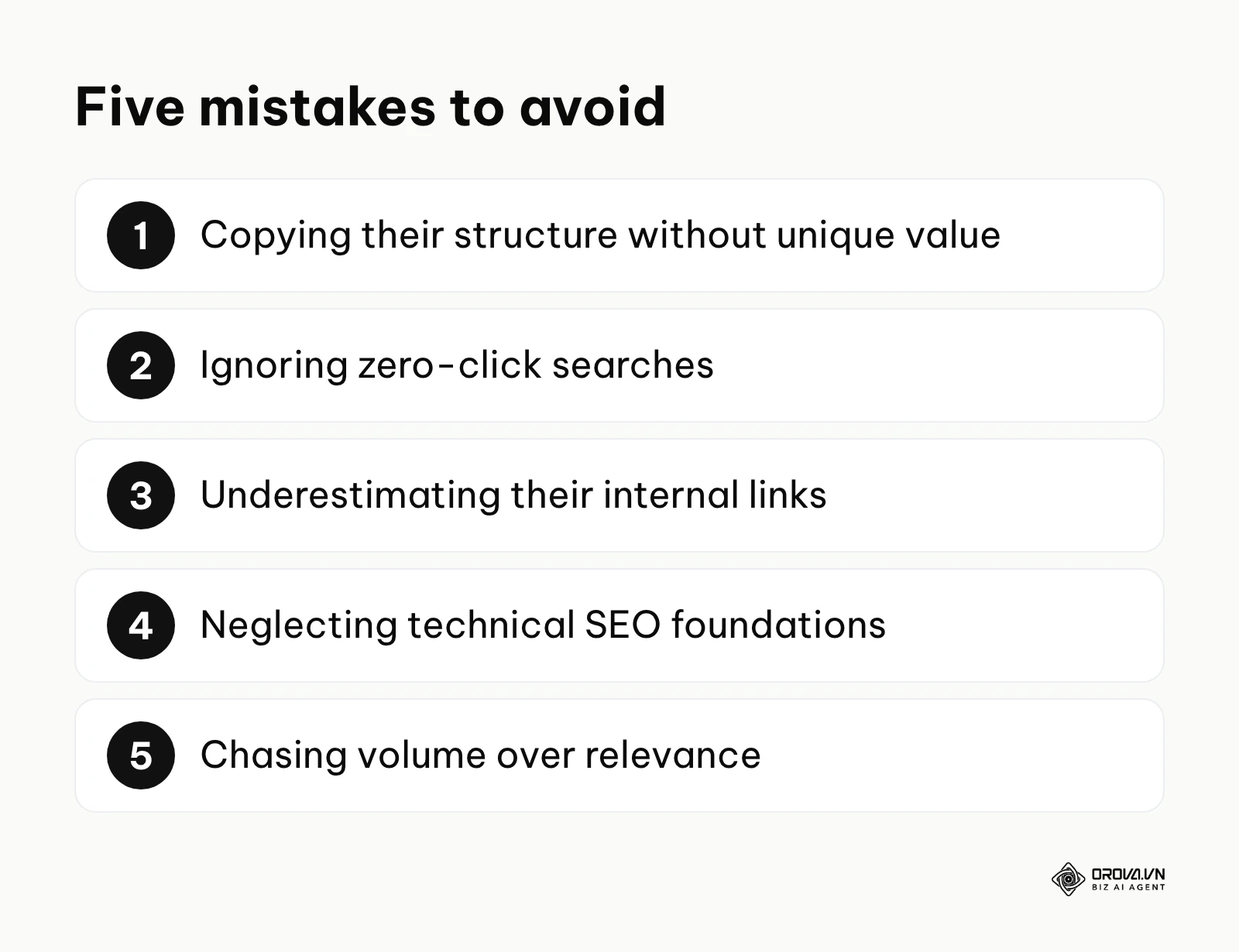
First, blindly copying the competitor's structure without adding unique value. If you look at a competitor's article and simply rewrite their exact headings using synonyms, you have created a commodity. Google has no incentive to rank a slightly reworded duplicate of an article it already trusts. You must inject original research, unique graphics, or a contrarian viewpoint to justify outranking them. Consequence: Your page gets indexed but permanently stuck on page 3. Fix: Always aim to create 10x content—material that is ten times more helpful, comprehensive, or user-friendly than the current top result.
Second, ignoring the reality of zero-click searches. Some keywords have massive search volumes but generate almost zero clicks because Google answers the query directly on the SERP with a featured snippet, a calculator, or an AI overview. Targeting "what time is it in London" is useless because no one clicks through to a website for the answer. Consequence: You rank number one but receive zero traffic. Fix: Always manually inspect the SERP before writing. If the page is dominated by massive Google widgets that perfectly answer the question, abandon the keyword.
Third, failing to account for the competitor's internal link structure. You might look at a competitor's page, see it is poorly written, and assume it will be an easy victory. However, if that poorly written page has 50 internal links pointing to it from highly authoritative pages within their own site, it will be incredibly resilient. Consequence: You write a better article but still cannot outrank their inferior content. Fix: Use search operators (e.g., site:competitor.com "target keyword") to estimate how aggressively they are internally linking to their target page. Be prepared to build a stronger internal architecture.
Fourth, neglecting technical SEO foundations. You can write the greatest, most intent-aligned article in the world based on flawless competitor research, but if your website takes 10 seconds to load, has broken mobile rendering, or suffers from chaotic architecture, Google will suppress it. Consequence: Brilliant content is buried due to infrastructure failures. Fix: Ensure your technical SEO foundations are pristine before launching a massive content offensive.
Fifth, chasing volume over relevance in specific industries. In the realm of ecommerce SEO, stores often try to steal broad, high-volume informational keywords from publisher blogs, completely forgetting that their site architecture is designed to sell products, not host academic essays. Consequence: High bounce rates and confused user journeys. Fix: E-commerce sites should ruthlessly focus on competitor product category keywords and specific transactional long-tail queries.
Where competitor keyword research is heading in the next few years: the author's take
The integration of AI Overviews into standard SERPs
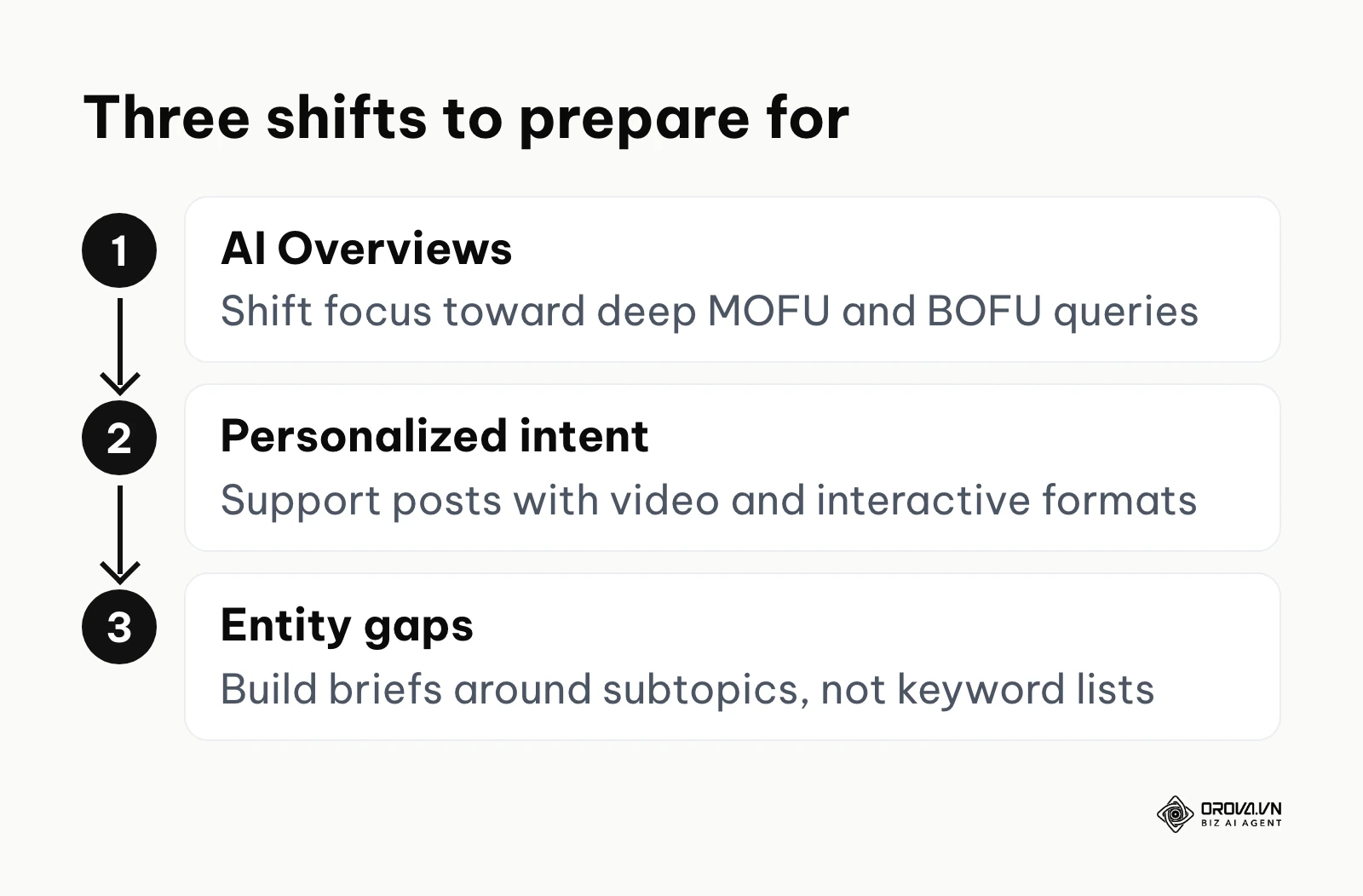
We are witnessing a real shift in how search engines present information. AI-generated summaries at the top of search results now appear for many informational queries. I believe that in the next 2-3 years, traditional competitor keyword research that focuses purely on extracting lists of informational "what is" queries will become largely obsolete. If an AI can answer a TOFU query perfectly without the user ever clicking a link, ranking organically below that AI block yields diminishing returns. Marketers must prepare now by aggressively shifting their keyword targeting strategy towards deep MOFU and BOFU queries—topics that require human experience, nuanced opinion, complex comparisons, and proprietary data that AI cannot easily summarize. The battleground is moving from basic information retrieval to trusted advisory content.
The rise of hyper-personalized search intent
Historically, we analyzed keywords as monolithic entities; a keyword had one primary intent. Today, we are seeing signs that search engines are heavily customizing results based on granular user history, location, and device context. I hypothesize that the future of competitor analysis will move beyond just knowing what a competitor ranks for, to understanding for whom they rank. A keyword might show a video tutorial to one user and an e-commerce page to another. To prepare, content creators must begin adopting a multi-format strategy. It will no longer be enough to just write a blog post; you must support that post with embedded video, interactive elements, and localized nuances to capture the fragmented, personalized intent of the exact same keyword.
The shift from keyword gaps to entity gaps
The era of meticulously counting how many times a competitor used a specific phrase is fading. Search engines now understand topics as interconnected "entities" rather than just strings of text. I strongly lean towards the prediction that future competitor research will focus entirely on entity mapping. Instead of asking "Did the competitor use the keyword 'best running shoes'?", we will ask, "Did the competitor cover the entities of pronation, sole durability, and moisture-wicking materials within their running shoe guide?" You should prepare by structuring your content briefs not around lists of keywords to inject, but around comprehensive lists of related subtopics and concepts that must be thoroughly explained to establish true topical authority.
Frequently asked questions about competitor keyword research
Should I prioritize hard keywords from weak competitors or easy keywords from strong competitors?
This is a classic strategic dilemma. Generally, you should prioritize easy keywords from strong competitors, specifically the long-tail variations they have ignored or covered thinly. A strong competitor might rank for an easy, obscure long-tail phrase simply because of their overall domain authority, without having a dedicated page for it. By creating a highly targeted, 10x content piece specifically for that easy phrase, you can often outmaneuver them. Attempting to steal hard, highly competitive head terms from a weak competitor is often a trap; if the keyword is truly hard, other massive sites are likely competing for it as well, making the battle incredibly difficult regardless of the one weak competitor you spotted.
How do I find competitor keywords if my niche is extremely small or local?
In hyper-niche or local markets, standard keyword volume tools often report "zero searches," which can be misleading. In these scenarios, you must rely heavily on manual search operators and analyzing the actual structure of local competitors' websites. Use operators to find their service pages and blog posts. Furthermore, leverage Google Search Console for SEO extensively; look at the exact, bizarre long-tail queries that bring a trickle of traffic to your own site, and aggressively expand on those topics. In small niches, relevance and extreme specificity trump raw search volume every time.
Can a competitor see that I am researching their keywords?
If you are using the zero-budget methods described in this guide—such as Google search operators or analyzing their URLs in Google Keyword Planner—your research is completely invisible to them. You are interacting with Google's index and databases, not their website servers directly. Even if you use paid third-party tools, that data is aggregated and anonymized. A competitor will only know you targeted their keyword when you finally publish superior content, outrank them on the SERP, and begin siphoning their organic traffic.
Will AI make manual competitor keyword research obsolete?
AI is fundamentally changing how we process data, but it will not render the strategic element of research obsolete. AI is excellent at rapidly categorizing lists, identifying patterns, and suggesting related topics. However, the critical decisions—evaluating whether a high-DR competitor's content is actually good, deciding if a keyword aligns with your specific business model, and determining the nuances of search intent—still require deep human business acumen. AI is a powerful assistant that accelerates the workflow, but the strategic direction must remain human-led.
Where to start today?
The sheer volume of data involved in competitive analysis can induce paralysis. Do not attempt to map your entire industry in one sitting. Based on your current situation, here is exactly where you should focus your energy during your next work session.
If you have a brand new website with zero traffic, your immediate focus must be on identifying the low-hanging fruit. Spend your next hour executing Step 1 and Step 2 of the workflow. Use Google search operators to scrape the blogs of your closest mid-tier competitors. Do not worry about search volume yet. Your goal is simply to build a raw list of 50 highly specific, long-tail topics that they have written about. This gives you a foundational understanding of the topical map you need to build.
If you have an established blog that has plateaued, you are likely suffering from poor funnel alignment. Your task is to export your current ranking keywords from Google Search Console and apply the principles from Step 4. Spend an afternoon brutally categorizing your existing traffic into TOFU, MOFU, and BOFU. You will almost certainly discover a glaring gap—usually a massive amount of awareness traffic with zero conversion-focused content to support it. Your next month of writing should be dedicated exclusively to filling that specific funnel gap.
If you are consistently ranking on page 2 but cannot break into page 1, you are losing the search intent battle or the depth battle against high-DR sites. Take your top 5 most frustrating page 2 keywords and execute the 5-step checklist from the Deep Analysis section. Manually review the pages outranking you. Identify exactly what format they are using and what subtopics they covered that you missed. Your immediate action is to take one of your page 2 articles and rewrite it into 10x content, aiming to unequivocally crush the current top result in terms of sheer value and comprehensive detail.
About the author

Builder of Orova
Nguyễn Đỗ Trọng Ân has 8 years of experience in marketing, including 6 years managing market development across Asia. He builds Orova, a Biz AI Agent that never sleeps: it plans, runs and optimizes work for businesses.
Run your business with AI Agents
Orova is the always-on Biz AI Agent — it plans, runs, and optimizes the work for you.
Save time, unlock productivity.