
What is on page SEO? A practical guide for the AI search era

On page SEO is everything you do on a single web page to help search engines understand it and to help the right readers choose it: the content itself, the title tag, headings, URL, images, internal links and structured data. If you publish good work and still see flat traffic, the page is often failing at one of these jobs, not at "SEO" in general.
Many marketers still treat on-page work as a keyword game: put the phrase in the heading, repeat it a few times, hope for the best. That approach has aged badly. Google's systems try to work out what a searcher actually needs, and AI Overviews now summarize answers before anyone clicks. This guide explains what on page SEO is, how it works today, how it differs from technical and off-page SEO, and how to audit and update pages without guessing.
What is On Page SEO?
On page SEO is the practice of optimizing individual web pages so they rank for relevant searches and earn clicks from the right people. It covers page-level elements you control directly: content, title tags, meta descriptions, headings, URLs, images, internal links and structured data. It sits inside the broader discipline of search engine optimization, next to technical SEO and off-page SEO.
To see where it fits, compare it with the other two core disciplines:
| Concept | How it differs | Example |
|---|---|---|
| On-Page SEO | Focuses on the content, context and HTML elements of a specific page. | Writing a comprehensive guide, choosing a clear H1, adding descriptive image alt text. |
| Off-Page SEO | Focuses on signals and reputation built outside your website. | Earning links from industry publications, brand mentions in the press. |
| Technical SEO | Focuses on infrastructure, crawlability and site-wide performance. | Improving server response time, fixing XML sitemaps, making the site mobile friendly. |
Think of a website like a house for sale. Technical SEO is the foundation and plumbing, making sure the house is structurally sound. Off-page SEO is the neighborhood's reputation, what other people say about the property. On-page SEO is the staging: arranging the rooms so the specific buyer who walks through the door immediately sees why this house fits them.
The Purpose and Meaning of On Page SEO
On page SEO exists to solve a communication problem between people and machines. A person can glance at a well-designed page and know it sells running shoes. A crawler sees HTML, text and links. On-page optimization makes the human value of the page explicit in a form search engines can parse: a title that names the topic, headings that outline it, alt text that describes images, and links that place the page in context.
In a full SEO strategy, on-page work sits in the middle. It depends on technical SEO, because if crawlers can't reach or render the page, nothing on it counts. And it supports off-page SEO, because links and mentions help most when the page they point to is clearly about something. Skip on-page work and even a page with strong backlinks may rank for the wrong queries, or for none.
If you ignore it, you lose control over how your page is presented. Search engines will still try to guess the topic, and they may pull an unhelpful snippet, misread the core subject, or match the page to searches that bring no business value.
When you don't need on page SEO yet: if your site is still in a closed beta or a staging environment, heavy optimization is premature. Likewise, if a landing page exists only for a three-day paid campaign and will be removed afterward, organic search is the wrong tool. In those cases, put the effort into conversion rate optimization and ad copy instead of title tags and entities.
The Value and Benefits of On Page SEO
The payoff from on-page work shows up at two levels: the business and the person doing the work.
Business Value: Revenue and Risk Mitigation
For a business, an optimized page is an asset. Paid traffic stops when the budget stops; a page that ranks can keep attracting visitors for months or years. Over time that can lower your blended customer acquisition cost. It also reduces risk: a site built on genuinely helpful, well-structured content is on firmer ground during algorithm updates than a site that depends on manipulative link tactics.
Practitioner Value: Control and Clarity
For the person doing the work, on-page SEO is the part of search you control most. You can't force a journalist to link to you, but you decide every word, heading and image on your own pages. That makes the work repeatable: you can change something, measure it, and keep or revert it based on data.
| Benefit | How to measure it | Where to look |
|---|---|---|
| More relevant organic traffic | Clicks and impressions for the queries you target | Google Search Console, Performance report |
| Better engagement | Engaged sessions, scroll depth, conversions | Your analytics tool |
| Higher click-through rate (CTR) | CTR per query and per page | Google Search Console |
| Lower acquisition cost | Cost per lead or customer across channels | Your CRM and finance data |
How fast results appear varies a lot by site, competition and how often Google recrawls the page, so compare each page against its own baseline rather than a generic timeline.
Discover Orova.vn – a Biz AI Agent platform with OROVA SEO, a complete solution for every website. The system supports search engine optimization from A to Z with features including keyword research, writing new SEO-ready articles, optimizing existing content, rank tracking, plus competitor analysis and in-depth technical analysis. Sign up today to experience OROVA SEO completely free (offer valid through July 7, 2027).
How On Page SEO Works (The AI-First Framework)
Modern on-page optimization goes beyond a list of tags. It starts with intent, then shapes the content so both people and machines can understand and reuse it, and only then polishes the HTML.
Mapping Content to the Search Intent Matrix
Before you write a word, match the page to the searcher's intent. Google is very good at inferring why someone searches, and if your format doesn't fit that reason, keyword placement won't rescue it.
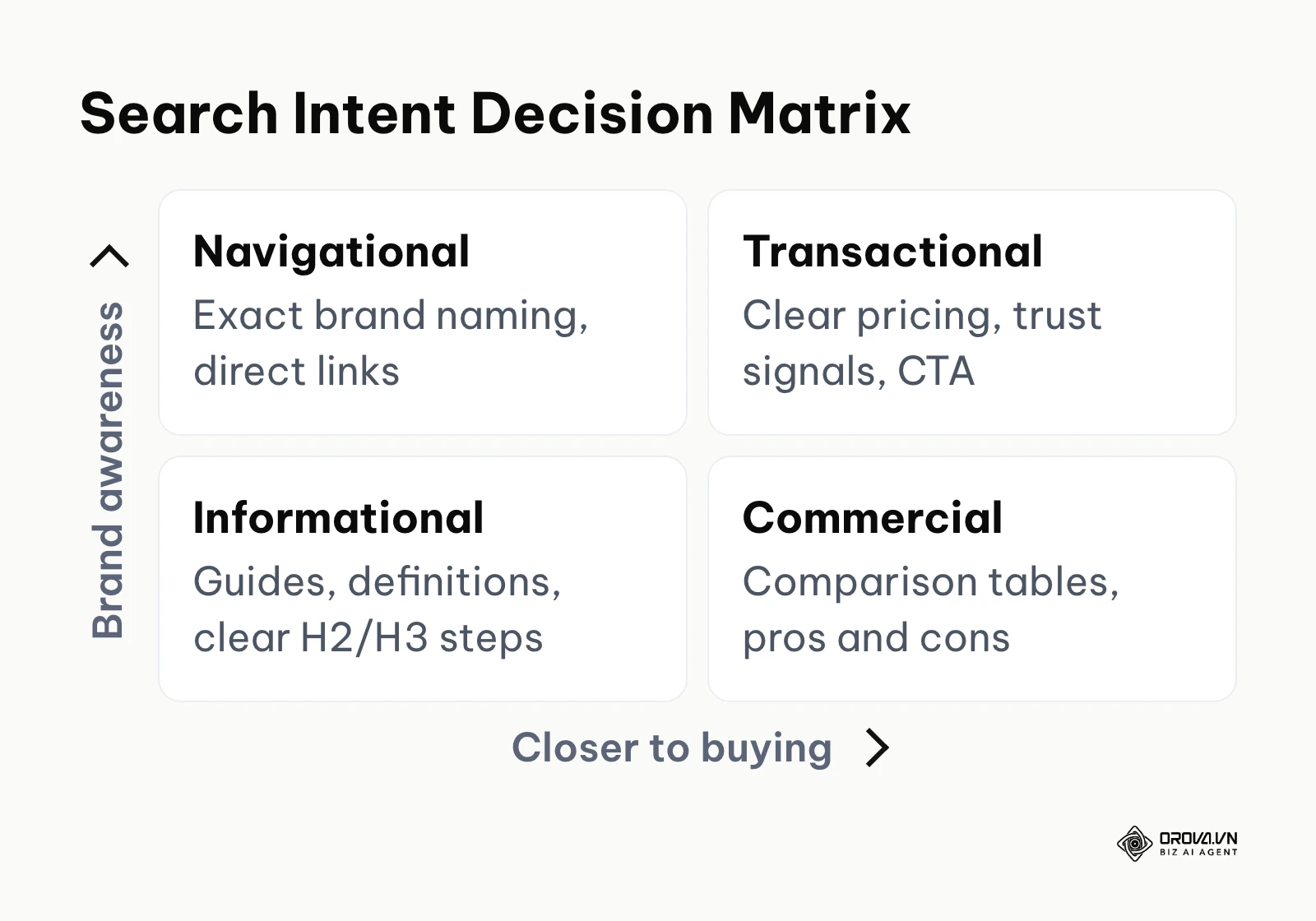
There are four primary intents, and your on-page setup should change with each:
- Informational Intent: The user wants to learn.
- On-Page Setup: Long-form guides, clear step-by-step headings (H2/H3), lists, and a table of contents. Educational language, no aggressive sales pitch.
- Commercial Intent: The user is comparing options before buying.
- On-Page Setup: Comparison tables, pros and cons, feature matrices and fair reviews. A layout built for quick scanning.
- Transactional Intent: The user is ready to buy or sign up.
- On-Page Setup: Few distractions, an H1 that names the product, trust signals, clear pricing, good product images and a visible call to action near the top.
- Navigational Intent: The user wants a specific brand or page.
- On-Page Setup: Exact brand naming, fast loading and direct links to the destination (for example, "Company X Login").
The quickest way to check intent is to search the keyword yourself and look at what already ranks: guides, product pages, comparison lists or a brand's own pages.
Illustrative example: Correcting an intent mismatch
- Context: A mid-sized B2B software company wanted to rank for "best inventory management software" with a direct sales landing page.
- What they did: They reviewed the top-ranking pages and saw they were all comparison guides. They rewrote the page as a fair comparison of several tools in the market, including their own, and added a comparison table plus pros and cons for each tool.
- Snag and fix: The sales team objected to naming competitors. Marketing compromised by highlighting their product's real strengths while staying factual about the others.
- Result: The page finally matched what searchers wanted, and it began to climb toward the first page and bring in better-qualified leads.
Optimizing for AI Overviews and Agentic Search
AI Overviews (which grew out of Google's earlier Search Generative Experience) and AI agents that browse on a user's behalf don't just list your page; they summarize it. If you want a deeper look at this shift, see our guide to AI SEO.
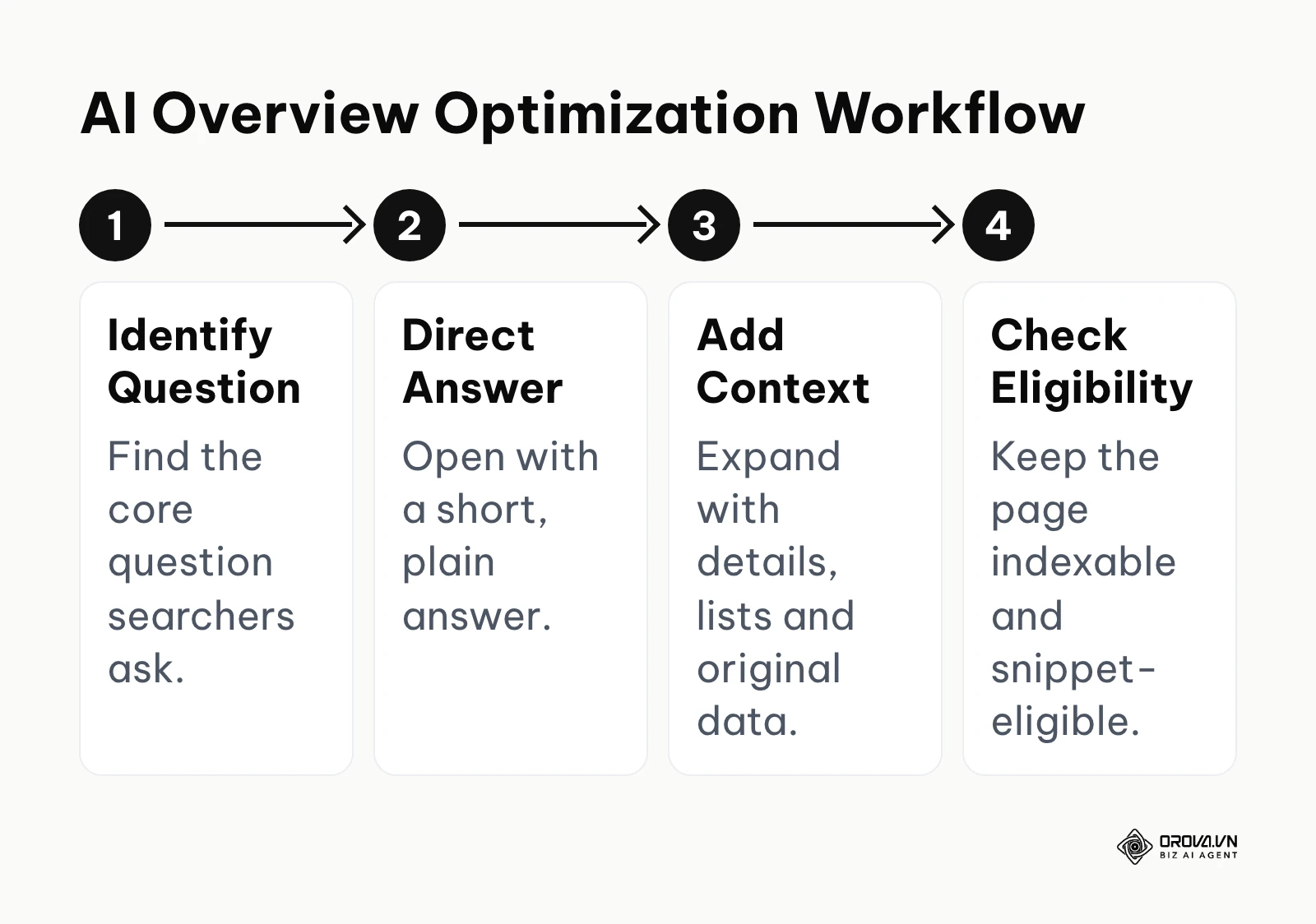
Google states that there are no extra technical requirements to appear in AI features: the same fundamentals apply, meaning the page must be indexable and eligible for a snippet, and the content must be helpful. What you can control is how easy your content is to understand and quote.
Two habits help. First, add something others don't have: original data, a clear framework, a worked example, a first-hand comparison. SEOs often call this "information gain." Second, use a direct-answer structure. When a heading asks a question, open the section with a short, plain answer (a few sentences, no warm-up), then expand with details or a list. This is the same pattern that helps with People Also Ask boxes, and it makes your text easier for any system to extract and cite. It doesn't guarantee inclusion, but it removes friction.
Semantic SEO and Entity Injection
Google doesn't rely only on matching keyword strings; it also tries to understand entities. An entity is a distinct, well-defined thing or concept, such as a person, place, organization, product or idea, and Google's Knowledge Graph stores facts about how entities relate.
If you write about "Apple," repeating the word "Apple" doesn't settle which Apple you mean. Mentioning related entities like "Tim Cook," "iPhone" and "Cupertino" makes it clear you mean the company, not the fruit. That context is what semantic SEO is about.
You may hear the phrase "LSI keywords." Latent semantic indexing is an old information-retrieval technique, and Google has said it doesn't use "LSI keywords." The useful idea behind the phrase is simply this: cover the topic fully and use the vocabulary a knowledgeable person would naturally use.
How do you find related entities without expensive tools?
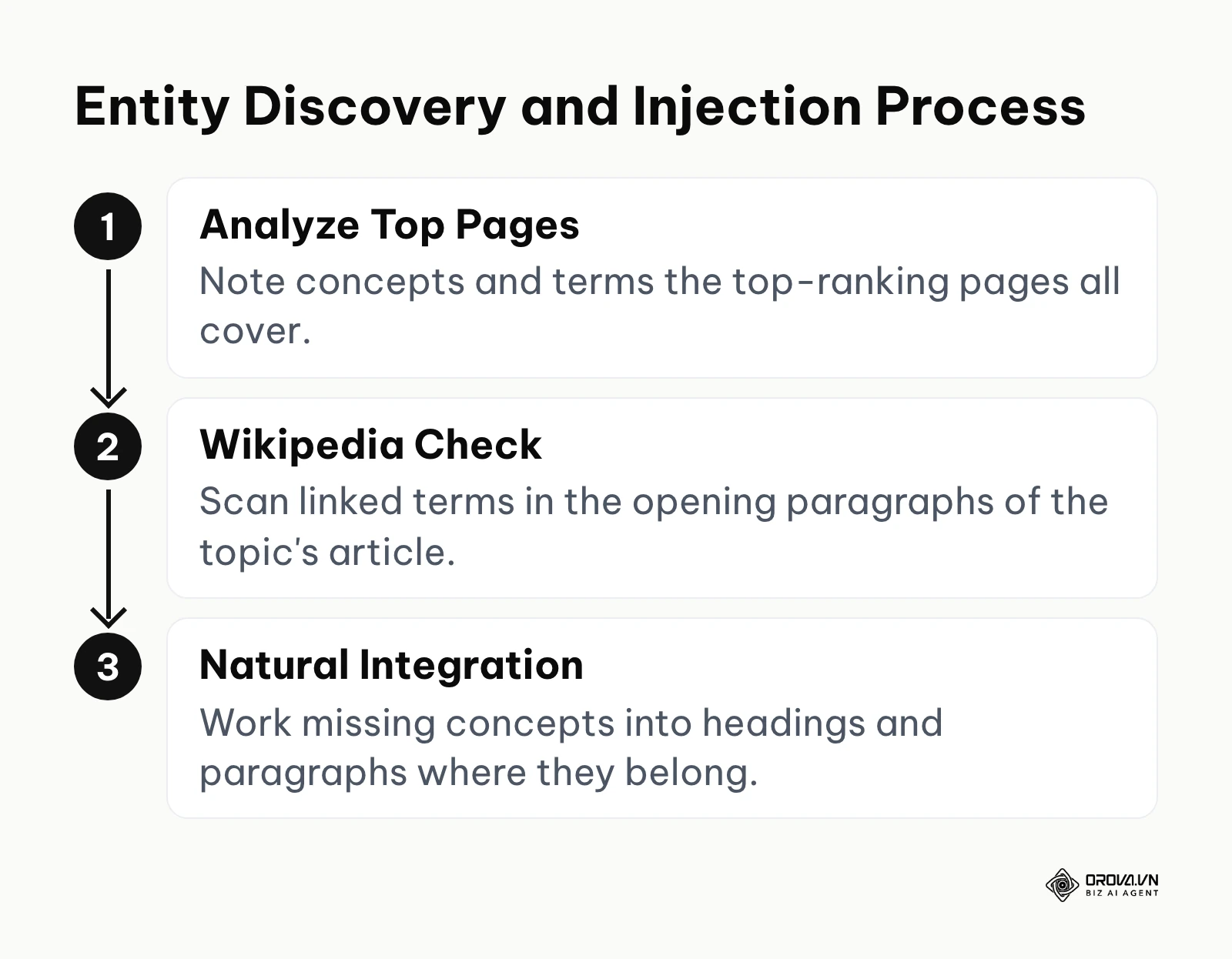
- Read the top-ranking pages and note the concepts, people, tools and terms they all cover.
- Look up your main topic on Wikipedia and scan the linked terms in the opening paragraphs; they show which concepts are commonly connected to it.
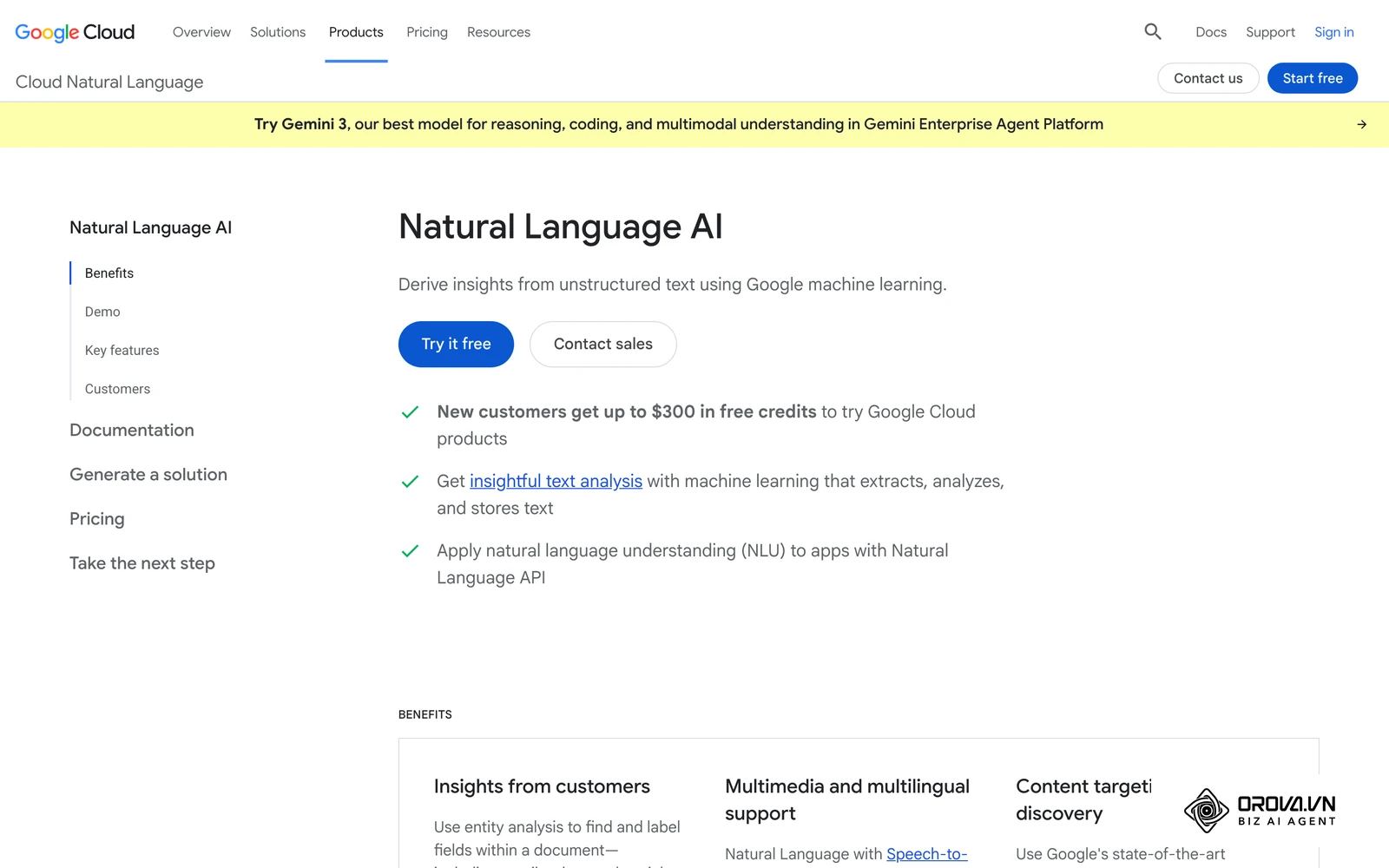
- Paste your draft into an entity-analysis demo, such as Google Cloud's Natural Language API, to see which entities a machine detects in your text.
Then work the missing concepts into your headings and paragraphs where they genuinely belong. Our SEO content writing guide covers how to do that without making the text read like a list of terms.
The Anatomy of a Perfectly Optimized Page
Semantic depth matters, but the core HTML elements are still the main signposts. Google's SEO Starter Guide recommends titles that are unique to each page and describe its content clearly and concisely.
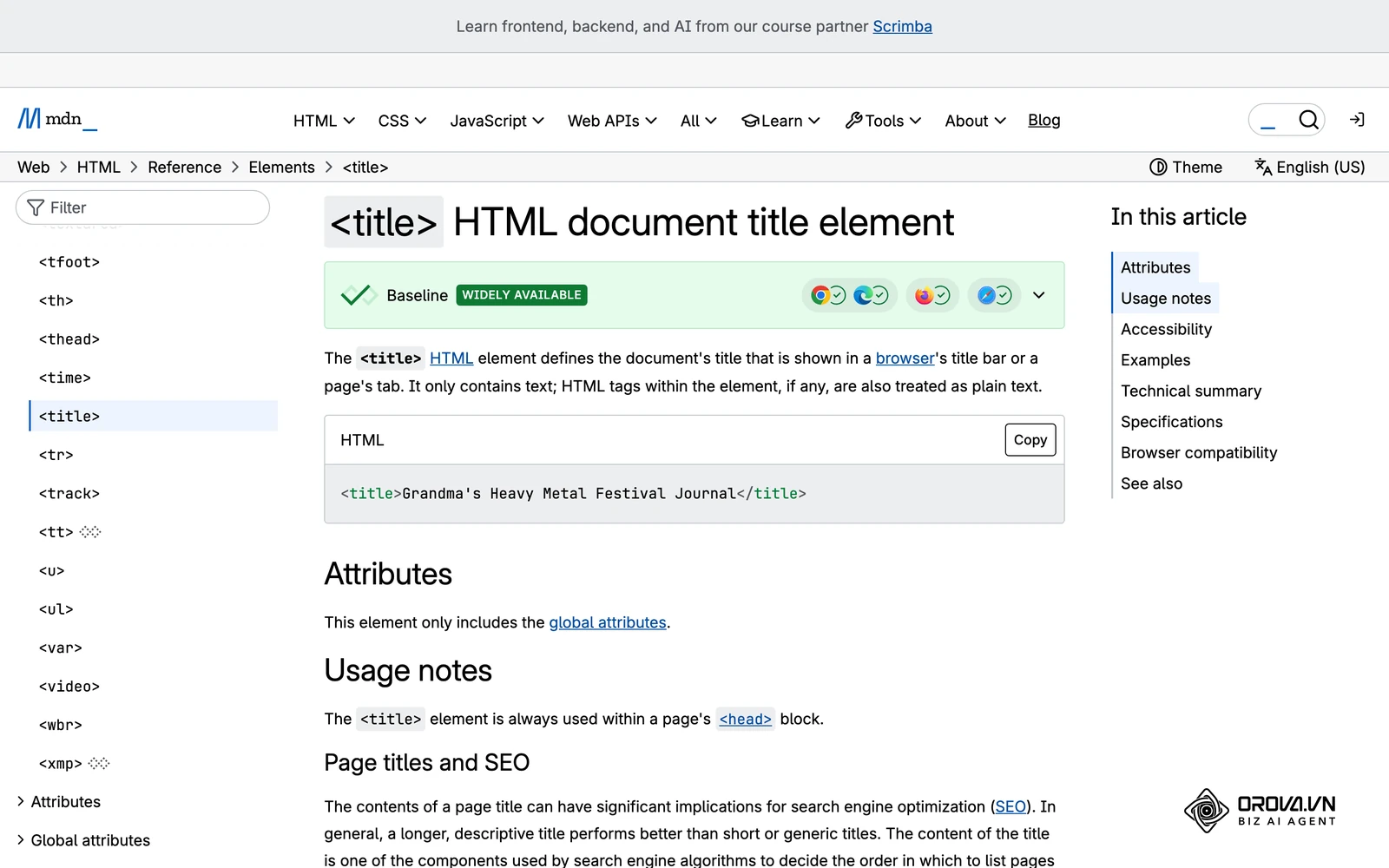
- Title tag: Put the main topic near the front. Google trims titles by pixel width, so titles of roughly 50 to 60 characters usually display in full. Google may also rewrite the title link it shows, often when the title is vague, stuffed or doesn't match the page.
- Meta description: A summary that works like ad copy in the results. Around 150 to 160 characters often displays fully on desktop. It isn't a ranking factor, and Google may show different text from the page if that better matches the query.
- Meta keywords tag: Google doesn't use it for ranking. You can leave it out.
- Headings (H1, H2, H3): Use one clear H1 that states the page topic (a sensible convention, though Google doesn't penalize more than one), H2s for the main subtopics and H3s for details. The result should read like a logical outline.
- URL structure: Short, descriptive and hyphen-separated. A slug like what-is-on-page-seo is far easier to understand than an ID string such as post-id-12345.
- Images: Search engines rely on text around an image to understand it. Use descriptive file names (for example, blue-running-shoes.jpg), alt text that describes what the image shows in context, and compressed files so the page stays fast.
Illustrative example: Fixing the anatomy of a page
- Context: A local bakery had a wedding cake page stuck on page 3 of the results, generating no inquiries.
- What they did: They changed the H1 from "Our Services" to "Custom Wedding Cakes in [City Name]," compressed several oversized photos that slowed the page, and replaced alt text like "IMG_9921" with "three-tier rustic wedding cake with fresh roses."
- Snag and fix: The owner didn't know how to compress images without losing quality, so they used a free batch compression tool and checked the results by eye.
- Result: The page loaded noticeably faster on phones, and over the following weeks it started appearing in local image results and bringing in tasting requests.
Internal Linking and Information Architecture
Pages don't exist in isolation. How they link to each other shapes how crawlers discover them and how ranking signals flow through your site. A practical internal linking strategy groups pages into topic clusters.
A broad pillar page (for example, a complete guide to email marketing) links to specific cluster pages (subject lines, segmentation, deliverability), and those cluster pages link back to the pillar with descriptive anchor text. This structure helps Google understand which page is your main resource on the broader topic and which pages go deeper on parts of it.
The Advanced On-Page SEO Audit Process
Optimizing once isn't enough; pages drift as competitors publish and searcher needs change. A simple audit sheet keeps the work systematic. A useful audit has three tiers:
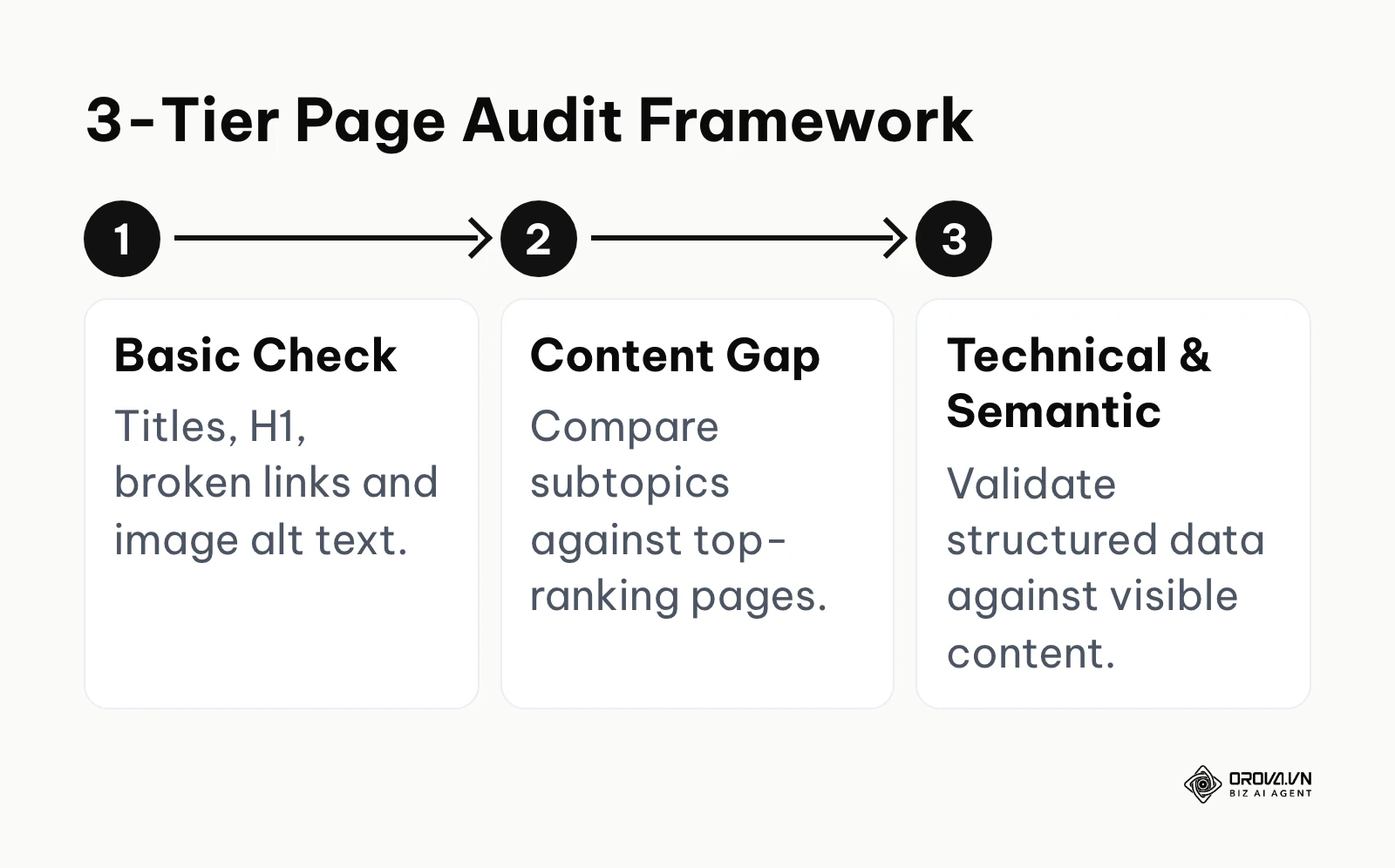
- The basic health check: List your URLs and check for missing or duplicate titles, a missing or vague H1, broken links (404 errors) and missing image alt text.
- The content gap review: This needs a human. Compare your page's subtopics against the top-ranking pages and note what you entirely missed or covered too thinly.
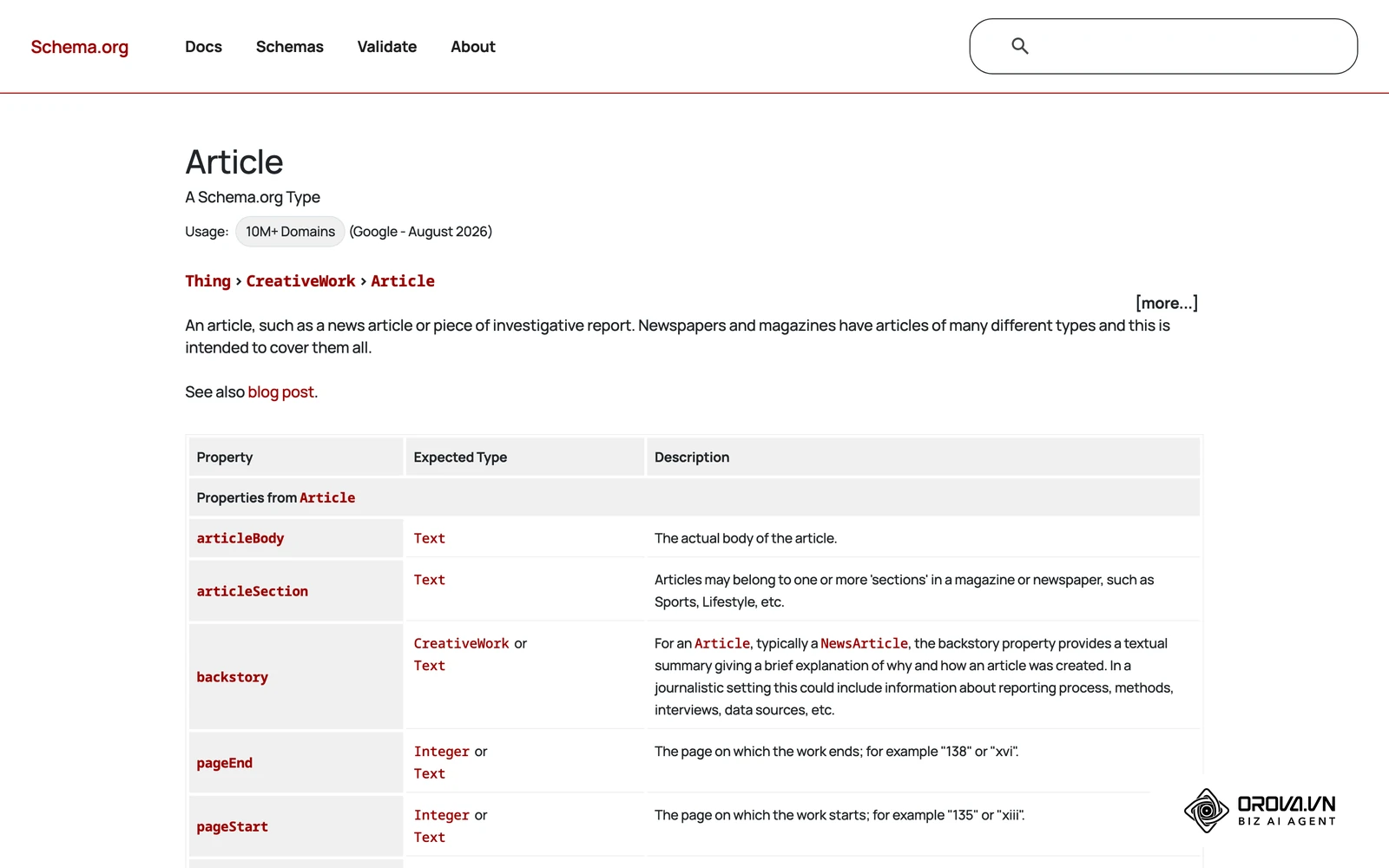
- The technical and semantic layer: Check structured data. Schema.org vocabulary gives search engines explicit clues about what a page is, such as an article, a product or an organization. Confirm the markup matches visible content and validates without errors. Note that since 2023 Google shows FAQ rich results only for a small set of well-known government and health sites, so don't add FAQ markup expecting a rich result.
You can build the sheet yourself in any spreadsheet tool with columns like these:
| URL | Target query | Intent | Tier 1 issues | Tier 2 gaps | Tier 3 checks | Priority | Date fixed | Clicks before (28 days) | Clicks after (28 days) |
|---|---|---|---|---|---|---|---|---|---|
| /what-is-on-page-seo | on page seo | Informational | Title too long, two images without alt text | No section on AI Overviews | Article markup valid | High | |||
| /pricing | brand name pricing | Transactional | H1 says "Plans" only | None | Product markup missing | Medium |
Sort by priority, fix the top rows first, and fill in the last three columns so you can see what actually moved.
Updating Old Pages Without Losing Rankings
The riskiest on-page change is the one people make most casually: rewriting or moving a page that already ranks. Two rules keep you safe.
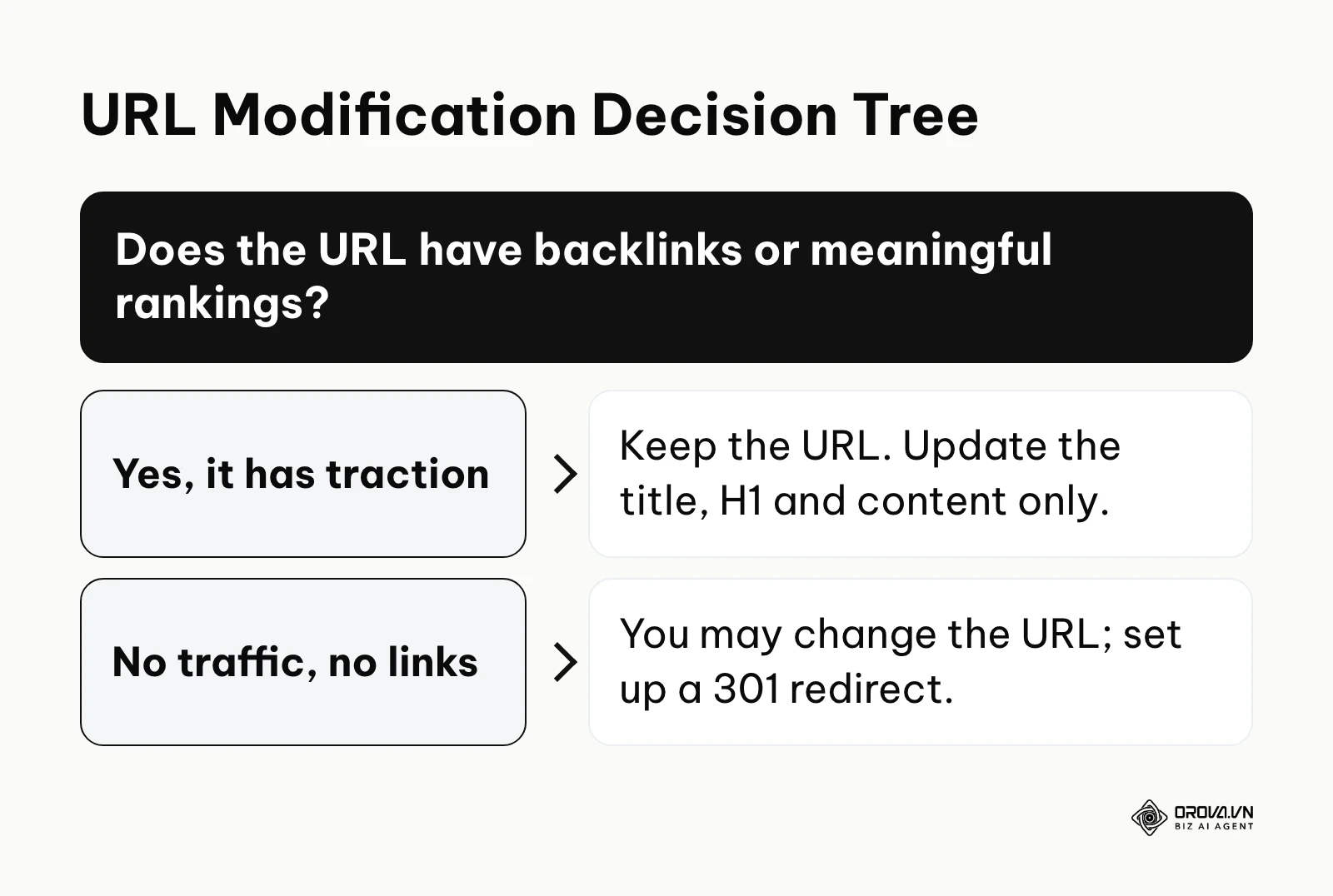
First, protect the URL. If a page has backlinks or ranks reasonably well, changing its address puts those signals at risk even with a redirect. Keep the URL and improve the title, H1 and body instead. Only move a page that has no meaningful traffic or links, and if you do, set up a 301 redirect from the old address.
Second, add rather than replace. Don't rewrite a page that ranks on page one from scratch. Find what's missing compared with the pages above you, add it, and keep the parts that already work.
Illustrative example: Updating legacy content
- Context: A software company had an article on "how to calculate payroll" that brought steady traffic but had sat in the middle of page one for two years.
- What they did: They reviewed the pages ranking above it and saw that each covered the current year's payroll tax changes. They added a new H2 section on those changes without deleting existing content, then updated the "last updated" date.
- Snag and fix: They worried that changing the date for a small edit might look manipulative, so they made sure the new section was substantial and genuinely useful before updating it.
- Result: The page moved up a few positions and gained daily sessions, without risking the ranking it already had.
With OROVA.VN and the OROVA SEO module, you put an end to the exhausting days of manual work for good. Instead of struggling for hours to write articles and compile reports, the entire process is now optimized and completed in just 5 minutes.
How to Adapt to Modern On Page SEO
What you should do next depends on your role.
For Small Business Owners
You don't need to become technical, but you should oversee the basics so you aren't paying for content that can't rank.
- Choose one primary topic and keyword per page before writing.
- Make sure your website platform lets you edit title tags and meta descriptions easily.
- Compress images before uploading them.
- Review your ten most visited pages and make sure each has a clear call to action that fits its intent.
For In-House Marketing Teams
Your goal is a repeatable system for content creation.
- Use a content brief template that makes writers name the target intent and key entities before drafting.
- Add a peer review step that checks heading structure, title and meta description.
- Run a quarterly content audit to find decaying posts that need refreshing.
- Set an internal linking rule: every new post links to a few older relevant posts, and those posts link back.
For SEO Agencies and Freelancers
Your value lies in what clients can't easily do themselves.
- Report on more than rankings: track clicks, SERP features and whether pages are cited in AI answers.
- Implement JSON-LD structured data where it matches the page type and visible content.
- Use entity analysis to build topic maps for client content clusters.
- Plan legacy content updates that improve old articles without losing current traction.
| Common Mistake | Consequence | How to Avoid |
|---|---|---|
| Changing the URL of an old, ranking post | Puts existing links and rankings at risk. | Keep the URL; update the title, H1 and content instead. |
| Keyword stuffing | Violates Google's spam policies and makes the text unpleasant to read. | Write naturally, cover related concepts, and read the text aloud. |
| Ignoring search intent | The page struggles to rank no matter how many links it earns. | Search the keyword yourself and study the top results before writing. |
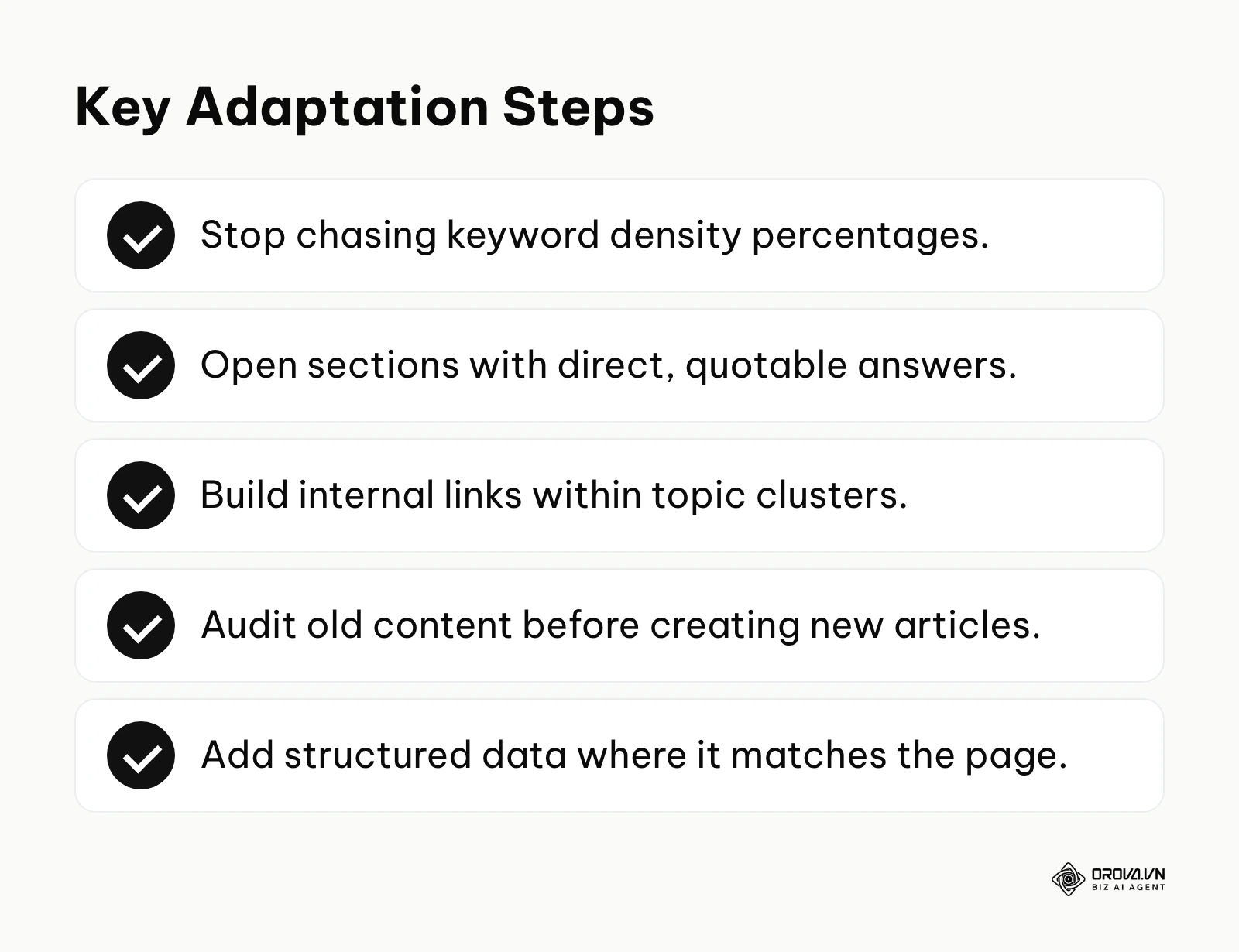
| Chasing a keyword density percentage | Forced, repetitive copy with no ranking benefit. | Use the main keyword where it fits naturally: title, H1, intro, a few headings. |
Where on page SEO is heading in the next few years: the author's take
These are my opinions, not forecasts with numbers attached. Here are three shifts I'm watching and how I'd prepare for each.
AI Overviews Will Push Sites Toward Fewer, Stronger Pages
Today, AI Overviews often answer simple, generic questions right on the results page, so thin posts that only restate a definition get fewer clicks. I think that over the next two to three years, a large library of short, overlapping posts will become more of a liability than an asset. Sites that do well will have fewer, deeper resources that are worth citing. My suggestion: audit your site now and merge thin articles that target the same question into one complete guide.
Topic Coverage Will Matter More Than Keyword Counts
Exact-match keyword tricks already do little on their own. My read is that keyword density will fade from serious SEO conversations entirely, and the question will become how well a page explains the relationships between concepts in its niche. To prepare, writers should treat keyword tools as a starting point, not the truth, and write like subject matter experts who naturally discuss everything that surrounds the core topic.
Software Will Take Over Much of the Execution Layer
Writing meta descriptions, compressing images and generating schema markup are repetitive tasks. I believe software will handle much of this execution work, and the SEO practitioner's value will shift from doing the tasks to setting the strategy and checking the output. People will still be needed for original angles, brand voice and fact-checking. This depends on AI tools becoming more reliable, since they still make factual and technical mistakes today, so the review step won't go away.
Frequently Asked Questions about On Page SEO
What is the ideal keyword density?
There isn't one. Google doesn't use a target keyword percentage, and forcing a phrase to hit a number usually produces awkward writing. Cover the topic fully, use related terms naturally, and place the main keyword where it helps readers: the title, H1, first paragraph and a few headings.
Will on page SEO still matter if AI search takes over?
Yes. AI answer systems retrieve and summarize content from pages they can crawl and understand, and they can still make mistakes. Clear headings, direct answers, accurate facts and valid structured data make your page easier to understand and quote correctly.
Do meta descriptions affect rankings directly?
No. Google doesn't use meta descriptions as a ranking factor. They matter because they can influence whether people click your result, and Google may replace them with text from your page when that fits the query better.
Does Google still use the meta keywords tag?
No. Google has ignored the meta keywords tag for ranking for many years. It does no harm, but it does no good either.
Can FAQ sections still earn rich results?
Rarely. Since 2023 Google has limited FAQ rich results to a small set of well-known, authoritative government and health websites. FAQ sections are still useful for readers and can help answer follow-up questions, but don't expect the expandable result for most sites.
Is E-E-A-T a ranking score?
No. E-E-A-T (experience, expertise, authoritativeness and trustworthiness) is a framework from Google's Search Quality Rater Guidelines that describes what high-quality content looks like. There's no E-E-A-T score you can measure; you show it through accurate content, clear authorship and real expertise.
Where Should You Start?
A large site that needs optimization can feel overwhelming. Start small and turn what works into a routine.
If you have no optimization process at all
Start with your most important pages. Spend one afternoon on your five highest-converting service or product pages and check three things: Is there one clear H1? Does the title describe the page and include the main topic? Are there any broken links? Fixing these basics is usually the fastest return on effort.
If you optimize sporadically but lack consistency
Create a publishing checklist and don't let new content go live without it. In a single morning, write a short process that requires the writer to identify search intent, list a few related entities to include, and write a unique meta description. Stopping new unoptimized content is more urgent than fixing old content.
If you optimize regularly but don't measure results
Set up a baseline tracking sheet. For each page, log the URL, the date you changed it, exactly what you changed (for example, "rewrote H1 and added an FAQ section") and its clicks for the previous 28 days. Check again 30 and 60 days later. That closes the feedback loop and turns on page SEO from guesswork into something you can measure and improve.
About the author

Builder of Orova
Nguyễn Đỗ Trọng Ân has 8 years of experience in marketing, including 6 years managing market development across Asia. He builds Orova, a Biz AI Agent that never sleeps: it plans, runs and optimizes work for businesses.
Run your business with AI Agents
Orova is the always-on Biz AI Agent — it plans, runs, and optimizes the work for you.
Save time, unlock productivity.