
GEO vs SEO: key differences and when to prioritize each

You have spent years building backlinks, fine-tuning title tags and working the right related terms into your landing pages. Your dashboards still show healthy impressions, yet clicks and leads from search feel flatter than they used to. If you are weighing geo vs seo, you are noticing a real shift in how people find information online. Here is the short answer: SEO (search engine optimization) works to get your page ranked and clicked in a list of results, while GEO (generative engine optimization) works to get your content understood, trusted and cited inside answers written by AI systems such as Google's AI Overviews, ChatGPT search, Perplexity and Gemini. GEO does not replace SEO. It sits on top of it, with a different goal, a different way of measuring success and a different style of writing.
For more than twenty years the deal between publishers and search engines was simple: you provide the content, the search engine sends the traffic. AI answers change part of that deal. When an assistant writes a complete answer on the results page or inside a chat, some users never need to click. Others click only one or two cited sources, and they arrive already informed. Being ranked first still matters, but being the source the answer leans on has become a second prize worth competing for.
This guide does not repeat long definitions. If you want the background first, read our explainer on what AI SEO is and our guide to unifying SEO, AEO and GEO into one content strategy. Here we stay on the comparison itself: how GEO and SEO differ in goals, in measurement and in writing, and when you should put your effort into one before the other.
GEO vs SEO: the core differences
At its core the difference lies in the end goal. SEO aims to place your page as high as possible in a list of links so that a person clicks it. GEO aims to shape your content so that an AI system can find it, understand it, trust it and mention your brand or page when it writes an answer. The two serve overlapping audiences but reward different things.
A useful picture: traditional SEO treats the search engine like a librarian pointing people to the right book. You polish the title and the catalog card so the librarian recommends you first. GEO treats the search engine more like a well-read assistant who skims many books, cross-checks the facts and writes a short summary on the spot. Your goal in GEO is to make your "book" contain the clearest, most specific and most useful material, so the assistant has a reason to quote you.
That difference reaches into every part of the work, from how content briefs are written to how budgets are split and how audits are run. SEO pays close attention to crawlability, keyword targeting, internal links and backlinks. GEO pays close attention to clear claims, specific facts, consistent entity information about your brand and authors, and page structure that makes individual passages easy to lift and quote. Seeing both sides clearly is the first step in deciding where your next hour of work should go.
Traditional SEO: optimizing for link-based algorithms
To see what changes, start with what stays. Traditional SEO follows a well-documented set of practices built around search engines that crawl and index the web page by page. If you need the full basics, our guide on what SEO is and how it works covers them; this section keeps only what matters for the comparison.
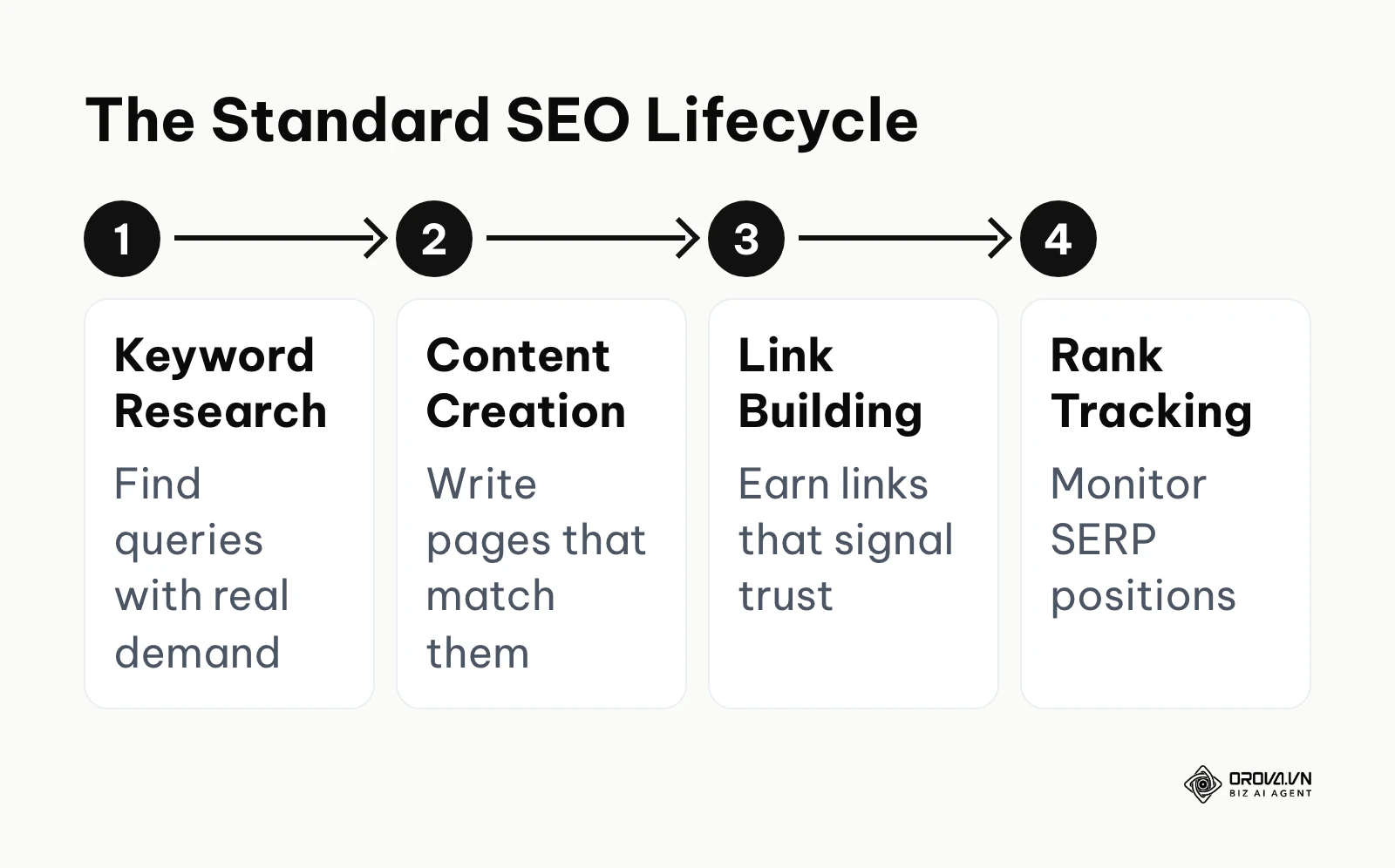
What SEO is built to do
SEO improves a site's visibility in organic search results. The underlying model is retrieval: when someone types a query, the engine looks into its index and returns the pages that best match, ordered by many ranking signals. Two families of signals have always carried weight: relevance (does the page answer what was asked?) and authority (do other reputable sites point to it?). A large share of classic SEO work is built around those two ideas: finding queries with real demand, writing pages that match them and earning links that signal trust.
Technical health sits underneath. Pages that cannot be crawled, render poorly on mobile or load slowly struggle no matter how good the writing is, which is why Core Web Vitals, HTTPS, clean sitemaps and sensible internal linking remain part of every serious SEO plan.
The core strengths of SEO
Traditional SEO is strongest when the user has a transactional or navigational intent. When someone searches "buy running shoes near me" or "Netflix login," they do not want an essay. They want a product category page, a store location or a login screen. In these cases a list of links is efficient: people want to compare options, look at photos and prices, read reviews and go straight to checkout.
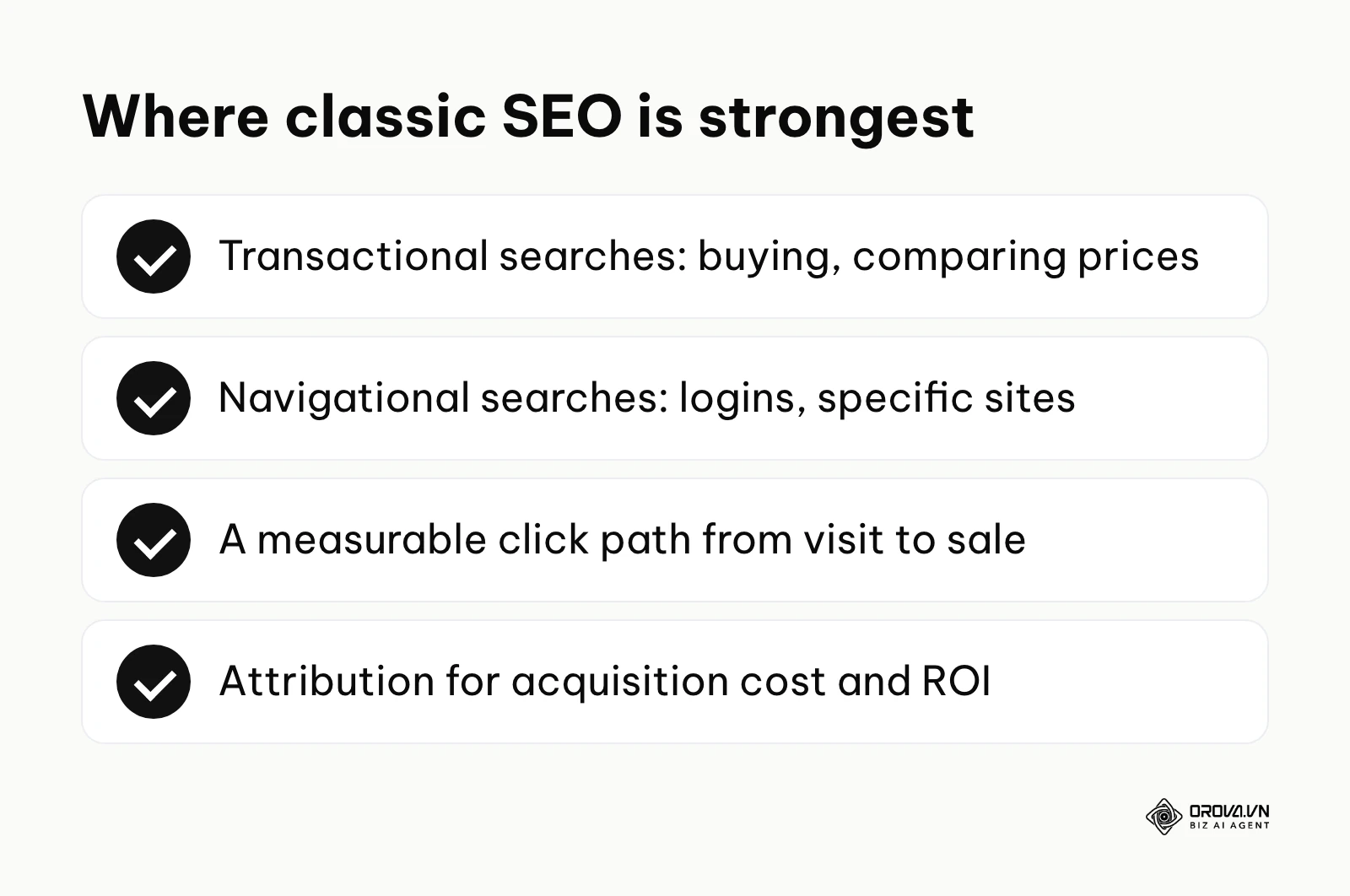
SEO also gives you a measurable, linear path. Because users must click to get what they want, you can track how many people visited, what they did and whether they bought. That attribution is what lets teams estimate customer acquisition cost and return on investment for organic search. Algorithm updates come and go, but this predictability is why SEO became a core line in so many marketing budgets.
Illustrative example: A marketing manager at a mid-sized B2B logistics company wanted more visibility for new freight routing software. The team audited its landing pages, aligned the H1 and title tags with the main query and ran outreach to earn a handful of links from industry publications. At first the pages stalled on page two, because the content read like an informational article while the query was transactional. After the page was restructured around a clear product summary and a cost calculator near the top, it began to match what searchers expected. The visible result was a steady first-page position and a noticeable rise in demo requests from procurement teams.
Where traditional SEO is vulnerable
Because ranking factors were so well documented, the web filled with pages written for algorithms rather than people: long, repetitive articles stretched to hit word counts, with the useful part buried under filler. Searchers learned to scroll past introductions to find one line they needed. That frustration is a big part of why direct, summarized answers became attractive. Pages whose only value is restating what everyone else says are the ones most exposed when an AI can summarize the same information in a few sentences.
GEO (generative engine optimization): the era of AI search
User expectations have moved from "here are some links where you might find the answer" to "here is an answer, with sources." GEO is the practice of adapting to that.
What GEO is and how AI answers are put together
Generative engine optimization is the work of making your content easy for AI search systems to find, understand and cite. It is a young field. There is no published "GEO ranking algorithm" in the way there are published SEO guidelines, and each AI product works differently and changes often. What can be said at the level of principle is this: many AI search experiences first retrieve relevant material from the web or an index, then use a large language model to write an answer from that material, often with links or citations to some of the sources. This pattern is commonly described as retrieval-augmented generation.
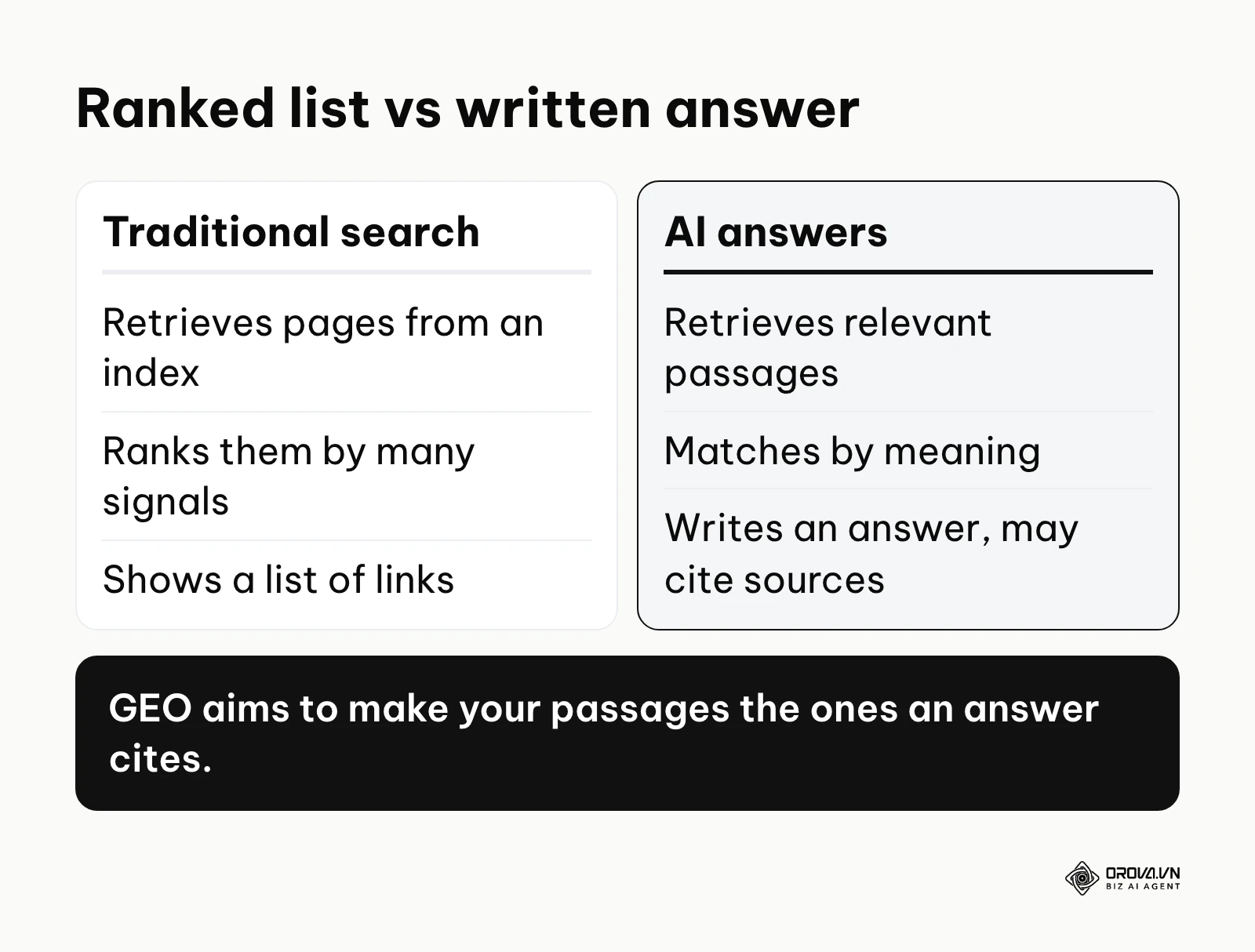
The term itself was popularized by a 2023 research paper titled "GEO: Generative Engine Optimization," written by researchers from Princeton University, Georgia Tech and other institutions. The paper tested content changes on a benchmark of queries and reported that additions such as citing sources, quoting experts and including concrete statistics tended to raise a page's visibility in generated answers, while old-style keyword stuffing did not help. Treat it as an early academic signal, not a rulebook: the experiments ran in a controlled setting, and commercial AI search products do not publish how they choose sources.
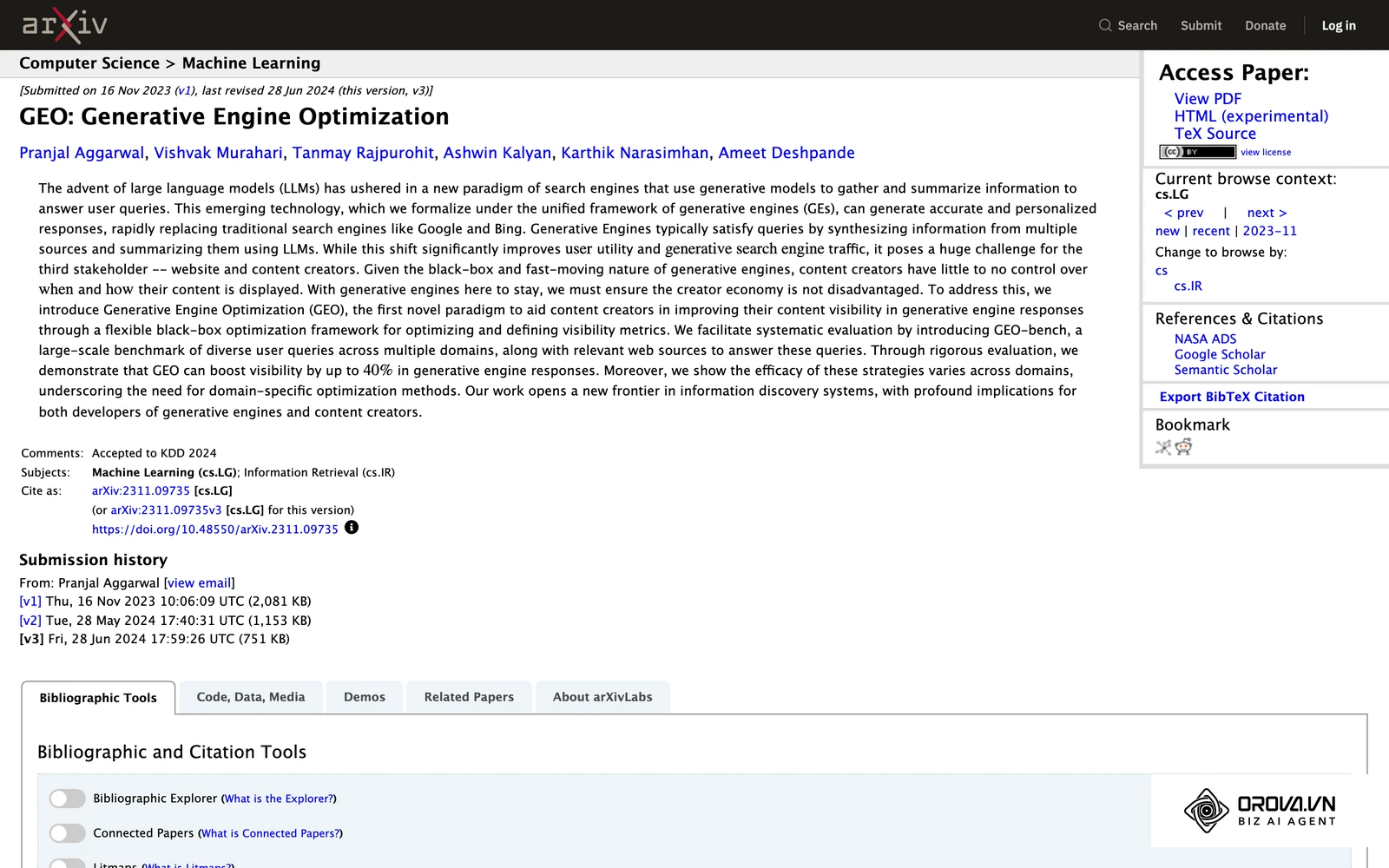
A simple model of how retrieval for AI answers works
You do not need to know any vendor's internals to optimize sensibly. A simplified model is enough:
- Breaking content into passages. Systems tend to work with passages (paragraphs, list items, table rows) rather than whole pages. A passage that makes sense on its own is easier to reuse.
- Matching by meaning. Modern retrieval generally matches the meaning of a question to the meaning of passages, not only the exact words, so a page can be found for phrasings it never uses verbatim.
- Writing the answer. The model writes a response from the selected passages and may show some of them as sources. Which sources are shown, and how many, varies by product and by query.
The practical takeaway: write passages that state a clear claim, give the specific detail behind it and can stand on their own when quoted.
Entities and E-E-A-T in GEO
Exact-match keywords matter less when systems match by meaning. What matters more is whether your brand, your authors and your topics are described consistently across the web. Entities are distinct things (people, organizations, products, places, concepts) that search systems try to recognize and connect.
Trust signals carry over from SEO. Google's Search Quality Rater Guidelines describe E-E-A-T (experience, expertise, authoritativeness and trustworthiness) as part of how quality is judged, and the same qualities make a page safer for any AI system to quote. AI answer products have a strong incentive to avoid spreading wrong information, so it is reasonable to assume that clearly sourced, clearly authored content is a better candidate for citation. If your page does not show who wrote it, why they are qualified and where its numbers come from, you give any system, human or machine, less reason to rely on it. Our SEO content writing guide covers how to build those signals into the page itself.
Why "information gain" matters
A key idea that separates useful GEO work from tired SEO habits is information gain: does your page add something that is not already everywhere else? In traditional SEO, many teams studied the top ten results and merged them into one longer article. For AI answers that approach adds little. A language model already carries a broad base of general knowledge, and an answer built from ten near-identical pages does not need yours specifically.
Content with high information gain includes original research and surveys, first-party data, specific expert opinions, worked examples, real case write-ups and recently updated figures. These are the details an AI answer cannot produce from general knowledge, so they give the system a reason to retrieve and cite your page, and they give a human reader a reason to click.
Discover Orova.vn – a Biz AI Agent platform with OROVA SEO, a complete solution for every website. The system supports search engine optimization from A to Z with features including keyword research, writing new SEO-ready articles, optimizing existing content, rank tracking, plus competitor analysis and in-depth technical analysis. Sign up today to experience OROVA SEO completely free (offer valid through July 7, 2027).
In-depth comparison: GEO vs SEO
To build a strategy that survives the shift, compare the two disciplines across the dimensions that actually change your day-to-day work.
| Dimension | Traditional SEO | Generative engine optimization (GEO) |
|---|---|---|
| Primary goal | Rank high in results to earn clicks | Be cited or mentioned in AI-written answers |
| How results are produced | Ranked list of pages from an index | Answer written by a model from retrieved sources |
| Content focus | Pages matched to specific queries | Clear, specific, self-contained passages with original detail |
| Authority signals | Backlinks, site reputation | E-E-A-T, consistent brand and author information, mentions |
| Technical foundation | Crawlability, sitemaps, Core Web Vitals, HTML tags | Same foundation plus clean structure and structured data |
| Success metric | Rankings, organic clicks, CTR, conversions | Citations and mentions in AI answers, visits from AI sources |
| Strongest query types | Navigational, transactional, local | Complex informational, comparison, multi-step questions |
Optimization target: keywords vs context and intent
In traditional SEO, keyword research is the foundation. Teams find the phrases people search, then make sure the page clearly targets them in the title, URL, headings and body. Older practice sometimes went further, building separate pages for tiny wording differences such as "repairing a tap" and "fixing a faucet," which bloated site structure.
For AI answers, chasing exact strings brings little. Systems that match by meaning treat "repairing a dripping tap" and "fixing a leaky faucet" as the same need. The target moves from individual keywords to the full question behind them: the sub-questions, the edge cases and the decisions a reader faces. Instead of five thin pages on near-identical phrases, you build one well-structured resource that answers the main question directly and then covers the related questions in clear sections. A practical way to find those related questions is to study the "People also ask" box; our People Also Ask guide shows how to mine it.
Keyword data does not disappear. It tells you which problems people have and how many have them. You simply use it to choose what to answer, not to decide how many times to repeat a phrase.
Technical strategies: backlinks vs schema and entities
Traditional SEO leans on backlinks to show authority. GEO leans more on structure to show meaning. If key facts are buried in long walls of text, it is harder for any system to pull the right passage and harder for a reader to scan.
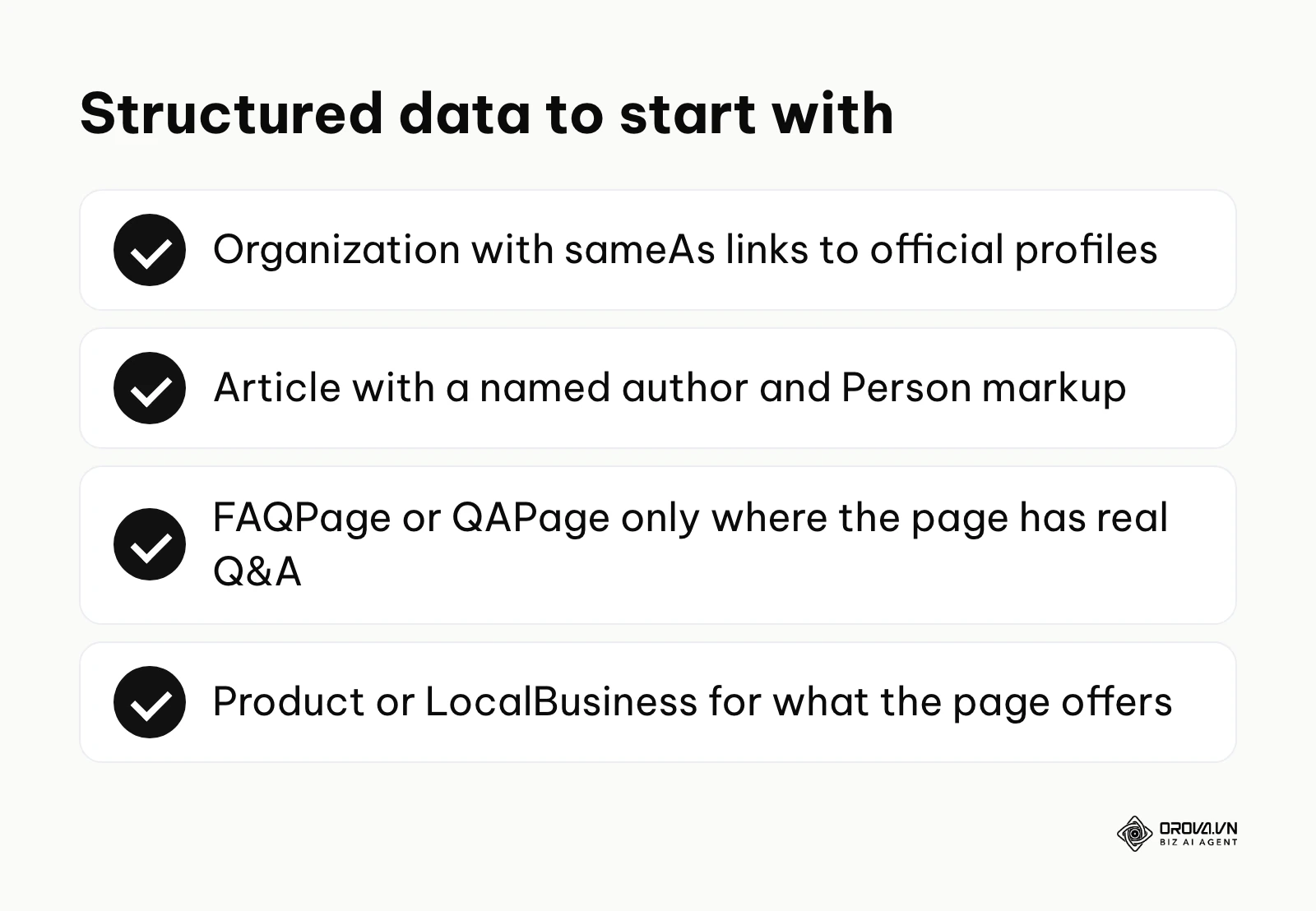
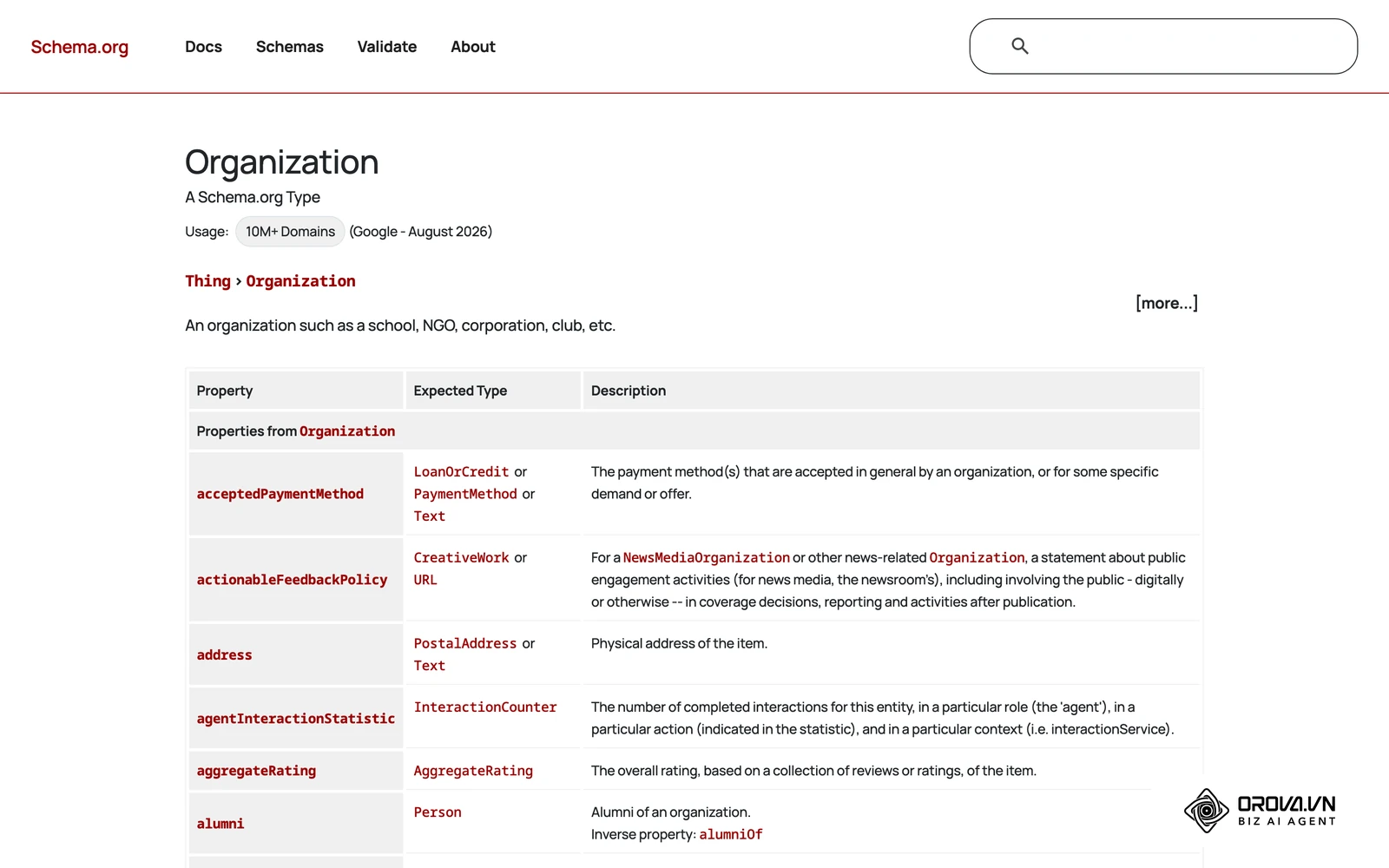
Structured data (schema markup, usually in JSON-LD) helps machines interpret what a page is about. It does not guarantee citations, and no AI provider has published a rule that says schema earns a mention, but it removes guesswork. Useful starting points:
- Organization with sameAs links that tie your site to your official profiles, so your brand is described consistently.
- Article with a named author, and a Person entity for that author linked to their professional profiles.
- FAQPage or QAPage markup where the page genuinely contains questions and answers, following each search engine's current eligibility rules.
- Product, LocalBusiness or other types that describe what the page actually offers.
The visible formatting matters just as much: descriptive headings, short paragraphs that open with the main point, lists for steps, tables for comparisons and specific numbers written plainly in the text.
Illustrative example: A content lead at a health information publisher wanted its articles to be used more often as sources in AI answers about common symptoms. An audit showed the articles had decent backlinks but were written as long, unbroken text with no clear author information. The team added author bios with credentials, marked them up with Person and Article schema, rewrote key sections so each opened with a direct answer, and split long explanations into question-led sections. The first rollout added heavy inline scripts that slowed pages down, which worried the engineering team, so the markup was moved into the server-side template. The visible result over the following months was that the publisher's pages appeared more often among the cited sources when the team checked its tracked questions in AI search tools.
The zero-click dilemma and conversion rates
The hardest part of the shift for many marketers is the zero-click search. When an AI answer fully resolves a simple question on the results page, the user has little reason to visit any website. Industry analysts have warned for several years that traditional search volume could fall as people move some questions to chat assistants, and many publishers report fewer clicks on simple informational queries.
If your business depends on display advertising from high-volume informational traffic (recipe blogs, basic definition sites, thin affiliate lists), this is a serious threat. Being cited is not enough when the click never comes. You need to change how your pages create value:
- Interactive tools. An AI can explain how a mortgage works, but the user still needs a calculator to enter their own numbers. Calculators, configurators and checkers keep a reason to visit.
- Deep resources behind a light gate. Share the clear, high-level answer openly so it can be cited, and offer the detailed dataset, template or report in exchange for an email address.
- Earlier calls to action. Visitors who click through from an AI citation often arrive with the basics already understood. Put your next step (demo, newsletter, trial, contact form) near the top instead of only at the end.
- Community and first-hand voices. Forums, user reviews and practitioner commentary offer lived experience that a summary cannot fully replace.
Measuring ROI: from traffic to AI share of voice
Measurement is the biggest gap in most GEO discussions. Google Search Console and Google Analytics were built for a click-based world. Search Console reports performance in Google Search, but it does not tell you how often a chat assistant mentioned your brand in a conversation that ended without a click. Our guide to using Google Search Console for SEO covers what it does measure well; for GEO you need to add two more lenses.
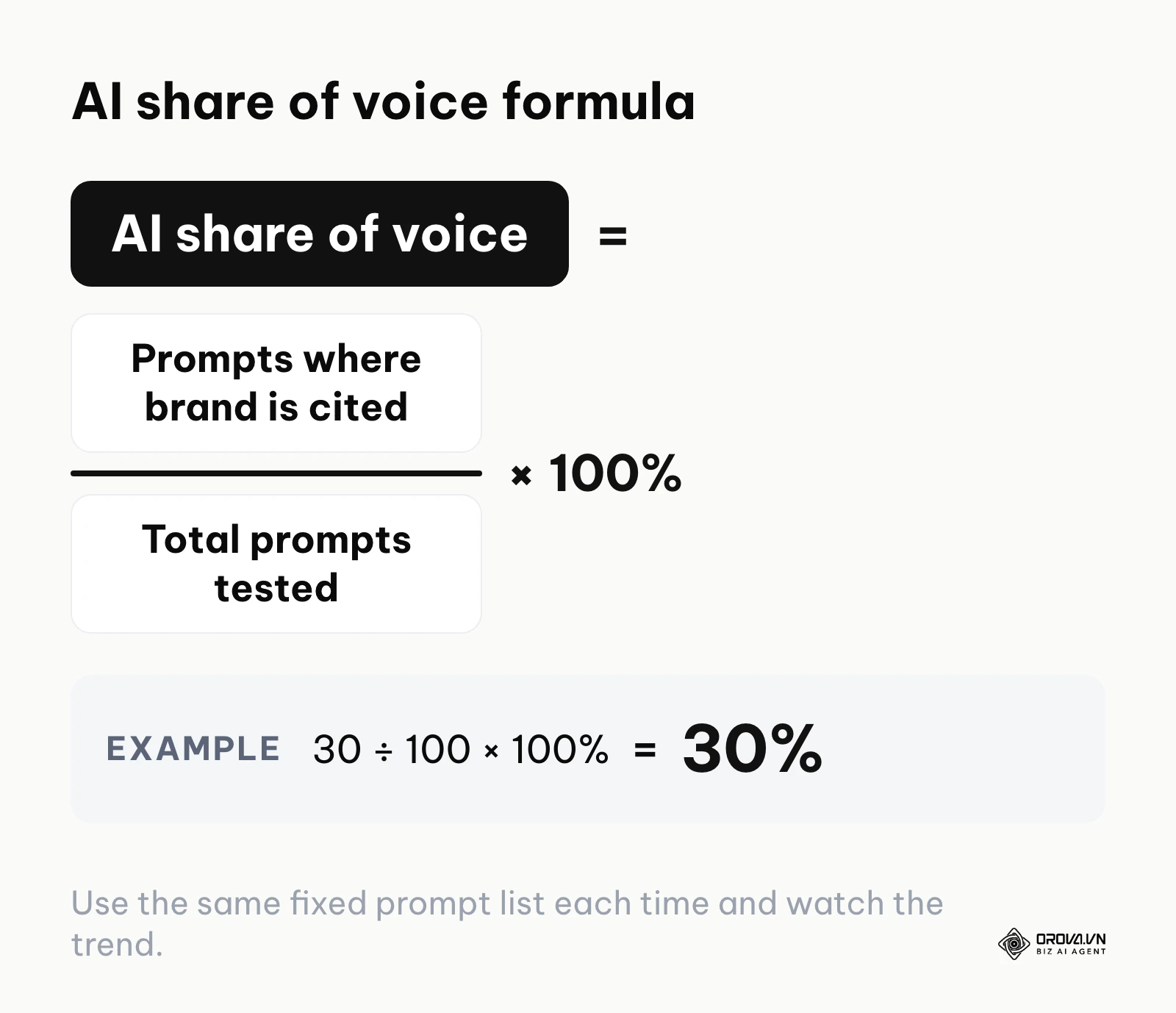
Lens one: AI share of voice. Because you cannot see inside other people's chats, you test the engines yourself. Build a fixed list of prompts that reflect your buyers' real questions across the buying journey, for example "What should an enterprise team look for in an AI writing tool for security-sensitive work?" On a regular schedule, run the same prompts in the assistants your audience uses and log what comes back. A simple formula keeps it comparable over time:
AI share of voice = prompts where your brand is cited ÷ total prompts tested × 100. If your brand is cited in 30 of 100 tracked prompts, your AI share of voice is 30%.
Answers vary from run to run and by account, location and model version, so treat this as a trend you watch over weeks, not a precise score.
A tracking log can be as simple as this:
| Prompt | AI tool | Brand cited? | Competitors cited | How the brand is described | Link to your site? |
|---|---|---|---|---|---|
| "Best CRM for real estate agencies" | ChatGPT | Yes (as a source) | Competitor A, Competitor B | Positive, "easy to set up" | Yes |
| "How to calculate B2B churn rate" | Perplexity | No | Competitor C | Not mentioned | No |
| "Pros and cons of [your brand]" | Google AI Overviews | Yes (in text) | None | Balanced | Yes |
| "Alternatives to [competitor]" | Gemini | Yes (in a list) | Competitor A | Neutral, "budget option" | No |
Look beyond whether you are mentioned to how. If the answers describe you as a budget option when you sell a premium enterprise product, the information about your brand across the web is sending mixed signals.
Lens two: visits from AI sources. When users click a citation, many AI tools pass a referrer. In GA4 you can create a custom channel group or an exploration that groups sessions whose source matches known AI assistant domains, then compare their engagement and conversion rates with regular organic search. Referrer data is incomplete, since some apps strip it, so this segment shows a floor, not the full picture. Even so, it gives you a way to show stakeholders whether AI-referred visitors behave differently from other organic visitors.
Decision matrix: when to prioritize SEO vs GEO
You do not need to abandon traditional search, and for many business models that would be a costly mistake. The practical skill is knowing which emphasis fits which page, based on what the searcher wants and what you sell. Pushing GEO tactics onto a pure product page wastes effort; leaving a complex guide as an unstructured wall of text makes it harder for AI answers to use.
| Business scenario | Recommended emphasis | Why | Where to focus |
|---|---|---|---|
| E-commerce product pages | SEO first | Shoppers want photos, prices, specs and reviews, and product listings still dominate transactional results | Page speed, product schema, clear titles, image alt text |
| B2B software with complex buying decisions | SEO + GEO together | Buyers ask detailed comparison questions that AI answers handle well, but still need to visit to book a demo | Comparison tables, original data, clear next steps |
| News and data publishers | GEO-led, SEO still required | Simple factual queries are often answered directly, so being the cited source matters | Clear attribution, structured articles, strong author pages |
| Local service businesses | Local SEO first | Map results and local listings drive urgent "near me" decisions | Business profile, reviews, consistent name, address and phone |
| Expert and research organizations | GEO-led, SEO still required | Answers to complex questions lean on authoritative, well-sourced material | Author credentials, citations, well-structured explainers |
| Travel and hospitality | SEO + local SEO, GEO for planning content | AI can suggest itineraries, but booking needs live availability and photos | Listings, image quality, trip-planning guides |
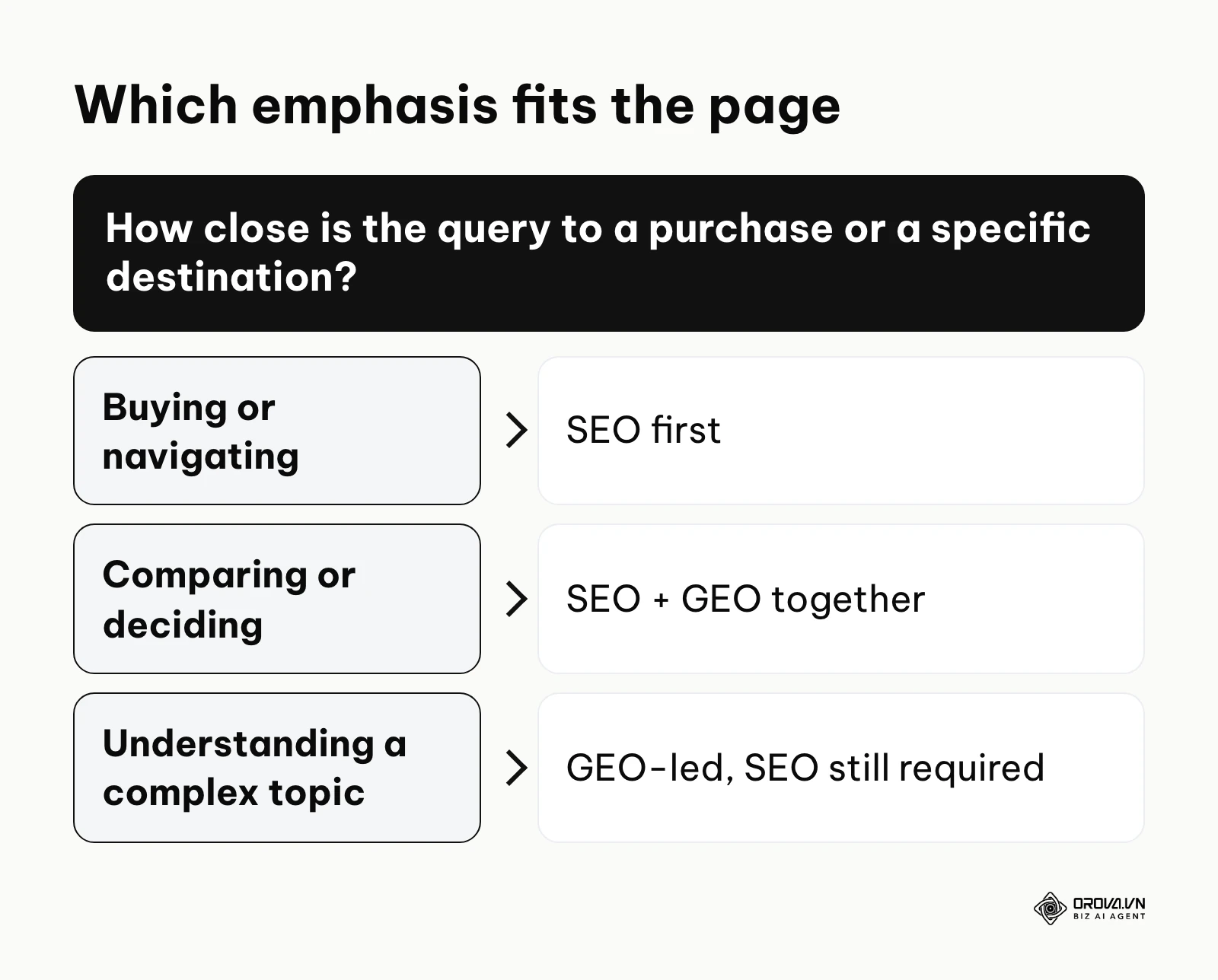
A simple rule of thumb: the closer a query is to a purchase or a specific destination, the more classic SEO matters; the more a query asks someone to understand, compare or decide, the more GEO matters.
The hybrid approach: transitioning from pure SEO to GEO
For most businesses, especially those that grow through content, the right path is hybrid. Keep the technical health, site structure and transactional visibility that SEO built, and layer GEO habits on top: clearer passages, original detail and consistent entity information. Do not delete your archive in a panic, but change how you audit it and how you write new pieces.
Steps to implement a hybrid model
Moving a team from an SEO-only mindset to a hybrid one changes editorial guidelines and KPIs, so it helps to phase it.
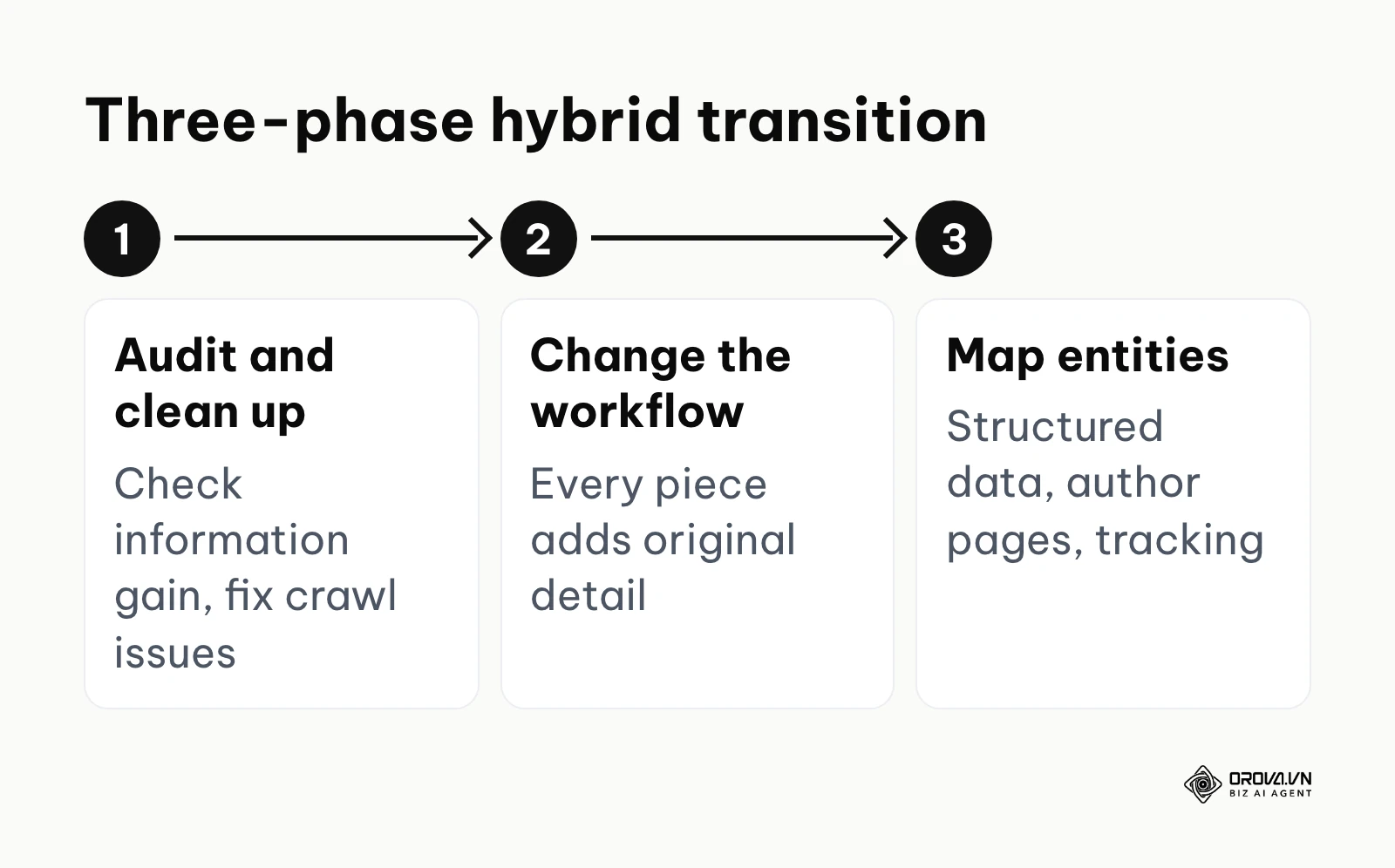
Phase 1: audit and clean up (first month) Stop judging content only by search volume and rankings. Audit your library for information gain. If you have many articles that only restate what is already on every competitor's site, merge them, rewrite them around original insight or retire them. Fix crawl and indexing problems while you are there; GEO cannot help a page that search systems cannot reach.
Phase 2: change the editorial workflow (second month) Stop commissioning generic guides that rephrase the first page of results. Make a new rule: every new piece adds something of its own, such as a quote from an in-house expert, a small survey, first-party numbers or a worked example. Briefs change from "keywords to include" to "questions to answer, entities to mention and original points to add." Each section should open with a direct answer before it explains.
Phase 3: technical entity mapping (third month) Build structured data into your templates so that authors, organization details and page types are marked up consistently. Make sure your Organization markup links to your official profiles and that every author has a real bio page. Then start the share-of-voice tracking described above so you have a baseline before you judge results.
Tooling can carry much of the repetitive work; Orova SEO, for example, writes, publishes and optimizes articles and connects to Google Search Console and GA4 for measurement.
Real-world scenarios and risk management
Illustrative example: An SEO lead at a wealth management platform saw organic traffic to basic finance definitions stall as AI Overviews answered those questions directly. The team stopped publishing generic articles such as "What is an IRA?" and required every new post to include a chart built from anonymized, aggregated platform data plus a comment from one of its certified financial planners. The freelance writers struggled with the new format at first and publishing slowed, which frustrated leadership. The fix was a short expert interview before each draft: writers spent a few minutes with an in-house planner to collect specific insights instead of researching from search results. Over the next quarters the brand appeared more often as a cited source in AI answers on the team's tracked questions, and consultation requests from those visitors held steady even as definition traffic fell.
Illustrative example: A B2B cybersecurity vendor watched traffic for broad queries like "best malware protection" soften as IT managers began asking chat assistants for shortlists. Rather than chase more keyword variants, the company started publishing a monthly threat report built from anonymized data observed across its own customer base. Because those findings did not exist anywhere else, the reports became a natural source for questions about current threats. Total site visits did not grow much, but demo requests from enterprise buyers rose, and sales calls increasingly mentioned that prospects had first seen the brand in an AI answer.
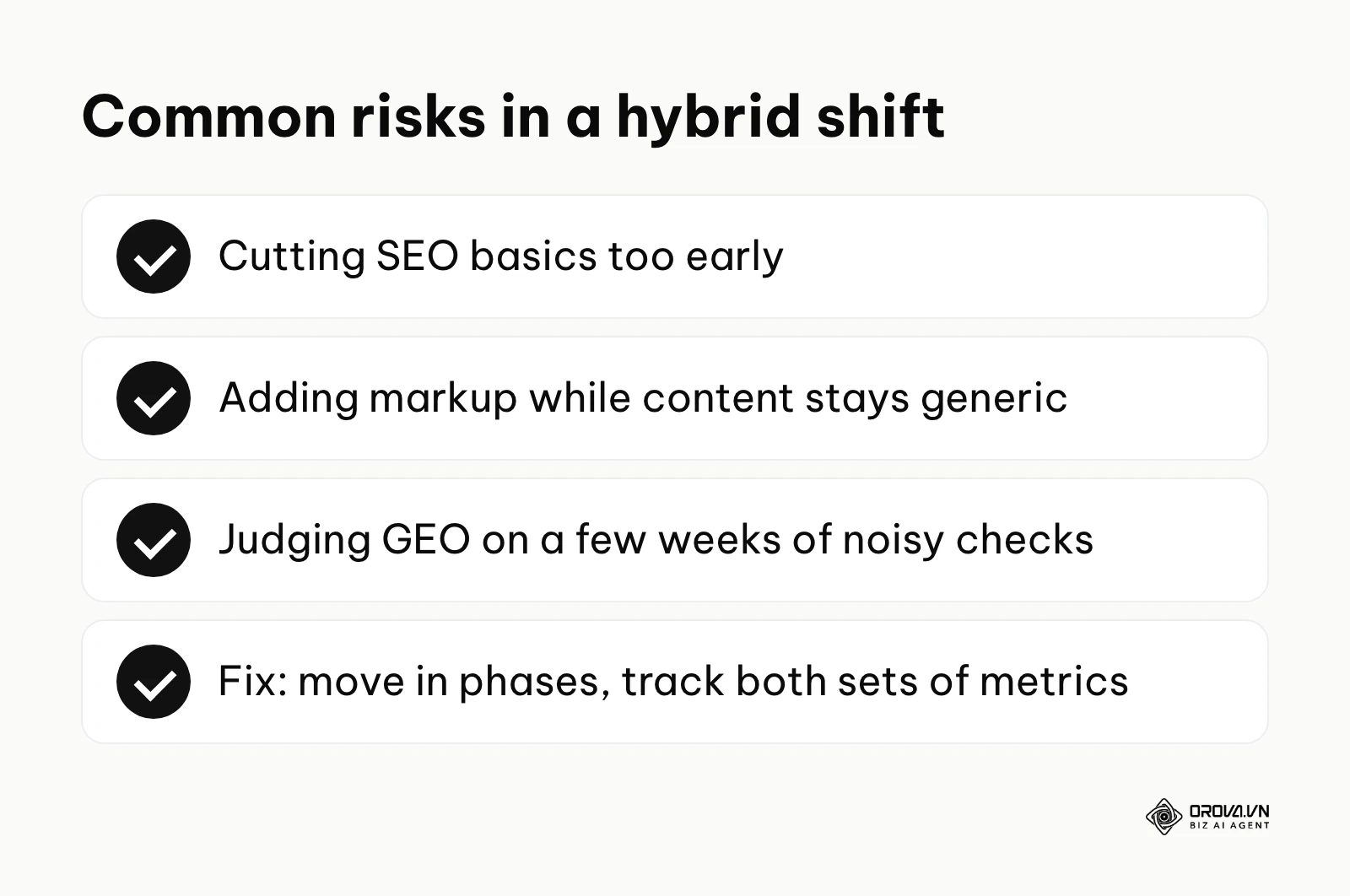
The main risks in a hybrid shift are predictable: cutting SEO basics too early, over-investing in markup while the content itself stays generic, and judging GEO on a few weeks of noisy checks. Move in phases and keep both sets of metrics side by side.
With OROVA.VN and the OROVA SEO module, you put an end to the exhausting days of manual work for good. Instead of struggling for hours to write articles and compile reports, the entire process is now optimized and completed in just 5 minutes.
Where GEO and SEO are heading in the next few years: the author's take
These are opinions, not forecasts with numbers. Each one starts from something visible today.
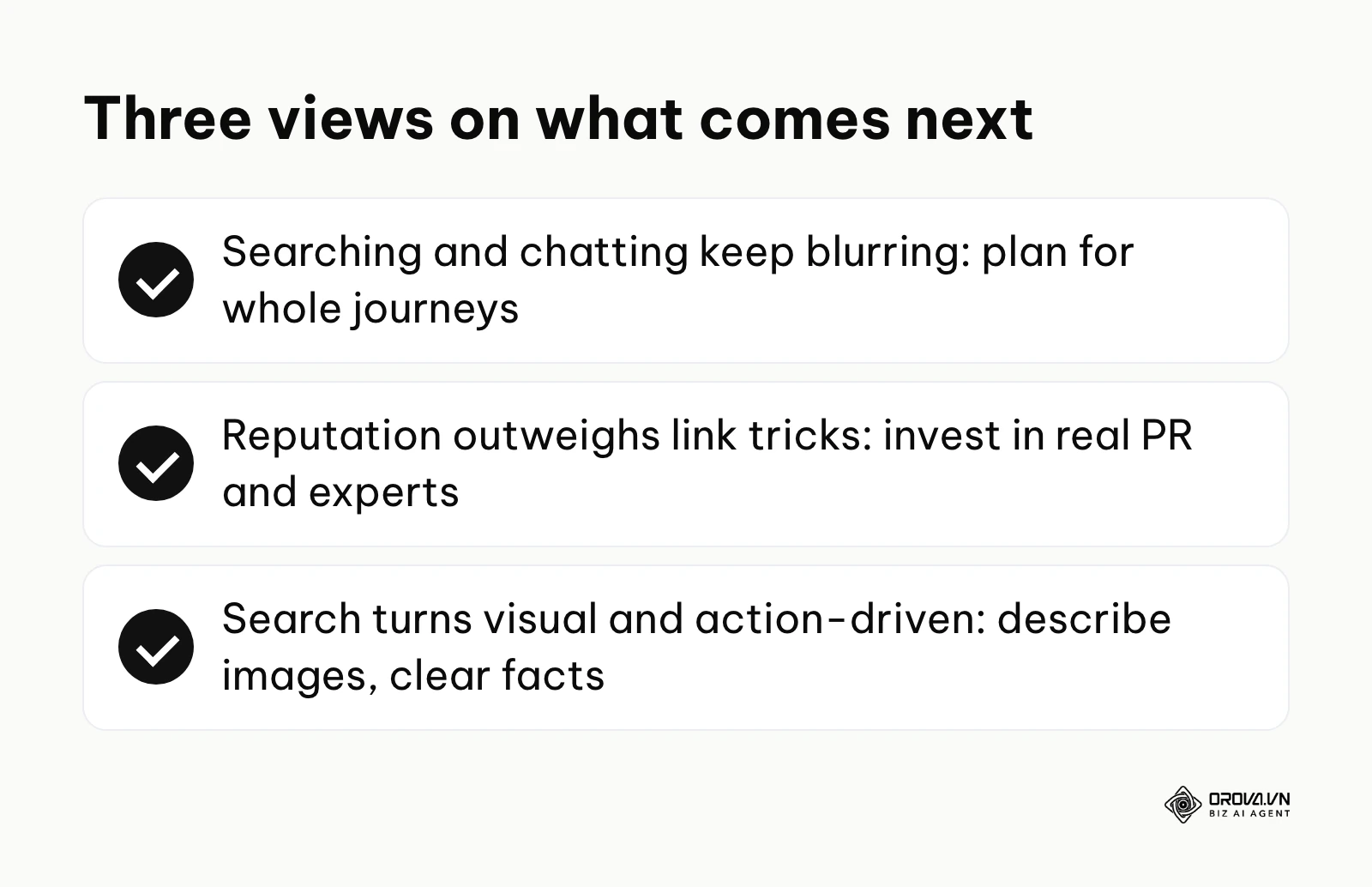
The line between searching and chatting will keep blurring
I think the mental line between "searching the web" and "asking an assistant" will keep fading. Today many people still use a search box for quick facts and a chat assistant for longer tasks, but assistants are being built into browsers, phones and operating systems, and search results now carry AI-written answers of their own. Over the next two to three years I expect more queries to arrive as multi-step requests rather than short keyword strings. My advice is to plan content around whole journeys (the first question, the follow-ups, the comparison, the decision) so your pages are useful at each step, not only for one isolated query.
Brand reputation will matter more than link tricks
My read is that manufactured authority will keep losing value. Search systems have spent years learning to discount paid and low-quality links, and AI answers give them another reason to favor sources that people already trust. I expect real-world signals, such as genuine mentions in respected publications and communities, expert authors with a visible track record and consistent brand information, to weigh more heavily over the next few years. The preparation is unglamorous: invest in real public relations, build your in-house experts into recognized voices and stop spending on cheap links.
Search will become more visual and more action-driven
I believe GEO will grow beyond text. People already point their phone camera at a problem and ask what is wrong, and AI tools increasingly read images, video and audio. At the same time, assistants are starting to complete tasks such as comparing options or filling in forms on a user's behalf. Over the next two to three years I expect well-described images, accurate transcripts for video and clean, machine-readable product and booking information to become a real advantage. Start now by giving every important visual a precise description and making key facts like prices and availability easy to read without guesswork.
Frequently asked questions about GEO vs SEO
Will AI search kill traditional SEO?
No. SEO is changing, not ending. For transactional and navigational searches, such as buying a product, booking a ticket or finding a login page, a list of links and visual results is still faster and more useful than a written answer. For informational and research questions, AI answers are taking a larger share of attention. Good GEO also depends on SEO basics: a page that cannot be crawled or indexed cannot be retrieved for an AI answer either.
How do I stop AI from using my content without citing me?
This is still an evolving legal and technical area. You can use robots.txt to control many crawlers, and several AI providers publish separate user agents for model training and for search features. Blocking a training crawler and blocking a search crawler are different decisions with different consequences, and blocking everything can also remove you from AI answers that would have cited you. Check each provider's current documentation before you change anything, and decide page type by page type rather than for the whole site.
What role does AI play in running a GEO strategy?
A large one, as long as people stay in charge of judgment. AI tools can help you compare your content with competing pages to spot missing questions, draft and validate structured data at scale, restructure long text into clearer sections and organize share-of-voice checks. Keep human review for facts, expert opinions and anything that represents your brand.
Does keyword volume still matter in GEO?
Yes, but as a compass rather than a target. Search volume still shows which problems people have and how common they are. You use that data to choose what to answer, then use clear structure, specific detail and expert input to decide how to answer it so both search engines and AI answers can use it.
How does GEO change budget allocation?
It usually shifts spending away from high-volume, low-depth content and link buying, and toward expert interviews, original research, digital PR and the technical work of structuring content well. Many teams end up publishing fewer pieces, each with more effort behind it and a stronger reason to be cited.
What happens to small businesses as AI search grows?
Small businesses can do well if they lean into what they know first-hand. Large companies often publish generic content at scale, while a small business can offer specific local knowledge, real customer stories and opinionated advice in a narrow niche. Focus on owning a few specific topics, collecting genuine reviews and keeping your business information consistent everywhere it appears.
Where should you start?
Moving from optimizing only for rankings to also optimizing for AI answers is a long project, not a sprint. Your first step depends on where you are today.
If your website is technically messy and poorly structured: Start with the foundation. Fix crawl and indexing issues, then add basic structured data (Organization, Article and author markup) to your most important pages. An AI answer cannot use your insights if search systems cannot reliably read your pages or tell who published them.
If you have strong content but little AI visibility: Run a baseline share-of-voice check. Take the 20 questions your customers ask most often while buying, run them in the AI assistants your audience uses and record who gets cited. Where it is not you, study what the cited pages offer that yours do not, such as a clearer answer, a specific number or a comparison table, and make your next content sprint about closing exactly those gaps.
If you rank well but are losing clicks to zero-click answers: Rework your page layouts for the visitors who still arrive. Move the most useful next step, whether a tool, a template, a short video summary or a sign-up, near the top of the page. Visitors from AI citations often already know the basics, so give them a reason to stay within the first screen.
If your team is short on time: Pick one content cluster, apply the hybrid workflow to it for a quarter and compare it with the rest of your site using both SEO metrics and AI share of voice. A small, measured test will tell you more than a site-wide overhaul. Getting the balance of geo vs seo right is less about choosing a side and more about making sure that when someone asks, your page is both easy to find and worth quoting. ---BAI---
About the author

Builder of Orova
Nguyễn Đỗ Trọng Ân has 8 years of experience in marketing, including 6 years managing market development across Asia. He builds Orova, a Biz AI Agent that never sleeps: it plans, runs and optimizes work for businesses.
Run your business with AI Agents
Orova is the always-on Biz AI Agent — it plans, runs, and optimizes the work for you.
Save time, unlock productivity.