
What is AI SEO? How to split SEO work between AI and people

AI SEO means two related things: using AI to take over parts of the SEO workload (research, drafting, audits, reporting), and shaping your site so AI search tools such as ChatGPT, Perplexity and Google AI Overviews can understand it and cite it. The practical question is not whether to use AI, but which SEO tasks to hand to it and which ones people should keep. If you have noticed traditional organic traffic plateauing despite publishing high-quality content, you are likely experiencing the gap between legacy search engine algorithms and modern machine-learning-driven information retrieval systems.
Many marketers mistakenly believe that simply generating hundreds of articles with language models constitutes a solid optimization strategy. However, this conflates two entirely different concepts. To navigate this new era effectively, you must understand the distinction clearly.
| Aspect | AI for SEO (Using Automation Tools) | SEO for AI (Optimizing for Generative Engines) |
|---|---|---|
| Core Definition | Utilizing machine learning software to automate repetitive daily workflows. | Restructuring website data to be easily cited by large language models. |
| Primary Goal | Scaling production speed, automating audits, and reducing operational costs. | Appearing as a highly trusted, direct source in generative answers. |
| Key Activities | Automated keyword clustering, bulk meta tag creation, algorithmic drafting. | Implementing semantic markup, entity optimization, building primary citations. |
| Target Audience | Content creators, marketing managers, and agency professionals. | Large Language Models (LLMs) and conversational search engines. |
This article separates the two ideas, shows how to divide the work between AI and people, and gives you a way to track AI referrers in GA4 and restructure content for generative engines.
What is AI SEO?
AI SEO is the dual practice of leveraging artificial intelligence tools to automate technical and content optimization workflows, while simultaneously structuring website data to rank prominently as cited sources within AI-powered search engines and generative conversational interfaces like ChatGPT and Google's AI Overviews.
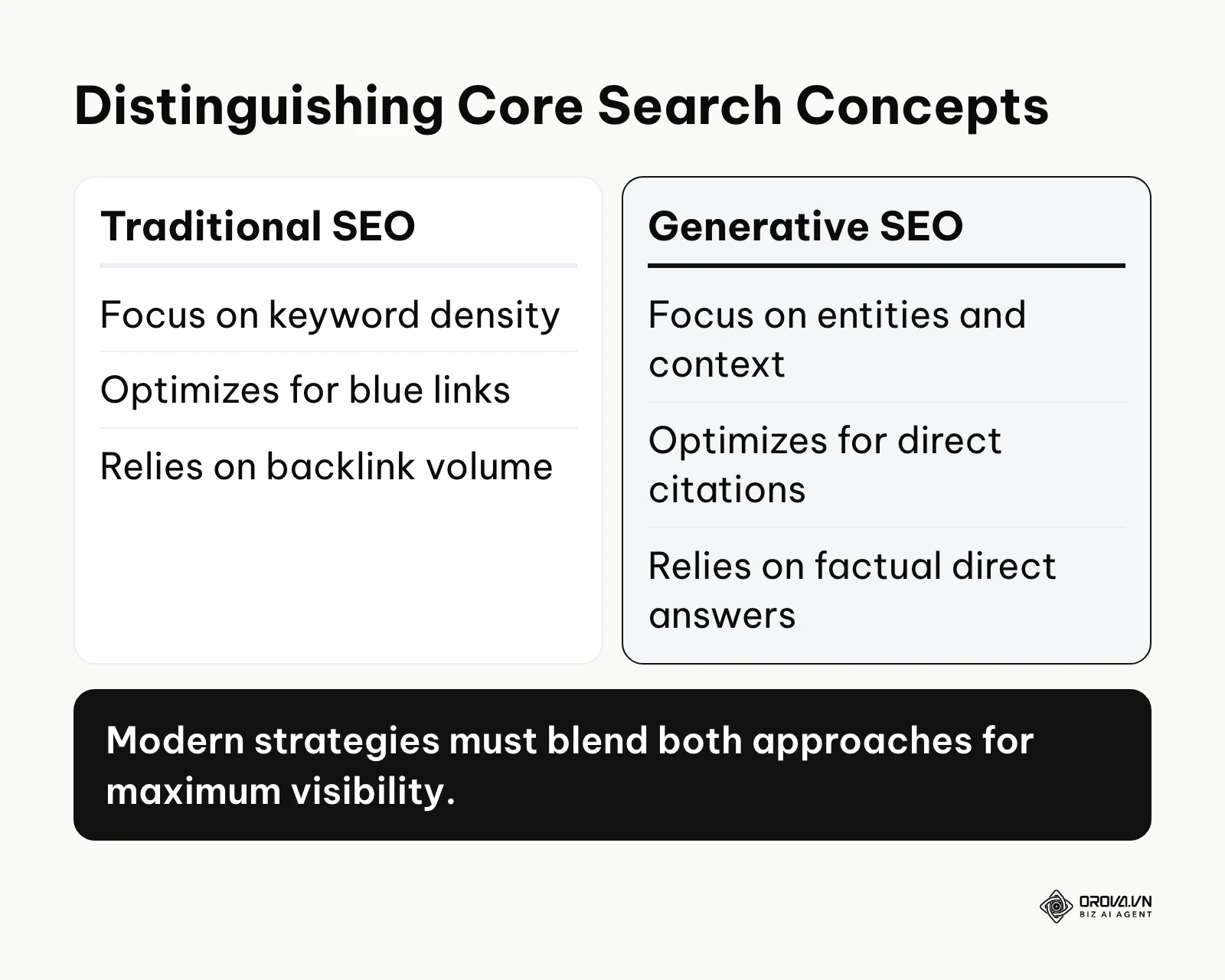
The term originated naturally as large language models began disrupting traditional browsing behaviors. It created an urgent necessity to optimize for generative engines rather than just competing for a spot among ten blue text links. Understanding the deep nuances requires separating this discipline from related marketing concepts that are frequently confused by beginners.
| Concept | How it Differs from the Main Subject | Practical Real-World Example |
|---|---|---|
| Traditional SEO | Focuses heavily on keyword density and backlink volume to rank links, whereas the modern approach prioritizes entities, context, and factual direct answers. | Building a massive 3,000-word article solely to rank #1 on a traditional results page for "best running shoes." |
| Generative Engine Optimization (GEO) | GEO is a specific subset focused entirely on appearing in conversational answers, ignoring the automation of back-office workflows entirely. | Formatting a highly specific paragraph as a direct Q&A to appear as a cited source within Perplexity. |
| Answer Engine Optimization (AEO) | AEO has historically been associated with featured snippets and voice assistants (like Siri or Alexa), while newer strategies also target multi-turn conversational platforms. | Optimizing a local business directory listing to concisely answer the voice query "Where is the nearest coffee shop?" |
Consider an everyday example: If you own a local hardware store, traditional optimization involves trying to rank your homepage for the broad term "hardware store near me." In contrast, the modern conversational approach involves structuring your product data and expertise so precisely that when a user asks a chatbot, "What specific materials do I need to build a weather-resistant deck in Seattle, and who sells them locally?" the machine synthesizes an answer that directly cites your store's tutorial and inventory as a trusted source. How the three disciplines fit together is covered in more depth in our guide to unifying SEO, AEO, and GEO.
Which SEO tasks AI can handle and which ones people should keep
The most useful way to think about AI SEO is as a division of labor. AI is fast at work that is repetitive, pattern-based and easy to check. People are still needed wherever the work depends on judgment, first-hand experience or accountability.
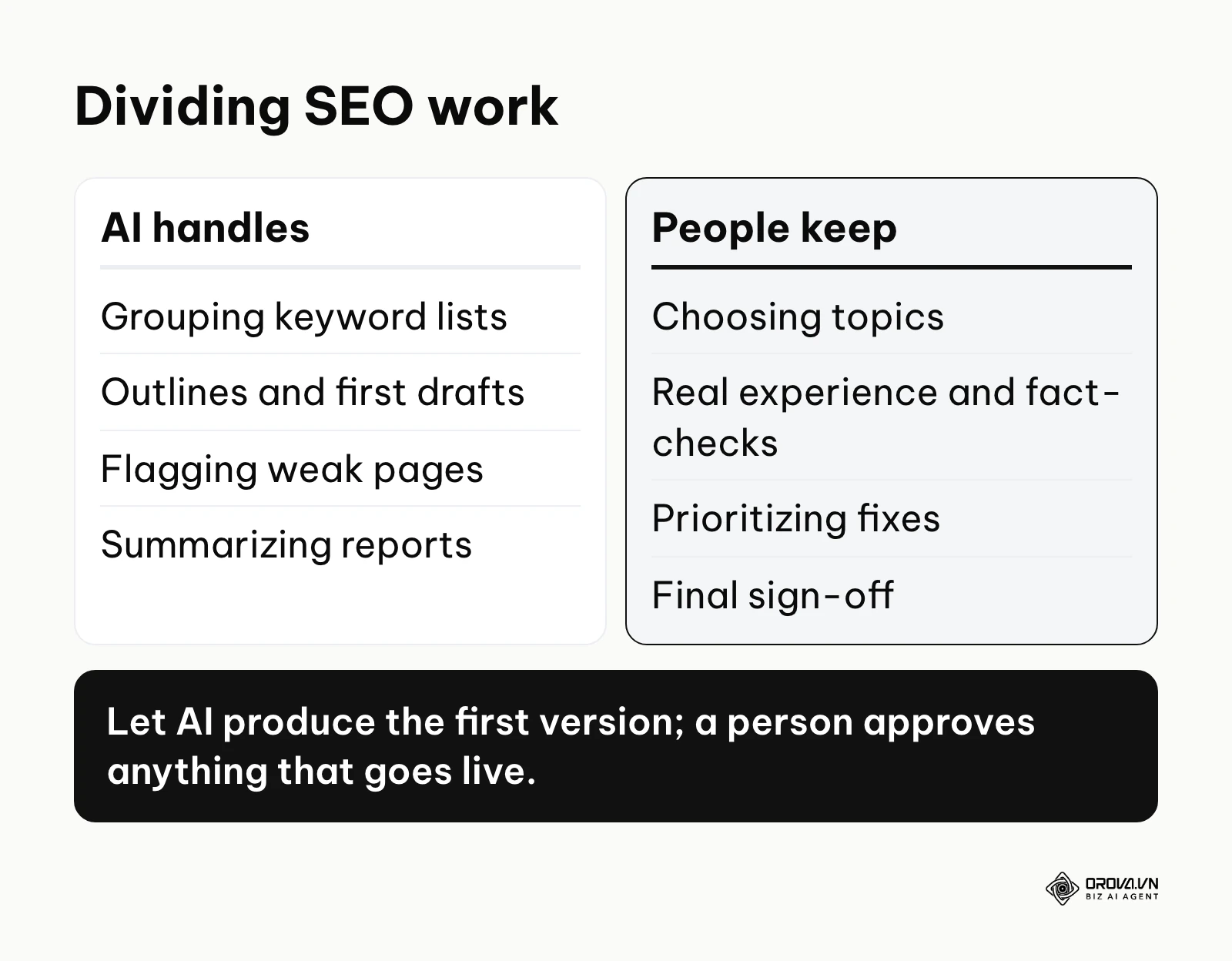
| SEO task | What AI does well | What people should keep |
|---|---|---|
| Keyword and topic research | Grouping large keyword lists, suggesting related questions, spotting intent patterns | Choosing which topics matter for the business and which to skip |
| Content drafting | Outlines, first drafts, meta titles and descriptions at scale | Adding real experience, examples and opinions; final fact-check and sign-off |
| Optimizing existing pages | Flagging thin sections, missing headings, weak meta tags across many URLs | Deciding what to merge, rewrite or retire |
| Technical checks | Scanning pages for common issues and summarizing them | Prioritizing fixes and working with developers |
| Reporting | Pulling Search Console and GA4 data into readable summaries | Interpreting the numbers and setting next steps |
| Brand and trust | Keeping tone consistent with a style guide | Owning claims, authorship and anything legal or medical |
A simple rule: let AI produce the first version, and let a person approve anything that goes live or makes a claim. If you are weighing outside help against software, the trade-offs are laid out in SEO consultants vs. AI automation.
The Significance of AI SEO in the Modern Search Ecosystem
The existence of these advanced optimization strategies stems from a fundamental, irreversible change in how users seek and consume information online. Historically, search algorithms acted primarily as digital librarians—you asked a question, and they provided a curated list of ten books (websites) where you might potentially find the answer. You had to do the reading. Today, generative search engines act as subject matter experts—you ask a question, and they read the books for you in milliseconds, synthesizing a direct, comprehensive, and highly contextual answer directly on the results page.
This evolution solves a critical problem for users: severe time scarcity and information overload. Users no longer want to click through five different websites, dodge intrusive popup ads, and scroll past lengthy, irrelevant introductions just to find a single piece of specific data. They demand immediate, synthesized knowledge. For businesses, however, this poses an existential threat. If a generative engine answers the user's query perfectly on the results screen (creating a zero-click search environment), the traditional pipeline of driving raw traffic to a website to eventually convert a lead is severely disrupted.
Within the broader marketing ecosystem, this discipline acts as the critical bridge between raw content creation and advanced entity recognition. Before this era, content simply needed to be readable by human users and discoverable by basic crawlers. Now, content must be semantically structured to feed complex neural networks. It sits downstream of your core business data architecture and upstream of the final user interaction.
If a company ignores this shift, they stand to lose their most valuable digital asset: visibility at the exact moment of high-intent user inquiry. You risk becoming completely invisible to a rapidly growing demographic of users who rely exclusively on platforms like ChatGPT, Perplexity, or Google AI Overviews for product recommendations, software comparisons, and deep B2B research.
When you do not need this approach: Despite the overwhelming industry hype, you should not prioritize this specific approach if your website operates entirely behind a secure login portal, relies exclusively on direct traffic via a highly recognizable household brand name, or if your business model depends solely on physical foot traffic driven by hyper-local map pack results. In these specific scenarios, investing heavily in generative engine visibility is a misallocation of resources. You should instead focus your budget on local citation building, customer retention programs, or conversion rate optimization for your existing direct traffic base.
The Value and Benefits of AI SEO
The integration of artificial intelligence into search optimization workflows delivers profound advantages that can be categorized into two distinct layers: the strategic, high-level value for the broader enterprise (impacting revenue, risk mitigation, and time to market) and the tactical, day-to-day benefits for the practitioners executing the work.
Strategic Value for the Enterprise
At the executive level, the primary metric of success is always return on investment. The modern search landscape introduces a level of operational efficiency that was previously unattainable for lean marketing teams. By leveraging software for tedious tasks like massive keyword clustering, technical log file analysis, and initial draft generation, businesses can dramatically scale their content output without a proportional, expensive increase in headcount. This severe time compression translates directly to significant cost savings.
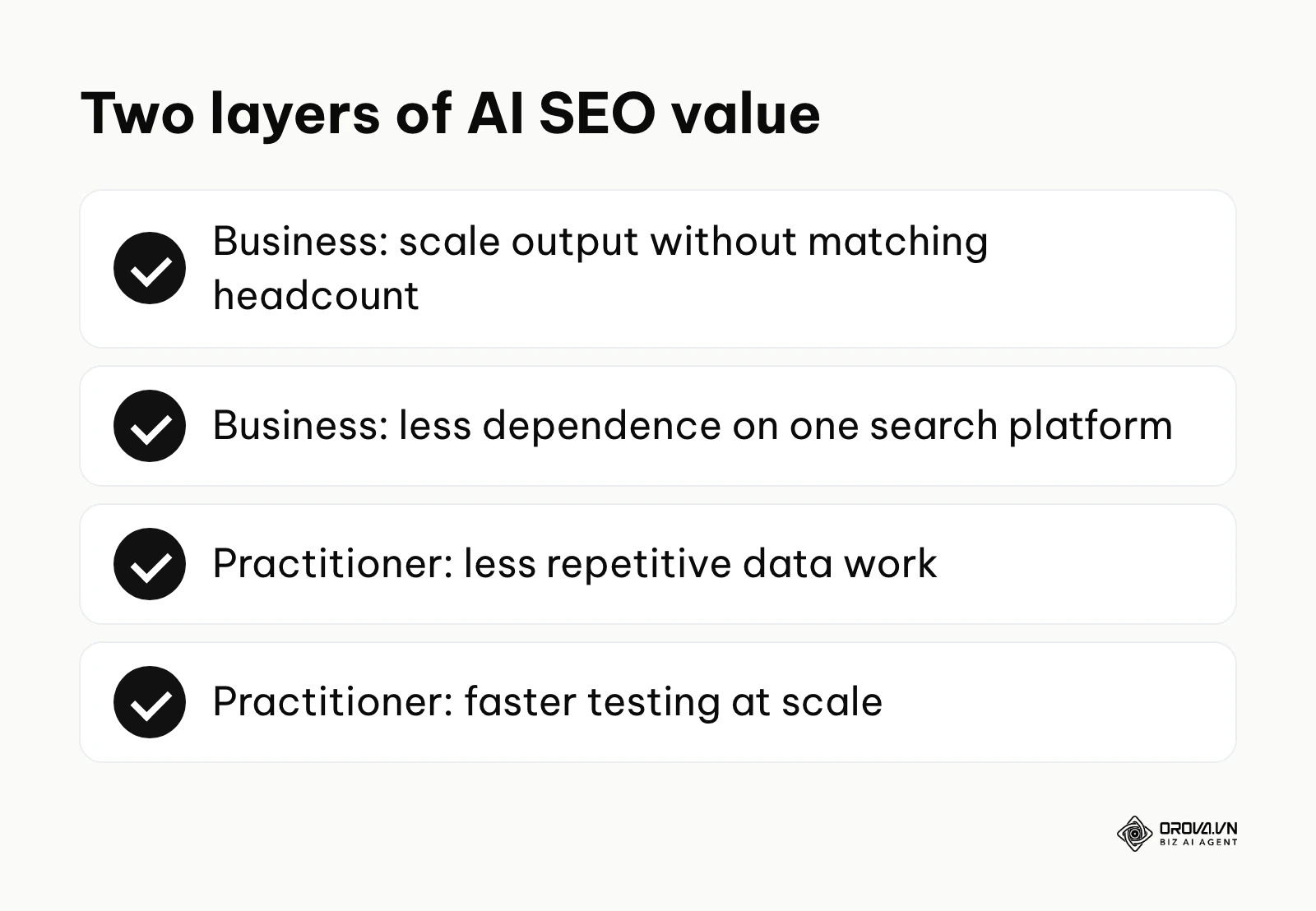
Furthermore, optimizing explicitly for generative engines mitigates the severe risk of platform dependency. By structuring your company's data as independent, verifiable entities, a business ensures its information is easily digestible by any future language model, rather than being beholden strictly to Google's legacy algorithm updates.
Illustrative example: A mid-sized B2B SaaS company struggled with unsustainable customer acquisition costs. Their traditional content strategy required massive investments in long-form guides that took many weeks to rank and generate leads.
- The marketing director implemented an automated technical audit system to identify semantic gaps across 500 existing legacy pages.
- They restructured their core product documentation into structured FAQ formats designed specifically for rapid machine ingestion.
- They deployed an automated internal linking script to connect orphaned pages logically.
The initial challenge was training the writing team to stop writing for outdated keyword density metrics and start writing for deep semantic relevance. In a scenario like this, the expected result is that the product pages start appearing as cited sources in AI answers for the questions they cover, opening a small but well-qualified channel that does not depend on ad spend.
Tactical Benefits for the Practitioner
For the in-house specialist or agency consultant, the benefits manifest most clearly in the complete elimination of menial, repetitive labor. Tools can now instantly parse thousands of search console queries to identify subtle intent shifts, allowing the practitioner to focus heavily on high-level strategy and user psychology rather than endless data entry in spreadsheets.
Additionally, automation radically accelerates the testing phase of optimization. You can dynamically adjust meta descriptions across thousands of pages and analyze the resulting click-through rate variations at scale, allowing for rapid iteration based on statistical significance rather than educated gut feelings.
| Core Benefit | Primary Measurement Metric | Expected Time to See Results |
|---|---|---|
| Scaling Content Production | Number of technically sound pages published per month | Immediate (Days 1-7) |
| Capturing Zero-Click Visibility | Inclusion rate in AI Overviews and LLM citations | Medium-term (several months) |
| Automating Technical Audits | Reduction in manual hours spent crawling and logging errors | Immediate (Days 1-7) |
| Semantic Entity Recognition | Increase in brand mentions within generative search platforms | Long-term (many months) |
Discover Orova.vn – a Biz AI Agent platform with OROVA SEO, a complete solution for every website. The system supports search engine optimization from A to Z with features including keyword research, writing new SEO-ready articles, optimizing existing content, rank tracking, plus competitor analysis and in-depth technical analysis. Sign up today to experience OROVA SEO completely free (offer valid through July 7, 2027).
How AI SEO Works: A Comprehensive Breakdown
Understanding the exact mechanics of modern search optimization requires dissecting it deeply into its core components. The process is no longer a simple, linear checklist of adding tags, but rather a continuous, dynamic loop of data structuring, entity validation, and automated refinement. We will break this down into the anatomy of optimization, specific strategies for different engines, and the exact structural templates required for long-term success.
Anatomy of Generative Optimization
The foundation of ranking prominently in a machine-driven environment relies heavily on providing clear, unambiguous data that a model can easily parse, verify against other sources, and confidently cite.
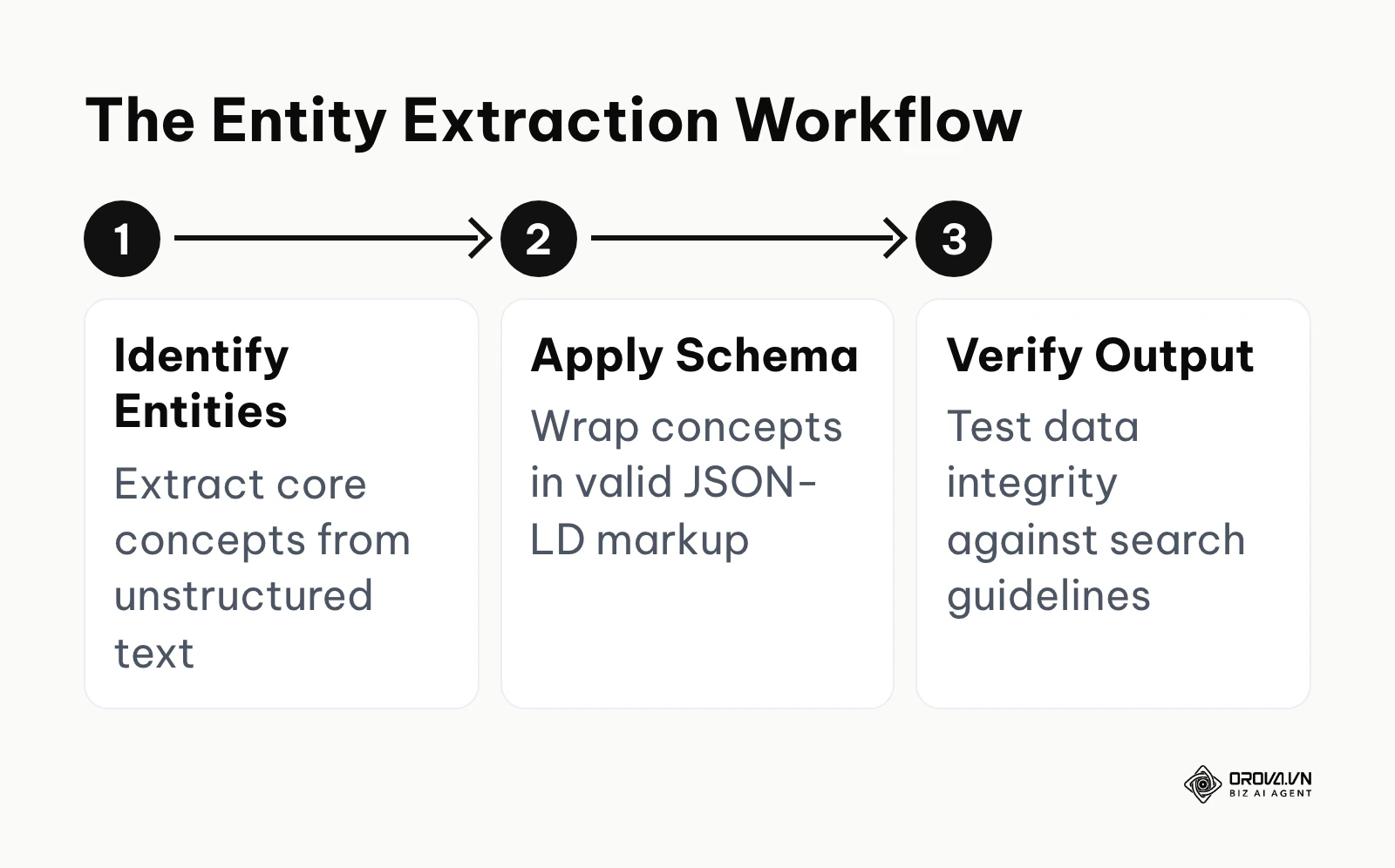
1. Entity Extraction and Structuring
- What it does: It transitions your website's content from a chaotic collection of text strings into a highly organized database of recognized entities (such as people, places, concepts, and specific products).
- Input: Unstructured, traditional blog posts or standard e-commerce product descriptions.
- Output: Semantically connected content utilizing comprehensive Schema markup (JSON-LD) that explicitly defines relationships between concepts.
- Common Failure Point: Over-stuffing the Schema markup with inaccurate, promotional, or conflicting information, leading search engines to distrust the site's data entirely and ignore the markup.
2. Conversational Intent Mapping
- What it does: Analyzes complex, long-tail, conversational queries that users naturally type into chat interfaces to determine the deep underlying intent behind the question.
- Input: Raw search query data, historical analytics, and competitor topic analysis.
- Output: A rigorous content matrix that addresses not just the primary question, but the logical sequence of follow-up questions a user would naturally ask in an ongoing chat session.
- Common Failure Point: Relying strictly on outdated keyword volume metrics rather than focusing on the complexity, nuance, and depth of the conversational thread.
3. Automated Content Lifecycle Management
- What it does: Uses specialized software to constantly monitor rankings, identify decaying content, and automatically suggest or dynamically implement updates to keep information aggressively fresh.
- Input: Live analytics data and historical ranking position fluctuations.
- Output: Dynamically updated articles and pages that maintain robust topical authority over long periods of time.
- Common Failure Point: Allowing automation tools to publish updates without any human editorial oversight, resulting in hallucinated facts, broken formatting, or severe brand voice dilution.
Differentiating Strategies: ChatGPT Search vs. Perplexity vs. Google AI Overviews
A massive, costly gap in current industry knowledge is treating all generative engines as a single monolith. They process information differently, utilize different underlying indexes, and require distinct optimization frameworks to achieve visibility.
Optimizing for Google AI Overviews Google's AI Overviews build on its existing index and ranking systems. Google states there is no special markup required: a page needs to be indexed and eligible to show a snippet in Search. In practice, pages that already rank well and answer the question clearly are the usual candidates. Your strategy must focus relentlessly on E-E-A-T (Experience, Expertise, Authoritativeness, and Trustworthiness) and absolutely pristine technical architecture.
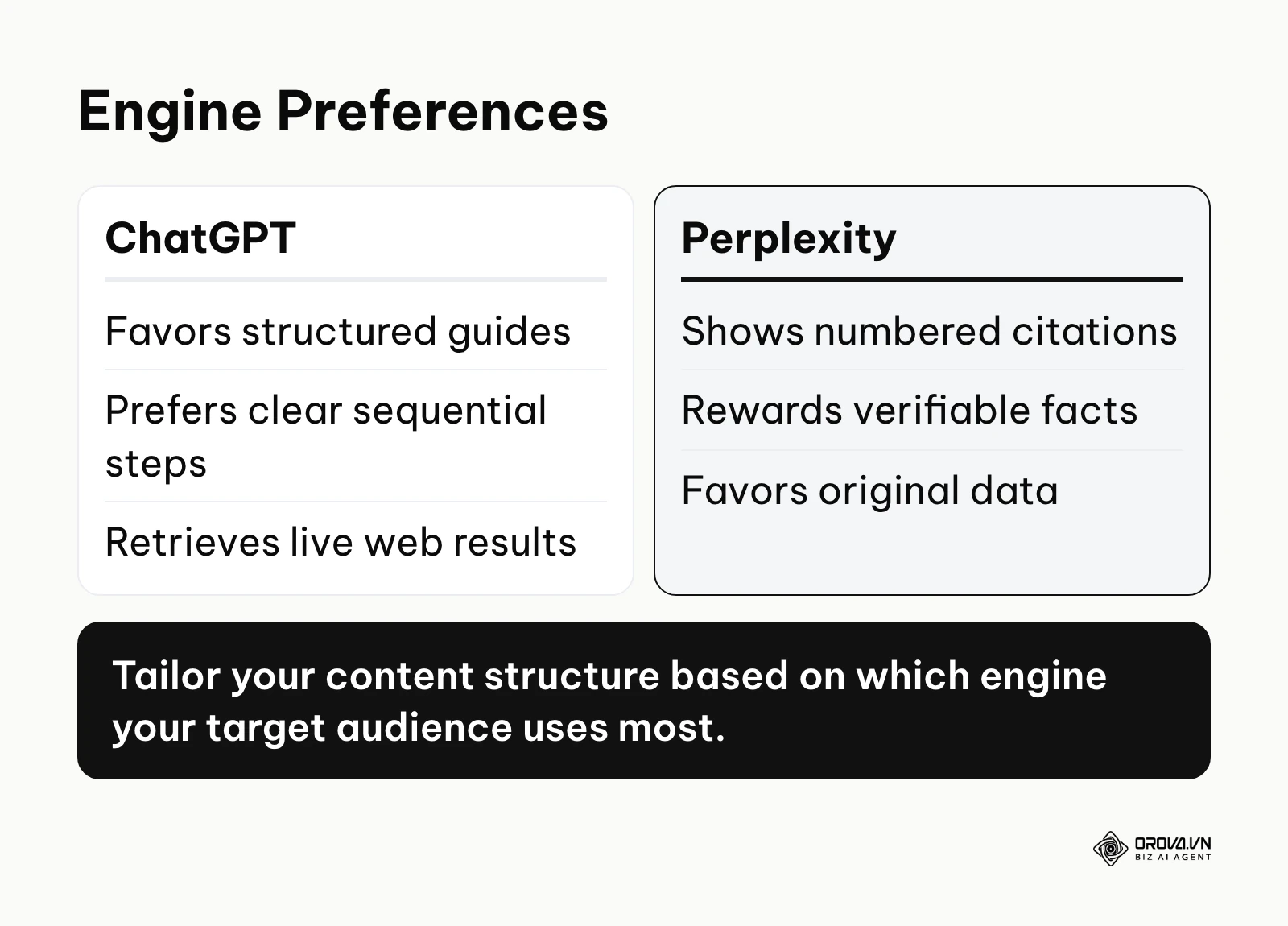
Optimizing for ChatGPT Search ChatGPT search retrieves live web results and tends to favor well-structured guides that break complex topics into logical, easily digestible steps. It looks for content that can be easily summarized into a conversational, flowing response. Using clear, sequential heading structures and providing distinct, bolded definitions early in the text is crucial.
Optimizing for Perplexity AI Perplexity shows numbered citations next to every answer, so it rewards content that is dense with clear, verifiable facts. Original research, specific data points and named sources give it something concrete to cite. If you publish a technical case study, include the method, the metrics and the raw numbers rather than vague marketing language.
The AI-Friendly Blog Post Template
To ensure your content is easily parsed, understood, and cited by generative engines, you must completely abandon the traditional "storytelling" blog format that buries the actual answer deep in the text to increase time-on-page. Instead, adopt a strict inverted pyramid structure heavily reliant on specific markdown formatting.
Here is the exact structural framework to use for every new informational asset:
- The Executive Summary (TL;DR Block): Placed immediately below the main H1 title. This must be a 50-word, highly factual summary of the entire page's conclusion. Machine models will aggressively scrape this block first.
- Direct Definitional Block: An H2 heading asking the core question (e.g., "What is [Topic]?") followed immediately by a bolded, one-sentence, highly precise definition.
- Structured Data Tables: Use markdown tables frequently to compare concepts, list technical specifications, or outline pricing tiers. LLMs excel at extracting and synthesizing tabular data accurately.
- The "Key Takeaways" Section: A bulleted list at the end of major sections summarizing the actionable points clearly.
- Deep-Dive FAQ Section: An H2 dedicated to long-tail questions, each answered directly in under 60 words. FAQPage markup can still help machines read the structure, but Google now shows FAQ rich results only for a limited set of sites, so do not count on the visual result.
The GEO Readiness Scoring Spreadsheet
To objectively measure how prepared your existing content is for conversational search, you need a quantifiable scoring system. Create a robust spreadsheet with the following specific criteria, scoring each row from 0 (Completely Missing) to 2 (Perfectly Executed):
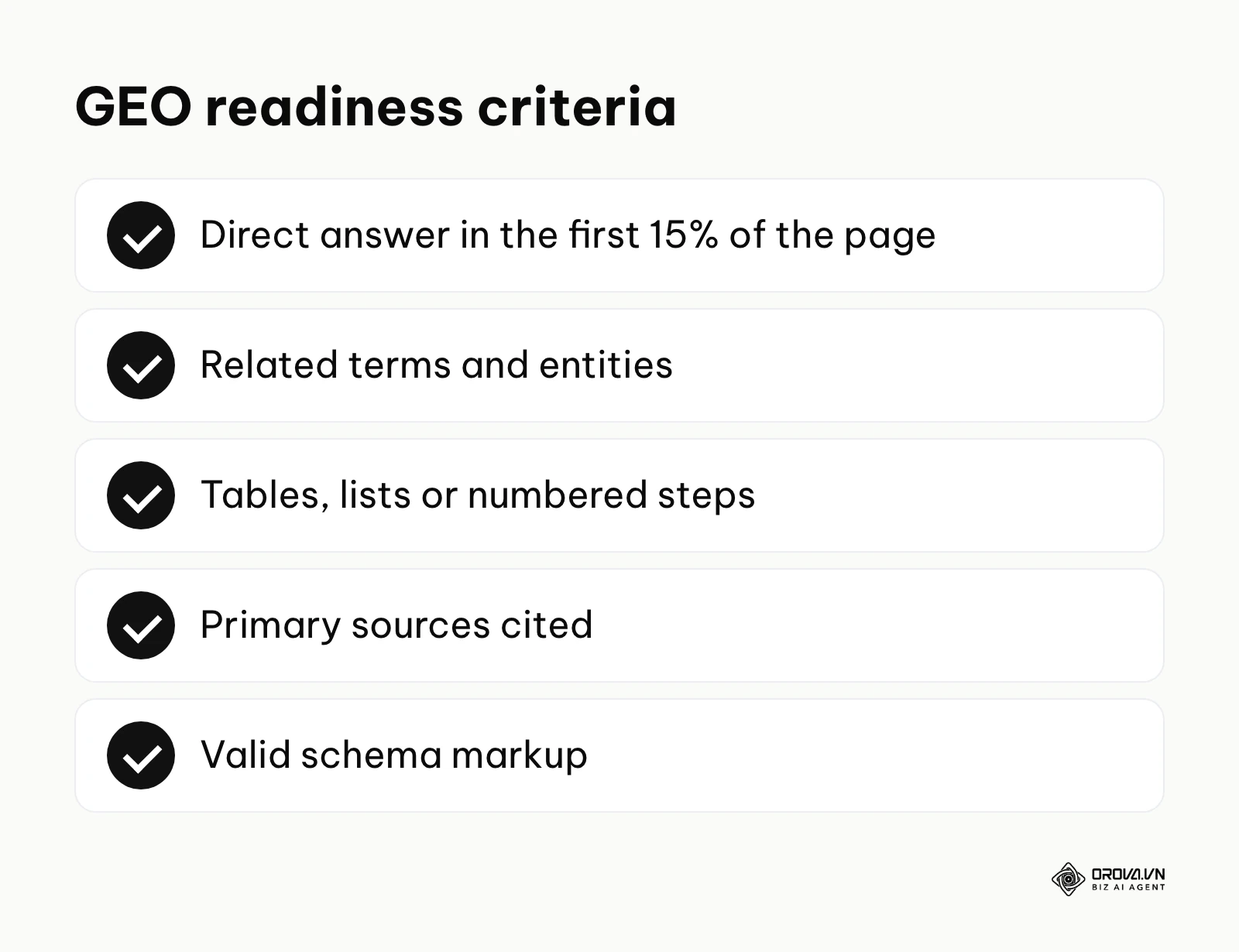
- Criterion 1: Direct Answer Proximity. Is the core question of the page answered clearly within the first 15% of the article's text?
- Criterion 2: Semantic Density. Does the content naturally include closely related terms and recognized entities without obvious keyword stuffing?
- Criterion 3: Formatting for Parsing. Are there at least three distinct markdown tables, bulleted lists, or numbered sequences used throughout the body?
- Criterion 4: Primary Source Quotation. Does the article actively cite internal proprietary data, original research studies, or named industry experts rather than just summarizing other competitor blogs?
- Criterion 5: Technical Schema Integration. Is the page successfully wrapped in valid Article, FAQ, or Organization JSON-LD markup that passes rich results tests?
A total score below 7 heavily indicates traditional, unstructured content that will likely be completely ignored by modern conversational engines.
Illustrative example: A specialized financial advisory firm wanted to capture high-net-worth leads asking highly complex tax planning questions on ChatGPT.
- The content team meticulously audited their existing "Ultimate Tax Planning Guide" which was historically a 4,000-word, unstructured wall of text.
- They applied the AI-Friendly Blog Post Template, moving the final financial conclusions to a concise TL;DR block at the very top and breaking the dense text into 15 highly specific FAQ blocks.
- They implemented custom, advanced schema markup to clearly define complex financial terms and equations.
Their biggest hurdle was convincing the strict compliance department to allow concise, direct answers instead of placing lengthy, legally mandated disclaimers at the immediate start of every paragraph. By moving the disclaimers to the end and tightening the answers, a guide like this gives AI search tools short, quotable passages to cite for questions about trust fund tax planning, which is exactly what the restructuring is meant to achieve.
| Types of AI Search | Defining Characteristics | Best Suited For |
|---|---|---|
| Conversational Chatbots (ChatGPT, Claude) | Focuses on multi-turn dialogue, synthesis of broad concepts, and coding/creative tasks. | Explanatory content, step-by-step tutorials, code documentation. |
| Generative Answer Engines (Perplexity) | Prioritizes strict citation, academic-style research, and factual accuracy. | Whitepapers, original data studies, deep-dive technical research. |
| Integrated Search Overviews (Google AI Overviews) | Blends traditional search results with AI summaries to provide a consensus view. | E-commerce product comparisons, local queries, high-volume generic informational searches. |
A 2023 research paper titled "GEO: Generative Engine Optimization," with authors from Princeton University and IIT Delhi among others, found that adding citations, quotations and statistics to a page tended to improve how visible it was in generative answers.
What to Do to Adapt and Start with AI SEO
Adapting to this entirely new paradigm requires tailored, specific strategies based tightly on your organizational role and resources. The exact actions a local business takes differ vastly from the rigorous requirements of an enterprise-level marketing team.
For Small Business Owners
Your primary focus should be on establishing unshakeable digital entities and robust local authority in the eyes of machine algorithms.
- Claim and aggressively optimize all knowledge panels: Ensure your Google Business Profile, Bing Places, and Apple Maps listings are perfectly accurate and comprehensive. AI engines use these as unquestionable ground-truth data.
- Implement automated review generation: Set up software systems to consistently gather detailed customer reviews. Models frequently summarize sentiment directly from reviews to answer subjective questions like "Is [Business Name] reliable?"
- Restructure service pages into FAQs: Convert generic paragraphs describing your standard services into direct question-and-answer formats that closely mimic how real customers speak.
- Leverage AI for rapid initial drafting: Utilize AI writing tools for website SEO to generate strong first drafts of local landing pages, but strictly enforce a policy to always inject your personal, localized expertise before hitting publish.
Illustrative example: A local landscaping business owner in Austin noticed a severe drop in phone calls despite ranking reasonably well on traditional Google maps.
- The owner claimed and updated all secondary directory listings across the web to ensure absolute name, address, and phone consistency.
- They used an automated tool to request detailed text reviews from past clients, specifically asking them to mention services like "drought-resistant lawn installation."
- They aggressively rewrote their homepage to explicitly answer the question "Who provides drought-resistant landscaping in Austin?"
The main struggle was getting busy clients to write specific, detailed reviews rather than just leaving a generic five-star rating without text. Once detailed text reviews accumulate, a business like this has a much better chance of being named when people ask AI assistants for eco-friendly landscaping options in the area.
For In-House SEO Managers
Your mandate is to scale operations efficiently and clearly prove ROI to leadership through advanced, irrefutable tracking.
- Establish AI Referrer Tracking in GA4: This is a critical, often-missed foundational step. You absolutely must isolate traffic coming directly from conversational engines.
- Conduct a Deep Semantic Entity Audit: Move far beyond traditional keyword gaps. Analyze deeply whether search engines correctly understand the specific entities your brand represents in your industry.
- Automate Internal Linking: Deploy advanced scripts or sophisticated plugins to dynamically link related concepts across your massive site, building a dense web of topical authority.
- Develop a strict prompt library for the content team: Standardize exactly how your writers use LLMs to ensure brand voice consistency and prevent hallucinations.
For Agency and Freelance SEO Professionals
You must urgently pivot from selling outdated deliverables (like "10 generic blog posts a month") to selling highly technical infrastructure and business outcomes.
- Offer GEO Audits as a premium new service: Analyze clients' existing content libraries specifically for machine readability and strict schema compliance.
- Build programmatic campaigns: Use large data sets and automation to generate hundreds of highly specific, valuable, and structured pages at scale.
- Train clients heavily on conversational intent: Educate stakeholders continuously on why raw search volume metrics are becoming vastly less relevant compared to deep semantic relevance.
- Implement automated reporting: Use API integrations to build custom dashboards that clearly show clients their visibility in generative answers, not just traditional rankings.
The GA4 Tracking Dashboard Template for AI Referrers
To accurately measure traffic from conversational engines, you cannot rely on default Google Analytics channel groupings. You must create a custom setup in GA4 to isolate this data:
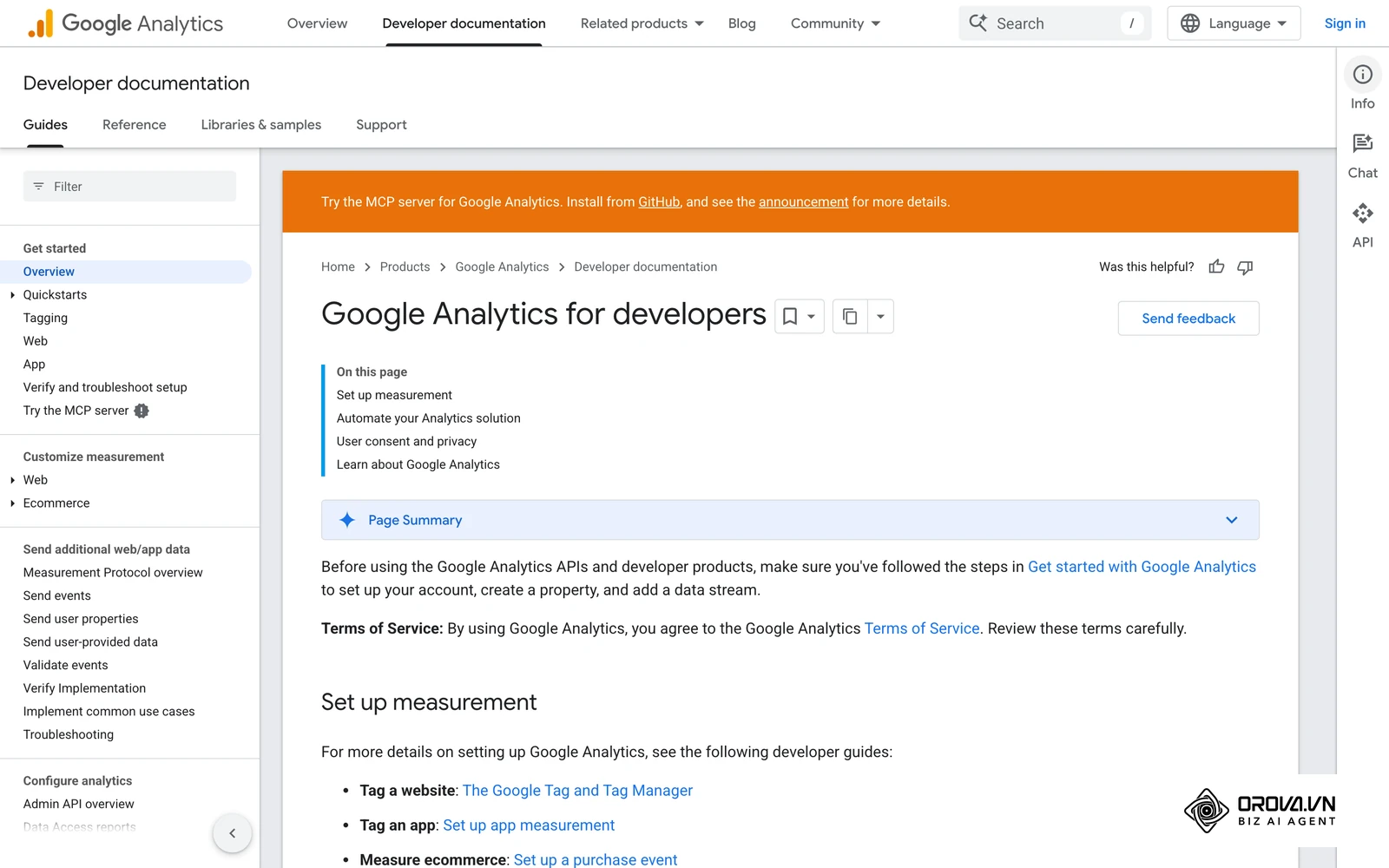
- Navigate to Admin > Data Streams: Ensure that enhanced measurement is toggled on completely.
- Create Custom Channel Grouping: Go to Admin > Data Display > Channel Groups. Create a brand new group specifically called "AI Search Engines."
- Define the Exact Rules: Set conditions where the Source matches or contains: chatgpt.com, perplexity.ai, claude.ai, gemini.google.com, copilot.microsoft.com, or android-app://com.openai.chatgpt. Clicks from Google AI Overviews arrive as ordinary Google organic traffic, so they cannot be separated this way; watch them in Search Console instead.
- Build an Exploration Report: Create a free-form exploration with the dimensions "Session source/medium" and "Landing page," filtered exclusively by your newly created "AI Search Engines" channel group. This highly specific view will reveal exactly which pages are successfully capturing machine-driven clicks.
The Automation Prompt Library
To streamline your daily workflow effectively, use these precise, highly engineered prompts when interacting with language models:
- For Content Scoring: "Act as a Generative Engine Optimization expert. Review the following text. Score it rigorously from 1-10 on its ability to be cited by an answer engine. Identify missing entities, lack of direct answers, and formatting flaws. Provide a revised TL;DR block."
- For Schema Generation: "Generate a perfectly valid JSON-LD FAQPage schema for the following list of questions and answers. Follow schema.org and Google's structured data guidelines. Output only the code."
- For Intent Expansion: "I want to become the definitive source for the topic '[Topic]'. List 10 long-tail, highly conversational questions a highly educated professional would ask about this specific topic in a multi-turn chat session."
| Common Strategic Mistake | Negative Business Consequence | How to Avoid It Effectively |
|---|---|---|
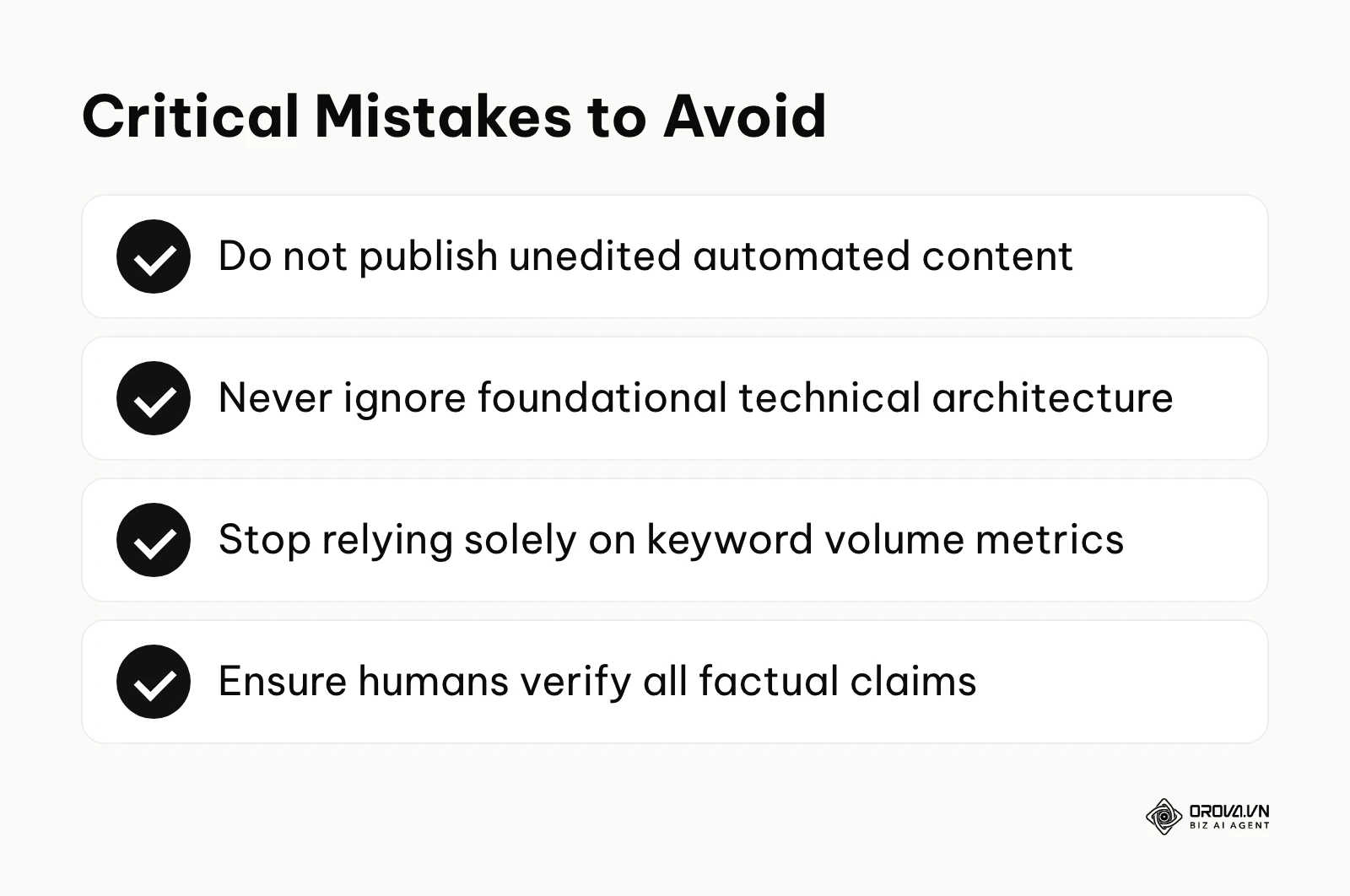
| Relying on 100% automated content without human editing. | Brand voice dilution, factual errors, and pages that add little value, which tend to lose visibility no matter how they were produced. | Implement a strict "human-in-the-loop" policy requiring editors to fact-check and inject unique experience. |
| Ignoring core technical architecture in favor of pure content volume. | Search engine crawlers fail completely to index the massive volume of new pages, rendering them totally invisible. | Maintain a rigorous XML sitemap, meticulously optimize crawl budget, and fix canonical errors before scaling. |
| Tracking only traditional blue-link keyword rankings. | A false sense of failure when organic clicks drop, missing the massive visibility gained in zero-click answers. | Set up custom GA4 tracking for referrers and aggressively monitor brand sentiment mentions across the web. |
For teams that want one place for this, Orova SEO writes SEO articles with illustrations, publishes them to WordPress or a website via API, and connects Google Search Console and GA4 to measure the results. For a step-by-step look at the writing side, see our SEO content writing guide.
With OROVA.VN and the OROVA SEO module, you put an end to the exhausting days of manual work for good. Instead of struggling for hours to write articles and compile reports, the entire process is now optimized and completed in just 5 minutes.
Where to Start with AI SEO?
Navigating this highly complex, rapidly shifting landscape can easily be overwhelming. The most effective approach is to correctly identify your current operational state and execute a single, high-impact action today rather than attempting to overhaul your entire marketing strategy overnight.
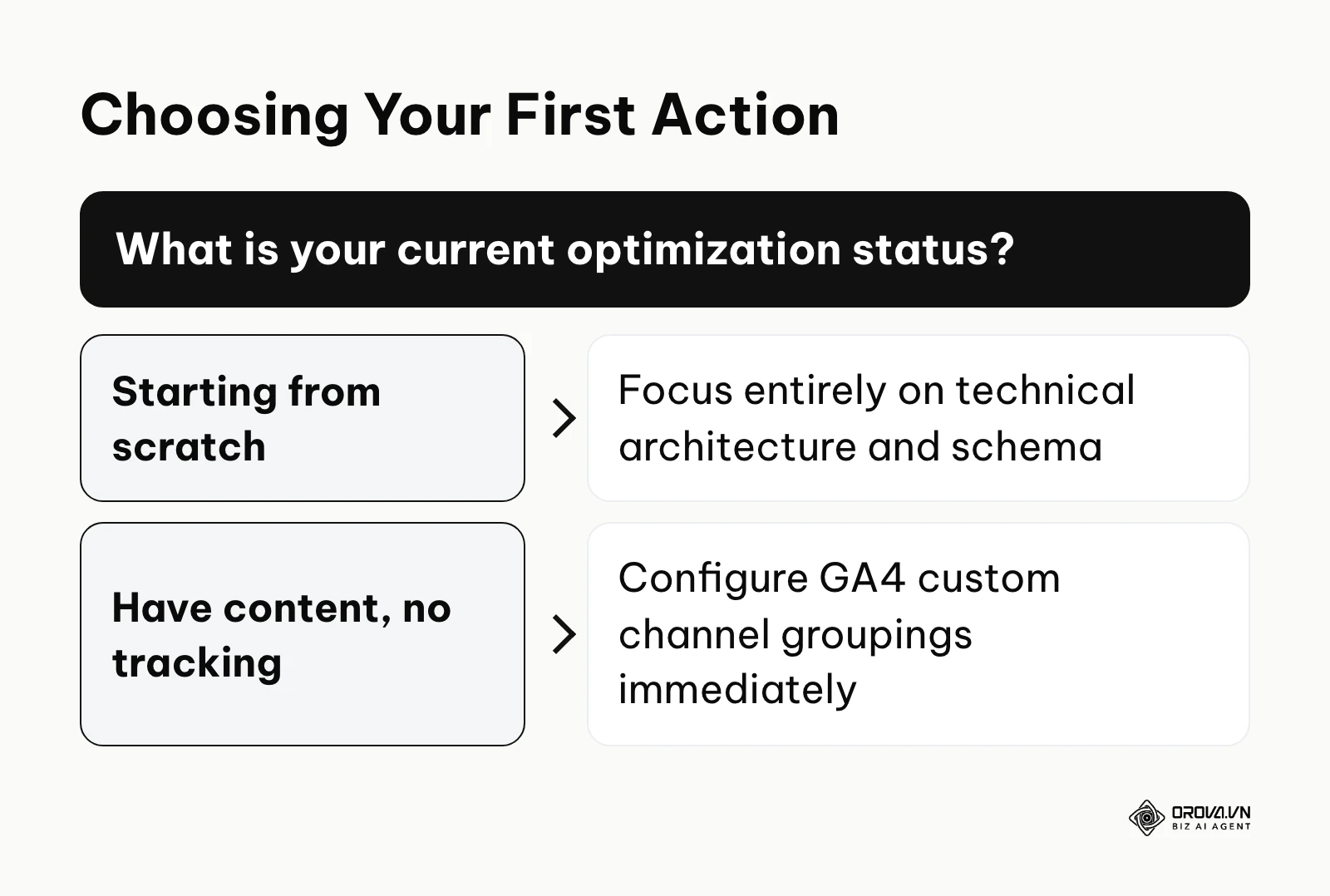
If you are starting from scratch and have no content strategy
Your immediate first step is to establish a pristine technical foundation and claim your entities firmly. Do not start by aggressively mass-producing automated articles. Instead, spend one focused afternoon perfectly configuring your Google Business Profile, ensuring all local citations match your website perfectly, and mapping out a logical core architecture for your site. Your ultimate goal is to make absolutely sure that when an algorithm looks for your brand, it finds a single, unambiguous source of truth regarding exactly who you are, what specific services you sell, and where you operate.
If you have existing content but it is scattered and underperforming
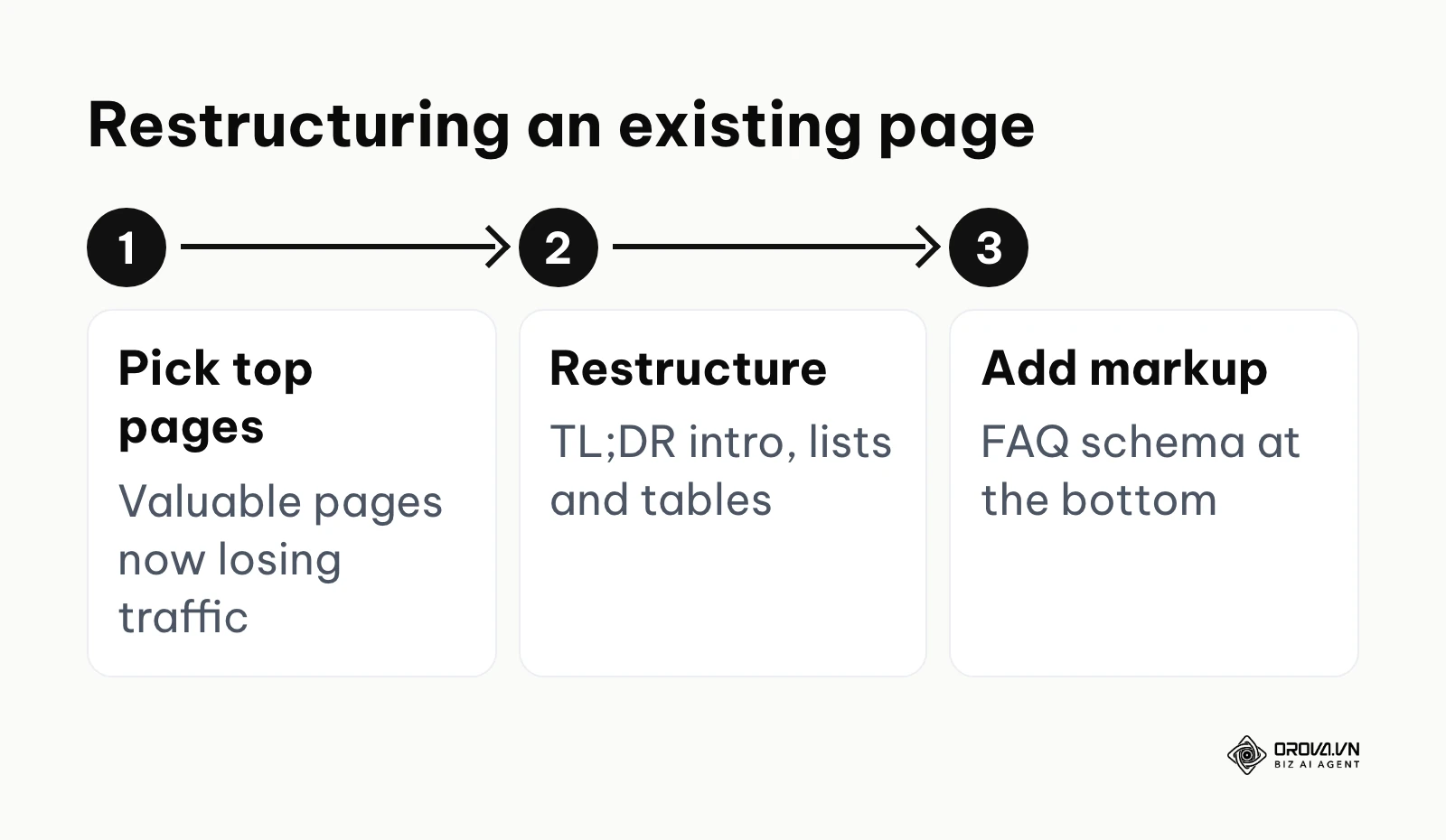
Your immediate first move should be conducting a rigorous semantic restructuring of your top 10 most historically valuable pages. Identify the specific pages that historically drove strong revenue but are currently losing traffic to zero-click answers. Spend a few hours rewriting the introductions to include a factual TL;DR block, converting long, dense paragraphs into highly scannable bulleted lists or tables, and adding explicit FAQ schema markup to the bottom of the page. You are essentially reformatting your existing expertise into a highly structured language that generative engines prefer to read.
If you are actively using tools but failing to measure the exact impact
Your immediate, non-negotiable priority is data visibility. You cannot optimize what you cannot clearly see. Stop creating new content entirely for one day and dedicate that exact time to setting up the custom GA4 tracking dashboard for conversational referrers outlined earlier in this comprehensive guide. By surgically isolating the traffic coming from Perplexity, Claude, and ChatGPT, you will finally establish a reliable baseline metric. This specific data allows you to prove conclusively which specific structural changes actually result in increased citations and valuable zero-click brand impressions.
By restructuring your core content, tracking AI referrers and keeping people in charge of judgment and sign-off, you can make AI SEO a dependable part of long-term growth.
Where AI SEO is heading in the next few years: the author's take
These are my opinions, not forecasts backed by data. They are based on how AI search tools and Google's results have changed up to 2026.
From answering questions to completing tasks
Today, more AI tools can already take actions such as comparing products or filling a cart, not just answer questions. I think that over the next two to three years a growing share of searches will be carried out by AI agents working on a user's behalf. If that happens, part of SEO will move from persuading a person to click toward making sure an agent can read your prices, stock and policies without guessing. My advice is to start with clean, well-documented product and service data that a machine can read.
Generic how-to content keeps losing value
Simple definitions and generic top-ten lists are the queries AI answers handle most easily today. My read is that this kind of content will bring in less and less traffic, while pages with original data, real experience and a clear point of view will keep earning visits and citations. I would shift budget away from rewriting what already exists and toward publishing things only your business knows.
SEO moves closer to data work
Technical SEO today is mostly crawling, rendering and sitemap hygiene. I believe the role will lean further into structured data, entities and how information is stored and exposed. Marketers will not need to become engineers, but I think the ones who can read JSON-LD, work with a spreadsheet of entities and talk clearly with developers will have an edge.
If people turn out to trust AI agents less than expected, or regulation slows them down, traditional search habits may last longer than I expect.
Frequently Asked Questions About AI SEO
Do we still need traditional SEO when we have AI SEO?
Yes, traditional optimization remains the absolute foundational infrastructure of all digital visibility. Generative engines still rely heavily on traditional ranking signals—like robust site architecture, high-quality backlinks, and exceptionally fast page load speeds—to determine which sources are authoritative enough to safely cite in their answers. If your website cannot be efficiently crawled and indexed by a traditional Googlebot, it will never be ingested by a neural network. Therefore, mastering the basics of SEO search engine optimization is a strict prerequisite, not an alternative, to executing modern strategies.
How do you purposefully appear in Google AI Overviews instead of relying on luck?
There is no guaranteed method, but you can improve your chances. First, the page must be indexed and eligible to show a snippet; in practice, pages that already rank well for the query are the usual sources. Second, your content must contain a concise, unambiguous paragraph that directly answers the query without any marketing fluff. Structuring your page with clear H2s and H3s, using logical list formats, and backing your claims with authoritative external links drastically increases the probability of being selected as a trusted source.
If AI answers everything without clicks, what is the revenue benefit of AI SEO?
The revenue benefit fundamentally transitions from capturing raw, unqualified traffic to capturing intense brand authority and highly qualified leads. When a machine consistently cites your business as the definitive answer, it establishes immense trust with the user. Even if users do not click through immediately on that specific query, this repeated brand exposure within highly trusted answers drives direct brand searches later in the buying cycle. Furthermore, for highly complex B2B queries, users will still click through to verify the raw data or consult your specific services, meaning the smaller amount of traffic you do receive is significantly closer to conversion.
How does E-E-A-T impact AI search visibility?
Google's Search Quality Rater Guidelines describe E-E-A-T (experience, expertise, authoritativeness and trustworthiness) as a way to judge whether content is reliable. E-E-A-T is not a single ranking factor, but the signals behind it, such as clear authorship, first-hand experience and accurate sourcing, help both search engines and AI tools decide which pages are safe to cite. Content with no visible author and no real experience has a harder time standing out.
What are the risks of using AI-generated content for SEO?
Google evaluates content on its quality, not on whether AI helped produce it. The real risk is publishing pages that add nothing new: if you use automation simply to reword articles that already exist, those pages are unlikely to perform, and mass-producing low-value pages to manipulate rankings falls under Google's spam policies whether a person or a tool wrote them. Additionally, models can frequently hallucinate facts or produce highly repetitive, soulless text that damages your brand's reputation and completely fails to convert human readers. The fix is to use automation for outlining, data analysis and first drafts, while human editors add unique insight and check every fact.
About the author

Builder of Orova
Nguyễn Đỗ Trọng Ân has 8 years of experience in marketing, including 6 years managing market development across Asia. He builds Orova, a Biz AI Agent that never sleeps: it plans, runs and optimizes work for businesses.
Run your business with AI Agents
Orova is the always-on Biz AI Agent — it plans, runs, and optimizes the work for you.
Save time, unlock productivity.