
What is keyword intent? A guide beyond the 4 basic types

Keyword intent is the goal behind a search query: what the searcher wants to learn, find, compare or buy when they type it. Getting keyword search intent right decides which page format can rank and convert. You spend weeks crafting a 3,000-word masterpiece. The writing is flawless, the images are custom-designed, and the page speed is incredibly fast. Yet, when you publish it, it barely cracks the second page of Google. Meanwhile, a competitor’s simple 500-word product page easily claims the top spot for your exact target keyword. You might wonder if their domain authority is just too high, or if they have a secret backlink strategy.
In reality, the problem is often much simpler: you misunderstood the keyword intent. You brought an encyclopedia to a prospect who just wanted a catalog. For years, marketers viewed keyword optimization as simply placing the right phrases in the right tags. That old approach is no longer sufficient. Today, search engines do not just read words; they analyze what the user is actually trying to accomplish. This article will explain exactly what keyword intent is, how to identify it accurately, and how to use it to structure your entire SEO strategy for maximum conversions.
What is keyword intent?
Keyword intent is the underlying goal, purpose, or problem that a user is trying to solve when they type a specific query into a search engine. It defines exactly what the searcher expects to find, dictating whether they want to read an educational article, compare software options, navigate to a specific login page, or make an immediate purchase.
The concept originated from information retrieval sciences long before modern SEO, where researchers realized that matching strings of text was useless if the format didn't match the user's task.
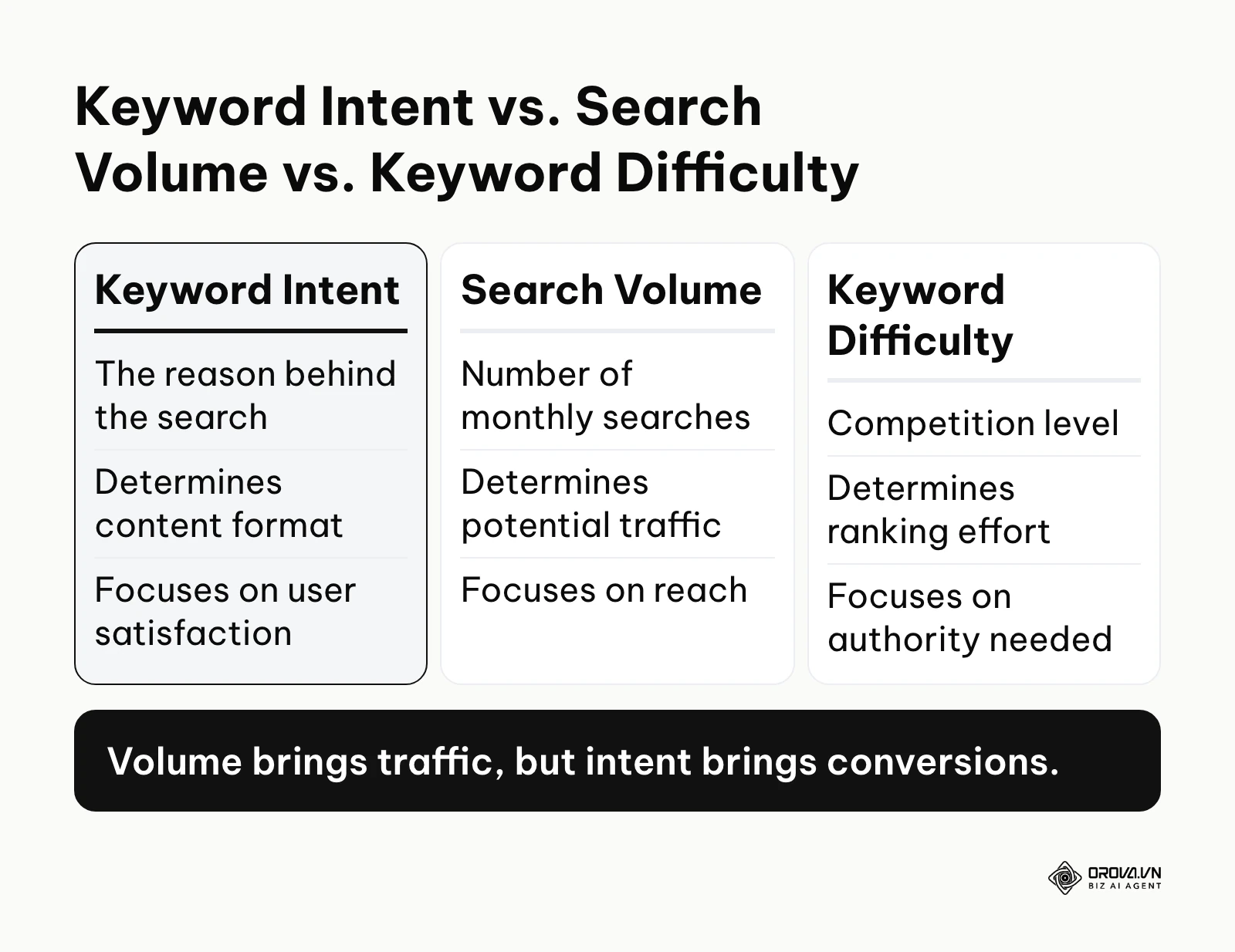
Keyword intent is often confused with other SEO metrics. Here is how they differ:
| Concept | How it differs from Intent | Example |
|---|---|---|
| Search Volume | Volume counts how many times a query is searched, while intent explains why it is searched. | "Shoes" (High volume, vague intent). |
| Keyword Difficulty | Difficulty measures how hard it is to rank based on competition, while intent dictates the format you must create to compete at all. | "Best CRM" (High difficulty, commercial intent). |
| Related terms | Related terms are semantically connected words used in the text, while intent is the reason the text exists. | Words like "interest rate" in an article about "mortgages". |
Consider a real-world example. If you walk into a hardware store and ask the clerk "How do I fix a leaky pipe?", you want advice (Informational). If you ask "Where are the wrenches?", you want directions (Navigational). If you ask "Which wrench is most durable?", you want a recommendation (Commercial). If you say "I'll take this wrench," you are ready to buy (Transactional). If the clerk hands you a wrench when you only asked for advice, you will leave confused. Search engines operate exactly like that clerk.
Why keyword intent matters in SEO strategy
Keyword intent exists to bridge the gap between human language and algorithmic sorting. It solves a massive problem for search engines: preventing users from abandoning the platform because they couldn't find what they needed quickly. For searchers, it saves time by filtering out irrelevant formats. For businesses, intent acts as a filter that qualifies traffic before it even reaches the website.
Keyword intent sits at the very foundation of your digital marketing strategy. It comes immediately after identifying your target audience but strictly before you write a single outline, decide on an architecture, or launch keyword research tools. When you map intent correctly, every subsequent step—from copywriting to internal linking—becomes clearer and more effective.
If you ignore keyword intent, you lose time, money, and momentum. You will waste resources creating content that search engines refuse to rank, simply because the format is wrong. You will attract visitors who bounce immediately because the page doesn't solve their immediate problem, dragging down your conversion rates.
When you do not need to focus on keyword intent yet
While crucial, analyzing intent is a waste of time in a few specific scenarios. If you have not yet defined your core product offerings or target audience, analyzing intent is premature; you must define your value proposition first. If you are exclusively running highly targeted account-based marketing (ABM) campaigns via direct email, SEO intent matters less because you are controlling the distribution channel. In these cases, focus on product-market fit and direct outreach scripts rather than search algorithms.
The business and operational benefits of keyword intent
Understanding and applying keyword intent provides clear advantages, splitting into high-level business value and practical, day-to-day operational benefits. The before/after scenarios below are illustrative examples, not client data.
Business Value: Reducing Customer Acquisition Costs
By targeting commercial and transactional intents, businesses stop wasting budget on visitors who are merely browsing. A commercial intent keyword such as "best CRM for startups" brings readers who are already comparing options. When your content precisely matches what a ready-to-buy user wants, conversion rates tend to rise, lowering your overall customer acquisition cost (CAC).
Before: A SaaS company bids heavily on the broad term "accounting software," attracting thousands of students doing research, resulting in a very low conversion rate. After: They shift focus to "Quickbooks alternatives for small business," attracting qualified leads and lifting the conversion rate noticeably.
Business Value: Mitigating Algorithm Risks
Search engines constantly update their core algorithms to better satisfy user intent. Google's Search Quality Rater Guidelines include a "Needs Met" rating that asks how well a result satisfies what the searcher was looking for. Pages built around that need tend to be more resilient when core updates arrive.
Before: A website relies on keyword stuffing and exact-match domains to rank, suffering a sharp traffic drop during a major algorithm update. After: The site focuses on comprehensive guides for informational queries and streamlined pages for transactional queries, keeping traffic far steadier through later updates.
Operational Benefit: Streamlining Content Production
For the SEO and content teams, intent dictates the exact template needed for a page. Writers no longer stare at a blank screen wondering how to structure an article; the intent tells them exactly what headers, tables, and calls to action are required.
Before: Writers spend three days drafting a 2,000-word essay for a keyword, only to have the SEO manager scrap it because the SERP demands a simple calculator tool. After: The SEO manager assigns the keyword with a strict "Tool/Calculator" intent tag, allowing developers to build it in one day.
Operational Benefit: Accurate Performance Measurement
When you categorize keywords by intent, you can set realistic KPIs. You stop expecting informational blog posts to generate immediate direct sales, and instead measure them by email sign-ups or time-on-page, reducing friction between marketing and sales teams.
Before: The marketing director panics because a highly trafficked glossary page isn't generating demo requests. After: The team measures the glossary page by assisted conversions and newsletter subscriptions, accurately proving its value in the upper funnel.
| Benefit | Measured by which metric | Where to check it |
|---|---|---|
| Reduced CAC | Conversion rate, cost per lead | Analytics conversions by landing page |
| Algorithm resilience | Traffic stability during updates | Search Console performance report |
| Streamlined production | Content turnaround time | Your content calendar or project tracker |
| Accurate measurement | Goal completion rate by page type | Analytics, grouped by page type |
Discover Orova.vn – a Biz AI Agent platform with OROVA SEO, a complete solution for every website. The system supports search engine optimization from A to Z with features including keyword research, writing new SEO-ready articles, optimizing existing content, rank tracking, plus competitor analysis and in-depth technical analysis. Sign up today to experience OROVA SEO completely free (offer valid through July 7, 2027).
How keyword intent works: The complete anatomy
To master keyword intent, you must dissect it into its core components. The process is not about guessing; it is about reverse-engineering the search engine results page (SERP) to see what the algorithm has already decided the user wants.
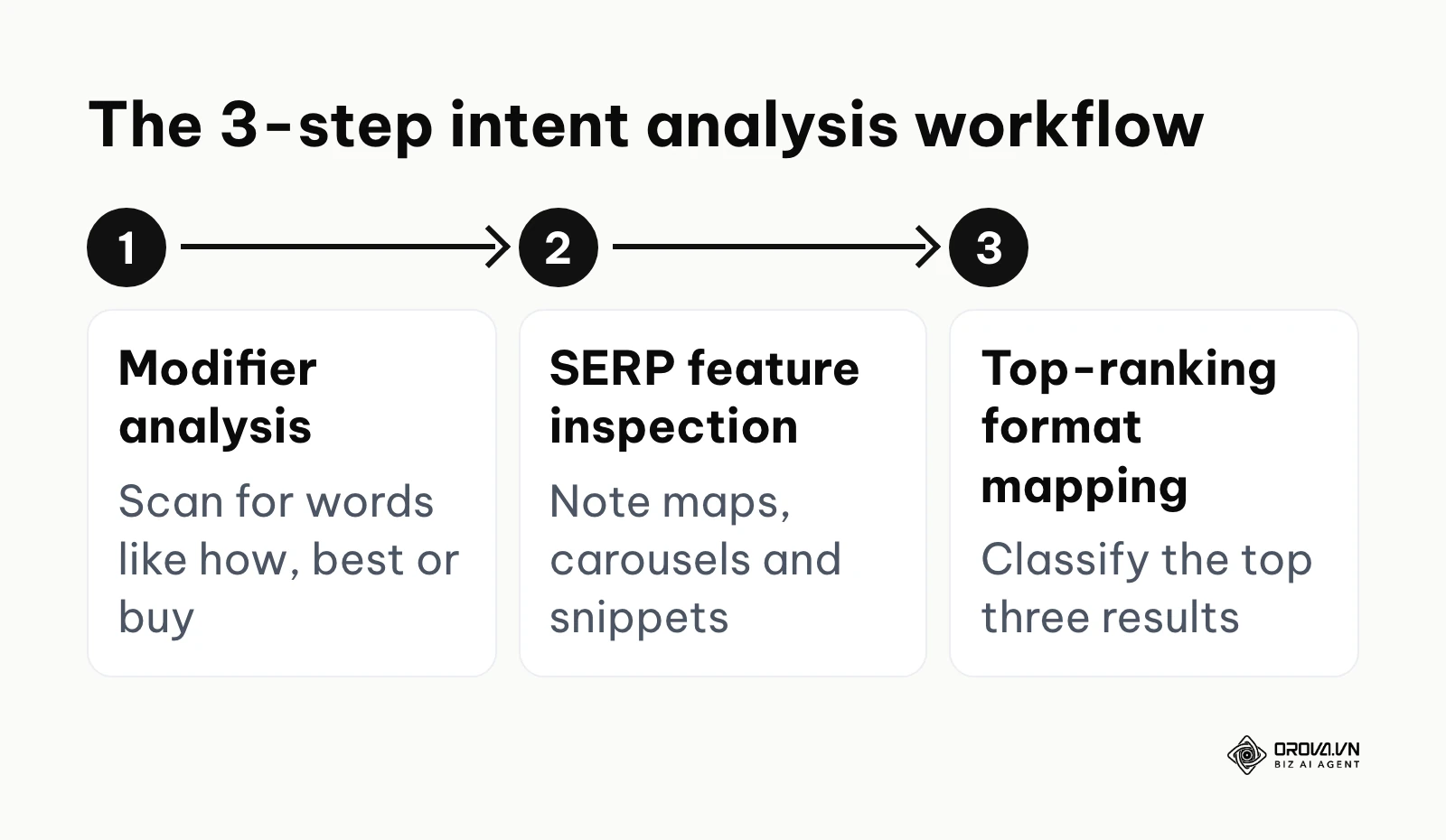
Step 1: Modifier Analysis (The Input)
The first step is looking at the words that surround the core topic. These are called modifiers.
- What you do: Scan the keyword list for specific prefixes or suffixes.
- Input: A raw list of keywords.
- Output: A preliminary classification based on vocabulary.
- Where it fails: Modifiers can be misleading. The word "best" usually implies commercial intent, but "best way to tie a tie" is purely informational.
Step 2: SERP Feature Inspection
Search engines use special features (like maps, shopping carousels, or video carousels) to satisfy specific intents instantly.
- What you do: Search the keyword in an incognito window and document every SERP feature present.
- Input: The targeted keyword.
- Output: Clues about the expected format (e.g., if you see a shopping carousel, the intent is transactional).
- Where it fails: Personalization or geographic location can change the SERP features you see compared to what your target audience sees.
Step 3: Top-Ranking Format Mapping
This is the most critical step. You must analyze the top three organic results because they represent what the algorithm currently considers the perfect intent match.
- What you do: Open the top three URLs and categorize their format (e.g., listicle, ultimate guide, product category page, tool, review).
- Input: The URLs of top competitors.
- Output: The exact page template you must create to compete.
- Where it fails: Sometimes the SERP is volatile, and the top results are mixed, indicating that the search engine itself is unsure of the dominant intent.
The 4 Basic Types of Keyword Intent
Traditionally, all intents fall into four primary buckets.
| Intent Type | Characteristics | Best Content Format |
|---|---|---|
| Informational | The user wants to learn something or find an answer to a specific question. Modifiers: how, what, why, guide, tutorial. | Long-form blog posts, step-by-step guides, FAQs. |
| Navigational | The user wants to find a specific website or physical location. Modifiers: brand names, login, customer service, near me. | Homepage, contact pages, optimized about pages. |
| Commercial | The user is researching options before making a purchase decision. Modifiers: best, top, vs, review, alternative. | Comparison charts, listicles, in-depth reviews, case studies. |
| Transactional | The user is ready to buy or take a specific action right now. Modifiers: buy, discount, price, download, sign up. | Product pages, pricing pages, landing pages with clear CTAs. |
Resolving Mixed Intent: The Decision Tree
Often, a single keyword will display a SERP with two completely different types of pages. For example, searching for "applicant tracking system" might show five informational guides explaining what an ATS is, and five software product pages trying to sell one. This is called Mixed Intent.
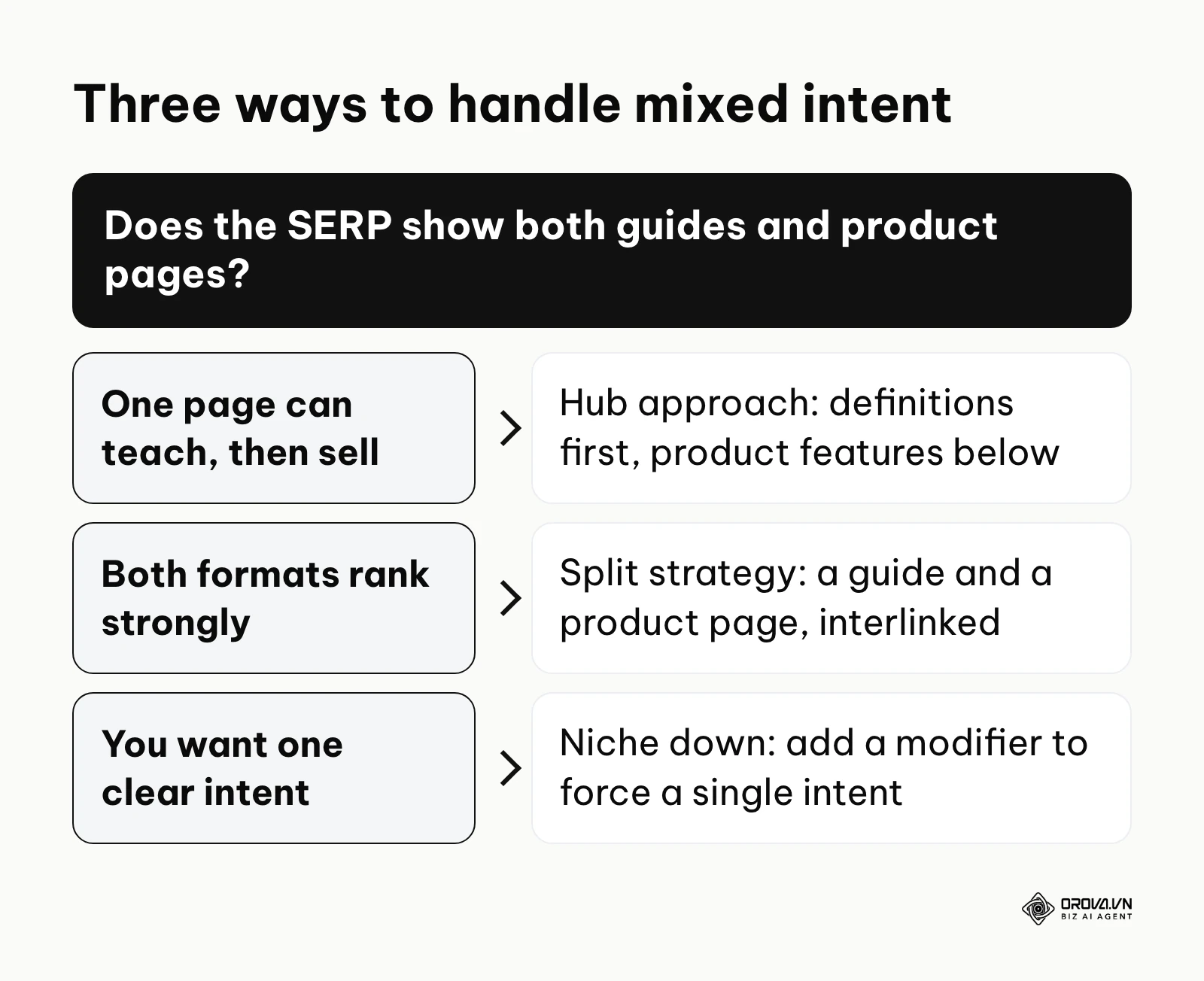
When you encounter Mixed Intent, you have three choices:
- The Hub Approach: Create a comprehensive "pillar" page that starts with informational definitions and naturally transitions into commercial product features further down the page.
- The Split Strategy: Create two separate pages targeting the same cluster—one purely educational guide, and one transactional product page—and interlink them heavily.
- The Niche Down: Add a modifier to your target keyword to force a single intent (e.g., changing "applicant tracking system" to "best applicant tracking system for startups").
AI-Driven Intent and AI Overviews
As search engines integrate generative AI (like Google's AI Overviews), informational intent is changing. Simple questions ("What is the capital of France?") are often answered directly at the top of the page, leaving websites with fewer clicks.
To survive this, you must target Complex Informational Intent. You have to answer questions that AI cannot reliably summarize because they require deep expertise, recent data, or nuanced opinions. Instead of targeting "what is a CRM," you must target "how to migrate from Salesforce to HubSpot without losing data." This requires understanding the subtle shift from generic fact-finding to complex problem-solving.
Illustrative examples: The cost of getting intent wrong
The three scenarios below are illustrative examples, not documented client cases, but they show the impact of intent mismatches better than theory.
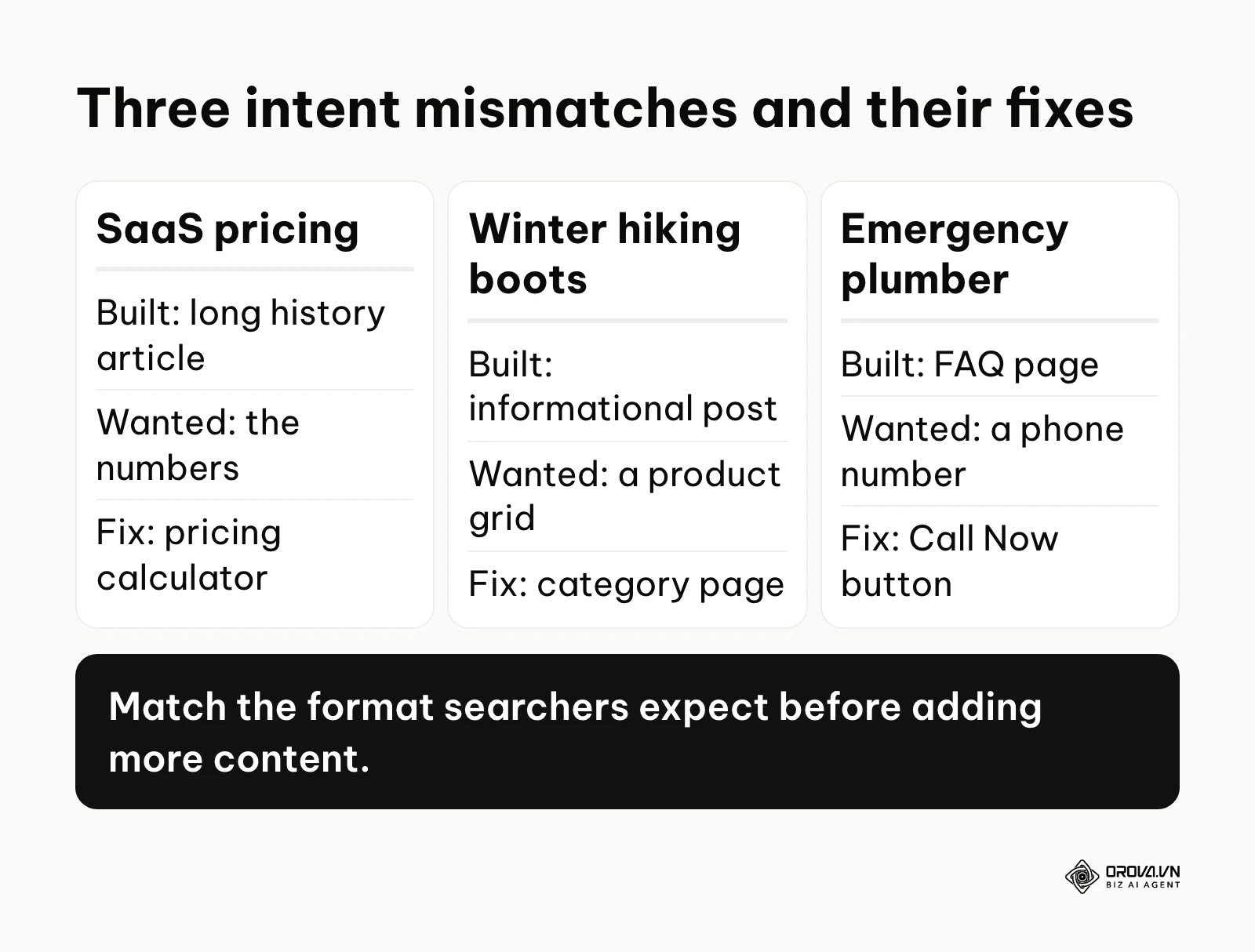
Illustrative example 1: The SaaS pricing page
- Context: A mid-sized B2B software company wanted to rank for "project management software cost."
- Actions taken: They wrote a massive 4,000-word blog post detailing the history of software pricing, the economic factors of SaaS, and industry averages.
- The stumbling block: The page ranked poorly and most visitors left within seconds. The intent was transactional/commercial, not informational. Users just wanted to see numbers.
- The result: They replaced the massive article with a simple, interactive pricing calculator tool. Over the following weeks, the page climbed toward the top results, and lead capture increased visibly.
Illustrative example 2: The e-commerce category mistake
- Context: An outdoor gear retailer wanted to dominate the keyword "winter hiking boots."
- Actions taken: They optimized an informational blog post titled "Everything You Need to Know About Winter Hiking Boots" and built heavily linked internal structures to it.
- The stumbling block: The SERP for "winter hiking boots" was dominated by transactional e-commerce category pages displaying product grids. Searchers wanted to shop, not read.
- The result: They shifted their optimization efforts to their actual product category page, following standard ecommerce SEO practice. The blog post was relegated to a supporting role. Revenue from that specific keyword segment grew steadily over the next quarter.
Illustrative example 3: The local service misdirection
- Context: A regional plumbing service wanted more calls for "emergency plumber."
- Actions taken: They created an extensive FAQ page explaining what constitutes a plumbing emergency and how to turn off the main water valve.
- The stumbling block: Users searching "emergency plumber" are in a panic; they have navigational and transactional intent. They do not want to read an FAQ; they want a phone number immediately.
- The result: They redesigned the page to feature a massive "Call Now" button above the fold and streamlined the text. Phone inquiries from organic search improved noticeably within days.
Actionable Resource: The Automated Intent Mapping Template
To handle thousands of keywords, you cannot analyze each SERP manually. You need an automated system. You can build a simple Google Sheets template to do much of the first-pass sorting.
Create three columns: Keyword, Search Volume, and Automated Intent. In the Automated Intent column, use a nested IF formula that looks for specific text strings within the keyword cell: =IF(OR(ISNUMBER(SEARCH("how", A2)), ISNUMBER(SEARCH("what", A2))), "Informational", IF(OR(ISNUMBER(SEARCH("best", A2)), ISNUMBER(SEARCH("vs", A2))), "Commercial", IF(OR(ISNUMBER(SEARCH("buy", A2)), ISNUMBER(SEARCH("price", A2))), "Transactional", "Manual Review Needed")))
This formula automatically tags your keywords based on modifiers. You then only need to manually review the complex, modifier-less keywords (like "CRM software") by checking the live SERPs.
How to adapt your strategy for keyword intent
Adapting your workflow to prioritize intent requires different actions depending on your role in the organization.
For Small Business Owners
As an owner, your time is limited. You must focus on intent that brings immediate revenue.
- Identify your "money keywords": List the exact phrases people use right before they hand you cash. Focus entirely on Transactional and Local Navigational intents.
- Audit your homepage: Ensure your homepage immediately clarifies what you do and where you are located, satisfying navigational intent.
- Build dedicated service pages: Stop putting all your services on one page. Create a specific, transactional page for every distinct service you offer.
For In-House Marketing Managers
Your job is to build a scalable, full-funnel content machine.
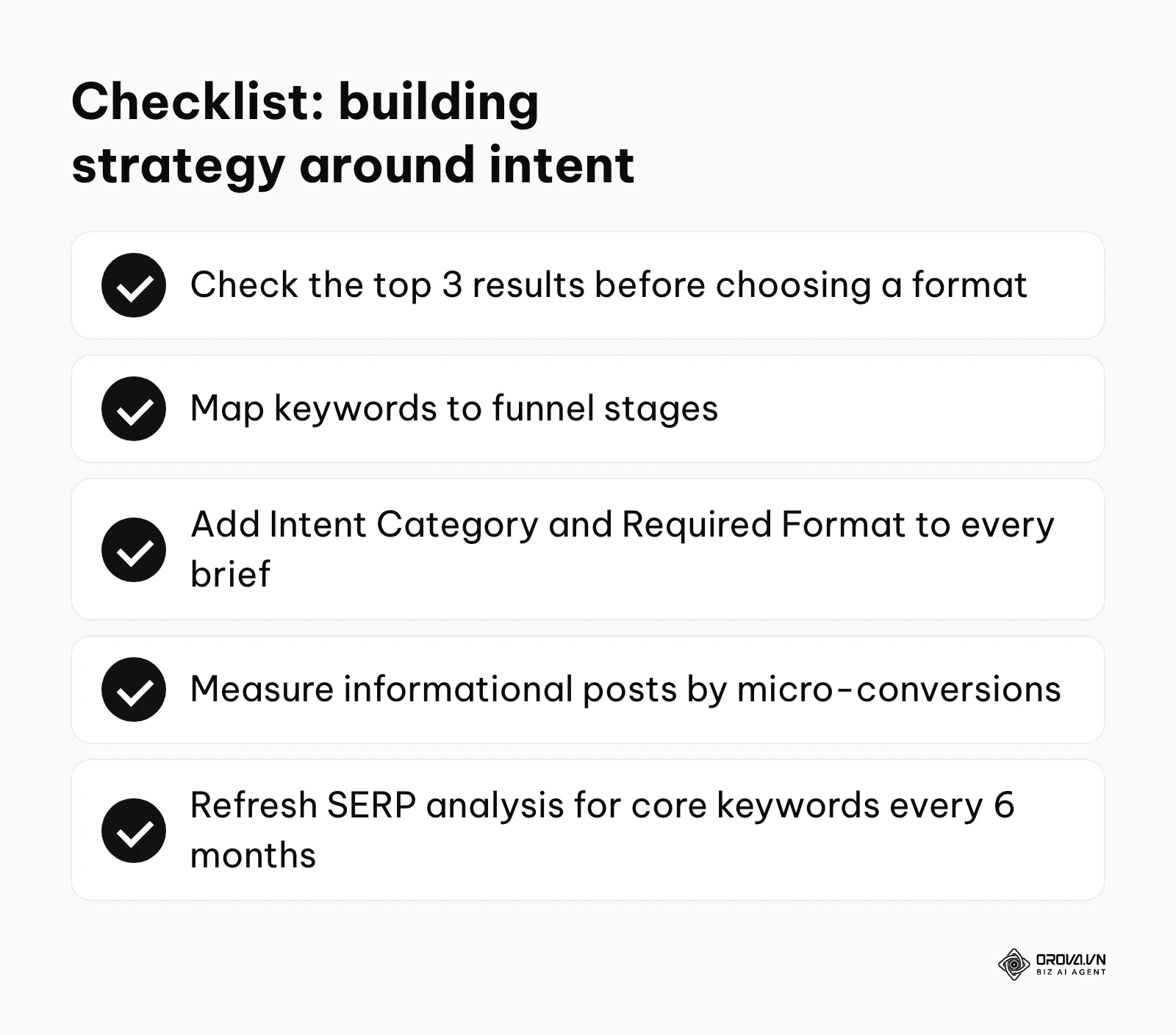
- Map your current keywords to the marketing funnel: Categorize your existing ranking keywords into Informational (Top of Funnel), Commercial (Middle of Funnel), and Transactional (Bottom of Funnel).
- Identify the missing intent stages: If you have massive traffic from informational posts but no sales, you have a gap in commercial intent content. Prioritize building comparison pages next.
- Implement strict content briefs: Mandate that every content brief assigned to a writer includes an "Intent Category" and "Required Format" section based on SERP analysis.
- Align metrics with intent: Stop measuring informational blog posts by direct sales. Measure them by engagement and micro-conversions (like newsletter sign-ups).
For SEO Agencies and Freelancers
Your value lies in explaining the "why" to clients who are obsessed with search volume alone.
- Educate clients during onboarding: Use visual examples to show why ranking for a high-volume, low-intent keyword will not generate the ROI they expect.
- Conduct intent mismatch audits: Find pages on the client's site that have high impressions but low clicks or high bounce rates. These are usually intent mismatches. Suggest formatting overhauls rather than just adding more text.
- Optimize for SERP features: Identify which commercial keywords trigger product carousels or review snippets, and implement schema markup to win those spots.
- Develop hybrid hub pages: For mixed intent keywords, build sophisticated pages that combine educational content with subtle transactional elements to satisfy multiple user journeys simultaneously.
| Common Mistake | Consequence | How to Avoid |
|---|---|---|
| Chasing volume over intent | High traffic, few conversions. | Filter keyword lists by commercial modifiers before prioritizing. |
| Writing a blog post for a transactional SERP | The page struggles to rank, regardless of word count or links. | Always check the top 3 results manually before choosing a format. |
| Forgetting to update intent over time | A page that ranked well drops as user behavior changes. | Refresh SERP analysis for core keywords every 6 months. |
With OROVA.VN and the OROVA SEO module, you put an end to the exhausting days of manual work for good. Instead of struggling for hours to write articles and compile reports, the entire process is now optimized and completed in just 5 minutes.
Where keyword intent is heading in the next few years: the author's take
The traditional four-bucket model still works as a starting point, but it is already showing cracks. These are three opinions, not forecasts backed by data, about where keyword intent is going and what to do about it.
The Rise of Hyper-Contextual Intent
Today, search engines already use signals such as location and device to interpret vague queries. My read is that over the next two to three years this context will weigh even more heavily, so the same keyword can carry a different intent depending on who searches, where and when. A search for "pizza" at noon on a desktop may lean toward finding a lunch spot, while the same search late at night on a phone leans toward ordering delivery. I think the practical preparation is to make sure your mobile experience, including your core web vitals, holds up in those urgent, context-driven transactional moments.
AI Will Squeeze Basic Informational Intent
AI Overviews already answer many simple questions at the top of the results page. I think that in the next few years, queries that need only a short factual answer will send noticeably less organic traffic to independent websites. If your strategy relies on answering questions like "what is a CRM" or "how to tie a tie," I would start shifting toward experience-led informational content: original data, clear opinions and practical detail that a summary cannot easily replace.
The Blurring of Commercial and Transactional Boundaries
Today, users often research (commercial) and buy (transactional) in separate steps and on separate sites. My read is that search interfaces will keep pulling these two phases closer together, so a reader may move from a comparison to a purchase with very few clicks. I would prepare by placing clear transactional paths, such as a link to the product or checkout page, directly inside commercial comparison content, so you are ready the moment the reader's intent shifts from research to purchase.
Frequently asked questions about keyword intent
Is keyword intent still needed when we have AI search?
Yes, absolutely. While AI might summarize the answers, the underlying intent of the user remains the same. The user still has a problem to solve. Your job shifts from just providing facts to providing the most useful, experience-backed format for that intent. AI makes understanding intent more critical because you have to target the complex intents that AI cannot easily satisfy.
How do I handle seasonal intent changes?
Some keywords change intent based on the time of year. "Halloween costumes" is informational in July but highly transactional in October. Watch your query data in Google Search Console closely to see when click-through rates shift. Create a dynamic page that features informational inspiration during the off-season and flips to a transactional product catalog as the season approaches.
What should I do if tools categorize intent incorrectly?
Automated SEO tools often mistake niche informational queries for commercial ones based on flawed modifier logic. Always trust your own manual SERP analysis over a tool's label. If the tool says "Commercial" but the top 10 results are academic PDFs, the true intent is informational.
Should I optimize one long page or multiple short pages for mixed intent?
If the SERP shows a heavy mix (e.g., 50% guides, 50% products), do not try to build one massive page that does both poorly. Build an informational guide and a transactional product page, and use clear, prominent internal links between them. Let the user decide which path they want to take, and let the search engine index both formats.
How often should I re-evaluate the intent of my target keywords?
Search intent is not static. A keyword that was informational five years ago might be highly commercial today as the market matures. You should audit the intent of your top 20 revenue-driving keywords every six months, checking if the SERP features or ranking formats have shifted.
Where to start?
Knowing the theory of keyword intent is useless without immediate application. The best way to begin depends entirely on the current state of your SEO program. Do not try to boil the ocean; take one specific action today.
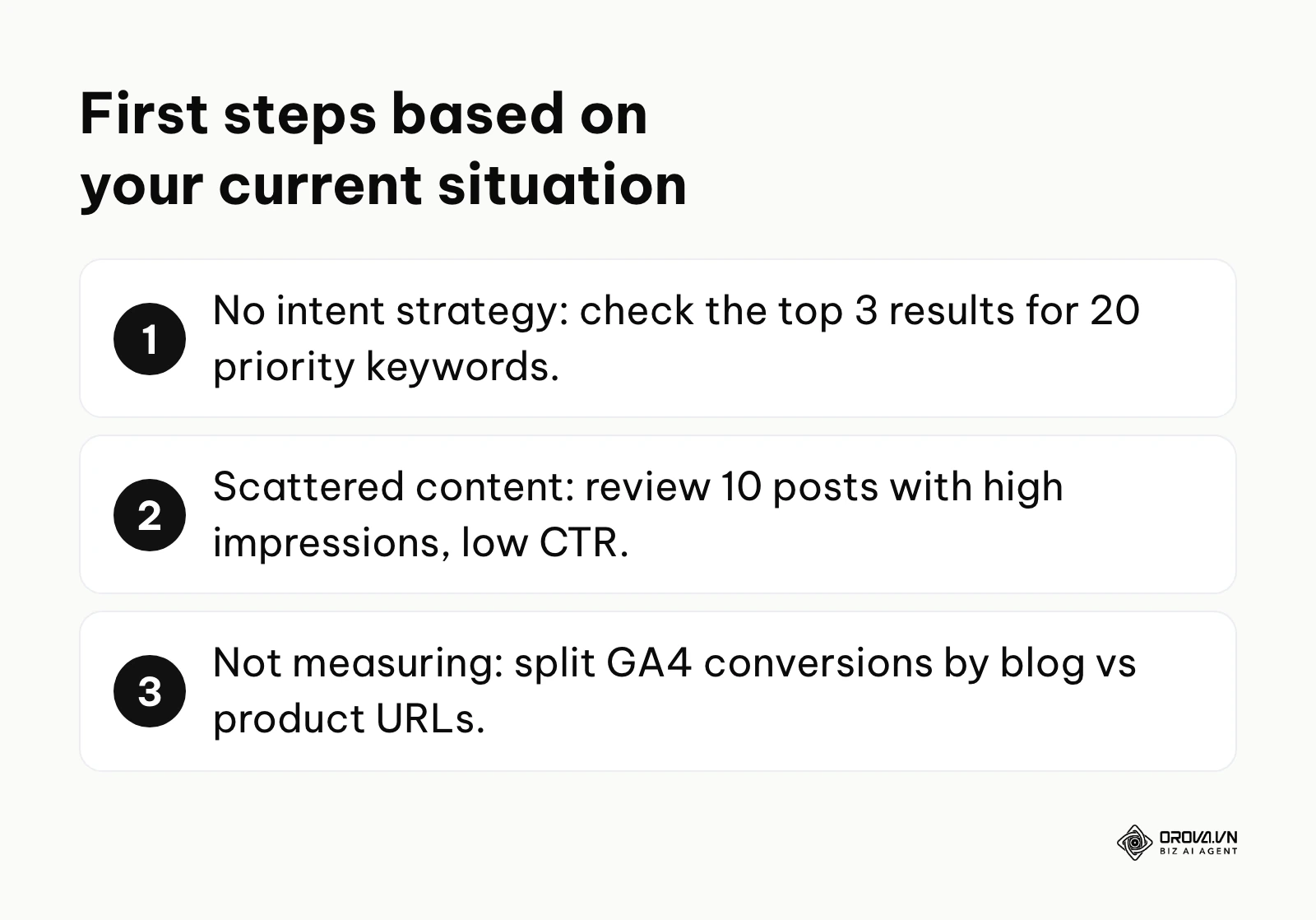
If you have no intent strategy at all: Start with mapping your existing priorities. Take your top 20 most important keywords—the ones you believe drive your business—and manually search them in an incognito window. Write down the dominant format (guide, product page, tool) of the top three results. If your current page for that keyword does not match that format, you have found your first major project. You must rewrite or restructure that page to match the algorithm's expectations.
If your content is scattered and inconsistent: You likely have pages suffering from intent mismatch. Go into your analytics platform and find the 10 blog posts with the highest impressions but the lowest click-through rates and lowest average time on page. These pages are likely ranking for keywords where the user expected a different format. Your first step is to analyze the SERPs for those specific queries and redesign the pages—perhaps changing a dense text article into a scannable listicle or a quick reference tool, improving your overall on-page SEO alignment.
If you are doing SEO but not measuring by intent: You need to fix your tracking immediately. Stop grouping all organic traffic into one bucket. Set up custom event tracking in Google Analytics 4 (GA4) to measure conversions based on the URL structure. Group your informational blog URLs into one segment and your transactional product URLs into another. Your first step is to establish a baseline: what is the actual conversion rate of your top-of-funnel educational content compared to your bottom-of-funnel landing pages? Once you have that data, you can allocate your budget intelligently.
Every search query is a person asking a question, trying to solve a problem, or looking to spend money. By mastering keyword intent, you stop guessing what they want and start delivering exactly what they need, exactly when they need it.
About the author

Builder of Orova
Nguyễn Đỗ Trọng Ân has 8 years of experience in marketing, including 6 years managing market development across Asia. He builds Orova, a Biz AI Agent that never sleeps: it plans, runs and optimizes work for businesses.
Run your business with AI Agents
Orova is the always-on Biz AI Agent — it plans, runs, and optimizes the work for you.
Save time, unlock productivity.