
What is tone of voice? Definition, guidelines template and 10 AI prompts

Tone of voice is how a brand sounds when it writes or speaks: the words it picks, the rhythm of its sentences, and the attitude it takes toward the reader. Your brand voice stays fixed, while your tone shifts with the situation. Every marketer eventually hits the same wall without one. The drafts come back sounding like five different companies: one article is overly academic, the next tries too hard to be funny, and the support emails read like a robotic instruction manual. If you rely on external writers or AI tools, keeping that consistent is harder than ever. This guide explains what tone of voice is, why many B2B companies get it wrong, and how to build a practical framework, with a guidelines template you can copy, a channel matrix, and 10 system prompts for training AI tools to sound like your brand.
What is tone of voice?
Tone of voice is the specific way a brand communicates its personality and values through written and spoken words, adjusting its emotional inflection based on the context and the audience. It is used to build trust, differentiating a company from competitors by ensuring consistent messaging across all touchpoints.
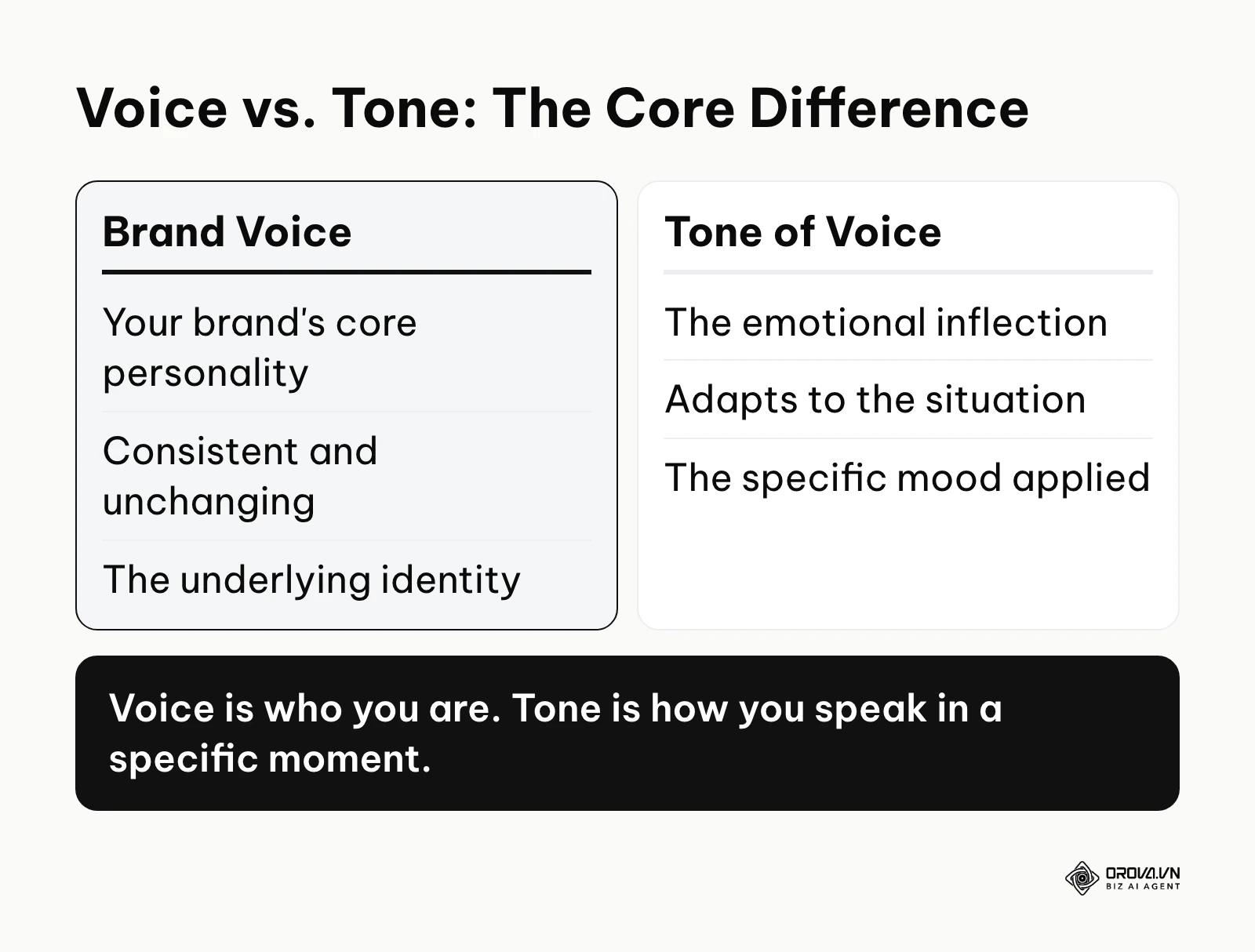
The concept originated in traditional advertising, where copywriters realized that how a message was delivered mattered just as much as what was being sold. Over time, as digital channels proliferated, it became necessary to codify this behavior so that hundreds of employees could write as a single entity.
People frequently confuse related concepts in this space. The table below clarifies the distinctions.
| Concept | Difference | Example |
|---|---|---|
| Brand Voice | The fixed personality of your company. It never changes, regardless of the situation. | A financial brand whose voice is consistently "authoritative and secure". |
| Tone of Voice | The emotional inflection applied to the voice. It changes based on the specific context. | The same financial brand using an "urgent but reassuring" tone during a market crash. |
| Brand Style Guide | The technical rules of grammar, formatting, and visual assets. | Rules stating that the company name must always be capitalized and lists must use bullet points. |
For an everyday example, think about how you speak to your friends versus how you speak to a judge in a courtroom. Your core personality (your voice) remains exactly the same, but you drastically adjust your vocabulary, pacing, and level of formality (your tone) to suit the environment and the listener.
The Meaning and Purpose of Tone of Voice
A defined tone of voice exists to solve a massive problem of fragmentation. As a company scales, the number of people communicating on its behalf multiplies. Without a central set of rules, your brand identity becomes entirely dependent on whoever happens to be typing on a given day. This fragmentation confuses buyers, dilutes your market positioning, and ultimately damages your credibility.
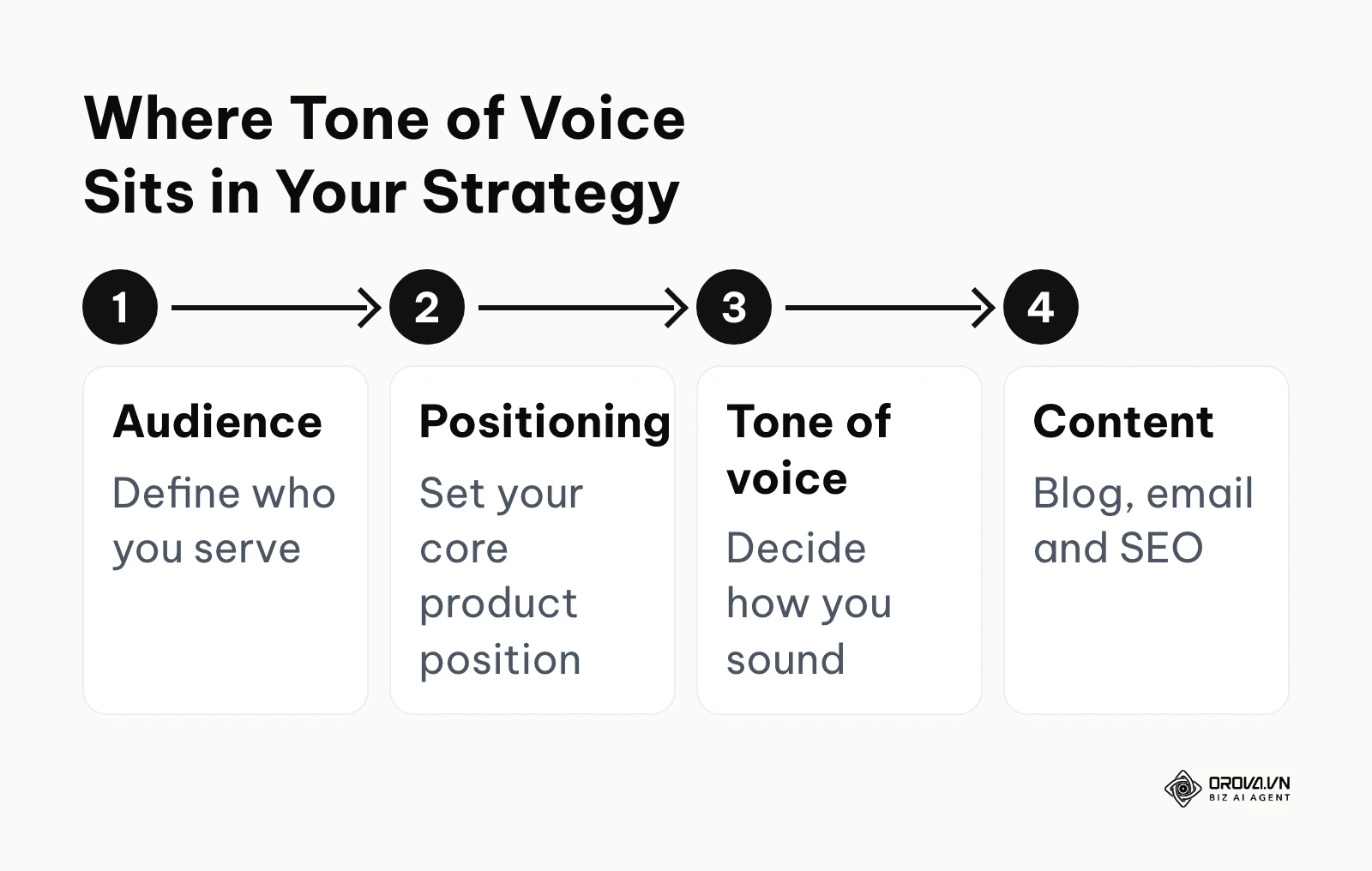
In the broader picture of marketing strategy, tone of voice sits right in the middle. It comes after you have defined your target audience and core product positioning, but strictly before you start producing blog posts, launching email campaigns, or scaling your search engine optimization (SEO) efforts. If you skip this step and go straight to content creation, you will likely spend countless hours rewriting drafts that just do not "sound right."
If you ignore tone of voice entirely, you lose the ability to build an emotional connection with your audience. In a B2B landscape where features and pricing are easily copied, how you make your buyers feel through your communication is often your only defensible moat.
When you don't need a tone of voice yet: First, if you are a solo founder still testing product-market fit with a handful of beta users, documenting guidelines is a waste of time. Your natural communication is enough. Second, if you run a hyper-local, single-service business relying entirely on offline relationships rather than digital marketing. Instead of overthinking your brand voice, focus entirely on direct customer feedback and iterating your core product until you are ready to scale your marketing team.
Values and Benefits of a Consistent Tone of Voice
Building a structured tone of voice delivers impact across two distinct layers: the macro business value and the direct benefits to the people doing the work.
Business Value: Protecting Revenue and Trust
From a business perspective, inconsistency creates risk. When a prospect reads a highly professional whitepaper but then receives a chaotic, slang-filled sales email, cognitive dissonance occurs. They lose trust. A consistent tone of voice protects your revenue by ensuring that the brand experience matches the buyer's expectations at every single touchpoint, which can shorten the sales cycle and support conversion rates.
Illustrative example:
- Context: A mid-sized SaaS company selling inventory management software, led by a newly hired CMO.
- Actions: The CMO audited all outbound communications, consolidated the messaging into a strict brand voice guideline, trained the entire sales team on these rules, and updated the core landing pages to match.
- Stumbling block: The sales team initially resisted, feeling the new guidelines made them sound too casual and unprofessional for enterprise clients. The CMO fixed this by creating a specific 'professional but warm' matrix for outbound sales emails.
- Result: The unified approach eliminated buyer confusion, leading to noticeably faster email replies from enterprise prospects and a smoother transition from the marketing pipeline to closed deals.
Direct Benefit: Empowering Content Creators
For the writers, designers, and managers doing the daily work, a defined tone eliminates guesswork. It removes the painful cycle of subjective edits where a manager rejects a draft simply because they "would not have phrased it that way." Clear guidelines give creators the confidence to produce work rapidly, knowing they are operating within approved boundaries. Teams without a shared standard tend to burn that time in redundant editing cycles instead.
Illustrative example:
- Context: A Content Lead at a fast-growing fintech startup managing a team of three junior writers.
- Actions: The lead exported 100 recent blog posts, categorized them by sentiment, and interviewed five key clients to understand their perception of the brand's writing.
- Stumbling block: They discovered that clients felt the existing tone was condescending and overly complex. The lead immediately fixed this by updating the guidelines to strictly ban academic jargon and enforce an educational, peer-to-peer stance.
- Result: Writers stopped submitting dense, unreadable drafts, and the team saw better reader retention and higher open rates on the weekly newsletter.
| Benefit | Metric to Measure | Time to See Results |
|---|---|---|
| Faster Content Production | Average hours spent drafting a standard article | 2 to 4 weeks |
| Reduced Revision Cycles | Number of edit rounds per published piece | 1 to 2 weeks |
| Higher Audience Trust | Return visitor rate and email open rates | 3 to 6 months |
Discover Orova.vn – a Biz AI Agent platform with OROVA SEO, a complete solution for every website. The system supports search engine optimization from A to Z with features including keyword research, writing new SEO-ready articles, optimizing existing content, rank tracking, plus competitor analysis and in-depth technical analysis. Sign up today to experience OROVA SEO completely free (offer valid through July 7, 2027).
How Tone of Voice Works: The Complete Framework
Building a tone of voice is not a creative writing exercise; it is an operational process. To make it work, you must dissect your communication into manageable, repeatable steps. Below is the complete anatomical breakdown of how to build, document, and scale your brand messaging.
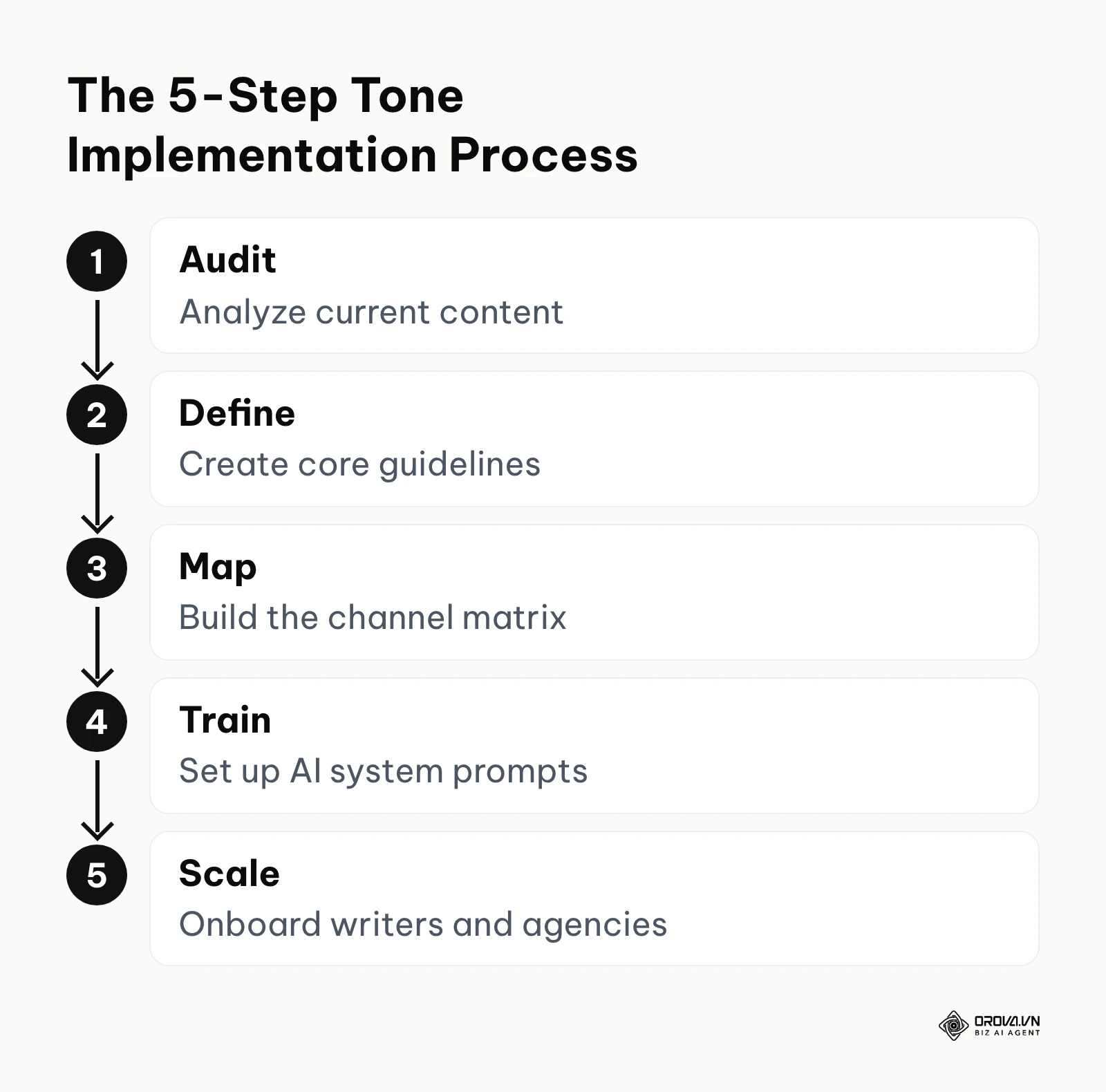
Step 1: The Audience and Content Audit
Before you can decide how you want to sound, you must objectively evaluate how you currently sound and who you are speaking to. This diagnostic step is crucial.
- What to do: Gather a representative sample of your recent content across all channels. This should include blog posts, social media updates, sales email sequences, and customer support macros. Read through them specifically looking for patterns in vocabulary, sentence length, and emotional resonance. Simultaneously, review your customer personas to understand their pain points and preferred communication styles.
- Input: 20 to 30 pieces of existing content, customer feedback logs, and current buyer persona documents.
- Output: A one-page audit summary that identifies the biggest inconsistencies in your current messaging and highlights the communication traits your best customers respond to positively.
- Common failure point: Marketers often only audit their best-performing content, ignoring the mundane, everyday communications like transactional emails or error messages, which are exactly where tone of voice usually falls apart.
Step 2: The Core Guidelines Template
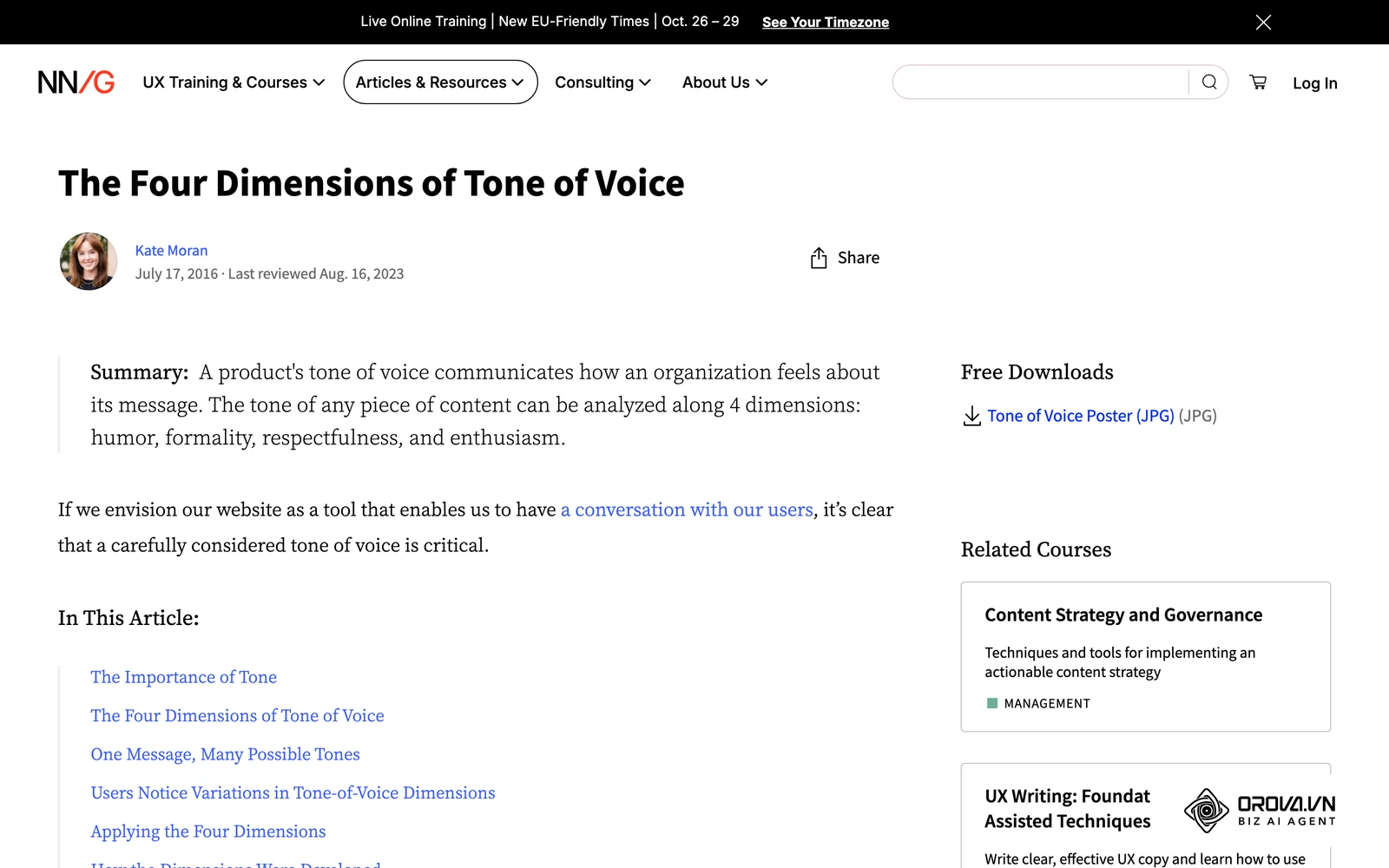
Once the audit is complete, you must document the rules. A good guideline is concise, highly specific, and actionable. Vague adjectives like "authentic" or "innovative" are useless unless you explain exactly what they look like in practice. A useful starting point is the Nielsen Norman Group model, which describes tone along four dimensions: funny vs. serious, formal vs. casual, respectful vs. irreverent, and enthusiastic vs. matter-of-fact. Placing your brand on each scale turns a vague adjective into a concrete position.
- What to do: Select three to four core attributes that define your brand voice. For each attribute, provide a brief description, a list of actionable "Do's," and a strict list of "Don'ts."
- Input: The insights gathered from the audit phase and alignment meetings with the executive team.
- Output: The Brand Voice and Tone Guidelines document.
- Common failure point: Creating a 50-page PDF that nobody ever opens. Keep it short, house it in a collaborative workspace like Notion or a Google Doc, and make it accessible to everyone.
Table: Types of Brand Voices in B2B
| Type of Voice | Core Characteristic | Best Suited For |
|---|---|---|
| The Trusted Advisor | Authoritative, calm, deeply educational, avoids hyperbole. | Financial services, cybersecurity, legal tech. |
| The Disruptive Challenger | Bold, slightly provocative, uses short sentences, challenges the status quo. | Martech startups, creative agencies, new SaaS categories. |
| The Helpful Peer | Conversational, empathetic, uses everyday language, highly practical. | Productivity software, HR tools, community platforms. |
The Brand Voice & Tone Guidelines Template
You can copy the framework below to start building your own documentation immediately.
| Voice Attribute | Description | Do's | Don'ts |
|---|---|---|---|
| Authoritative but Accessible | We are experts, but we never talk down to our audience. We explain complex ideas simply. | Do use short paragraphs. Do define acronyms on the first use. | Don't use academic jargon. Don't write sentences longer than 25 words. |
| Empathetic | We understand the daily struggles of our users. We validate their pain points before offering solutions. | Do use "You" and "We". Do acknowledge the difficulty of their work. | Don't be overly positive or toxic. Don't dismiss their challenges as trivial. |
| Action-Oriented | We respect our readers' time. We get straight to the point and provide clear next steps. | Do start headers with strong verbs. Do provide exact templates. | Don't write long philosophical introductions. Don't leave the reader wondering what to do next. |
Step 3: The Multichannel Tone Matrix
Your voice is constant, but your tone must flex depending on where the conversation is happening. A technical whitepaper requires a different emotional inflection than a LinkedIn post. The Tone Matrix maps exactly how your core voice shifts across different environments.
- What to do: List your primary communication channels. For each channel, define the audience state of mind, the specific tone you should adopt, and one hard rule for that environment.
- Input: Your core guidelines template and a list of your active marketing channels.
- Output: A quick-reference matrix that writers can check before drafting content for a specific platform.
- Common failure point: Applying the exact same tone everywhere. If your social media posts sound exactly like your legal disclaimers, you are failing to adapt to the medium.
The Tone of Voice Matrix
| Channel | Audience State of Mind | The Tone to Apply | The Hard Rule |
|---|---|---|---|
| Blog / SEO Articles | Searching for specific answers, highly focused, low patience. | Educational, structured, highly objective. | Always provide the direct answer in the first 100 words. |
| LinkedIn Posts | Scrolling for networking and quick insights, open to conversation. | Conversational, slightly opinionated, peer-to-peer. | Never use formal corporate jargon or press-release speak. |
| Email Newsletters | Subscribed, already trusts the brand, looking for curated value. | Warm, exclusive, directly addressing the individual. | Always write as if you are sending an email to a single respected colleague. |
| Customer Support / PR | Often frustrated, seeking immediate resolution or clarity. | Calm, highly empathetic, deeply respectful. | Never use humor when addressing a customer problem or a system outage. |
Step 4: Training AI with System Prompts
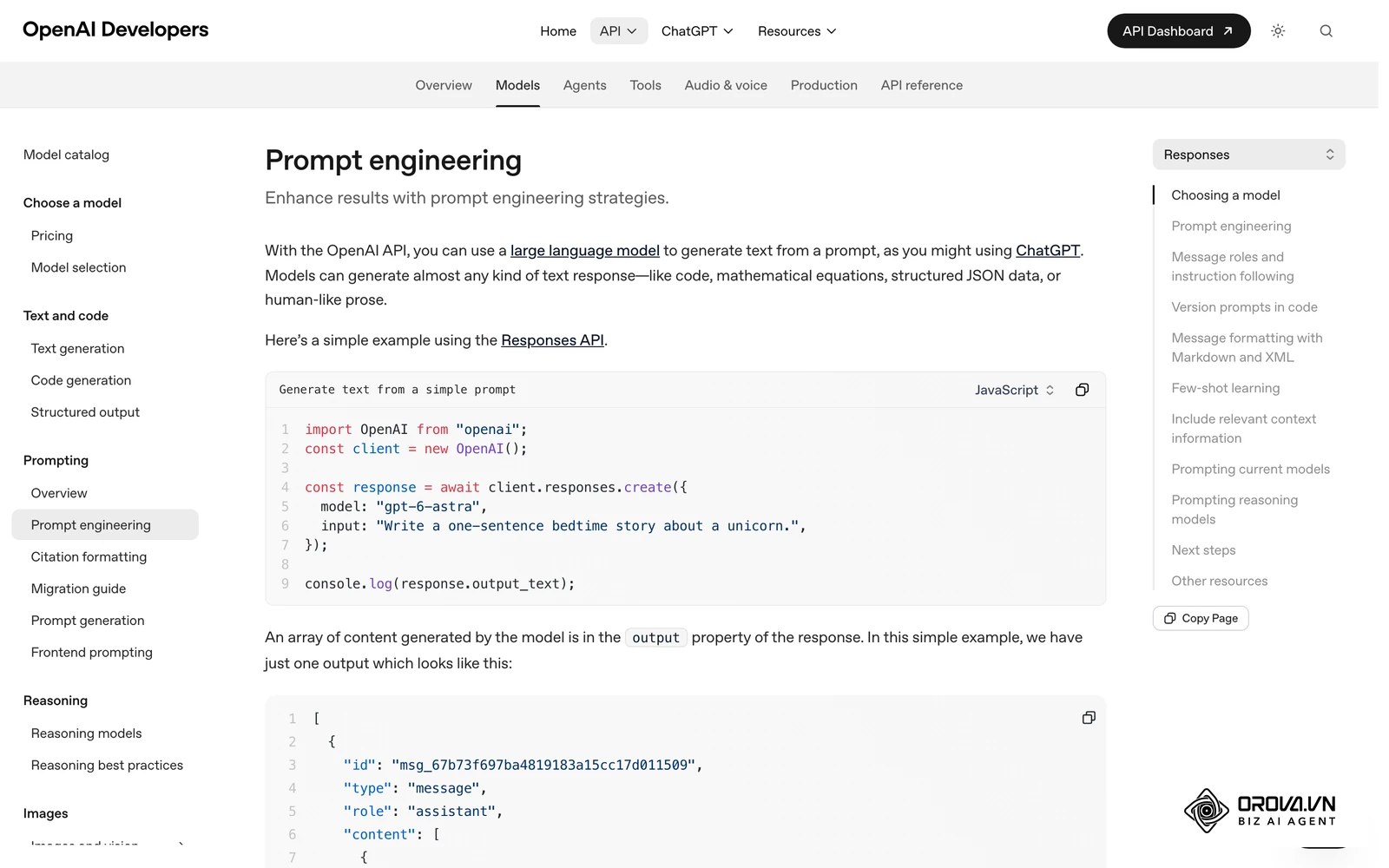
With the rise of AI writing tools, having a human-readable PDF is no longer sufficient. You must translate your brand voice into machine-readable instructions. A System Prompt is a set of overarching rules given to a generative AI model before it begins a specific task, strictly governing how it formulates its output. Without these prompts, AI defaults to a generic, overly enthusiastic tone that instantly ruins your credibility.
- What to do: Convert your guidelines and matrix into strict, parameterized prompt templates. You must tell the AI exactly who it is, who it is talking to, and what stylistic constraints it must obey.
- Input: The Voice Guidelines and the Tone Matrix.
- Output: A library of tested System Prompts ready to be copy-pasted into ChatGPT, Claude, or your internal tools.
- Common failure point: Giving the AI vague instructions like "write in a professional tone." You must use constraints, negative prompts (what NOT to do), and structural formatting rules.
Below is a master list of 10 System Prompts you can use to train AI on your specific B2B tone of voice. Replace the bracketed information with your specific details.
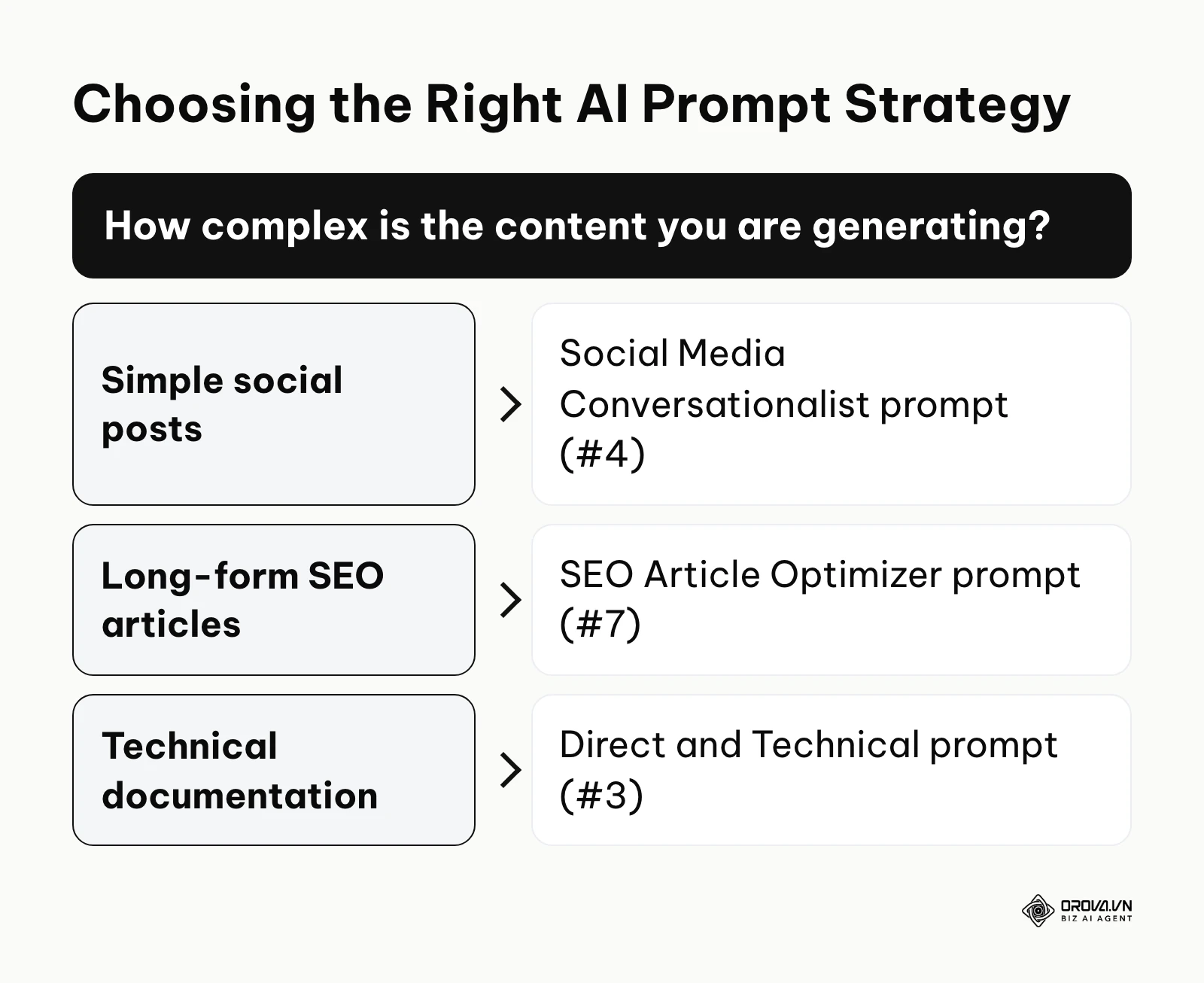
1. The Core Persona Prompt Use this as the foundation for general content generation.
"You are an expert copywriter for [Company Name], a B2B SaaS company that sells [Product] to [Target Audience]. Your voice is authoritative, empathetic, and highly actionable. You strictly avoid corporate jargon, fluff, and overly enthusiastic adjectives like 'revolutionary' or 'game-changing'. Write at an 8th-grade reading level. Prioritize short sentences and clear formatting."
2. The Empathetic B2B Educator Prompt Use this when explaining complex concepts to beginners.
"Adopt the persona of a patient, highly knowledgeable mentor in the [Industry] space. Your goal is to explain [Topic] to a reader who is overwhelmed. Validate their frustration in the opening paragraph. Break down complex theories using simple, everyday analogies. Do not sound condescending. Use bullet points heavily."
3. The Direct and Technical Prompt Use this for product documentation or feature releases.
"Act as a senior technical product manager speaking to other engineers. The tone must be strictly objective, precise, and devoid of marketing fluff. State the problem, the technical mechanism of the solution, and the exact outcome. Do not use exclamation points. Do not try to sell the feature; just explain how it works."
4. The Social Media Conversationalist Prompt Use this for LinkedIn or Twitter content.
"Draft a social media post for [Platform]. The tone should be conversational and slightly opinionated, as if a senior executive is sharing a hard-learned lesson with their peers. Start with a contrarian hook. Avoid emojis unless absolutely necessary. Keep paragraphs to a maximum of two sentences. End with a question that genuinely invites debate."
5. The Crisis Communication Prompt Use this for downtime alerts or sensitive announcements.
"You are writing a critical update regarding [Issue]. The tone must be intensely calm, transparent, and respectful. Do not make excuses. State clearly what happened, what we are doing to fix it right now, and when the next update will be. Eliminate all humor, marketing language, and promotional links."
6. The Newsletter Curator Prompt Use this for weekly email updates.
"Write a weekly newsletter intro. The tone is warm, exclusive, and direct. Write as if you are sending a personal email to a single, respected colleague. Use first-person singular ('I', not 'We'). Keep the language relaxed but professional. Focus on delivering immediate value before asking the reader to click any links."
7. The SEO Article Optimizer Prompt Use this to ensure long-form content ranks well while maintaining voice, aligning perfectly with standard SEO content writing practices.
"You are optimizing a 2000-word blog post. Maintain an educational and highly structured tone. You must explicitly answer the user's search intent in the first 100 words. Ensure every H2 and H3 is descriptive. Do not use generic transitions like 'In today's digital age' or 'Let's dive in'. Keep the focus strictly on actionable advice."
8. The Case Study Storyteller Prompt Use this to make customer success stories engaging rather than dry.
"Write a B2B case study. The tone should read like compelling business journalism, not a sales brochure. Focus heavily on the human element and the specific friction the customer faced before using our product. Present the solution factually. Use data to support the narrative, but never let the data overshadow the story of the customer's success."
9. The Executive Ghostwriter Prompt Use this when writing thought leadership for a CEO or founder.
"Adopt the voice of a seasoned CEO in the [Industry] sector. The tone is reflective, strategic, and highly confident. Do not focus on product features; focus on macro market trends and organizational psychology. Use strong, declarative sentences. The writing should feel earned through years of hard experience, avoiding any superficial advice."
10. The Conversion Copywriter Prompt Use this for landing pages and direct response assets.
"You are writing conversion copy for a landing page targeting [Audience]. The tone is urgent, clear, and highly benefit-driven. Strip away all unnecessary words. Focus entirely on the specific pain point the user is experiencing right now and position the product as the immediate relief. Every sentence must drive the reader toward the call-to-action."
Step 5: Scaling Across Agencies and Products
When you rely on multiple freelancers or agencies, simply handing them the prompt library is not enough. You must implement a governance system to ensure the tone remains intact across different external teams and varied product lines.
- What to do: Build a mandatory onboarding process for all external writers that requires them to submit a short test piece mimicking your brand voice before they are assigned major projects. Furthermore, set up an editorial review checklist that specifically grades the draft on tone compliance, not just grammar.
- Input: The finalized guidelines, prompts, and a standardized editorial checklist.
- Output: A consistent, high-quality stream of content regardless of who wrote the initial draft.
- Common failure point: Assuming that experienced writers will automatically understand your specific brand nuances without explicit training and feedback loops.
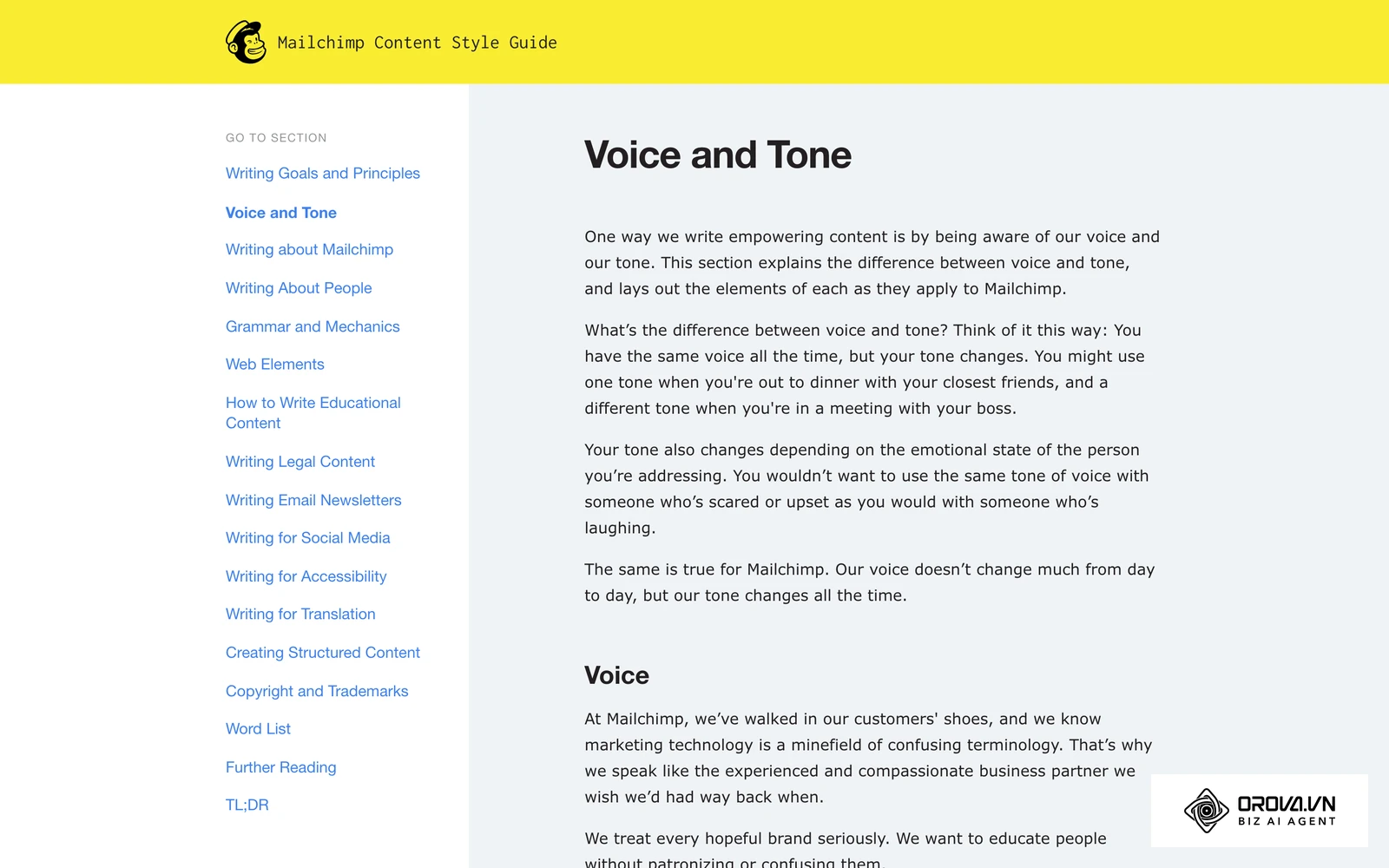
Some companies go a step further and publish their guide openly. Mailchimp's content style guide, with its well-known voice and tone section, is a classic public example: any freelancer can read it before writing a single line, and the tone shifts it describes for different situations are easy to see in the brand's own copy.
If your company has multiple products targeting completely different demographics, you must decide whether to use a monolithic voice (one voice for everything, like Apple) or a portfolio approach (different voices for different sub-brands, like Procter & Gamble). For most B2B SaaS companies, a monolithic voice with slight tonal adjustments in the matrix is far more efficient and manageable.
With OROVA.VN and the OROVA SEO module, you put an end to the exhausting days of manual work for good. Instead of struggling for hours to write articles and compile reports, the entire process is now optimized and completed in just 5 minutes.
How to Adapt and Build Your Tone of Voice
Different roles in the organization require different immediate actions to implement these guidelines effectively. Here is exactly what you should do based on your position.
For B2B Founders and Business Owners
Founders are often the source of the original brand voice. Your job is to extract that voice from your head and get it onto paper so you can delegate content creation.
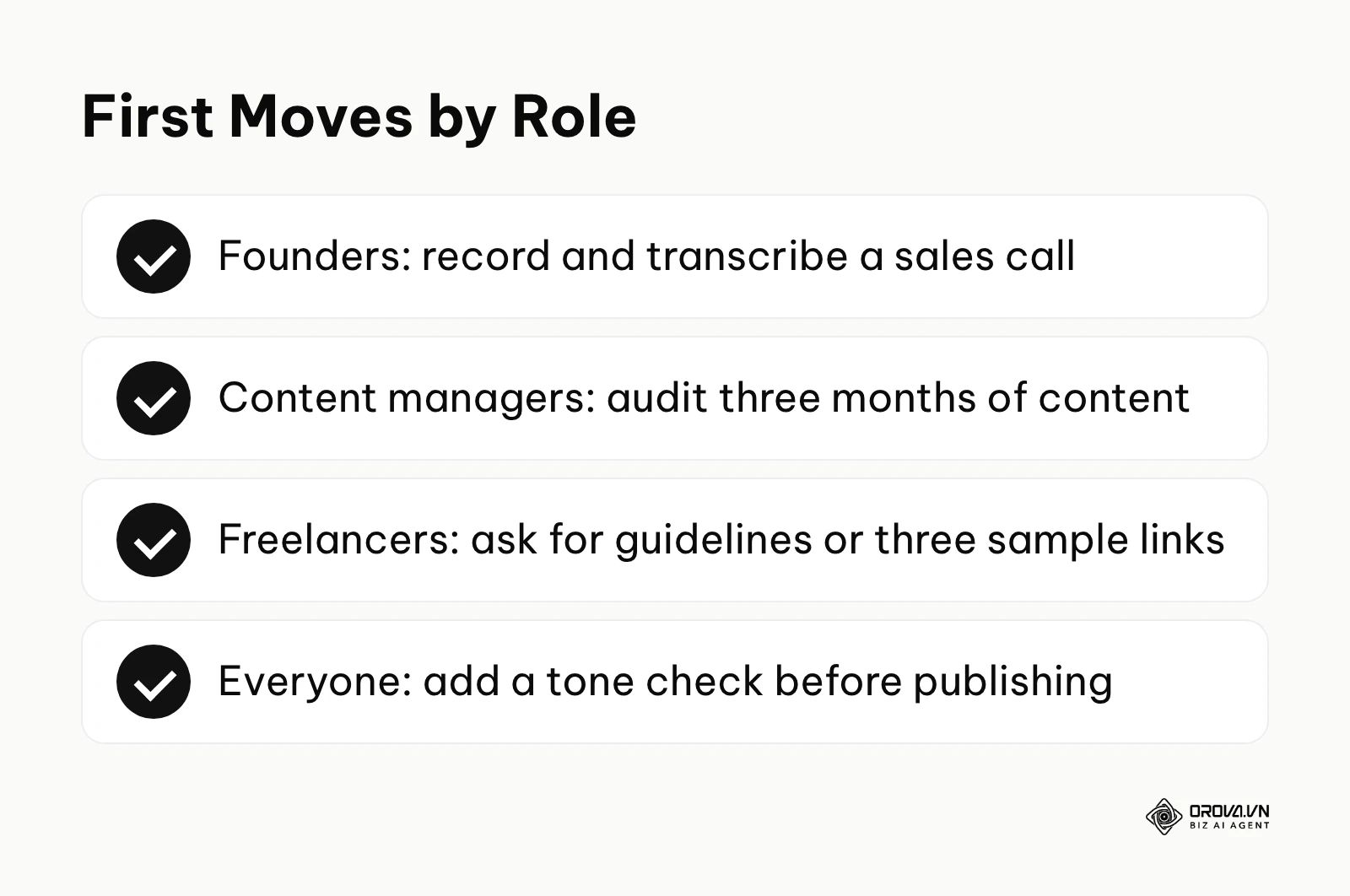
- Record yourself explaining your core product value to a prospect on a sales call.
- Transcribe the recording and highlight the specific adjectives, analogies, and pacing you naturally use.
- Distill these highlights into three core voice attributes.
- Delegate the creation of the full guidelines document to your marketing lead, using your attributes as the non-negotiable foundation.
For In-House Content Managers
You are the operational enforcers of the tone. Your job is to build the systems that make compliance easy for the rest of the company.
- Complete a comprehensive audit of the last three months of published content.
- Draft the Tone of Voice Matrix and get buy-in from the sales and customer support teams.
- Build the library of AI System Prompts and distribute them to the team.
- Integrate a mandatory "Tone Check" step into your editorial workflow before any piece is published.
For Freelancers and Agency Partners
Your value increases massively when you can adapt quickly to a client's specific voice without requiring endless rounds of revisions.
- Always ask the client for their documented brand voice guidelines before writing a single word.
- If they do not have one, proactively ask them for three links to content they feel perfectly represents how they want to sound.
- Build a custom AI System Prompt for that specific client to help you generate initial outlines that align with their style.
- Submit your first draft with notes explaining exactly how you applied their desired tone, demonstrating your strategic value.
Illustrative example:
- Context: A freelance B2B writer managing content production for four different technical clients.
- Actions: The freelancer created a custom AI system prompt for each client, verified the readability of drafts using the Hemingway app, and always asked for explicit 'Do and Don't' vocabulary lists upfront during onboarding.
- Stumbling block: The clients initially provided vague requests like "make the writing pop" or "make it sound professional." The freelancer fixed this by presenting them with A/B tone samples—one highly formal and one conversational—forcing the clients to choose a definitive direction.
- Result: The freelancer consistently secured approved drafts on the first round of review, eliminating the endless, unpaid revision cycles that plague most freelance relationships.
| Common Mistake | Consequence | How to Avoid It |
|---|---|---|
| Relying on vague adjectives | Writers misinterpret what "authentic" means | Provide concrete examples of what NOT to do |
| Ignoring negative constraints | AI generates overly enthusiastic, generic text | Always include strict "Do not use..." rules |
| Failing to audit past content | Guidelines do not match reality | Base the rules on what actually works with buyers |
Where Tone of Voice Is Heading in the Next Few Years: The Author's Take
The mechanics of brand messaging are shifting as AI writing becomes part of everyday content work. Here are three views on where tone of voice is going, and what you can do now to prepare. These are opinions, not forecasts.
Static PDF Guidelines Will Lose Ground
I think the traditional brand guideline document will matter less over the next two to three years. Today, most companies still rely on PDFs and wiki pages that people must read and interpret. The signal I see is that more writing now starts inside AI tools, which need instructions rather than reading material. My read is that guidelines will increasingly live as tested prompts and reusable instructions that both people and AI tools work from. I could be wrong if smaller businesses find that too complex to maintain. To prepare, start translating your current guidelines into clear system prompts today.
Tone Will Adapt to the Reader, Not Just the Channel
I lean toward the view that B2B tone of voice will become less one-size-fits-all. Right now, most companies adjust tone by channel, such as social versus blog. As personalization tools mature, I expect more brands to adjust tone for different buyer roles as well: a more objective, data-heavy version for a technical buyer, and a more conversational, outcome-focused version for a marketing director. You can prepare by building a tone matrix that covers your main buyer personas, not just your channels.
Human Imperfection Will Become a Signal
As polished, grammatically flawless writing becomes cheap to produce, I suspect audiences will start to value a little friction. In a feed full of perfectly structured content, the brands that stand out may be the ones that occasionally break their own rules: a slightly informal phrase, an unusual structure, or a strong opinion stated plainly. This fits a holistic approach to SEO, where the reader's experience counts as much as keyword placement. Start preparing by giving your best writers room to take considered creative risks when the context calls for it.
Frequently Asked Questions About Tone of Voice
Is tone of voice still needed with AI?
Yes, it is more critical than ever. Generative AI naturally defaults to a generic, highly average writing style that sounds like everyone else. Without a rigorously defined tone of voice and strict system prompts, using AI will actively destroy your brand's unique identity and blend your content into the noise.
How do we fix a boring B2B brand voice?
A boring voice usually stems from a fear of offending anyone, leading to hyper-professional, sanitized corporate jargon. To fix it, start by interviewing your best customers and paying attention to the exact language they use to describe your product. Adopt their conversational phrasing, eliminate acronyms, and inject a stronger, more decisive point of view into your content.
When should a brand completely change its tone?
A brand should consider a complete tonal rebrand if they are pivoting their core product offering to a drastically different target audience, or if extensive customer feedback indicates that the current tone is actively alienating buyers (e.g., sounding too arrogant or too inexperienced). It should not be changed simply because the marketing team is bored with it.
How do you measure the ROI of brand voice?
You can measure the impact by tracking specific engagement metrics before and after implementation. Look at the reduction in internal editing time, the increase in email response rates for outbound sales, and perform sentiment analysis on social media comments. Consistency supports brand recall and trust, which can help lower customer acquisition costs over time.
Can multiple products share the same voice?
Typically, yes. If the products serve similar demographics under a unified corporate brand, a single core voice with slight tonal adjustments via a matrix is the most efficient approach. However, if a company acquires a product targeting a completely different market (e.g., a B2B enterprise software company buying a B2C consumer app), the voices must remain distinct to avoid confusing both audiences.
Where to Start Implementing Your Tone of Voice?
Depending on the current maturity of your marketing operations, your immediate next step will look very different. Identify your situation below and take the corresponding action.
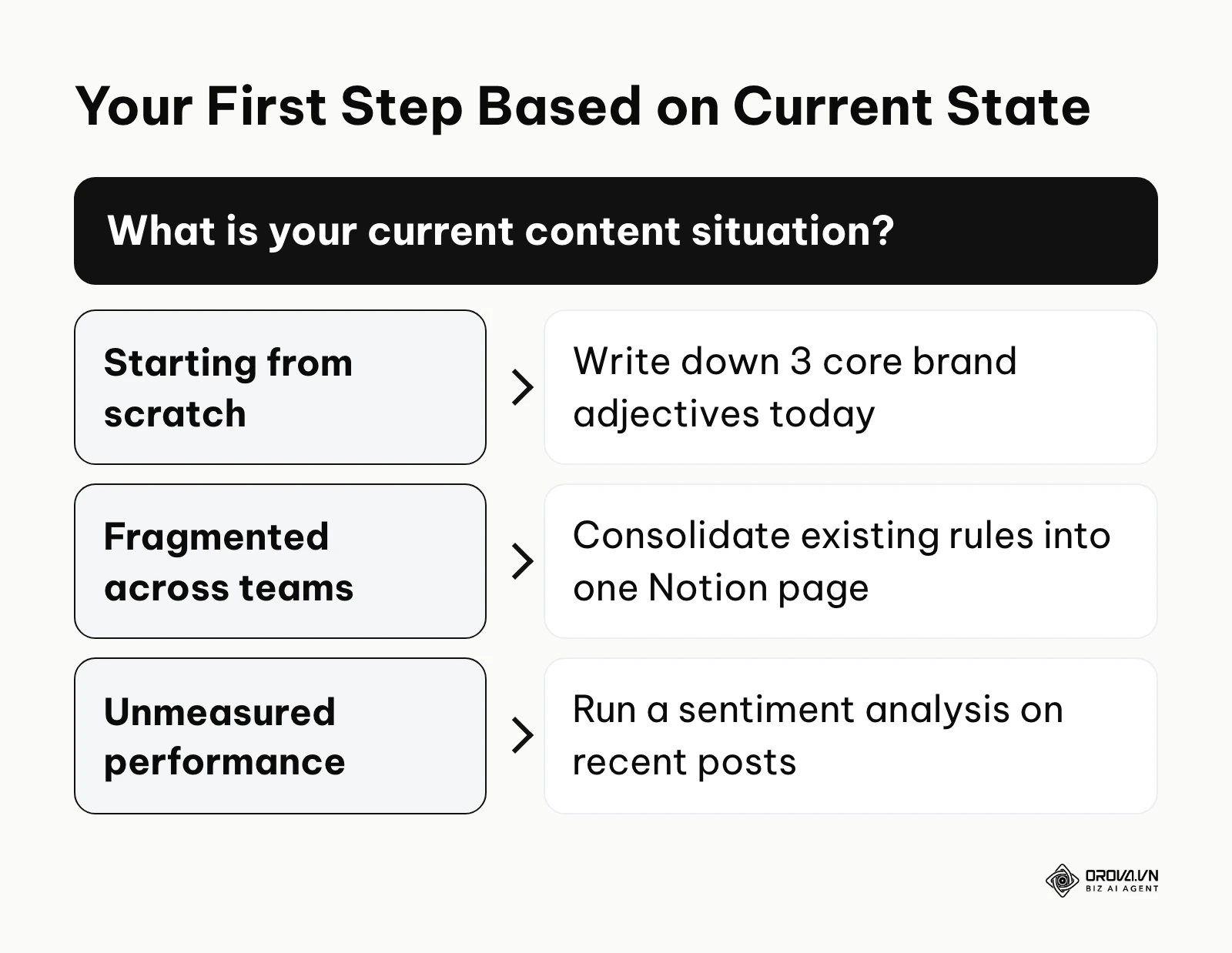
If you are starting entirely from scratch with no documented rules, do not attempt to build a massive matrix today. Your first step is simply to write down the three core adjectives that best describe how you want your brand to be perceived, and the three adjectives you absolutely want to avoid. Send this simple six-word list to anyone who writes for your company. This alone will solve half of your consistency problems.
If your content is fragmented and different teams are using conflicting styles, your immediate step is consolidation. Gather the disjointed rules, the informal style guides the sales team uses, and the editing notes the marketing team relies on. Compile them into a single, accessible Notion page or Google Doc. You do not need to create new rules yet; just centralize the ones that already exist so everyone is looking at the same source of truth.
If you have guidelines in place but unmeasured performance, your next step is diagnostic. Run a sentiment analysis or simply manually review the last ten pieces of published content against your guidelines. Identify the exact points where the actual output deviated from the documented rules. Use this data to refine your AI system prompts, ensuring that the guardrails are tight enough to prevent the deviations from happening in the next batch of content.
About the author

Builder of Orova
Nguyễn Đỗ Trọng Ân has 8 years of experience in marketing, including 6 years managing market development across Asia. He builds Orova, a Biz AI Agent that never sleeps: it plans, runs and optimizes work for businesses.
Run your business with AI Agents
Orova is the always-on Biz AI Agent — it plans, runs, and optimizes the work for you.
Save time, unlock productivity.