
Paid ad platforms in 2026: which channels fit your business

Many marketers and business owners stare at a screen full of paid ad platforms and feel completely paralyzed. You have a budget, you need customers, but throwing money at Google or Meta without a clear strategy often results in burned cash and zero return. The common advice is to "be everywhere," but spreading a small budget across ten different networks is a guaranteed way to fail. You need a system to evaluate which channel actually fits your current business stage.
The short answer: start with the platform that matches how your buyers already behave. Search platforms (Google, Microsoft) capture people who are already looking for you, social platforms (Meta, TikTok, Pinterest) create demand, LinkedIn reaches B2B decision-makers, and marketplaces such as Amazon sit closest to the sale. This guide groups the main platforms by marketing task and by business scenario (B2B SaaS, e-commerce, local business), suggests a starting test budget range for each, and shows how to combine them into a profitable advertising stack. If you want to stop guessing and start acquiring customers systematically, you are in the right place.
What are paid ad platforms and which one is right for you?
Paid ad platforms are digital networks where businesses pay to display promotional content to specific audiences based on search queries, demographics, or browsing behavior. You should use them when you need immediate visibility and measurable lead generation. However, you should not rely on them if your product has a negative profit margin, as the acquisition costs will quickly bankrupt your operations.
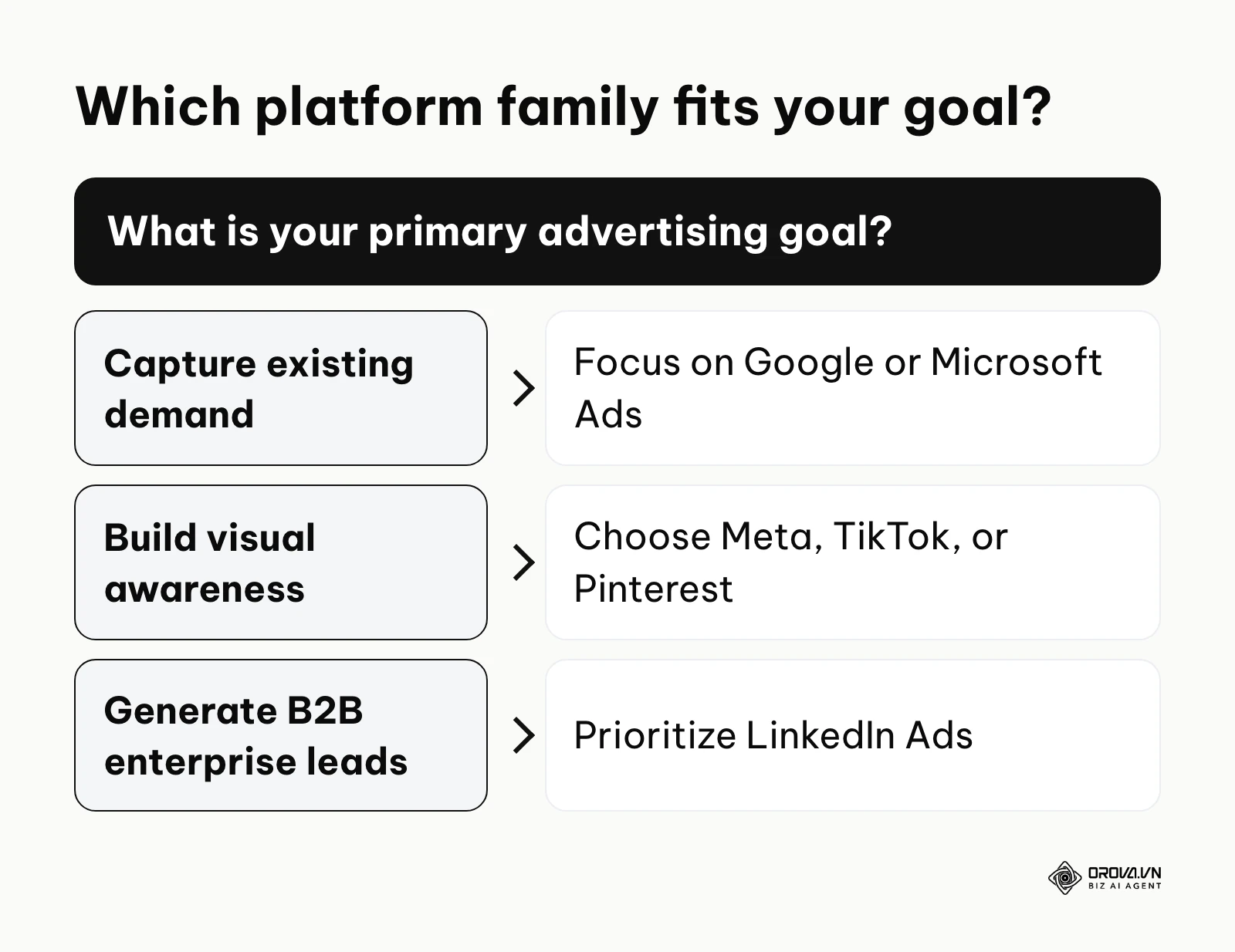
Choosing the right platform depends entirely on your business model and your available testing budget. If you run a local service business, your approach will look entirely different from a venture-backed software company.
The decision flowchart below summarizes the fundamental logic you should apply before spending your first dollar.
At a glance: the main paid ad platforms
Before diving into the deep mechanics of each system, you need a high-level overview of the landscape. The table below categorizes the major players, defining their core function and indicating which scale of business they suit best.
| Platform Name | Category | Main Task | User Value | Suitable Scale |
|---|---|---|---|---|
| Google Search Ads | Search Intent | Capturing active demand | Puts you in front of users actively looking to buy | Solo to Enterprise |
| Microsoft Advertising | Search Intent | Capturing active demand | Reaches an older, higher-income demographic with lower competition | Small Biz to Enterprise |
| Meta Ads | Social Discovery | Building visual awareness | Unmatched demographic and interest-based targeting | Solo to Enterprise |
| TikTok Ads | Social Discovery | Viral brand awareness | Drives massive engagement with younger, trend-focused audiences | Small Biz to Enterprise |
| Pinterest Ads | Social Discovery | Visual product inspiration | Reaches users actively planning future purchases | E-commerce Brands |
| LinkedIn Ads | B2B Networking | Generating professional leads | Pinpoint targeting by job title, industry, and company size | B2B Teams to Enterprise |
| Quora Ads | Niche Knowledge | Answering specific questions | Builds authority in highly specialized, knowledge-based niches | Solo to Agency |
| Amazon Ads | E-commerce | Direct product sales | Targets buyers at the exact moment they are browsing a marketplace | E-commerce Brands |
| Criteo | Retargeting | Dynamic product remarketing | Brings lost shoppers back to complete their purchases | Mid-size to Enterprise |
| Reddit Ads | Niche Community | Engaging passionate forums | Accesses highly specific, highly engaged community discussions | Niche Brands |
| X (Twitter) Ads | Real-time | Event and news marketing | Capitalizes on real-time trends and live industry conversations | Agencies to Enterprise |
OROVA ADS applies AI Agent to automate and optimize ad performance on Google, Meta and TikTok. Scale your budget safely, monitor 24/7 and expand your business quickly.
Experience the solution at orova.vn/ads
Paid ad platforms by primary marketing task
Understanding a platform's technical features is useless if you do not understand the human psychology behind it. People use different websites for different reasons. Your job is to match your advertisement to their current state of mind. We have categorized the top platforms based on the actual marketing tasks they perform best.
Capturing active search intent
When a user types a specific query into a search engine, they are actively looking for a solution. They have high intent, meaning they are much closer to making a purchase decision than someone casually scrolling through a social feed. That is why search is usually the first channel to test when people already know what they want.
Google Search Ads Google Search Ads allow you to bid on specific keywords so your website appears at the top of the search results page. This platform operates on a Pay-Per-Click (PPC) model, meaning you only pay when someone actually clicks your link.
The core value proposition here is timing. You are reaching people who have their credit cards ready and are actively seeking a solution to their immediate problem. It is highly measurable, and conversion rates are often strong because the visitor arrived with a specific need. This platform fits best for local services (plumbers, dentists), high-ticket B2B software, and emergency solutions where the user needs an answer right now.
Suggested starting test range (the author's rule of thumb, not an industry figure): roughly 15 to 30 dollars per day. The goal is to gather enough clicks to see which keywords actually convert.
To start using this platform:
- Conduct keyword research to identify high-intent phrases your customers are searching for.
- Write compelling ad copy that directly answers the user's specific query.
- Set up conversion tracking on your website to measure exactly which keywords generate sales.
Illustrative example: A local dental clinic with two doctors wanted to increase their emergency appointments to fill empty afternoon slots. First, they created a Google Search campaign targeting exact phrases like "emergency dentist near me" and "tooth extraction today". Second, they set a strict daily budget of 30 dollars. Third, they directed the traffic to a dedicated mobile landing page featuring a prominent "Call Now" button. Initially, they stumbled by leaving the keyword settings on "broad match," which wasted money on people searching for dental schools. They quickly fixed this by switching to "exact match" and adding negative keywords. As a visible result, the clinic began receiving more phone calls for urgent extractions, and the extra appointments covered the ad spend.
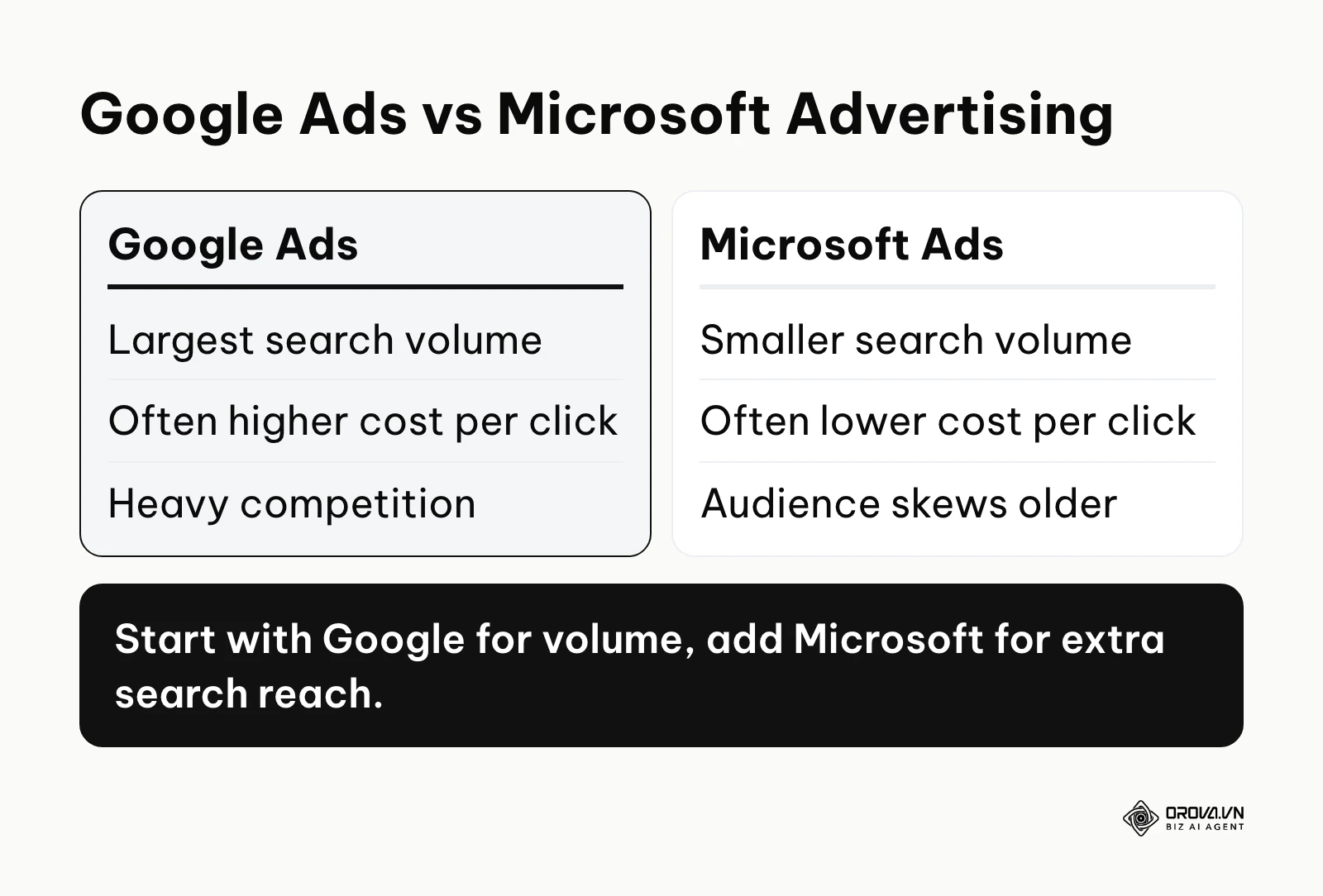
Microsoft Advertising (Bing) Microsoft Advertising works much like Google Ads but serves ads on Bing and Microsoft's partner search network. It has a smaller share of searches, but it has its own advantages.
The primary value is less competition. Because everyone defaults to Google, Microsoft Advertising can offer a lower Cost Per Click (CPC) in some niches. Its audience also tends to skew older and includes many people searching from work computers. This makes it an excellent fit for B2B companies, financial services, and businesses targeting a mature demographic.
Suggested starting test range (author's rule of thumb): roughly 10 to 20 dollars per day.
To start using this platform:
- Import your existing, successful campaigns directly from Google Ads using their built-in import tool.
- Review the imported bids and budgets instead of copying them blindly, because the auction behaves differently.
- Monitor your search term reports closely during the first week to ensure traffic quality.
Driving visual discovery and social engagement
Social media platforms are not search engines. Users are there to be entertained, connect with friends, or discover new trends. Advertising here requires interrupting their scroll with highly engaging, visual content. You are creating demand, not just capturing it. If you need a refresher on campaign structures, this guide on what an ad campaign is and how to structure one provides a solid foundation.
Meta Ads (Facebook/Instagram) Meta Ads Manager runs advertising across Facebook, Instagram, Messenger, and Meta's partner placements. Its delivery system is one of the most mature in social advertising.
The core value lies in its granular targeting and machine learning capabilities. You can target users based on life events, detailed interests, and past purchasing behavior. The delivery system is good at finding people likely to buy, even if they have never heard of your brand. This platform is perfect for e-commerce apparel, consumer goods, local event promotions, and lead generation for services with broad appeal. If you want a deep dive into the interface, our guide to what Facebook Ads Manager is and how it works covers the setup in detail.
Suggested starting test range (author's rule of thumb): roughly 20 to 50 dollars per day per ad set, so the system gets enough conversions to leave its learning phase.
To start using this platform:
- Install the Meta Pixel on your website to track user behavior and build retargeting audiences.
- Create three different visual creatives (images or videos) to test which aesthetic resonates best.
- Launch a campaign with a broad audience targeting setting, allowing the algorithm to find the buyers for you.
Illustrative example: A boutique coffee roaster wanted to launch a new premium espresso blend to a national audience. First, they shot high-quality, short-form videos showing the roasting process. Second, they set up a Meta Ads campaign targeting people interested in specialty coffee equipment. Third, they allocated 40 dollars a day to test the campaign. They stumbled initially by layering too many interests, making the audience too narrow for the algorithm to optimize effectively. They fixed this by removing the restrictive filters and letting the system optimize for conversions broadly. As a visible result, their cost per acquisition came down noticeably, and the first batch of the new blend sold out.
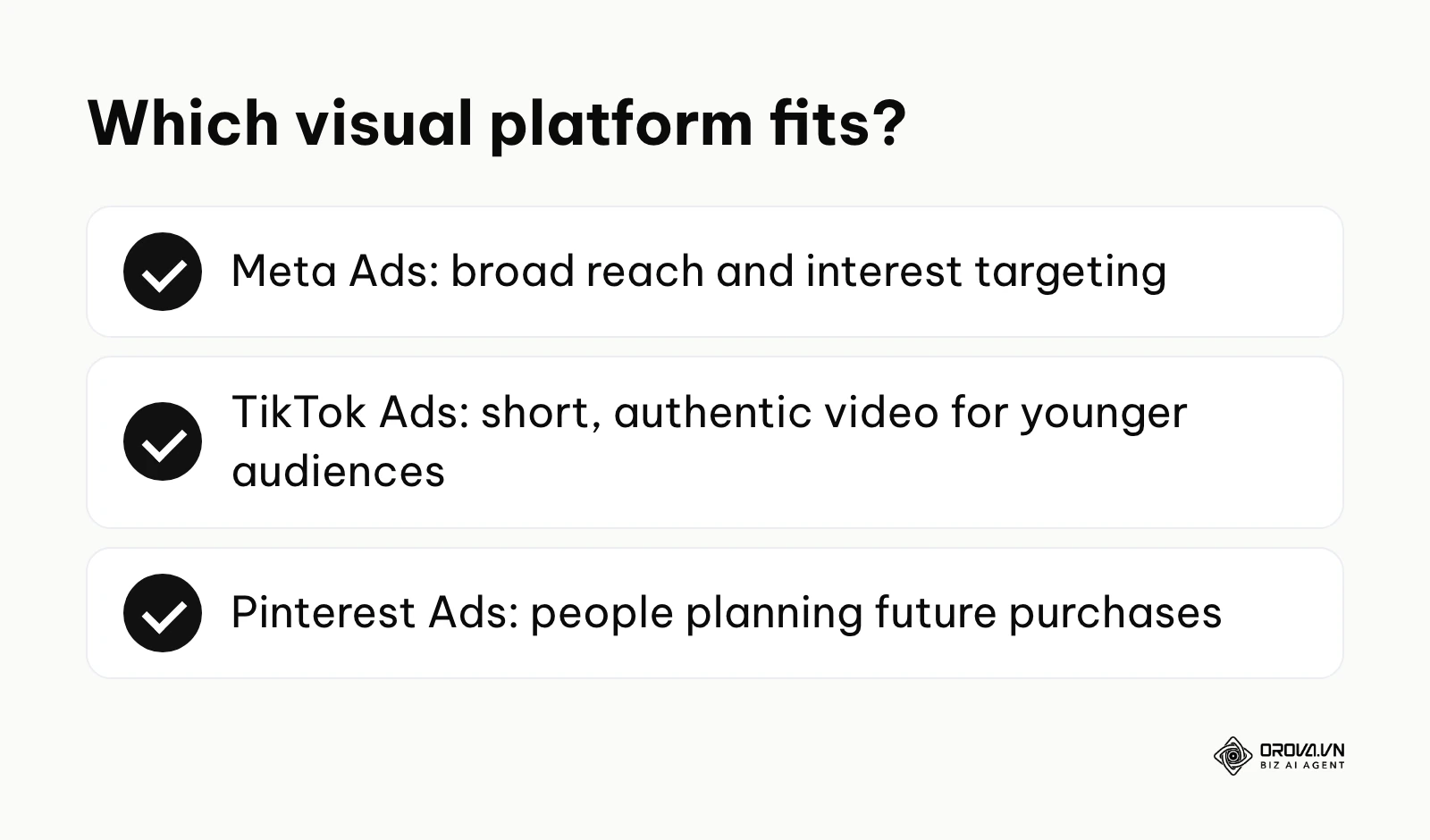
Short video and visual planning platforms
Meta is not the only way to create demand with visuals. Two other platforms reach people in a very different mood.
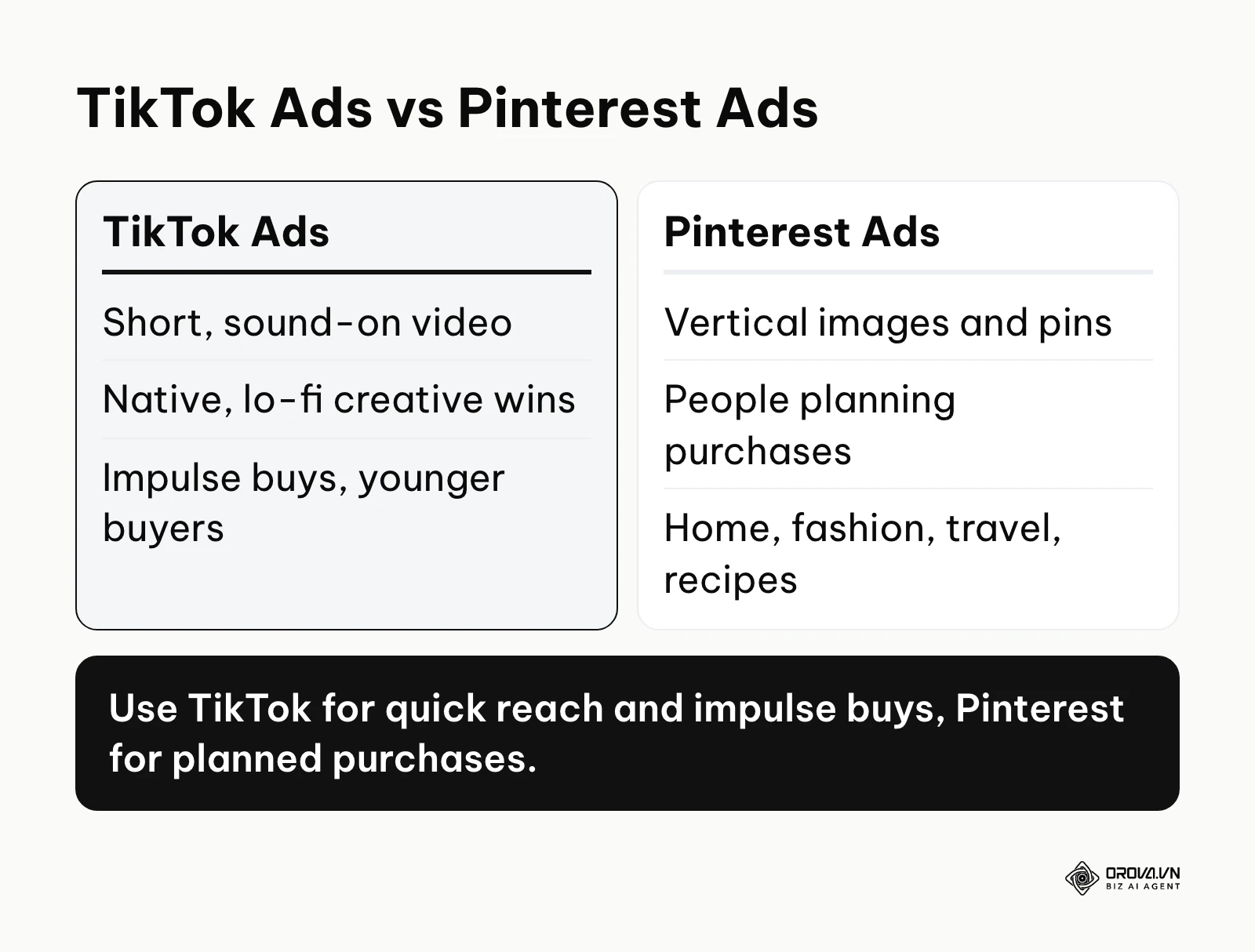
TikTok Ads TikTok Ads capitalize on short-form, user-generated video content. The platform thrives on authenticity, trends, and sound-on experiences.
The value proposition is unparalleled organic-style reach and viral potential. Unlike polished corporate commercials, the best performing ads here look like native content created by everyday users. It is highly effective for driving impulse purchases and building massive brand awareness quickly. This platform is ideal for beauty brands, tech gadgets, mobile gaming apps, and any business targeting Gen Z and younger Millennials.
TikTok sets its own minimum budgets, which can change, so check the current ones in your account. Suggested starting test range (author's rule of thumb): roughly 20 to 50 dollars per day per ad group.
To start using this platform:
- Study the current trending audio tracks and video formats on the organic "For You" page.
- Partner with a micro-influencer or create lo-fi, authentic video content that does not feel like an advertisement.
- Launch a conversion campaign using the TikTok Pixel to track add-to-cart events.
Pinterest Ads Pinterest is a visual discovery engine where users actively plan for their future. They create boards for weddings, home renovations, and wardrobe upgrades.
The immense value of Pinterest Ads is the mindset of the user. They are already in a planning and purchasing state of mind, actively looking for inspiration. Pins can also keep surfacing in search for longer than a typical social post, which can bring residual traffic. It is the perfect platform for home decor brands, fashion retailers, travel agencies, and recipe bloggers.
Suggested starting test range (author's rule of thumb): roughly 10 to 15 dollars per day.
To start using this platform:
- Create high-resolution, vertically oriented images that showcase your product in a lifestyle setting.
- Use keyword-rich descriptions and titles for your promoted pins to ensure they appear in relevant searches.
- Install the Pinterest Tag to build audiences based on users who have engaged with your specific product categories.
Generating B2B leads through professional networks
Selling software or consulting services to other businesses requires a completely different environment. You need to reach decision-makers based on their professional identity, not their weekend hobbies.
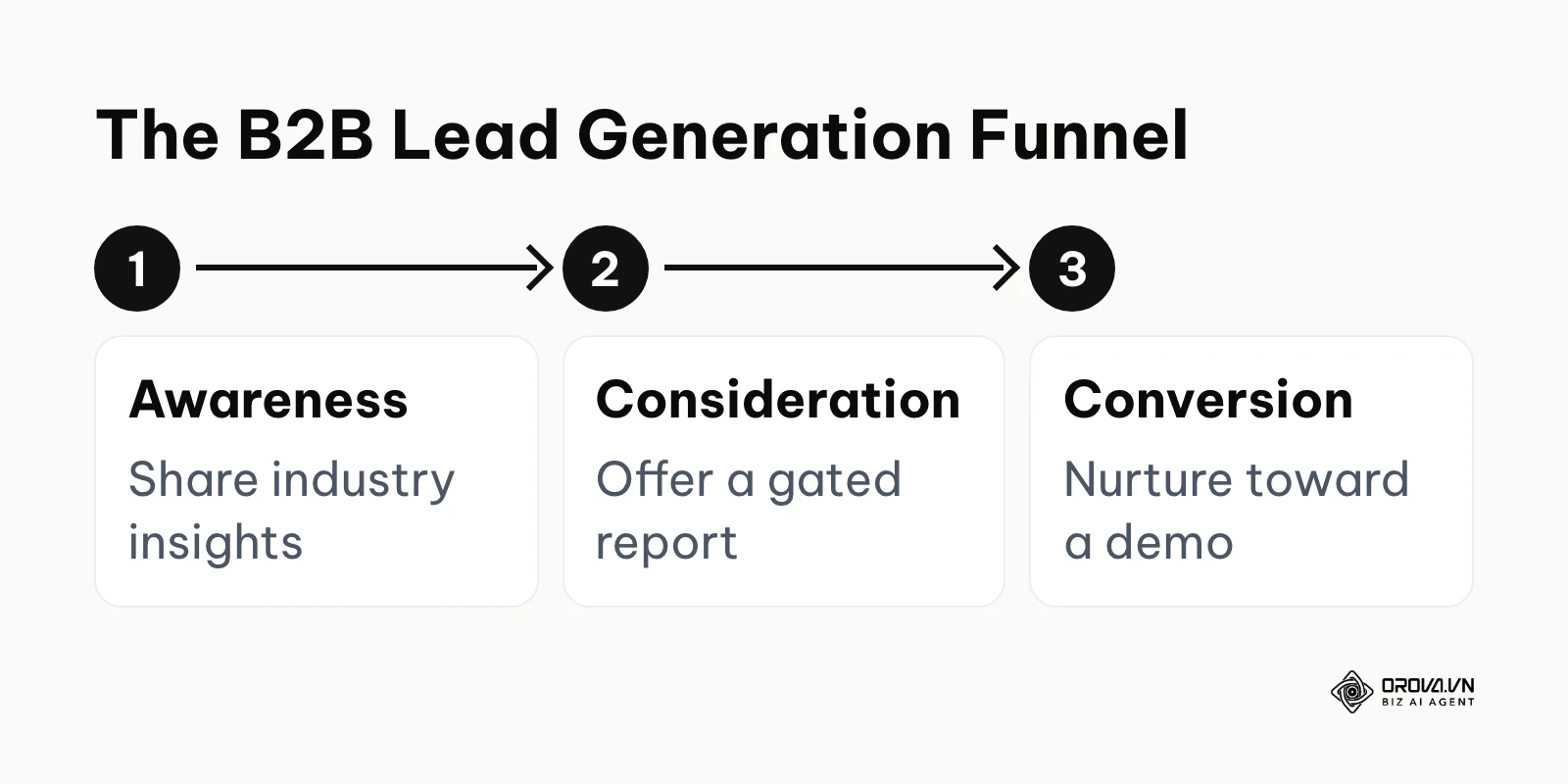
LinkedIn Ads LinkedIn is the largest professional networking site, and its advertising platform allows you to target users based on their exact professional profile.
The absolute core value is the targeting precision. You can isolate audiences by their specific job title (e.g., "Chief Information Security Officer"), company size, industry, and even specific company names. Clicks are usually expensive, but lead quality is often high. This platform fits best for B2B SaaS companies, enterprise consulting firms, high-level recruitment, and corporate event organizers.
Because the auction is competitive, the suggested starting test range (author's rule of thumb) is higher: roughly 50 to 100 dollars per day to generate meaningful data.
To start using this platform:
- Define your exact buyer persona, listing the precise job titles and industries they belong to.
- Create a high-value piece of gated content, such as an industry report or a detailed whitepaper.
- Launch a Lead Generation campaign using LinkedIn's native lead gen forms to collect emails without forcing users to leave the platform.
Illustrative example: A cybersecurity startup needed to generate enterprise leads for their new threat detection software. First, they built a LinkedIn Ads campaign targeting IT Directors at companies with over five hundred employees. Second, they allocated 80 dollars a day to a campaign promoting a direct "Request a Demo" offer. Third, they ran the campaign for a week. They stumbled hard; the clicks were costing them twelve dollars each, and nobody was booking a demo. They realized their ask was too aggressive for cold traffic. They fixed this by switching the offer to a free, downloadable "2026 Threat Landscape Report". As a visible result, they began capturing a steady flow of relevant emails, which their sales team could nurture toward demos.
Quora Ads Quora is a question-and-answer platform where professionals and enthusiasts gather to share knowledge on highly specific topics.
The value proposition is contextual relevance. You can place your advertisement directly alongside specific questions that your target audience is asking. If someone is reading a thread about "the best CRM for small agencies," your ad for a CRM software will appear right there. It is highly effective for niche B2B tools, educational courses, and complex products that require explanation.
Suggested starting test range (author's rule of thumb): roughly 10 to 20 dollars per day.
To start using this platform:
- Identify the top 50 questions on Quora that directly relate to the problem your product solves.
- Write ads that read like helpful answers rather than aggressive sales pitches.
- Target those specific questions or broad topics related to your industry to capture highly relevant traffic.
E-commerce direct sales and retargeting
For businesses selling physical goods online, the bottom of the funnel is where the profit is made. These platforms focus on capturing users who are already shopping or bringing back those who abandoned their carts. If you want to understand the mechanics of bringing users back, read our guide to ad retargeting and winning back lost visitors.
Amazon Ads Amazon Advertising allows sellers to promote their products directly within the Amazon search results and product detail pages.
The value here is proximity to the point of sale. Users searching on Amazon are not looking for information; they are looking to buy a product right now. Conversion rates are often strong because checkout is only a click or two away. This platform is an absolute necessity for any e-commerce brand that sells physical products through the Amazon marketplace.
Suggested starting test range for Sponsored Products (author's rule of thumb): roughly 10 to 20 dollars per day.
To start using this platform:
- Ensure your product listing is fully optimized with high-quality images, bullet points, and positive reviews.
- Launch an automatic targeting campaign to let Amazon discover which search terms convert best for your product.
- Harvest the profitable search terms from the automatic campaign and move them into a manual, tightly controlled campaign.
Criteo Criteo specializes in dynamic retargeting for large e-commerce websites. It serves personalized banner ads to users across the open web after they leave your site.
The core value is its massive publisher network and dynamic creative optimization. If a user looks at a specific pair of red shoes on your website and leaves, Criteo will automatically show them an ad featuring those exact red shoes on a news website three hours later. It is designed for mid-size to enterprise e-commerce retailers who already have significant daily website traffic.
Because it relies on high-volume data, it suits stores that already have steady traffic; the suggested starting test range (author's rule of thumb) is roughly 30 to 50 dollars per day.
To start using this platform:
- Integrate the Criteo tracking tag across all pages of your e-commerce store.
- Upload and sync your complete product catalog feed so the system knows what items are available.
- Set your target return on ad spend, and allow the algorithm to bid dynamically across the web to bring shoppers back.
Niche communities and real-time marketing
Sometimes, the best strategy is to insert your brand into ongoing, passionate conversations or breaking news events.
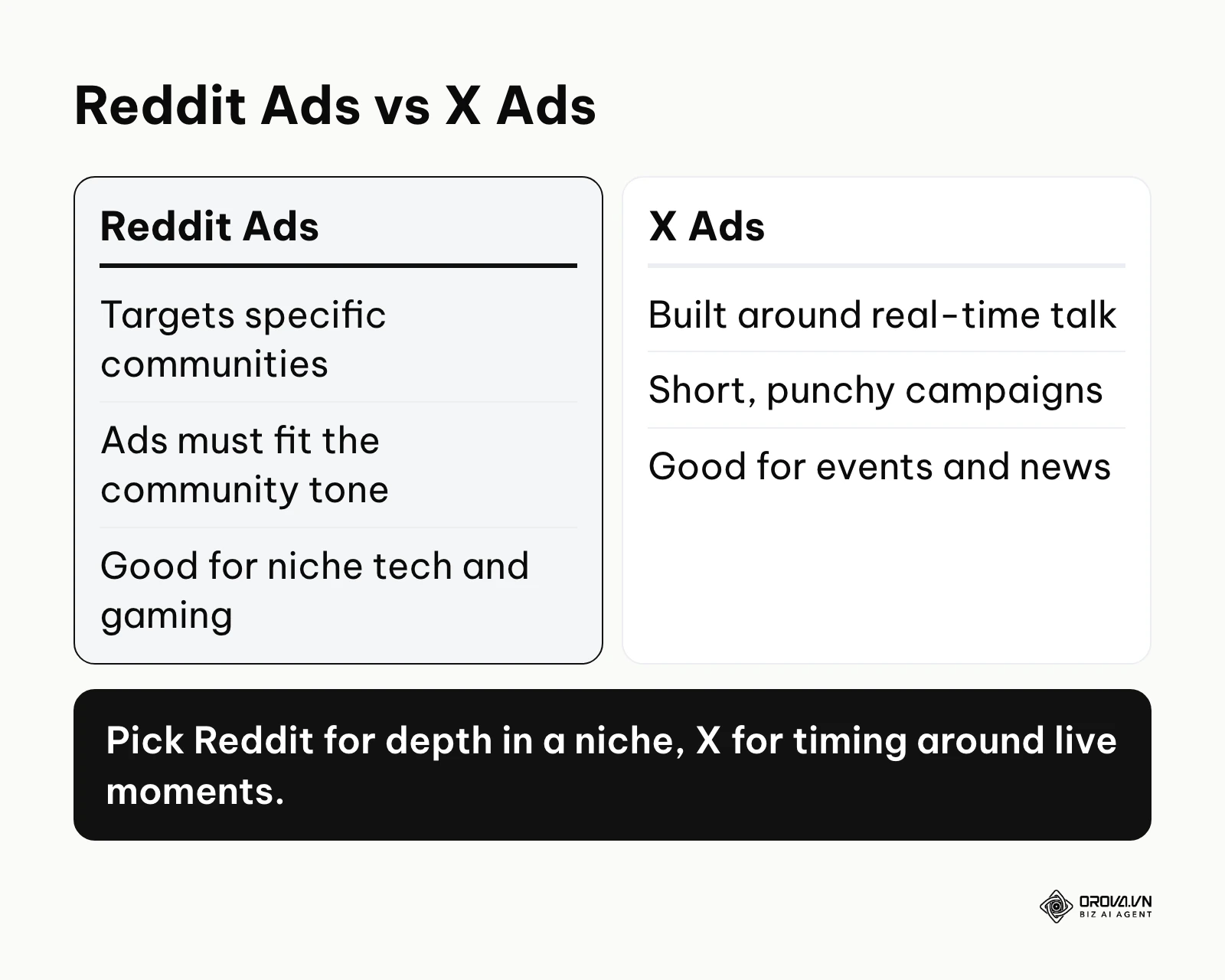
Reddit Ads Reddit is a massive collection of highly specific communities (subreddits) dedicated to every topic imaginable, from vintage watches to enterprise server maintenance.
The value proposition is deep niche penetration. You can target users based on the specific communities they actively participate in. However, the Reddit audience is notoriously hostile to intrusive advertising. Your creative must add value, use inside jokes, or speak directly to the culture of that specific subreddit. It fits best for gaming companies, specialized tech hardware, and brands willing to be conversational and transparent.
Suggested starting test range (author's rule of thumb): roughly 10 to 20 dollars per day.
To start using this platform:
- Spend time organically browsing the subreddits you intend to target to understand the tone and rules.
- Decide in advance how you will handle comments on your ads, and have someone ready to reply in the tone of the community.
- Write ad copy that sounds like a genuine Reddit post, acknowledging the platform and the specific community.
X (Twitter) Ads X (formerly Twitter) is the pulse of real-time conversation, news, and live events.
The primary value is timeliness. It is a strong fit for launching a product during a major industry conference, newsjacking a trending topic, or engaging in B2B thought leadership. The lifespan of a tweet is short, so campaigns here must be punchy and highly relevant to the moment. It fits well for PR agencies, crypto projects, media companies, and B2B SaaS brands hosting live events.
Suggested starting test range (author's rule of thumb): roughly 10 to 20 dollars per day.
To start using this platform:
- Identify the specific hashtags and accounts that your target audience follows religiously.
- Create short, text-heavy ads with a single, clear call to action and a striking image.
- Monitor your campaigns daily, as trends on this platform shift rapidly and ad fatigue sets in faster than anywhere else.
Managing several platforms at once
Managing multiple platforms manually means logging into different dashboards, exporting spreadsheets, and guessing at attribution. Once you run two or more channels, look for a way to see spend, conversions, and changes in one place, and to feed real conversion data (from your CRM or a conversions API) back to each platform instead of relying only on browser pixels. Orova Ads, for example, manages Google, Meta, and TikTok campaigns from one dashboard.
Test budgets and relative costs by business scenario
To build a realistic budget, you need a sense of what a click and a customer cost. Cost Per Click (CPC) drives your traffic volume, while Customer Acquisition Cost (CAC) decides your profitability. Exact prices change by country, industry, season, and auction, so this guide does not quote per-click prices. Instead, the table below shows how costs usually compare and where each scenario should start.
| Business scenario | Start with | Relative click cost | Add next | Suggested monthly test range (author's rule of thumb) |
|---|---|---|---|---|
| B2B SaaS / enterprise | Google Search Ads + LinkedIn Ads | High | Microsoft Advertising, retargeting | About 2,000 to 4,000 dollars |
| E-commerce (physical products) | Meta Ads + Google (Search or Shopping) | Low to moderate | Pinterest, TikTok, Amazon Ads | About 1,000 to 2,500 dollars |
| Local business (services) | Google Search Ads | Moderate to high, depending on the trade | Meta Ads for retargeting nearby visitors | About 450 to 900 dollars |
These ranges are not industry data. They are simply the daily test ranges suggested earlier in this guide, multiplied over roughly a month, so each test has enough room to produce a readable result. Your real costs will depend on creative quality, landing page conversion rate, and local competition.
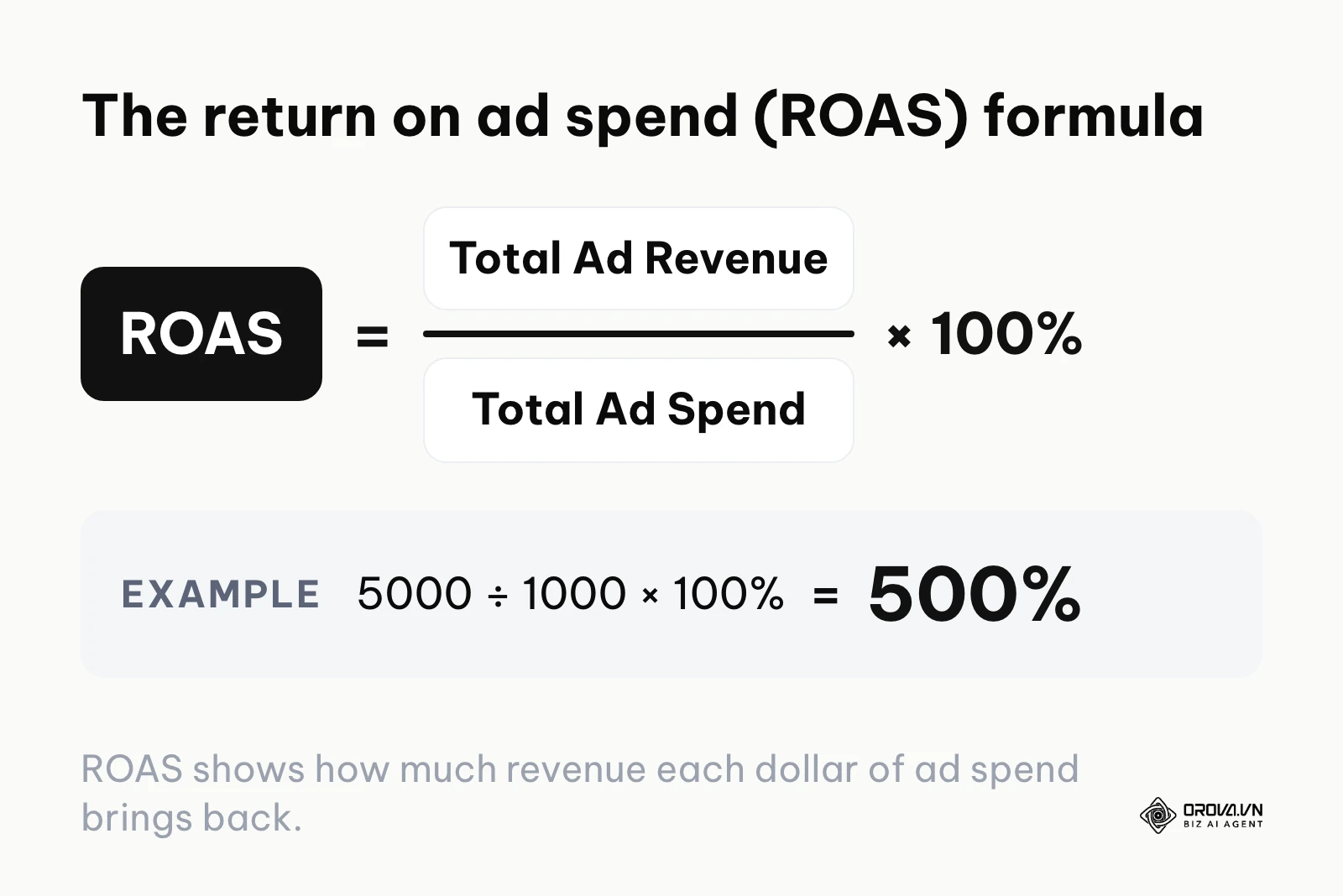
Judge each channel by profit, not by clicks. Return on ad spend (ROAS) is ad revenue divided by ad spend: 5,000 dollars of revenue from 1,000 dollars of spend gives a ROAS of 500%. For worked examples, see our guide to the ROAS formula and how to improve it.
Want to scale your budget but afraid of breaking performance? 📉
Integrate OROVA ADS now - an AI Agent that automatically monitors and optimizes Google, Meta, TikTok ads 24/7. Now, expanding and replicating your Performance Ads team is just one click away.
🚀 Try it now at: orova.vn/ads
Cross-channel strategy and budget allocation
No single platform is perfect. Google captures intent but does little to build brand awareness. Meta builds awareness but loses some attribution to privacy changes. A robust cross-channel strategy uses one platform to fill the top of your funnel and another to close the sale at the bottom.
The table below outlines a minimum advertising stack based on your team size and operational scale.
| Operational scale | Recommended platform stack | Primary logic |
|---|---|---|
| Solo founder / freelancer | Google Search OR Meta Ads | Focus limited resources on mastering one channel to avoid spreading the budget too thin. |
| Small business (under 10 employees) | Google Search + Meta Ads | Use Google to capture ready buyers, and Meta to retarget website visitors who did not purchase. |
| Growing team (3 to 5 marketers) | Google + Meta + LinkedIn or TikTok | Keep the core engines (Google and Meta) and reserve about 20% of the budget to test one new platform. |
| Established agency | Several networks + a cross-channel management tool | Deploy across all relevant networks and use one tool to monitor bidding and reporting across them. |
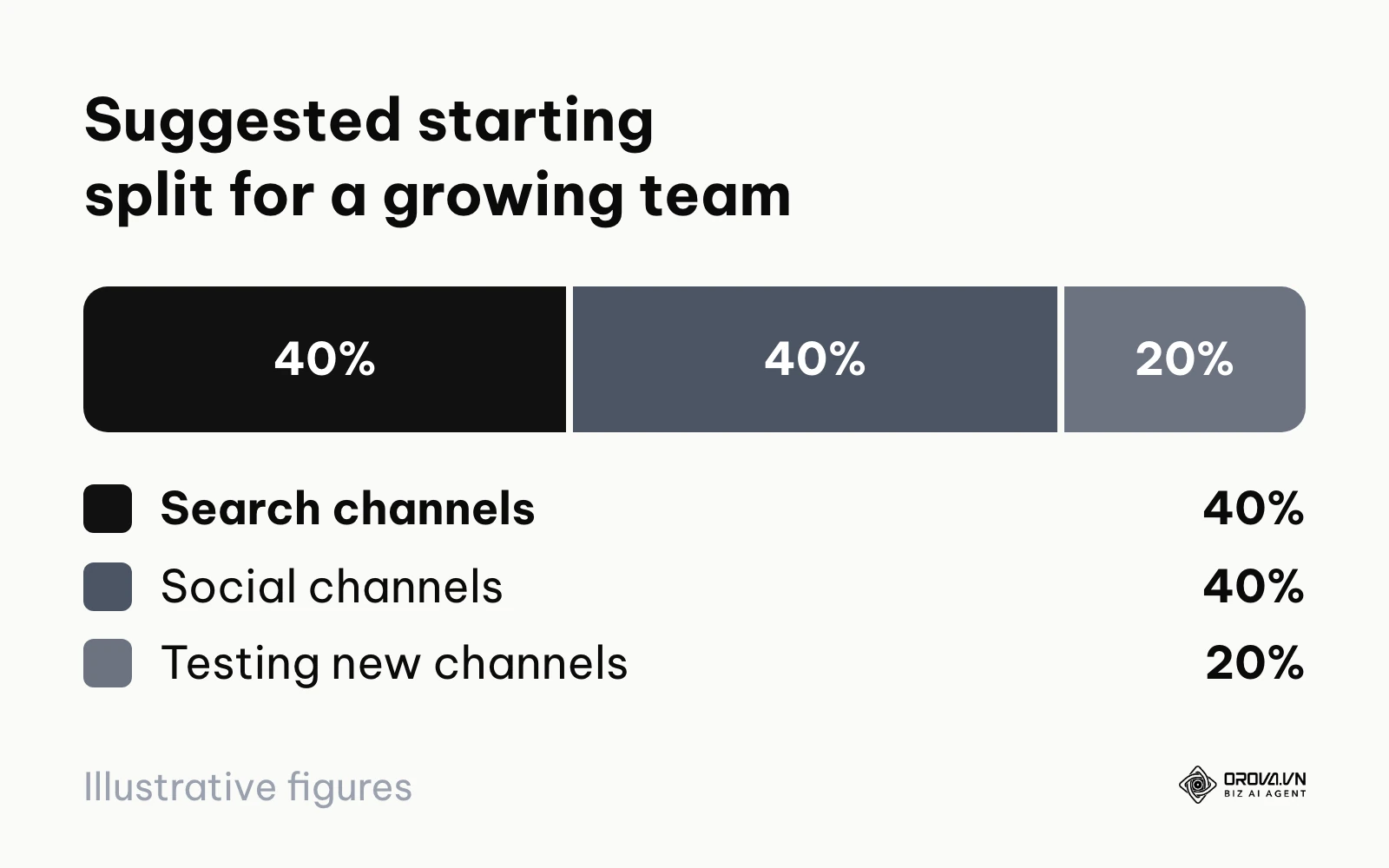
For a growing team, a simple starting split the author suggests is about 40% on search intent channels, 40% on social discovery channels, and 20% on testing new or niche channels. Shift the weights as soon as your own data shows which channel returns more profit.
When building this stack, marketers often fall into predictable traps.
The first trap is the attribution illusion. If you run Meta Ads and Google Ads simultaneously, both platforms will often claim credit for the same sale. If you simply add up the sales reported in both dashboards, you will double-count your revenue and believe your campaigns are more profitable than they are. Rely on a central source of truth, like your CRM or an analytics tool, to deduplicate these conversions.
The second trap is starving the algorithm. Delivery algorithms need data to optimize. If you have 30 dollars a day and split it across six campaigns on three platforms, none of them will get enough clicks to learn who your ideal customer is. Consolidate your budget into one or two campaigns until you have proven profitability.
The third trap is creative stagnation. An ad that works well in January will often fade by March because of ad fatigue. Keep feeding the platforms new variations of images and copy.
Where paid ad platforms are heading in the next few years: the author's take
Here is how I read the direction of paid advertising. These are opinions, not forecasts with numbers.
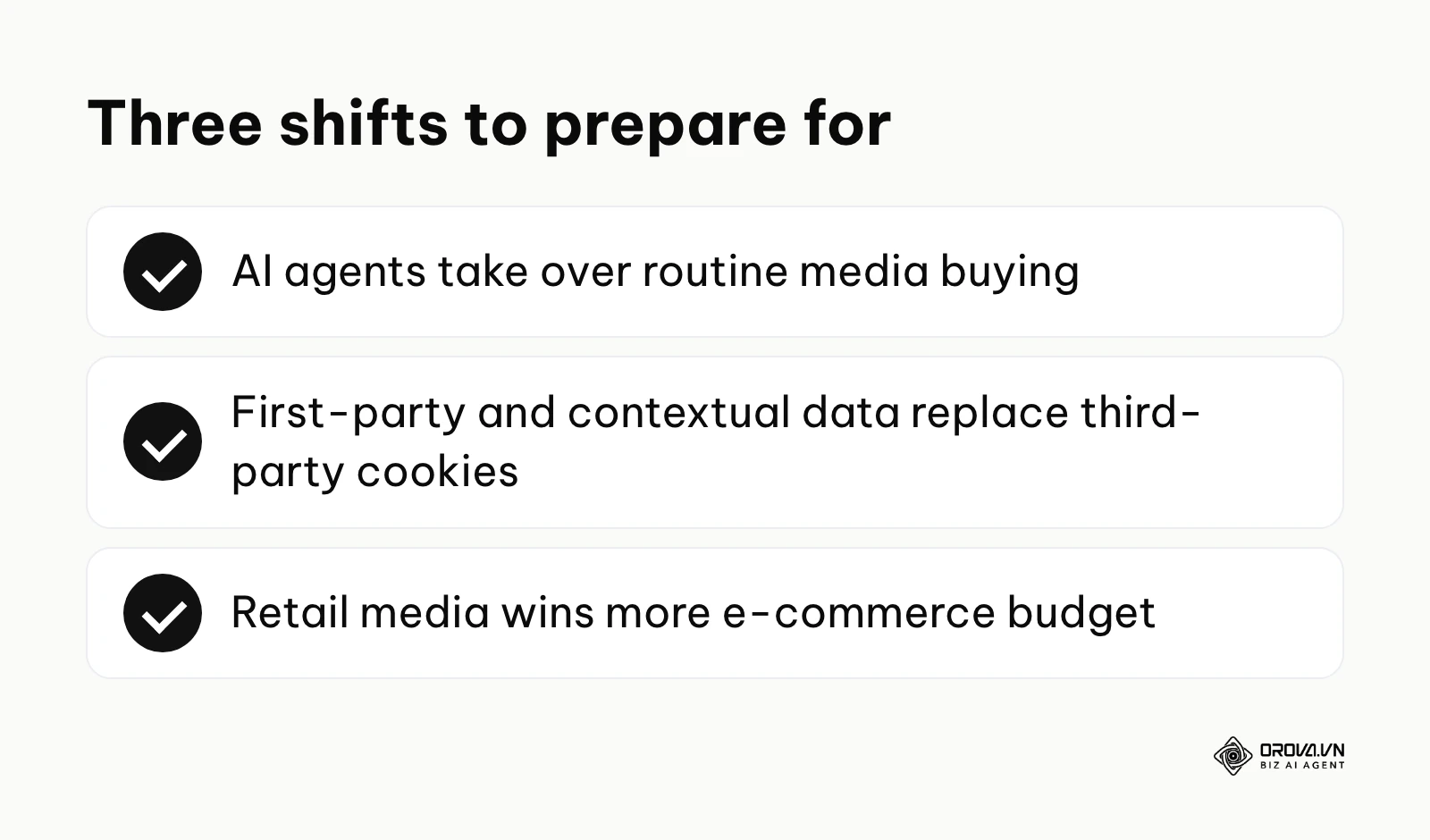
AI agents will take over routine media buying
I think the daily routine of a media buyer who adjusts bids and budgets by hand every morning will shrink sharply over the next two to three years. The signal is already visible today: platforms keep pushing advertisers toward automated campaign types such as Google's Performance Max and Meta's Advantage+ options. My read is that the next step is agent-style workflows, where software proposes creative, adjusts budgets, and pauses losing ads against profit goals set by a human. To prepare, move your own skills from pushing buttons toward financial planning, clear rules for the automation, and customer insight.
Contextual and first-party data will matter more than third-party cookies
I think cross-site tracking of individuals will keep getting weaker as browsers, operating systems, and regulators tighten privacy. Today you can already see platforms leaning on modeled conversions and server-side conversion APIs. Over the next few years, I expect targeting to rely more on context (where the ad appears) and on data customers give you directly. To prepare, build your own first-party data now: email lists, CRM records, and a clean way to send real conversions back to each ad platform.
Retail media networks will win more e-commerce budget
My read is that retail media networks such as Amazon Ads, Walmart Connect, and Instacart Ads will keep taking e-commerce budget from general social platforms. Shoppers on a retail app are already in buying mode, and the retailer can see whether an ad view turned into a sale on its own store. If you sell physical products through retailers, start setting aside a small experimental budget for these platforms so you learn them before competitors do.
Frequently asked questions about paid ad platforms
What is the most cost-effective ad platform?
There is no single "cheapest" platform. A platform with a very low cost per click might deliver poor leads that never buy, which makes it expensive in terms of actual customer acquisition. Generally, Google Search is cost-effective for capturing ready buyers, while Meta is cost-effective for building broad awareness. Measure effectiveness by return on investment, not by the cost of a click.
How much should a beginner spend on ads?
If you are just starting out, allocate a budget you are comfortable losing, because the first few weeks are mainly for buying data and learning. As a rule of thumb, the author suggests about 20 to 50 dollars per day on one platform for at least two weeks. Spending much less often starves the platform's algorithm, so it cannot figure out who your ideal customer is.
Will AI completely replace human media buyers?
AI is taking over the technical, repetitive parts of media buying, such as adjusting bids, duplicating ad sets, and monitoring spend pacing. It does not replace the human parts of strategy: understanding customer pain points, developing brand messaging, and setting business goals. Marketers who can direct AI tools to carry out their strategy will move faster.
How long does it take to see results from paid ads?
Unlike Search Engine Optimization (SEO), paid ads can generate traffic the moment you turn them on. Seeing profitable results usually takes longer, often a few weeks. The platforms need time to test audiences, gather conversion data, and let their delivery algorithms stabilize.
Which platform is least affected by privacy updates?
Platforms that rely on search intent (like Google Ads and Microsoft Advertising) and platforms with large logged-in user bases (like Amazon Ads) are generally less affected by tracking restrictions. They rely on what the user is doing right now on their own property rather than following the user across the open internet.
Where should you start?
Reading about eleven different advertising networks can cause analysis paralysis. The key to success in paid media is decisive, measured action. Identify which of the three situations below describes you, and take the single matching step today.
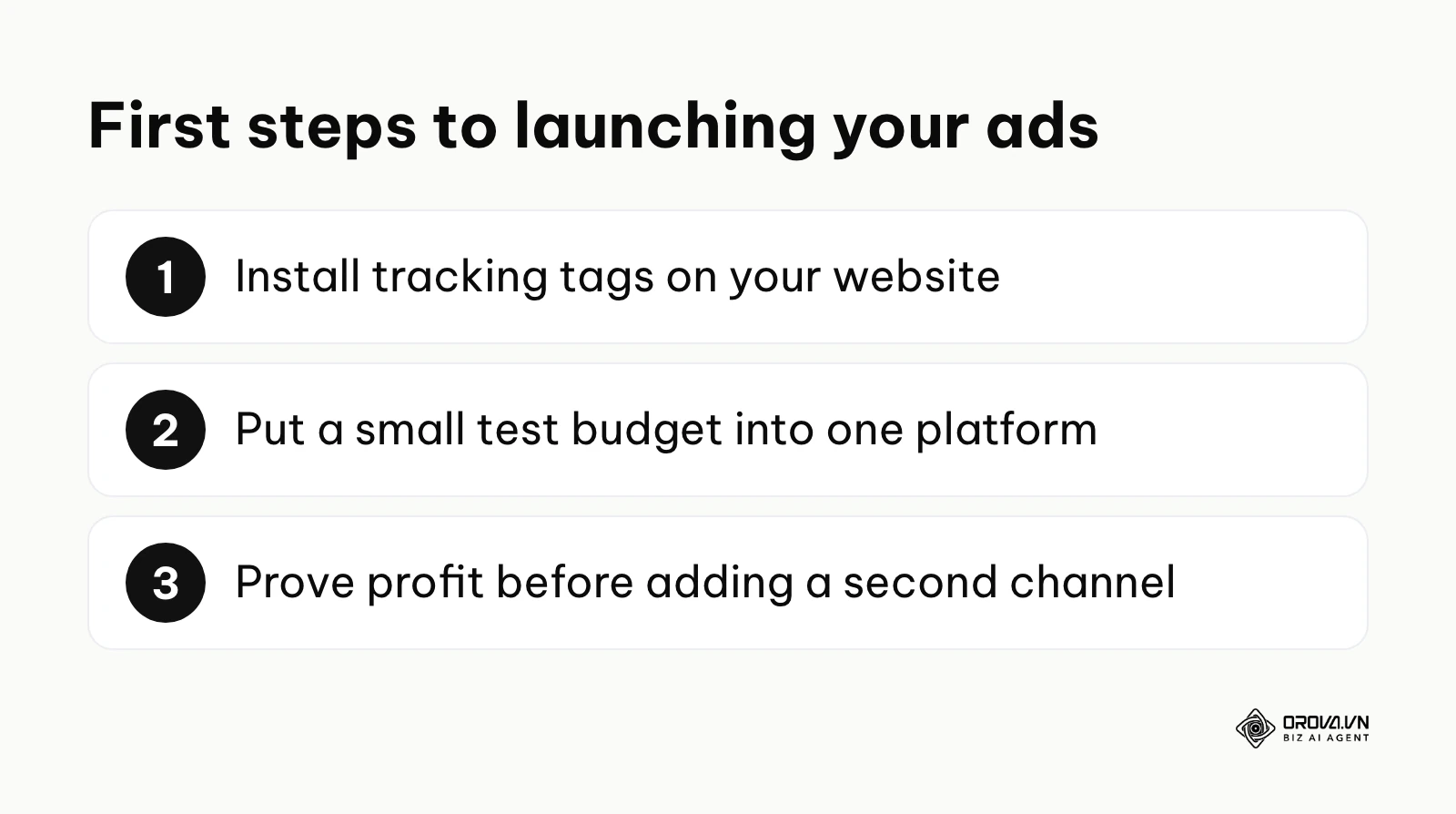
If you have zero budget and are just testing the waters, your first step is purely technical. Do not spend anything yet. Instead, set up the tracking tags for Google, Meta, and LinkedIn on your website. Even if you do not run ads for months, these tags start building audiences you can retarget later, which makes future campaigns more efficient.
If you have a small, defined budget (under 1,000 dollars a month) and need sales soon, pick one bottom-of-funnel platform. If people actively search for your service, choose Google Search Ads and set up a tightly themed campaign with exact match keywords. If your product needs a visual demonstration, choose Meta Ads and launch a simple video campaign. Ignore every other platform until this first channel proves profitable.
If one channel is already profitable, your next step is to add a second channel that does a different job. Keep the winning channel running, move a small share of the budget (around 20%, as suggested above) to a second platform from your scenario row in the table, and judge it against the same profit measure before you scale it.
About the author

Builder of Orova
Nguyễn Đỗ Trọng Ân has 8 years of experience in marketing, including 6 years managing market development across Asia. He builds Orova, a Biz AI Agent that never sleeps: it plans, runs and optimizes work for businesses.
Run your business with AI Agents
Orova is the always-on Biz AI Agent — it plans, runs, and optimizes the work for you.
Save time, unlock productivity.