
What is an ad campaign? A practical guide for small budgets

An ad campaign is a coordinated set of ads built around one goal, one budget and one timeframe, and it is what separates predictable growth from random spending. Picture the opposite: you log into your advertising dashboard, heart pounding. You have just spent your first 100 dollars. You see a handful of clicks, a few likes, but zero sales. Your bank account is draining, and you are left wondering if digital marketing is just an expensive casino for big brands. This is a common reality for many business owners. The old way of running ads—throwing up a single image, targeting a broad demographic, and hoping for the best—no longer works. It is simply not enough to buy traffic; you must orchestrate a journey.
That is where a structured ad campaign comes in. This guide will walk you through exactly how to plan, launch, and scale an ad campaign on a small budget. You will learn how to move past random acts of promotion and build a predictable, data-driven system that actually generates a return on your investment, even if you are entirely new to media buying.
What is an ad campaign?
An ad campaign is a coordinated series of promotional messages designed to achieve a specific marketing goal within a defined timeframe. It acts as the structural container for your advertising efforts, allowing you to organize audience targeting, budget allocation, and creative assets across multiple channels simultaneously.
The term originated from military operations, where a "campaign" denoted a series of coordinated battles meant to achieve a singular strategic objective. Advertisers later borrowed it for multi-channel, themed marketing pushes rather than one-off placements.
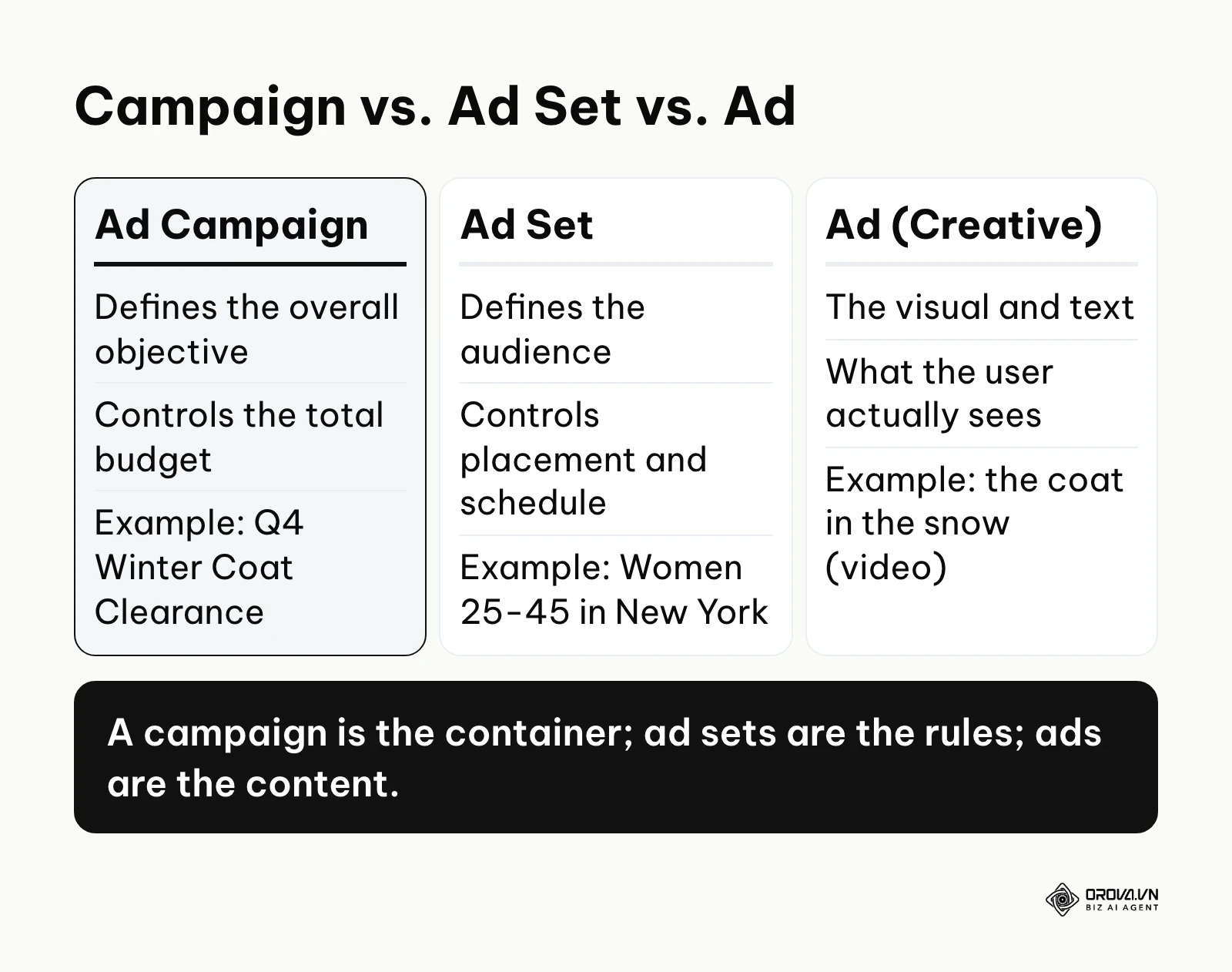
It helps to separate it from the elements inside it.
| Concept | How it differs | Example |
|---|---|---|
| Ad Campaign | The master folder. Dictates the core objective (e.g., Lead Generation) and the total budget. | "Q4 Winter Coat Clearance" |
| Ad Set (or Ad Group) | The targeting rules. Dictates who sees the ads, where they appear, and the schedule. | "Women 25-45 in New York" |
| Ad (Creative) | The actual content. The image, video, and text that the user interacts with. | A video showing the coat in the snow. |
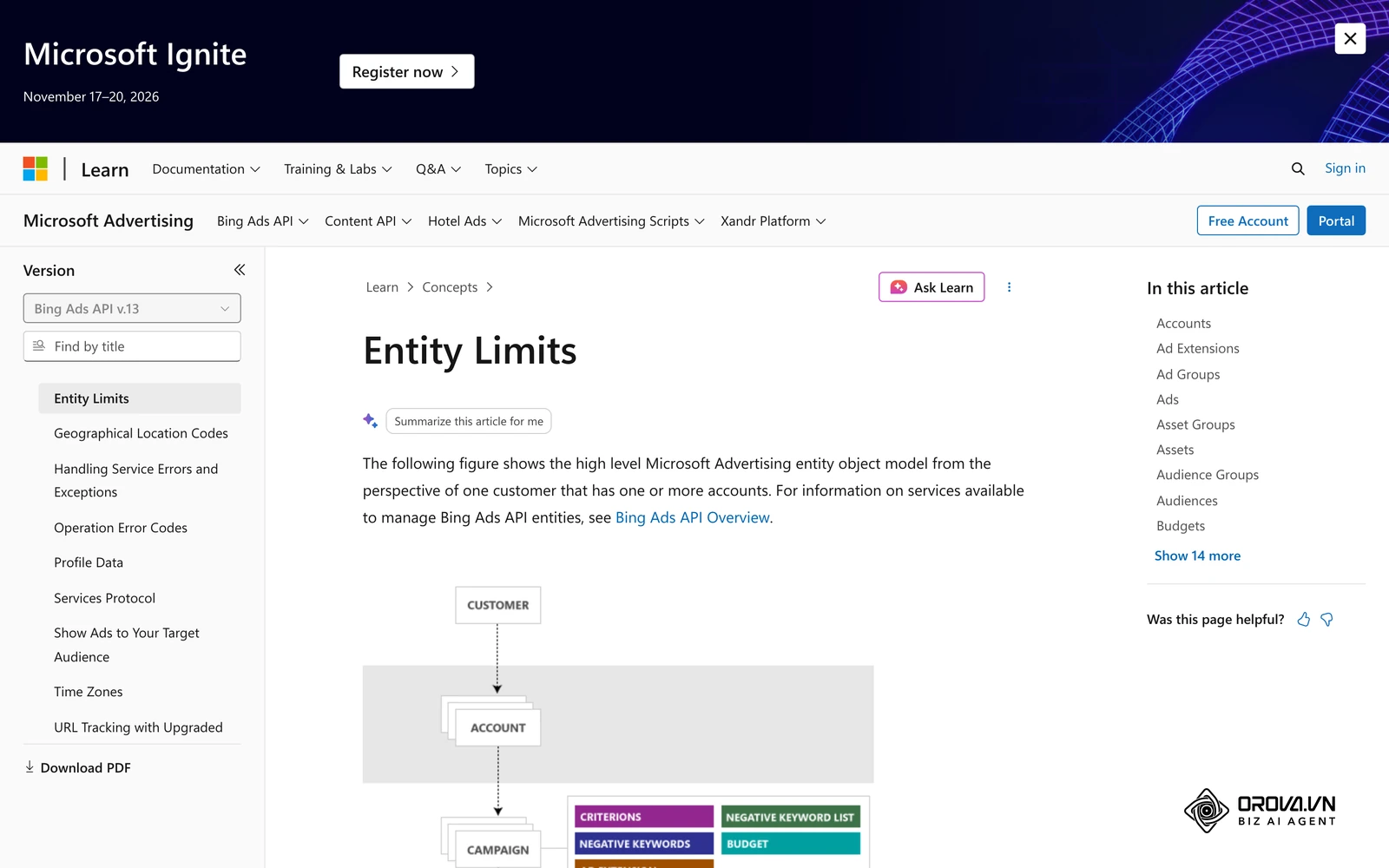
For a real-life example, imagine a local bakery. A single "ad" is a flyer taped to the window. An "ad campaign" is deciding to sell 100 custom wedding cakes this spring, printing specific flyers for bridal shops, running targeted digital videos to newly engaged couples, and tracking exactly which channel brought in the bookings over a three-month period.
The significance of an ad campaign
An ad campaign exists to solve the problem of unpredictable revenue. For business owners, relying solely on word-of-mouth or organic social media reach is incredibly risky; you are at the mercy of algorithms you do not control. An ad campaign provides a lever: a system where you can put money in and predictably get customers out.
In the big picture of your business, an ad campaign sits exactly in the middle of your growth engine. It comes after market research and product development, but before sales and customer retention.
If you skip building a proper campaign and instead just hit "Boost Post" whenever you feel like it, you lose entirely on data. You will spend money, but you will not know why someone bought, making it impossible to repeat the success or scale the effort.
When you don't need an ad campaign yet You should pause before launching an ad campaign if your product lacks clear market validation or if your website frequently crashes. Pouring money into a broken funnel is a waste. Similarly, if your profit margin is too thin to absorb initial testing costs, or if you cannot handle a sudden influx of new orders, an ad campaign will only accelerate operational failure. Instead, focus on gathering organic feedback, improving your product offering, and building a reliable customer service process first.
The value and benefits of a structured ad campaign
Running a highly organized ad campaign brings layered benefits, split distinctly between the overall business health and the daily life of the marketing practitioner.
Value for the business
For a business, a structured campaign means financial control. You are no longer spending blindly. Businesses that run their advertising from one shared set of data, rather than as isolated promotions, are in a far better position to bring their customer acquisition costs down. You gain the ability to test risk safely, measure exactly what a new customer costs, and forecast future revenue based on current spend.
Value for the practitioner
For the marketer or media buyer, a structured campaign brings mental clarity. Instead of waking up and wondering what to post, you have a defined testing protocol. If an ad fails, it is not a personal failure; it is simply a data point telling you to shift budget to the winning variation. It turns a creative guessing game into a mathematical certainty.
Illustrative example:
- Context: A regional B2B software firm was spending 2,000 dollars a month on various boosted posts without tracking leads. The marketing manager felt overwhelmed and the CEO was frustrated by the lack of pipeline.
- Steps taken: The manager stopped all boosting. They structured a single ad campaign focused purely on demo signups. They created three ad sets (cold industry interests, lookalike audiences, and website retargeting) and gave each a strict daily budget.
- Stumble: In the first week, the cost per lead from the cold audience was alarmingly high. They panicked but realized the retargeting ad set was generating cheap, high-quality leads.
- Result: They shifted 80% of the budget to retargeting and lookalike audiences. By week four, the company saw a consistent flow of 15 qualified demo requests per week, clearly visible on their analytics dashboard.
| Benefit | Measured by which metric? | Time to see results |
|---|---|---|
| Predictable Lead Flow | Volume of Conversions | 1 - 2 weeks |
| Reduced Wasted Spend | Cost Per Acquisition (CPA) | 2 - 4 weeks |
| Clear Target Insights | Click-Through Rate (CTR) | 3 - 5 days |
OROVA ADS applies AI Agent to automate and optimize ad performance on Google, Meta and TikTok. Scale your budget safely, monitor 24/7 and expand your business quickly.
Experience the solution at orova.vn/ads
The anatomy of an ad campaign
To understand how to build an ad campaign, we must dissect it. Most digital campaigns across major platforms operate on a similar fundamental architecture. Before diving into the steps, it helps to know which vehicle you are driving.
| Type of Campaign | Characteristics | Best for |
|---|---|---|
| Search (Intent-based) | Text ads triggered by specific keywords. High conversion rate, high cost. | Products people actively look for (e.g., Plumbers, Software). |
| Social (Discovery-based) | Image/Video ads in feeds. Interrupts users. Lower intent, cheaper clicks. | Visual products, brand awareness, impulse buys. |
| Retargeting | Follows users who previously visited your site. Extremely high ROI. | Any business with existing website traffic. |
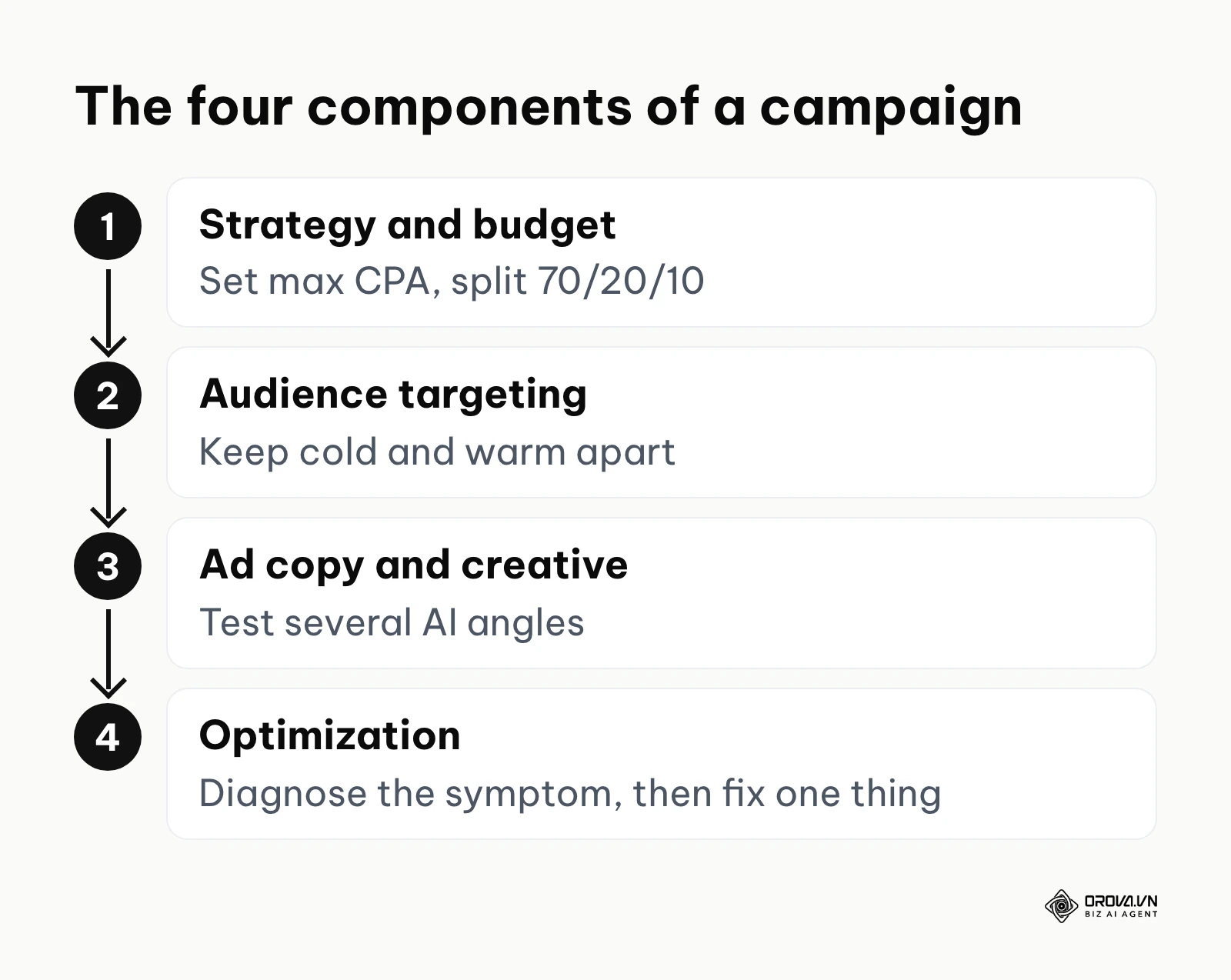
Let us break down the core components of building a modern campaign.
Component 1: Strategy and small budget allocation
The biggest gap for most beginners is figuring out how to launch an ad campaign without a Fortune 500 budget. You do not need 10,000 dollars a month; you can start with 300 to 500 dollars. The secret is rigid allocation.
Do not guess your budget. Create a simple spreadsheet. Define your maximum acceptable CPA (Cost Per Acquisition). If you sell a product for 100 dollars and your profit margin is 50 dollars, you cannot spend more than 50 dollars to acquire a customer. Understanding this ties directly into mastering the ROAS formula.
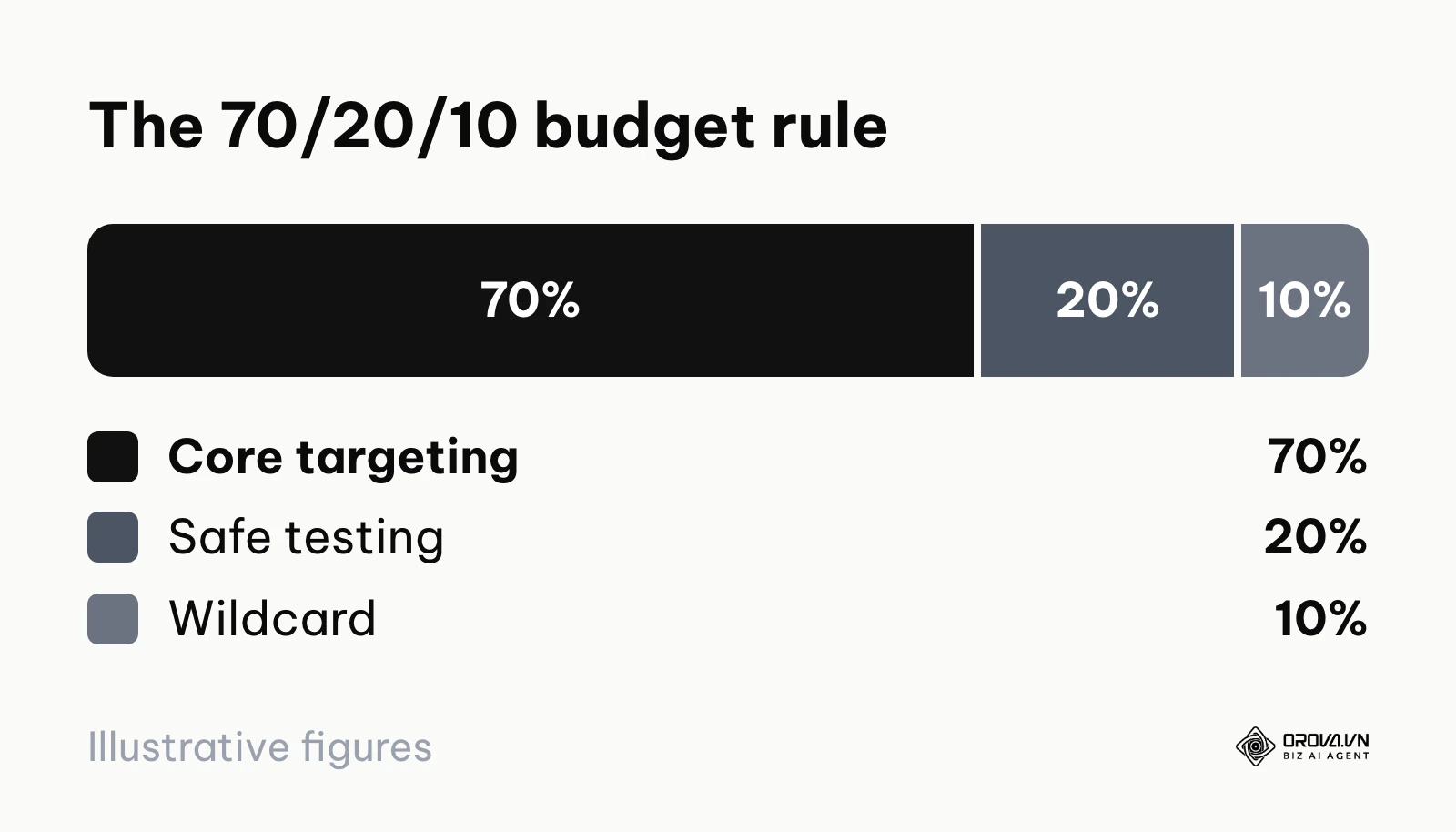
For a 500-dollar monthly budget, apply the 70/20/10 rule:
- 70% (350 dollars): Core targeting. The most likely audience to buy (e.g., Retargeting website visitors or very precise local interests).
- 20% (100 dollars): Safe testing. Trying a new angle or a lookalike audience.
- 10% (50 dollars): Wildcard. A completely different creative format just to see if it catches fire.
Component 2: Audience targeting
Your campaign lives or dies by who sees it. The architecture of your ad sets must reflect different stages of awareness. Overlapping audiences across ad sets are a common driver of ad fatigue, because the same people keep seeing your ads from several directions.
You must separate your cold audiences (people who have never heard of you) from your warm audiences (people who follow your page or visited your site). Mixing them in one ad set confuses the platform's algorithm and artificially inflates your costs. Master your audience settings in the Facebook Ads Manager or Google equivalent before spending.
Component 3: Ad copy and creative (AI integration)
The visual and textual elements of your ad are your front line. In the past, you needed an agency to test different messages. Today, you must leverage AI. A digital ad campaign strategy that ignores AI is already obsolete.
You need volume to find what works. Use tools to generate angles. For example, use a prompt like this in your AI chat tool: "Act as a direct response copywriter. I am selling an ergonomic desk chair. Write 3 variations of Facebook ad copy. Angle 1: Focus on back pain relief. Angle 2: Focus on productivity. Angle 3: Focus on modern design. Keep each under 100 words."
Take those outputs, pair them with batch-generated images, and put them into your campaign. This allows you to test the psychological angle rather than just guessing.
Component 4: Real-time optimization and troubleshooting
An ad campaign is not a "set it and forget it" tool. It requires active management. When metrics go wrong, you must have a logical troubleshooting process.
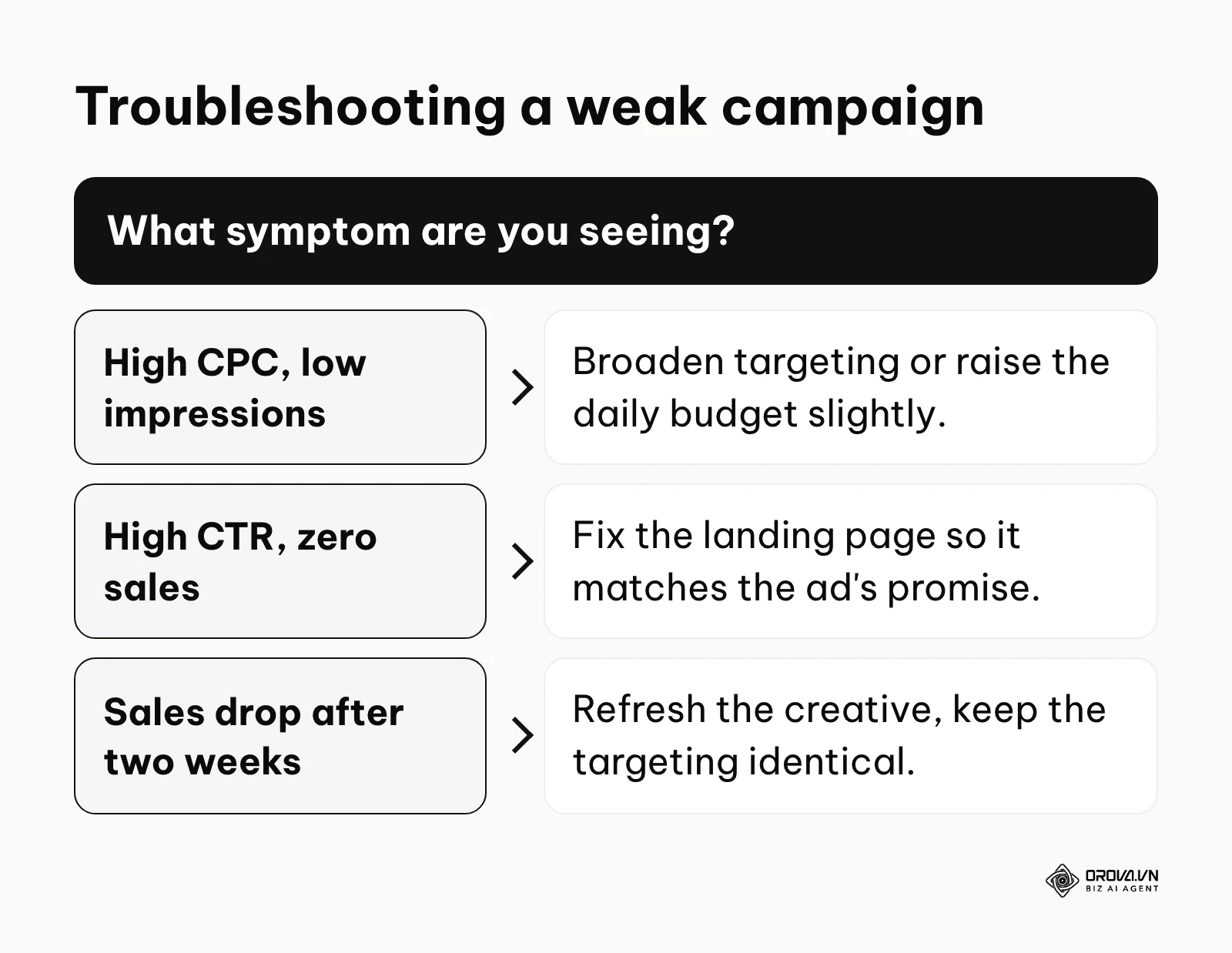
- Symptom: High CPC (Cost Per Click), Low Impressions. Diagnosis: Your audience is too small, or your bid is too low. Fix: Broaden your targeting parameters or increase your daily budget slightly.
- Symptom: High CTR (Click-Through Rate), Zero Sales. Diagnosis: The ad is great, but the landing page is failing. Fix: This is a conversion rate optimization issue. Check site speed, pricing, and ensure the page matches the ad's promise.
- Symptom: Good initial sales, then sudden drop-off after two weeks. Diagnosis: Ad fatigue. The same people are seeing the ad too many times. Fix: Refresh the creative. Swap the image or video while keeping the targeting identical.
Illustrative example:
- Context: An online plant store owner started a discovery campaign with a 15-dollar daily budget, using AI to generate 5 different ad copy variations.
- Steps taken: She launched the campaign, closely monitoring the dashboard. After 48 hours, she noticed one variation had a phenomenal click-through rate, but not a single purchase had been made.
- Stumble: Instead of turning off the ad, she clicked the link herself. She realized the ad was pointing to a general homepage, forcing users to search for the specific rare plant featured in the ad, causing them to bounce.
- Result: She updated the ad destination URL to point directly to the specific product page. Within the next 24 hours, she secured 3 conversions from the exact same ad creative.
What to do to adapt to modern ad campaigns
The landscape of digital advertising shifts rapidly. How you approach a campaign depends heavily on your role within the business.
For small business owners
- Define your math first: Never launch an ad without knowing your break-even point.
- Start with retargeting: Before trying to reach millions of strangers, spend 5 dollars a day showing ads to people who already visited your website.
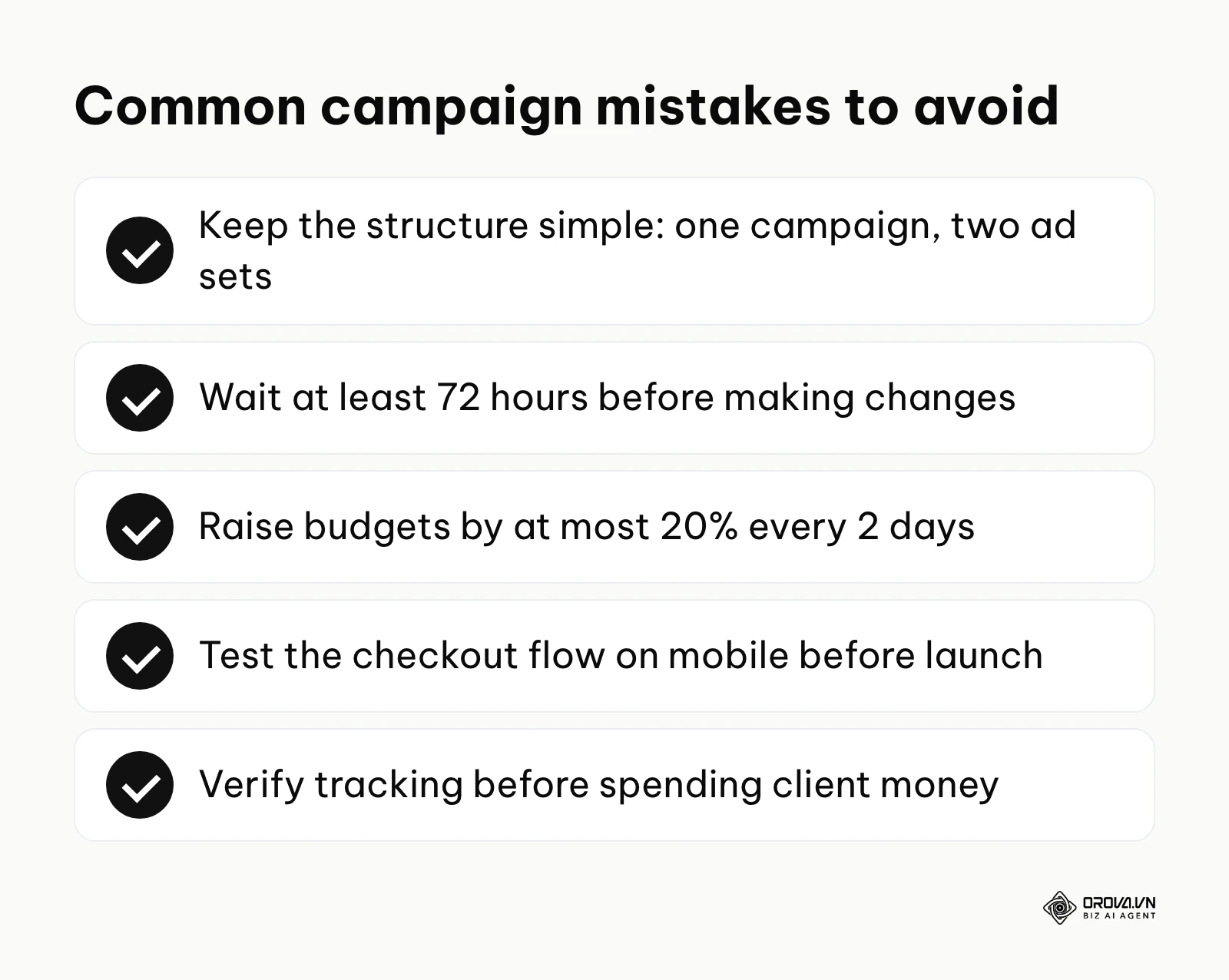
- Keep structure simple: One campaign, two ad sets, three ads per set. Do not overcomplicate your account layout.
For in-house marketing managers
- Implement naming conventions: Standardize how you name campaigns (e.g., Year_Month_Objective_Audience) so reporting is seamless.
- Set up automated rules: Protect the budget by creating rules that automatically pause ads if the CPA exceeds a certain threshold.
- Consolidate platforms: Stop looking at Meta, Google, and TikTok in isolation; look at the blended cost of acquiring a customer.
For freelance media buyers
- Focus on creative strategy: The platforms' algorithms are handling the targeting now; your value is in writing better copy and briefing better videos.
- Insist on tracking verification: Refuse to spend a client's money until you have personally verified the pixel or Conversion API is firing correctly.
- Educate the client on the testing phase: Set clear expectations that the first two weeks are for buying data, not necessarily printing profit.
| Common Mistake | Consequence | How to Avoid |
|---|---|---|
| Tinkering too early | Resets the algorithm's learning phase, driving up costs. | Wait at least 72 hours before making any changes. |
| Scaling budget too fast | Breaks the campaign and ruins performance stability. | Increase budgets by a maximum of 20% every 2 days. |
| Ignoring the landing page | Paying for expensive traffic that immediately leaves. | Test the checkout flow on mobile before launching. |
Illustrative example:
- Context: A local gym owner was trying to run his own membership drive campaigns. He was constantly checking the app, turning ads on and off every few hours based on his gut feeling.
- Steps taken: He realized he was hurting his own results. He sat down, defined a strict target CPA of 20 dollars, and set up a campaign with a rule to only pause ads if they spent 40 dollars without a lead.
- Stumble: The automated rule paused his favorite video ad on day two. He wanted to override it, but forced himself to trust the data and let the budget flow to a simpler image ad that was actually converting.
- Result: By stepping back, he freed up 10 hours a week, and the campaign stabilized, delivering steady trial signups at 18 dollars each.
Want to scale your budget but afraid of breaking performance? 📉
Integrate OROVA ADS now - an AI Agent that automatically monitors and optimizes Google, Meta, TikTok ads 24/7. Now, expanding and replicating your Performance Ads team is just one click away.
🚀 Try it now at: orova.vn/ads
Where ad campaigns are heading in the next few years: the author's take
As we look toward the future of digital advertising, the mechanics of how we launch and manage campaigns are undergoing a massive shift. Based on the data and platform updates visible as of 2026, here is how I see the landscape evolving over the next two to three years.
AI transitions from advisor to autonomous operator
Currently, many marketers use AI to brainstorm ideas or analyze data after the fact. I believe that within the next three years, the standard workflow will shift toward autonomous execution. You will not build ad sets manually; you will simply provide a business objective, a budget, and a library of raw assets. The AI will dynamically assemble the ads, test thousands of micro-variations, and shift budgets across Google, Meta, and TikTok with far less hands-on approval. To prepare, you must transition your skills from "button-clicking" inside ad managers to high-level strategic inputs and business economics. Of course, if privacy regulations strictly limit algorithmic autonomy, this timeline could be delayed.
Creative volume will replace micro-targeting
I lean heavily toward the idea that targeting audiences based on precise interests (like "people who like tennis and live in Austin") will become obsolete. Privacy-first tracking is forcing platforms to use broad targeting. Because of this, the ad creative itself will become the main targeting tool. Your video or image will dictate who stops scrolling. I expect brands will need to produce far more creative assets than they do today, relying on generative AI to prevent aggressive ad fatigue. You should start building internal systems for rapid content creation now.
Multi-platform synchronization becomes mandatory
My read is that the single-platform media buyer is on the way out. Consumers bounce between TikTok, Instagram, and Google Search within minutes. If your ad campaigns are siloed, you will over-report conversions and double-pay for the same customer. In the near future, survival will require a centralized data hub that tracks the holistic user journey. If you are only looking at native platform dashboards, you need to begin integrating server-side tracking and unified analytics immediately.
Frequently asked questions about ad campaigns
Is an ad campaign still necessary with AI?
Yes, absolutely. AI is a tool, not a strategy. While AI can write your copy and optimize your bids, it cannot define your business goals or understand your profit margins. You still need to design the overarching ad campaign to give the AI boundaries, objectives, and a budget to work within.
How much minimum budget is needed to test an ad campaign?
You do not need thousands of dollars. A minimum viable test can be run on 10 to 20 dollars a day per platform. The key is to run it long enough (at least 5-7 days) to gather statistically significant data. Testing with 2 dollars a day will simply not give the algorithms enough data to learn who your ideal customer is.
How often should I refresh ad creatives?
This depends entirely on your spend and audience size. If you are spending 500 dollars a day on a small local audience, ad fatigue will set in within a week. If you are spending 20 dollars a day on a national audience, a creative might last months. Monitor your CTR and your frequency metric; if frequency goes above 3 and CTR drops, it is time to refresh.
What are some good digital ad campaign strategy resources?
Beyond the official help centers and learning hubs that Meta, Google and TikTok run for advertisers, focus on learning fundamental copywriting and data analysis. If AI is part of your plan, this guide to AI ads shows where it fits into day-to-day campaign work.
Where to start with your ad campaign?
Reading about campaign structure is easy; taking the first practical step is where most people get stuck. Do not try to implement everything at once. Identify your current state and take one specific action today.
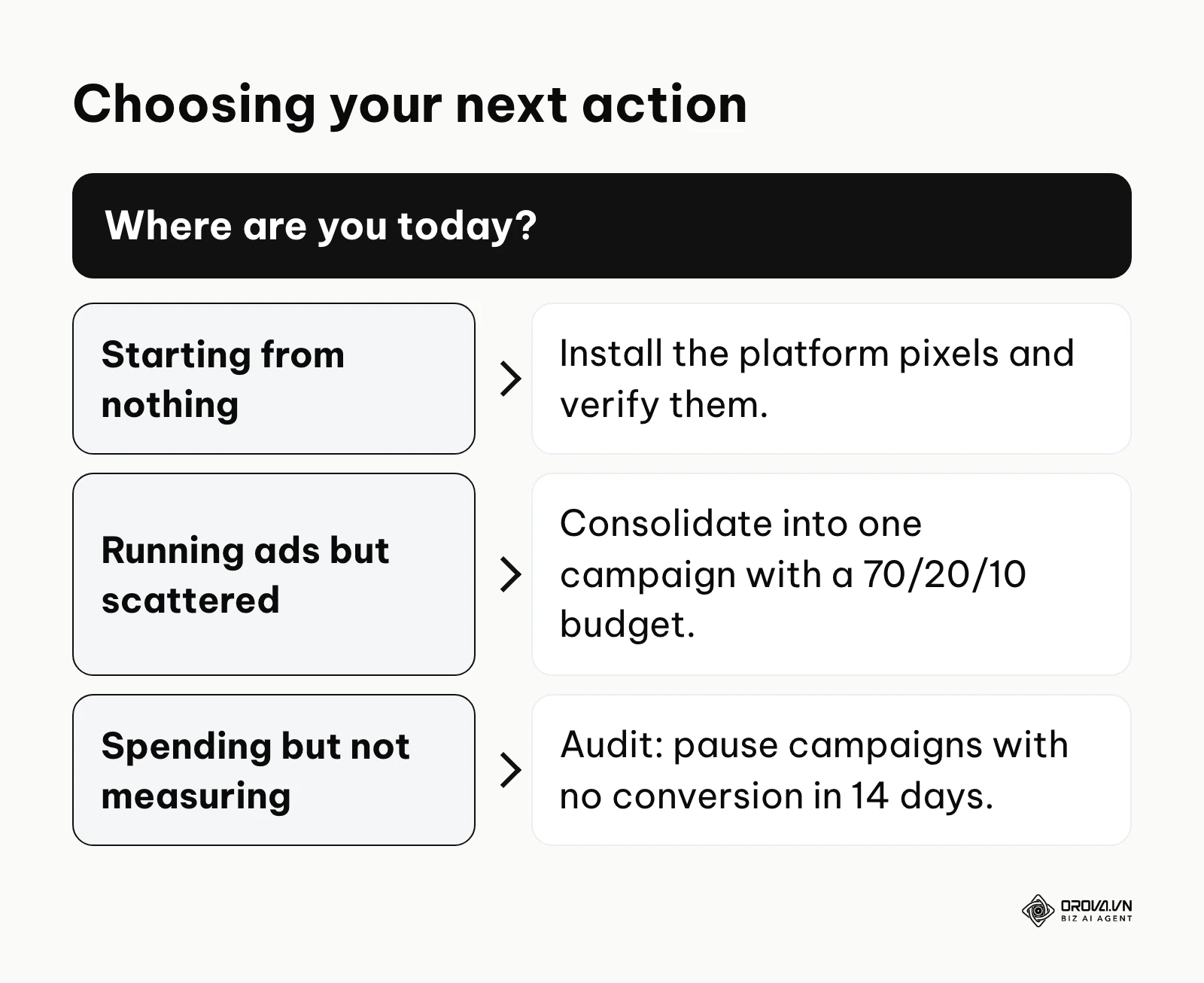
State 1: Starting from nothing
If you have never run an ad and do not have tracking installed, your first step has nothing to do with writing ad copy. Spend your next working session exclusively on installing the Meta Pixel, Google Tag, or TikTok Pixel on your website. Verify that they are firing correctly when someone makes a purchase or fills out a form. Spending money before this is functional is equivalent to driving blindfolded.
State 2: Running ads but scattered
If you have boosted a few posts, run a search ad here and there, but feel totally disorganized, your first step is consolidation. Stop all currently running micro-promotions. Open a spreadsheet and build your budget allocation based on the 70/20/10 rule. Define one single objective for the next 30 days (e.g., "Generate 50 Leads") and build one unified campaign to achieve it.
State 3: Spending but not measuring
If you are already spending a decent amount but cannot confidently state your Cost Per Acquisition, your first step is an audit. Pause any campaign that has run for more than 14 days without generating a tracked conversion. Then, map out your customer journey from the click to the final sale, and identify exactly where the data is breaking. Focus on fixing the measurement gap before you increase your budget by another dollar.
About the author

Builder of Orova
Nguyễn Đỗ Trọng Ân has 8 years of experience in marketing, including 6 years managing market development across Asia. He builds Orova, a Biz AI Agent that never sleeps: it plans, runs and optimizes work for businesses.
Run your business with AI Agents
Orova is the always-on Biz AI Agent — it plans, runs, and optimizes the work for you.
Save time, unlock productivity.