
What Is Local SEO? A 30-Day Plan for Small Businesses

Local SEO is the practice of making a business show up when people nearby search for what it sells, especially in the map results and the "near me" listings on Google. If you run a brilliant local business, yet when potential customers search for your services nearby, your competitors appear first on the map. This is a frustrating reality for many brick-and-mortar stores and service providers. Often, business owners believe that simply having a beautiful website or an active Facebook page is enough to attract local foot traffic. However, this outdated understanding falls short because Google’s algorithms for local searches prioritize specific geographic relevance and trust signals over general online presence. If you are struggling to bridge the gap between online searches and in-store visits, mastering this discipline is your most critical next step. This guide will walk you through the exact blueprint to dominate your neighborhood's search results, handle unfair reviews, and build a sustainable local footprint without needing an expensive agency. By the end of this article, you will have a clear, actionable path to make your business the undeniable top choice in your area.
What is Local SEO?
Local SEO is a specialized search marketing strategy used to optimize a business's online presence to attract more customers from relevant geographic searches. It is used to dominate local map packs and neighborhood search results. Unlike general SEO, which targets a global audience, local SEO strictly prioritizes physical proximity.
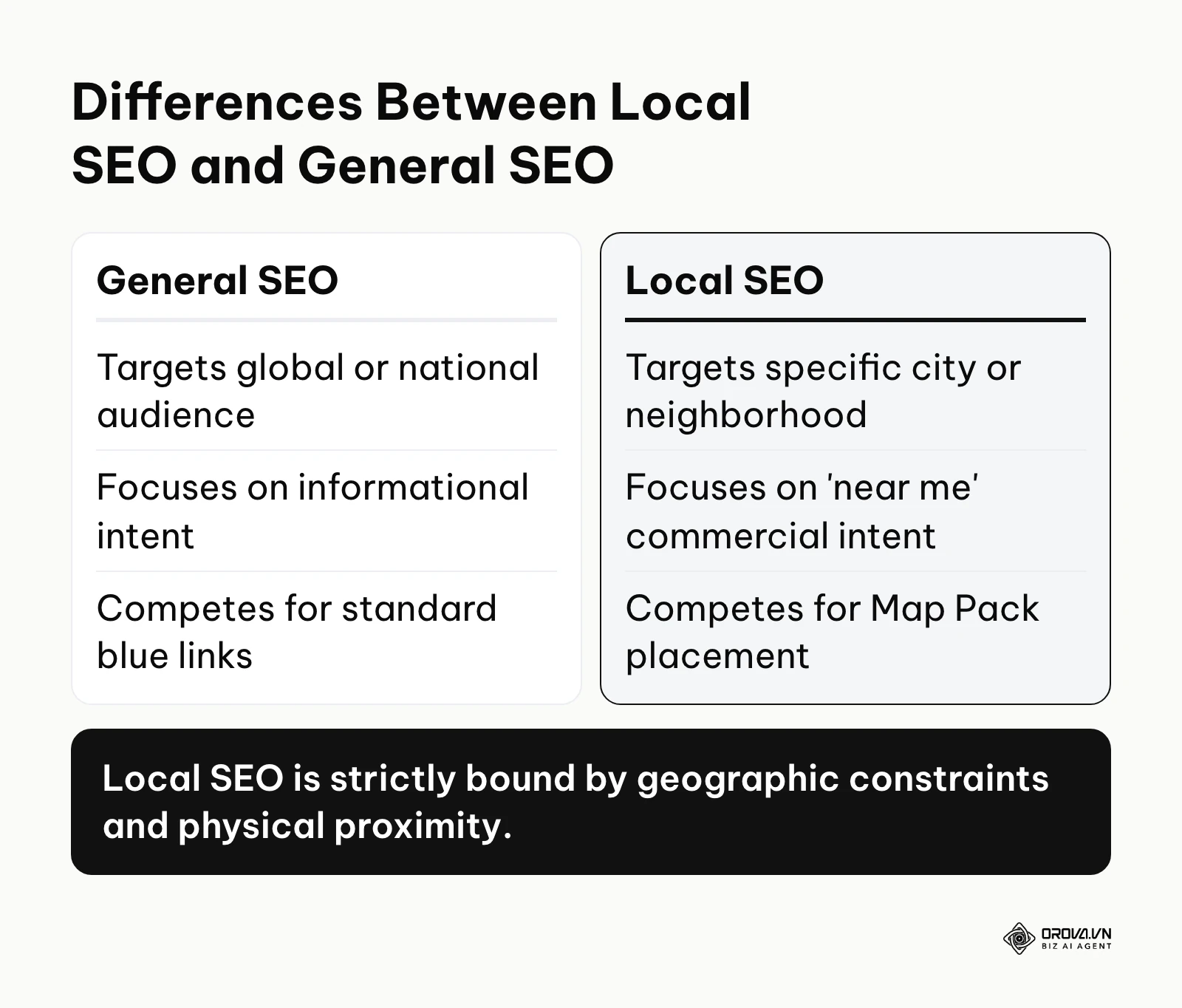
The concept emerged in the mid-2000s when search engines began utilizing IP addresses and device geolocation to serve customized, location-specific results to users. Before this, searching for a plumber would yield national directories rather than someone down the street. Today, local optimization is the backbone of regional commerce.
To clarify how it fits into the broader marketing ecosystem, here is how it compares to similar concepts:
| Concept | How it differs | Example |
|---|---|---|
| Local SEO | Focuses on geographic queries and Map Pack placement | "plumber near me" |
| General SEO | Focuses on organic search results globally for informational intent | "how to fix a leaky pipe" |
| Local Paid Ads (PPC) | Pay-per-click placement at the top of local results | Sponsored map pin for a plumber |
An everyday example: Imagine you are craving pizza. You pull out your phone and search "pizza near me." The three restaurants that show up on the map right at the top are there because of effective local optimization, not necessarily because they make the absolute best pizza in the world. They have communicated their location and authority to Google better than their competitors.
The Meaning and Role of Local SEO in Your Business
Local SEO exists to solve a very specific problem: the friction between a customer's immediate, localized need and a business's physical capability to fulfill it. For the consumer, it solves the problem of finding trustworthy, nearby solutions rapidly. For the business owner, it solves the problem of invisibility in their own backyard. Without it, your digital storefront is practically hidden behind a brick wall.
In the broader picture of your marketing strategy, local optimization acts as the crucial middle-of-the-funnel engine. A broad search engine optimization (SEO) campaign might bring national traffic to your informational blog posts, but it is local SEO that captures the high-intent user who is standing three blocks away with a credit card in hand. It sits directly between brand awareness and the final transaction.
If you ignore this discipline, you lose out on the highest-converting traffic available on the internet. You surrender market share to competitors who might offer inferior services but understand how to manage their digital footprint. Ultimately, failing to optimize locally means you are actively leaving money on the table every single day.
When You Do Not Need Local SEO: There are specific situations where investing in local SEO is a waste of resources. First, if you run a purely global e-commerce brand without a physical storefront, local algorithms will not benefit you. Second, if you are a SaaS company selling enterprise software worldwide, your customers search for solutions, not proximity. Finally, if your business is a traveling pop-up shop changing cities constantly, you cannot establish the permanent consistency required. In these cases, focus on general search optimization, international SEO if you sell across countries, and paid acquisition instead.
The Value and Benefits of Local SEO
Understanding the tangible returns on your investment is critical before diving into the technical mechanics. The value of local optimization can be split into two distinct layers: the macro value for the business as a whole, and the micro benefits for the marketing team executing the strategy.
Tangible Revenue Growth and Lead Generation
For the business, the primary value is direct revenue generation. By securing a spot in the top three map results (known as the Local Pack), you capture the lion's share of high-intent clicks. When you compare SEO costs with running continuous pay-per-click ads, local organic traffic usually offers a better long-term return. Once you rank, you do not pay for each individual click or phone call, drastically lowering your overall customer acquisition cost.
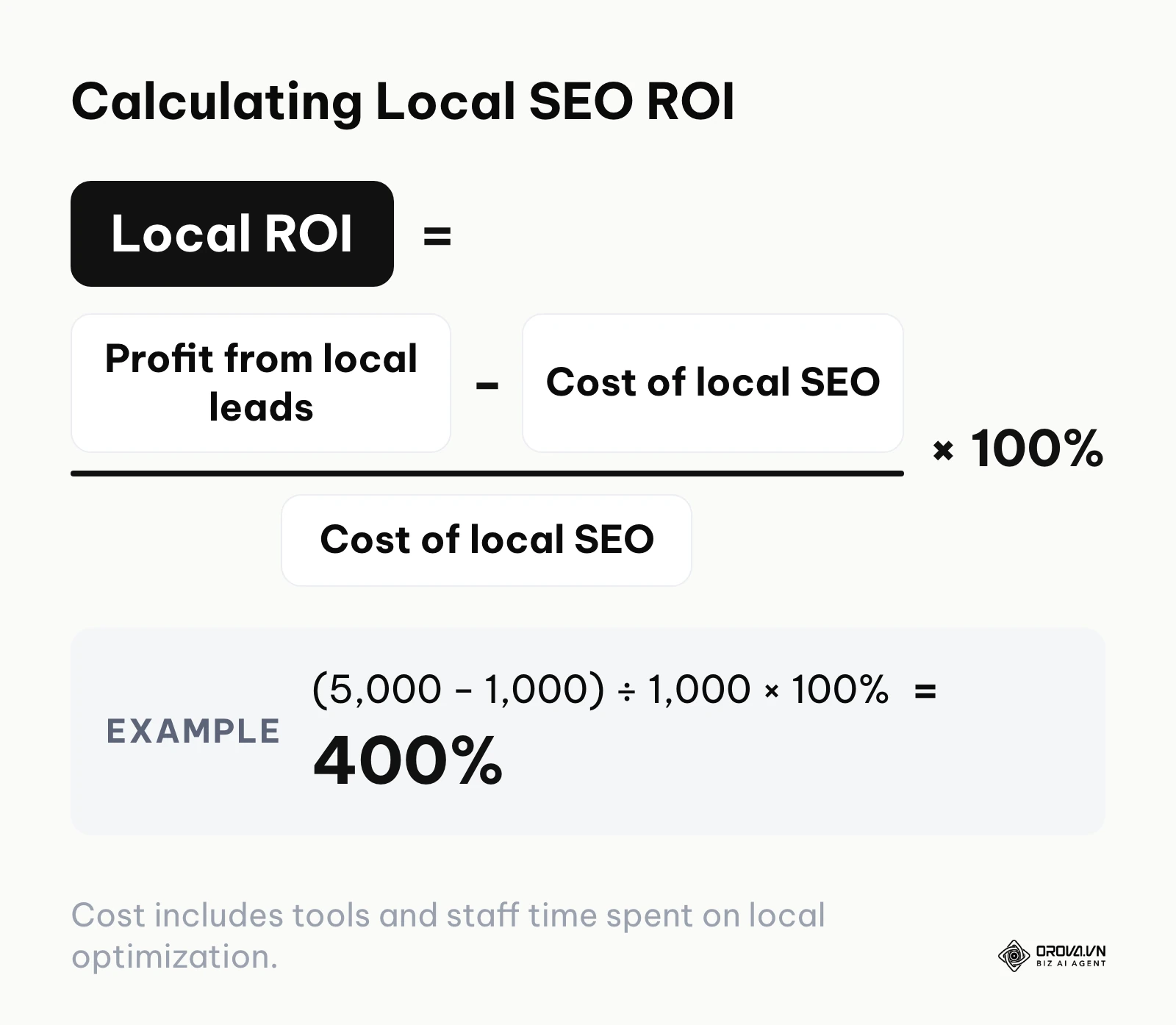
To measure the return, use a simple formula: Local ROI = (Profit from local leads − Cost of local SEO) ÷ Cost of local SEO × 100%. For example, if customers who found you through the map brought in 5,000 in profit over a quarter (in your own currency), and your tools plus staff time cost 1,000, the ROI is (5,000 − 1,000) ÷ 1,000 × 100% = 400%.
Risk Mitigation and Brand Protection
Beyond just revenue, local SEO acts as a defensive moat for your brand. By actively managing your digital footprint and accumulating positive reviews, you insulate your business from occasional negative feedback or aggressive competitor tactics. A robust, highly-rated profile establishes undeniable social proof, ensuring that when potential customers look you up to verify your legitimacy, they are met with a wall of trust and authority rather than empty space or unmanaged complaints.
Time Efficiency for the Marketing Team
For the practitioners and marketers doing the daily work, a structured local strategy eliminates guesswork. Instead of constantly chasing viral social media trends that rarely convert to local sales, the team can focus on measurable, repeatable tasks like citation building and review management. It provides a clear framework where specific inputs reliably generate specific outputs.
The table below summarizes these benefits, how to measure them, and the expected timeline for results:
| Benefit | Measured By | Visible After |
|---|---|---|
| Increased Local Visibility | Impressions in Google Search Console and profile views in your Business Profile performance report | 2 to 4 weeks |
| Higher Foot Traffic/Calls | Phone calls and direction requests in your Business Profile performance report | 1 to 3 months |
| Lower Acquisition Costs | Cost Per Acquisition (CPA) compared to paid ads | 3 to 6 months |
Discover Orova.vn – a Biz AI Agent platform with OROVA SEO, a complete solution for every website. The system supports search engine optimization from A to Z with features including keyword research, writing new SEO-ready articles, optimizing existing content, rank tracking, plus competitor analysis and in-depth technical analysis. Sign up today to experience OROVA SEO completely free (offer valid through July 7, 2027).
How Local SEO Works: A Deeper Dive into the Mechanics
To succeed, you must understand the underlying gears that drive local search algorithms. Google does not randomly select businesses; it evaluates thousands of data points to determine which entity best answers the user's query.
The Anatomy of a Local Search
Google's own Business Profile help page on local ranking names three main factors that decide your position in the map pack: relevance, distance, and prominence.
- Relevance is how well your business profile matches what someone is searching for. If your profile is vague, Google will not show it.
- Distance is exactly what it sounds like: how far is the searcher from your physical location?
- Prominence is how well-known your business is in the offline world, translated into online data (links, articles, and reviews).
Claiming and Optimizing Your Google Business Profile (GBP)
Surveys of local SEO practitioners consistently rank the Google Business Profile among the strongest local ranking signals. This free tool allows you to control how your business appears on Google Search and Maps. To optimize it effectively, you must ensure every single field is filled out accurately. This includes selecting the most specific primary category, adding secondary categories, writing a clear business description that naturally mentions your main services and area, and uploading high-resolution photos of both the interior and exterior of your location.
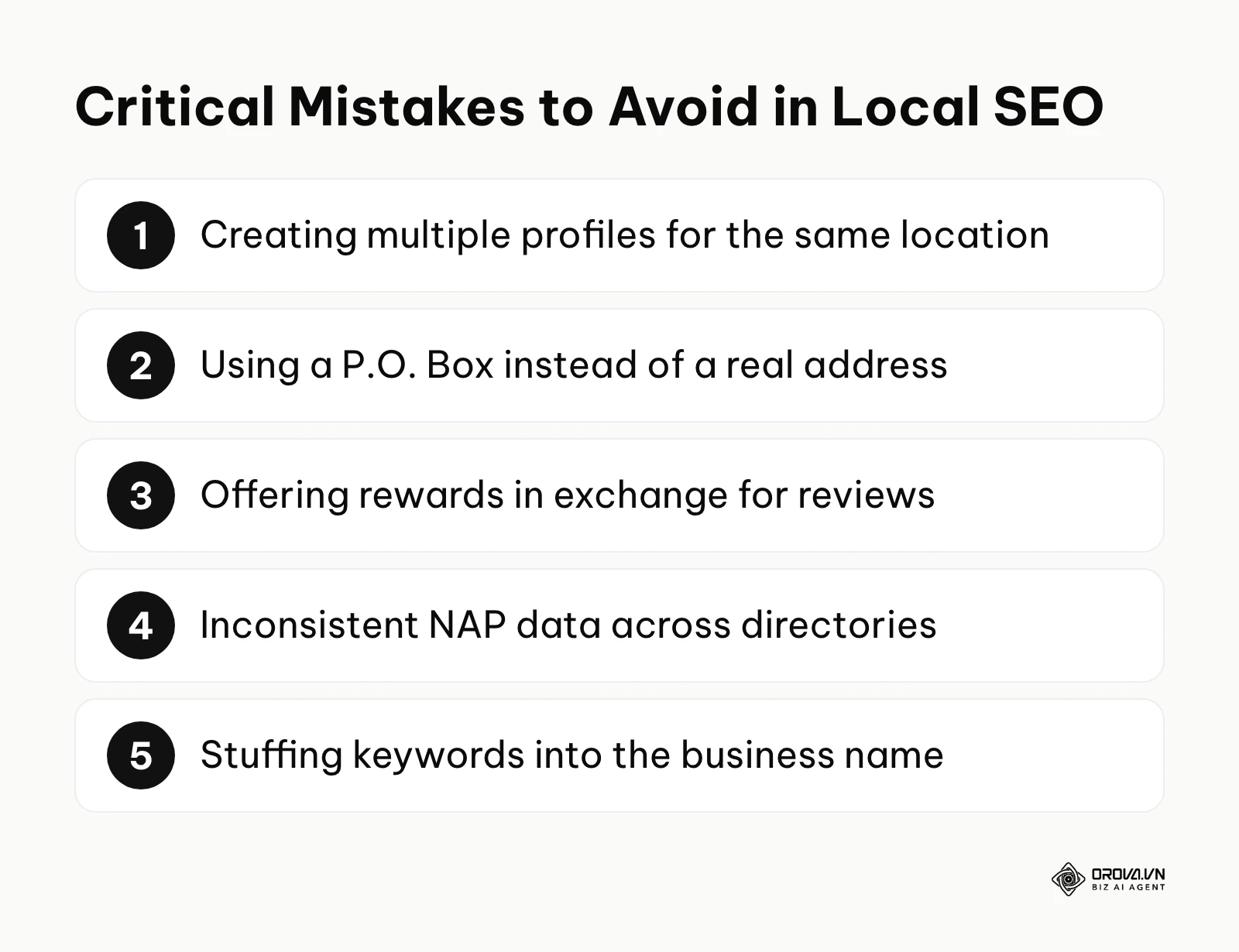
Use your real-world business name exactly as it appears on your signage. Stuffing extra keywords or city names into the name field (for example "Joe's Pizza Best Pizza Downtown") breaks Google's guidelines and can get the profile suspended; put those words in your categories, description, and website instead.
The Video Verification Masterclass
In recent years, Google has tightened verification to prevent spam listings, and video recording is now one of the most common verification methods offered. Many business owners fail this step because they do not prepare adequately.
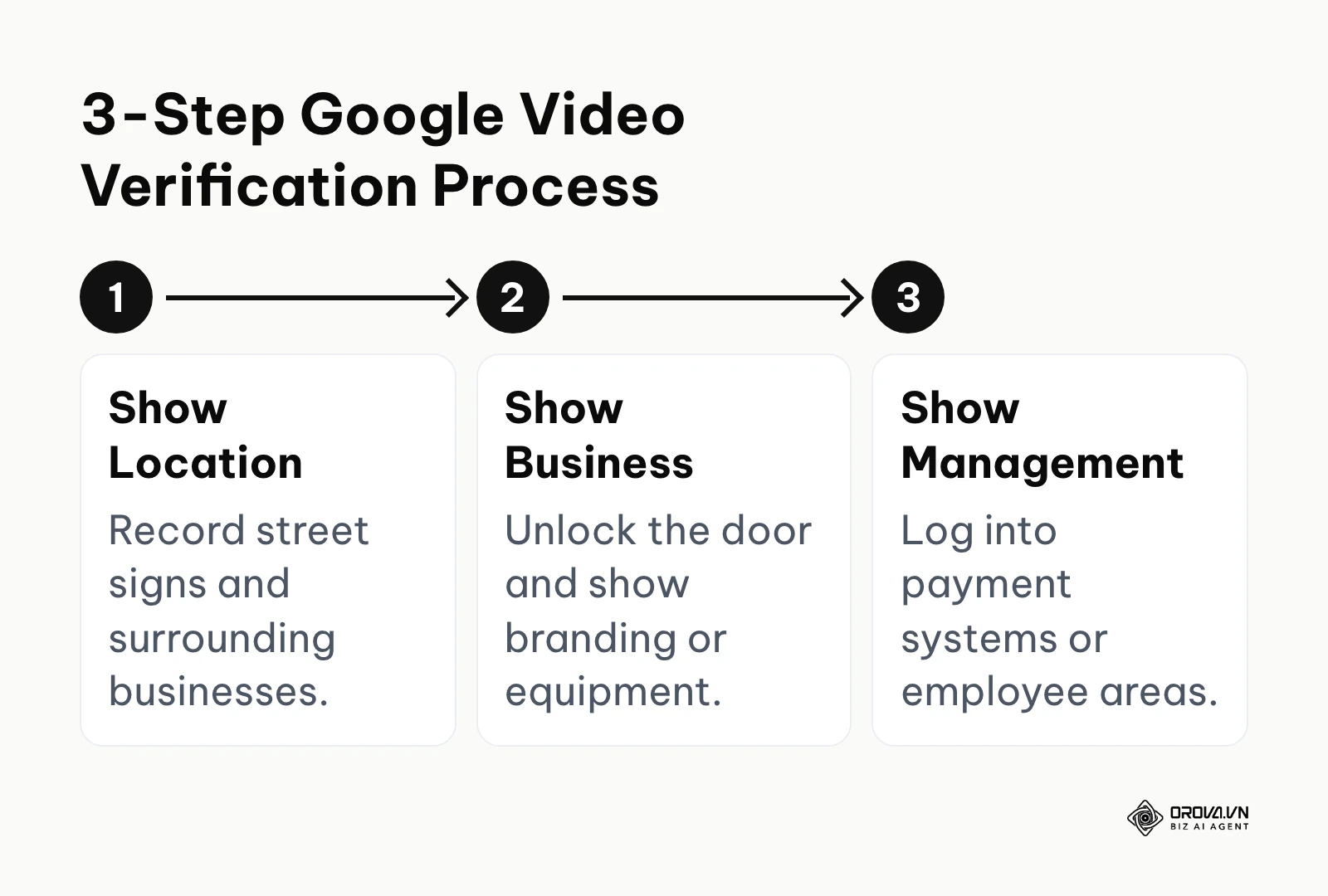
The Verification Script Framework:
- The Approach: Begin outside. Record the street signs at your intersection. Slowly pan to your building's exterior, ensuring your permanent, branded business sign is clearly visible.
- The Entry: Walk to your front door and physically demonstrate unlocking it with a key. This proves to the reviewer that you have authorized access to the premises, not just a passerby.
- The Operations: Walk inside and show the operational tools of your trade. If you are a restaurant, show the kitchen equipment. If you are an office, show the branded desks and the business license hanging on the wall.
- The Management: Finally, walk behind the counter and demonstrate management access. Log into your Point of Sale (POS) system, open a branded software dashboard, or unlock the cash register.
Google asks for one continuous, unedited recording. Check the exact requirements shown in your verification screen before you start, because they can change.
Local SEO for Service-Area Businesses (SABs)
Not every business has a storefront that welcomes customers. Plumbers, mobile detailers, and home cleaners travel to the client. Google refers to these as Service-Area Businesses (SABs). If you are an SAB, displaying your residential address is a violation of Google's guidelines and a privacy risk.
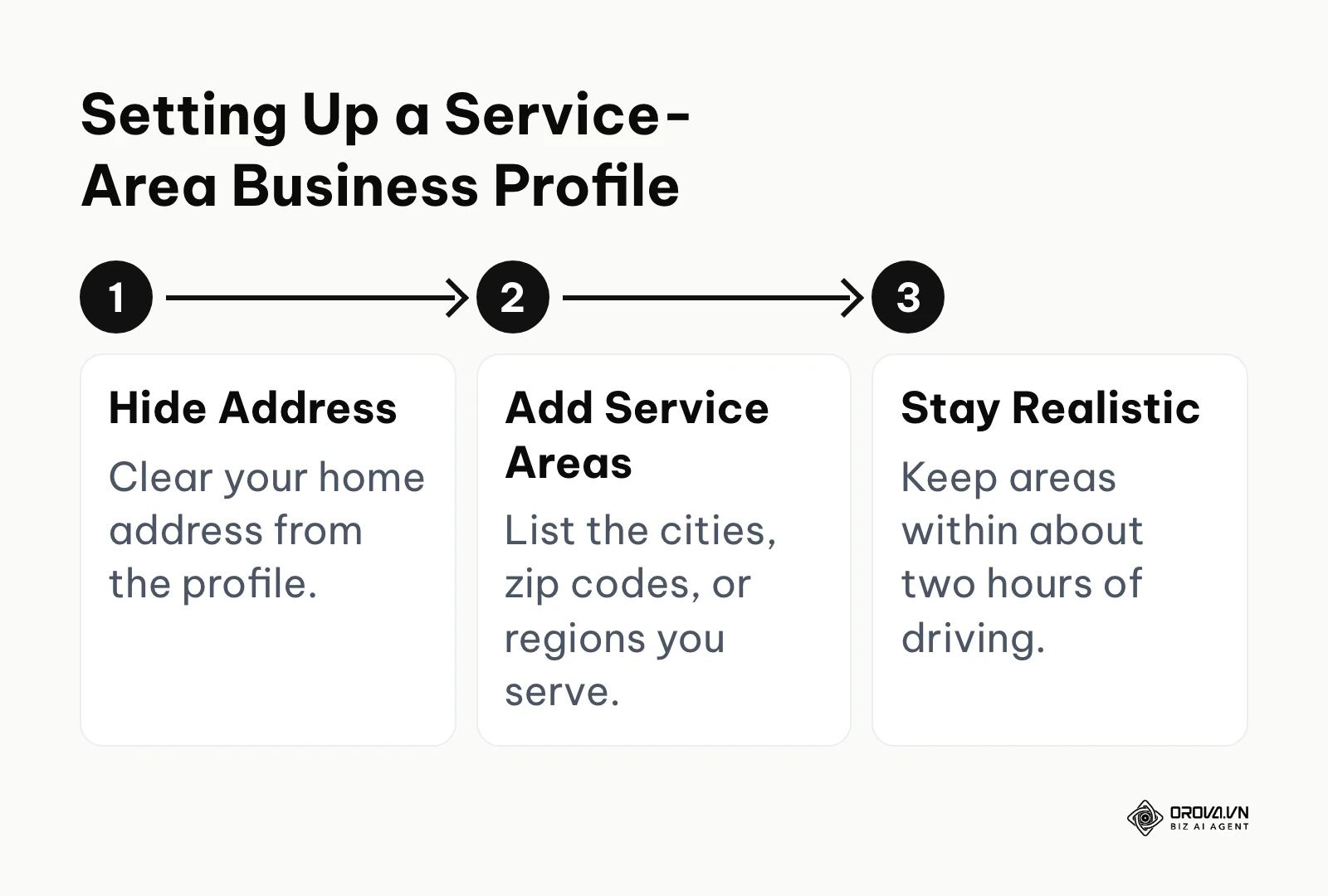
To set this up correctly, you must clear your physical address in the GBP dashboard. Instead, you select the option indicating you make deliveries or home visits, and then input the specific zip codes, cities, or regions you serve. Be warned: Google's guidelines say your service area should generally not extend farther than about two hours of driving time from where your business is based. Going well beyond that can get the profile flagged or suspended.
Example scenario:
- Context: A mobile car detailing service operating out of the owner's home wanted to rank in three specific wealthy suburbs without displaying their residential address to the public.
- Steps taken: The owner registered a Google Business Profile, selected "Yes" to providing home visits, and left the physical address completely blank. They then defined their exact service area by listing the zip codes of the target suburbs.
- Stumble and fix: They mistakenly added a city well outside a two-hour drive, and the profile was suspended. They fixed this by removing the distant city to comply strictly with guidelines and submitting a reinstatement request alongside their official business registration documents.
- Result: The profile was reinstated quickly, the home address remained completely hidden, and the business began appearing in the local map pack whenever residents in the targeted zip codes searched for mobile car detailing.
Managing and Scaling Customer Reviews
Reviews are the lifeblood of local prominence. A steady stream of genuine, positive reviews signals to both Google and potential customers that your business is active and trusted. However, hoping customers will leave reviews organically is not a strategy. You must ask for them systematically.
Ask every customer the same way, whether you expect a glowing review or not. Here are three fill-in-the-blank templates you can use immediately:
Template 1: The Direct Text Message (For quick services like plumbing or repairs) "Hi [Customer Name], thanks for choosing [Business Name] for your [Service Provided] today! It would mean the world if you took 30 seconds to share an honest Google review here: [Link]. Thanks, [Your Name]!"
Template 2: The Follow-Up Email (For high-consideration services like clinics) "Dear [Customer Name], It was great seeing you on [Date]. We hope you are doing well! We constantly strive to provide the best care possible. Would you mind sharing your experience with our team on Google? Click here: [Link]. Your feedback helps our small business grow!"
Template 3: The In-Store Script (For restaurants and retail) "Hi [Customer Name], we hope you loved the [Specific Dish]! We're a local family business and reviews help us keep the lights on. If you have a moment, scan this code on the receipt and tell us honestly how we did."
What not to do: never buy reviews, write them yourself, ask staff or relatives to post them, or offer discounts, freebies, or gifts in exchange for a review (especially a 5-star one). Google's policies ban these practices, and they can lead to removed reviews, a warning on your profile, or a suspension. The legitimate path is slower but safe: ask every customer, make it easy with a short link or QR code, and reply to every review.
Defending Your Reputation: Handling Fake and Negative Reviews
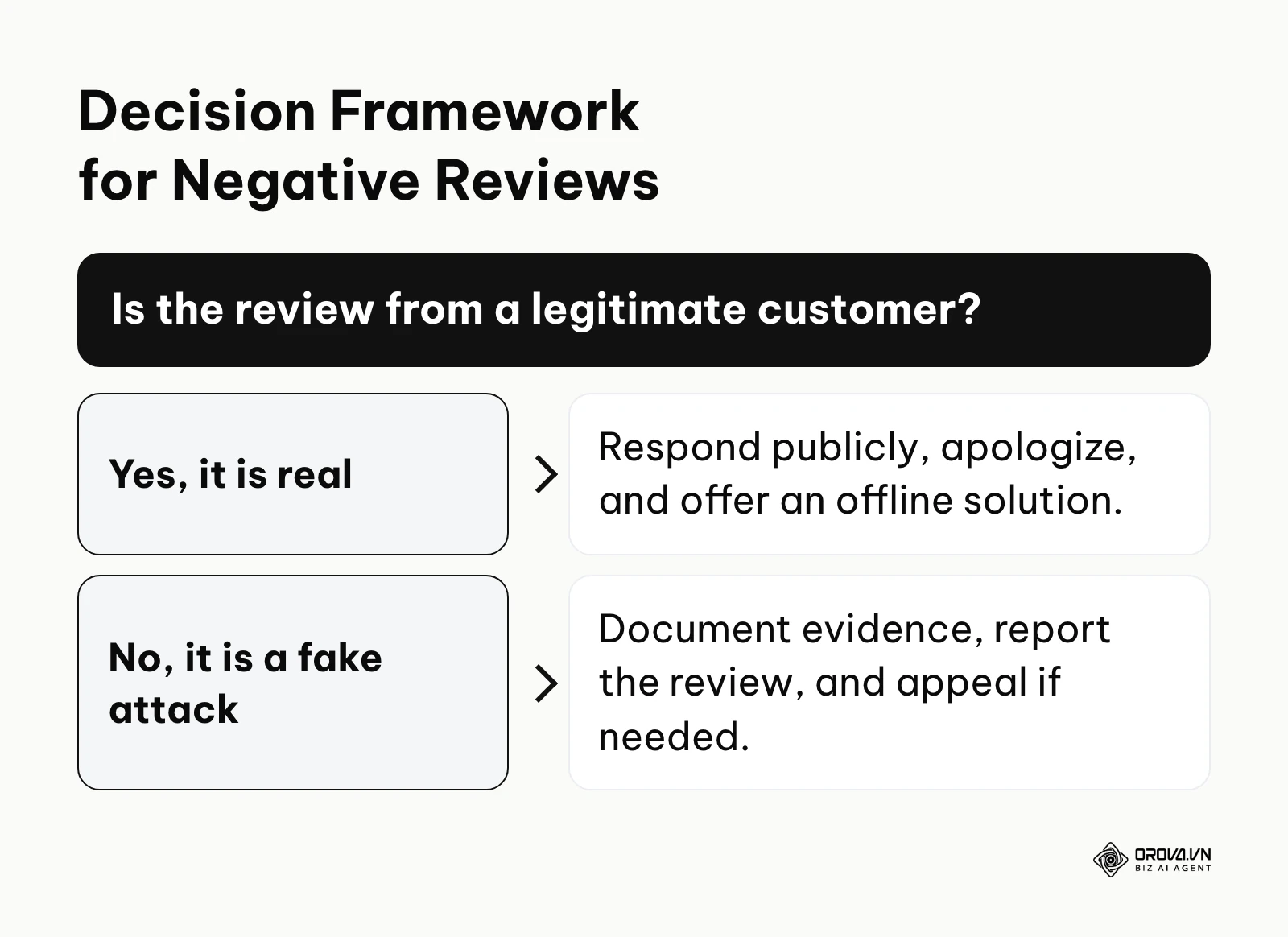
As your visibility grows, so does the risk of unfair or malicious reviews from competitors or bots. Knowing how to handle these crises is essential for brand survival.
Example scenario:
- Context: A highly-rated local dental clinic suddenly received ten 1-star reviews in two days from anonymous accounts, dropping their rating from 4.8 to 3.9.
- Steps taken: The clinic manager documented the timeline of the reviews, cross-referenced the reviewer names against their patient database, and reported each review as policy-violating from their Business Profile. They also replied professionally stating they had no record of these individuals as patients.
- Stumble and fix: Google's automated system initially rejected the flags. The manager fixed this by submitting an appeal through Google's review management tool, with a clear timeline showing the attack pattern and the lack of patient records.
- Result: After review, Google removed the fake reviews, the clinic's rating recovered, and new patient calls returned to normal levels.
Vertical-Specific Case Studies
Different industries require slightly different local optimizations.
| Niche | Primary Focus | Key Action |
|---|---|---|
| Dentists & Clinics | Trust and Authority (YMYL) | Build practitioner-specific profiles and link to detailed service pages. |
| Restaurants | Visuals and Menus | Upload high-quality food photography regularly and keep the menu and reservation link up to date. |
| Home Services | Speed and Trust | Optimize for emergency keywords and keep service hours and service areas accurate. |
Building Local Citations and NAP Consistency
A citation is any online mention of the name, address, and phone number (NAP) of a local business. Inconsistent NAP data is one of the most common problems holding established businesses back in local results.
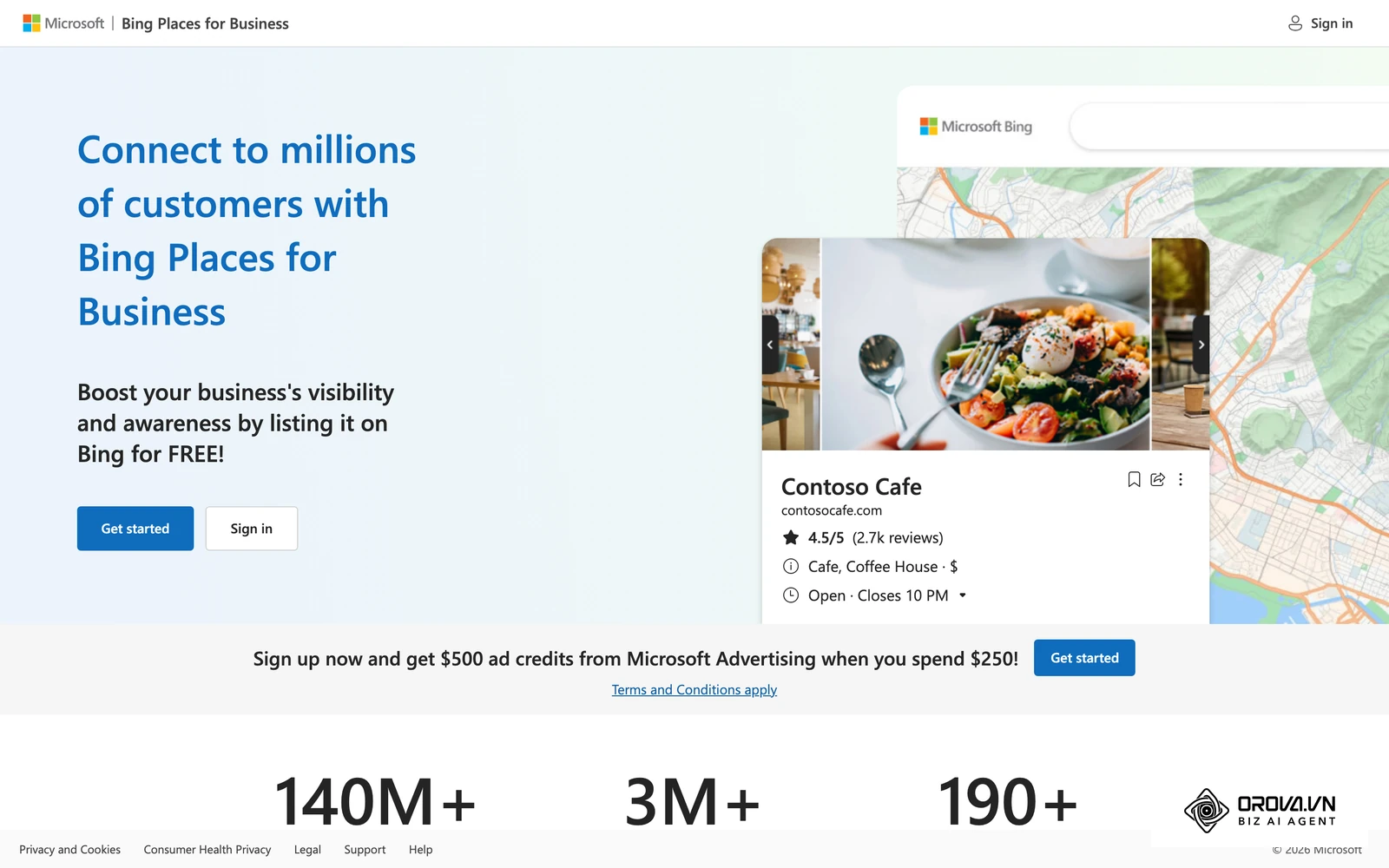
The ecosystem relies on primary data aggregators (such as Data Axle and Foursquare). These massive databases feed information to hundreds of smaller tier-2 directories. If you have an old phone number listed on a primary aggregator, it will propagate across the web like a virus, confusing Google's entity resolution algorithm. You must run a comprehensive audit, claim your listings on major platforms like Yelp, Apple Maps, and Bing Places, and ensure the formatting of your NAP is identical across the board.
On-Page Optimization for Local Intent
Your website must corroborate the data on your map listing. You must utilize robust keyword research to uncover the exact hyper-local terms your community is searching for. If you serve multiple cities, do not just list them in the footer. Create dedicated "City Pages." A proper city page embeds a unique Google Map of the area, lists specific local projects completed in that city, and features local customer testimonials.
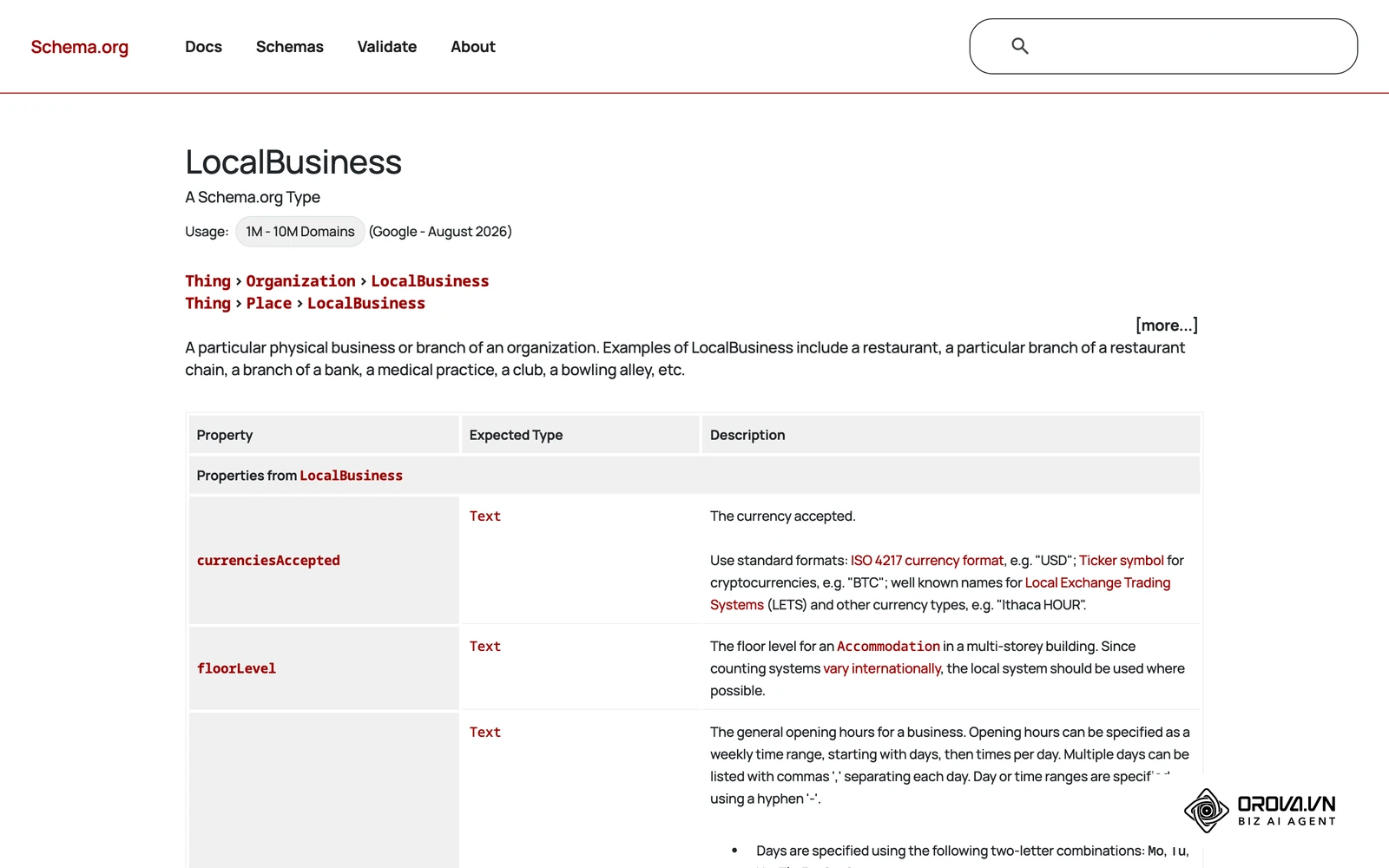
Furthermore, implementing LocalBusiness Schema markup—a specific type of JSON-LD code placed in the header of your site—directly communicates your business hours, coordinates, and contact info to Google's crawlers without relying on them to parse visible text.
What You Need to Do to Adapt and Get Started
Execution is the only thing that separates a visible business from an invisible one. Depending on your role, your approach to local optimization will vary.
The Small Business Owner
If you are managing the business yourself, you need a streamlined, actionable plan that cuts through the technical jargon. Consider this your definitive local strategy template.
| Day/Week | Task | Description |
|---|---|---|
| Week 1 | The Foundation | Claim your Google Business Profile, verify it via video, and fill out 100% of the core information (hours, categories, description). |
| Week 2 | Citation Cleanup | Audit your top 20 directory listings (Yelp, Apple Maps, Facebook). Ensure your Name, Address, and Phone number are identical. |
| Week 3 | The Review Engine | Implement a systematic way to ask for reviews. Print a QR code for your counter and set up text message templates for post-service follow-ups. |
| Week 4 | On-Page Basics | Update your website's homepage title tag and H1 to include your primary service and city name (e.g., "Emergency Plumber in Austin"). |
Example scenario:
- Context: A local Italian restaurant owner wanted to increase Tuesday night foot traffic but was overwhelmed by technical marketing jargon and lacked a formal strategy.
- Steps taken: The owner committed to a simplified local strategy. They claimed their Google Business Profile, started asking dine-in customers to scan a QR code for a review, and added their neighborhood name to their website's homepage title tag.
- Stumble and fix: Initially, customers ignored the QR code printed on the receipt. The owner fixed this by having the waitstaff hand every table a small QR code card with the bill, personally explaining how much an honest review helps.
- Result: The restaurant collected a steady flow of new reviews within a month and moved up in the local map pack, which led to a visibly full dining room on typically slow Tuesday nights.
The In-House Marketer
If you are an internal marketing manager, your job is to scale the foundational work into a predictable lead generation engine.
- Implement UTM Tracking: Add UTM parameters to your GBP website link to track exactly how much traffic and revenue comes from the map pack in Google Analytics.
- Publish Local Content: Build a resilient local content plan by writing blog posts about local events, community sponsorships, or hyper-local case studies to build geographic relevance.
- Answer Customer Questions: Answer questions customers ask through your profile and reviews promptly, and publish a clear FAQ page on your website. Profile features change often, so work with whatever your dashboard currently offers.
- Publish Regular Updates: Use the posts (updates) feature in your Business Profile to share offers, events, and new products, which shows customers that the business is active.
The Agency or Freelancer
Agencies must leverage dedicated SEO tools to manage citations across hundreds of client locations simultaneously without losing quality.
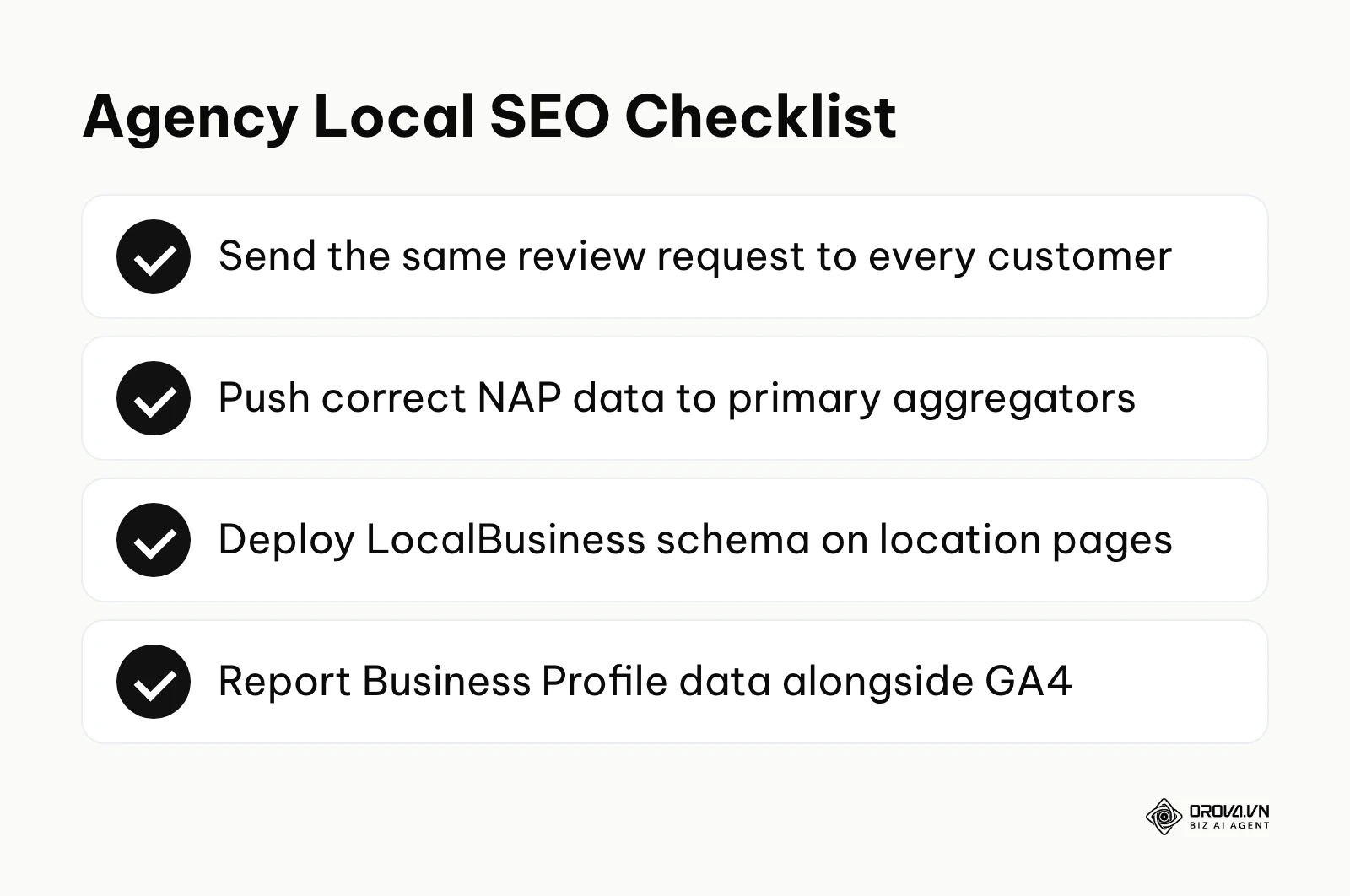
- Consistent Review Requests: Automate review requests so every customer gets the same invitation. Do not filter out unhappy customers before they reach Google (so-called review gating), because Google's policies forbid it.
- Aggregator Submission: Use API connections to push correct NAP data directly to primary data aggregators, bypassing manual entry.
- Schema Deployment: Deploy dynamic LocalBusiness schema across all client location pages using Google Tag Manager.
- Advanced Reporting: Build dashboards that combine Business Profile performance data with GA4 data to show clients the real return. Pair this with a regular technical review, as in this SEO audit case study.
With OROVA.VN and the OROVA SEO module, you put an end to the exhausting days of manual work for good. Instead of struggling for hours to write articles and compile reports, the entire process is now optimized and completed in just 5 minutes.
Where local SEO is heading in the next few years: the author's take
As we look ahead, the local search ecosystem is undergoing a massive transformation. Based on the shifts I can see today, I foresee three trends that will redefine how local businesses connect with their communities.
AI-Driven Conversational Local Discovery
We are currently seeing a rapid rise in users asking complex, conversational questions to AI assistants rather than typing fragmented keywords into search bars. I believe that within the next two to three years, local search will shift heavily towards these conversational engines answering complex situational queries. Users will ask, "Where can I find a gluten-free Italian restaurant open right now that has outdoor seating?" You need to prepare for this now by ensuring your website content answers highly specific, long-tail questions rather than just listing basic services. However, this prediction could be wrong if users revert to traditional map interfaces out of habit and find conversational interfaces too slow.
The Dominance of Visual and Video Verification
Currently, Google is aggressively pushing for live video verifications to combat spam in local results. I expect this to evolve into an environment where user-generated video reviews become the primary trust signals for ranking. My read is that search engines may start to favor businesses with recent, customer-made video, leaving text-only profiles a step behind. You should start encouraging your most loyal customers to upload short video reviews. Of course, this trend might fail to materialize if bandwidth costs or platform storage limits force search engines to deprecate heavy video hosting for small listings.
Hyper-Personalized Local Results
Today, search results are already heavily influenced by the user's immediate physical location. I lean towards the prediction that future map packs will be hyper-personalized based on the searcher's personal history, dietary preferences, and previous travel patterns. Two people standing on the same street corner will see completely different local recommendations based on their past behavior. To prepare, you must build robust customer loyalty programs, as search algorithms will heavily favor businesses the user has interacted with previously. Note that this prediction could be entirely invalidated if strict global privacy regulations are enacted, restricting the collection of personal location history.
Frequently Asked Questions About Local SEO
Are local SEO efforts still necessary when AI search engines provide direct answers?
Yes. AI assistants often draw on the same sources as maps and search, such as business profiles, directories, reviews, and your own website. If that information is missing or inconsistent, the AI has little reason to recommend you. Optimizing for traditional maps is simultaneously optimizing for AI retrieval.
How can I rank in neighboring cities where I don't have a physical address?
You need to create dedicated, highly localized "city pages" on your website for each target area. Additionally, optimizing a Service-Area Business profile can help, though Google's algorithm will always strictly favor businesses with actual physical proximity to the searcher.
What should I do if my local rankings drop completely after a Google core update?
First, do not panic and make drastic changes. Audit your profile to ensure you have not suffered a technical suspension. Often, a temporary drop is due to an algorithm recalibrating proximity weights. Focus on generating real reviews and ensuring your NAP data remains perfectly consistent.
Does responding to reviews actually impact local search rankings?
It helps. Google's own tips for improving local ranking recommend replying to reviews, because it shows customers you value their feedback and encourages more people to leave reviews, which supports prominence over time.
How many citations do I really need to build?
Quality matters far more than quantity. Focus on the major platforms (such as Yelp, Bing Places, Apple Maps) and the directories that matter in your industry and city, rather than spamming thousands of low-quality listings.
Where Should You Start?
This final phase is tailored based on where your business currently stands. Local optimization is not a one-size-fits-all race; your first move depends entirely on your existing foundation.
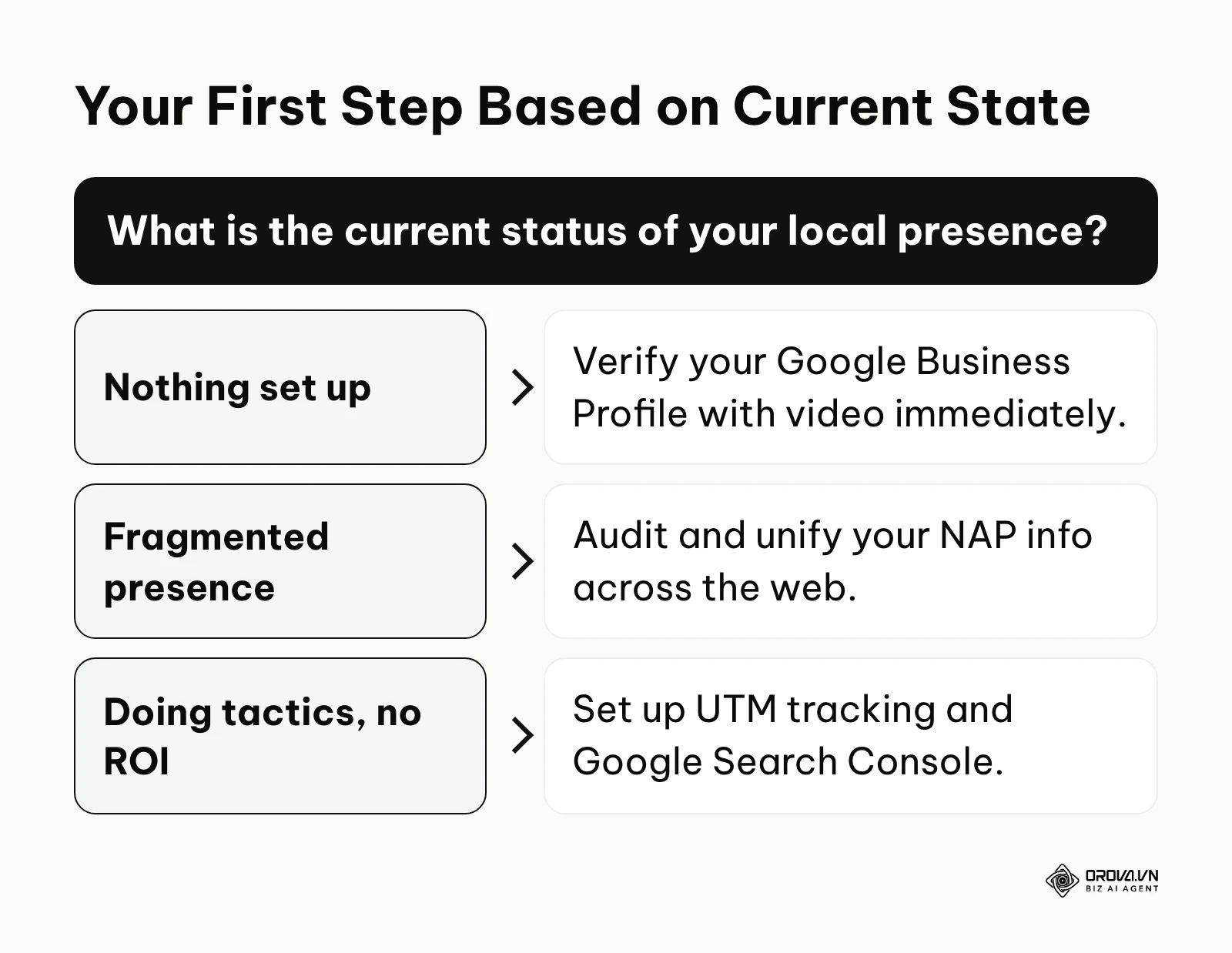
If You Have Absolutely Nothing Set Up
If you have never registered your business online, your immediate and only focus should be claiming your Google Business Profile. Do not worry about your website or social media yet. Spend a dedicated afternoon gathering your legal business documents, setting up a Google account, and completing the video verification process. This single action provides the highest immediate return and establishes your base entity in the search graph.
If You Have Basic Profiles but They Are Fragmented
If your business is listed on a few platforms but the information is inconsistent, your first step is a comprehensive NAP cleanup. Dedicate a session to listing every directory you are on, standardizing your Name, Address, and Phone number format, and manually updating the top three aggregators. Inconsistent data is one of the most common reasons established businesses struggle to rank, so fixing it comes first.
If You Are Implementing Tactics but Not Measuring ROI
If you are already getting reviews and publishing local content, but have no idea what is working, your next step is establishing a reliable data infrastructure. You must immediately implement UTM tracking codes on your primary website link within the Google Business Profile dashboard. By doing this in a single afternoon, you will finally be able to see exactly how many map clicks translate into actual revenue, bringing clarity to your entire local SEO campaign.
About the author

Builder of Orova
Nguyễn Đỗ Trọng Ân has 8 years of experience in marketing, including 6 years managing market development across Asia. He builds Orova, a Biz AI Agent that never sleeps: it plans, runs and optimizes work for businesses.
Run your business with AI Agents
Orova is the always-on Biz AI Agent — it plans, runs, and optimizes the work for you.
Save time, unlock productivity.