
AI resume screening tools: a 2026 buyer's guide to choosing well

Imagine staring at a dashboard displaying 800 unread applications for a single mid-level engineering role. If a recruiter spends just 90 seconds reviewing each document, that equates to 20 solid hours of manual reading—time completely drained from actual candidate engagement, strategic planning, or interviewing. This operational bottleneck is precisely why talent acquisition leaders are desperately seeking solutions, but the landscape is notoriously difficult to navigate. The market is flooded with platforms slapping "machine learning" labels on outdated technology.
If you are evaluating ai resume screening tools, relying on generic software lists or vendor marketing materials will almost certainly lead to costly procurement mistakes. The real challenge isn't finding a tool that can read text; it's finding a system that integrates flawlessly with your existing infrastructure, actively mitigates legal risks, and understands the nuanced context of human careers. This guide provides a rigorous, technical blueprint to help you dissect the market, evaluate core capabilities, and select a platform that delivers measurable ROI without exposing your organization to compliance disasters.
AI resume screening tools: Beyond basic keyword matching
Fundamentally, AI resume screening software is a category of HR technology designed to automatically ingest, parse, evaluate, and rank candidate profiles against the specific requirements of a job description. However, treating this category as a monolith is a critical error. To make an informed purchasing decision, HR leaders must understand the distinct technological generations that define the current market.
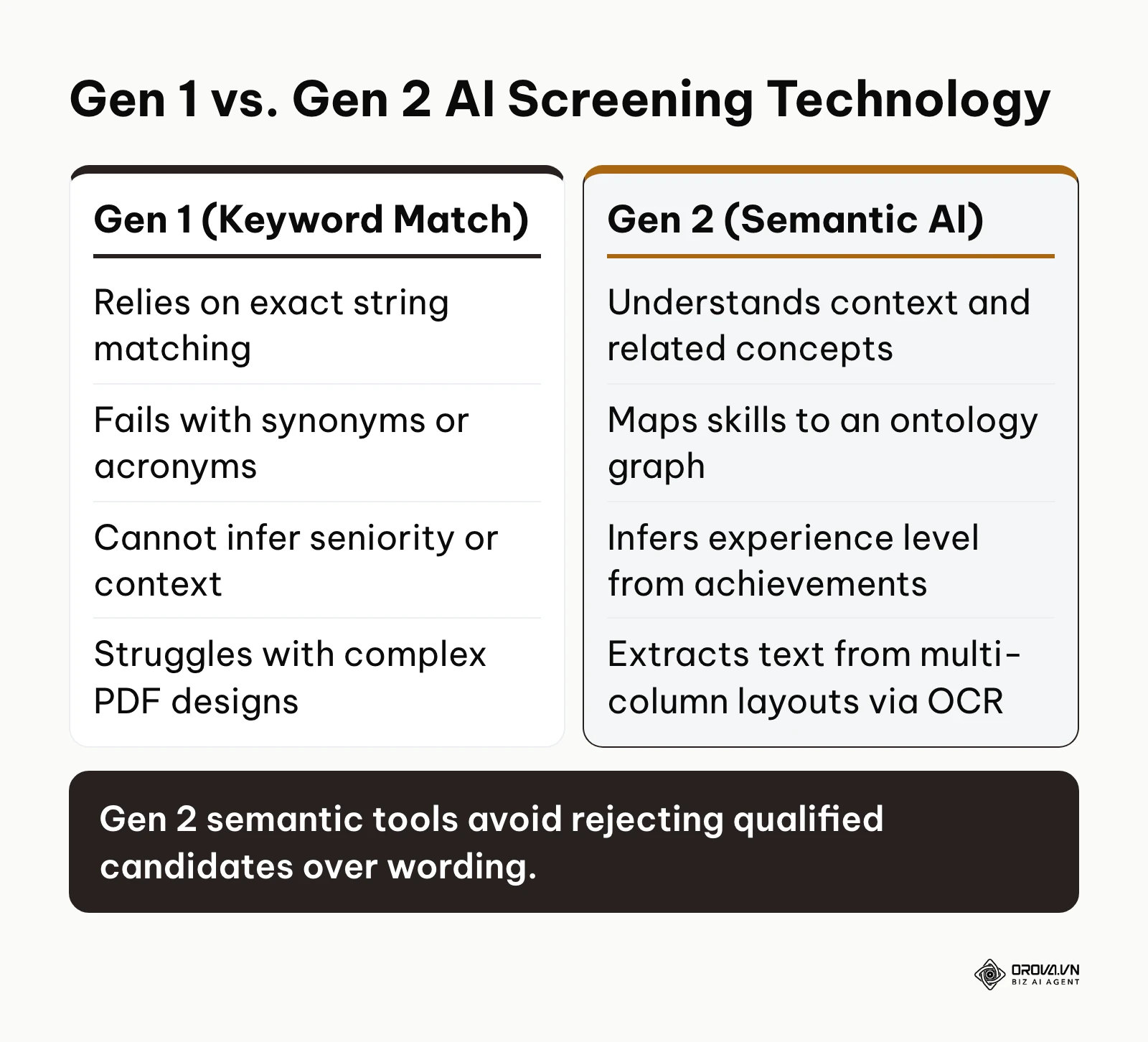
Historically, human resources relied heavily on first-generation (Gen 1) parsers. These systems were essentially glorified search engines operating on rigid, rules-based algorithms and basic Optical Character Recognition (OCR). They scanned documents for exact keyword matches. If your job description asked for a "Software Engineer" and the candidate listed "Full-Stack Developer," a Gen 1 tool would likely assign a low score or reject the candidate entirely, completely blind to the contextual synonymity of the roles. This reliance on exact matches creates an incredibly high false-negative rate, discarding highly qualified talent simply because they didn't stuff their document with the precise jargon expected by the machine. It is essentially applying basic, rigid logic similar to early optimization tactics, rather than true intelligence.
In contrast, second-generation (Gen 2) platforms leverage contextual and semantic AI, powered by Natural Language Processing (NLP) and Large Language Models (LLMs). These tools don't just read words; they analyze relationships. They map skills, experiences, and achievements to a vast, dynamic ontological graph of human capabilities. A Gen 2 system understands that a candidate who managed a "multi-million cross-border migration project" possesses leadership, budget management, and technical architecture skills, even if those exact words never appear in the text. Furthermore, advanced AI can parse highly complex, multi-column graphical resumes that would shatter traditional OCR engines. Choosing the right tool requires prioritizing this deep semantic inference over surface-level matching. If you want the mechanics of how a resume parser turns a file into structured fields, that is covered separately; this guide stays focused on comparing and choosing tools.
The 2026 vendor comparison matrix
To navigate the crowded market, you must categorize platforms based on their primary architectural focus and target use case. The following matrix summarizes several well-known solutions, categorizing them by their core functional identity rather than generic marketing claims. Note that evaluating these systems requires a clear understanding of your organizational size and existing technical stack.
| Tool Name | Core Category | Primary Job / Core Strength | ATS Integration Capability | Ideal Target User |
|---|---|---|---|---|
| Eightfold AI | Talent Intelligence Platform | Deep semantic matching across massive talent networks. | Enterprise-grade (Bi-directional APIs) | Global enterprises with massive historical databases. |
| Paradox | Conversational AI | High-volume screening through chat and text-message interfaces. | Native ATS connectors | Retail, hospitality, and high-volume frontline hiring. |
| HireVue | Multi-modal Assessment | Combining text screening with video/audio analysis. | Broad ecosystem of native apps | Mid-market to enterprise seeking holistic assessment. |
| SeekOut | Outbound Sourcing & Analytics | Discovering passive candidates and analyzing talent pools. | Strong API for data pushing | Executive search and highly specialized technical recruiting. |
| Fetcher | Automated Sourcing | Automating the top-of-funnel outreach and initial filtering. | Standard webhook support | Fast-growing startups lacking dedicated sourcers. |
| Beamery | Talent Lifecycle Management | Nurturing leads and managing the entire candidate journey. | Enterprise CRM integration | Companies treating recruitment like advanced marketing. |
| Orova Recruit | End-to-End Suite | Unified workflow from JD creation to interview scoring. | Standalone workspace | SMBs and mid-market teams needing an all-in-one hub. |
This matrix serves as a foundational map. However, simply knowing the names is insufficient; you must drill down into how these distinct technological approaches operate in practice to determine which aligns with your operational realities.
Deep dive into tool categories and core technologies
The most effective way to evaluate these tools is to examine them through the lens of the specific problems they solve. A tool designed for high-volume retail hiring will fail catastrophically if deployed to screen senior machine learning architects. Let's break down the primary categories.
Group 1: Keyword-matching automation and high-volume parsing (Gen 1)
While the industry is shifting toward semantic AI, Gen 1 keyword-matching automation still dominates the high-volume, frontline hiring space. These systems are designed for scenarios where velocity and binary qualifications (e.g., "Has a valid CDL license," "Available for night shifts") are more critical than nuanced skill inference. They operate via strict Boolean logic and regex (regular expressions).
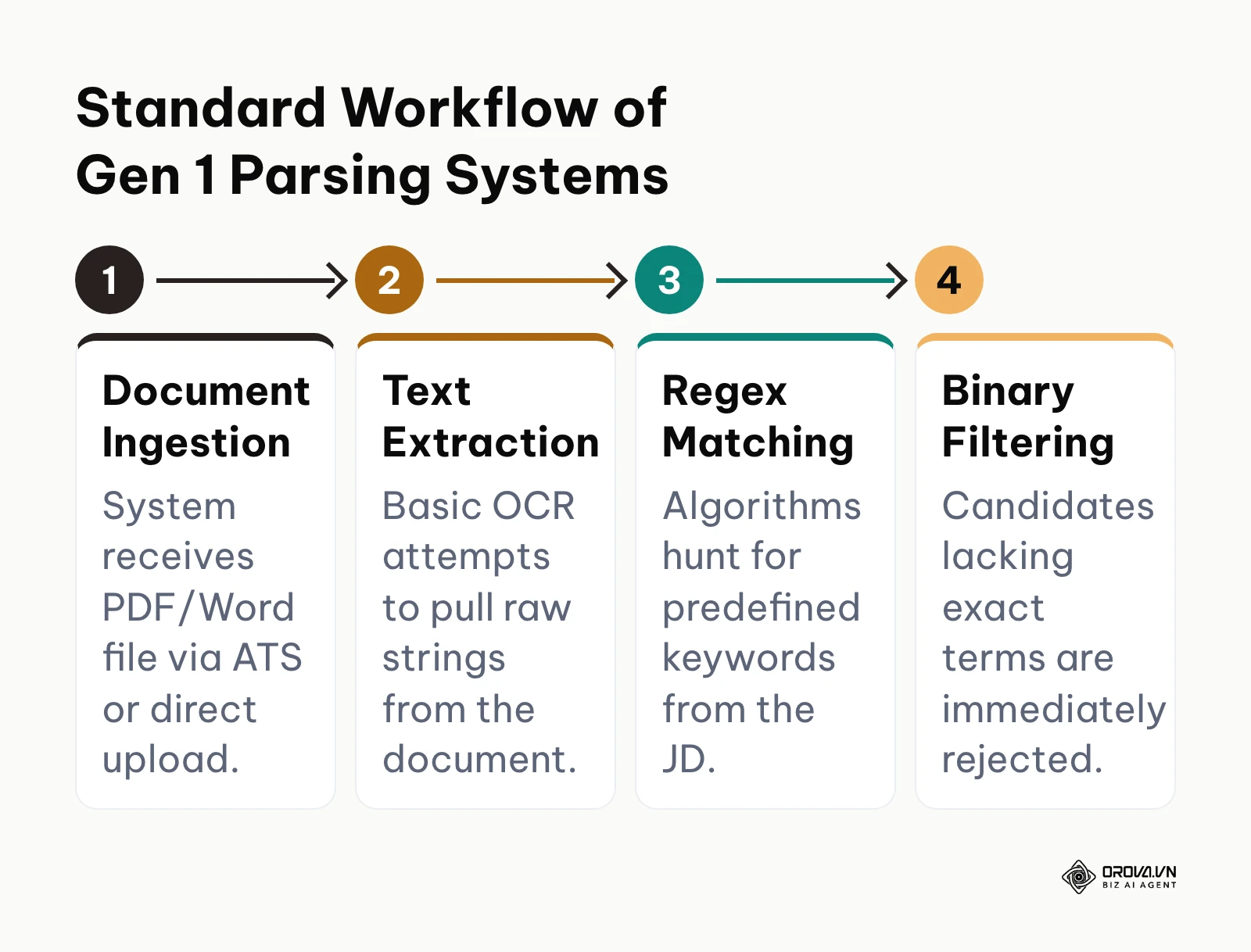
How it works: The system extracts raw text from incoming files. It then scans this text against a rigid checklist defined by the recruiter. If the document contains the required strings, it passes the gate; if not, it is automatically sorted into a rejected pile. Core Value: Extreme processing speed. When hiring 500 warehouse workers for a holiday rush, human review is impossible. These tools act as a brutal but efficient initial filter. Ideal User: Retail, logistics, and call centers dealing with thousands of highly standardized applications per week. How to get started:
- Standardize your intake format (force candidates to use plain-text forms rather than uploading complex PDFs).
- Build an exhaustive, rigorous dictionary of accepted keywords and their exact variations.
- Set hard Boolean filters (Yes/No criteria) for deal-breaker qualifications.
Illustrative example: Context: A regional logistics manager at a mid-sized delivery firm needed to hire 150 seasonal drivers within two weeks. They were receiving over 2,000 applications via a generic web form. Steps taken: The manager deployed a Gen 1 parsing tool. They configured the system to instantly reject any application lacking the exact phrases "Class A CDL" and "clean driving record," while auto-advancing the rest to a scheduling queue. Stumbling block & Fix: Initially, the tool rejected 40% of valid candidates because they wrote "Commercial Driver's License" instead of the acronym "CDL." The manager had to urgently halt the automation, manually review the rejected pile, and rewrite the system's regex rules to include a massive dictionary of standard variations and long-tail phrasing. Results: After refining the rules, the system processed the remaining 1,200 applications in under an hour, isolating 300 viable candidates and allowing the team to meet the two-week hiring deadline.
Group 2: Contextual and Semantic AI for technical hiring (Gen 2)
When hiring for roles requiring complex, abstract skills—such as software engineering, product management, or strategic design—keyword matching fails. Gen 2 systems utilize semantic AI to understand the relationships between concepts.
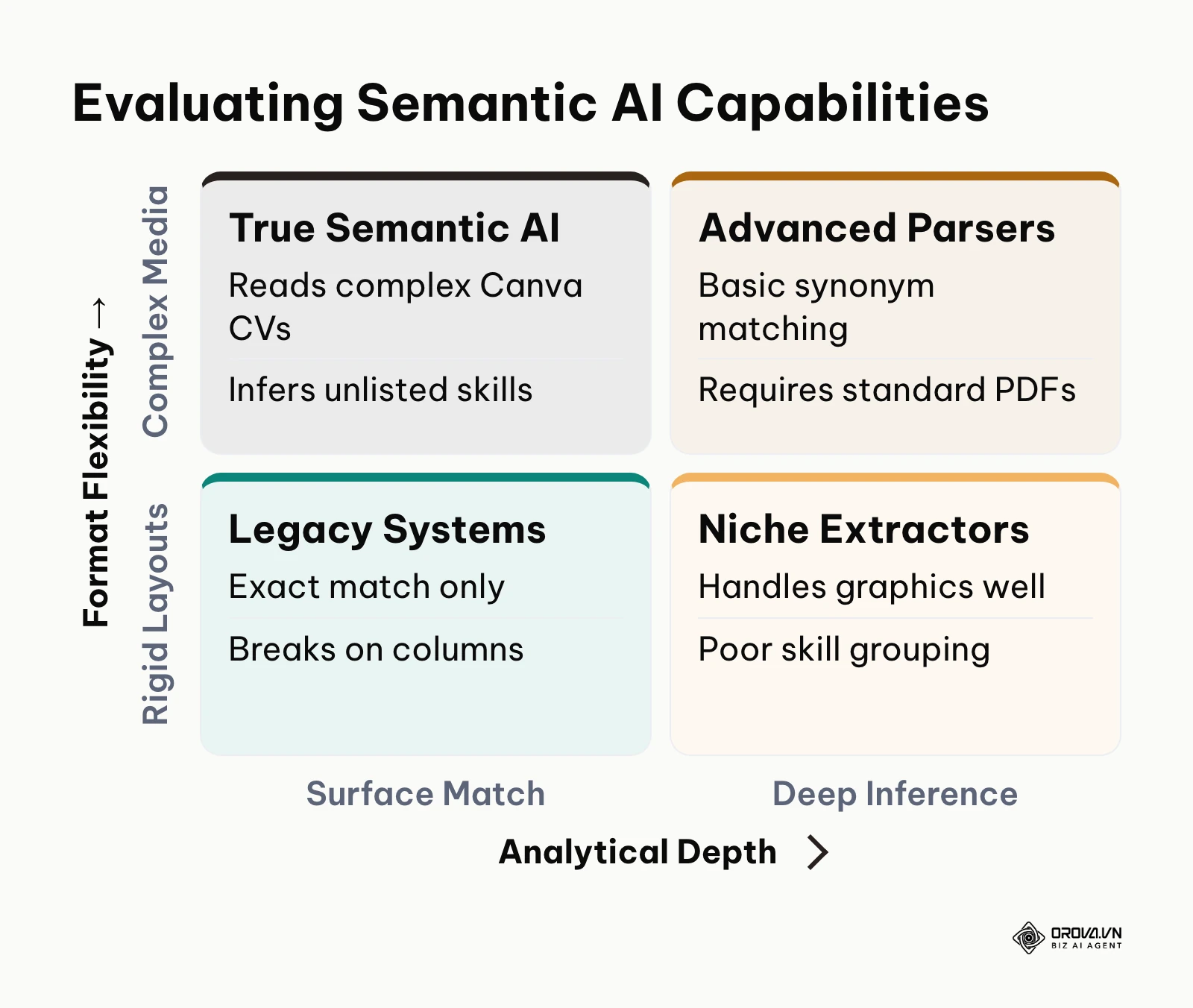
How it works: These platforms process the document using NLP to extract entities (skills, companies, degrees). Crucially, they map these entities against an ontological database. The AI understands that a candidate proficient in "TensorFlow" and "PyTorch" is likely a Machine Learning Engineer, even if that specific title isn't prominent. Furthermore, advanced OCR within these systems can deconstruct complex, multi-column PDFs (often used by designers or marketers) by analyzing the spatial relationship of text blocks, rather than just reading left-to-right. Core Value: Drastically reducing false negatives and uncovering "hidden gem" candidates who possess the right skills but lack standard formatting or traditional job titles. Ideal User: Tech companies, engineering firms, and any organization hiring for specialized, knowledge-worker roles. How to get started:
- Connect the tool to your ATS and allow it to ingest your historical successful hire data to calibrate its baseline understanding of your industry.
- Define the outcomes needed for the role, rather than just a list of required software proficiencies.
- Run a shadow test: Have the AI rank a batch of 100 historical resumes and compare its top 10 against your actual human hires.
Illustrative example: Context: The Head of Talent at a Series B fintech startup was struggling to find Lead Data Scientists. The manual screening process was rejecting candidates who had non-traditional backgrounds but exceptional project portfolios. Steps taken: They implemented a semantic AI screening platform. Instead of searching for "Python" and "SQL," they configured the tool to look for contextual evidence of "managing large-scale data migrations" and "deploying predictive models to production." Stumbling block & Fix: The AI initially over-indexed on academic researchers who had heavy theoretical backgrounds but lacked commercial deployment experience. The team had to recalibrate the model's weighting, instructing it to prioritize evidence of commercial impact (e.g., mentioning revenue, user scale, or specific cloud infrastructure deployments). Results: The recalibrated system surfaced three candidates from the "rejected" pile of their ATS who had non-standard job titles but exactly the required commercial deployment experience. Two of those candidates advanced to the final interview stage.
Group 3: Diversity, Equity, and Compliance-first platforms
The deployment of algorithmic screening has triggered massive regulatory scrutiny. Tools in this category prioritize mitigating algorithmic bias and ensuring strict adherence to employment laws over aggressive automation features.
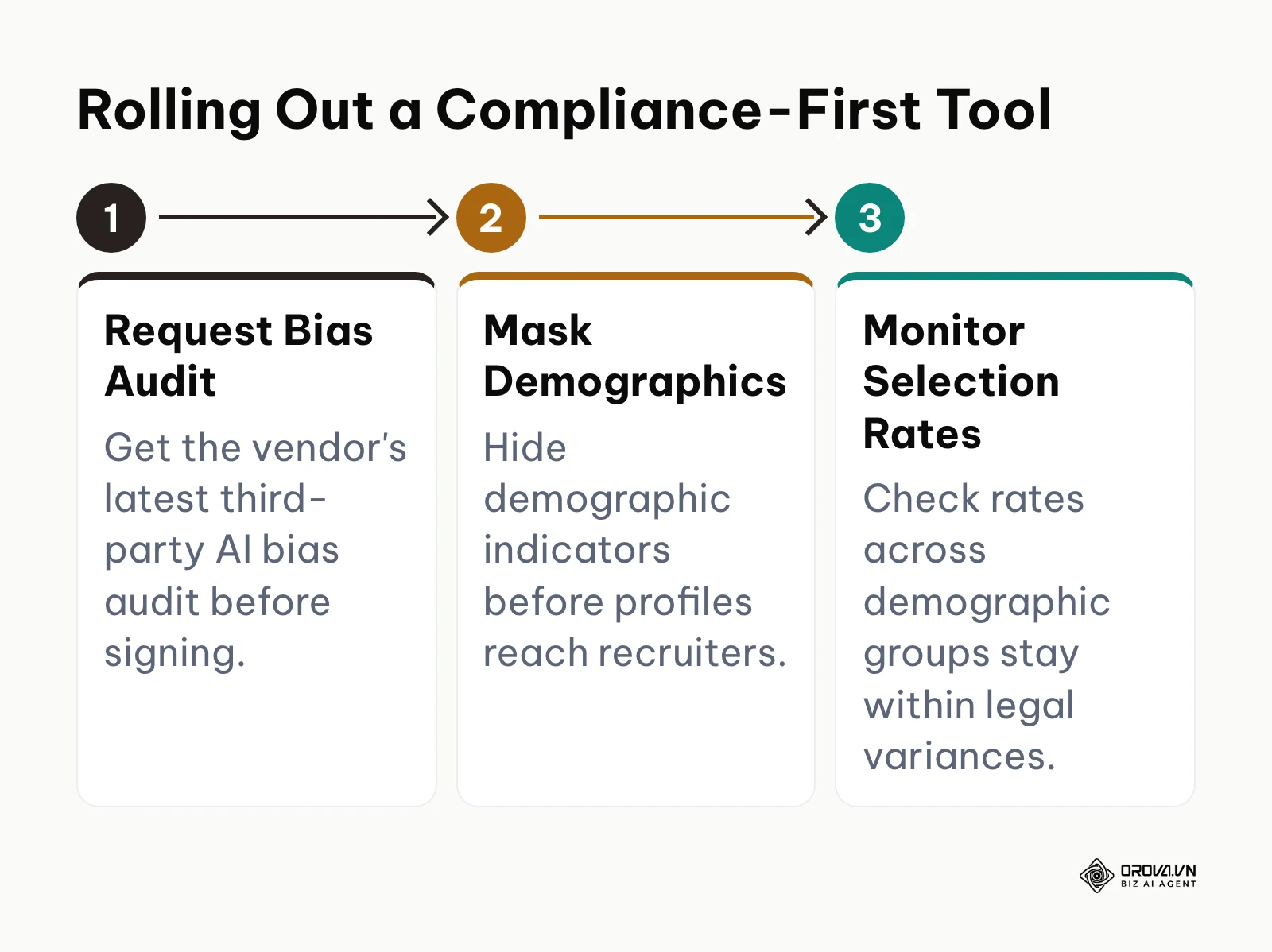
How it works: These platforms are built with "explainability" at their core. When they score a candidate, they generate a transparent audit trail detailing exactly which data points influenced the decision. More importantly, they employ techniques like "demographic blinding," actively stripping names, addresses, graduation dates, and affiliated organizations from the text before the core matching algorithm evaluates the skills. They undergo regular, independent third-party bias audits. Core Value: Risk mitigation. They allow organizations to leverage AI efficiency without running afoul of anti-discrimination laws or inadvertently amplifying historical biases. Ideal User: Government contractors, highly regulated financial institutions, and enterprise organizations operating in jurisdictions with strict AI laws (like New York City). How to get started:
- Request the vendor's most recent third-party AI Bias Audit report before signing a contract.
- Configure the system to execute aggressive data masking (hiding demographic indicators) before presenting profiles to human recruiters.
- Establish a continuous monitoring protocol to ensure the AI's selection rates across different demographic groups remain within acceptable legal variances.
Illustrative example: Context: A large healthcare provider was transitioning to automated screening but was terrified of violating EEOC guidelines, given their history of prioritizing diverse hiring initiatives. Steps taken: They adopted a compliance-first screening platform. They enabled full demographic blinding and mandated that the system provide a "score rationale" for every candidate advanced to the interview stage. Stumbling block & Fix: During the initial test phase, the HR team realized the AI was still subtly penalizing candidates who had resume gaps, disproportionately affecting women returning from maternity leave. They worked directly with the vendor's data science team to manually adjust the algorithm to ignore employment gaps entirely when calculating the technical proficiency score. Results: Following the adjustment, the platform successfully processed 4,000 applications for nursing positions while keeping advancement rates across demographic groups within the range their legal team had set, securing compliance approval from their legal department.
Group 4: End-to-end AI recruitment suites
Fragmenting your recruitment process across multiple point solutions (one tool for screening, another for scheduling, another for interviewing) creates massive data silos and exhausts your recruiters. End-to-end suites consolidate these functions into a single, intelligent workflow, treating candidate screening not as an isolated step, but as part of a continuous loop.
How it works: These platforms manage the entire lifecycle. They don't just read documents; they act on them. A true suite integrates the evaluation logic directly into subsequent actions. For example, if the system identifies a gap in a candidate's technical experience during the screening phase, it automatically queues a specific technical question for the interview phase. Core Value: Massive reduction in context-switching for recruiters, centralized data governance, and a seamless, unified experience for the applicant. Ideal User: Mid-market companies and SMBs that lack the IT resources to manage complex, custom API integrations between a dozen different software vendors. How to get started:
- Map your entire recruitment workflow on a whiteboard, identifying every point where data is currently manually copied from one system to another.
- Migrate your job descriptions and evaluation rubrics into the central platform.
- Train your hiring managers on using the centralized dashboard rather than relying on disparate email threads and spreadsheets.
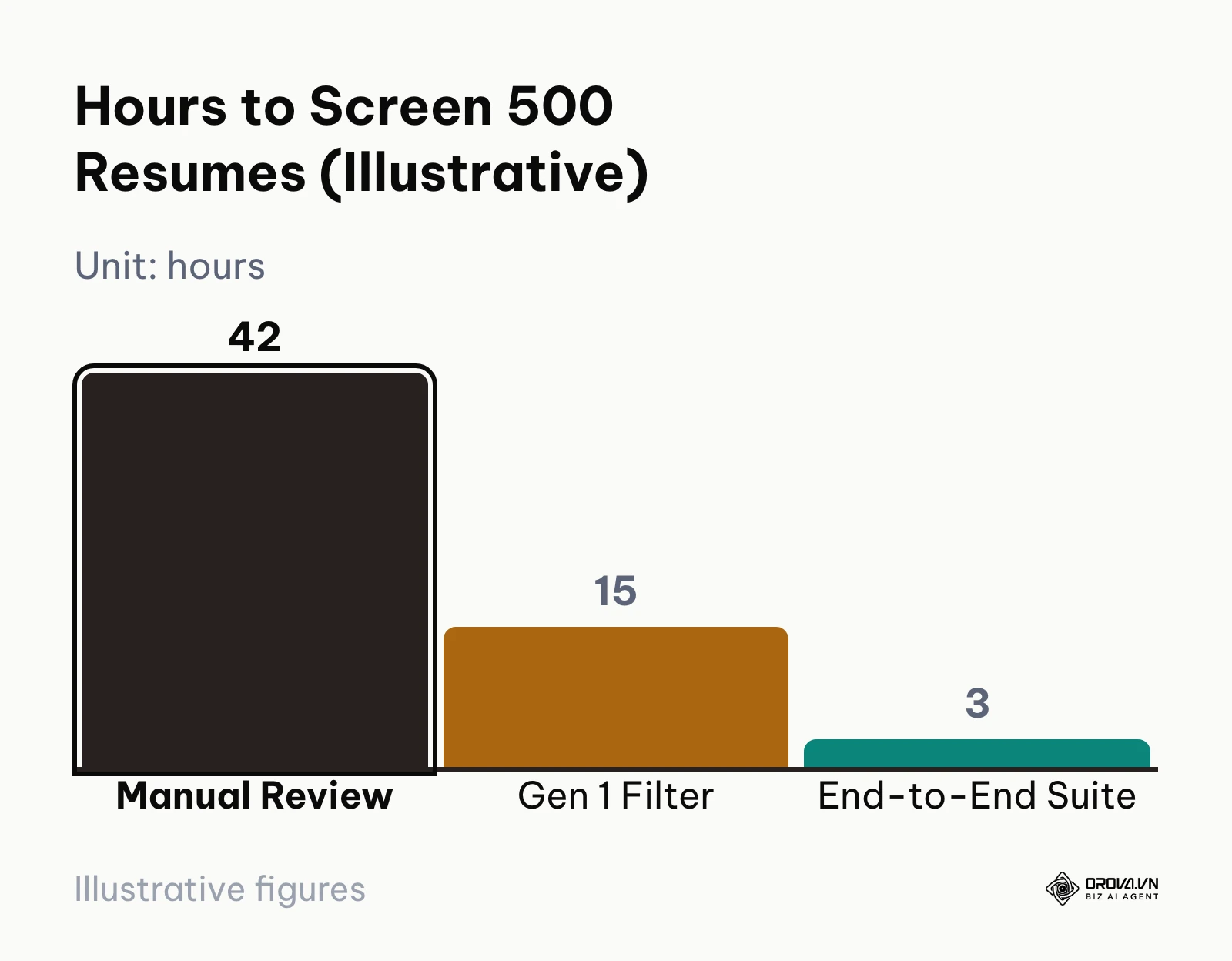
Illustrative example: if a team needs around 42 hours to review 500 resumes manually, a Gen 1 keyword filter might bring the human review time down to about 15 hours, and a unified suite that carries the screening results straight into interview preparation to around 3 hours. These figures are only for illustration; the real numbers depend on the role, the quality of your criteria, and how much of the output your recruiters still double-check.
Struggling to read hundreds of applications by hand? Orova Recruit lets you write JDs, set clear criteria for each position, and score up to 500 CVs per position against them, with exact quotes from each CV shown as evidence for the score. Word, PDF and scanned files are supported. Stop skimming and start talking to the right candidates.
The buyer's blueprint: ATS integration, ROI, and compliance
Selecting the technology is only the first phase. The implementation graveyard is full of advanced AI tools that failed because buyers ignored the operational realities of integration, financial justification, and legal risk. You must treat the procurement process as a strategic architecture decision, not a simple software subscription.
The minimum AI toolset by company size
Before evaluating specific features, baseline your requirements against your organizational scale. Over-buying technology results in bloated budgets, while under-buying leads to systemic failure under pressure.
| Company Scale | Essential Capability | Tool Focus | Why this matters |
|---|---|---|---|
| Small (1-50 employees) | Unified workflow | End-to-end suites | You lack the IT resources to stitch together multiple point solutions; you need a single hub. |
| Mid-Market (51-500) | Semantic matching | Gen 2 / Contextual AI | You are competing for specialized talent against larger firms and cannot afford false negatives. |
| Enterprise (500+) | Data orchestration & Bias control | Compliance-first platforms | Your primary risks are legal exposure and managing massive, fragmented historical databases across global regions. |
| Staffing Agencies | Speed & Sourcing aggregation | Predictive sourcing tools | Your business model relies on velocity and aggregating talent from disparate external networks rapidly. |
Trap 1: Ignoring ATS integration capabilities and data silos
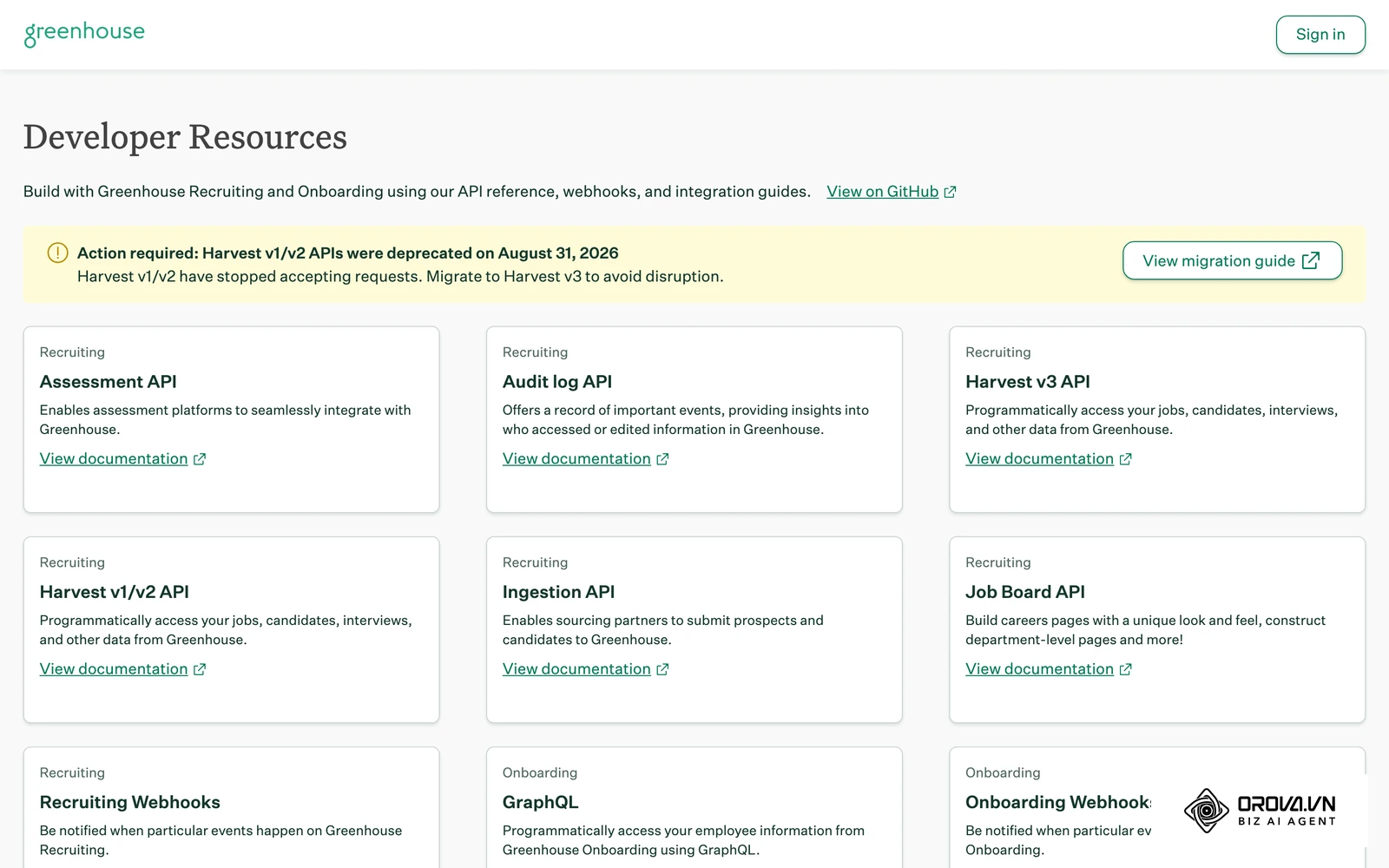
One of the most common reasons AI screening deployments fail is a lack of deep integration with the organization's existing Applicant Tracking System (ATS). If a recruiter has to log into Workday or Greenhouse, export a CSV file of applicants, log into a separate AI tool, upload the file, wait for the processing, export the results, and manually update the candidate statuses back in the ATS—the automation has failed. You have merely shifted the manual labor from reading to data entry.
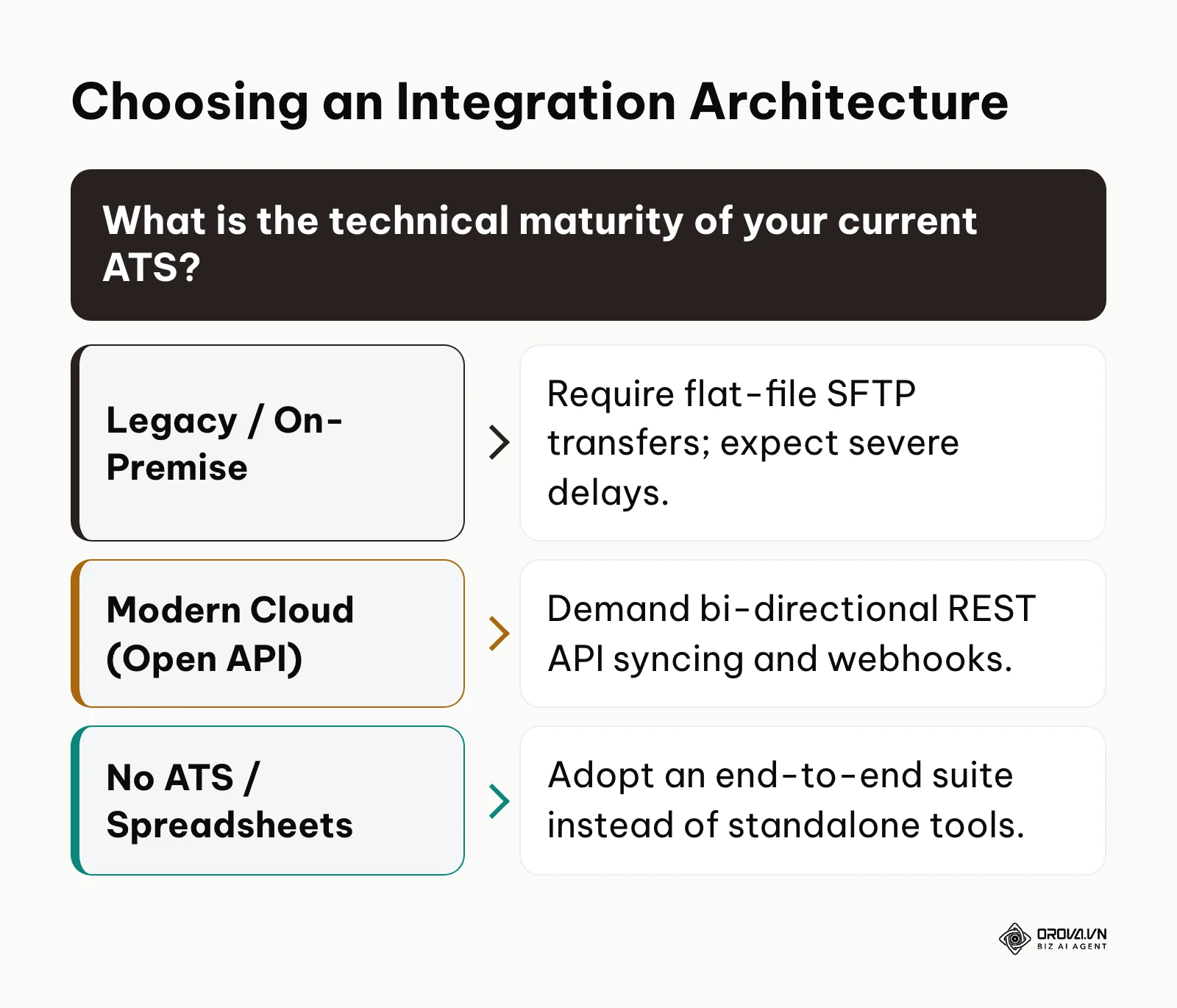
A true native integration requires bi-directional data syncing via robust REST APIs or webhooks. When a candidate applies, the payload should immediately trigger the AI tool. The tool processes the unstructured data, structures it, generates a score, and pushes that score, along with qualitative notes, directly into custom fields within the ATS. The recruiter should ideally never leave their primary ATS dashboard. When evaluating vendors, demand technical documentation proving they can natively write data back to your specific ATS version, not just read from it. If you are still deciding which system should be your system of record in the first place, work through an ATS vs HRIS decision framework before you shortlist any screening vendor.
Trap 2: Buying without a calculated ROI (and hidden costs)
Do not accept a vendor's generic "time saved" calculator at face value. A rigorous ROI calculation must account for the significant hidden costs of deployment. The financial justification must include the software licensing, the IT man-hours required for API integration, and the productivity dip during the training period.
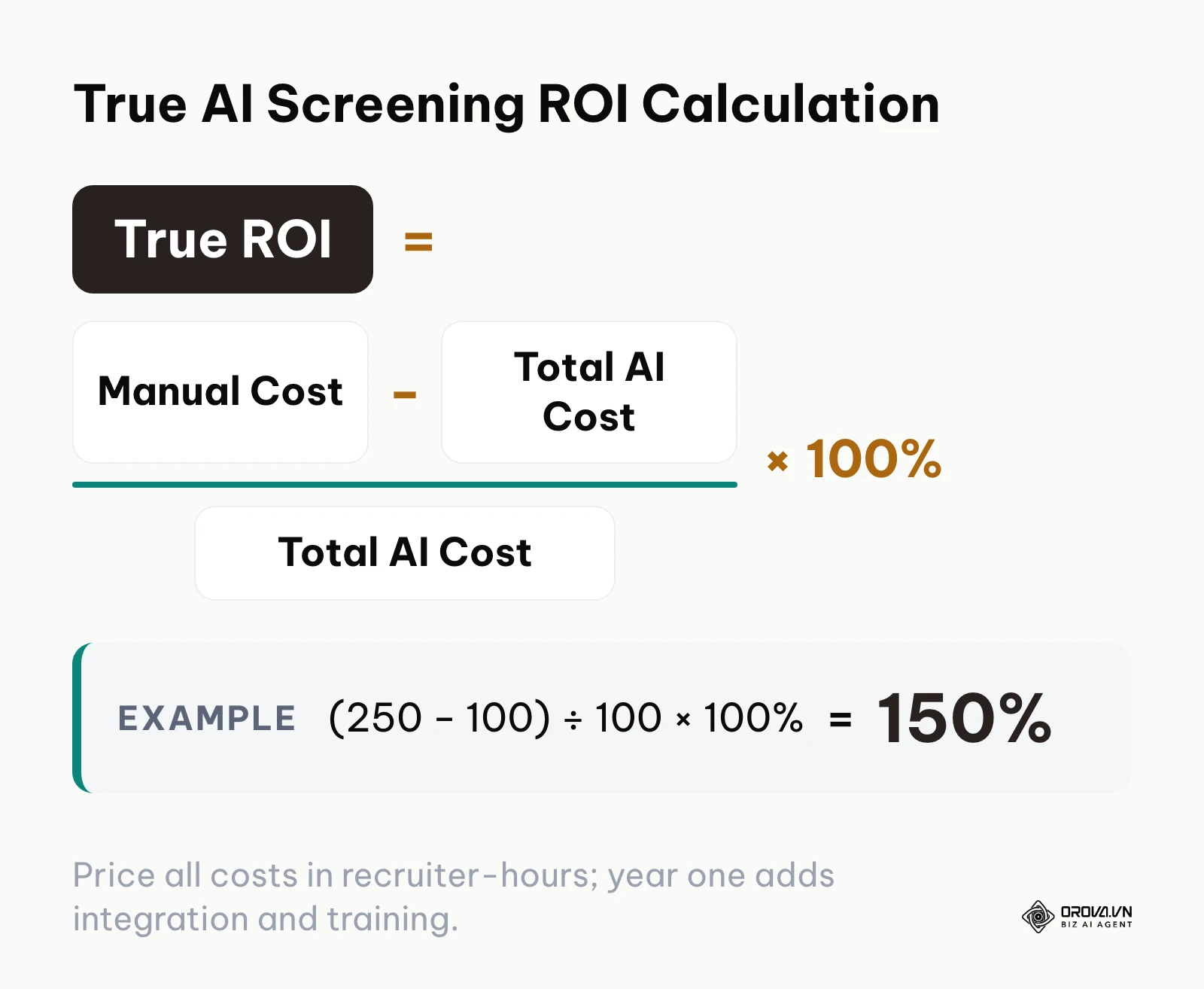
To calculate the True ROI, you must first accurately baseline your manual costs, and it helps to price everything in one unit, such as recruiter-hour equivalents. If your team reviews 5,000 resumes a year at 3 minutes each, that is 250 recruiter hours. If the software licence, the IT consulting needed to integrate with your legacy HRIS, and the training hours together cost the equivalent of 250 hours in year one, your year-one ROI is zero. In year two the integration and training costs largely fall away; if the licence alone is worth about 100 hours, the formula becomes (250 − 100) ÷ 100 × 100% = 150%. The value usually compounds after the first year, but presenting a flawed, overly optimistic calculation to your CFO will destroy the project's credibility. Always model the costs comprehensively.
Trap 3: Overlooking legal compliance, GDPR, and algorithmic bias
Using AI to make employment decisions is no longer an unregulated frontier. In the United States, Title VII of the Civil Rights Act applies to selection procedures whether a human or an algorithm runs them, and the U.S. Equal Employment Opportunity Commission (EEOC) made that point in 2023 technical assistance on adverse impact in AI-based selection tools. The employer remains responsible for the outcome. You cannot blame the vendor if the AI discriminates.
Furthermore, jurisdictions are passing specific laws. As outlined by the New York City Department of Consumer and Worker Protection (DCWP) in the 2023 'Notice of Adoption of Final Rules Relating to Automated Employment Decision Tools (Local Law 144)', companies using these tools must conduct an independent bias audit annually and publish the summary of results. If an AI tool is trained on your historical hiring data, and your company historically favored candidates from specific universities or demographics, the AI will learn and scale that bias. You must demand transparency regarding how the model is trained and how it weights data, and check how candidate data is stored and transferred under GDPR if you handle European applicants.
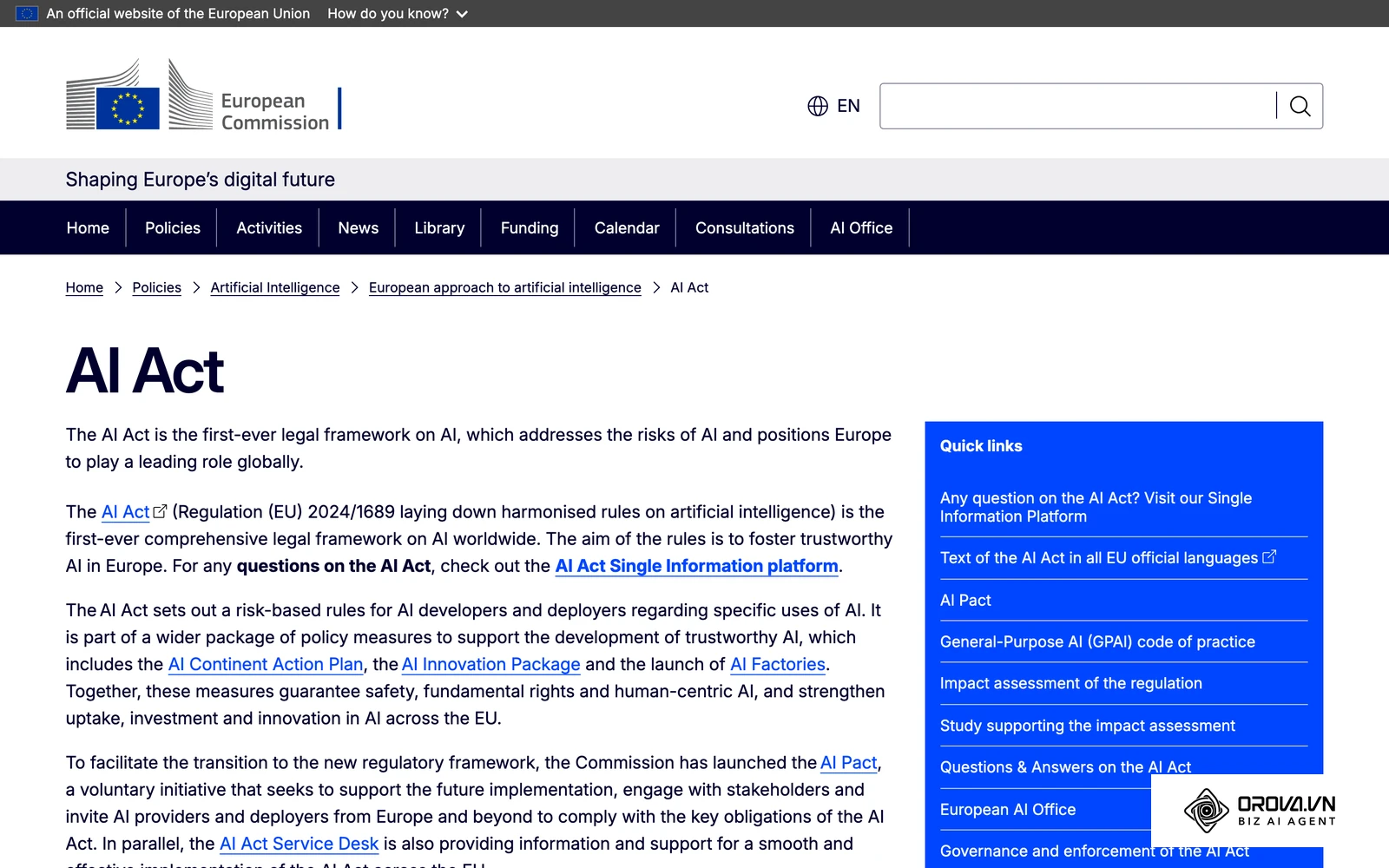
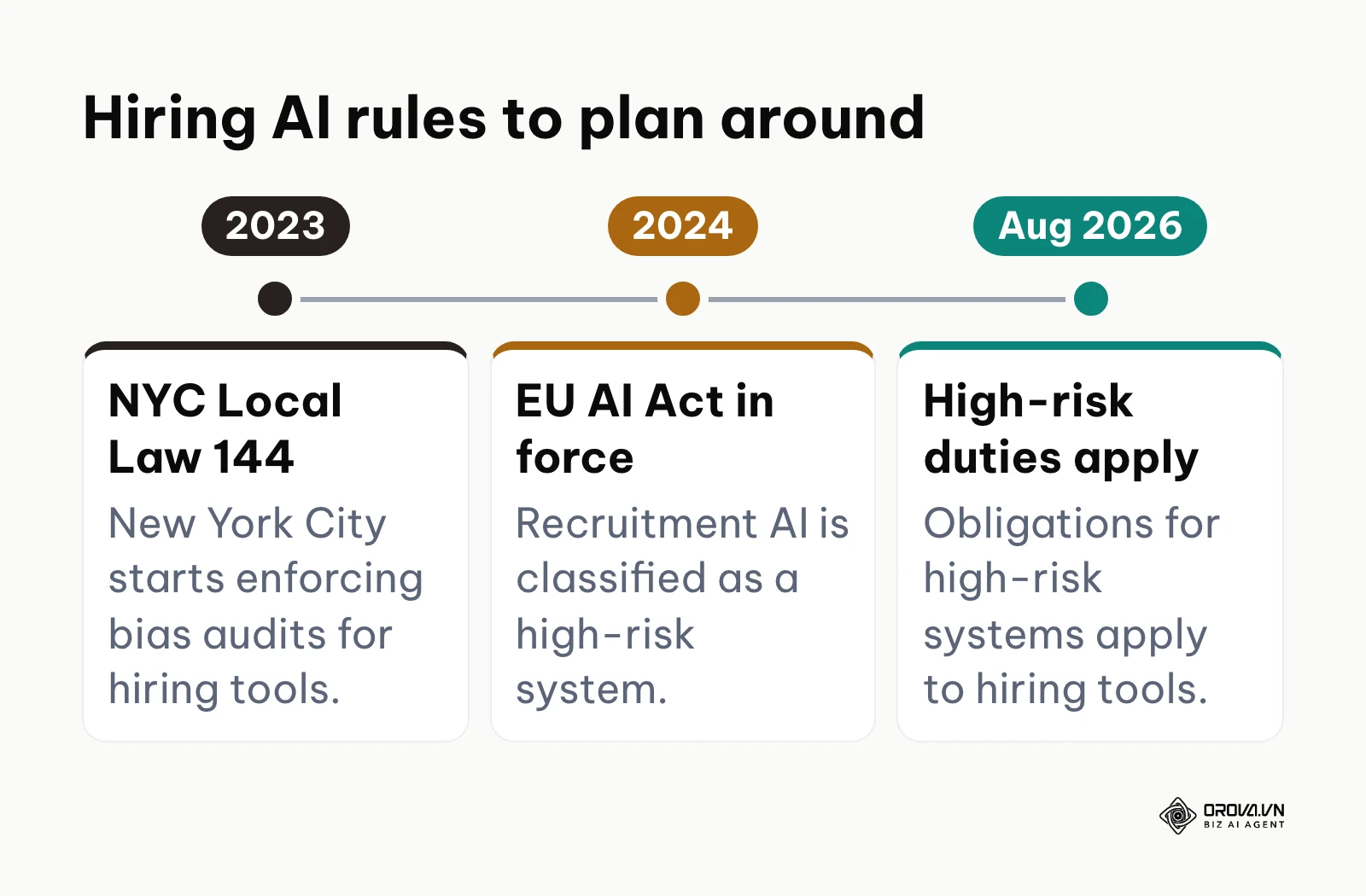
Europe adds a second layer. The EU AI Act, which entered into force in 2024, classifies AI systems used to recruit, filter applications, or evaluate candidates as high-risk, with the obligations for high-risk systems applying from August 2026. For buyers, that means asking vendors for technical documentation, logging, human oversight options, and evidence of risk management, not just a promise of fairness. The short timeline: 2023, New York City starts enforcing Local Law 144 bias audits; 2024, the EU AI Act enters into force; August 2026, high-risk obligations apply to hiring tools.
The 15 hard questions to ask software sales teams
Before signing any contract, force the vendor's technical sales team to answer these specific, operational questions. Vague marketing answers are a massive red flag.
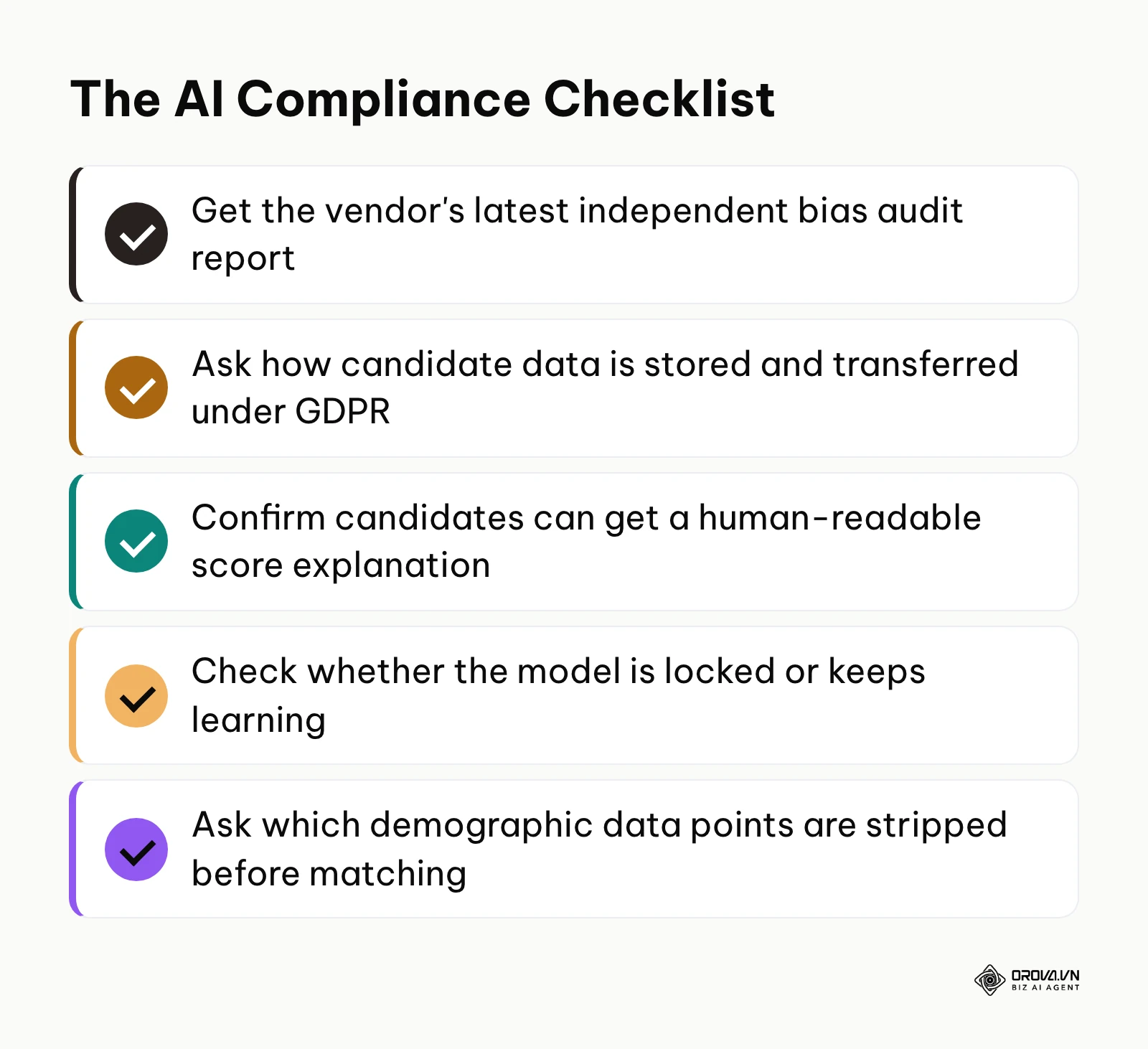
- "Can you provide a copy of your most recent independent, third-party AI Bias Audit report?" (If they say "our AI is inherently unbiased," walk away).
- "Does your system use a locked model, or does it continuously learn and update based on our specific hiring decisions?" (Continuous learning can accidentally ingest new biases).
- "Exactly which demographic data points does your system strip out before executing the semantic matching phase?"
- "If a candidate requests an explanation for their score under GDPR guidelines, how does your system generate a human-readable audit trail?"
- "Do you have a native, bi-directional API integration with [Your Specific ATS], or does it require middleware like Zapier?"
- "Can your OCR engine accurately extract text from a two-column PDF created in Canva, or does it scramble the reading order?"
- "What is the exact percentage of your model's training data that comes from non-Western or non-English speaking markets?"
- "How does your algorithm handle significant chronological employment gaps on a resume?"
- "If the system encounters an acronym or internal job title it doesn't recognize, what is its default behavior?"
- "What are the specific rate limits on your API if we experience a sudden spike of 10,000 applications in a single day?"
- "Who owns the derivative data generated when your model analyzes our proprietary candidate pool?"
- "Can we manually adjust the weighting of specific skills or criteria, or is the scoring algorithm a complete black box?"
- "What is the average implementation timeline, in weeks, from contract signing to the first automated score appearing in our ATS?"
- "Do you charge implementation fees, or are onboarding services included in the annual license cost?"
- "Can the system detect and flag potential AI-generated or heavily optimized 'resume stuffing' tactics?"
Ready to bring screening and interviews into one place? Orova Recruit generates interview questions from the JD and CV, records and transcribes voice or text notes, scores and compares candidates, schedules interviews, and sends stage-based emails to candidates from your company inbox. Sign up and try it free until July 7, 2027, no card needed.
Future trends in AI resume screening: Author's perspective
Looking ahead, the landscape of recruitment technology is poised for radical shifts. The era of simply parsing text and matching it to a job description is coming to an end. Based on the current trajectory of applied machine learning in human capital management, I believe we are approaching several structural changes that will redefine how we evaluate talent.
The death of the traditional resume and the rise of verified skill wallets Over the next few years, I suspect that parsing traditional, self-authored PDF resumes will start to look like an outdated practice. The fundamental flaw of a resume is that it is unverified self-reporting. I believe we will see a gradual shift toward candidates submitting "skill wallets"—cryptographically verified records of their achievements, project contributions, and technical assessments. AI tools will pivot from trying to understand what a candidate wrote about themselves to analyzing the raw data of what they have actually produced. Organizations should begin preparing for this by standardizing their technical assessment platforms, ensuring they can ingest verified test scores rather than relying solely on narrative documents.
Predictive attrition and trajectory modeling Currently, AI screening looks backward, analyzing what a candidate has done. I anticipate that the focus will increasingly shift toward predictive trajectory modeling. The AI will not just assess if a candidate can do the job today, but will try to estimate how likely they are to succeed in the role over the longer term, based on the velocity of their past career progression. In my view, organizations that skip an audit of their historical hiring data before implementing AI risk scaling their existing biases. If predictive models are trained on flawed historical promotion data, they could lock out non-traditional candidates. HR teams must ruthlessly clean their historical performance data now; an AI can only predict the future accurately if the past data it learns from is objective and meticulously structured.
Hyper-personalization in automated outreach While screening focuses on filtering, the immediate next step is engagement. I expect AI systems to increasingly bridge the gap between analyzing a profile and executing highly personalized, multi-channel outreach. The system will screen a passive candidate, understand their specific technical niche, and automatically generate an outreach sequence that speaks directly to their past projects, moving far beyond generic "We have an exciting opportunity" templates. The risk here is automation fatigue; candidates will quickly learn to spot AI-generated outreach. To prepare, recruitment teams must focus heavily on developing their employer brand and authentic voice, ensuring that when the AI does initiate contact, the underlying message is compelling, human-centric, and uniquely tailored to the organization's actual culture.
Frequently asked questions about AI resume screening tools
Can AI screening tools accurately read complex, heavily designed resumes? This depends entirely on the generation of the technology. Older Gen 1 parsers that rely on basic OCR typically fail when encountering multi-column layouts, infographics, or non-standard fonts; they often read straight across the page, scrambling the text. Modern Gen 2 tools use spatial analysis models to understand the visual hierarchy of the document, allowing them to accurately extract data from highly complex, graphically intense PDFs.
Will an AI tool automatically learn our company's existing hiring biases? If a vendor uses a "continuous learning" model trained exclusively on your historical hiring decisions without rigorous safeguards, yes. If your historical data shows a preference for candidates from specific universities or specific demographic backgrounds, the AI will identify that pattern and optimize for it, effectively scaling your past biases. This is why compliance-first tools prioritize independent bias auditing and allow you to lock the model or manually override weightings to prevent the ingestion of flawed historical practices.
Do these tools completely replace human recruiters? No, and treating them as a replacement strategy is a massive operational risk. AI tools are highly efficient at processing unstructured data at scale and identifying patterns, making them excellent at the top of the funnel. However, they cannot assess cultural alignment, negotiate complex compensation packages, or build rapport. The goal of these tools is to handle the high-volume data processing so human recruiters can dedicate their time to strategic relationship building and high-level interviewing.
What is the hidden cost of implementing these platforms? The largest hidden costs are data preparation and technical integration. If your historical ATS data is messy, unstructured, or incomplete, the AI will perform poorly. Organizations often underestimate the IT consulting hours required to build bi-directional APIs between the screening tool and their legacy HR systems, as well as the time required to train the recruitment team to trust and effectively utilize the new centralized dashboards.
How do AI tools handle candidates trying to "game" the system? Candidates often attempt to optimize their resumes similarly to how marketers optimize web pages for search engines, stuffing them with invisible keywords (white text on a white background) or excessive jargon. Many advanced AI systems try to detect these anomalies. They look for context and semantic relationships; if a resume contains the word "Kubernetes" 15 times but lacks any contextual description of a deployment architecture, a well-designed system should flag the profile as a potential manipulation attempt rather than granting it a high score.
Where to start?
Navigating the transition to automated screening can be paralyzing. The best approach is not to immediately contact vendors, but to objectively assess your current internal state. Depending on your organization's primary pain point, your first move should be highly targeted.
If you are overwhelmed by sheer volume but lack technical resources: Do not attempt to purchase a complex, standalone semantic engine that requires custom API development. Your first step, achievable this week, is to map your existing ATS capabilities. Log into your provider's documentation and determine if they support native webhooks or offer a pre-built app marketplace. Your goal is to identify which AI screening tools can be plugged into your existing workflow with a simple OAuth connection, rather than a six-month IT project.
If your current tech stack is a fragmented mess of point solutions: If your recruiters are constantly toggling between an ATS, a separate video interviewing platform, and a standalone parsing tool, your first step is to halt any new point-solution purchases. Spend an afternoon documenting the exact flow of data through your recruitment lifecycle. Identify where the bottlenecks and data drops occur. Your objective is to build a business case for migrating to a unified, end-to-end suite that consolidates these functions, drastically reducing context-switching and improving data hygiene.
If you are terrified of compliance risks and algorithmic bias: Before implementing any automation, you must understand your baseline. Your first step is to conduct a manual audit of your last 100 hires. Analyze the demographic breakdown and the specific universities or backgrounds those hires possessed. If you identify a stark lack of diversity or a heavy reliance on a narrow set of criteria, you know that training an AI on this data will be disastrous. Your immediate goal is to refine your standardized evaluation rubrics and ensure your upcoming AI procurement process strictly mandates demographic blinding and third-party bias audits.
The landscape of ai resume screening tools is complex, but by prioritizing deep integration, demanding compliance transparency, and calculating true ROI, you can transform your talent acquisition pipeline from a manual bottleneck into a strategic advantage.
About the author

Builder of Orova
Nguyễn Đỗ Trọng Ân has 8 years of experience in marketing, including 6 years managing market development across Asia. He builds Orova, a Biz AI Agent that never sleeps: it plans, runs and optimizes work for businesses.
Run your business with AI Agents
Orova is the always-on Biz AI Agent — it plans, runs, and optimizes the work for you.
Save time, unlock productivity.