
B2B lead generation: how to build an AI-powered pipeline in 7 steps (2026)

B2B lead generation is the systematic process of identifying, qualifying, and engaging commercial business accounts that possess an active need and demonstrable budget for your solution. In practice, it means finding companies that match your ideal customer profile, checking public evidence that they fit, collecting their business contact channels, and moving them into your customer relationship management (CRM) database for outreach. To execute this system successfully, you need administrative access to your sending domain DNS records, dedicated prospecting workspace accounts, and access to public web crawlers and data validation services. Setting up this automated architecture typically requires two to three business days of initial configuration. Teams selling high-volume consumer goods or low-ticket direct-to-consumer commodities should not follow this guide, as enterprise prospecting frameworks are specifically engineered for multi-stakeholder commercial sales cycles.
What is B2B lead generation and how does modern pipeline creation work?
B2B lead generation transforms raw commercial market data into sales opportunities through seven structured execution stages, taking approximately two to four weeks to reach full production scale. This process eliminates manual list scrubbing by combining buying signal detection, evidence-based account scoring, and multi-source contact enrichment.
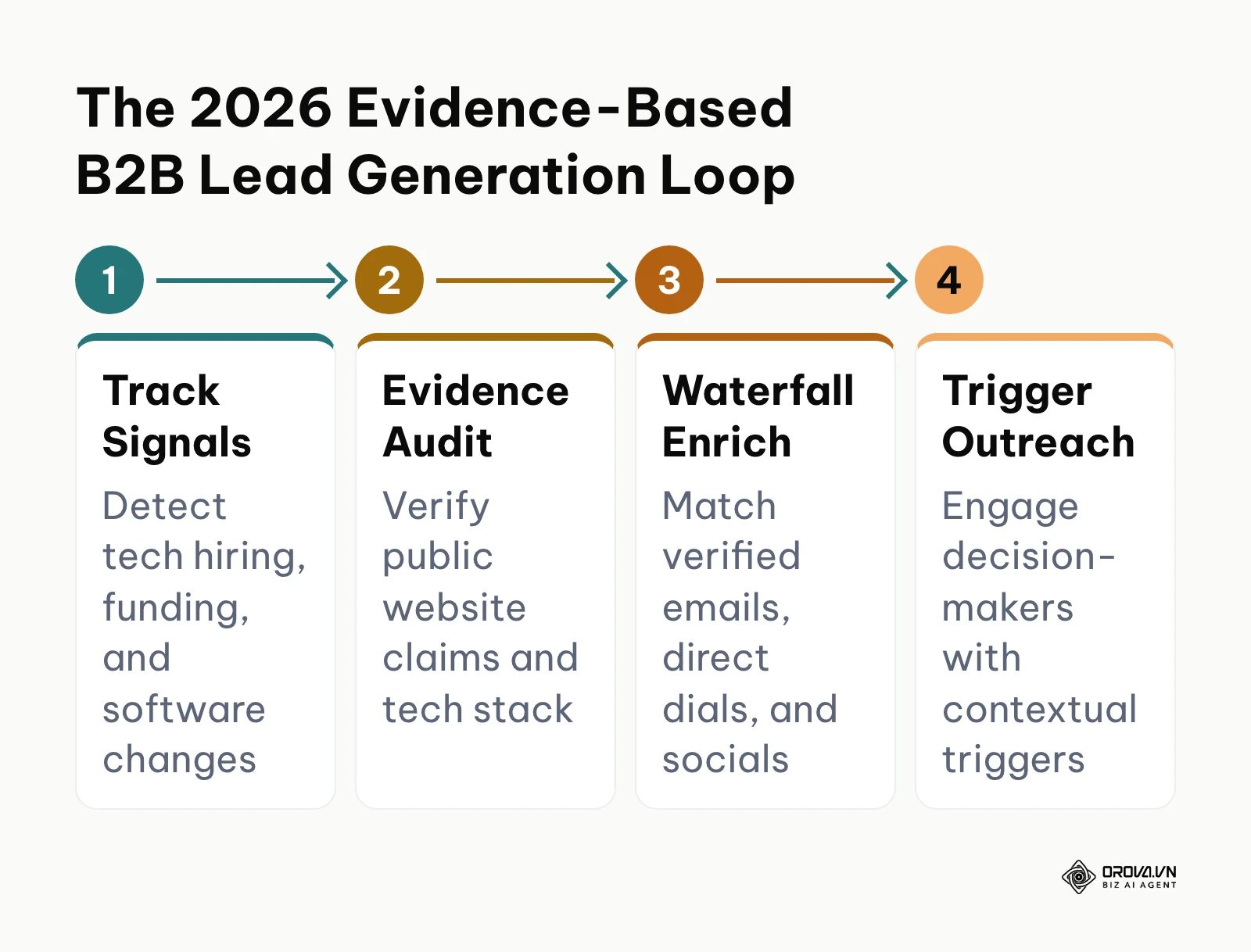
Historically, commercial prospecting relied on purchasing static database lists and sending generic messaging across broad industry codes. As of 2026, corporate spam filters, strict domain reputation protocols, and buyer fatigue have rendered static list scraping obsolete. Modern sales operations now prioritize high-intent triggers, verifying public technological signals and corporate milestones before initiating outreach. The diagram below summarizes this updated four-stage execution loop.
Gartner's research on the B2B buying journey reports that buying groups spend only around 17% of their purchase time meeting with potential suppliers. Because buyers do most of their evaluation before talking to sales reps, your prospecting system must identify accounts while they are actively researching or experiencing structural operational shifts. Modern teams achieve this by extracting public breadcrumbs left on job boards, regulatory filings, corporate technology headers, and company news updates.
Prerequisites before launching your B2B lead generation engine
Building a reliable outbound engine requires assembling technical infrastructure and operational assets before extracting a single contact record. Relying on makeshift setups or using your primary business domain for high-volume automated queries risks permanent domain blacklisting and data contamination.
The table below outlines the core components required to build an enterprise outbound pipeline, their acquisition sources, and the systemic risks of omitting them.
| Required Component | Acquisition Source | Setup Time | Impact If Missing |
|---|---|---|---|
| Secondary Sending Domains | Domain registrars (Cloudflare, Namecheap) | 1-2 hours | Primary company domain risks spam blacklisting and ruined email deliverability |
| Dedicated DNS Authentication | DNS hosting manager (SPF, DKIM, DMARC records) | 1-2 hours | Emails land directly in recipient spam folders due to unauthenticated sender signatures |
| Public Web Extraction Tool | Headless browser extractors or automated bot crawlers | 2-4 hours | Inability to parse dynamic modern websites, limiting pipeline to outdated static directories |
| Verification & Hygiene Engine | Real-time SMTP and MX ping verification services | 1 hour | High bounce rates, triggering automated mailbox suspension by hosting providers |
| CRM Prospect Repository | Centralized sales database (Orova Connect, HubSpot) | 2-3 hours | Lead records scatter across disparate spreadsheets, causing lead leakage and duplicate outreach |
Ensure all secondary domains are distinct variations of your primary corporate brand. If your primary domain is brandname.com, configure domains such as trybrandname.com or getbrandname.net. These dedicated domains protect your core day-to-day corporate communication channels from algorithmic deliverability penalties during high-volume outbound campaigns.
Step 1: Define your evidence-backed ideal customer profile for B2B lead generation
Define your ideal customer profile (ICP) using verifiable public evidence instead of broad demographic generalities. Vague criteria such as "companies in North America with 50 to 200 employees" force sales development representatives to manually evaluate hundreds of unqualified businesses. Instead, translate your qualification criteria into specific public artifacts that exist on a company's website, job boards, or code repositories.
Open your prospecting workspace or strategic planning document. Divide your qualification parameters into three structured layers: firmographic baselines, technographic footprints, and operational buying triggers. For each criterion, identify the exact URL path where proof can be detected, such as /careers, /privacy-policy, /terms, or the HTML DOM headers of the prospect's primary web domain.
Review the completed profile to ensure every parameter can be evaluated with a binary yes-or-no check supported by quoted text or code snippets. When qualification rules are unambiguous, programmatic crawlers and artificial intelligence parsers can evaluate accounts without human guesswork.
A common failure at this stage is selecting subjective indicators, such as "innovative culture" or "fast-growing brand." When automated parsers encounter subjective rules, they produce inconsistent scoring. Replace these with tangible evidence points, such as "active job postings for machine learning engineers" or "presence of a specific CRM script tag."
The checklist below provides 15 verifiable criteria across firmographic, technographic, and intent layers. You can feed these directly into automated scoring rules.
| Qualification Layer | Criterion Name | Location of Website Proof | AI Scoring Weight (1-10) |
|---|---|---|---|
| Firmographic | Active Physical Office Presence | Footer physical address or /contact schema markup | 4 |
| Firmographic | Executive Leadership Structure | /about, /team, or executive author bylines | 6 |
| Firmographic | Enterprise Terms of Service | /terms page containing commercial contract clauses | 4 |
| Firmographic | Multi-Language Market Support | Language toggles and country-specific URL subdirectories | 6 |
| Technographic | Marketing Automation Platform | Head scripts (HubSpot, Marketo, Pardot tracking tags) | 8 |
| Technographic | Product Analytics Infrastructure | Network scripts (Segment, Mixpanel, Google Analytics 4) | 6 |
| Technographic | Cloud Hosting Provider | Reverse DNS records and server response headers (AWS, Cloudflare) | 6 |
| Technographic | Payment Gateway Integration | Client checkout JavaScript (Stripe, Adyen, Braintree API) | 8 |
| Technographic | Customer Support Widget | Live chat embeds (Intercom, Zendesk, Drift script tags) | 6 |
| Buying Trigger | Departmental Scaling | /careers listing 3 or more open roles in one department | 10 |
| Buying Trigger | Leadership Transition | Press release or blog post detailing executive appointments | 8 |
| Buying Trigger | Institutional Capital Injection | News section announcing Series A-C venture funding rounds | 10 |
| Buying Trigger | Compliance Certification Need | Site documentation referencing SOC2, ISO27001, or GDPR audits | 8 |
| Buying Trigger | Regional Market Expansion | New international office launch announced in media releases | 8 |
| Buying Trigger | Tech Stack Migration | Job listings citing deprecation or migration of existing tools | 10 |
Illustrative example (hypothetical):
- Context: A mid-market B2B software firm with 12 sales representatives targeted financial institutions. The team was wasting 35 hours per week reviewing generic lead lists purchased from industry databases.
- What they did: They rebuilt their ICP around three technical requirements: presence of modern identity verification scripts on the client login portal, active career openings for regulatory compliance officers, and public documentation mentioning European Union data sovereignty.
- Snag and fix: Their web scrapers initially failed to inspect login pages hidden behind client portals. To resolve this, they updated their crawler to inspect public API documentation pages (/developers) and sub-processor lists on privacy pages, which revealed the exact security architecture.
- Result: Outbound account qualification rates shifted from 14% to 68%, and sales representatives eliminated manual website verification entirely.
Step 2: Track active buying signals to source B2B lead generation accounts
Identify high-intent accounts by monitoring real-time commercial signals rather than querying dormant company directories. Signal tracking identifies businesses undergoing strategic transitions, such as organizational restructuring, technological upgrades, or capital investment.
Configure automated listening monitors across public data hubs. Navigate to online corporate registries, technology tracking engines, and employment portals. Set keyword filters for senior executive titles like "Chief Information Officer", "Head of Growth", and "VP of Sales". Pair these filters with technology keywords matching your complementary or competitive tool ecosystems.
Your query monitor will generate an active stream of company domain names whenever an organization registers a public corporate milestone. Each record must display the target website domain, the detected signal category, and a direct hyperlink to the original public source.
If your signal feed produces excessive noise, such as small consultancies or recruiting agencies hiring on behalf of undisclosed clients, tighten your source exclusions. Exclude staffing agency domains by filtering out standard recruitment company categories and staffing agency website footers.
Signals reveal when a commercial organization is most receptive to addressing operational bottlenecks. When a company appoints a new executive, that leader often reviews the existing technology stack and vendor list early in their tenure. Capturing these moments provides a competitive advantage over competitors relying on blind outreach.
Step 3: Extract public company data for B2B lead generation targeting
Extract company information systematically from open web resources, business registries, and industry associations. The goal of this step is to transform raw unstructured web data into structured account profiles without manual copy-pasting.
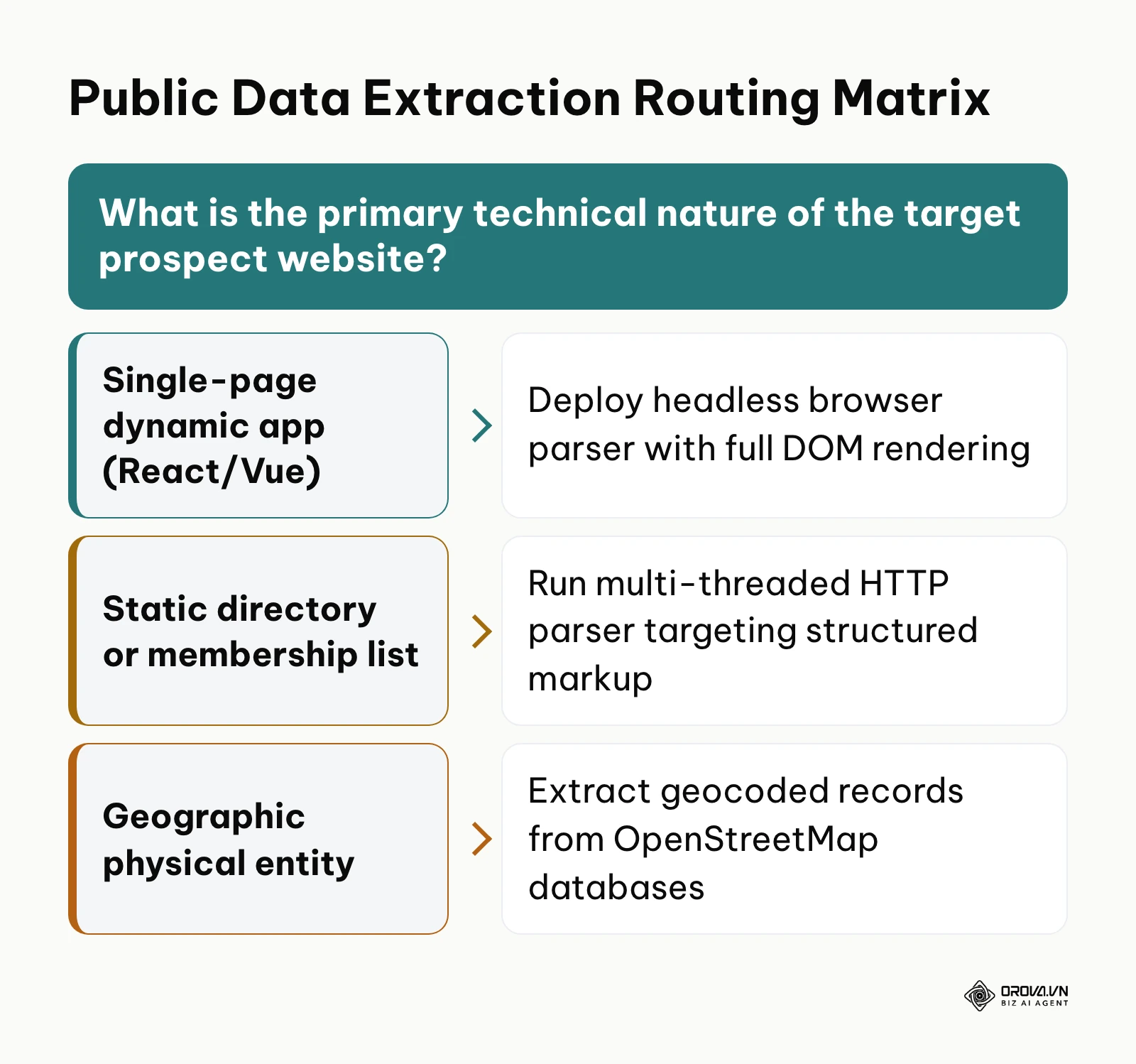
Launch your web crawler or public data extraction script. Enter your target industry vertical and regional jurisdiction. Point the crawler toward open business registers, certified trade association member lists, or public business databases. When scraping modern dynamic websites built on reactive JavaScript frameworks, use headless browser instances to render the full Document Object Model (DOM) before extracting textual elements.
Review your exported output file. A successful extraction yields a clean comma-separated values (CSV) or spreadsheet file containing company names, root web domains, primary corporate phone numbers formatted with international country codes (such as +1 for the United States or +44 for the United Kingdom), corporate email addresses, and active social media profile URLs.
Websites that employ dynamic rendering or aggressive rate limiting can cause extractors to return incomplete data or trigger request timeouts. If this occurs, lower your crawler concurrency, implement polite request delays between page visits, and configure the crawler to follow secondary internal hyperlinks, like /contact, /about-us, and /legal.
The decision matrix above outlines how to route your extraction based on the technical architecture of the target domain.
Ensuring that telephone numbers are standardized with international calling prefixes during initial extraction prevents dialing failures later in your outbound cadences.
Use the table below to check what each public source type gives you before you move the records into scoring in Step 4:
| Public Source Type | Typical Fields Extracted | Common Problem | Fix |
|---|---|---|---|
| Business registries and directories | Company name, root domain, business phone | Outdated or duplicate listings | Deduplicate by root domain |
| Trade association member lists | Company name, website, industry category | Static pages with few contact details | Follow links to each member's /contact page |
| Open map data (OpenStreetMap) | Business name, physical address, phone | Branches listed as separate companies | Group locations under one root domain |
| Dynamic company websites (React/Vue) | Emails, phone numbers, social profile links | Empty results from a plain HTTP request | Render the page in a headless browser |
| Company /about and /team pages | Named contacts and job titles | Missing names on many pages | Leave the field blank instead of guessing |
Step 4: Score prospects using AI verification for B2B lead generation
Score and qualify prospective accounts using an artificial intelligence evaluation framework anchored in verifiable evidence. Automated qualification fails when algorithms assign arbitrary numerical scores without accountability. Every score must be tied to verbatim excerpts extracted from the prospect's public web presence.
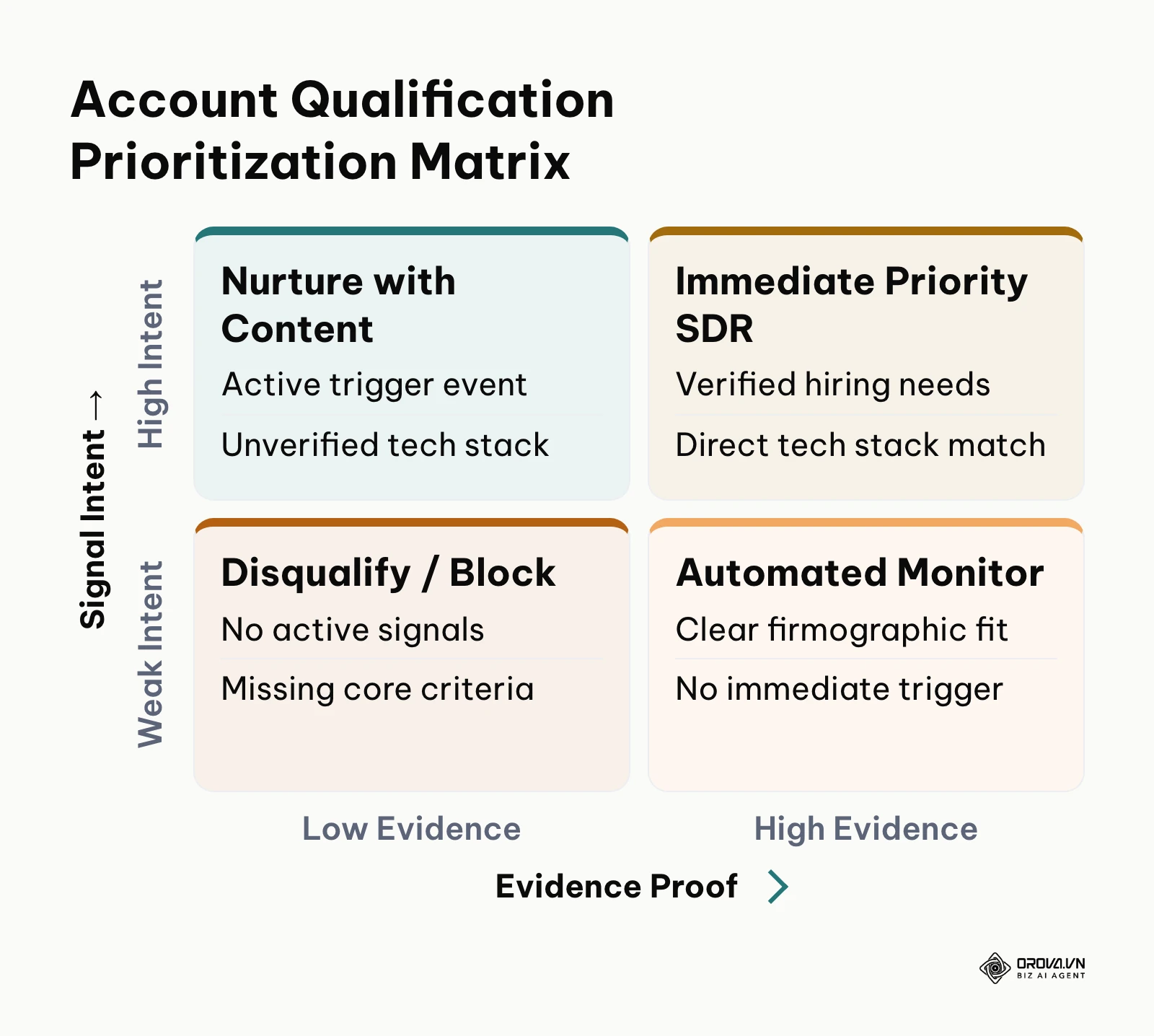
Open your automation scoring engine. Input your 15-point criteria framework established in Step 1. Configure the model to evaluate each criterion using a three-tier output: Passed, Failed, or Insufficient Evidence. Let the model judge each check, but calculate the score with a fixed formula in code rather than asking the AI for a number. For every evaluated item, require the system to extract an exact quote from the prospect's website and provide the corresponding source URL.
Apply a weighted numerical scale from 1 to 10 for each criterion. Designate foundational parameters as Mandatory. For example, if a target business must maintain a self-hosted e-commerce portal, mark this rule as Mandatory. If the scraper finds direct evidence that the account relies entirely on a third-party hosted marketplace, the mandatory score drops below 50 points, and the system automatically disqualifies the account.
Qualifying Score = (Sum of weights of passed criteria / Sum of weights of all evaluated criteria) * 100
Verify the accuracy of your scored data set by inspecting the output table. An audited profile must present the aggregate score, clear status tags (Qualified, Consider, or Not qualified), and clickable source links supporting every passed criterion.
If the scoring model returns "Insufficient Evidence" across a large batch of domains, the crawler may be evaluating unindexed splash pages or landing pages that lack deep site architecture. To resolve this, expand the crawler's parsing scope to ingest sub-pages, such as technical documentation directories, case study repositories, and published terms of service.
By requiring automated parsers to substantiate every positive evaluation with a verbatim text snippet, you prevent hallucinations and ensure that sales reps receive accounts that meet your operational thresholds.
Spent hours searching the web and still can't find B2B prospects that fit your ideal customer profile? Orova Bot uses AI to find businesses based on your description. With a list of relevant prospects to contact, you spend less time searching and more time selling.
Try it now at orova.vn/bot
Step 5: Execute waterfall data enrichment to reveal B2B lead generation contacts
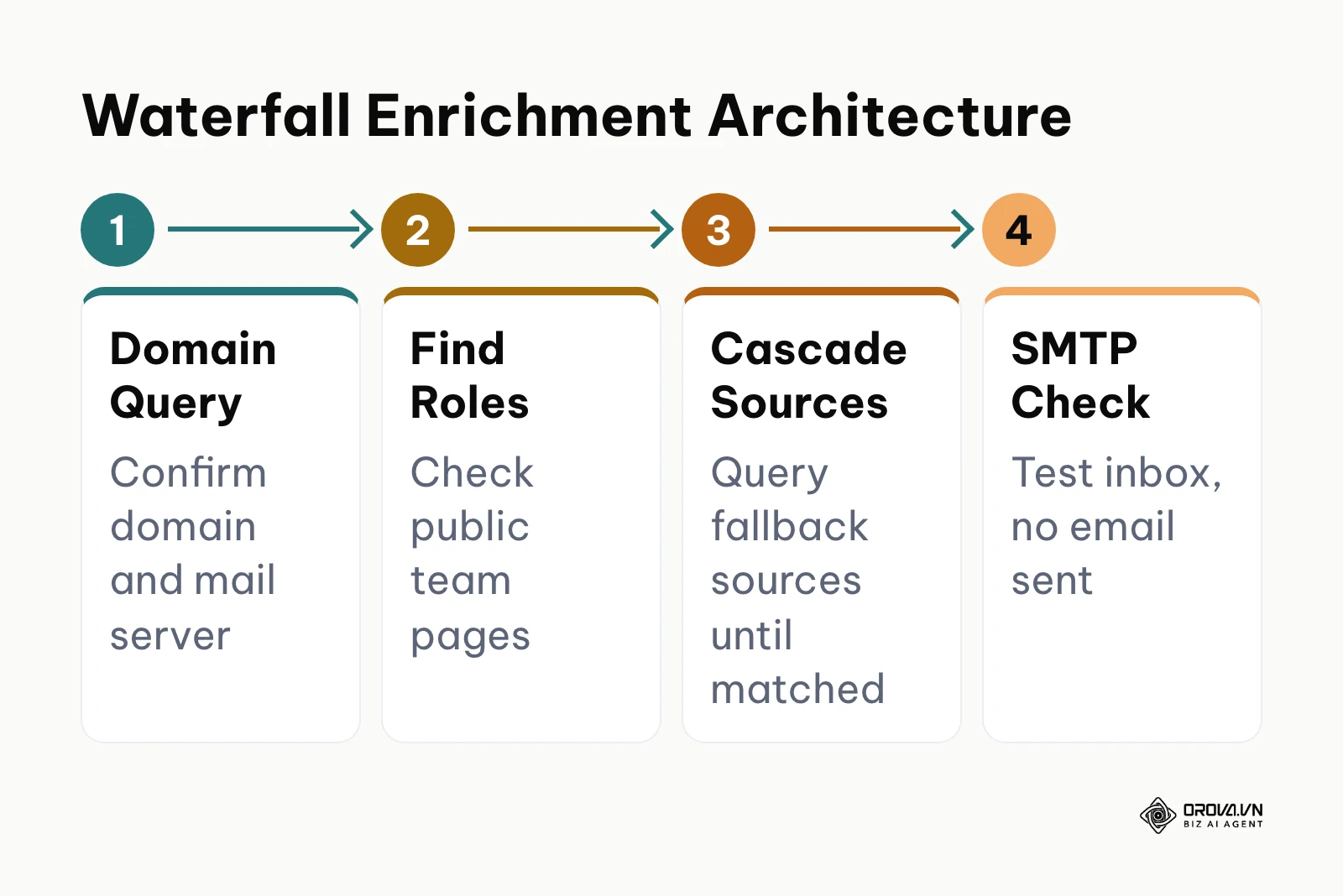
Locate and verify individual decision-maker contact details using waterfall data enrichment. Relying on a single contact data provider frequently results in missing records and high bounce rates, because people change roles and companies change email formats faster than any single database is updated. A waterfall enrichment model queries fallback data providers sequentially until a verified match is confirmed.
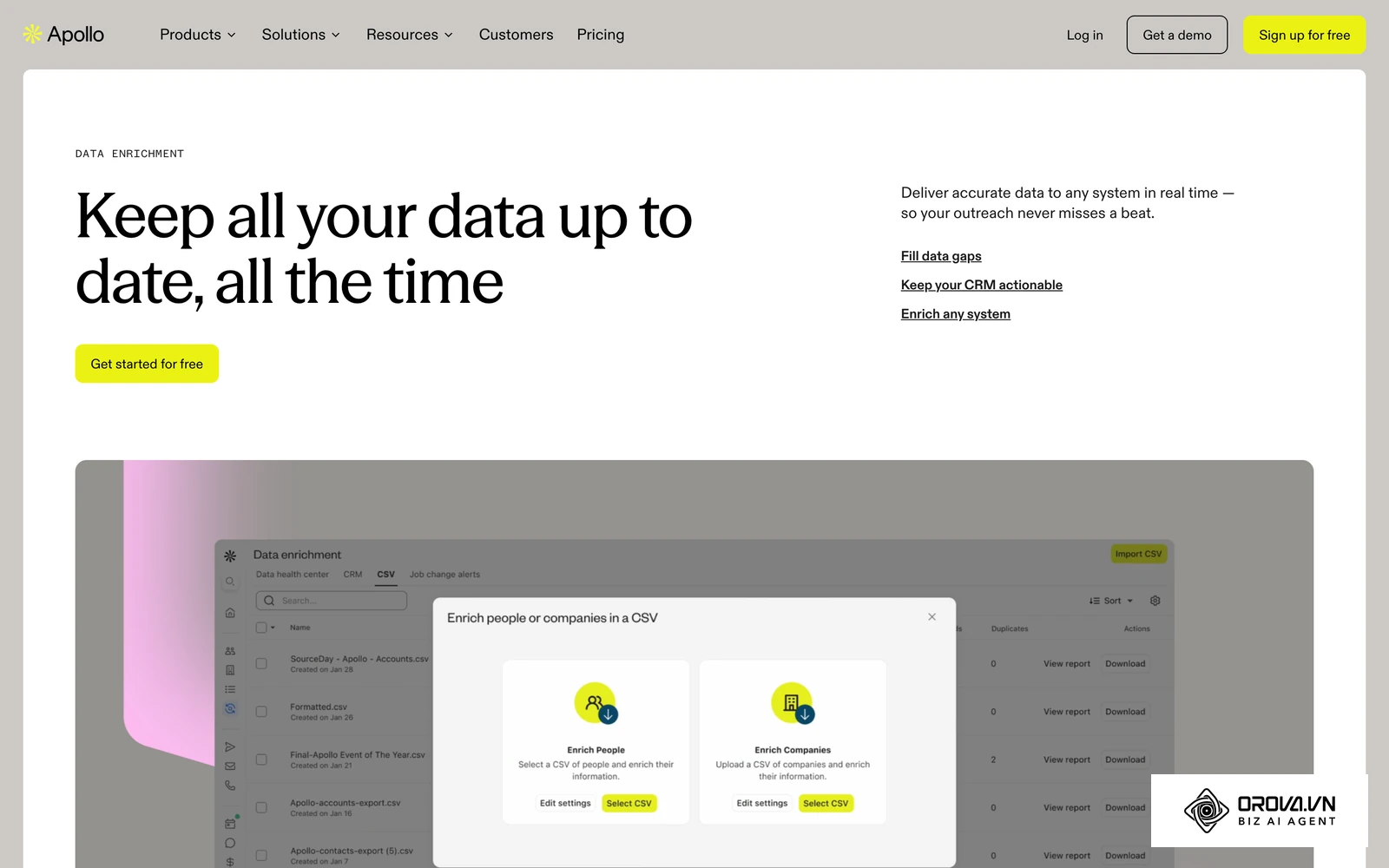
Open your enrichment workflow tool. Connect your scored list of approved company domains. Set your buyer persona parameters to filter for specific executive functions, such as VP of Engineering, Director of Infrastructure, or Head of Procurement. Configure the enrichment cascade to first query your primary contact data layer. If no email or telephone number is returned, instruct the system to automatically query a secondary provider, followed by an open public records registry.
The diagram below illustrates the sequential architecture of a multi-vendor waterfall enrichment pipeline.
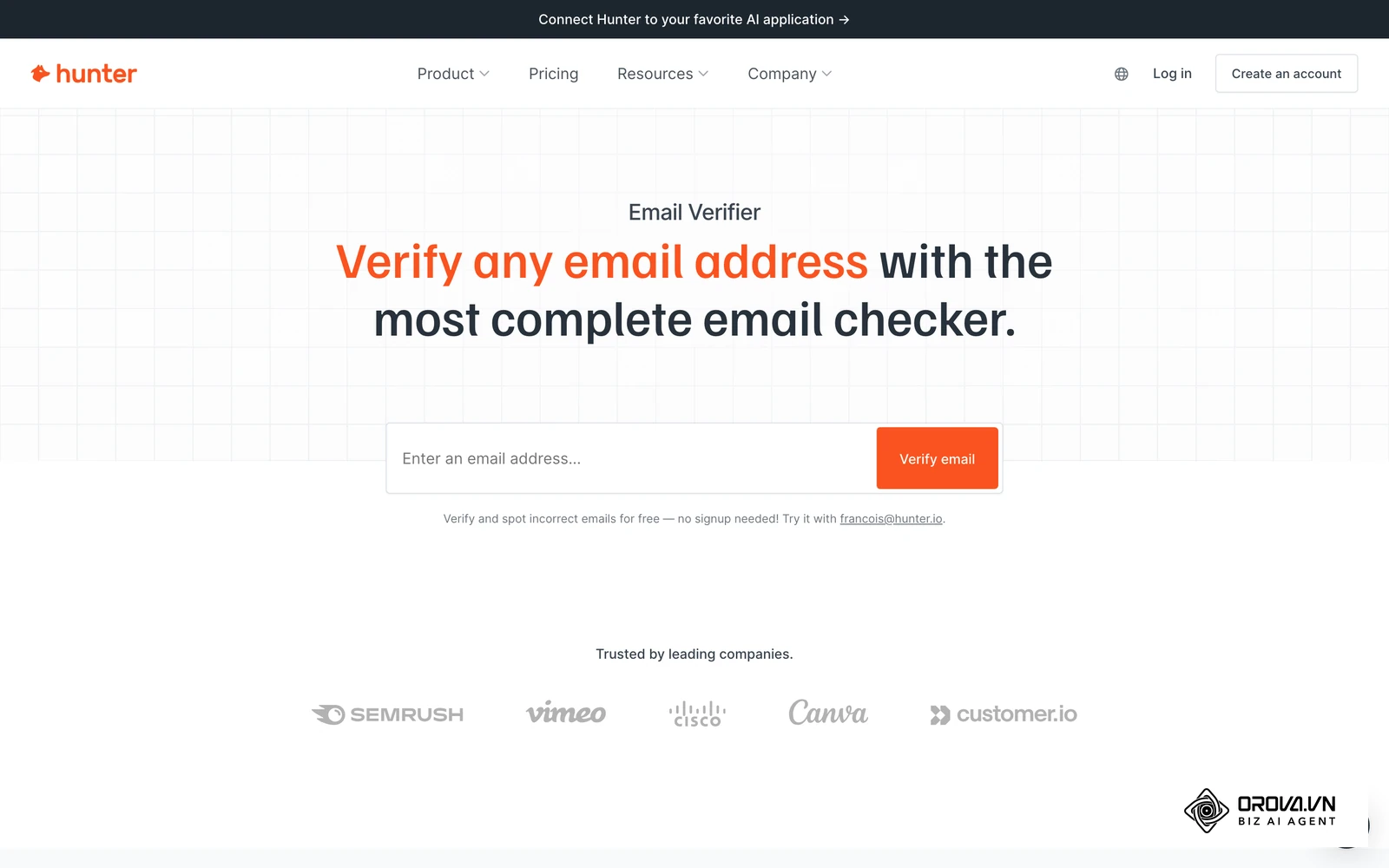
After completing the multi-vendor cascade, the pipeline sends each retrieved email address to a real-time mail exchange (MX) and simple mail transfer protocol (SMTP) verification gateway. This step tests server handshakes without transmitting an actual email message.
Inspect the enriched output table to verify data hygiene. Each decision-maker record must display their full name, verified business email, sanitized corporate phone number, public LinkedIn profile URL, and an explicit SMTP verification tag showing Deliverable. Catch-all and unverifiable addresses should be routed into a separate manual review queue.
If your cascade yields an unusually high proportion of catch-all email domains, do not immediately send cold messages to those addresses. These domains accept all incoming mail at the server gateway before silently dropping unrecognized addresses, which can damage your sender reputation. Route catch-all addresses through specialized email validation tools or target those individuals through alternate channels, such as professional social platforms.
Integrating bottom of the funnel content assets into later outreach steps ensures that verified prospects receive high-value product specifications rather than generic promotional materials.
Use the template below as the column layout for your enriched output. The rows are fictional sample data that show how each status should be handled.
| Domain | Contact Name | Title | Enriched Email | SMTP Status | Next Action |
|---|---|---|---|---|---|
| example-logistics.com | Jane Doe | VP Supply Chain | jane.doe@example-logistics.com | Deliverable | Add to trigger sequence |
| example-cloud.com | John Roe | Head of Security | j.roe@example-cloud.com | Deliverable | Add to trigger sequence |
| example-labs.net | Alex Kim | Director of Operations | alex@example-labs.net | Catch-all | Manual review queue |
| example-fintech.org | (not published) | Chief Risk Officer | info@example-fintech.org | Generic inbox | Research named contact first |
Step 6: Configure deliverability guardrails for B2B lead generation outreach
Protect your technical domain reputation and ensure regulatory compliance before launching outbound communications. Modern spam filtering algorithms monitor sender infrastructure, message velocity, bounce frequencies, and domain authentication records.
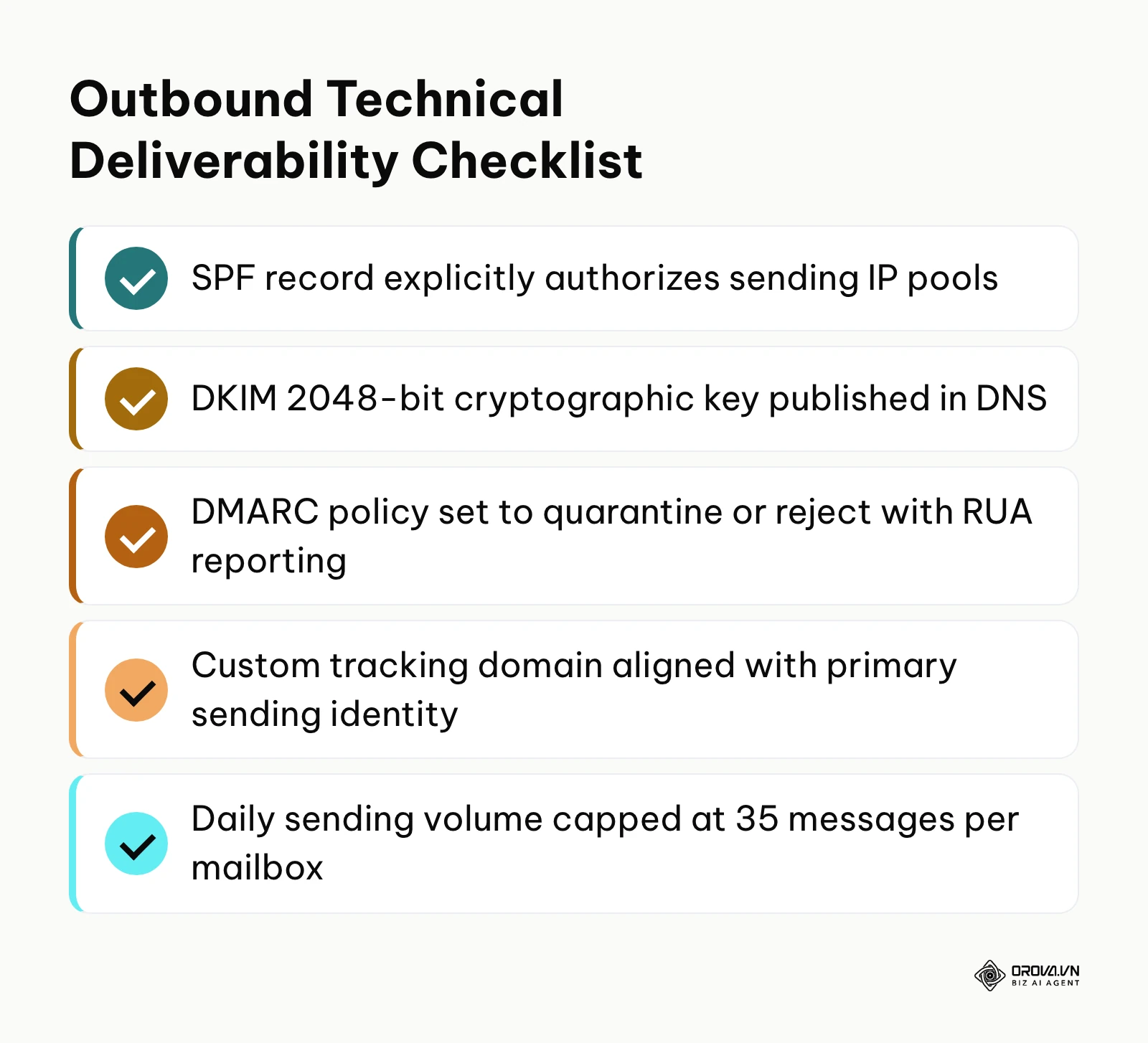
Log into your secondary domain DNS management console. Create four mandatory domain authentication records:
| Record | DNS Type | Example Value | What It Does |
|---|---|---|---|
| Sender Policy Framework (SPF) | TXT | v=spf1 include:_spf.google.com ~all | Lists the mail servers allowed to send for your domain |
| DomainKeys Identified Mail (DKIM) | TXT | Public key from a 2048-bit key pair generated in your email workspace | Signs each message so receivers can confirm it was not altered |
| Domain-based Message Authentication, Reporting, and Conformance (DMARC) | TXT | v=DMARC1; p=quarantine; rua=mailto:dmarc-reports@yourdomain.com; pct=100 | Tells receiving servers how to handle unauthenticated messages and where to send reports |
| Custom Tracking Domain (CTD) | CNAME | track.yourdomain.com pointing to your outreach delivery platform | Keeps tracking links aligned with your sending domain |
Connect your mailboxes to an automated warm-up network for a minimum of 14 consecutive days before launching campaigns. Gradually increase sending limits, capping daily outbound volume at 35 cold prospect messages per mailbox. If your campaign requires delivering 350 messages per day, distribute that volume across 10 distinct mailboxes hosted across multiple secondary domains.
To maintain compliance with international data privacy regulations, such as the General Data Protection Regulation (GDPR) in the European Union and the CAN-SPAM Act in the United States, include an unambiguous opt-out mechanism and your physical business address in every message footer. When processing enterprise contacts, document your legitimate interest assessment and process publicly available corporate data responsibly.
| Regulation | Where It Applies | What to Put in Place Before Sending |
|---|---|---|
| CAN-SPAM Act | United States | Accurate sender details, a non-misleading subject line, your physical postal address, and a working opt-out link that you honor |
| GDPR | European Union | A documented legitimate interest assessment, only the contact fields you need, and a process for objection and deletion requests |
| Local data protection laws | Each market you sell into | Check the rules of that market yourself; your team stays responsible for compliance |
Illustrative example (hypothetical):
- Context: An enterprise cloud analytics provider launched an outbound campaign using three newly registered domains, sending 120 messages per mailbox daily.
- What they did: Within five days, their email open rates collapsed from 42% to 3%, and two domains were placed on global spam blacklists due to insufficient warming and missing DKIM keys.
- Snag and fix: They halted all active sequences immediately, generated 2048-bit DKIM records, implemented a DMARC quarantine policy, and capped daily volume at 30 messages per address while running an automated warming network for three weeks.
- Result: Sending reputation restored across major inbox providers, open rates rebounded to 58%, and zero domains remained on active blocklists.
Executing structured LinkedIn advertising campaigns alongside authenticated cold email outreach creates multi-touch brand exposure that improves cold response rates.
Step 7: Launch event-triggered outreach campaigns for B2B lead generation
Engage qualified decision-makers using contextual messaging tied to the verifiable buying signals detected in Step 2. Generic cold email templates fail because they offer no clear justification for why the prospect is being contacted at that specific time.
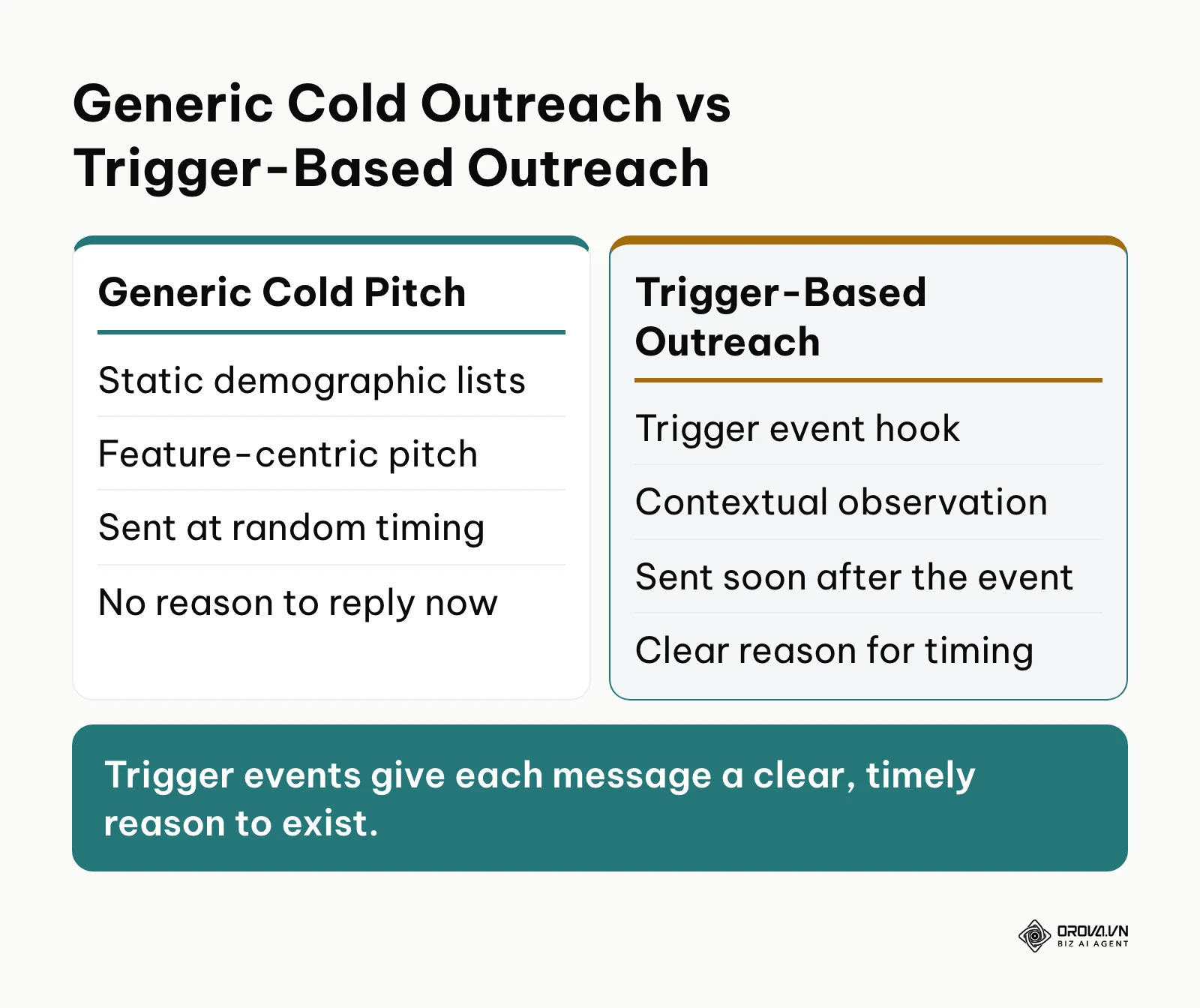
Open your outbound sequencer. Build five specialized campaign tracks mapped to specific trigger categories. Keep message copy concise, ideally between 60 and 90 words. Structure each email with three core components: an opening reference to the public trigger event, an operational problem observation tied to that event, and a low-friction call to action proposing an exchange of insights rather than an immediate sales pitch.
Review your sequence tracking dashboard 48 hours after launch. Compare reply rates against your previous generic campaigns, and keep bounce rates under 2%.
If open rates are healthy but replies stay low, your opening trigger is successfully generating curiosity, but your value proposition or call to action is falling flat. Refine your message to focus on a specific operational friction point rather than requesting a 30-minute introductory phone call.
Before writing, map each trigger to the public source where you verify it and the angle your opening line should take:
| Trigger | Where to Verify It | Opening Angle | Template |
|---|---|---|---|
| Funding round | Company news page or press release | Growth plans the new capital will fund | Template 1 |
| New senior leader | Press release, team page, or company blog | Priorities a new leader reviews early | Template 2 |
| Technology migration | Job listings and public site scripts | Risks during the switch | Template 3 |
| Executive press feature | Trade publication interview | A specific point the executive made | Template 4 |
| New regional office | Company announcement or local news | Setup work in the new location | Template 5 |
Below are five event-driven outreach templates mapped to verified commercial triggers.
Trigger Template 1: Recent Institutional Funding Round
Subject: [Company Name]'s Series B expansion and infrastructure roadmap

Hi [First Name],

Noticed [Company Name]'s recent capital announcement dedicated to scaling your core data infrastructure. Congratulations to the entire team.

Usually, as engineering teams double their headcount post-Series B, managing cross-platform data compliance creates unexpected deployment bottlenecks. We developed an architectural framework that automates data governance auditing across distributed cloud environments.

Open to reviewing the technical architecture breakdown we prepared for growing data teams?

Best,
[Your Name]
Trigger Template 2: Senior Leadership Appointment
Subject: Question regarding your infrastructure priorities at [Company Name]

Hi [First Name],

Congratulations on stepping into the [Job Title] position at [Company Name].

When new leadership takes over distributed IT operations, the first 90 days usually involve auditing legacy pipeline costs and consolidating redundant monitoring software.

We published an operational benchmark comparing modern automation architectures with legacy configurations. Would you be open to reviewing the checklist to support your upcoming quarterly stack review?

Best,
[Your Name]
Trigger Template 3: Technology Migration Detected
Subject: Observation on [Company Name]'s recent [Tech Stack] migration

Hi [First Name],

Noticed via your public engineering headers that [Company Name] recently began transitioning architecture toward [New Technology].

Teams undergoing this specific platform migration frequently encounter unexpected latency synchronization issues between their legacy customer database and the new event broker. We built a migration verification blueprint that catches data mismatches before going live.

Worth sending over the deployment checklist to your engineering lead?

Best,
[Your Name]
Trigger Template 4: Executive Press Feature or Interview
Subject: Your perspective on [Specific Industry Challenge] in [Publication]

Hi [First Name],

Read your recent commentary in [Publication Name] regarding the impact of tightening compliance mandates on modern logistics fleets. Your point about regional supply chain verification was particularly insightful.

We put together an operational workflow specifically engineered to automate chain-of-custody documentation across cross-border hubs.

Would you be open to an eight-minute workflow walkthrough showing how peer logistics operators handle this automation?

Best,
[Your Name]
Trigger Template 5: Regional Office Expansion
Subject: Supporting [Company Name]'s new [City/Region] facility launch

Hi [First Name],

Saw the recent announcement regarding [Company Name]'s new regional logistics hub opening in [City/Region].

Scaling operations into a new geographic territory often introduces localized vendor integration friction and fragmented communication flows between headquarters and field units. We help regional operations heads streamline branch onboarding using automated communications bots.

Open to seeing a three-minute demo showing how other operations directors run localized facility onboarding?

Best,
[Your Name]
Illustrative example (hypothetical):
- Context: A commercial cybersecurity firm targeted Chief Information Security Officers (CISOs) at logistics companies with 200 to 1,000 employees.
- What they did: The business configured monitors to alert them whenever a logistics firm announced a new physical distribution facility. They deployed Trigger Template 5, referencing the specific municipal permit approval.
- Snag and fix: Their first 40 messages were sent from a single mailbox, causing two regional internet service providers to throttle delivery. They redistributed the campaign across six authenticated mailboxes and capped delivery speed.
- Result: The campaign generated 9 booked enterprise product demonstrations from 120 targeted accounts within three weeks.
Supporting these sequences with lead generation content marketing gives sales representatives relevant case studies and benchmarks to share with prospective buyers during follow-up touchpoints.
Complete workflow checklist for B2B lead generation
The operational matrix below outlines the complete end-to-end B2B lead generation process. Use this checklist to audit your technical infrastructure, track operational progress, and identify pipeline bottlenecks.
| Step Number | Core Task | Done Criteria | Estimated Time |
|---|---|---|---|
| Step 1 | Define Evidence-Based ICP | 15 verifiable criteria documented across firmographic, technographic, and intent layers | 3-4 hours |
| Step 2 | Establish Signal Tracking | Live webhook alerts tracking funding announcements, senior executive hires, and tech shifts | 2 hours |
| Step 3 | Extract Public Company Data | Structured spreadsheet with root domains, sanitized business phone numbers, and web links | 3-5 hours |
| Step 4 | Run AI Evidence Scoring | Prospects classified into Passed, Consider, or Disqualified with cited website proof quotes | 2-3 hours |
| Step 5 | Waterfall Data Enrichment | Verified decision-maker contact records showing Deliverable SMTP authentication tags | 3-4 hours |
| Step 6 | Configure Technical Guardrails | SPF, DKIM, DMARC, and custom tracking domains active with 14-day mailbox warming completed | 14-16 days (mostly warming) |
| Step 7 | Deploy Trigger Sequences | Five event-driven message sequences scheduled across authenticated mailboxes capped at 35/day | 3-4 hours |
Is your sales team making plenty of calls but reaching prospects whose needs don't match your offer? Orova Bot uses AI to select suitable B2B prospects and explain why they're worth calling. Your team gets a list they can start calling right away, with clear reasons to prioritize each prospect.
Try it at orova.vn/bot, free through July 7, 2027.
Common B2B lead generation mistakes and how to fix them
Even experienced commercial marketing and sales operations teams run into systemic issues that stall outbound pipeline generation. The table below outlines five common operational failures, their root causes, and actionable solutions.
| Operational Mistake | Common Underlying Cause | Actionable Correction Strategy |
|---|---|---|
| Sudden Drop in Deliverability | Mailbox volume spike or missing DMARC record | Immediately lower daily outbound sending limits to below 30 messages per account, audit DNS records, and run an automated inbox warm-up tool for 14 days. |
| High Contact Data Bounce Rate | Relying on unverified static contact databases | Implement multi-vendor waterfall enrichment combined with real-time SMTP handshake verification before loading contacts into active outbound sequences. |
| Low Prospect Reply Rates | Generic cold email templates lacking context | Shift from static industry list messaging to event-driven triggers, incorporating public corporate milestones into your email subject lines and openers. |
| Sales Reps Rejecting Leads | Subjective or poorly calibrated ICP definitions | Replace loose demographic profiles with verifiable public website artifacts and require AI scoring models to cite supporting text snippets. |
| Account Duplication in CRM | Multiple scrapers running without unified domain keys | Establish the root company domain as a unique database key across all outreach workflows and implement automated deduplication rules. |
Orova Bot covers the search, extraction, and qualification part of this workflow. You describe the businesses you want in one sentence, and AI splits it into criteria and search terms (keywords, country, industry, region) that you can edit before the bot runs. Automatic filters check data such as "has email", "has phone", or "correct country", while AI checks evaluate each criterion as pass, fail, or insufficient evidence, with a verbatim quote and source link that the system confirms actually appears on the page. You assign 1-10 weights, mark criteria as Required or Bonus, and set your own thresholds for Qualified, Consider, and Not qualified accounts.
The bot works only with data that businesses publish themselves: public directories and business portals, OpenStreetMap, YouTube, industry association member lists, and related pages, with web search used last when open sources run out. It collects company names, emails, phone numbers with country codes, websites, and social profiles across 44 networks (Facebook, TikTok, LinkedIn, YouTube, WhatsApp, LINE, and more). You can export Excel or CSV files with scores, reasons, and source links, or send leads that have an email into Orova Connect contact groups. "Delete and block" keeps removed emails, phones, and domains from coming back in later runs, and you can run several bots at the same time for different regions.
How to measure B2B lead generation performance and acquisition cost
Evaluating a lead generation engine requires analyzing pipeline economics and conversion velocity rather than tracking surface-level vanity metrics, like raw impressions or email open rates.
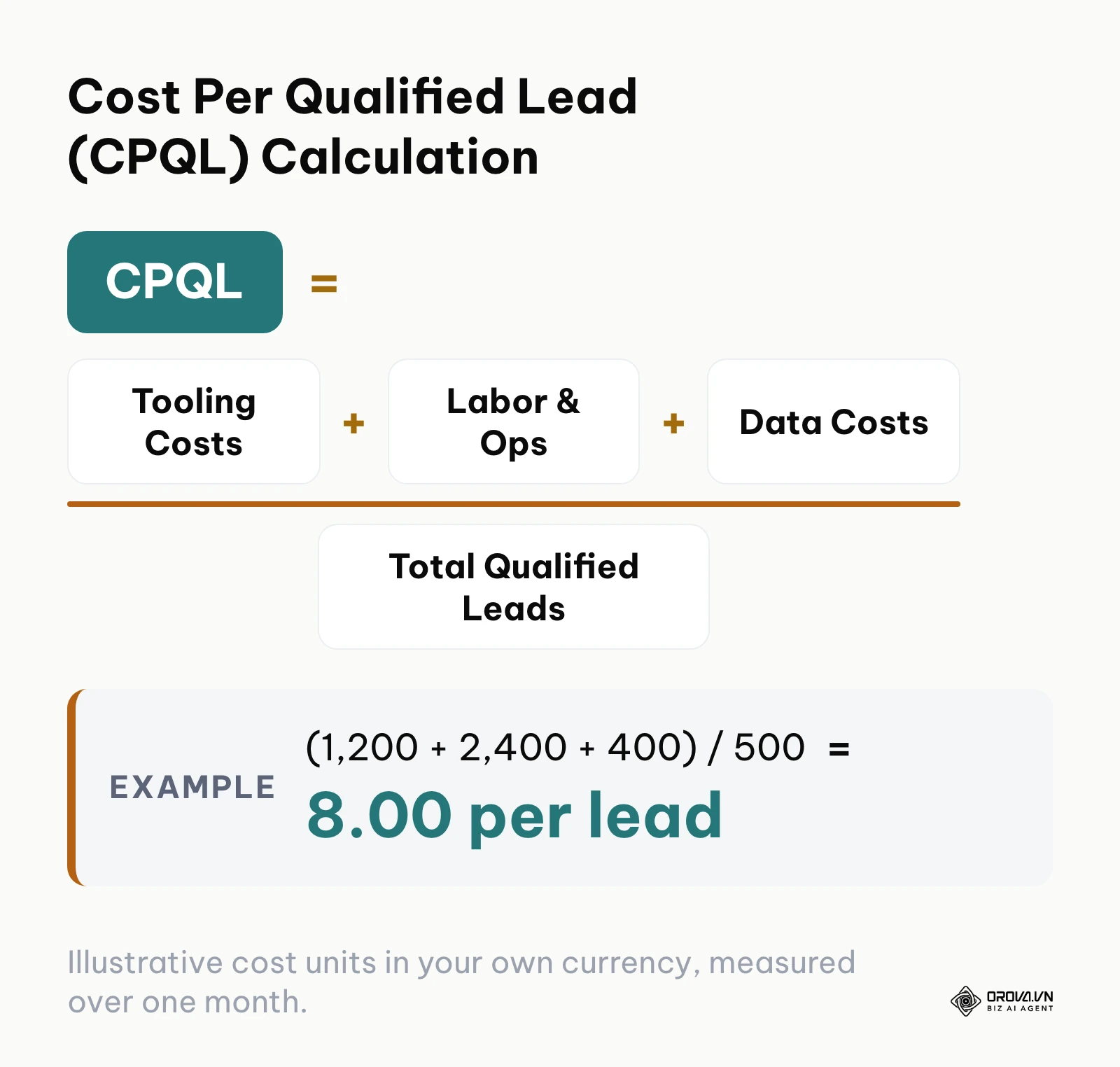
To understand the financial efficiency of your acquisition model, track Cost Per Qualified Lead (CPQL). Unlike broad marketing metrics that divide total expenditure by unvetted email contacts, CPQL measures the true fully loaded cost to secure an account that meets your strict evidence criteria. The formula below details this calculation.
The table below shows how to compare three operational models targeting 500 qualified commercial accounts per month.
| Operational Model | Software & Tool Licenses (per month) | Human Labor & Management (per month) | Cost Per Qualified Lead (CPQL) |
|---|---|---|---|
| AI prospecting bot + part-time sales ops | 450 - 900 | 1,200 | 3.30 - 4.20 |
| Outsourced lead gen agency | 0 (included in retainer) | 4,500 - 7,500 retainer | 9.00 - 15.00 |
| Internal SDR team | 1,200 - 2,200 | 12,000 (2 SDRs + manager) | 26.40 - 28.40 |
All amounts are illustrative cost units in your own currency, not market benchmarks; CPQL is the monthly total divided by 500 qualified leads. Replace them with your own invoices and payroll. For example, a team spending 1,200 on tools, 2,400 on labor, and 400 on data in one month, and producing 500 qualified leads, has a CPQL of (1,200 + 2,400 + 400) / 500 = 8.00 per qualified lead.
Track performance using a three-tier pipeline scorecard:
- Data Infrastructure Tier: Monitor email bounce rates (maintain strictly below 2%), spam complaint rates (Google's sender guidelines recommend staying below 0.1% and never reaching 0.3%), and domain health scores via Google Postmaster Tools.
- Engagement Quality Tier: Track positive reply rates on trigger campaigns versus generic campaigns, and the ratio of replies to discovery calls booked.
- Pipeline Conversion Tier: Measure the velocity of qualified accounts progressing from initial discovery to active sales opportunities within a 30-day window.
Review data bounce rates and domain health metrics weekly. Evaluate pipeline conversion velocity at the end of each monthly sales reporting cycle to identify drop-offs between qualification and closed deals.
Building an AI marketing automation stack helps connect these pipeline metrics directly to your CRM, ensuring full visibility into your customer acquisition costs.
Trends in B2B lead generation over the next few years: author's perspective
Current prospecting trends show that traditional cold outbound tactics are hitting an algorithmic wall. Enterprise email security providers and mailbox hosts are aggressively filtering unauthenticated communications, while corporate buyers are increasingly researching solutions anonymously across closed communities before contacting vendors.
I believe that over the next two to three years, static contact databases will lose much of their value for outbound teams. High employee turnover and rapid changes in tech stacks cause static databases to degrade faster than centralized brokers can update them. In my view, the market will shift decisively toward decentralized, real-time extraction engines that inspect public websites, code repositories, and job registries on demand. Outbound sales workflows will transition from static list buying to continuous signal verification.
I also expect artificial intelligence to fundamentally alter how prospecting criteria are verified. Rather than relying on rigid demographic parameters, AI agents will evaluate target accounts by analyzing public operational breadcrumbs. These systems will audit corporate case studies, parse customer feedback threads, and inspect website script deployments to confirm an account's fit before generating personalized outreach copy.
However, this prediction could prove inaccurate if major web platform operators implement aggressive anti-bot defenses that block automated search bots, or if regulatory agencies enact strict restrictions on automated business indexing. To prepare for these potential shifts, sales operations teams should invest now in building first-party data capture mechanisms, auditing their domain technical hygiene, and training their teams to build outreach around real-time buying triggers.
Frequently asked questions about B2B lead generation
How does artificial intelligence automate B2B lead qualification without manual website reviews?
Modern AI models parse the raw HTML Document Object Model and render dynamic JavaScript frameworks across target company websites. Instead of asking human sales reps to confirm whether a business uses a specific technology or targets a certain market, the system runs programmatic queries against the site's text and code architecture. The model extracts verbatim text snippets as supporting proof, matches them against user-defined criteria, and calculates a qualification score from the results of each check.
How can a business maintain email deliverability while scaling B2B lead generation outreach in 2026?
Maintaining high email deliverability requires distributing outbound message volume across multiple secondary sending domains rather than relying on a single corporate domain. Each domain must have authenticated SPF, DKIM, and DMARC DNS records, along with a custom tracking domain. Outbound volume should be capped at 30 to 35 messages per mailbox per day, and all contact lists must undergo pre-send SMTP and MX validation to keep overall bounce rates strictly below 2%.
What is the primary difference between inbound and outbound B2B lead generation?
Inbound lead generation attracts prospective buyers through search engine optimization, whitepapers, webinars, and paid advertising, capturing prospects who are actively seeking solutions. Outbound lead generation proactively identifies and contacts qualified decision-makers using signal tracking, public data extraction, and contextual cold outreach. Modern commercial teams balance both approaches to maintain pipeline stability across shifting market conditions.
How should organizations manage data privacy compliance like GDPR and CAN-SPAM during automated lead generation?
Compliance requires processing only publicly available commercial contact records that have a clear, demonstrable relationship to the prospect's professional role. Under the CAN-SPAM Act, outbound messages must include an accurate physical postal address and a clear, functional opt-out mechanism. Under GDPR regulations, organizations must document a legitimate interest assessment, process only necessary corporate contact fields, and honor opt-out and deletion requests promptly. Each team remains responsible for complying with the laws of the markets it sells into.
What is the most effective way to handle catch-all email domains during contact verification?
Catch-all domains are configured by corporate IT teams to accept all incoming messages at the server level, making standard SMTP handshake verification inconclusive. Rather than blasting unverified catch-all addresses—which risks triggering hidden bounce penalties—route these records into a separate review queue. Verify the contact through alternative channels, such as professional social media platforms, or test the address using specialized email verification tools before launching automated outreach.
Where should you start with B2B lead generation?
If you are a solo founder or leading an early-stage startup without dedicated sales operations resources, avoid purchasing expensive enterprise database subscriptions. Spend your first afternoon defining your 15-point evidence-based ideal customer profile, setting up a secondary domain with clean SPF, DKIM, and DMARC authentication records, and manually qualifying your first 50 accounts using public website evidence to validate your core value proposition.
If you are a growth marketing lead managing a sales team that is struggling with low outreach response rates, audit your existing contact database for data decay. Connect a real-time SMTP verification tool to your CRM, purge all invalid, bounced, and unverified records, and shift your sales development reps away from generic cold lists by building your first automated campaign focused entirely on companies with active executive hiring triggers.
If you lead an enterprise revenue operations department looking to modernize your technology stack, audit your current software licensing costs and calculate your fully loaded Cost Per Qualified Lead across internal and outsourced channels. Deploy an automated web-scraping bot to test signal-based data extraction against your legacy database providers, and run a controlled two-week pilot comparing response rates between static list outreach and evidence-verified prospects. Taking these focused initial steps will help you establish a dependable, scalable engine for B2B lead generation.
About the author

Builder of Orova
Nguyễn Đỗ Trọng Ân has 8 years of experience in marketing, including 6 years managing market development across Asia. He builds Orova, a Biz AI Agent that never sleeps: it plans, runs and optimizes work for businesses.
Run your business with AI Agents
Orova is the always-on Biz AI Agent — it plans, runs, and optimizes the work for you.
Save time, unlock productivity.