
Bottom of funnel content: what it is and how to drive B2B deals

Producing high-performing bottom of funnel content is the most dependable way to transform qualified search traffic into contracted revenue. Many growth teams pour substantial marketing budgets into broad educational guides, celebrating sharp increases in organic traffic while sales representatives struggle with underqualified leads and stalled pipelines. The traditional belief that generating massive top-of-funnel awareness will naturally trickle downward into customer acquisition no longer holds true. Modern evaluators do not navigate linear buying funnels. They enter the evaluation stage equipped with specific technical criteria, skeptical of generic marketing claims, and searching for granular comparisons, pricing breakdowns, and implementation realities. This comprehensive guide details how to build bottom of funnel content that operates as an internal selling engine for your prospects. You will discover practical frameworks for objective competitor comparisons, techniques to optimize for generative artificial intelligence search engines, downloadable kits to empower enterprise champions, and attribution models that prove direct pipeline velocity.
What Is Bottom of Funnel Content?
Bottom of funnel content is high-intent marketing material designed to convert qualified prospects into paying customers during their final purchase decision. It educates evaluators on product mechanics, commercial terms, and vendor trade-offs, differing from top-of-funnel awareness content by addressing specific buying objections rather than introducing broad industry topics.
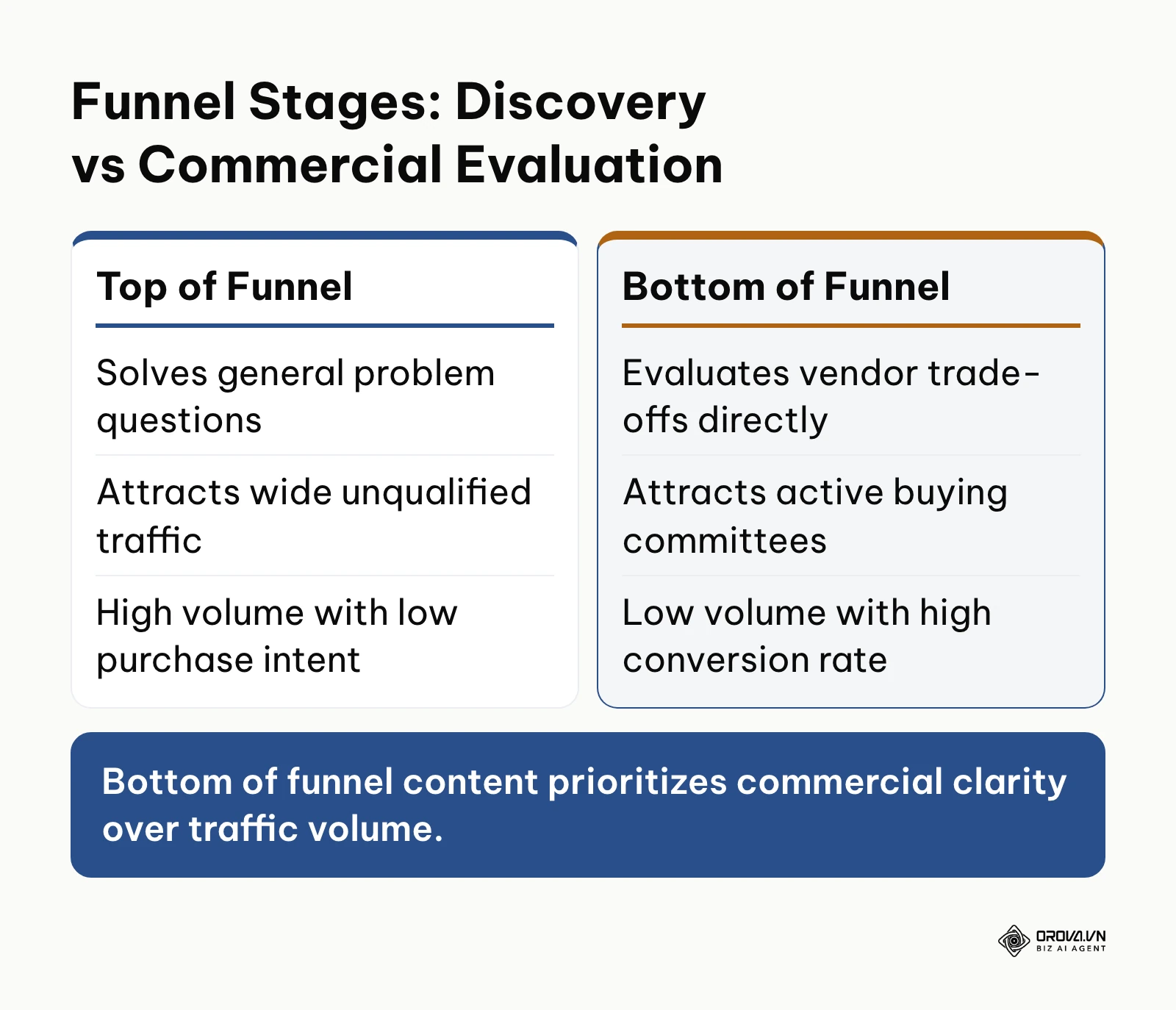
The term comes from the classic marketing funnel, which traces back to the AIDA model (Awareness, Interest, Desire, Action) usually attributed to advertising pioneer E. St. Elmo Lewis. In this model, the narrowing funnel shape illustrates how a large pool of casual observers tapers down to a small, decisive group of committed buyers. Bottom of funnel content occupies that final commercial threshold. In practice it takes a handful of recognizable forms: comparison pages, alternatives pages, pricing explainers, case studies, and migration guides. If you want the full picture of how the earlier stages feed this one, see the SaaS SEO funnel guide; this article stays focused on the final stage.
Marketers frequently conflate bottom of funnel content with standard documentation or internal sales decks. While these assets share factual product details, their operational intent differs entirely.
| Content Concept | Key Difference in Intent and Scope | Real-World Operational Example |
|---|---|---|
| Product Documentation | Written for existing users seeking implementation steps rather than evaluating commercial trade-offs. | A technical guide explaining how to configure a webhook endpoint inside an existing account. |
| Sales Enablement Decks | Internal private collateral used exclusively by sales representatives during live prospect calls. | A confidential slide deck comparing enterprise discounting tiers during late-stage procurement. |
| Middle of Funnel Guides | Explores various methodologies to solve an acknowledged problem without validating specific vendor features. | An architectural overview comparing cloud data warehouses against self-hosted data lakes. |
| Bottom of Funnel Content | Publicly accessible assets designed to help an active buyer validate why a specific product satisfies their requirements. | An in-depth head-to-head comparison analyzing two competing analytics platforms on data retention and seat pricing. |
Consider a consumer purchasing a vehicle. Top-of-funnel research involves reading articles about fuel efficiency versus battery range. Middle-of-funnel evaluation involves deciding whether an electric SUV or a plug-in hybrid suits their daily commuting habits. Bottom of funnel content corresponds to the moment the buyer visits an authorized dealership to inspect the warranty terms, calculate monthly lease payments, compare trunk dimensions against a specific competitor, and take a final test drive. In business-to-business transactions, your content must serve that exact same validating function.
The Core Purpose of Bottom of Funnel Content
Bottom of funnel content exists to resolve the final friction points that prevent an interested evaluator from committing budget to your solution. High-intent prospects rarely suffer from a lack of general knowledge. Instead, they struggle with choice overload, fear of internal embarrassment if an implementation fails, and skepticism toward vendor marketing claims. When structured properly, bottom of funnel content neutralizes these anxieties by providing transparent technical proof, clear pricing boundaries, and verifiable deployment expectations.
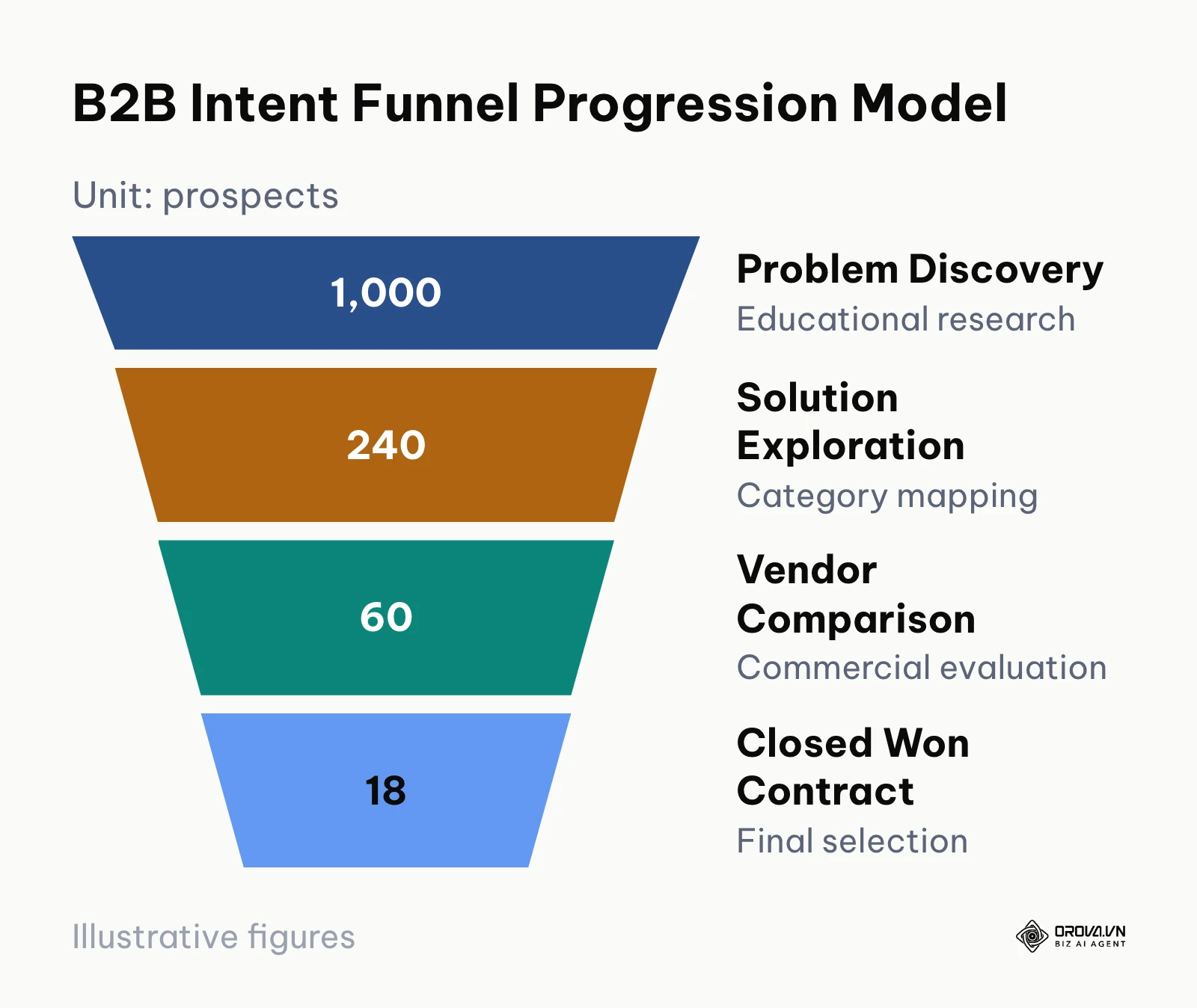
In the broader marketing ecosystem, bottom of funnel content bridges the gap between digital discovery and contractual execution. It builds upon foundational work established within your broader content strategy framework. While top-of-funnel articles introduce the problem category and middle-of-funnel pieces outline strategic solutions, bottom of funnel assets equip the buyer to defend their vendor selection before their peers, department heads, and procurement managers.
Bypassing bottom of funnel content carries severe commercial costs. First, when you refuse to publish direct comparison pages, third-party review sites and competitors will control your narrative. A prospect searching for your brand name against an established rival will land on an external forum or a competitor's biased teardown, immediately placing your product at a psychological disadvantage. Second, omitting conversion-focused content inflates customer acquisition costs. Without public pricing explainers and detailed migration guides, expensive sales representatives spend their introductory discovery calls answering basic technical specifications and pricing structures rather than diagnosing business needs.
There are specific operational moments where investing in bottom of funnel content is premature. If an early-stage startup has not yet achieved product-market fit and refactors its core feature architecture every two weeks, publishing static comparison pages wastes engineering and editorial hours. Similarly, if you are establishing an entirely novel product category where organic search volume for competitor alternatives is zero, searchers cannot find your comparison assets. In these scenarios, growth teams should prioritize direct founder customer interviews and top-of-funnel educational problem validation until consistent demand patterns emerge.
The Multi-Layered Value of Bottom of Funnel Content
Evaluating the business return of conversion-oriented marketing requires looking beyond basic web traffic. High-performing bottom of funnel content delivers distinct advantages across executive balance sheets and everyday marketing operations.
Business Value: Revenue Acceleration, Lower Customer Acquisition Cost, and Mitigated Deal Churn
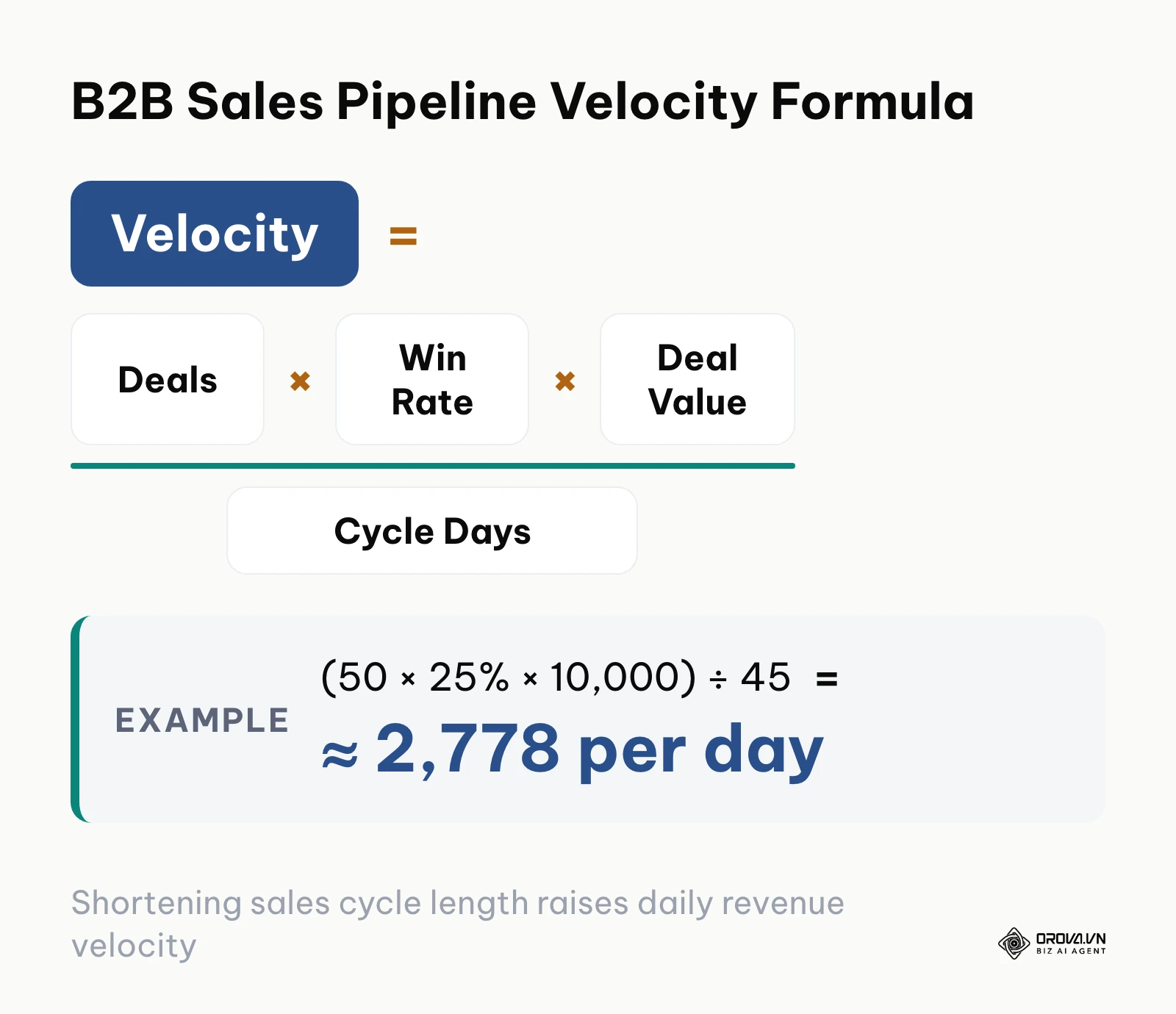
From an executive viewpoint, bottom of funnel content functions as a financial lever that directly impacts sales pipeline velocity, which represents the speed at which qualified leads convert into recognized revenue. It is usually calculated as opportunities × win rate × average deal value ÷ sales cycle length in days. Illustrative example: 50 opportunities × 25% × 10,000 deal value ÷ 45 days ≈ 2,778 in pipeline value per day. Shorten the cycle and the daily figure rises without adding a single lead.
When prospects access comprehensive comparison matrices and clear implementation timelines prior to initiating contact, they progress through sales discovery stages much faster. Aligning editorial focus with late-stage needs eliminates redundant qualification cycles and prevents pipeline stagnation.
Furthermore, transparent bottom of funnel assets protect your customer success team from post-purchase churn. When content openly communicates what a product does not support, ill-fitted customers self-disqualify before signing contracts. The customers who proceed possess realistic expectations regarding implementation scope, resulting in higher lifetime value and reduced onboarding friction.
Illustrative example: A twelve-person business-to-business software team providing automated compliance auditing noticed that while their organic blog traffic grew steadily, their sales team struggled to close outbound deals against an entrenched enterprise competitor. The content lead implemented two dedicated competitor alternative pages and a public pricing calculator that broke down monthly audit fees by employee headcount. When prospects expressed concern over migration complexity, the team embedded a step-by-step security audit checklist and an application programming interface uptime dashboard directly into the comparison asset. Within two billing cycles, prospective clients began referencing the compliance checklist on their introductory sales intake forms, and the sales team observed inbound discovery calls shortening from forty-five minutes to twenty minutes.
Practitioner Value: Streamlining Inbound Workflows and Equipping Sales Enablement
For content marketers, demand generation specialists, and sales enablement managers, bottom of funnel content provides practical utility that simplifies daily workflows. Rather than continually producing generic thought leadership articles that generate ambiguous pipeline attribution, practitioners gain assets that directly support live sales conversations.
Sales representatives frequently face prospects who raise complex technical objections regarding data security, third-party integrations, or contract cancellation terms. When high-caliber bottom of funnel assets exist, sales reps can immediately forward authoritative, branded documentation that resolves those hesitations without waiting for custom engineering review. This synergy transforms marketing from a cost center producing vanity pageviews into an active sales enablement partner.
Tracking these late-stage assets against your broader marketing dashboard KPIs provides operational clarity on which content topics contribute directly to signed customer agreements.
| Bottom of Funnel Content Benefit | Primary Measurement Metric | Expected Timeframe to Observe Impact |
|---|---|---|
| Compressed Sales Cycles | Sales Cycle Length (Average Days from Lead to Closed-Won) | 60 to 90 days following asset publication |
| Reduced Sales Objection Overhead | Average Duration of Initial Qualification Discovery Calls | 30 to 45 days after sales team asset adoption |
| Elevated Conversion Rates | Demo Request to Qualified Opportunity Conversion Percentage | 45 to 60 days following organic ranking |
| Decreased Early Account Churn | 90-Day New Customer Retention and Onboarding Completion Rate | 90 to 120 days post-contract execution |
| Improved Pipeline Velocity | Dollar Value of Active Opportunities Closed per Calendar Month | 60 to 90 days across core pipeline stages |
Discover Orova.vn – a Biz AI Agent platform with OROVA SEO, a complete solution for every website. The system supports search engine optimization from A to Z with features including keyword research, writing new SEO-ready articles, optimizing existing content, rank tracking, plus competitor analysis and in-depth technical analysis. Sign up today to experience OROVA SEO completely free (offer valid through July 7, 2027).
How Bottom of Funnel Content Works: Architecture, Formats, and Execution
Executing an effective bottom of funnel content strategy requires technical rigor, editorial discipline, and an understanding of multi-stakeholder purchasing behavior. Unlike high-level informational articles, conversion-stage pages must withstand scrutiny from technical architects, financial controllers, and executive leaders.
Component 1: Competitor Alternatives and Direct Comparison Pages
Competitor alternative pages and head-to-head comparison articles target evaluators typing explicit commercial queries into search engines, such as "[Competitor] alternatives" or "[Brand A] versus [Brand B]". These searchers have already validated their problem and are actively narrowing down vendor shortlists. A "vs" page compares two named products; an alternatives page lists several options for people leaving one incumbent, as in this roundup of Surfer SEO alternatives. For page templates, see the guide to comparison pages.
To construct these pages effectively, teams require structured inputs: accurate competitor feature sets, clear pricing tiers, verified customer review themes, and authentic product interface captures. The intended output is a definitive evaluation page that answers every practical question a buyer possesses about functional differences.
The primary failure point of competitor pages is the Bias Trap. Traditional search engine optimization articles routinely commit the fatal mistake of claiming their proprietary software wins every single evaluation category across usability, pricing, features, and support. Sophisticated evaluators immediately detect this lack of objectivity, discount the credibility of the entire page, and bounce back to search results.
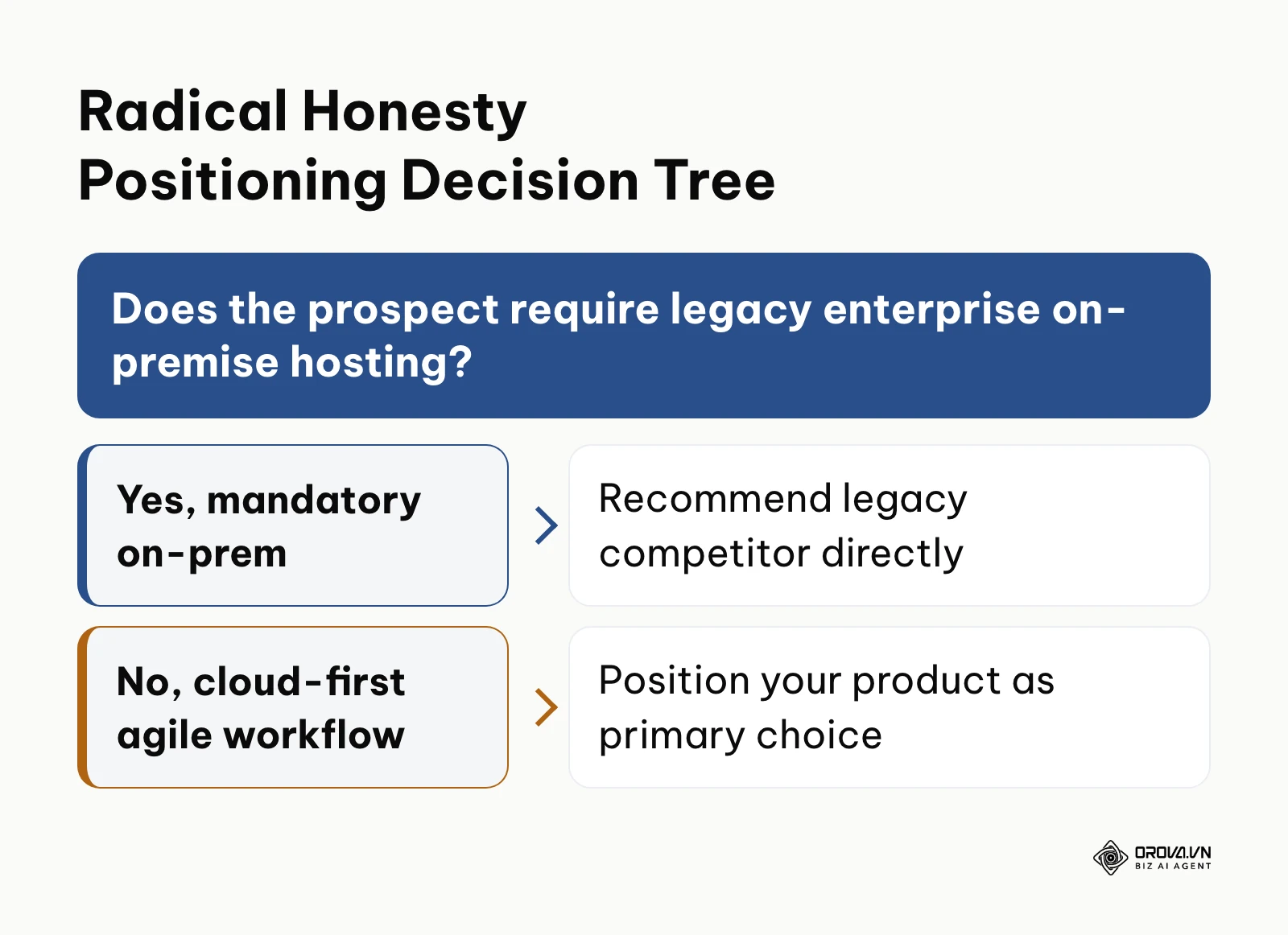
To build trust that converts, implement the Radical Honesty Comparison Framework. This approach demands that you openly acknowledge areas where your competitor excels and clearly define who should choose their product over yours.
| Evaluation criteria | Primary competitor profile | Our product |
|---|---|---|
| Ideal organization size | Global enterprise | Mid-market and scale-up teams |
| Hosting | Dedicated on-premise | Multi-tenant cloud |
| Deployment timeline | Multi-month implementation | Self-serve setup |
| Extensibility | Proprietary scripting | Standard REST API and webhooks |
| Pricing visibility | Custom quote only | Public tiers |
| Who it is NOT for | Fast-moving teams needing instant deployment | Organizations requiring air-gapped on-premise servers |
When you transparently declare that an enterprise requiring legacy on-premise server deployment should choose your competitor, you earn credibility. When you then argue that your platform fits cloud-first teams prioritizing rapid implementation, buyers are far more likely to take the claim seriously.
Component 2: Generative Engine Optimization for AI Search and Answer Engines
As of 2026, many buyers also use generative artificial intelligence search platforms, such as Perplexity, ChatGPT Search, and Google AI Overviews, for early vendor research (Google AI Overviews are available in markets such as the United States and the United Kingdom). Rather than browsing ten blue links, evaluators prompt AI engines with complex, multi-variable queries: "Compare Solution A and Solution B on SOC2 Type II compliance, seat-based pricing, and HubSpot synchronization for a fifty-person team."
Generative Engine Optimization (GEO) ensures your bottom of funnel content is ingested, understood, and cited as an authoritative source by large language models.
To optimize your comparison pages for artificial intelligence extraction, adhere to four structural principles:
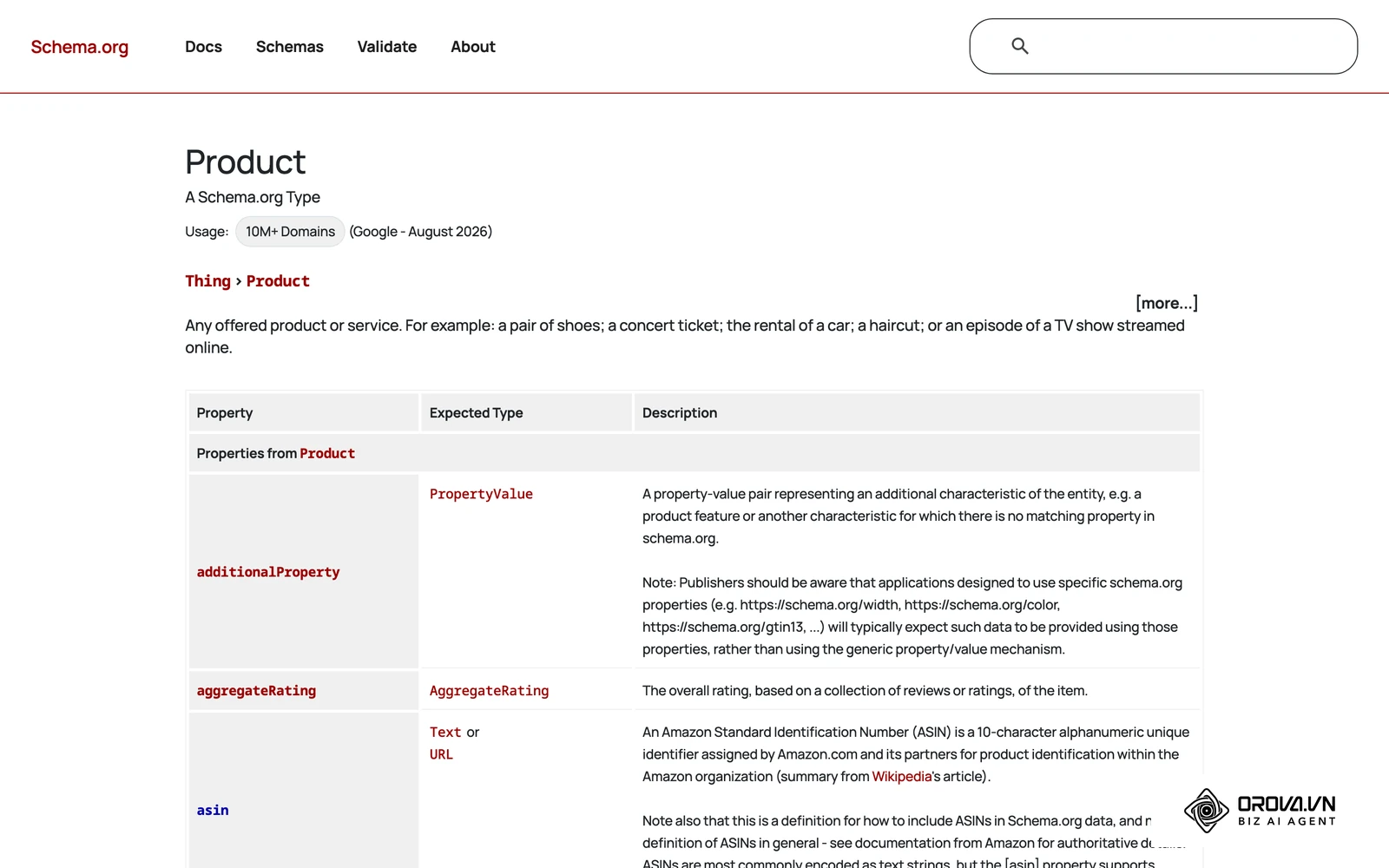
- Structured Schema Markup: Embed accurate Product, Review, or SoftwareApplication structured data using JSON-LD. Note that Google stopped showing FAQ rich results on May 7, 2026, so FAQPage markup no longer earns a special search snippet; a plain, well-written FAQ section is still useful to readers and AI systems. This provides machine-readable signals regarding features, pricing parameters, and operational capabilities without relying on ambiguous text parsing.
- Machine-Readable Markdown Tables: Format all comparative data inside clean HTML or Markdown tables with explicit header rows. Large language models prioritize tabular structures when answering comparative prompts because tables present unambiguous key-value relationships.
- Objective Declarative Syntax: Avoid marketing superlatives like "the most revolutionary interface on the market" or "unparalleled customer delight." Large language models favor neutral, factual assertions such as "includes native bidirectional HubSpot contact synchronization via REST API with a five-minute sync interval."
- Entity Disambiguation: Clearly reference established software categories, compliance frameworks, and industry terminology within the opening sentences of every section to reinforce topical knowledge graph connections.
Component 3: Buying Committee Enablement and Internal Champion Content Kits
In business-to-business transactions, the individual reading your bottom of funnel content is rarely the sole decision-maker. Instead, they act as an internal champion: a practitioner or team lead who loves your product but must now convince an internal buying committee consisting of a Chief Financial Officer, an Information Security Officer, and a Department Head.
Buying groups spend much of their journey away from vendors: reconciling internal stakeholder priorities, reviewing documentation, and evaluating compliance risks internally. If your bottom of funnel content only addresses the practitioner, your champion will struggle to defend your software in executive meetings.
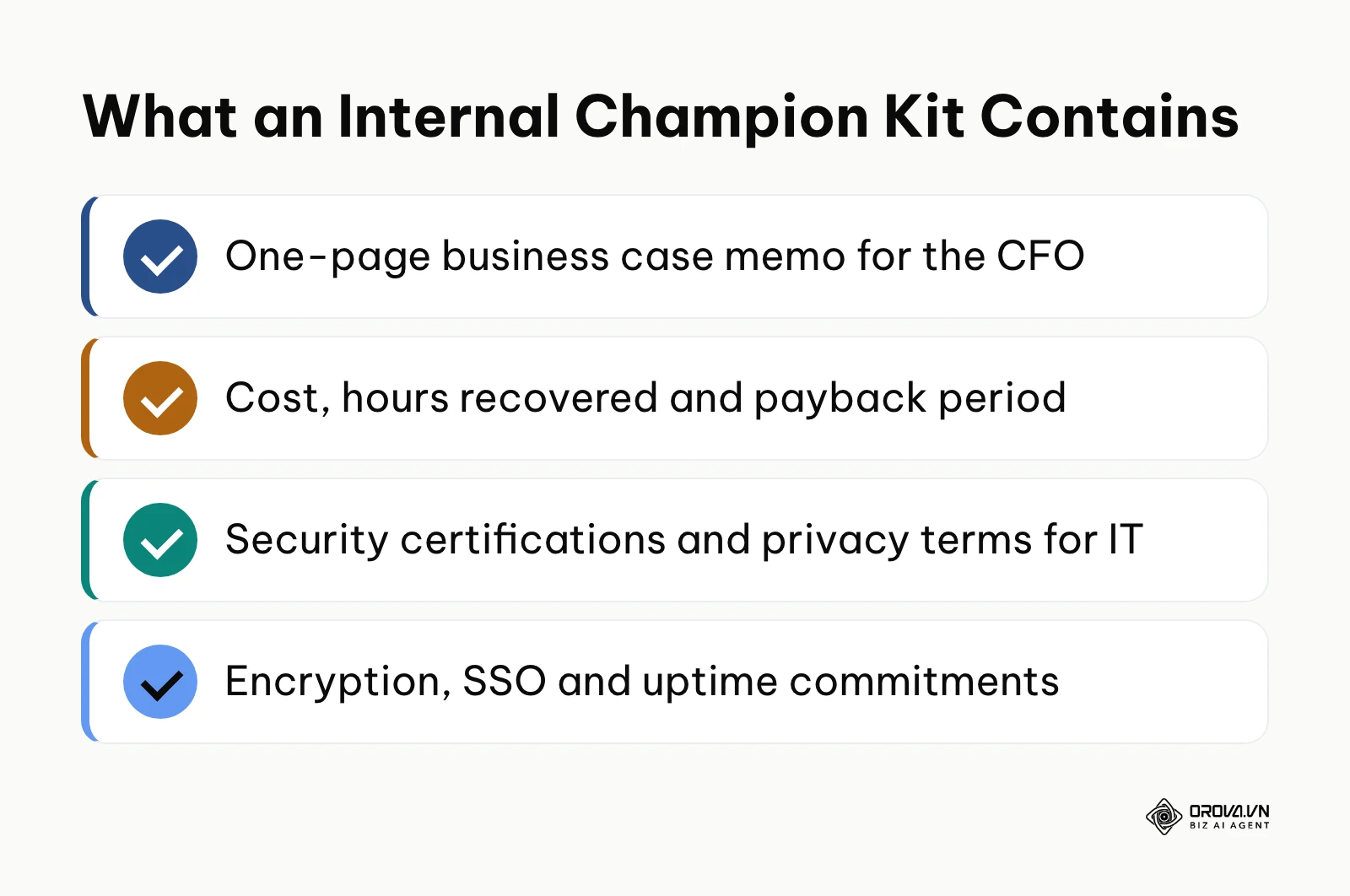
To solve this challenge, incorporate an Internal Champion Selling Kit directly into your bottom of funnel assets as downloadable or copyable executive memos.
The 1-Page Business Case Memo for the CFO
MEMORANDUM: Business Case for Modernizing Our Software Infrastructure
TO: Chief Financial Officer / Executive Leadership Team
FROM: [Internal Champion Name / Department Lead]
DATE: [Date]
SUBJECT: Capital Allocation Request for Vendor Modernization

1. EXECUTIVE SUMMARY & PROBLEM STATEMENT:
Our team currently spends an estimated [X] manual hours weekly managing disjointed
workflows and reconciling administrative discrepancies across legacy spreadsheets.
This operational friction creates delayed campaign delivery and limits output capacity.

2. PROPOSED VENDOR SELECTION:
We recommend deploying [Software Name] on their professional tier. This platform
consolidates automated workflow scheduling, multi-channel publishing, and direct
performance measurement into a single unified workspace.

3. FINANCIAL IMPACT & RETURN ON INVESTMENT:
- Direct Annual Software Cost: [annual subscription cost from the vendor's pricing page].
- Anticipated Labor Capacity Recovered: [hours per week saved] x [team members] x 52.
- Labor Value Restored: [hours recovered] x [loaded hourly cost].
- Projected Payback Period: [annual cost] ÷ [monthly labor value restored].

4. IMPLEMENTATION RISK MITIGATION:
The vendor provides automated REST API migration utilities, with a documented
cutover plan. Expected deployment: [N] calendar days, with a parallel-run period
before we switch off the current tool.
The Technical and Security Compliance Checklist for IT
Provide an easily scannable section that addresses enterprise architecture and data governance requirements:
- Security Certifications: SOC2 Type II compliance audit reports available under standard mutual non-disclosure agreements.
- Data Privacy Protocols: Full adherence to General Data Protection Regulation (GDPR) and California Consumer Privacy Act (CCPA) standards with signed Data Processing Agreements.
- Encryption Architecture: AES-256 bit encryption for data at rest; TLS 1.3 encryption for all data in transit across public networks.
- Identity & Access Management: Native Single Sign-On (SSO) integration supporting SAML 2.0 and SCIM provisioning for automated seat management.
- Uptime Reliability & SLAs: Contractually guaranteed 99.9% application uptime backed by real-time status dashboards and financial service credits.
Component 4: High-Velocity Migration and Switching Guides
Prospects currently utilizing a competitor platform represent the highest-intent audience in your market. They have already secured budget, established organizational need, and experienced the frustration of inadequate software. However, the greatest barrier preventing them from switching is not product interest, but the fear of operational disruption, data loss, and lengthy employee retraining.
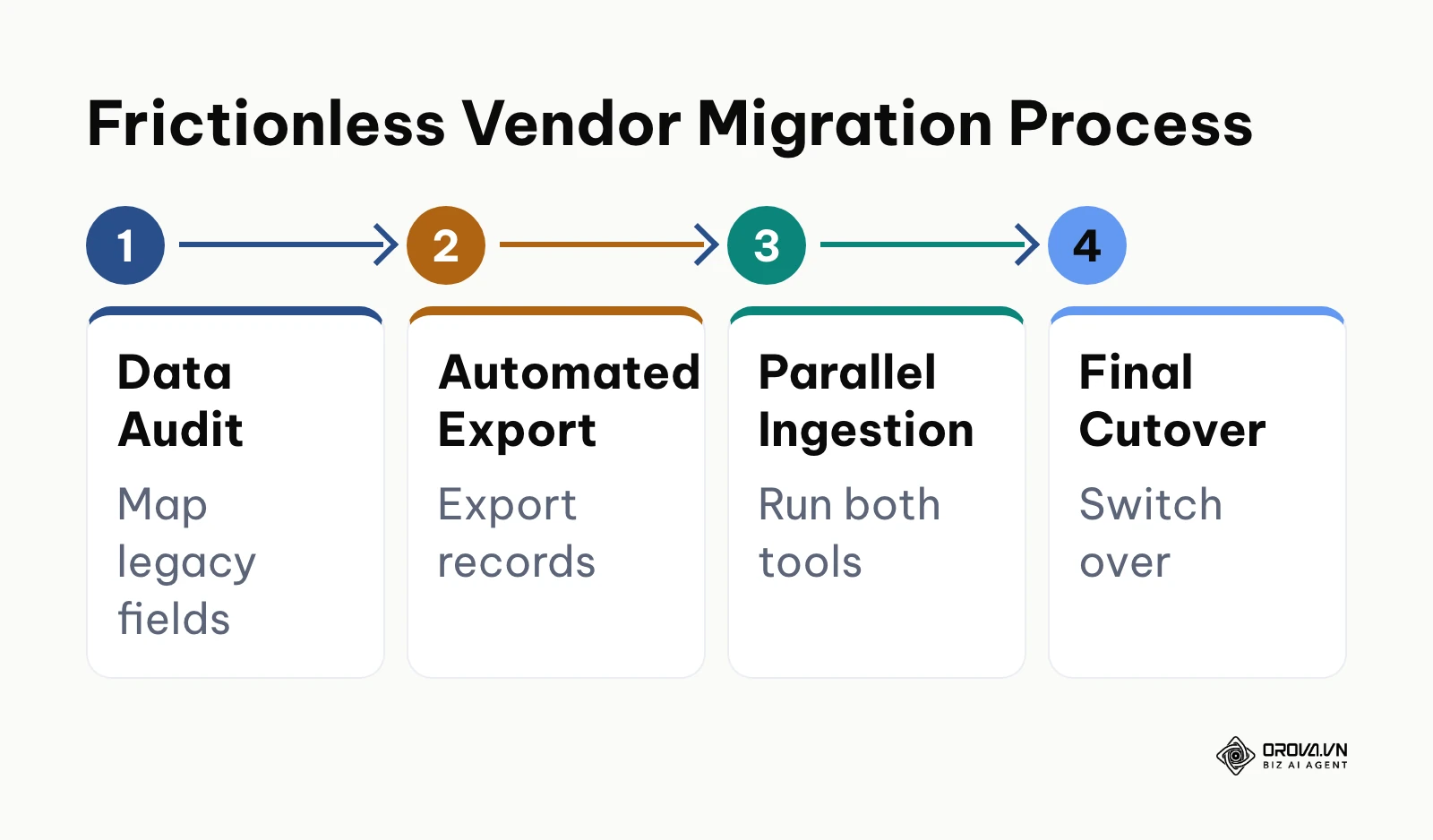
A high-velocity migration guide eliminates this anxiety by detailing the exact steps required to transition accounts smoothly:
- Pre-Migration Audit Checklist: A structured inventory list helping the client identify active webhooks, user seats, and historical data tables that require archiving.
- Automated Data Mapping Protocols: Explaining how your import utility maps legacy competitor database fields to your modern architecture without manual CSV editing.
- Zero-Downtime Parallel Ingestion: Demonstrating how the customer can run both platforms concurrently during an onboarding window to verify operational parity before cutting over live production traffic.
- Post-Migration Parity Verification: A validation script or quality assurance checklist confirming that all active integrations operate without latency.
Component 5: Verifiable Case Studies and Granular Social Proof
General customer testimonials stating that a tool is "amazing" or "helped our business grow" carry negligible conversion weight in bottom of funnel environments. Evaluators demand verifiable, operational proof that mirrors their specific company size, technology stack, and industry regulatory constraints.
Structure your case studies around clear operational milestones: baseline operational bottlenecks, implementation timeframe, integration challenges encountered, and verified performance deltas. Linking these real-world narratives directly to your broader social proof and customer success materials validates your claims and reinforces the rest of your funnel. A useful case study follows a fixed shape: customer profile, starting problem, what changed, how long it took, and the before-and-after metric, stated only if the customer agreed to publish it.
Component 6: Multi-Touch Revenue Attribution and Pipeline Velocity Modeling
A persistent challenge for marketing leaders is proving the direct pipeline impact of bottom of funnel content when sales cycles span ninety days or involve multiple stakeholder touchpoints. Start by defining what counts as a conversion; this explainer on the conversion event covers the setup. Relying solely on last-click analytics fails because buyers frequently browse comparison articles on mobile devices or work laptops before booking a demo through a branded search navigation path weeks later.
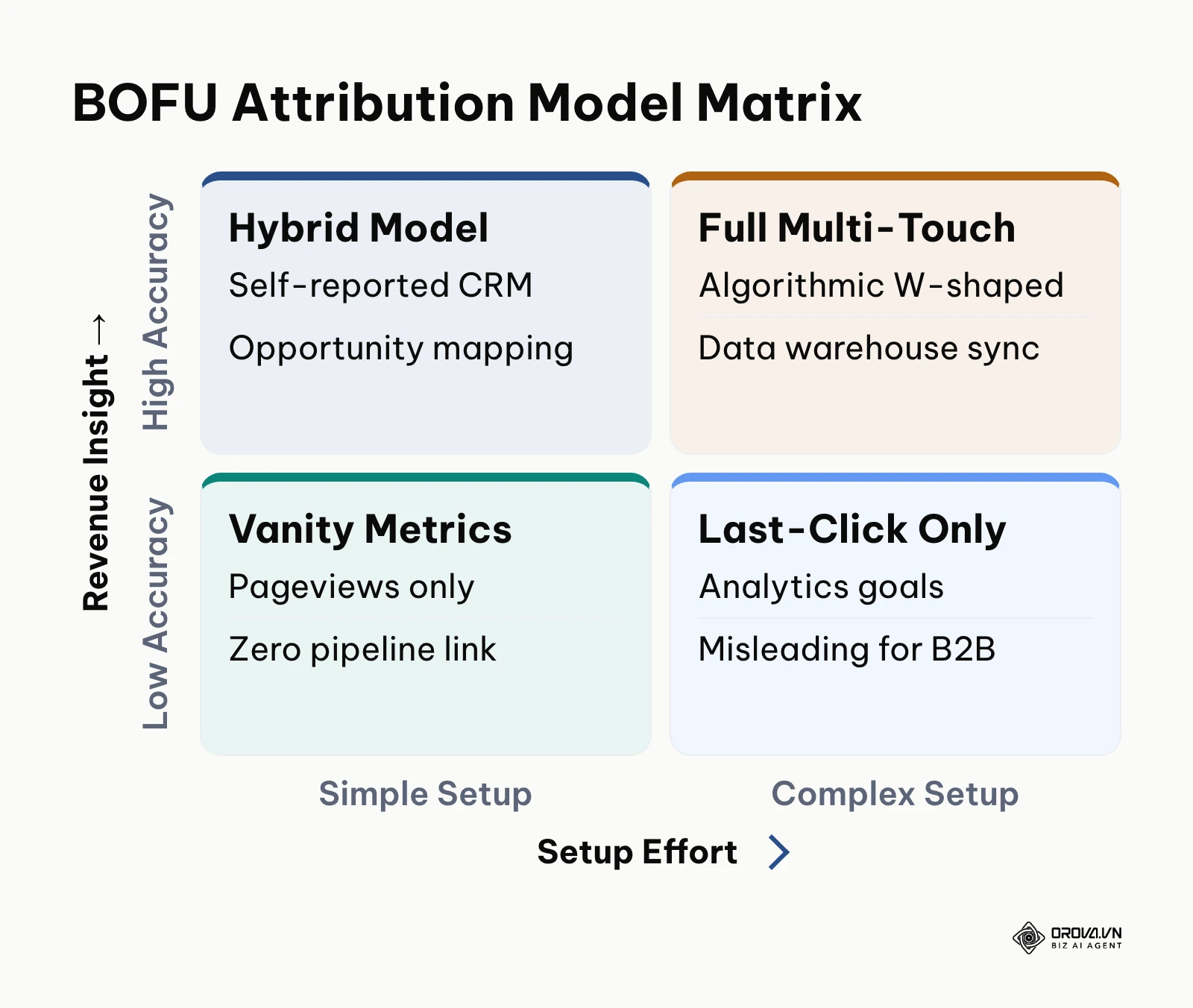
To capture genuine pipeline influence, implement a three-tier attribution framework:
- Mandatory Self-Reported Attribution: Place an open text form field on your inbound demo request page asking: "What specific article, comparison page, or resource convinced you to evaluate us today?" Buyers at the bottom of the funnel routinely name specific comparison guides or competitor teardowns.
- Opportunity URL Engagement Tracking: Utilize customer relationship management (CRM) automations in HubSpot or Salesforce to map every web session associated with a business email domain during an active deal cycle.
- Pipeline Velocity & Win Rate Delta Analysis: Calculate the win rate of sales opportunities that engaged with at least one bottom of funnel asset against opportunities that engaged exclusively with top-of-funnel content or outbound cold emails.
To read search-side demand for these pages, the Google Search Console reports show which "vs", "alternatives", and "pricing" queries already bring impressions. Then use this formula in your revenue spreadsheet:
BOFU win-rate lift (%) = (win rate of deals that touched BOFU content − baseline win rate) ÷ baseline win rate × 100
| Bottom of Funnel Content Format | Core Operational Characteristics | Ideal Buyer Context & Segment |
|---|---|---|
| Direct Head-to-Head Comparisons | Two-vendor feature matrices, pricing teardowns, and architecture evaluations. | Buyers choosing between two finalized short-listed vendors. |
| Multi-Competitor Alternative Hubs | Comprehensive roundups categorizing alternatives by operational scale and use cases. | Disillusioned customers actively seeking replacements for legacy incumbents. |
| Technical Migration Blueprints | Step-by-step data schema mapping, API export scripts, and downtime prevention plans. | Technical teams hesitant to switch due to operational disruption risks. |
| Transparent Pricing Teardowns | Interactive cost calculators, seat expansion tiers, and hidden fee disclosures. | Procurement officers and CFOs validating budget requirements. |
| Interactive Product Walkthroughs | Self-guided clickable sandboxes showcasing real application workflows. | Evaluators wanting to verify usability before booking live sales demos. |
| Specialized Business Case Memos | Downloadable executive summaries outlining expected ROI and labor recovery. | Internal champions preparing formal budget allocation requests. |
Illustrative example: A forty-person mid-market data integration provider faced stagnant conversion rates on their primary demo booking page. The product marketing team audited their pipeline and discovered that many qualified prospects stalled during the final security review stage because buyers worried about cloud migration downtime. The team published an exhaustive competitor migration guide that included a downloadable one-page CFO business case memo, JSON-LD Product schema, and a step-by-step parallel ingestion blueprint. When competitors warned buyers that switching platforms would cause data corruption, the provider's sales team simply sent the prospective client the technical migration blueprint. Within sixty days, prospects began sharing the CFO memo directly with their finance directors, and inbound deals touching the migration guide achieved an eight-day reduction in their average contract signing timeline.
Actionable Implementation: How to Deploy Bottom of Funnel Content Across Teams
Executing high-converting bottom of funnel content requires tailoring workflows to organizational capacity. Whether you operate as an independent founder, lead an enterprise marketing team, or manage client deliverables within an agency, execution must follow a structured progression.
For Bootstrapped Founders and Small Business Owners
- Audit Closed-Won and Closed-Lost Sales Notes This Week: Review your recent customer acquisition conversations and identify the single competitor mentioned most frequently by prospects.
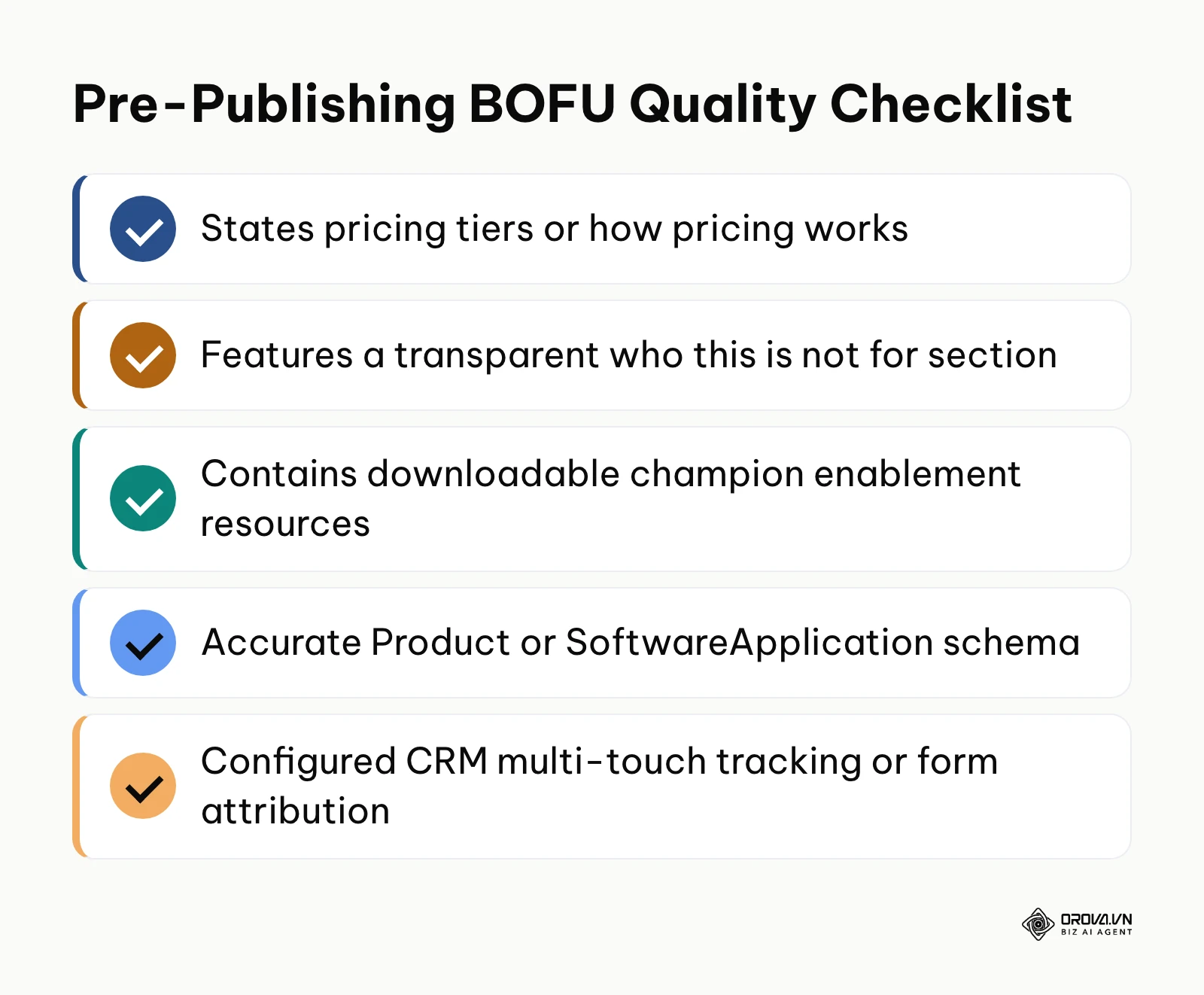
- Publish an Unbiased "Who We Are NOT For" Page: Create a straightforward comparison article that clearly outlines three operational scenarios where your product is the ideal choice and two scenarios where the prospect should select your competitor.
- Embed Public Pricing Boundaries: Eliminate ambiguity by publishing your base monthly pricing and explicit tier upgrade conditions directly on your website.
- Draft a Simple 1-Page Business Proposal Template: Provide prospective buyers with a short downloadable memo they can forward to their business partner or accountant to justify the expenditure.
For In-House Marketing Leaders and Content Strategists
- Extract Search Console Evaluation Queries This Week: Audit your search console properties for commercial queries containing terms like "pricing," "alternatives," or "vs" that currently land on generic product homepages.
- Establish the Radical Honesty Evaluation Matrix: Collaborate with sales engineers and customer support managers to map out genuine competitor strengths and technical limitations across fifteen specific criteria.
- Implement Full Schema Markup and Machine-Readable Tables: Add accurate Product or SoftwareApplication structured data and clean comparison tables to late-stage evaluation pages.
- Deploy Self-Reported Attribution Fields: Add an open-ended form field on demo confirmation screens to track which specific comparison guides influenced the prospect's booking decision.
- Construct Champion Enablement Portals: Develop dedicated security and financial justification packets that sales representatives can distribute following discovery calls.
For Marketing Agencies and Independent Consultants
- Conduct a Client Competitor Positioning Audit This Week: Evaluate your client's top three revenue competitors and identify gaps where no authoritative comparison or migration content currently exists.
- Transition Editorial Calendars from TOFU to BOFU: Shift part of the client's monthly content production budget away from low-intent informational articles toward high-intent comparison and migration assets.
- Design Standardized Champion Selling Kits: Package one-page business case memos and technical compliance checklists as core deliverables within your conversion optimization retainers.
- Report on Pipeline Influence Rather Than Vanity Traffic: Shift monthly executive reporting dashboards away from raw organic impressions toward assisted conversions, demo requests, and closed pipeline attribution.
| Phase | Deliverables | Owners |
|---|---|---|
| Week 1: Discovery | Objection audit and competitor query mapping | Content lead, sales reps |
| Week 2: Synthesis | Honest scorecard draft and compliance checklist | Product marketing, sales engineering |
| Week 3: Assembly | Drafting, schema markup, CFO memo | Content strategist, web developer |
| Week 4: Launch | Publishing, sales training, CRM tracking | Marketing ops, sales enablement |
| Execution Mistake | Business & Pipeline Consequence | Preventive Action |
|---|---|---|
| Complete Vendor Self-Bias | Evaluators immediately identify dishonest comparisons and bounce to external review platforms. | Enforce the Radical Honesty framework by explicitly stating competitor strengths and ideal customer profiles. |
| Hiding All Pricing Information | Prospects assume the software is prohibitively expensive and abandon evaluation. | Display transparent starting prices or clear operational pricing tiers directly on comparison pages. |
| Neglecting the CFO Persona | Evaluators love the software but cannot justify the capital expenditure to finance directors. | Include a downloadable one-page business case memo detailing labor capacity recovery and payback timeframes. |
| Writing Only for Human Eyes | Artificial intelligence answer engines misinterpret or ignore unstructured comparison prose. | Format comparison criteria using machine-readable HTML tables and structured JSON-LD schema markup. |
| Measuring Pageviews Over Deals | Marketing teams optimize for traffic volume rather than closed-won revenue impact. | Track late-stage content success using self-reported form attribution and CRM opportunity pipeline velocity. |
Illustrative example: A boutique digital agency managing marketing campaigns for three specialized financial technology companies discovered that their clients were dissatisfied with monthly reports showing high organic blog traffic but stagnant sales pipeline growth. The agency audited the clients' editorial calendars and replaced four generic top-of-funnel educational articles with two competitor alternative guides and a dedicated data security compliance checklist. During the initial rollout, one client expressed concern that publishing public competitor comparisons would invite competitive retaliation, but the agency mitigated this by relying strictly on verified, publicly documented pricing and feature specifications. Within forty-five days, the fintech clients observed their first direct enterprise inbound requests that cited the comparison guides verbatim in their intake notes, prompting the clients to extend their ongoing retainers.
Once these pages exist, test their layout and calls to action with the methods in this guide to conversion rate optimization, and connect them to your wider lead generation content marketing.
With OROVA.VN and the OROVA SEO module, you put an end to the exhausting days of manual work for good. Instead of struggling for hours to write articles and compile reports, the entire process is now optimized and completed in just 5 minutes.
Bottom of Funnel Content Trends in the Coming Years: Author Perspectives
The mechanisms governing how businesses evaluate and purchase software are shifting rapidly. Drawing upon operational patterns visible across the industry today, I anticipate three transformative shifts in how conversion-stage marketing will function over the next two to three years.
First, I believe AI purchasing assistants will take over a growing share of initial vendor shortlisting. As of 2026, corporate evaluators already use conversational interfaces to synthesize software capabilities. In the coming years, procurement teams will instruct specialized autonomous agents to evaluate API documentation, security compliance certifications, and pricing tiers across dozens of vendors simultaneously. Content marketers who rely on narrative storytelling and emotional sales copy will find their assets ignored by automated crawlers. To prepare, growth teams must structure their bottom of funnel content into machine-readable knowledge graphs, standardized comparison tables, and unambiguous semantic entities. This prediction could prove incorrect if enterprise security regulations strictly prohibit autonomous procurement agents from accessing external web networks or if enterprise buyers insist on personal relationship-based evaluations.
Second, I think gated sales discovery calls will become less common as buyers demand radical self-serve transparency. Today, forward-thinking software vendors publish granular pricing calculators and interactive sandboxes directly on their public websites. Over the next three years, I expect more buyers to grow impatient with sales teams that hide basic pricing behind mandatory qualification calls. Content creators should begin publishing transparent commercial criteria, including implementation timelines and contract termination terms, directly within their comparison assets today. This trend may fail to materialize if macroeconomic volatility forces software vendors back into opaque pricing models to protect profit margins during enterprise negotiations.
Third, I suspect role-specific champion portals will gradually supplement static downloadable case study files. Rather than handing prospective buyers generic case study documents, modern software platforms will allow evaluators to generate interactive business cases tailored to their exact industry and headcount in a single click. Marketing teams should prepare by modularizing their customer proof points into queryable component blocks rather than long-form static articles. This transition could be delayed if marketing teams lack the engineering bandwidth required to deploy interactive dynamic web applications.
Frequently Asked Questions About Bottom of Funnel Content
Is bottom of funnel content still necessary when AI answer engines summarize vendor options?
Bottom of funnel content remains necessary because generative artificial intelligence platforms do not generate facts out of thin air; they extract and synthesize information directly from high-authority, structured web documents. When you publish objective comparison matrices, detailed migration workflows, and verified customer case studies, you supply the exact factual data that conversational engines cite in their synthesis answers. If you do not publish these conversion assets, artificial intelligence engines will draw their answers directly from your competitors' comparison pages.
How do you write an honest competitor comparison without driving prospects away?
Writing an effective competitor comparison requires applying the Radical Honesty framework, which openly acknowledges your competitor's genuine functional strengths and clearly defines customer profiles that are ill-suited for your product. When you explicitly inform readers about scenarios where your software is not the right choice, you build trust that validates your credibility. Prospects whose requirements align with your strengths tend to convert more readily because they know your claims are grounded in factual reality.
How can bottom of funnel content help non-technical users convince their finance team to release budget?
Bottom of funnel content supports non-technical evaluators by providing structured Champion Enablement Kits that translate software features into executive financial metrics. Incorporating a downloadable one-page business case memo outlines the executive problem statement, direct capital costs, and projected labor recovery in terms a Chief Financial Officer respects. This collateral allows your internal champion to present a defensible financial justification during formal procurement meetings without requiring technical expertise.
How do you accurately attribute revenue to a blog post when B2B sales cycles span several months?
Attributing revenue across extended sales cycles requires combining qualitative self-reported attribution with multi-touch customer relationship management tracking. Adding an open-ended form field on your demo booking page captures the specific comparison guides that influenced the buyer's decision, while CRM automation tracks website addresses visited by company email domains during the deal cycle. Measuring the win rate and pipeline velocity delta between opportunities that touched conversion assets and those that did not provides a clear picture of revenue impact.
How frequently should bottom of funnel comparison pages and migration guides be updated?
Conversion-stage assets should undergo a structured operational audit at least once every calendar quarter to maintain absolute factual accuracy. Competitors frequently modify their pricing tiers, adjust packaging boundaries, release new integration capabilities, and update security certifications throughout the year. Presenting outdated competitor specifications damages your credibility and exposes your team to prospect skepticism during live sales discovery calls.
Should pricing details be made publicly accessible within bottom of funnel articles?
Publishing transparent pricing ranges or operational cost parameters is recommended whenever feasible for modern software products. High-intent evaluators actively search for pricing clarity to determine whether a solution fits within their departmental budgetary constraints. When you hide basic pricing behind mandatory discovery calls, time-constrained evaluators frequently abandon your site and choose competitors who provide transparent cost expectations upfront.
Where Should You Start?
Transforming your digital presence into a consistent conversion engine requires taking concrete action based on your current operational maturity.
If your business currently possesses zero conversion-stage marketing assets, your immediate objective is to audit your sales call notes from the past quarter. Identify the single competitor that prospects mention most frequently during discovery conversations, schedule an afternoon session with your sales engineers, and write a neutral head-to-head comparison outline that details three features where your product excels and two features where the competitor is the stronger choice.
If your team has published scattered, disconnected conversion assets across various web pages, your focus must center on consolidation and champion enablement. Gather your disparate customer quotes, security compliance summaries, and implementation timelines into a single, cohesive Champion Enablement Kit that your sales team can link to in their email signatures and follow-up templates.
If your marketing organization actively produces late-stage articles but struggles to prove revenue contribution to executive leadership, focus on measurement infrastructure. Add a single open-ended self-reported attribution question to your primary demonstration booking form asking prospects which specific comparison resource influenced their evaluation, and map those responses directly to closed-won opportunities inside your customer relationship management platform.
Executing these initial steps will systematically eliminate buyer hesitation, shorten your team's sales cycles, and prove the tangible commercial value of high-performing bottom of funnel content.
About the author

Builder of Orova
Nguyễn Đỗ Trọng Ân has 8 years of experience in marketing, including 6 years managing market development across Asia. He builds Orova, a Biz AI Agent that never sleeps: it plans, runs and optimizes work for businesses.
Run your business with AI Agents
Orova is the always-on Biz AI Agent — it plans, runs, and optimizes the work for you.
Save time, unlock productivity.