
10 best Surfer SEO alternatives in 2026, compared by workflow

You are staring at a content editor, watching a gauge stubbornly sit at 68/100. To turn it green, the tool insists you add the phrase "best CRM for small business" five more times into a 500-word section. You know it will sound robotic. Your writer knows it will sound robotic. But the gamification of optimization has trained us to chase the score, regardless of readability. This is the exact moment many professionals start searching for a capable surfer seo alternative.
For years, platforms dictating keyword density were the undisputed champions of on-page optimization. They provided a much-needed roadmap for an SEO blog strategy and for everyday SEO content writing. However, as search engines have aggressively evolved to understand context, semantics, and human intent, the traditional model of strictly counting terms is beginning to show its age. If you are managing a growing team, monitoring tight budgets, or simply tired of compromising your brand's voice for an arbitrary metric, finding the right replacement is crucial. This guide compares the main alternatives by how they score text and fit your workflow, and provide a roadmap for transitioning your team without risking your hard-earned traffic.
Surfer SEO Alternatives: Why Are Teams Switching?
The search for alternatives is rarely driven by a single missing feature; it is usually a combination of operational friction and strategic misalignment. Teams are realizing that while traditional on-page tools are powerful, they often enforce a workflow that doesn't scale elegantly across diverse content types.
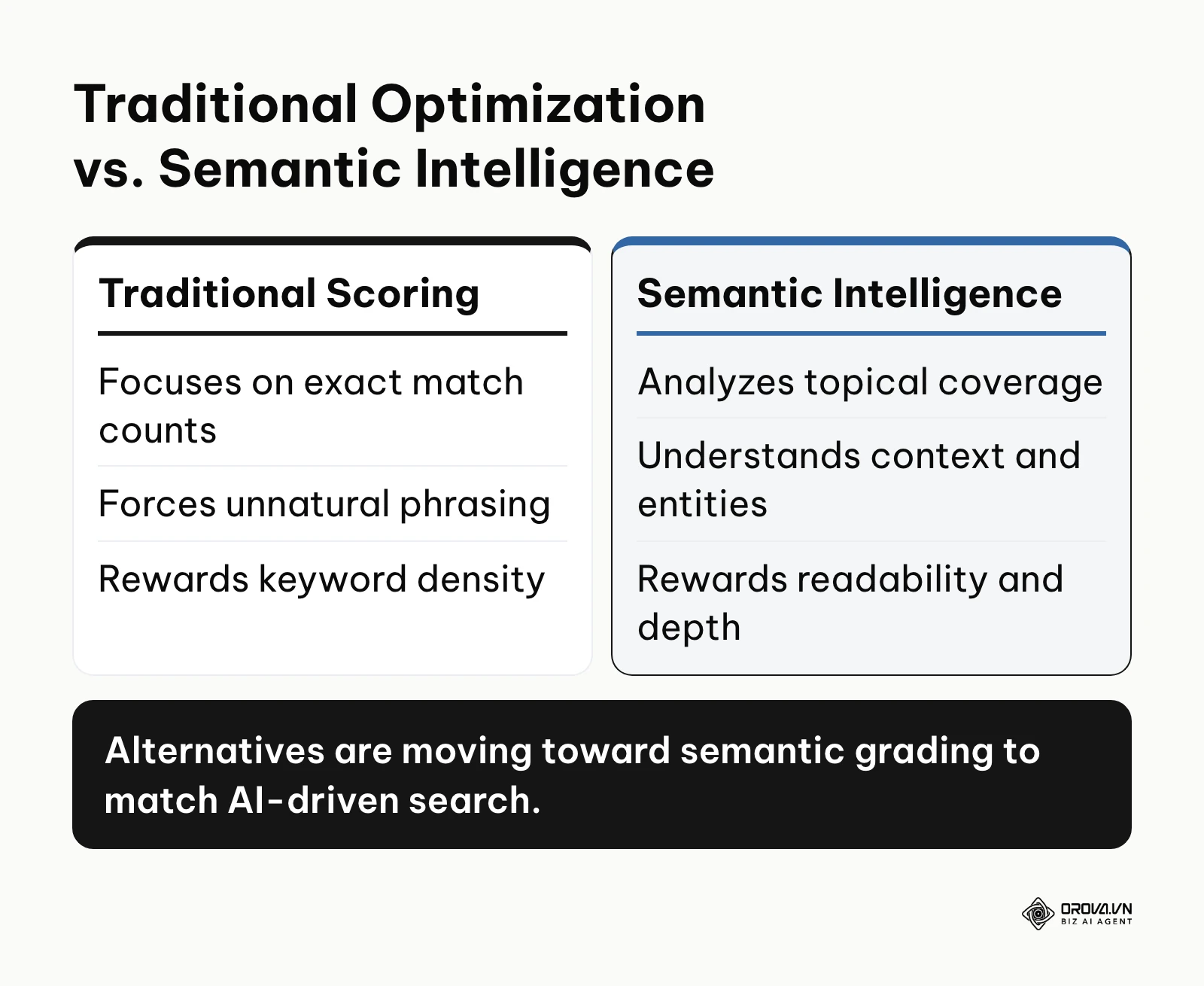
The primary catalyst for exploring a surfer seo alternative often comes down to the fundamental question: is surfer seo worth it for our specific operation? For high-volume publishers or agencies scaling their client base, usage-based plans can become a noticeable line item, and editorial teams may feel pressured to "get it right" on the first pass instead of drafting freely. Check the current plan details on each vendor's official pricing page before you compare costs.
Furthermore, there is a growing backlash against what the industry calls "Frankenstein content." When an algorithm demands the unnatural insertion of exact-match long-tail keywords—often ignoring basic grammar or logical flow—the resulting text suffers. Writers spend more time reverse-engineering the scoring system than crafting compelling narratives. Teams are actively seeking tools that evaluate the comprehensiveness of a topic rather than the sheer repetition of target phrases. They want software that understands that "cost of acquisition" and "CAC" serve the same semantic purpose, freeing writers to focus on quality rather than compliance.
The Semantic Scoring Test: A Side-by-Side Reality Check
It is easy to compare pricing tiers, but how do these tools actually interpret text? To find a genuine surfer seo alternative, you must understand how different algorithms grade the exact same paragraph. Not all scoring mechanisms are created equal.
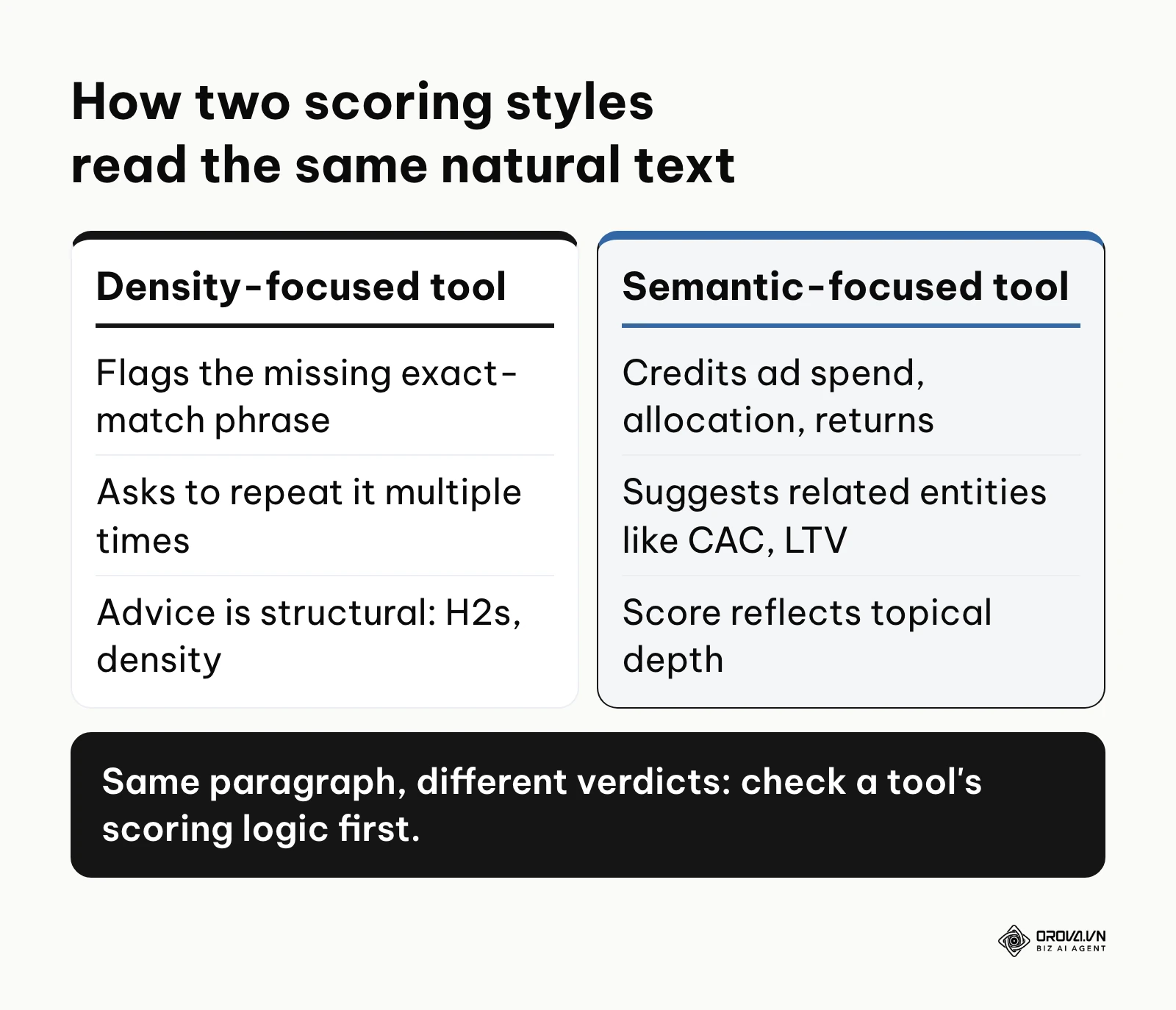
Many legacy tools still rely heavily on variations of TF-IDF (Term Frequency-Inverse Document Frequency). While useful, this can lead to aggressive keyword stuffing recommendations. Modern alternatives leverage advanced Natural Language Processing (NLP) to extract entities and understand the relationships between concepts, based on the Natural Language API documentation by Google Cloud (2023). Here is a simple illustration of the difference.
Imagine a 300-word sample text about "optimizing marketing budgets." The text is written naturally, discussing resource allocation, ad spend, and calculating returns, but it intentionally avoids repeating the exact phrase "marketing budget optimization."
When fed into a traditional density-focused tool, the score typically plummets. The tool flags the absence of the exact match keyword and demands its insertion multiple times. The advice is entirely structural: "Add keyword X to an H2," "Increase density of keyword Y to 2.5%."
Conversely, when that same natural text is analyzed by a highly semantic alternative (like Clearscope or MarketMuse), the score often reflects the depth of the content. These tools recognize that discussing "ad spend," "resource allocation," and "calculating returns" inherently covers the topic of marketing budgets. They might suggest adding related entities—perhaps mentioning "customer acquisition cost" or "LTV"—rather than demanding mindless repetition.
Illustrative example:
- Context: An in-house content team for a financial software company was tasked with writing a sensitive guide on tax compliance.
- Actions: The lead editor tested their standard draft against two tools. Tool A demanded the phrase "small business tax compliance software" be used exactly 8 times. Tool B (a semantic alternative) suggested expanding the section on "IRS audit triggers" to improve topical authority.
- Hurdles: The writers initially panicked because Tool B gave them a lower initial score, as they had missed several crucial subtopics, even though their keyword density was perfect according to Tool A.
- Results: By following Tool B's semantic suggestions, the team produced a highly authoritative piece. The finished page answered the reader's implicit questions far more completely, which is the kind of topical depth search engines reward over word counting.
This test reveals a crucial distinction: are you paying for a glorified word counter, or an engine that genuinely understands the entity seo landscape of your industry?
CMS Compatibility Matrix: Going Beyond WordPress
A significant, yet frequently overlooked, factor in choosing a surfer seo alternative is how well it plays with your existing technology stack. The friction between drafting content and publishing it is where many SEO operations bleed time and resources.
Historically, the workflow has been cumbersome: draft in a word processor, run it through the SEO tool's web app, copy the optimized text, paste it into the Content Management System (CMS), fix all the broken formatting, adjust the images, and finally hit publish. This "copy-paste tax" is a massive drain on productivity.
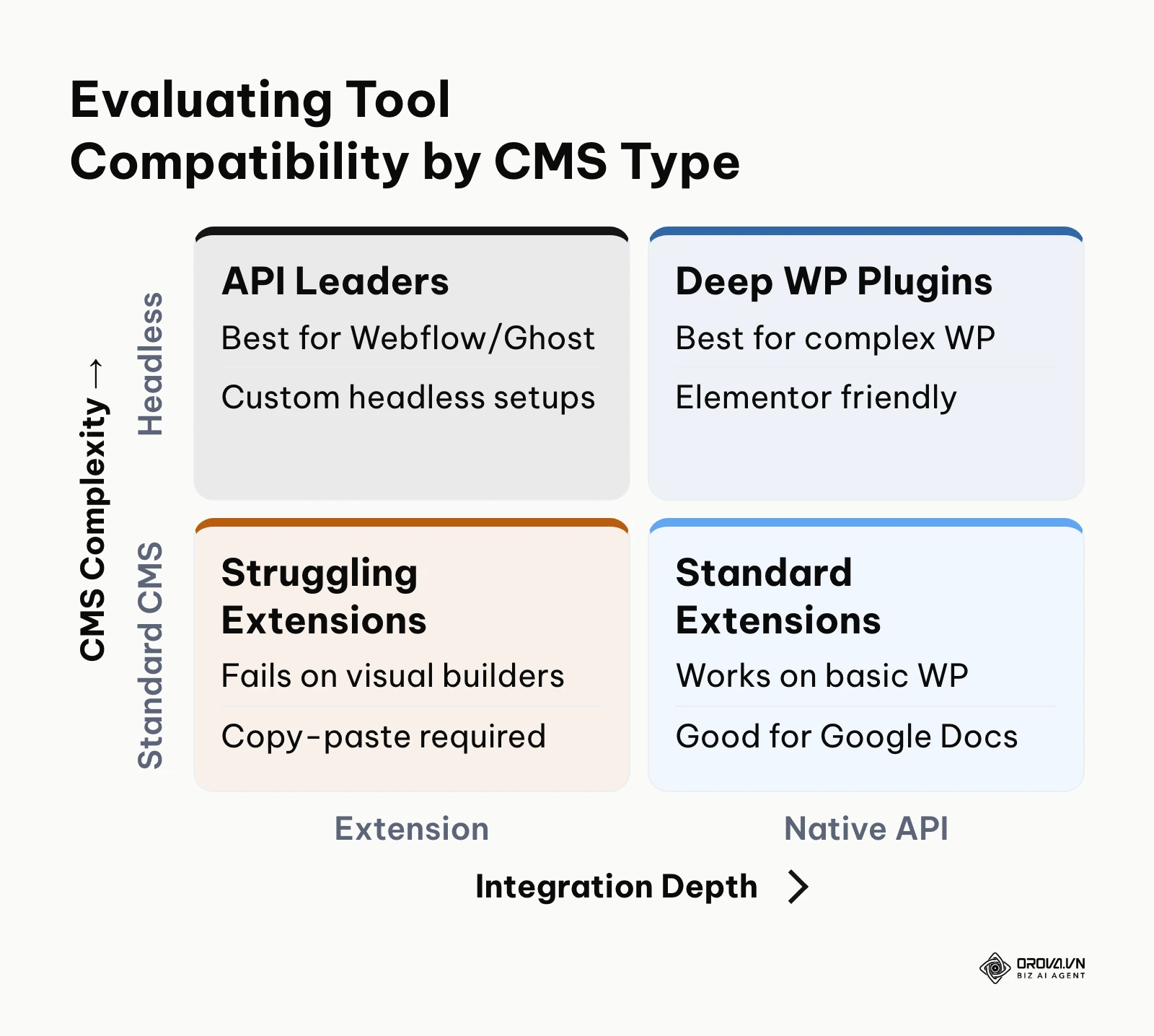
While almost every tool on the market offers a WordPress plugin or a Google Docs add-on, the landscape of digital publishing in 2026 extends far beyond basic WordPress setups. Teams utilizing headless architectures, Shopify storefronts, or modern visual builders like Webflow and Framer often find that standard Chrome extensions fail miserably. The extensions cannot parse the complex nested HTML of visual canvases, leaving writers unable to see their optimization score while actually building the page.
If you operate outside a standard WordPress environment, you must prioritize tools that offer robust native APIs or specialized integrations. You need an alternative that can either pull the live rendered HTML from your staging site for analysis or push optimized content directly into your CMS database without stripping the styling. The ability to seamlessly integrate the scoring mechanism into your specific editorial environment is often the deciding factor between a tool your team loves and a tool they actively avoid using.
Preparing for AI Overviews (GEO): Which Tools Lead the Way?
As we look toward the future of search, traditional ten-blue-link optimization is no longer the sole objective. The rise of Generative Engine Optimization (GEO)—optimizing content to be cited by AI overviews and large language models—requires a fundamental shift in how we grade text.
A forward-thinking surfer seo alternative must help you adapt to this environment. AI engines do not retrieve information by matching keyword strings; they retrieve information by understanding facts, relationships, and authoritative consensus. Therefore, a tool that merely counts how many times your competitors used a phrase is poorly equipped to help you rank in an AI-generated summary.
The tools leading the charge in GEO focus heavily on structuring data logically. They analyze whether your text provides clear, definitive answers to complex questions. They evaluate the density of factual statements, the clarity of your definitions, and the logical progression of your arguments. They encourage the use of specific, unambiguous language over vague marketing copy. When evaluating alternatives, ask yourself: does this tool help my writers sound more authoritative to a machine learning model, or does it just help them stuff more variations of a keyword into the introduction? Optimizing for AI requires clarity, conciseness, and structured data, far beyond what simple density metrics can measure.
Summary of 10 Surfer SEO Alternatives
To help you navigate the crowded market, we have categorized the most prominent tools available today. This table provides a high-level overview of their primary focus and target audience.
| Tool Name | Core Grouping | Primary Focus | Best Value For | Suitable Scale |
|---|---|---|---|---|
| Clearscope | Premium Intelligence | Readability & Semantic Depth | Top-tier editorial teams | Agency / Enterprise |
| MarketMuse | Premium Intelligence | Content Strategy & Inventory | Large-scale content audits | Enterprise |
| NeuronWriter | Budget / Freemium | NLP Scoring on a Budget | Solopreneurs & niche sites | Solo / Small Team |
| Dashword | Budget / Freemium | Simple, fast brief creation | Rapid content deployment | Small Team |
| Frase | AI Writing / Research | Automated brief generation | Fast-paced content mills | Agency / Mid-size |
| WriterZen | Topic Discovery | Clustering & Keyword groupings | Building topical authority | Mid-size |
| Outranking | AI-First Workspace | SERP-based briefs and AI drafting | AI-assisted workflows | Agency |
| Orova SEO | AI-First Workspace | Writing, publishing & optimizing | Teams that want one workflow | Solo to Agency |
| PageOptimizer Pro | Niche Technical | Scientific correlation data | Technical SEO specialists | Agency / Solo Tech |
| InLinks | Niche Technical | Entity extraction & internal linking | Semantic web structuring | Agency / Enterprise |
Discover Orova.vn – a Biz AI Agent platform with OROVA SEO, a complete solution for every website. The system supports search engine optimization from A to Z with features including keyword research, writing new SEO-ready articles, optimizing existing content, rank tracking, plus competitor analysis and in-depth technical analysis. Sign up today to experience OROVA SEO completely free (offer valid through July 7, 2027).
In-Depth Breakdown by Workflow
Choosing the right platform requires matching the tool's philosophy to your team's workflow. Here is how each category works in practice.
Enterprise Content Intelligence (For High-Stakes SEO)
This category represents the premium tier of the market. These tools are built for organizations where a single ranking position carries real revenue, and they prioritize semantic depth over gamification.
Clearscope often comes up as a direct premium competitor when people compare surfer seo vs clearscope. Its interface is intentionally minimalist, stripping away overwhelming charts to focus the writer purely on the text. Clearscope's grading algorithm is highly sensitive to readability and the natural inclusion of broad concepts. It excels in environments where writers are subject matter experts who need gentle guidance on topical coverage rather than strict rules on keyword placement. Its simple interface can make onboarding non-SEO writers easier.
MarketMuse takes a different approach, positioning itself as a comprehensive content strategy platform. While it offers a robust content editor, its true power lies in its inventory analysis. MarketMuse crawls your entire domain, identifying topical gaps and estimating how hard new topics may be for your site based on your existing coverage. It tells you not just how to write an article, but which article you should write next to maximize your topical authority. Expect a steeper learning curve, since it is built for enterprise-scale content programs.
How to start: If transitioning to this tier, begin by importing your top 10 highest-converting URLs. Run them through the new analyzer to see the delta between your current optimization and the platform's semantic recommendations. Use these insights to build your new editorial guidelines.
Budget-Friendly and Free Surfer SEO Alternatives
Not every project can justify a premium monthly subscription. For independent publishers, affiliate marketers, or small businesses testing the waters of content marketing, budget-friendly options provide essential NLP capabilities without the enterprise price tag.
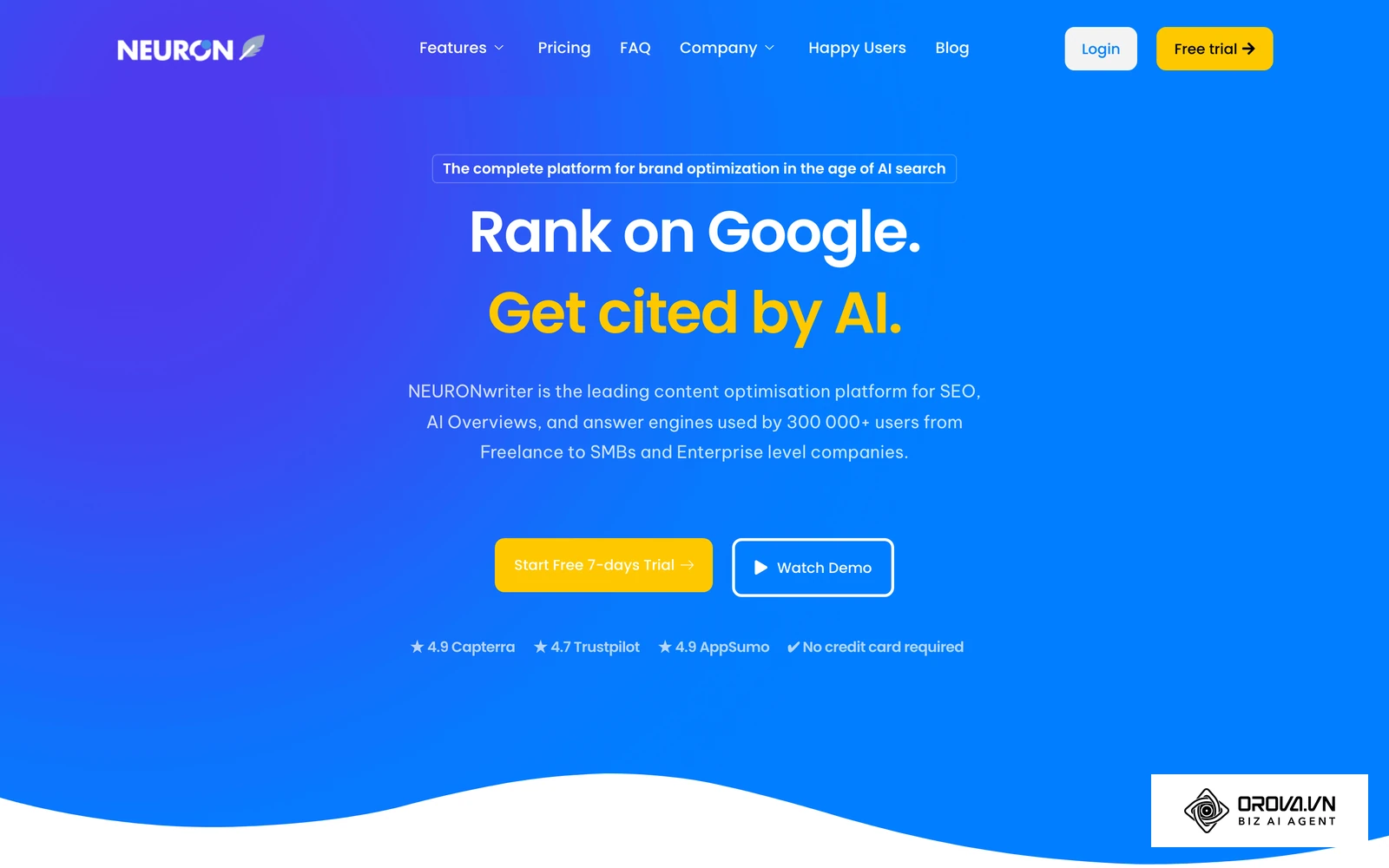
NeuronWriter is a popular lower-cost option. It provides semantic recommendations based on top-ranking competitors and includes integrated AI drafting tools. While the UI can occasionally feel cluttered compared to premium options, the core scoring engine is robust. It is an excellent entry point for users who want to transition from basic on-page plugins to data-driven semantic optimization without breaking the bank.
Dashword focuses on speed and simplicity. It streamlines the process of creating content briefs, allowing editors to quickly compile competitor outlines, common questions, and required keywords into a single, shareable document. If you build briefs this way, an SEO content outline process keeps them consistent across writers. It is lighter than the larger platforms on domain-wide auditing but focuses on getting a well-structured brief into a writer's hands as fast as possible.
How to start: To leverage these tools effectively, sign up for a trial and use them exclusively for updating decaying content. Run an old post through the editor, apply the suggested semantic terms, and monitor the results over three weeks. This provides a low-risk environment to validate the tool's effectiveness before committing.
AI-First Workspaces and Auto-Publishers
A newer group of platforms does more than grade content: they take part in creating and publishing it.
Orova SEO is designed for teams looking to eliminate the friction between strategy and execution. It is AI SEO software that writes, publishes, and optimizes. You can generate SEO-standard articles with illustrations in a brand voice you set yourself. It reduces the "copy-paste tax" by publishing to WordPress or to your website through its own API, and it can schedule new posts. For older content, it can optimize posts in bulk while keeping the original URLs. You can connect Google Search Console and GA4 to measure results, and a built-in Visual Editor lets you edit posts directly on the connected website. Its keyword suggestions draw on GSC, Google Keyword Planner, Google Suggest, and AI, with monthly search volume and intent.
Outranking is another option in the AI-first space, focused on SERP-based briefs and AI-assisted drafting. It analyzes the SERP to build highly detailed outlines and uses AI to assist in drafting sections that specifically target the identified semantic gaps. It is built for teams that want AI to handle the heavy lifting of research and structure, leaving the human editor to refine the final output.
Illustrative example:
- Context: A solo marketing manager at a mid-sized B2B firm was struggling to maintain a consistent publishing schedule while simultaneously trying to update a backlog of 200 outdated blog posts.
- Actions: They transitioned from a traditional workflow to an AI-first auto-publisher. They configured the tool's brand voice settings using their top-performing historical posts and set up the API connection to their staging environment.
- Hurdles: Some older posts used custom page templates, so the manager reviewed each updated post on the live site before moving to the next batch.
- Results: The backlog moved in batches instead of one document at a time, the original URLs stayed in place, and the manager tracked impressions in GSC to see which refreshed posts recovered.
How to start: When adopting AI-first workflows, never automate your highest-converting pages immediately. Start by configuring the brand voice parameters meticulously. Run tests on low-traffic, informational queries to ensure the AI's output aligns with your editorial standards before enabling auto-publishing.
Specialized Semantic & Entity Analyzers
Some SEO professionals require a scalpel, not a Swiss Army knife. These tools are built for technical SEOs who want granular control over their on-page data and entity structuring.
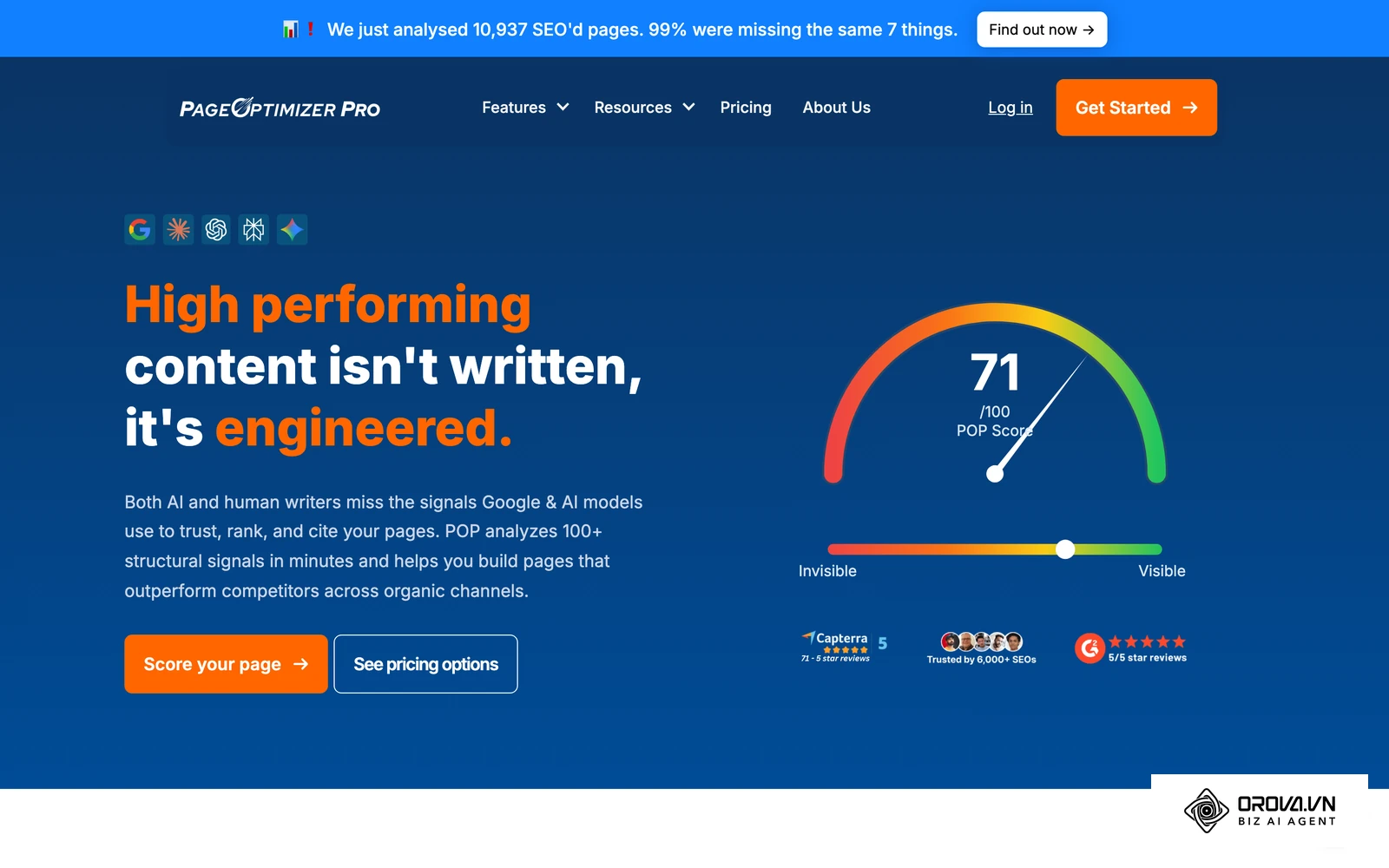
PageOptimizer Pro (POP) is built around a data-driven, correlation-based approach to on-page SEO. It does not concern itself with readability or subjective quality; it analyzes exactly what HTML elements (H1s, bold tags, schema) the competitors are using and tells you where to place your terms to match or exceed them. It is technical and best suited to users who understand the underlying mechanics of search algorithms.
InLinks approaches optimization from the perspective of the semantic web. It focuses heavily on entity extraction and automated internal linking. Instead of just suggesting words, InLinks analyzes the underlying concepts on your page and can generate entity Schema markup for your pages. It is useful for building topical clusters and helping search engines understand the relationships between your articles.
How to start: These tools require a solid foundational understanding of SEO. Start by using them to audit your pillar pages. Implement the specific technical recommendations (like adjusting heading structures or adding entity schema) and track the movement of your secondary keywords, as these often respond fastest to technical on-page tweaks.
The 5-Step Migration Guide: Switching Without Losing Traffic
Deciding on a surfer seo alternative is only half the battle. The true challenge lies in migrating your team and your processes without disrupting your publishing velocity or tanking your current rankings. Switching software mid-campaign introduces significant risk if not handled methodically.
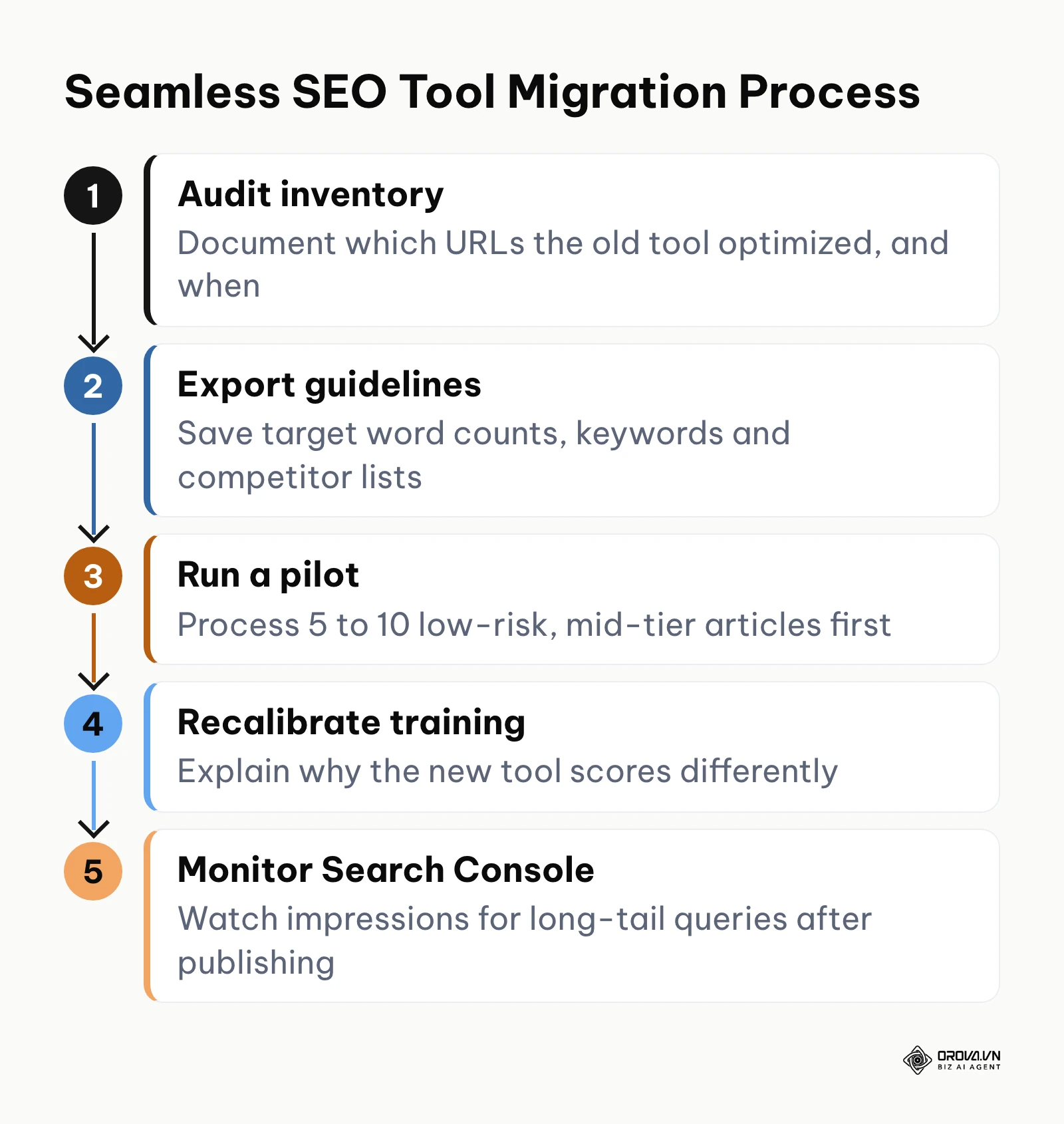
Follow this 5-step checklist to ensure a smooth transition:
- Audit and Isolate Your Inventory: Before canceling any subscriptions, clearly document which URLs were optimized using your old tool and when. You need a baseline to understand if a future drop in traffic is due to algorithm updates or the loss of your previous optimization strategy.
- Export Your Target Guidelines: Do not lose your historical keyword research. If you have unwritten briefs or partially optimized drafts in the old platform, export the target word counts, primary keywords, and competitor lists. You will need these to calibrate the new tool.
- Run a Controlled Pilot Program: Never switch your entire editorial team overnight. Select a cohort of 5 to 10 low-risk, mid-tier articles. Process them entirely through the new platform. This allows you to identify workflow bottlenecks—like integration failures or confusing UI elements—before they impact your critical content.
- Recalibrate Team Training: This is the most crucial step. If your team is used to chasing a 90/100 score on the old platform, they might panic when the new tool (which likely uses a different scoring logic) gives them a 60/100. Train your editors on why the new tool scores differently. Emphasize that the goal is semantic depth and readability, not just hitting an arbitrary metric.
- Monitor Search Console Relentlessly: After publishing the first batch of articles optimized with the new tool, monitor your Google Search Console coverage and performance reports closely. Look for unexpected fluctuations in impressions for long-tail queries, which can indicate whether the new semantic approach is resonating with the search engine.
When you transition, you are not just changing software; you are changing the psychological framework your writers use to construct sentences. Handle the transition with patience and clear communication.
Building Your SEO Stack: Recommendations by Team Size
The "best" tool is entirely dependent on the operational scale of your organization. What works for a solo blogger will likely cripple a large agency, and vice versa.
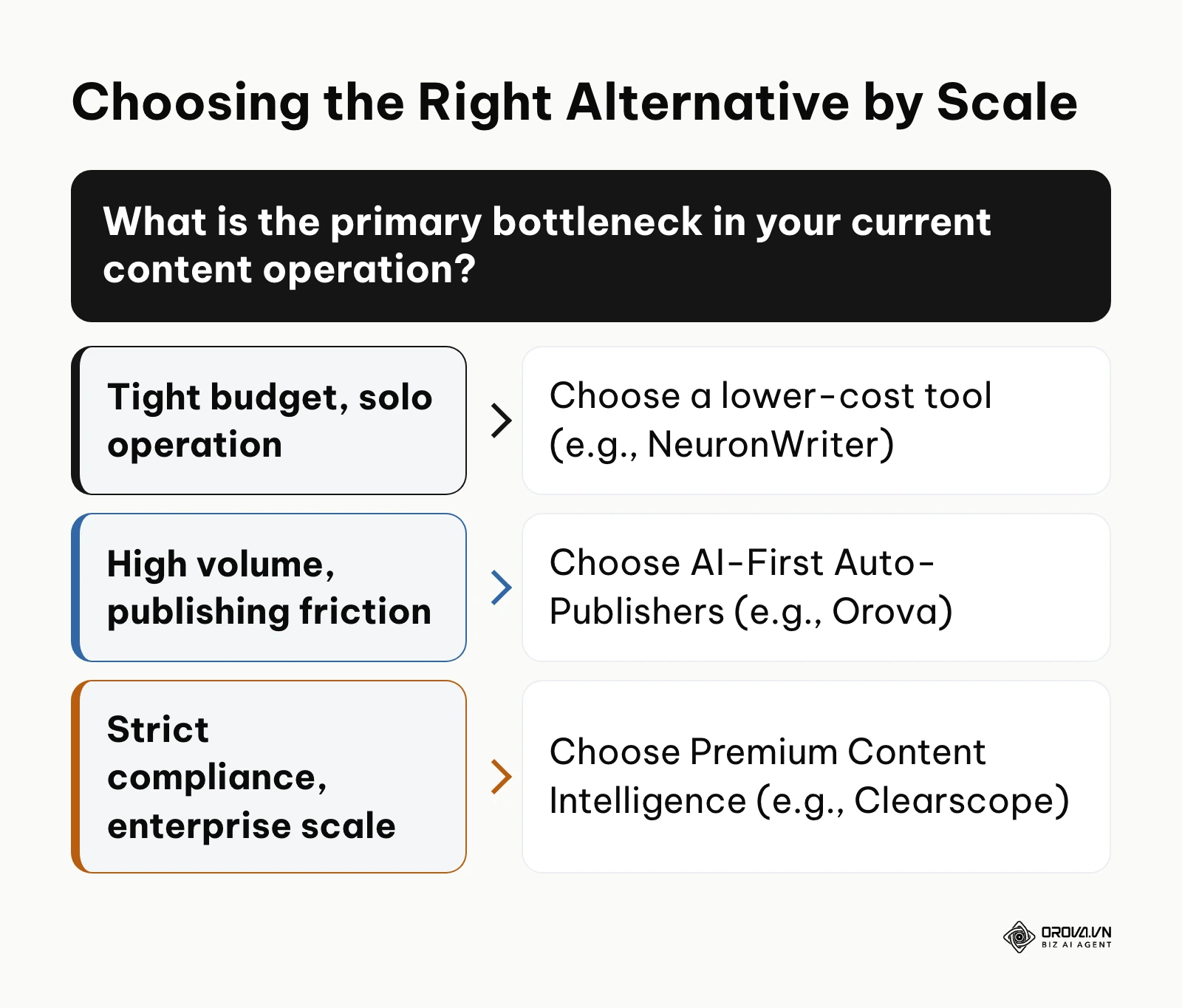
For Solopreneurs and Small Niche Sites, budget constraints and ease of use are paramount. You cannot afford to spend days learning complex enterprise software. Lower-cost tools like NeuronWriter provide NLP-based scoring without enterprise-level overhead. These tools allow a single operator to punch above their weight class by systematically improving topical relevance. The primary pitfall here is analysis paralysis—spending too much time tweaking scores instead of simply publishing more content.
For Small to Mid-Sized In-House Teams (3-5 writers), the bottleneck usually shifts from budget to workflow friction. The time spent creating briefs, reviewing drafts, and managing the CMS becomes a significant drain. This is where AI-first workspaces and strong integrations shine. A team at this scale needs a platform that centralizes the brief creation and grading process, allowing the managing editor to maintain quality control without manually reviewing every single keyword insertion. The danger for mid-sized teams is over-automation; they must ensure the brand voice isn't diluted by heavily relying on AI suggestions.
For Large Agencies and Enterprise Operations, compliance, scale, and deep strategic insights are required. When managing dozens of clients or thousands of URLs, you need robust reporting and impeccable semantic grading. Premium platforms like Clearscope or MarketMuse become necessary investments. At this scale, calculating your seo roi on the tool is critical; the high monthly cost must be justified by a measurable reduction in editorial revision time and a higher success rate in securing competitive rankings. The pitfall here is tool bloat—paying for enterprise features that the daily writers never actually use.
Illustrative example:
- Context: An independent SEO consultant was managing content for 5 different small business clients using a highly technical, correlation-based SEO tool.
- Actions: The consultant tried to scale their operation by hiring freelance writers, but the writers found the technical tool's UI incomprehensible, leading to constant revisions and missed deadlines.
- Hurdles: The consultant realized the tool was perfect for an SEO expert but terrible for a freelance writer. They needed to change their stack to accommodate their new operational scale.
- Results: They switched the writing team to a user-friendly, brief-focused alternative (like Dashword), reserving the technical tool only for final audits on high-value pages. This hybrid approach cut revision rounds noticeably and made onboarding new writers easier, showing that a tool must match the user's technical proficiency.
With OROVA.VN and the OROVA SEO module, you put an end to the exhausting days of manual work for good. Instead of struggling for hours to write articles and compile reports, the entire process is now optimized and completed in just 5 minutes.
Content Optimization Trends for 2026: Author's Perspective
As we navigate through 2026, the landscape of content optimization is shifting rapidly beneath our feet. Based on the current trajectory of search algorithms and user behavior, here is how I view the evolution of this space in the coming years.
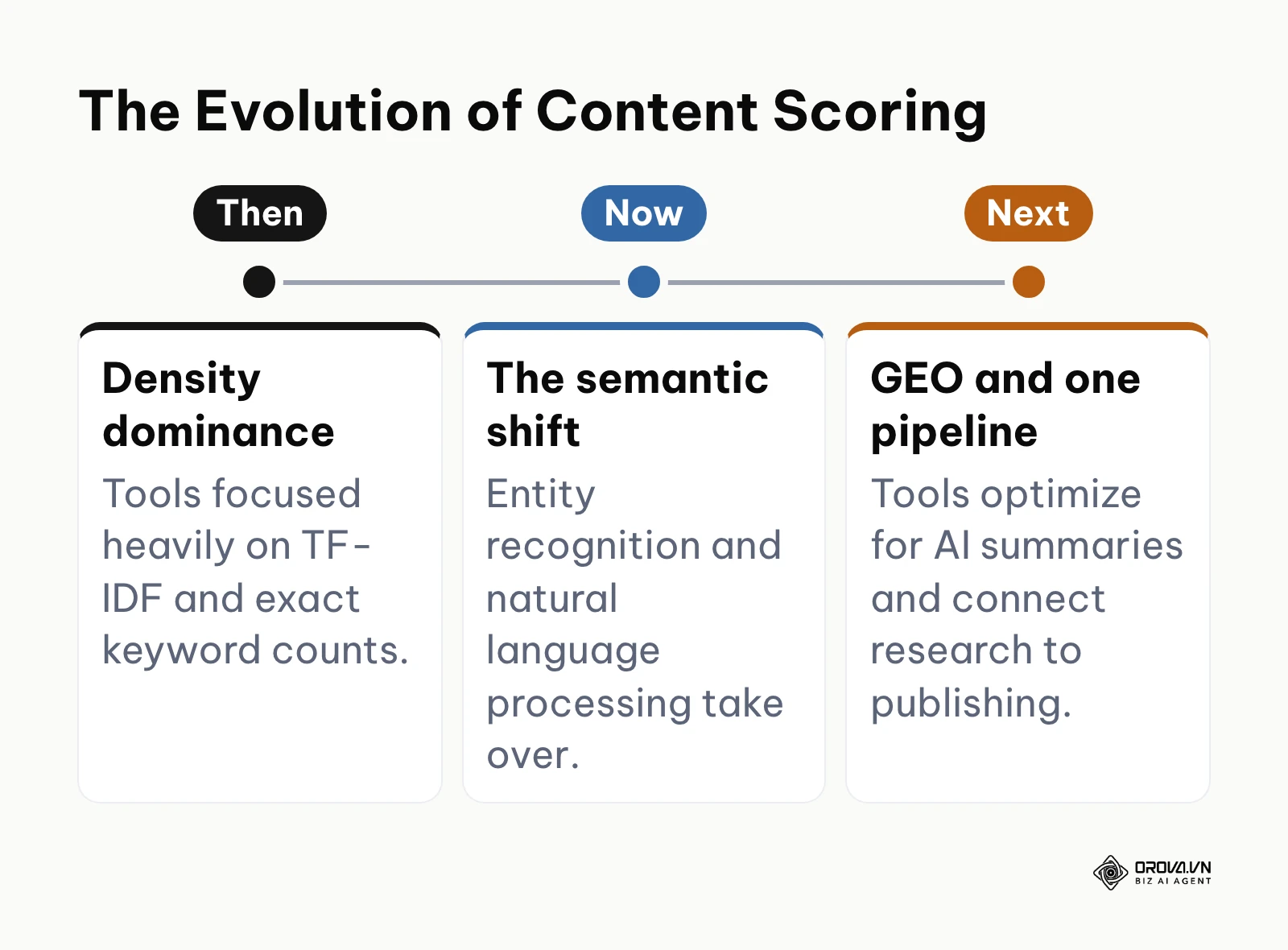
The Death of the Arbitrary Metric I believe that over the next few years, the concept of a single "content score" (e.g., 85/100) will become largely obsolete. Some advanced tools are already moving away from unified metrics toward multi-dimensional grading—scoring readability, factual density, and semantic coverage separately. I suspect that search engines are penalizing content that appears mathematically "perfect" but lacks human nuance. SEO professionals need to prepare for a reality where passing an optimization tool's test does not guarantee a ranking; instead, they must focus on training writers to use the tools as broad topical guides rather than rigid rulebooks.
Optimization for AI Summaries Becomes Standard I strongly suspect that Generative Engine Optimization (GEO) will overtake traditional ten-blue-link SEO as the primary focus for informational queries. The tools of tomorrow will not just tell you what keywords to use; they will analyze how easily an LLM can parse your formatting to extract a direct answer. There are early signs of this as platforms begin to emphasize structured data and entity relationships over text density. If you want to future-proof your content strategy, you must start structuring your articles with clear, definitive answers and bulleted lists that AI models can effortlessly digest and cite. Utilizing strategies like chatgpt for seo will be less about generating text and more about simulating how an AI interprets your published page.
The Complete Consolidation of the Publishing Pipeline Finally, I foresee the complete collapse of the fragmented content workflow. The days of using one tool for keyword research, another for drafting, a third for grading, and a CMS for publishing are ending. The market will heavily favor platforms that offer end-to-end workspaces. Teams will demand software that handles the entire lifecycle—from the initial API pull of Search Console data to the final automated push to the live server. To prepare, organizations should begin auditing their current tech stack and identifying areas where manual data transfer is slowing down their publishing velocity.
Frequently Asked Questions about Surfer SEO Alternatives
How do I preserve my SEO strategy for old posts if I cancel my legacy subscription? If you cancel a tool, you do not lose your rankings, but you do lose the specific data framework that justified those optimizations. Before canceling, export your project data, specifically the target word counts and the primary semantic entities for your top pages. If a page starts decaying later, you can feed those historical parameters into your new tool to establish a baseline for updates.
Which alternatives actually score based on semantics rather than just keyword counting? Tools like Clearscope, MarketMuse, and InLinks are built fundamentally on semantic analysis rather than simple term frequency. They analyze the relationships between entities and the overall comprehensiveness of the topic. If a tool demands you use a specific phrase exactly 14 times, it is likely relying on outdated density metrics.
Are there any viable free options for small blogs or beginners? While truly robust platforms require massive computing power and therefore charge subscriptions, lower-cost tools like NeuronWriter offer entry-level plans aimed at low-volume users; check each vendor's official pricing page for current terms. Additionally, leveraging standard Google Docs add-ons for basic readability checks is a zero-cost way to improve quality before investing in dedicated SEO software.
How does changing tools affect the morale of a writing team? Changing optimization tools often causes significant short-term friction. Writers become accustomed to the quirks of a specific grading algorithm. When a new tool scores their previously "perfect" work poorly, it can cause frustration. It is vital to communicate that a lower score on a new platform is not a reflection of poor writing, but rather a different mechanical interpretation of the text.
Do these tools support non-English languages effectively? Support varies wildly. While almost all tools handle English flawlessly, languages like Vietnamese, German, or Spanish require specific NLP training models. When evaluating an alternative, do not just check if the language is listed in a dropdown menu; run a live test with a native text sample to ensure the tool actually understands the grammar and semantics, rather than just translating English rules poorly.
Where Should You Start Today?
Choosing a new platform from a massive list can lead to severe analysis paralysis. The best approach is to identify your single largest pain point and take one decisive action to address it this week.
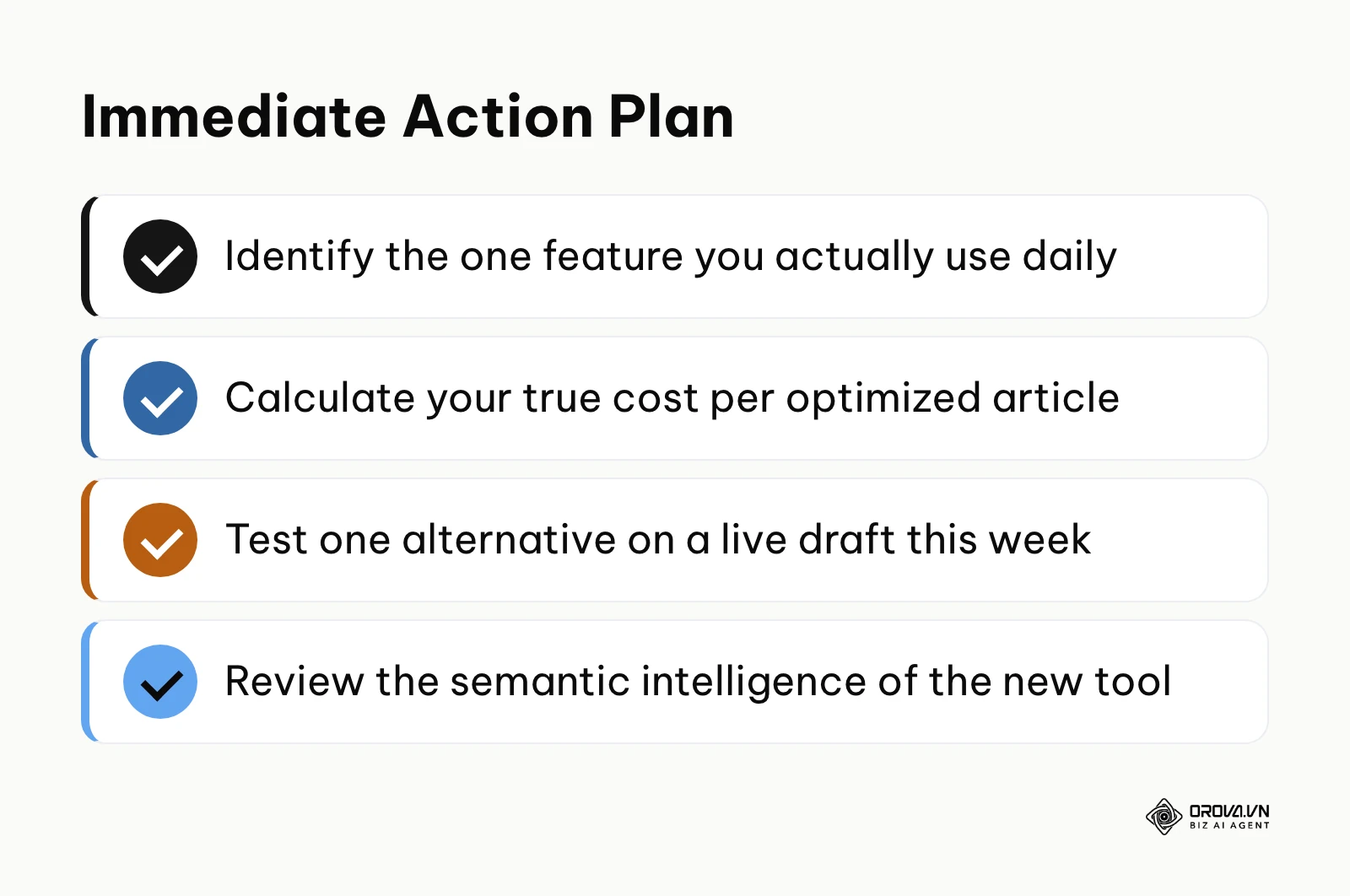
If your primary issue is being overwhelmed by complex data and contradictory scoring, your first step should be to run a side-by-side test. Take a draft that you are currently struggling to optimize in your existing tool, sign up for a trial of a highly semantic alternative (like Clearscope or NeuronWriter), and see how the recommendations differ. The clarity of the new UI might instantly resolve your bottleneck.
If your organization is severely budget-constrained, stop looking at enterprise solutions. Your immediate action should be to audit your current monthly spend on all SEO tools. Calculate your exact cost per optimized article. Then, test a budget-friendly option like NeuronWriter on three new articles to determine if the lower cost justifies a slightly different feature set.
If your team is suffering from severe workflow friction and publishing bottlenecks, your priority is integration. Your next step should be to evaluate AI-first workspaces that connect directly to your CMS. Set up a staging environment, connect the API of a tool that supports auto-publishing, and run a test to see how much time is saved by eliminating the manual copy-paste process. Fix the workflow first, and the content velocity will naturally follow.
About the author

Builder of Orova
Nguyễn Đỗ Trọng Ân has 8 years of experience in marketing, including 6 years managing market development across Asia. He builds Orova, a Biz AI Agent that never sleeps: it plans, runs and optimizes work for businesses.
Run your business with AI Agents
Orova is the always-on Biz AI Agent — it plans, runs, and optimizes the work for you.
Save time, unlock productivity.