
What is an SEO blog? The complete guide to ranking in the AI era

Many writers spend hours crafting brilliant articles, hitting publish, and then watching their analytics dashboard flatline. The reality of modern digital publishing is that writing well is no longer enough to guarantee an audience. In an internet saturated with AI-generated text, hoping that readers will simply stumble upon your website is a strategy destined to fail. If you want consistent, targeted traffic that converts into loyal subscribers or paying customers, you must build a system designed to intersect with exactly what people are searching for. This is where an SEO blog becomes essential.
The traditional approach to blogging—writing about whatever interests you on any given day—rarely builds sustainable traffic. Today, your content must serve a specific function, answering precise questions while satisfying complex search engine algorithms. This guide will walk you through exactly what an SEO blog is, the mechanics of how to optimize blog posts for SEO, and the advanced strategies you need to outrank competitors and AI overviews.
What is an SEO blog?
An SEO blog is a strategic approach to creating and managing content designed to rank highly in search engines while answering specific user queries. It is used to drive organic traffic, build authority, and convert readers, differing from a personal journal by prioritizing search intent and technical optimization over pure self-expression.
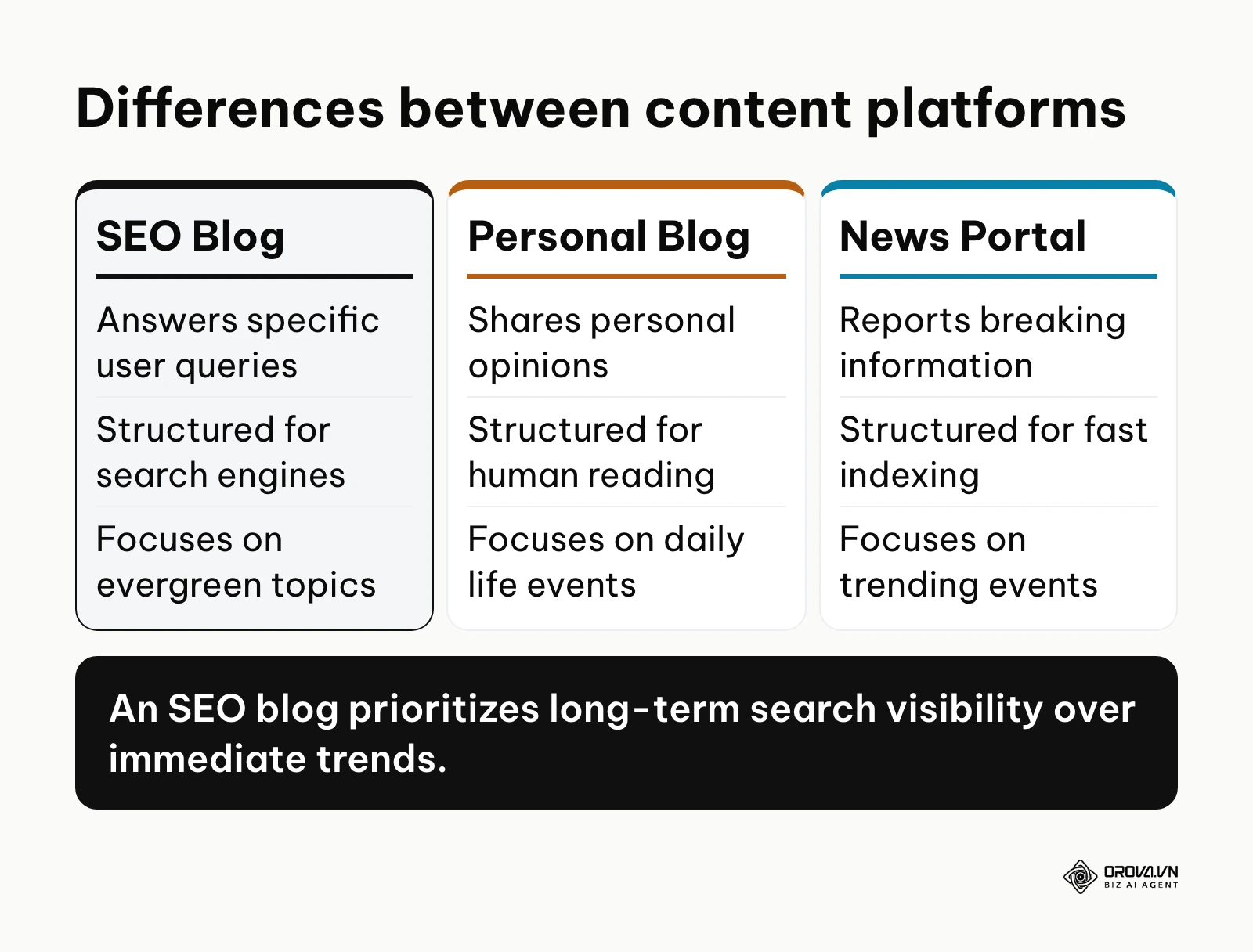
The concept evolved heavily over the last decade. In the early days of the internet, optimizing content meant stuffing as many keywords as possible into a short article. Today, search engines use advanced natural language processing to understand the context, depth, and helpfulness of a page. A modern SEO blog is less about manipulating algorithms and more about structuring high-quality information in a way that search engines can easily parse and present to users.
| Feature | SEO Blog | Personal Blog | News Portal |
|---|---|---|---|
| Primary Goal | Answer search intent | Share opinions | Report events |
| Traffic Source | Search engines (Google) | Social media, direct | Discover, social |
| Lifespan | Evergreen (years) | Ephemeral (days) | Ephemeral (hours) |
A practical example makes this distinction clear. If you run a personal food blog, you might write a post titled "My weekend baking disaster," detailing your feelings and mistakes. If you run an SEO blog in the food niche, you would instead write a highly structured, step-by-step guide titled "How to fix dense sourdough bread," focusing entirely on solving a specific problem that thousands of people search for every month.
The meaning of an SEO blog in the larger digital strategy
An SEO blog exists to bridge the gap between a user’s unresolved problem and your business’s solution. When someone turns to a search engine, they are actively looking for an answer. By providing that answer comprehensively and clearly, your brand becomes the trusted authority in their mind before they even realize they need to buy anything.
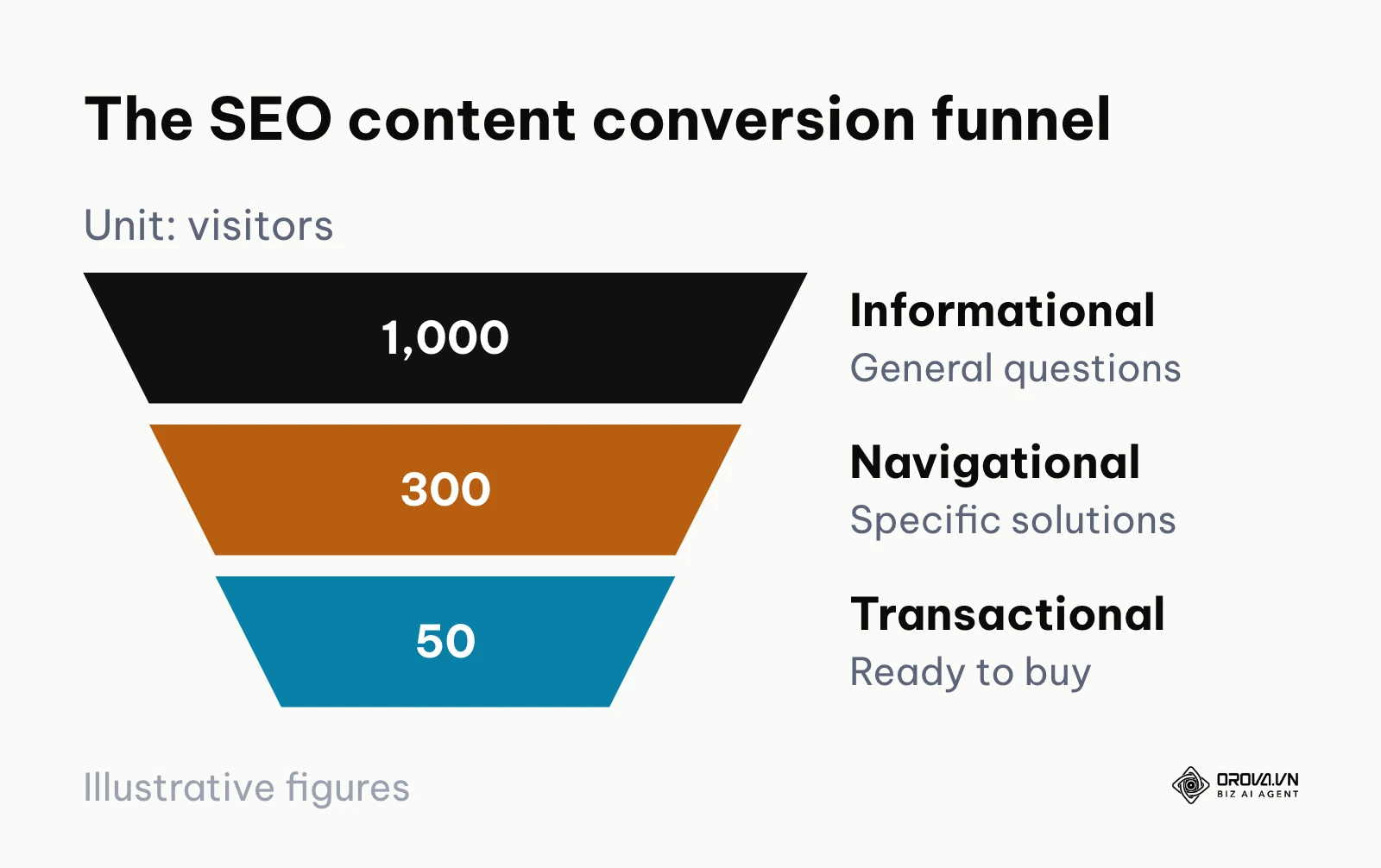
In the broader picture of digital marketing, an SEO blog sits squarely at the top and middle of the sales funnel. Before a user searches for a specific software product, they search for the symptoms of their problem. Before they look for a local mechanic, they search for "why is my car engine ticking." If your website only consists of product pages or service descriptions, you are entirely invisible to the vast majority of potential customers who are still in the research phase.
If you choose to ignore SEO blogging, you accept a permanent dependency on paid advertising. Without organic traffic, the moment you stop spending money on ads, your traffic drops to zero. An SEO blog builds a sustainable asset that continues to attract visitors long after the initial investment of time and resources.
When you don't need an SEO blog yet: If you operate a highly visual product brand, like a boutique clothing line, investing heavily in long-form text is wasteful; you should prioritize visual platforms like Instagram or TikTok instead. Similarly, for hyper-local emergency services like 24/7 towing, users need immediate phone numbers, not deep educational content, making a Google Business Profile much more effective. Finally, if you are launching a completely novel technology with zero existing search volume, an SEO blog won't help initially; you must rely on PR and outbound sales to generate awareness first.
The value and benefits of optimizing blog posts
The return on investment from a properly managed SEO blog impacts both the overarching business metrics and the daily workflow of the people creating the content. It shifts marketing from an expense to an asset-building exercise.
Lower Customer Acquisition Cost (CAC)
For the business, the most immediate financial benefit is the reduction in customer acquisition cost. Paid search ads require you to pay for every single click. If your budget runs out at noon, your visibility disappears. A well-optimized blog post, however, requires an upfront investment of time to write and format, but once it ranks on the first page, it can generate hundreds or thousands of clicks per month at no additional marginal cost. This drastically lowers the blended cost of acquiring a new lead over time.
Compounding Traffic ROI
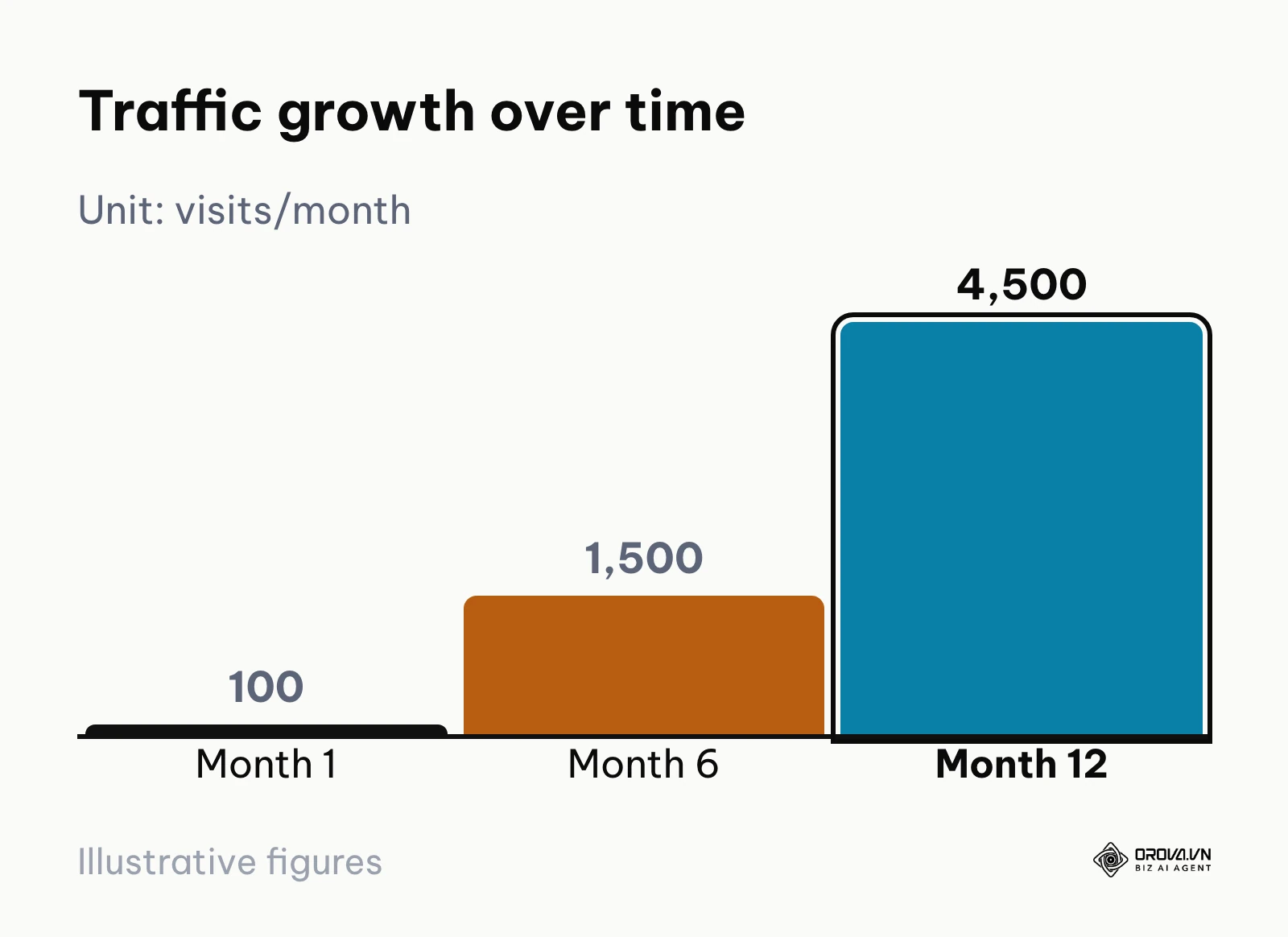
Content marketing through SEO behaves much like compound interest. A single high-quality post might bring in fifty visitors its first month. But as that page earns backlinks, establishes authority, and climbs the rankings, it might bring in five hundred visitors a month a year later. When you continuously publish and optimize a library of content, these individual traffic streams stack on top of each other, creating a compounding growth curve that paid media simply cannot replicate.
Clearer Content Direction
For the person managing the website, adopting an SEO framework eliminates the stress of staring at a blank page and wondering what to write about today. Because an SEO blog relies on keyword research and data analysis, your content calendar is dictated by actual user demand rather than internal guesswork. You know exactly what topics your audience cares about, how they phrase their problems, and what format they prefer to consume the information in.
Better Audience Insights
When you optimize blog posts for SEO, you inevitably integrate analytics tools to track your performance. These tools reveal incredible insights about your audience. You can see which specific phrases lead to the most time spent on a page, which topics drive newsletter signups, and which geographies your readers come from. This data loop allows you to continuously refine not just your content, but your actual product or service offerings based on what people are demonstrating an interest in.
| Benefit | Measured By | Typical Horizon |
|---|---|---|
| Lower CAC | Cost per lead / Cost per click | Long term |
| Compounding Traffic | Total monthly organic sessions | Medium term |
| Clearer Direction | Number of planned articles | Immediate |
| Audience Insights | Search queries in Console | Short term |
Illustrative example: A mid-sized B2B SaaS company with a three-person marketing team was struggling to generate inbound leads. They audited their existing site, researched bottom-of-funnel keywords, and published ten comprehensive comparison guides over two months. Initially, their new pages were not being indexed by search engines, so they resolved this by manually submitting a clean XML sitemap and adding internal links from their high-traffic homepage. Within three months, their comparison guides began appearing on the first page of search results, leading to a visible, steady stream of daily demo requests in their CRM pipeline.
Discover Orova.vn – a Biz AI Agent platform with OROVA SEO, a complete solution for every website. The system supports search engine optimization from A to Z with features including keyword research, writing new SEO-ready articles, optimizing existing content, rank tracking, plus competitor analysis and in-depth technical analysis. Sign up today to experience OROVA SEO completely free (offer valid through July 7, 2027).
How an SEO blog works in the AI era
The mechanics of running a successful SEO blog have fundamentally shifted. It is no longer just about writing a long article and inserting a target phrase five times. You must navigate AI overviews, algorithmic content decay, and strict quality guidelines. Here is the complete breakdown of how a modern SEO blog operates from research to maintenance.
Keyword Research and Intent Matching
Every successful post begins with data. Keyword research is the process of discovering the exact words and phrases your potential readers type into search engines. However, finding a high-volume keyword is only the first step; you must perfectly match the search intent behind it.
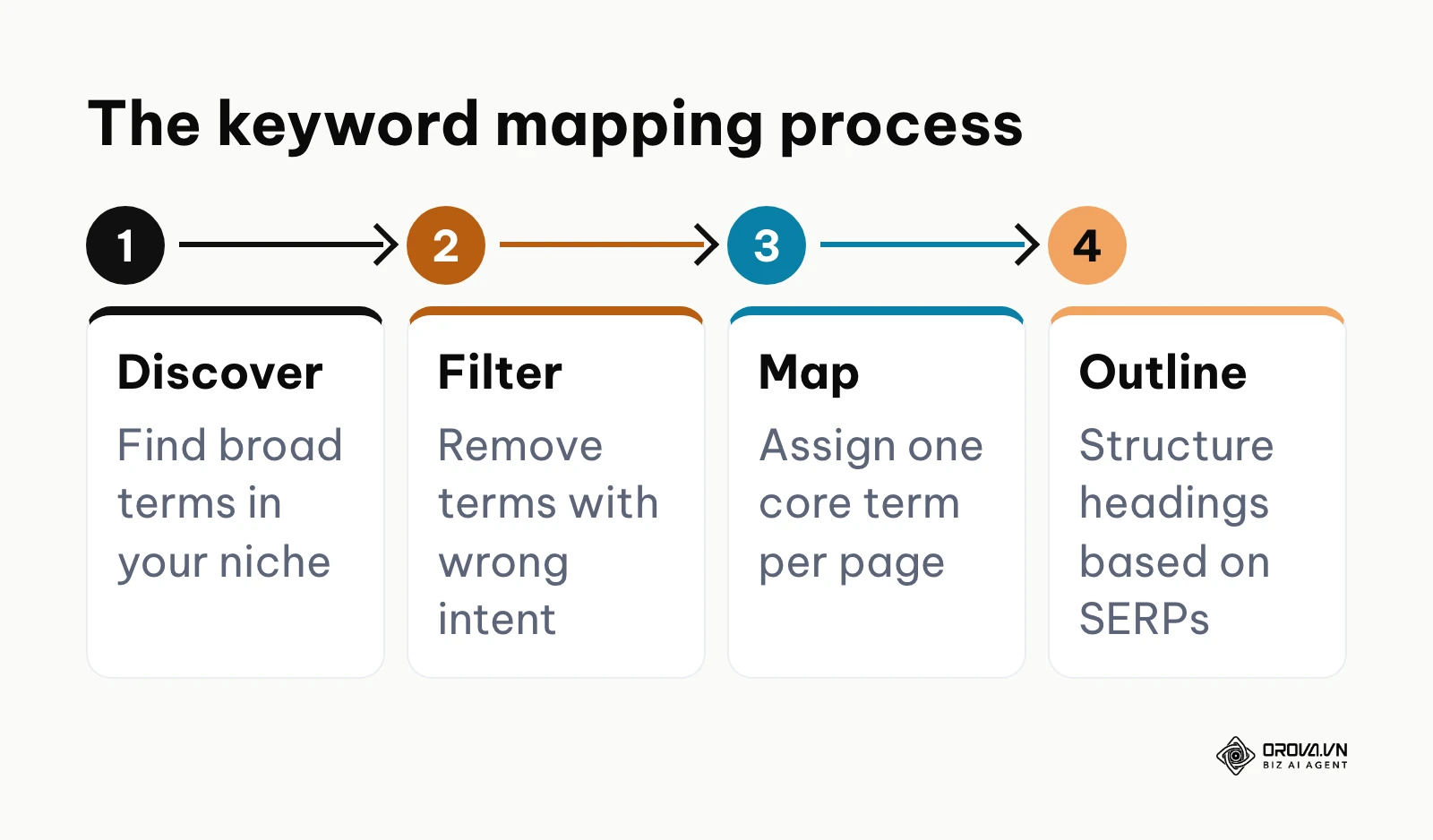
- Action: Use SEO tools to find relevant queries, analyze the current search engine results page (SERP) to determine what format Google prefers (listicle, how-to guide, definition), and map one primary keyword to one specific URL. Turning that mapping into a brief is covered in how to build an SEO content outline. Understanding what is a keyword in SEO is the foundation of this step.
- Input: Seed topics relevant to your business, access to a keyword planner tool, and a spreadsheet for mapping.
- Output: A structured content calendar where every planned post has a target keyword, a defined user intent, and an estimated search volume.
- Common Failure Point: Targeting keywords that are too broad or highly competitive (like "marketing"), or writing a long-form guide when the user intent clearly shows they just want a quick calculator or a short list.
Crafting E-E-A-T Content to Beat AI Overviews
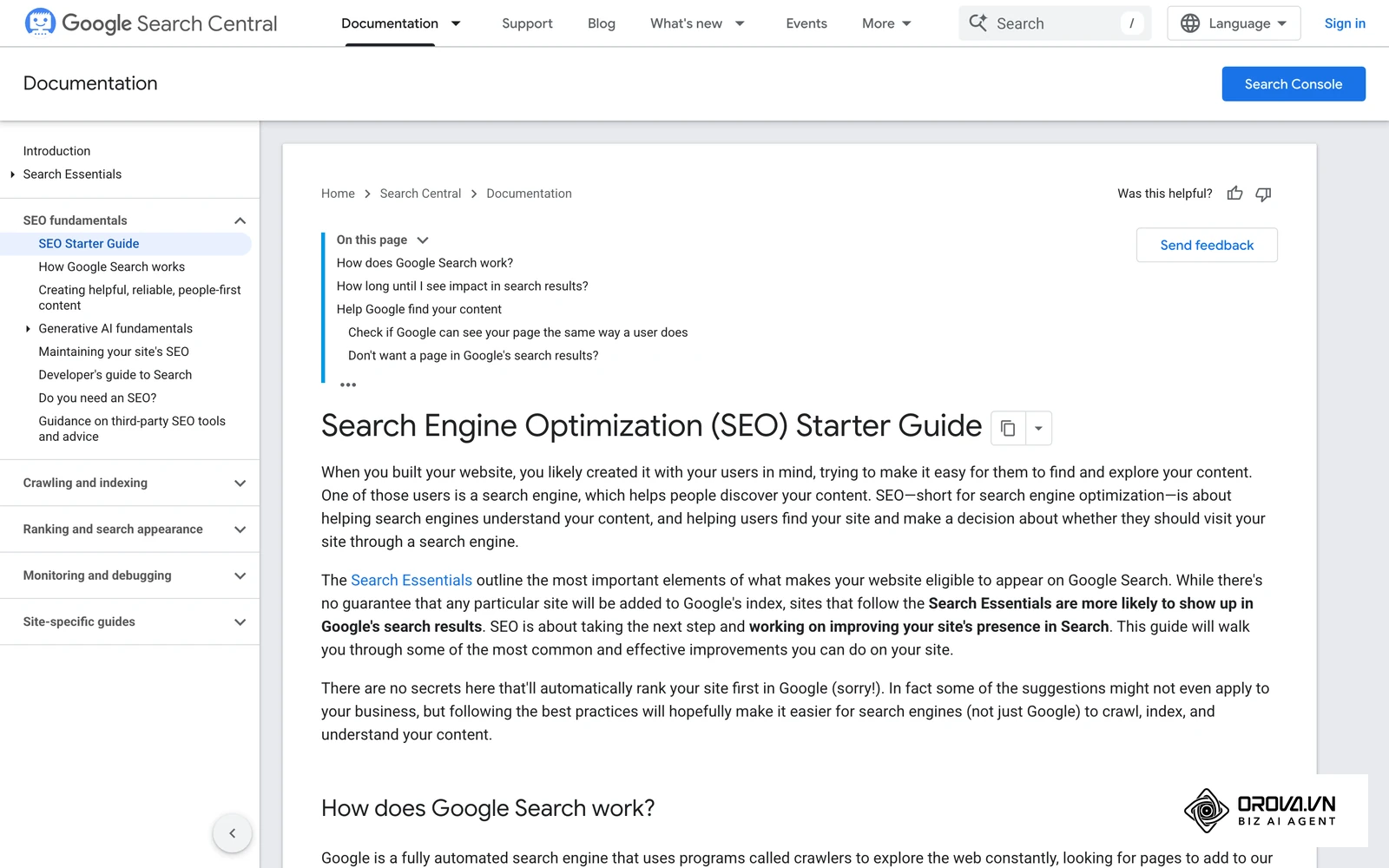
With the rise of generative AI, search engines are frequently placing AI Overviews (formerly SGE) at the very top of the results page, summarizing basic information. To survive, an SEO blog must provide what AI cannot: real-world Experience, Expertise, Authoritativeness, and Trust (E-E-A-T). According to the Search Quality Evaluator Guidelines by Google (2024), human raters specifically look for first-hand experience when evaluating the quality of a page.
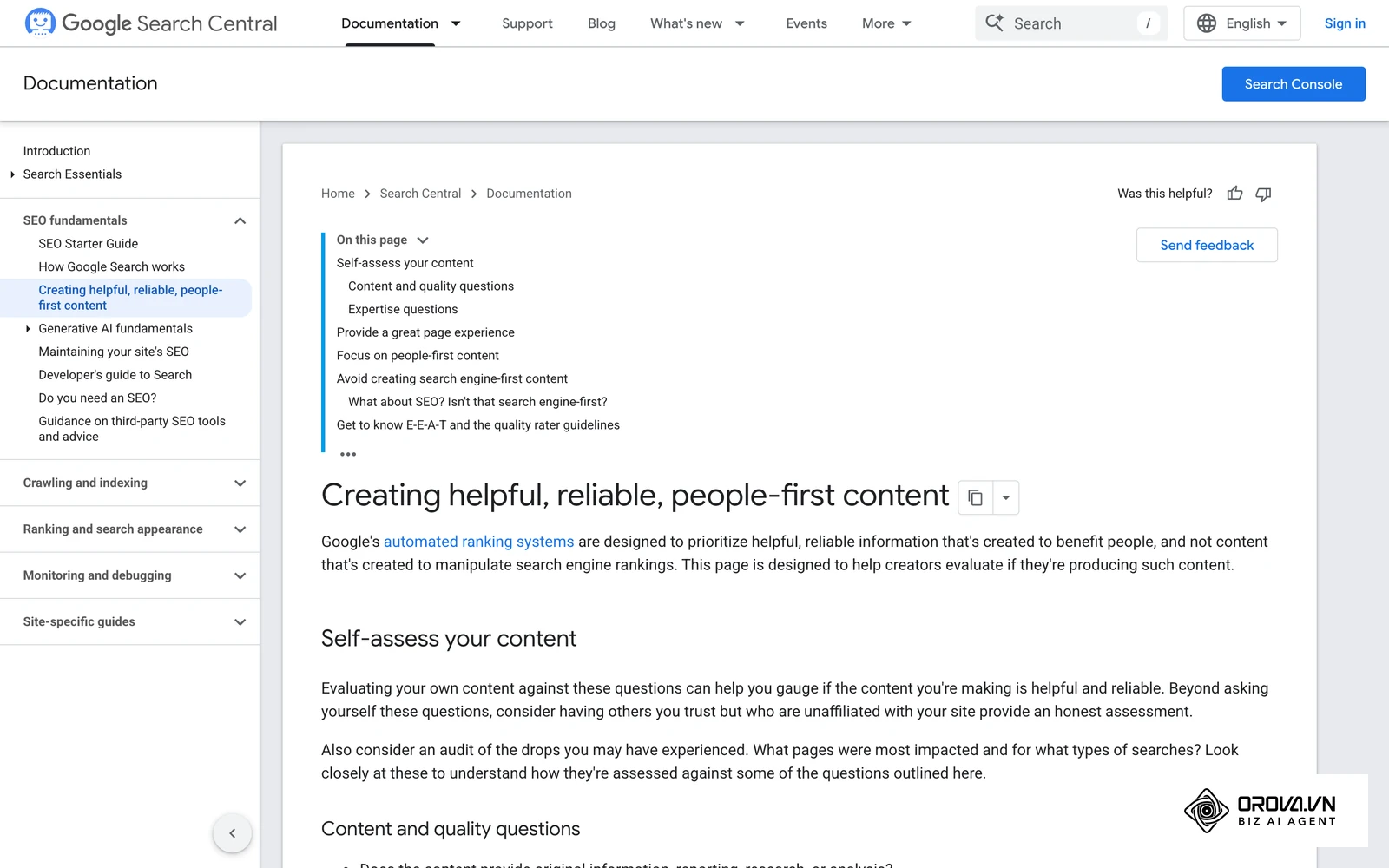
- Action: Inject unique perspectives into every post. Do not just summarize what is already on the internet. Share proprietary data, interview subject matter experts, and include original photographs of the process you are describing. If you are reviewing a product, show pictures of you holding it. If you are describing a technical process, include screenshots of your own dashboard showing your own mistakes and fixes.
- Input: Raw drafts, expert interviews, original media files, and personal case studies.
- Output: A highly differentiated blog post that cannot be easily replicated by a large language model summarizing existing web pages.
- Common Failure Point: Relying entirely on generic stock photos and writing highly theoretical advice without ever demonstrating that the author has actually performed the task being described.
Illustrative example: A solo freelance writer managing a personal finance blog wanted to increase affiliate revenue. They interviewed three certified financial planners, compiled original quotes, and structured a detailed 3,000-word guide on managing credit card debt. After publishing, they noticed the time-on-page was extremely low because the text was too dense, so they broke the content up by adding custom infographic summaries and a sticky table of contents. The revised post not only retained readers longer but eventually secured the featured snippet on Google, resulting in daily affiliate link clicks that were clearly visible in their dashboard.
The Quality Scorecard Framework
One of the most persistent problems in SEO blogging is the vague advice to "write high-quality content." Without measurable criteria, quality is subjective. A modern SEO blog relies on a quantifiable scorecard to evaluate every post before it goes live. Technical checks such as structured data belong on the scorecard too; these JSON-LD schema examples for SEO show what valid markup looks like.
- Action: Review the final draft against a strict set of binary yes/no questions designed to enforce both technical SEO best practices and user experience standards.
- Input: The final draft of the article, formatting tools, and the scorecard criteria.
- Output: A final, polished URL that is technically sound and highly readable.
- Common Failure Point: Skipping the review process under tight deadlines, leading to published posts with missing alt text, broken internal links, or massive walls of text that scare users away.
| Criterion | Question to Ask | Pass / Fail |
|---|---|---|
| Intent | Does the H1 title accurately reflect the user's search intent? | [ ] |
| Experience | Does the post include at least one original image or proprietary data point? | [ ] |
| Structure | Are H2 and H3 tags used logically to break up the text? | [ ] |
| Clarity | Is the primary question answered within the first 150 words? | [ ] |
| Linking | Are there at least three internal links pointing to relevant core pages? | [ ] |
| Technical | Are all images compressed and given descriptive alt text? | [ ] |
Content Distribution in the First 24 Hours
SEO is notoriously slow. It can take months for a new blog post to climb the rankings. However, relying entirely on search engines to discover your content is a mistake. You need initial traffic to validate the page and send behavioral signals.
- Action: Execute a distribution checklist immediately after publishing. Send the article to your email newsletter subscribers. Break the core concepts down into a thread for social media platforms. Share it in relevant industry communities or forums, ensuring you are adding value rather than just dropping a link.
- Input: The published URL, a segmented email list, and active social media accounts.
- Output: An immediate spike in initial traffic that generates early user engagement metrics (time on page, scroll depth) and potentially earns natural backlinks.
- Common Failure Point: Spending twenty hours writing an article and zero minutes promoting it, resulting in the page sitting idle for months while waiting for search engine crawlers.
Auditing and Reversing Content Decay
Most blogs focus entirely on publishing new content. However, traffic on older posts naturally declines over time—a phenomenon known as content decay. Competitors publish better guides, search intent shifts, or the information simply becomes outdated. Refreshing a page that already has history and backlinks is often a faster path to regaining visibility than starting a new URL.
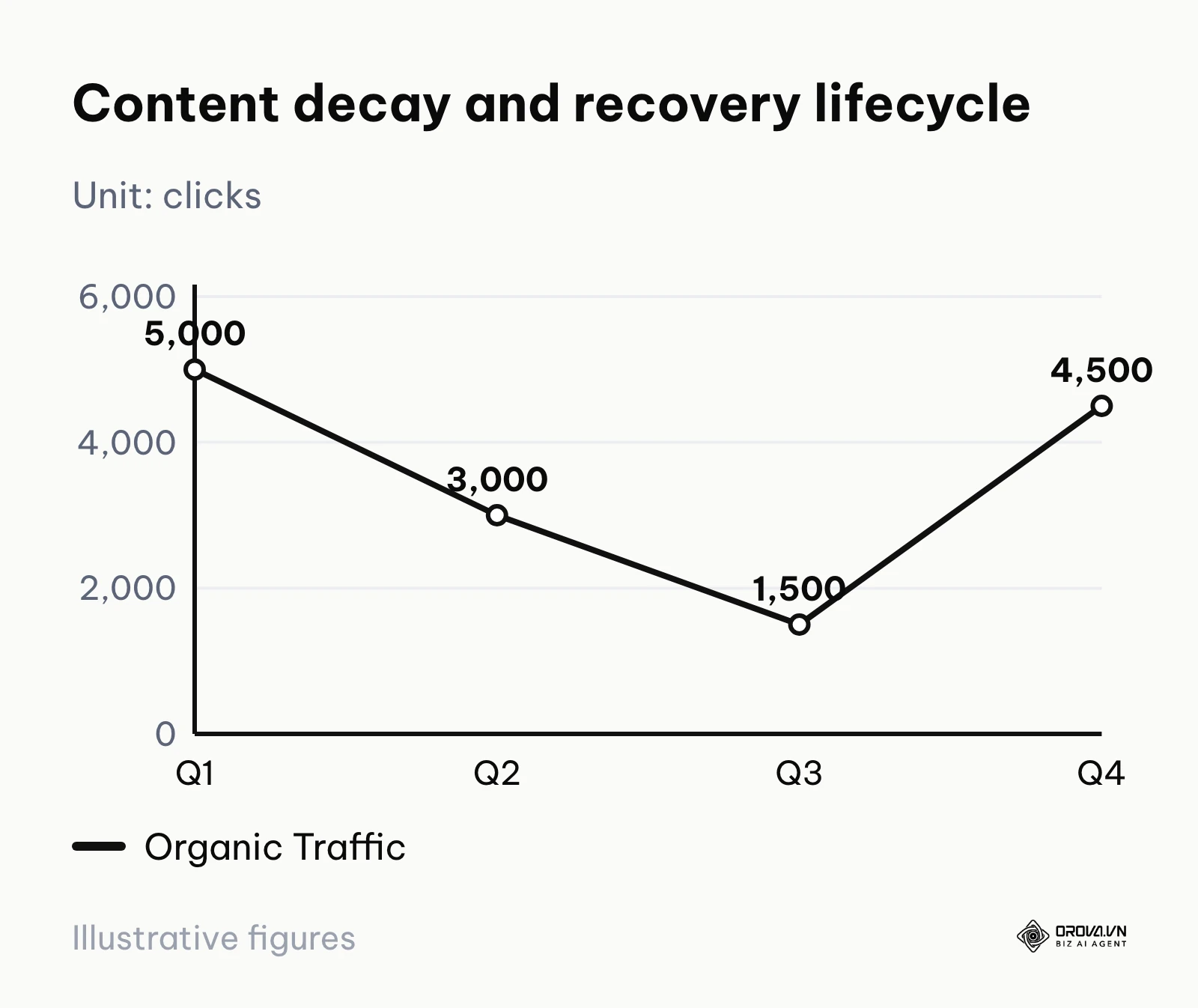
- Action: Build a routine system to identify decaying posts. Export your traffic data from the past twelve months and look for pages that have lost more than 20% of their organic traffic compared to their peak.
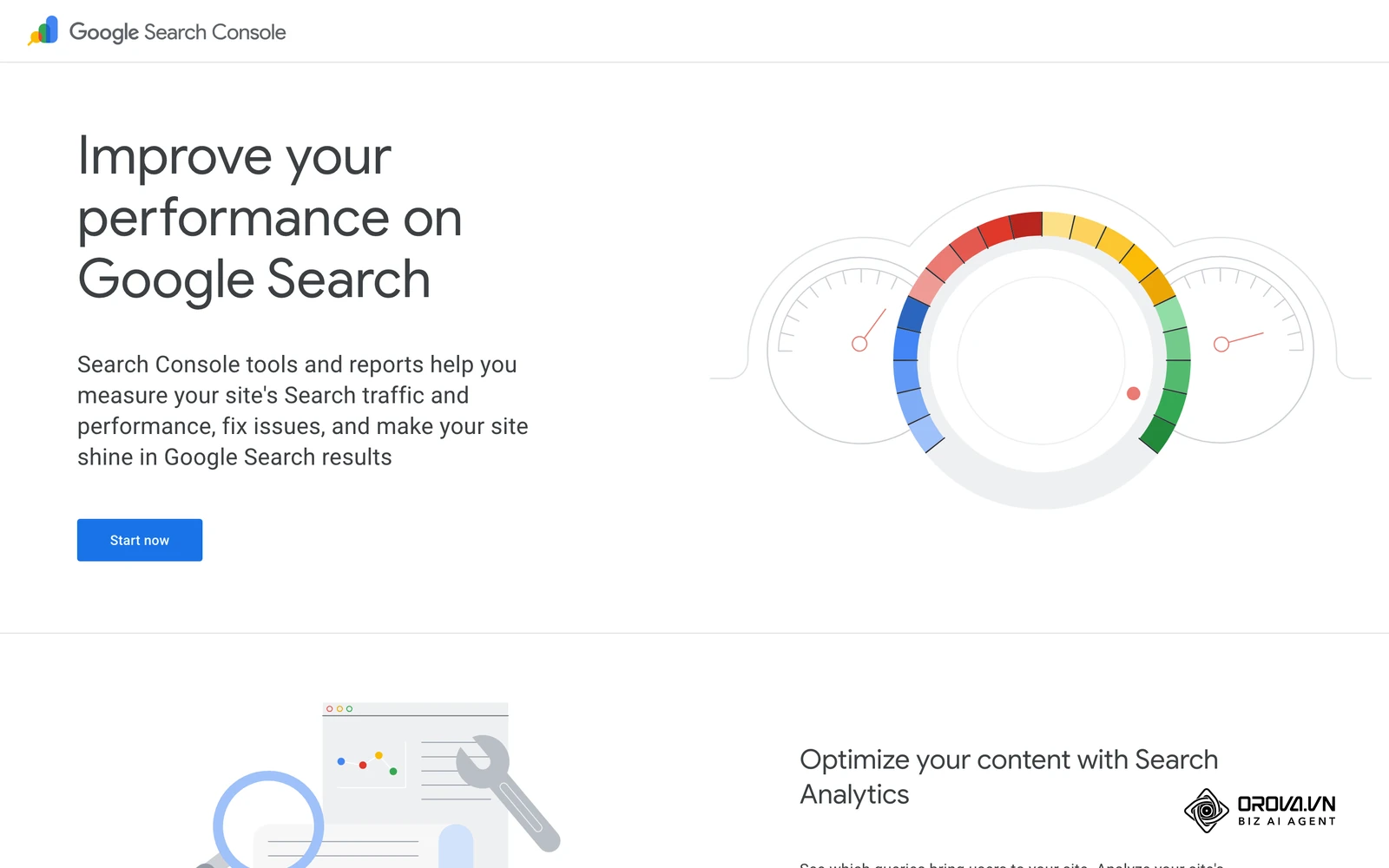
- Input: Historical Google Search Console data and a tracking spreadsheet.
- Output: A prioritized list of URLs that need to be refreshed, expanded, or rewritten to regain their lost rankings.
- Common Failure Point: Ignoring historical data entirely, resulting in a website bloated with hundreds of low-quality, outdated posts that drag down the overall domain authority.
Illustrative example data:
| URL Path | Publish Date | Peak Traffic (Monthly) | Current Traffic | Status | Action Required |
|---|---|---|---|---|---|
| /guide-to-crm | Jan 2024 | 1,200 | 450 | Decaying | Update |
| /email-templates | Mar 2024 | 800 | 850 | Stable | Leave |
| /seo-tips-old | Nov 2023 | 300 | 15 | Dead | Merge |
The Decision Tree: New Post vs. Merge/Redirect
As your blog grows, you will inevitably encounter situations where you want to target a keyword, but you vaguely remember writing something similar two years ago. Creating a new post that competes with your own old post causes keyword cannibalization, confusing search engines about which page to rank. This guide to keyword cannibalization explains how to detect and fix it.
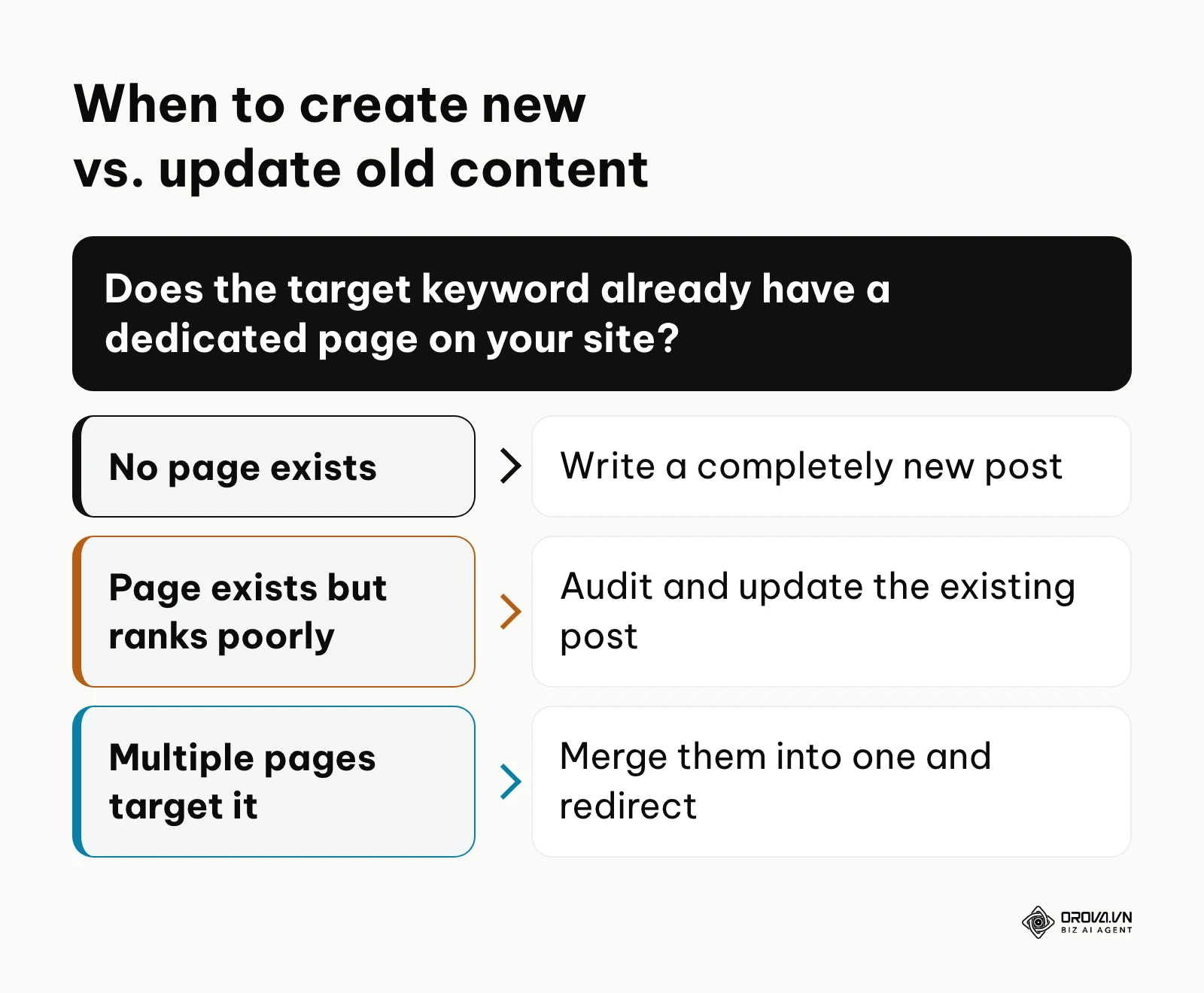
- Action: Before writing any new article, search your own site using the site:yourdomain.com [keyword] operator. If a page exists but is outdated, do not write a new one; update the existing URL to preserve its historical authority and any backlinks it has earned. If multiple thin pages cover the exact same topic, merge their content into one comprehensive guide and set up 301 redirects from the old URLs to the new master URL.
- Input: The target keyword and a list of your existing indexed pages.
- Output: A clean site architecture where one comprehensive page targets one specific topic, pooling all authority rather than splitting it.
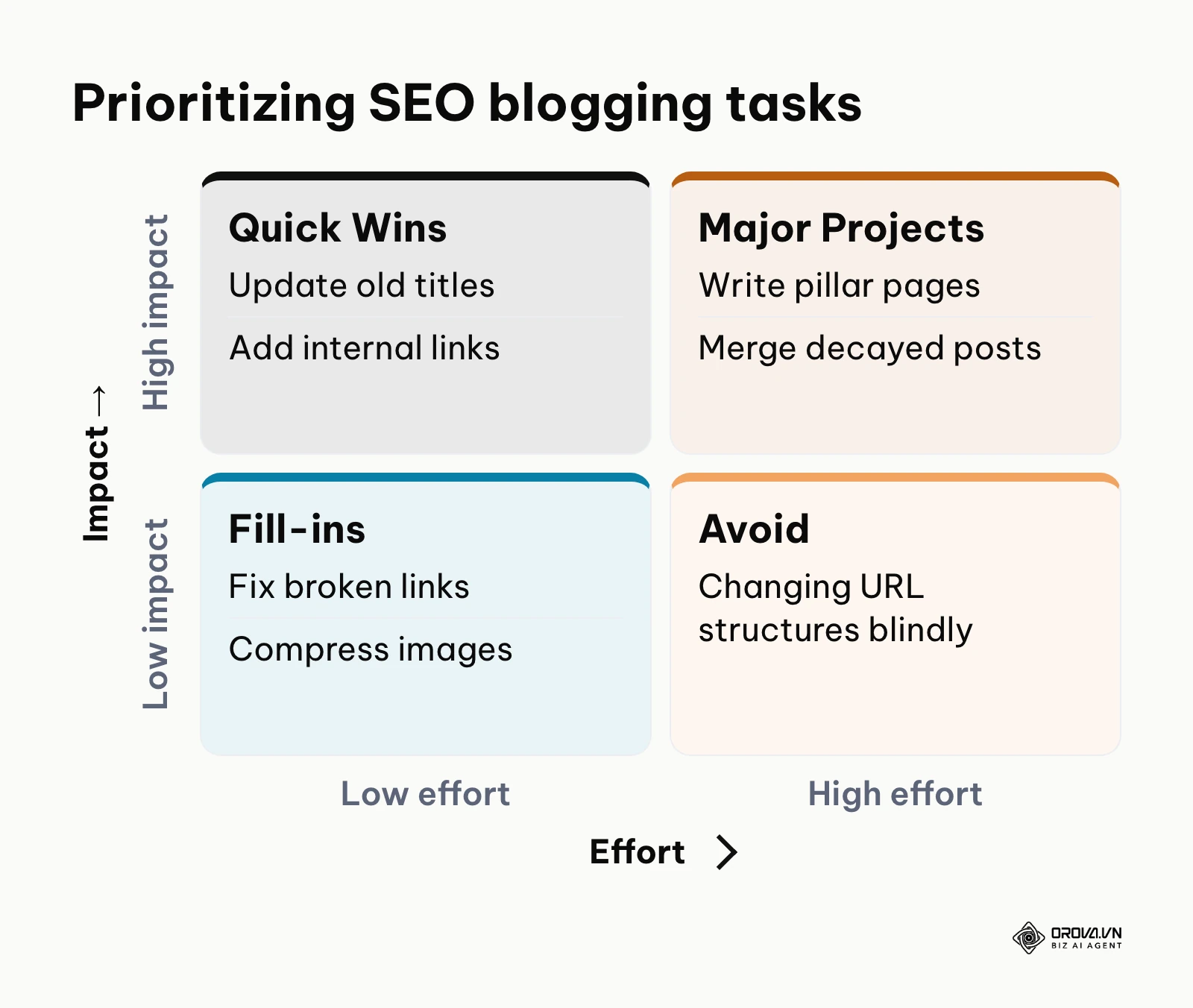
- Common Failure Point: Changing the URL structure of an old, high-performing post during an update, which breaks existing backlinks and resets the page's authority to zero.
How to adapt and start an SEO blog strategy
Implementing these strategies looks different depending on your resources, team size, and goals. Here is how different roles can adapt their workflows to build a successful SEO blog.
For Solo Bloggers
If you are managing everything yourself, resource constraint is your biggest enemy. You cannot compete with massive media sites on output volume, so you must compete on depth and personality.
- Pick a highly specific micro-niche where large sites lack deep expertise.
- Conduct keyword research to find long-tail, low-competition queries.
- Commit to publishing one incredibly detailed, E-E-A-T rich post per week rather than daily shallow updates.
- Spend equal time distributing your post in niche communities as you do writing it.
For In-house Content Marketers
If you are part of a company marketing team, your challenge is alignment. Your content must drive measurable business results while satisfying the demands of various stakeholders.
- Audit your existing content library to identify quick wins and severe content decay.
- Build a content calendar mapped directly to the questions your sales team fields most often.
- Establish a formal quality scorecard to standardize output across multiple writers or freelancers.
- Implement strict tracking using analytics tools to prove the ROI of your organic traffic efforts to leadership.
For Agency SEO Professionals
If you manage SEO for clients, your focus must be on scalable systems and demonstrating clear, localized value.
- Set expectations clearly: SEO blogging is a long-term strategy, not a quick fix.
- Focus heavily on optimizing the client's internal linking structure to distribute authority.
- Implement a rigorous content update schedule for the client’s historical posts.
- Automate performance reporting to clearly show the link between traffic growth and revenue.
| Common Mistake | Consequence | How to Avoid |
|---|---|---|
| Writing without keyword research | Zero organic traffic despite great writing | Always map posts to verified search volume |
| Changing URLs on old posts | Breaking backlinks and losing rankings | Keep the original URL when updating content |
| Ignoring content decay | Gradual, steady loss of overall site traffic | Audit top 20 pages every six months |
| Chasing impossible keywords | Wasting months trying to outrank Wikipedia | Target long-tail, specific queries first |
With OROVA.VN and the OROVA SEO module, you put an end to the exhausting days of manual work for good. Instead of struggling for hours to write articles and compile reports, the entire process is now optimized and completed in just 5 minutes.
The future of SEO blogging: Author's predictions
As of 2026, the landscape of digital content is shifting rapidly. The barrier to generating text has dropped to zero, meaning that the sheer volume of information online is exploding. Looking ahead over the next few years, I believe the way we approach an SEO blog will require a fundamental recalibration.
AI will force a shift toward hyper-niche, opinionated content
I think generic, encyclopedic content is increasingly being absorbed by AI overviews at the top of the search results. If you write an article explaining "what is a mortgage," an AI can answer that faster and better. I expect that over the next few years, successful SEO blogs will rely far less on generic definitions. Instead, you must lean into hyper-niche, highly opinionated content. The future belongs to writers who take a definitive stance, share controversial industry takes, and provide extreme nuance based on deep personal experience that an AI model struggles to synthesize.
Search intent will fracture into chat-based conversational queries
Currently, we optimize for relatively static keyword phrases. However, as users become accustomed to conversational AI interfaces, I believe search queries will become incredibly long, complex, and highly specific. We are moving away from searching "best running shoes" to asking "what are the most durable running shoes for a heavy runner with flat feet who runs on concrete." To prepare, you must structure your blog content to answer highly specific, multi-layered questions rather than just broad topic categories.
Brand entity will outweigh individual page metrics
Historically, you could rank a single brilliant page on a relatively weak domain if the on-page SEO was perfect. I strongly suspect this era is ending. Shifting towards what is entity SEO means focusing on how search engines perceive your entire brand. I believe Google is moving toward weighing the entity (the author or the brand) as much as the content itself. If your brand is not mentioned across the web in relevant contexts, it will become increasingly difficult to rank individual blog posts, regardless of how perfectly they are optimized.
Frequently asked questions about SEO blogs
Is an SEO blog still needed with AI tools like ChatGPT?
Yes. While AI tools can provide quick answers, they are fundamentally summarizing existing information. When users need deep analysis, trusted opinions, first-hand reviews, or complex problem-solving based on current data, they still seek out human-written, authoritative articles. An SEO blog that heavily integrates real-world experience cannot be replaced by a generative text model.
Will using AI like ChatGPT for blogging result in a Google penalty?
Google's guidance on AI-generated content (Google Search Central, 2023) states that the focus is entirely on whether the content provides genuine value to the user, regardless of how it was produced. For a deeper look at drafting and on-page structure, see our SEO content writing guide. Using AI to generate massive amounts of unedited, low-quality spam will result in your site being ignored or penalized. However, using AI as an assistant to outline, brainstorm, or refine your grammar is perfectly safe, provided the final output is rigorously edited for accuracy and infused with your unique expertise.
Should I write one long comprehensive post or a topic cluster of five short posts?
Generally, a topic cluster approach is highly effective. Instead of writing one massive 10,000-word post that tries to answer everything, create one strong "pillar" page that covers the broad topic, and then link it to several shorter, highly specific "cluster" posts that dive deep into sub-topics. This structure makes it easier for users to find exactly what they need and helps search engines understand the depth of your topical authority.
How do you know if a blog post has enough information without keyword stuffing?
You have enough information when you have comprehensively answered the user's primary question and the logical follow-up questions they might have. Do not look at arbitrary word counts or keyword density percentages. Instead, look at the top-ranking pages for your target query. If they all include a pricing comparison chart and a video tutorial, your post will likely need those elements as well to be considered fully comprehensive by search algorithms.
How to optimize blog posts for SEO if I am not a technical expert?
You do not need to be a developer to run a successful SEO blog. Focus entirely on the fundamentals: ensure your site loads quickly, use descriptive URL slugs, format your text with clear H2 and H3 headings so it is easy to skim, and compress your images before uploading them. The most critical aspect of SEO optimization is the quality and structure of your writing, not writing complex code.
Where to start right now
Knowing the theory is useless without execution. How you begin applying these strategies depends entirely on what your website looks like today. Avoid trying to do everything at once; focus on establishing a baseline of data and quality first. Creating a comprehensive SEO report guide helps you track your progress accurately from day one.
If you have Nothing (a brand new website or no existing blog): Your single first step this afternoon is to set up Google Search Console and Google Analytics 4. Do not write a single word until these tools are active. You must have the infrastructure in place to measure how search engines crawl your site and how users interact with it. Once connected, spend one hour brainstorming a list of ten specific questions your ideal customers ask before buying your product.
If your content is Fragmented (you have dozens of random posts with no strategy): Your first step is to perform a content audit on your top ten highest-traffic pages. Export their data, review them against the Quality Scorecard provided earlier, and look for obvious technical errors like broken images, missing alt text, or missing internal links. Fixing these existing assets will yield faster results than writing a new article from scratch.
If you are Unmeasured (you write regularly but have no idea what works): Your first step is to map your existing articles to specific target keywords. Open a spreadsheet and list every URL you have published. Next to each URL, define the exact keyword it is supposed to rank for. If you find multiple pages targeting the same keyword, you have immediately identified cannibalization issues that need to be merged.
Illustrative example: A regional marketing agency managing a local law firm's website needed to recover traffic that had dropped over the past year. They exported the client's traffic data, identified five historical pillar pages suffering from severe content decay, and systematically rewrote the outdated legal precedents in those articles. The team faced pushback from the client who feared changing old URLs would break existing links, so they meticulously kept the exact original URLs and only updated the on-page content and publication dates. Shortly after the updates went live, the firm's website regained its top-three positions for local practice area searches, bringing in a noticeable increase in direct phone inquiries to the front desk.
About the author

Builder of Orova
Nguyễn Đỗ Trọng Ân has 8 years of experience in marketing, including 6 years managing market development across Asia. He builds Orova, a Biz AI Agent that never sleeps: it plans, runs and optimizes work for businesses.
Run your business with AI Agents
Orova is the always-on Biz AI Agent — it plans, runs, and optimizes the work for you.
Save time, unlock productivity.