
What is ad spend? Definition, metrics and how to manage it

Imagine staring at your campaign dashboard at the end of the month, realizing you have spent a large share of your budget but cannot definitively point to the exact revenue those dollars generated. You are not alone. Many marketers treat their ad spend like a slot machine—inserting cash and hoping for a massive payout without understanding the underlying mechanics. The traditional approach often involves blindly throwing money at Google or Meta, assuming that merely participating in the auction guarantees visibility and sales. However, this outdated mindset is exactly why scaling fails.
In short, ad spend is the money you pay advertising platforms such as Google, Meta, or TikTok to show your ads, and nothing else. This guide explains what ad spend includes and excludes, how it differs from your ad budget, how to measure it with ROAS, MER, and CPA, and how to pace and reallocate it across channels. By moving beyond basic definitions, we provide actionable frameworks, practical templates, and clear rules for managing every dollar, ensuring you never have to guess whether your campaigns are driving actual business value or simply inflating vanity metrics.
What is Ad Spend?
Ad spend is the total amount of money a business directly pays to advertising networks to display commercial messages to a target audience. It is used to acquire traffic, generate leads, and drive sales, but differs from the overall marketing budget by excluding production costs, software subscriptions, and agency fees.
Historically, the concept originated in traditional media buying where businesses purchased fixed blocks of television airtime or newspaper real estate. With the rise of programmatic digital advertising, this cost transformed into a fluid, auction-based metric that can fluctuate by the second. Understanding this distinction is crucial because confusing media costs with operational costs leads to highly inaccurate return calculations.
To clarify the boundaries, here is how ad spend differs from other closely related financial concepts in marketing:
| Concept | How it differs | Example |
|---|---|---|
| Ad Spend | Only covers the direct payment to the platform for delivering the ad. | The amount Google bills you for clicks on a search campaign. |
| Marketing Budget | Encompasses all departmental costs, including salaries, tools, and creative production. | Ad spend plus the fee paid to a designer for the banner image. |
| Customer Acquisition Cost | The total blended cost of acquiring a single customer, incorporating everything. | Dividing the total marketing budget by total new clients. |
Ad Spend vs Ad Budget
The two terms are often used interchangeably, but they answer different questions. Your ad budget is the plan: the ceiling you approve for a month or a campaign before anything runs. Your ad spend is the reality: what the platforms actually charged you once the auctions ran. A healthy account keeps actual spend close to the budget line without hitting it too early. If you still need to set that ceiling, our guide to calculating and allocating an ads budget walks through the planning side; this article focuses on the money once it is flowing.
Consider a simple everyday scenario: Imagine you want to sell lemonade. The ad spend is the money you pay the local community center to let you put a sign on their premium bulletin board. The marketing budget, however, includes the cost of the markers, the poster board, and the money you pay your friend to draw an attractive lemon on the sign.
How to Measure Ad Spend: ROAS, MER and CPA
Knowing how much you spent is only half the picture. Ad spend becomes useful when you put it next to what it produced. Three metrics do most of the work:
| Metric | Formula | What it tells you |
|---|---|---|
| ROAS (return on ad spend) | Revenue attributed to ads ÷ Ad spend | How much revenue each campaign or channel returns per dollar of media. |
| MER (marketing efficiency ratio) | Total revenue ÷ Total ad spend across all channels | Whether paid media as a whole is paying off, regardless of attribution disputes between platforms. |
| CPA (cost per acquisition) | Ad spend ÷ Number of conversions | What you pay for each lead, sale, or sign-up. |
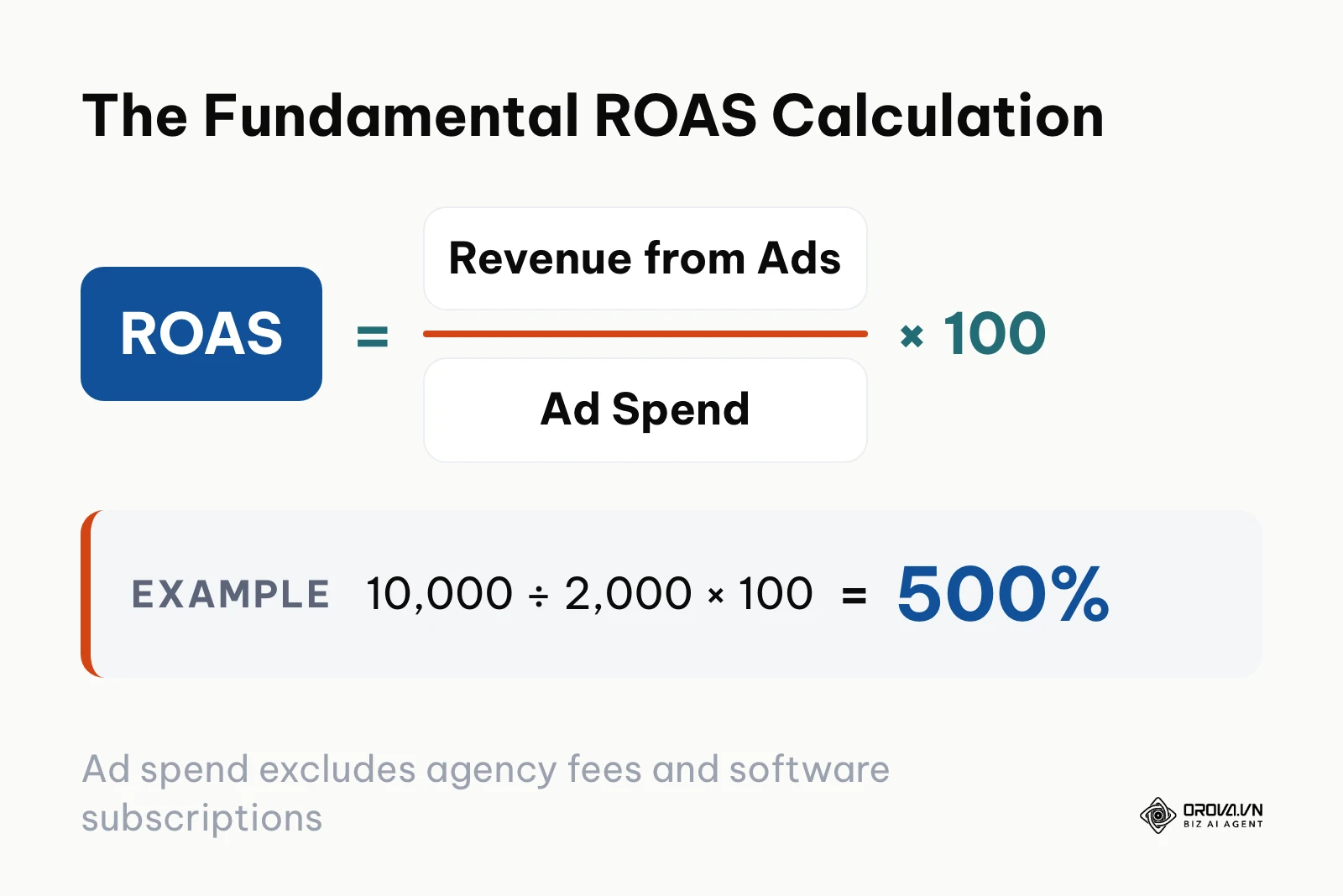
Illustrative example: a store attributes 10,000 dollars of revenue to campaigns that cost 2,000 dollars in ad spend. Its ROAS is 10,000 ÷ 2,000 × 100 = 500%, or 5:1. For a step-by-step walkthrough of the calculation, see the ROAS formula guide, and to find the minimum ROAS at which you stop losing money, use a break-even ROAS calculator.
ROAS reads the platform's attribution, so it can look better than reality when Meta and Google both claim the same sale. MER ignores attribution and simply compares total revenue with total spend, which makes it a good sanity check. CPA is the metric to watch when you sell leads rather than checkout orders; if you are torn between bidding to a cost target or a return target, compare target CPA vs target ROAS.
Why Ad Spend Strategy Matters
Ad spend strategy exists to solve a massive problem for businesses of all sizes: the rapid, unchecked burning of capital without proportional revenue generation. For marketing teams and business owners, unmanaged paid media is one of the highest-risk areas of operations. A strategy places guardrails around this expenditure. It positions paid advertising accurately within the larger business picture—specifically, sitting directly between product development (what you sell) and sales operations (how you close the deal).
Without a rigorous tracking strategy, you lose visibility into which specific dollars are driving profit and which are completely wasted on bot traffic or irrelevant audiences. If you ignore proper budget management, you risk exhausting your monthly funds in a matter of days due to algorithm spikes, leaving your business invisible during crucial buying periods later in the month.
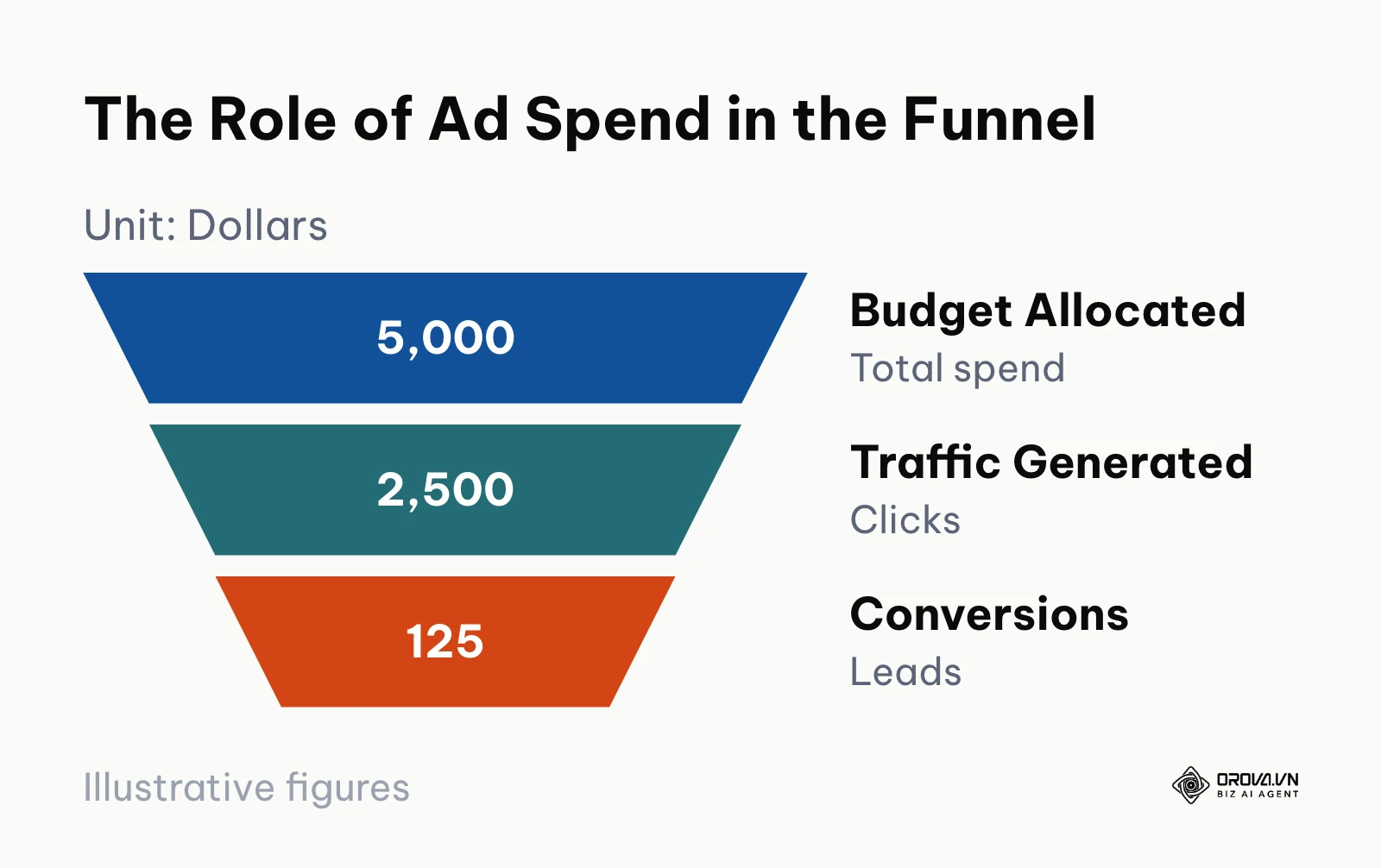
Illustrative example: 5,000 dollars of ad spend that buys 2,500 clicks and 125 leads works out to 2 dollars per click and 40 dollars per lead. Each step of that funnel is a place where money can leak.
Example scenario: A regional B2B logistics company looking to acquire new warehouse clients. They initially deposited a large lump sum into a search campaign without daily limits. Over the first weekend, a poorly configured keyword match type triggered thousands of irrelevant clicks from consumers looking for personal moving boxes, draining the account. The team immediately audited the search terms, added over two hundred negative keywords, and implemented strict daily budget caps. As a result, the daily dashboard showed a complete halt in irrelevant traffic, and the sales team started receiving qualified warehouse inquiries by Tuesday morning.
When you do not need ad spend yet: You should abstain from allocating funds to paid platforms if your core product lacks market fit or your website has a broken conversion funnel. Paying to drive traffic to a flawed system is a massive waste of capital. Additionally, if you currently possess a highly engaged organic audience that generates more leads than your operations team can process, forcing paid campaigns is entirely premature. Instead, prioritize improving customer retention, repairing website technical issues, and maximizing organic content reach before attempting to scale aggressively with paid media channels.
The Value of Managing Ad Spend
Implementing a tight control system over your media investments delivers profound value across two distinct layers: macro business impact and micro operational improvements.
Financial Predictability and Risk Mitigation
For the business entity, rigorous management translates directly into financial safety. When you establish strict rules for daily and weekly expenditures, you eliminate the risk of a platform algorithm error bankrupting your department. This predictability allows executives to forecast revenue with much higher accuracy. By linking every dollar spent to a tangible business outcome, the company can confidently scale profitable channels and ruthlessly cut wasteful ones, thereby protecting cash flow.
Operational Clarity and Reduced Stress
For the practitioner—the media buyer or marketing manager—effective tracking eliminates the panic of the end-of-month reporting cycle. Instead of scrambling to manually reconcile invoices from different platforms, the practitioner operates with absolute clarity. They know exactly how much budget remains for the week and can make calm, data-driven decisions regarding bid adjustments and creative testing without the constant fear of overspending.
Example scenario: A mid-sized software startup managing three separate platform accounts simultaneously. The marketing manager was manually downloading CSV files from Meta, Google, and LinkedIn every Friday to calculate total weekly expenditure. The main hurdle was the time delay; by the time the data was consolidated, they had often already overspent on a poorly performing LinkedIn ad set. To fix this, they built a centralized automated dashboard using API connectors to pull current spend data. The visible result was a clean, single-screen interface that allowed the manager to instantly identify and pause a failing campaign on a Wednesday afternoon, reallocating the funds to a profitable Google Search campaign before the weekend.
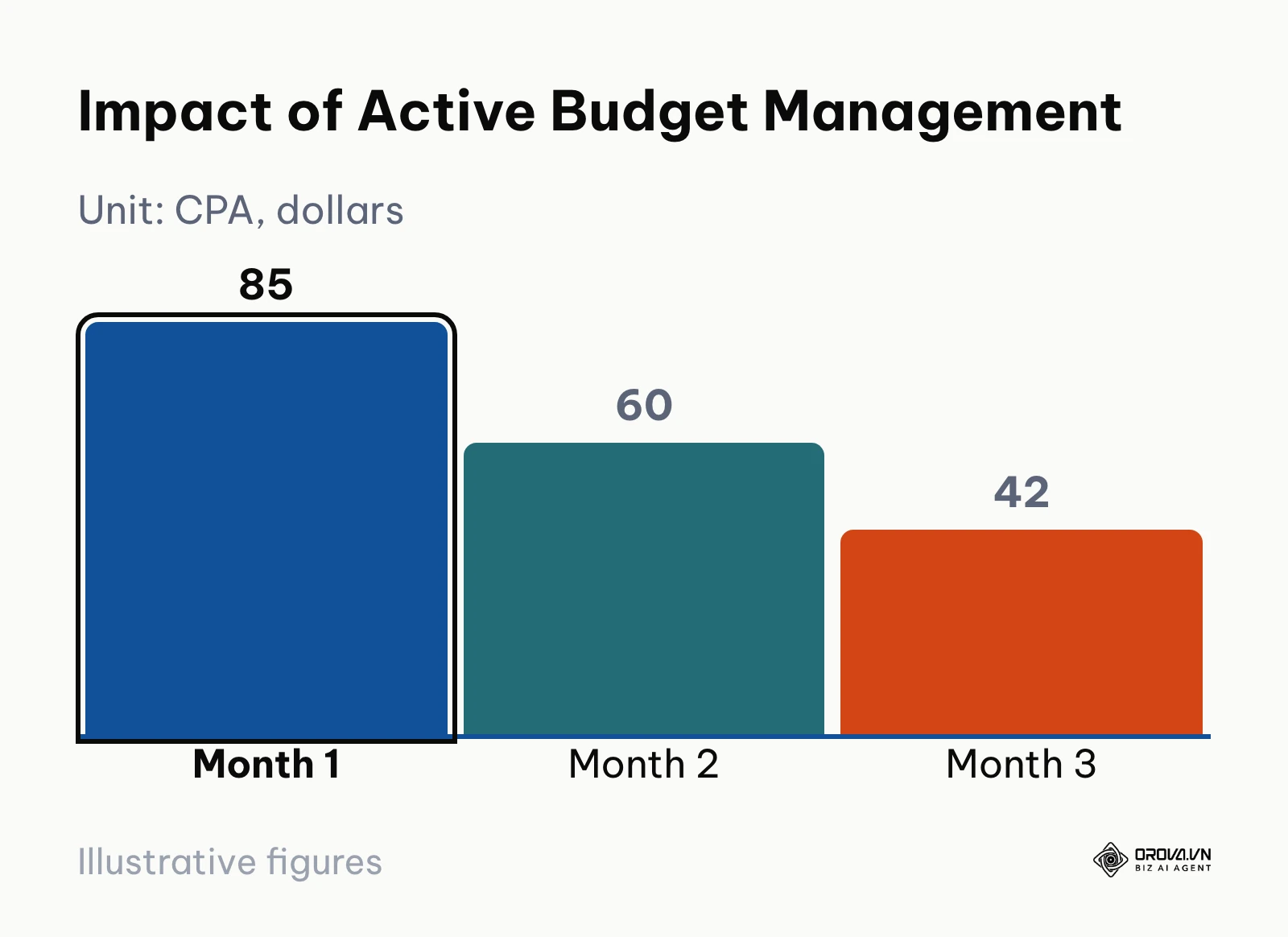
Illustrative example: an account whose CPA moves from 85 dollars in month one to 60 in month two and 42 in month three after pacing and reallocation rules are introduced. The exact figures will differ for every business, but the direction is what you are watching for.
Here is how you can measure the tangible benefits of a structured management approach:
| Benefit | Measured by which metric | Visible after how long |
|---|---|---|
| Reduced Budget Waste | Decrease in Cost Per Acquisition (CPA) | 2 to 4 weeks |
| Improved Traffic Quality | Increase in Conversion Rate | 1 to 2 weeks |
| Better Cash Flow Protection | Variance between Target and Actual Spend | 1 month |
OROVA ADS applies AI Agent to automate and optimize ad performance on Google, Meta and TikTok. Scale your budget safely, monitor 24/7 and expand your business quickly.
Experience the solution at orova.vn/ads
How Ad Spend Allocation Works
Understanding the mechanics of ad spend requires breaking down the process into strategic components. It is not a single action but a continuous cycle of planning, deploying, monitoring, and shifting funds. This section details the critical components of a modern execution framework.
The Anatomy of Ad Spend
Before you launch a campaign, the budget must be dissected into actionable units.
- Setting the Objective: You must define whether the money is meant to buy impressions, clicks, or completed forms.
- Defining the Inputs: This includes your daily budget cap, your target bid price, and your audience parameters.
- Generating Outputs: The platform consumes the inputs and outputs raw data: impressions delivered, clicks generated, and the resulting cost per click.
- Identifying Points of Failure: The most common failure point in this anatomy occurs when broad targeting inputs overlap with aggressive bidding inputs, causing the platform to spend money rapidly on low-intent users just to fulfill the daily budget quota.
Depending on the platform and goal, your costs will be calculated differently. You must understand the core billing models to align your budget expectations:
| Type of Spend Model | Characteristics | Best Suited For |
|---|---|---|
| Cost Per Mille (CPM) | You pay for every 1,000 times your ad is shown, regardless of clicks. | Brand awareness and massive reach campaigns. |
| Cost Per Click (CPC) | You only pay when a user physically clicks your ad. | Search intent campaigns driving direct traffic. |
| Cost Per Action (CPA) | The algorithm optimizes to hit a specific cost for a lead or sale. | Performance marketing focused purely on revenue. |
Multi-Channel Budget Allocation Strategy
Modern advertising requires presence across multiple networks, which introduces the complexity of cross-channel allocation. If you put all your money into one platform, you risk rapid audience fatigue. A robust strategy divides the budget based on the user's position in the buying journey.
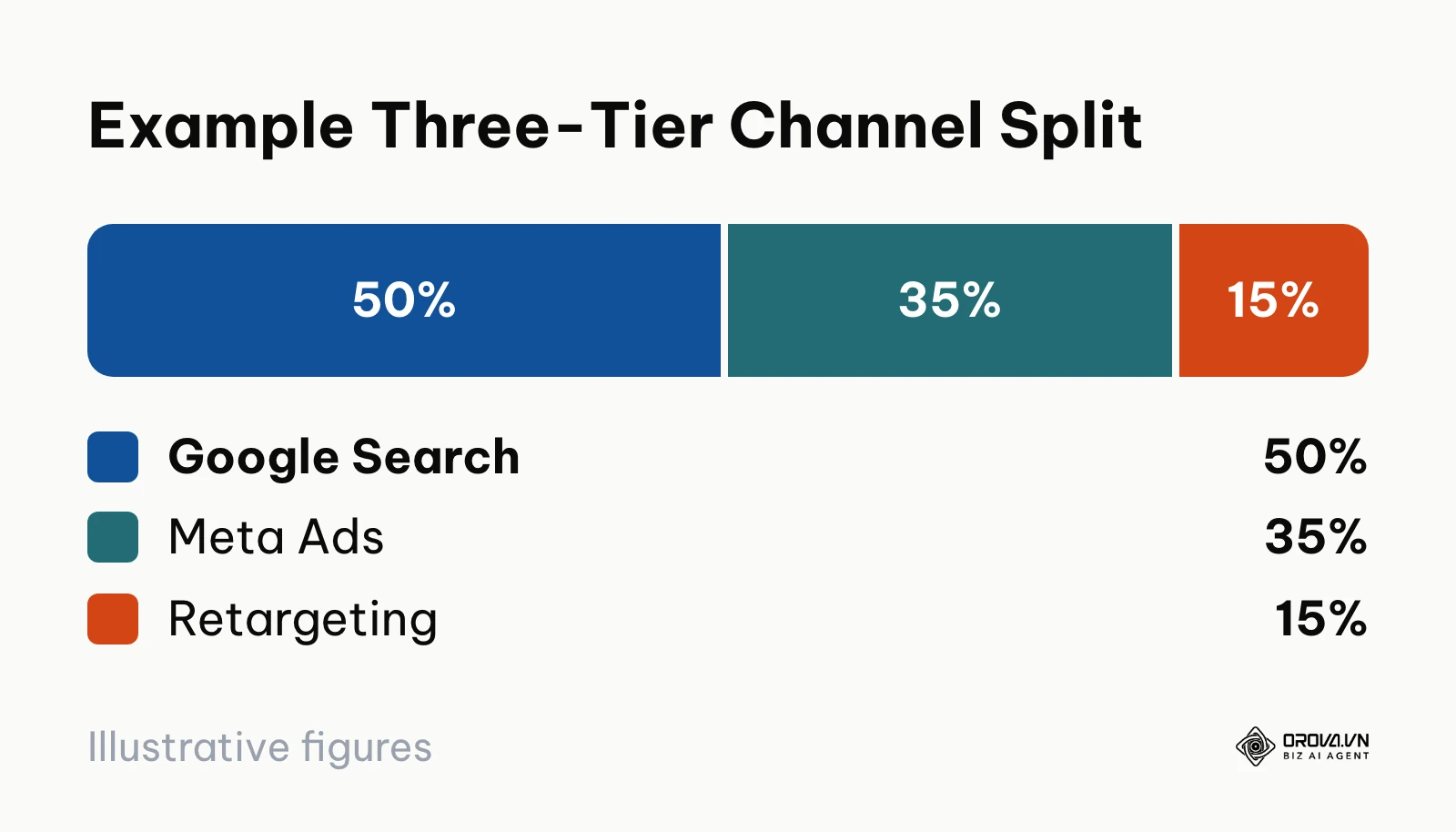
Typically, a foundational approach divides the budget into three tiers:
- High-Intent Capture: Platforms like Google Search capture users actively looking for a solution. Because these users are ready to buy, this channel often receives the largest share of the budget; a common starting point is around 40-50%. The clicks are expensive, but the conversion rates are high.
- Demand Generation: Platforms like Meta (Facebook/Instagram) and TikTok are used to generate interest among users who do not yet know they have a problem. This tier requires engaging visual content and often takes 30-40% of the budget as a starting point. It feeds the top of your funnel.
- Retargeting: Across all networks, a dedicated slice of the budget (10-20%) must be reserved strictly for showing ads to people who have previously visited your website but did not buy. This is often your highest returning segment.
When structuring these tiers, it is vital to plan your split carefully to ensure no tier starves the others of necessary funding.
The Ad Budget Pacing Template
To avoid spending your entire monthly allowance in the first two weeks, you must utilize budget pacing. Pacing is the practice of tracking your actual daily spend against a theoretical ideal daily spend.
To implement this immediately, you should create a Google Sheets Ad Budget Pacing Template with the following structure:
- Column A (Date): List every day of the month.
- Column B (Daily Target): Your total monthly budget divided by the number of days in the month.
- Column C (Cumulative Target): A running total of what you should have spent by that date.
- Column D (Actual Daily Spend): The data you input from your ad platforms each morning.
- Column E (Actual Cumulative Spend): A running total of what you have actually spent.
- Column F (Variance): The critical column. Subtract Column C from Column E. If the number is heavily positive, you are overspending and need to lower daily caps. If the number is heavily negative, you are underspending and missing opportunities.

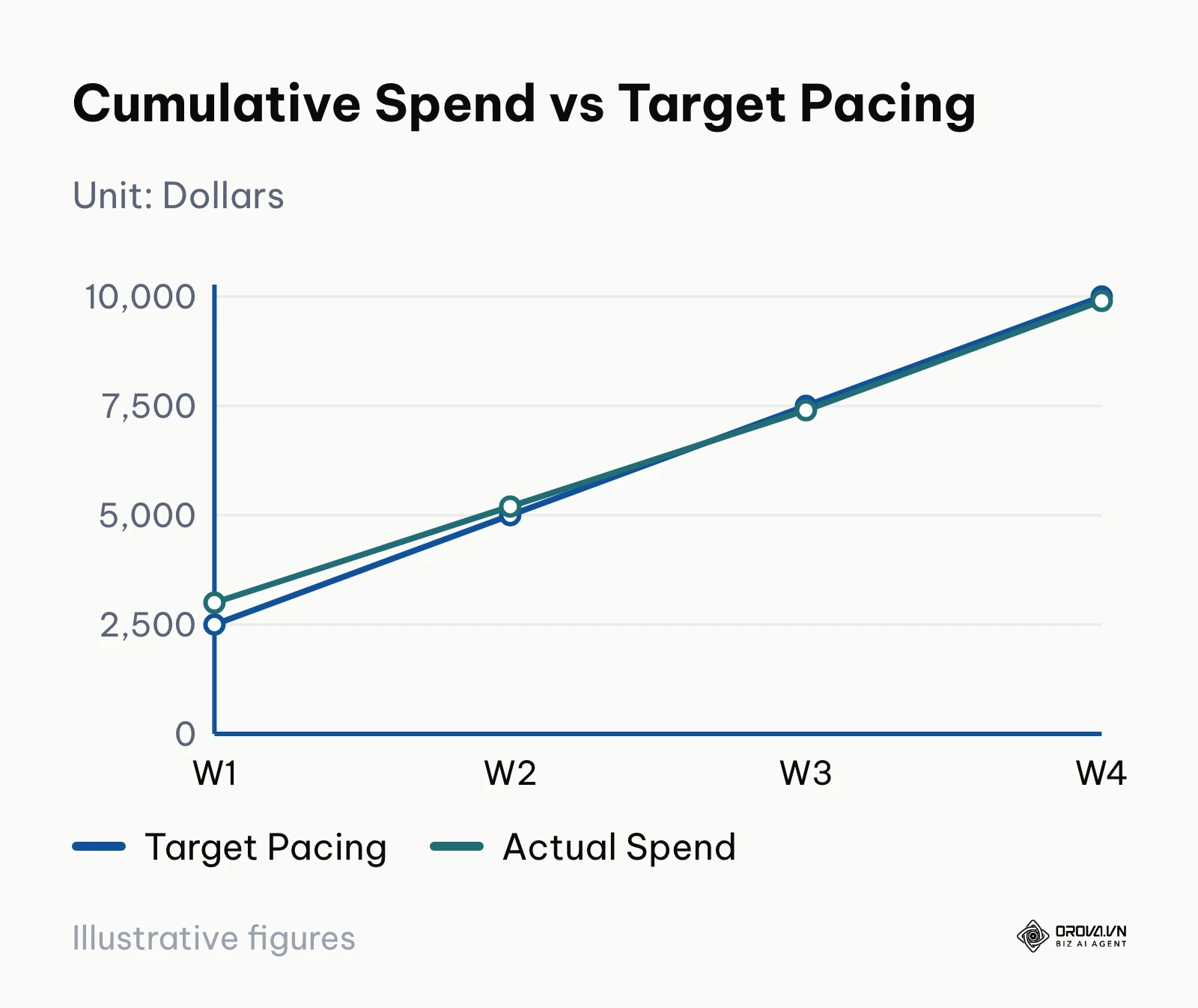
Illustrative example: on a 10,000-dollar monthly budget, the cumulative weekly targets are 2,500, 5,000, 7,500, and 10,000 dollars. Actual spend of 3,000 dollars after week one signals front-loading; ending the month at 9,900 dollars means the pacing recovered.
Using this simple spreadsheet transforms budget management from a guessing game into a precise mathematical exercise. It forces the media buyer to look at the numbers daily, catching runaway campaigns before they cause structural financial damage.
Dynamic Reallocation: Shifting Funds on the Fly
Static budgets are a recipe for mediocrity. Dynamic reallocation is the advanced tactic of moving money between channels and campaigns mid-month based on recent performance. If Google Search is generating leads at roughly a third of the cost of Meta leads, it makes zero business sense to keep spending equally on both platforms.
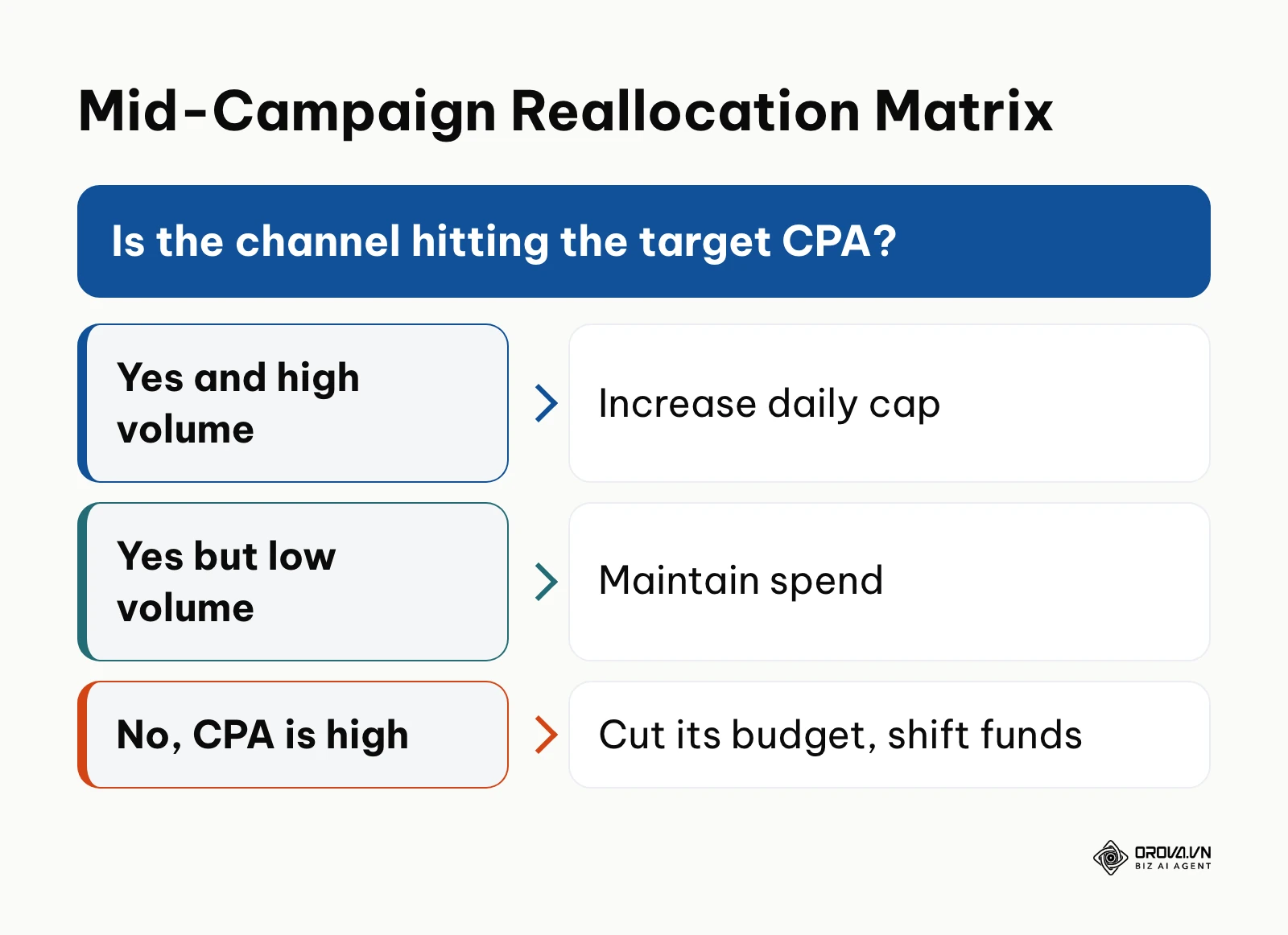
The strategy requires setting strict performance thresholds. For instance, you establish a rule: if any campaign exceeds your maximum acceptable cost per lead over a 72-hour window, its budget is slashed by 50%. Those recovered funds are then immediately injected into the campaign currently boasting the lowest cost per lead. This fluid movement requires constant vigilance and a clear view of your core metrics to execute correctly without breaking the platform learning phases.
Example scenario: An online fitness apparel retailer trying to balance aggressive growth with profitability. During a major holiday sale, they allocated equal daily budgets to both top-of-funnel video views and bottom-of-funnel retargeting. Mid-week, the creative fatigue set in on the video ads, causing the cost per click to quadruple, while the retargeting pool was severely restricted by its low budget cap. The media buyer quickly intervened, shifting 60% of the daily allocation away from the video campaigns and injecting it directly into the retargeting sets. The immediate outcome was a visible surge in completed checkout events on their Shopify dashboard within hours, rescuing the overall profitability of the holiday promotion.
Monthly Ad Spend Audit Checklist
To ensure long-term health, every advertiser must conduct a rigorous audit at the close of every billing cycle. This is not just about reporting numbers, but finding hidden waste.
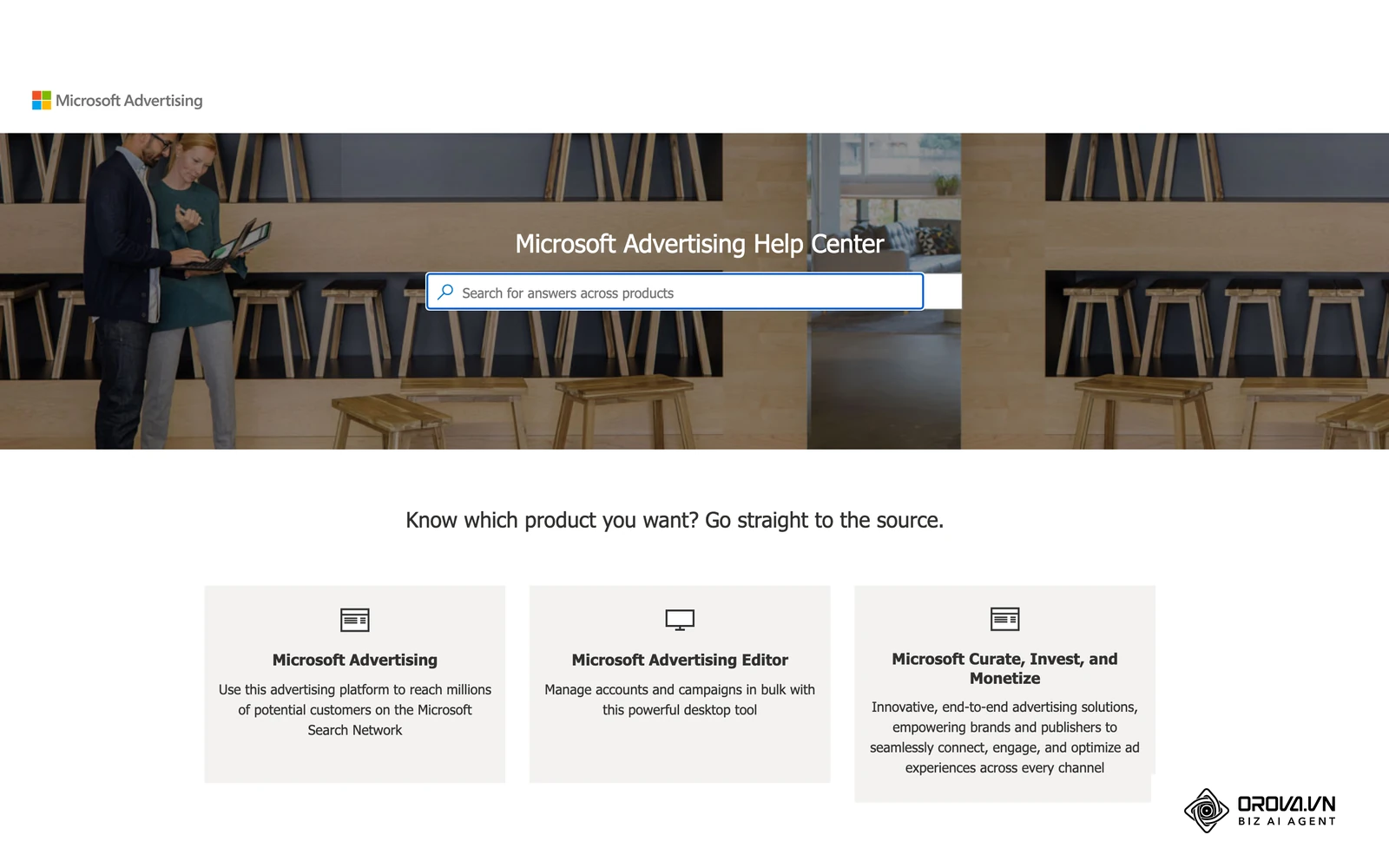
- Review Search Terms: In Google Ads, sort your search term report by highest cost. Identify any phrase that consumed significant budget without producing a conversion and immediately add it to your negative keyword list.
- Check Placement Reports: In display and video networks, review exactly which websites and apps showed your ads. Exclude low-quality apps and sites that generate accidental clicks.
- Audit Platform Discrepancies: Compare the conversion numbers reported by Meta and Google against the actual sales recorded in your CRM or Shopify store. Platforms often over-report due to attribution windows.
- Assess Creative Fatigue: Look at the frequency metric on your social ads. If users are seeing the same image more than three times a week and click-through rates are dropping, pause the ad and introduce new creative.
- Re-evaluate the ROAS Target: Plug your final numbers into the core ROAS formula to ensure your baseline profitability metrics are still holding up against rising platform costs.
How to Start Managing Your Ad Spend
Adopting proper management techniques looks different depending on the size of your operation and your specific role. Here is a tailored breakdown for different professionals navigating this ecosystem.
For Small Business Owners
When you are bootstrapping with a small monthly budget, every dollar must be guarded fiercely.
- Focus purely on bottom-of-funnel intent. Start with Google Search campaigns targeting specific, high-intent long-tail keywords.
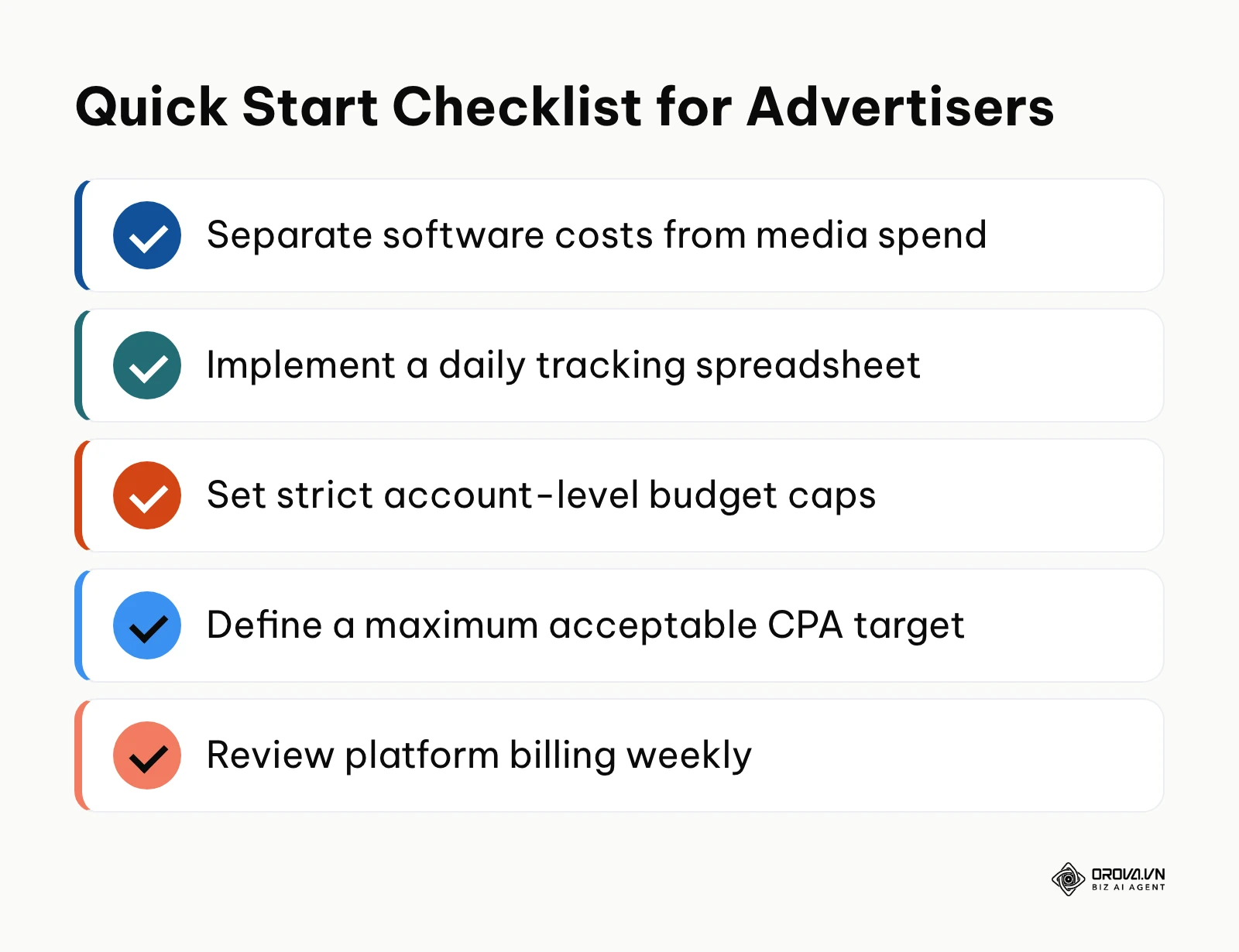
- Set hard daily account limits at the billing level to ensure you cannot accidentally overspend while you sleep.
- Check your search terms report every two days to ruthlessly exclude irrelevant clicks.
- Avoid broad awareness campaigns on social media until you have established a reliable revenue stream from search.
For Corporate Marketing Managers
Managers dealing with five-figure budgets across multiple team members need robust systems over manual checks.
- Implement a unified pacing dashboard that aggregates spend data from all active platforms.
- Establish clear cost-per-acquisition (CPA) thresholds with your media buying team, detailing exactly when a campaign must be paused.
- Structure your budgets into clear silos: 70% for proven performers, 20% for testing new creatives, and 10% for entirely experimental channels.
- Conduct weekly sync meetings focused solely on variance reports to catch pacing issues early.
For Agency Media Buyers
Professionals managing money on behalf of clients face the challenge of communicating complex budget shifts transparently.
- Build client-facing dashboards that clearly separate media spend from the agency management retainer fees.
- Set up automated email alerts that trigger if a specific campaign spends more than 20% of its daily allocation in a single hour.
- Utilize script automation in platforms like Google Ads to automatically pause campaigns when they hit their monthly cap.
- Document every single dynamic reallocation decision in a change log to justify strategy shifts during monthly client reviews.
To avoid critical failures regardless of your role, you must be aware of the most frequent stumbling blocks:
| Common Mistake | Consequence | How to Avoid It |
|---|---|---|
| Leaving campaigns on default "Broad Match" settings. | Rapidly burning budget on completely irrelevant search terms. | Use phrase and exact match types, and build extensive negative lists. |
| Forgetting to set a lifetime or monthly account limit. | Waking up to an invoice far above expectations. | Always configure hard billing thresholds in the account settings. |
| Raising daily budgets in large jumps (a common rule of thumb is no more than about 20% at a time). | Re-triggering the algorithm's learning phase and destabilizing performance. | Increase budgets slowly in small increments over several days. |
Want to scale your budget but afraid of breaking performance? 📉
Integrate OROVA ADS now - an AI Agent that automatically monitors and optimizes Google, Meta, TikTok ads 24/7. Now, expanding and replicating your Performance Ads team is just one click away.
🚀 Try it now at: orova.vn/ads
Ad Spend Trends in the Coming Years: Author's Perspective
As we navigate through the complexities of digital advertising as of 2026, the landscape of budget allocation is undergoing massive structural shifts. In my view, the era of manual bid adjustments and gut-feeling budget splits is gradually closing.
AI Will Fully Overtake Manual Budget Pacing
The signs are already prevalent today with platforms pushing automated bidding strategies aggressively. I believe that the habit of a human manually moving sliders to adjust daily budgets will become increasingly rare. AI agents can evaluate cross-channel performance far faster than a person, proposing or executing reallocations that human teams struggle to keep up with. To prepare for this, media buyers must pivot away from tactical execution and focus heavily on feeding the AI superior business data, such as profit margins rather than just raw revenue. However, if platforms restrict API access for third-party optimization tools, this transition could be delayed, forcing a reliance on native, often biased, platform algorithms.
The Convergence of Creative and Spend Strategy
Currently, creative teams and media buying teams often operate in silos. I expect these roles to converge, with ad spend allocation increasingly shaped by creative velocity. Algorithms may increasingly raise budgets on specific video assets that trigger emotional resonance metrics, relying less on traditional audience targeting. Advertisers should prepare by building massive creative testing libraries today, ensuring they have the volume of assets required to feed these highly demanding distribution engines.
First-Party Data Will Dictate Cost Efficiency
With the continued degradation of third-party cookies, signal loss is pushing acquisition costs up on many networks. I think one of the most reliable ways to maintain efficient ad spend moving forward is through the rigorous application of first-party data. Companies that upload robust, clean customer lists to build precise lookalike audiences are likely to compete more efficiently in the auctions. Businesses must start prioritizing aggressive email and phone number collection immediately, treating their CRM as the ultimate weapon against rising advertising inflation.
Frequently Asked Questions About Ad Spend
Navigating the financial intricacies of paid media often leads to a specific set of recurring questions. Here are the most critical inquiries addressed clearly.
How do I know if I am overspending or underspending on a new campaign?
You determine this by comparing your actual daily spend against your target Cost Per Acquisition (CPA). If you are spending steadily every day but generating zero leads over a full week, you are likely overspending on poor targeting. Conversely, if your campaign is highly profitable but stops delivering ads by 2 PM every day because it hits its daily limit, you are severely underspending and leaving revenue on the table.
How do I separate ad spend from platform hidden fees?
Ad spend should strictly represent the media cost. However, platforms often apply local taxes, currency conversion fees, or foreign transaction charges depending on your billing setup. To separate these, you must regularly reconcile the actual charge on your corporate credit card against the media spend reported in the platform dashboard. It is highly recommended to set up billing in your local currency to avoid unpredictable exchange rate fluctuations that artificially inflate your perceived costs.
Is ad spend still necessary when AI generates free organic content?
Yes, ad spend remains absolutely necessary, even with the proliferation of AI-generated content. While AI can create massive volumes of blog posts and social updates, organic reach is limited and unpredictable on most social and search platforms. Ad spend guarantees distribution and visibility precisely when the user has high intent to purchase, something organic content cannot reliably control.
What is the ideal percentage of revenue to allocate to ad spend?
There is no universal number, as it depends heavily on your business model and margins. Established businesses usually reinvest a modest single-digit to low double-digit share of revenue into marketing, with ad spend taking part of that pie. Work backwards from your margin and your break-even ROAS rather than copying another company's percentage. Startups focusing on hyper-growth often invest significantly more.
How does ad spend impact organic search rankings?
Directly, ad spend has zero impact on your organic SEO rankings; paying Google for ads does not buy you better organic placement. Indirectly, however, heavy ad spend can increase overall brand awareness. Users who see your ads repeatedly might later perform a direct organic search for your brand name, which increases organic branded traffic, though this is a secondary effect rather than a direct algorithmic ranking boost.
Where to Start?
Jumping into rigorous budget management can feel overwhelming. Depending on your current operational maturity, your very first move should be highly targeted to avoid systemic paralysis. Solid PPC ad management principles will guide these initial steps, and a clear set of ad performance metrics keeps you honest about results.
If you currently have no tracking in place: Your absolute first step is to completely halt the launch of any new campaigns and spend one afternoon building the basic Google Sheets pacing template detailed earlier. You cannot optimize what you cannot see, and establishing a daily habit of logging into the platforms and recording your spend manually will instantly highlight where your money is draining fastest.
If you are spending across multiple channels but the data is scattered: Your immediate priority is to consolidate your reporting into a single view. Stop analyzing Meta and Google in isolation. Dedicate your next working session to mapping out your total weekly budget on a whiteboard, visualizing exactly what percentage of the total pie is going to search versus social, and forcing yourself to justify that exact percentage split based on last month's performance.
If you are tracking spend but ignoring the return metrics: You must immediately bridge the gap between your ad platforms and your CRM. The first action to take tomorrow morning is to set up offline conversion tracking or implement a robust Conversion API. This forces the platform algorithms to stop optimizing for cheap, useless clicks and start optimizing for actual qualified leads that register in your sales database.
About the author

Builder of Orova
Nguyễn Đỗ Trọng Ân has 8 years of experience in marketing, including 6 years managing market development across Asia. He builds Orova, a Biz AI Agent that never sleeps: it plans, runs and optimizes work for businesses.
Run your business with AI Agents
Orova is the always-on Biz AI Agent — it plans, runs, and optimizes the work for you.
Save time, unlock productivity.