
Target CPA vs Target ROAS: How to choose and switch safely

Advertisers and media buyers often find themselves paralyzed when configuring new Google Ads campaigns. You meticulously craft your ad copy, carefully select your keywords, and set up your tracking, but when it comes time to choose how the machine learning algorithm will spend your money, doubt creeps in. The endless debate surrounding target cpa vs target roas has plagued the performance marketing industry for years. In short, Target CPA tells Google to win as many conversions as possible at an average cost you set, while Target ROAS tells it to win as much conversion value as possible at a return you set. Traditional advice often dictates a simplistic rule: use Target CPA if you are generating leads, and use Target ROAS if you are running an e-commerce store.
This dangerous oversimplification leaves massive amounts of potential profit on the table. It completely ignores the complexities of modern business models, particularly in the B2B space where a single lead could be worth fifty dollars or fifty thousand dollars. If you feed the wrong instructions to Google's highly advanced bidding algorithms, you risk either throttling your account's growth or burning through your marketing budget on low-quality traffic that never converts into actual revenue.
This in-depth guide is designed to strip away the confusion and provide a highly technical, yet practical framework for understanding exactly how these bidding strategies function under the hood. We will dissect the data prerequisites, expose the hidden risks of algorithmic learning phases, and demonstrate how to properly map your offline CRM data to fuel value-based bidding. Instead of vague theoretical recommendations, you will walk away with a concrete decision matrix, a custom methodology to calculate your exact targets, and a precise standard operating procedure for switching strategies without crashing your active campaign performance.
Target CPA vs Target ROAS: The Core Difference
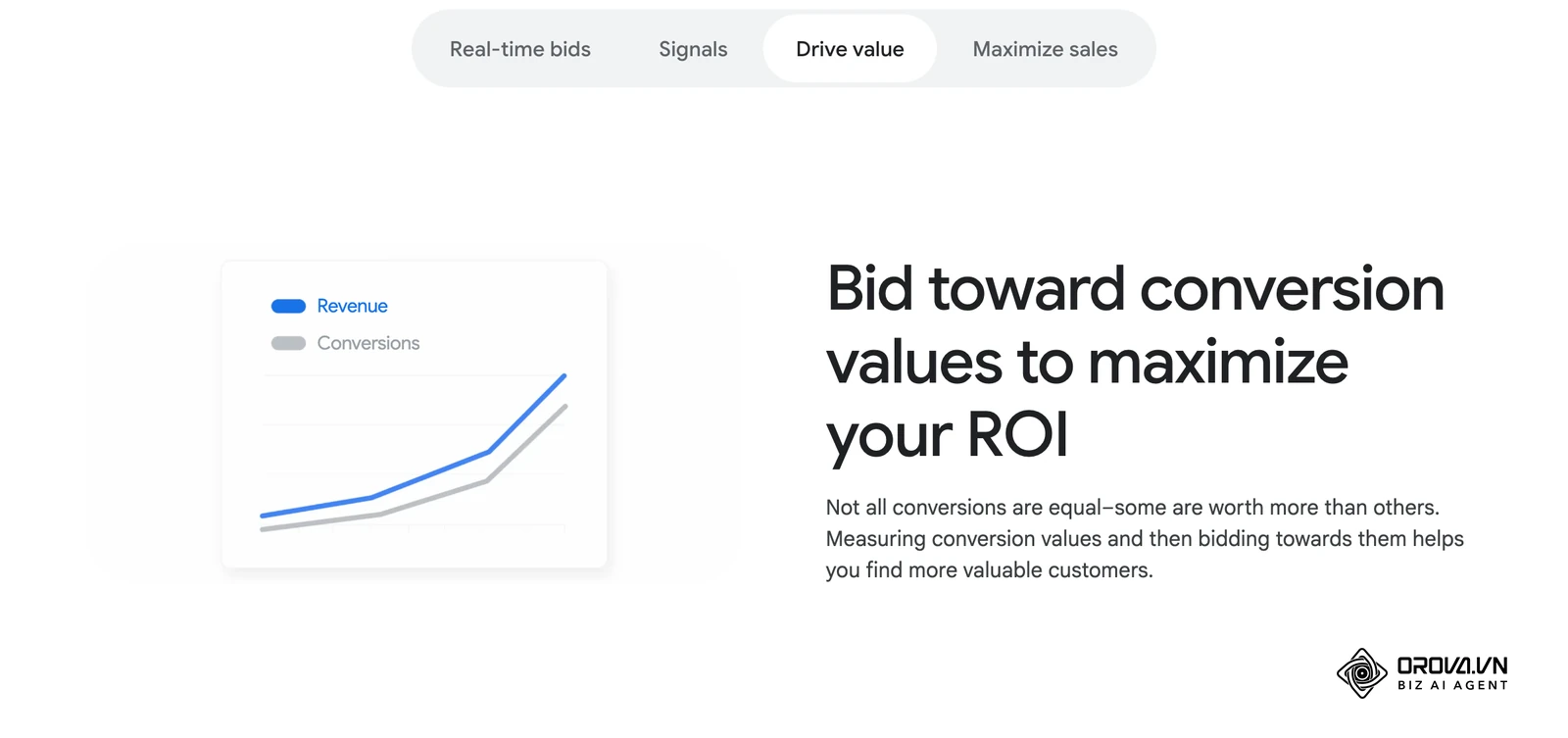
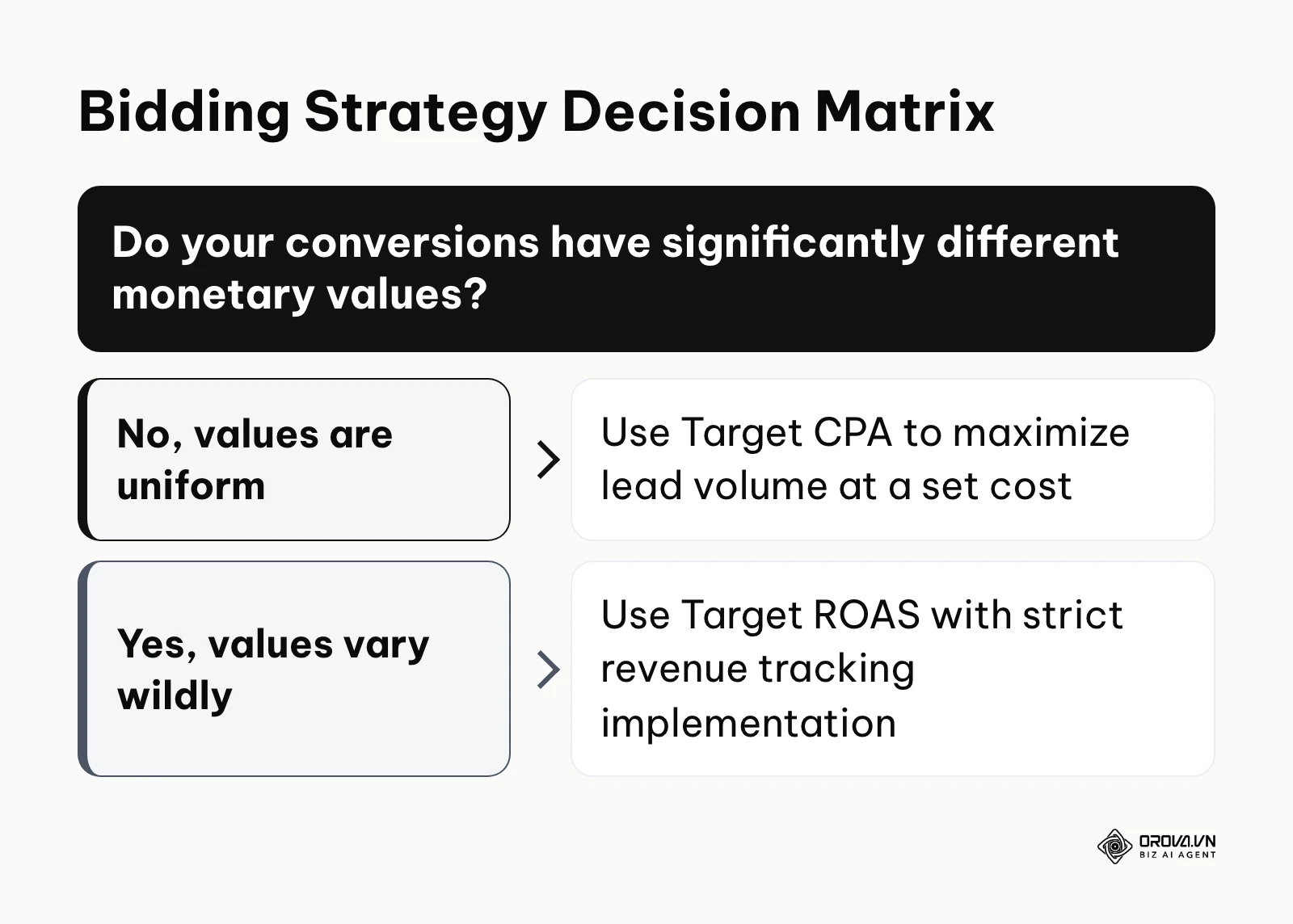
Target CPA focuses purely on acquiring conversions at a specific average cost, treating every single lead or sale equally regardless of its monetary value. Target ROAS prioritizes the actual revenue generated per dollar spent, aggressively seeking high-value conversions even if they cost significantly more to acquire upfront. Choose CPA for uniform conversion values; choose ROAS when your transaction values vary widely.
Understanding the Bidding Strategies
To make an informed decision, you must first deeply understand the mechanics of how Google's artificial intelligence processes data during an auction. Every single time a user conducts a search on Google or loads a page on the Display Network, an instantaneous auction takes place. The bidding strategy is one of the key choices you make during Google Ads campaign setup, and it acts as the master instruction set guiding the algorithm on how aggressively it should participate in that specific auction on your behalf.
What is Target CPA?
Target CPA (Target Cost Per Action) is an automated smart bidding strategy that leverages machine learning to generate as many conversions as possible at or below a specific cost threshold that you define. When you select this strategy, you are essentially telling Google, "I do not care exactly how much I pay for a single click, as long as the average cost to acquire a finalized conversion balances out to this specific number over time."
According to Google's Help Center article "About Target CPA bidding", the algorithm analyzes historical information about your campaign and evaluates the contextual signals present at the exact moment a user is eligible to see your ad. These auction-time signals include the user's precise geographic location, the time of day, the specific device they are using, their operating system, their browser, and whether they belong to any of your remarketing audiences.
By cross-referencing these millions of data points against your historical conversion data, the system calculates the statistical probability that this specific impression will result in a conversion. If the predictive model determines the probability is exceptionally high, it will aggressively increase your bid, potentially paying a premium CPC (Cost Per Click) to win the auction. If the signals suggest the user is merely browsing for information, the algorithm will bid very low or abstain entirely.
The true strength of Target CPA lies in its ability to deliver predictable volume. It acts as a highly efficient acquisition engine, scaling your lead flow while keeping your finance department happy with a stable acquisition cost. However, its greatest strength is also its critical flaw: Target CPA is fundamentally blind to value. To this algorithm, a user who downloads a free PDF checklist is mathematically identical to a user who purchases a 10,000-dollar enterprise software subscription, provided both actions are tracked as primary conversions. Therefore, you should NOT use Target CPA if your product catalog has vastly different price points or if your lead generation efforts attract clients with wildly different lifetime values (LTV).
What is Target ROAS?
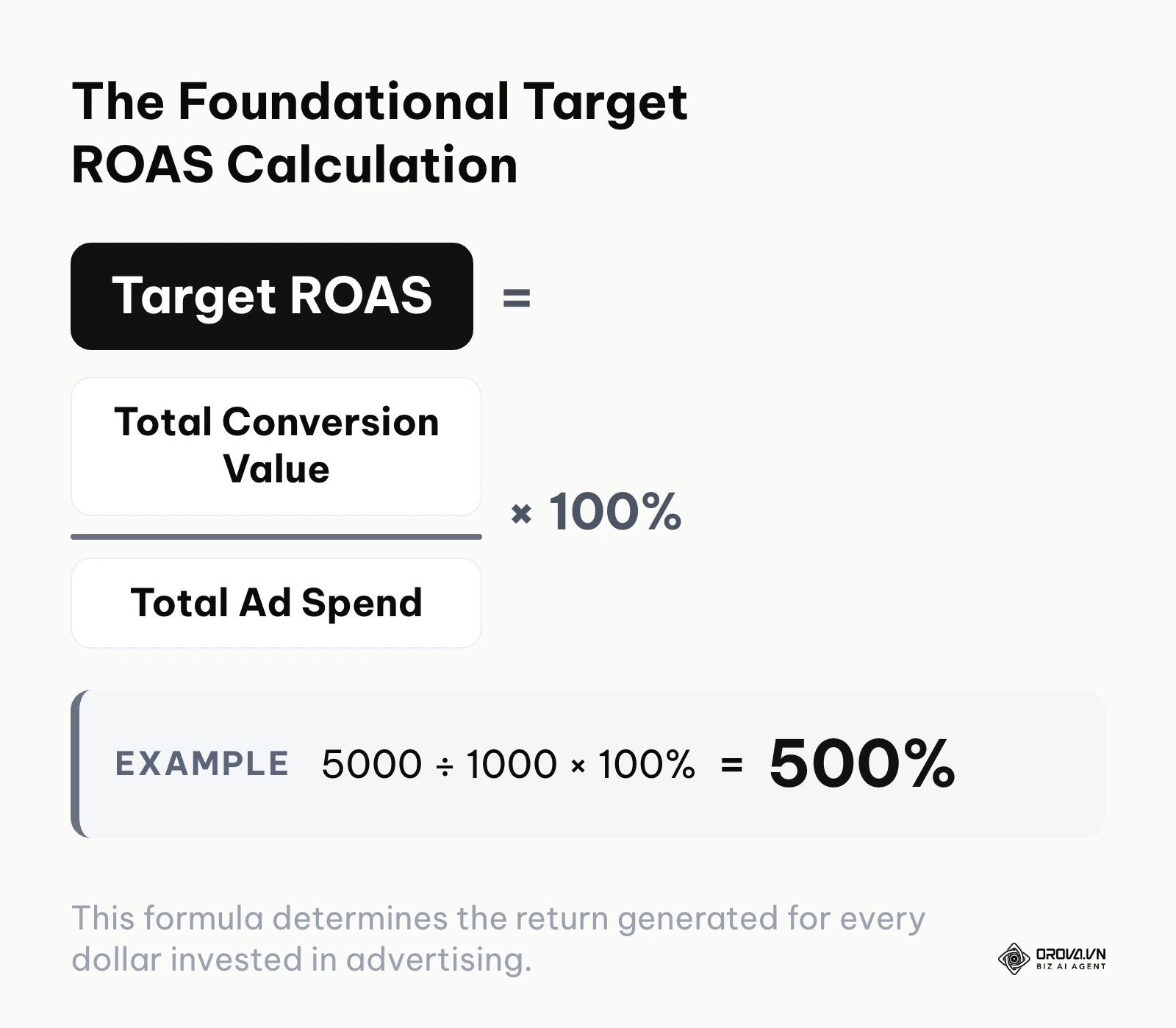
Target ROAS (Target Return on Ad Spend) represents a paradigm shift from cost-based optimization to value-based bidding. Instead of merely predicting the likelihood of a conversion occurring, Target ROAS attempts to predict the actual monetary value that a specific user will generate if they convert. You are instructing the algorithm, "For every one dollar I spend on advertising, I expect you to return exactly this much revenue." For example, if a campaign generates 5,000 dollars in conversion value from 1,000 dollars in ad spend, its ROAS is 500%.
As Google's Help Center article "About Target ROAS bidding" explains, advertisers must consistently pass dynamic conversion values back to the platform for the machine learning models to accurately predict future revenue. When the algorithm evaluates an auction, it is no longer just looking for the easiest conversion; it is hunting for the most profitable one. If the system's predictive models indicate that a specific auction is likely to produce a high-value conversion, it will bid higher to win that click, even if it means driving the temporary CPA to uncomfortable levels, because it trusts the anticipated revenue will justify the upfront cost.
The real power of Target ROAS is its ability to maximize your overall profit margins rather than just padding your conversion counts with low-quality leads. This strategy is naturally suited for e-commerce businesses with diverse shopping cart sizes. However, figuring out when to use target roas for lead generation is where advanced media buyers separate themselves from beginners.
Through Offline Conversion Tracking (OCT), B2B companies can pass closed-won deal values from their CRM back to Google Ads. Once the algorithm understands that certain demographics or search queries lead to massive enterprise contracts rather than small self-serve subscriptions, it will radically shift your budget allocation. You should NOT use Target ROAS if you cannot accurately and consistently track revenue values, or if your account has extremely low conversion volume, as the algorithm will not have enough data to build accurate predictive models and may stop spending your budget entirely.
OROVA ADS applies AI Agent to automate and optimize ad performance on Google, Meta and TikTok. Scale your budget safely, monitor 24/7 and expand your business quickly.
Experience the solution at orova.vn/ads
Detailed Comparison: Target CPA vs Target ROAS
Understanding the theoretical definitions is only the first step. To truly master these strategies, we must compare how they behave across several critical operational dimensions. This deep dive will expose the nuances that dictate success or failure in live accounts.
| Criteria | Target CPA | Target ROAS |
|---|---|---|
| Primary Optimization Goal | Maximize conversion volume | Maximize total conversion value |
| Success Metric | Cost per Acquisition ($) | Return on Ad Spend (%) |
| Ideal Business Model | Uniform pricing, standard lead gen | Varied cart sizes, high-ticket B2B |
| Data Requirement | Moderate (a steady flow of recent conversions) | High (steady conversions with accurate values) |
| Bid Behavior | Bids higher for high probability | Bids higher for predicted high value |
| Algorithmic Risk | May acquire cheap, low-quality leads | May stop spending if target is too high |
| Implementation Complexity | Simple (Basic pixel tracking) | Complex (Dynamic values or CRM APIs) |
| CRM Reliance (B2B) | Low | Extremely High |
Optimization Goal and Algorithm Behavior
The fundamental difference in optimization goals drastically alters how your ads are served. Target CPA operates on a binary logic system: a conversion either happens, or it does not. The algorithm seeks the path of least resistance to hit your cost target. If it finds a pocket of cheap inventory—perhaps on mobile apps within the Display Network, or lower-intent search queries—it will funnel your budget there to acquire volume cheaply. This is why advertisers often complain about lead quality dropping when switching to automated CPA bidding without strict targeting constraints.
Target ROAS, conversely, operates on a spectrum of value. It actively avoids cheap conversions if the predicted revenue is negligible. It analyzes historical patterns to identify the behavioral markers of your most valuable customers. For instance, it might notice that users searching on desktop computers during business hours tend to purchase your premium software tier, while mobile users at night only buy the basic tier. Even if the desktop clicks cost five times as much, the Target ROAS algorithm will aggressively bid on them because the anticipated revenue multiple satisfies your overall return requirement.
Data Requirements and the Learning Phase
Machine learning algorithms are completely dependent on the quality and volume of the data they ingest. If you starve the algorithm, it will make poor decisions. Target CPA is relatively forgiving. Google's recommended conversion thresholds differ by campaign type and have changed over the years, so check the current Help Center guidance for your campaign type before switching. As a working rule, Target CPA behaves more predictably once a campaign has a steady flow of recent conversions; with only a handful, performance will be highly volatile.
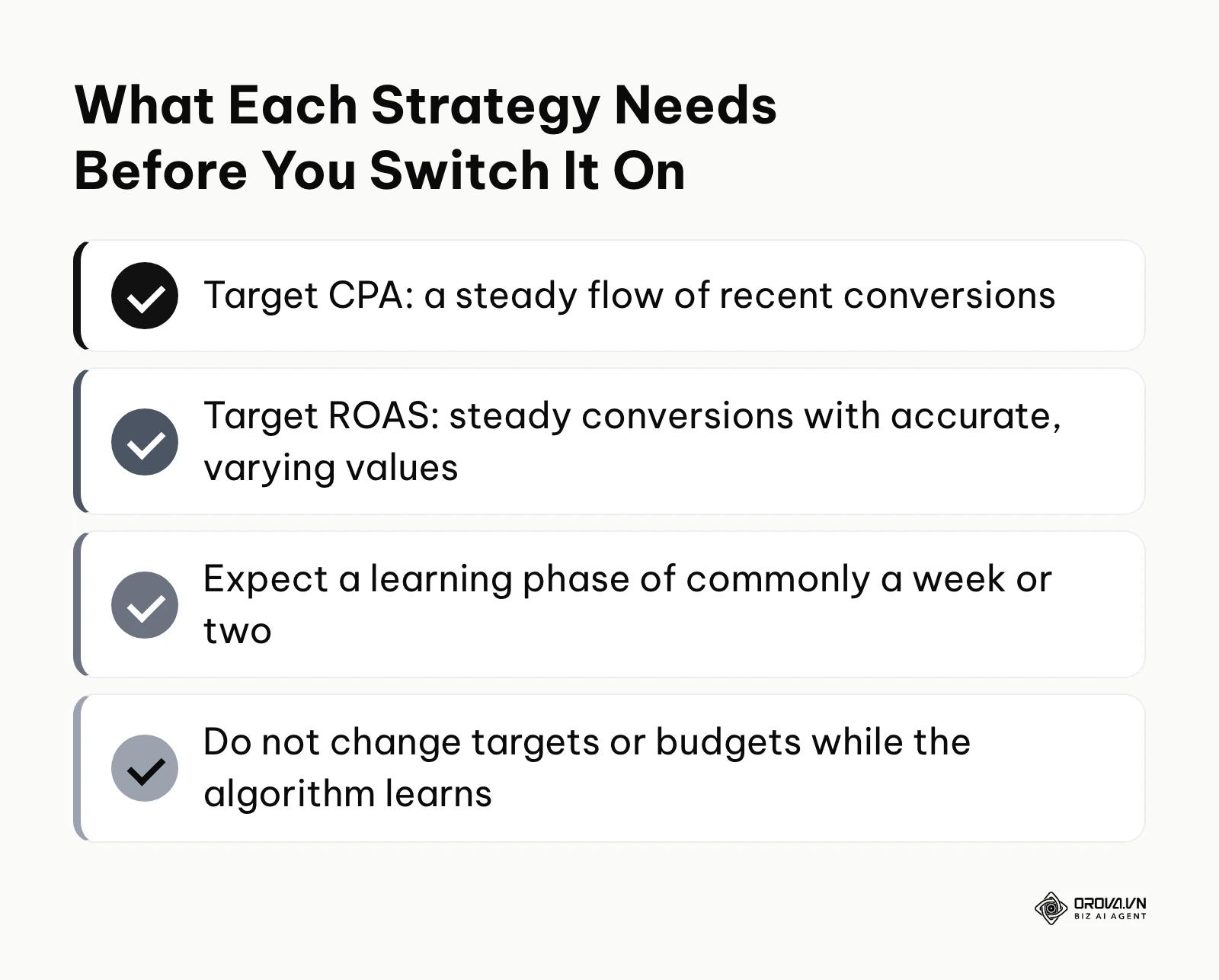
Target ROAS is significantly more demanding. It needs not only conversions but accurate conversion values that genuinely vary, so the algorithm can learn which auctions bring more revenue. Attempting to run Target ROAS without a robust, continuous stream of value data is a recipe for disaster.
When you activate either strategy, your campaign enters a "Learning Phase", commonly a week or two, and longer for low-volume accounts or long conversion delays. During this period, the algorithm is intentionally testing different bid levels across various auctions to calibrate its predictive models. Performance will fluctuate wildly. Your CPA might double, or your ROAS might plummet. This is the most critical juncture: inexperienced media buyers panic and change their targets or budgets during this phase, which can trigger a new learning period and force the algorithm to recalibrate. You must have the discipline to let the system learn.
Value Tracking and CRM Integration
This is the most critical differentiator, particularly when evaluating target cpa vs target roas for lead gen campaigns. For Target CPA, a simple Google tag firing on a "Thank You" page is sufficient. For Target ROAS, the technical infrastructure must be flawless.
If you are an e-commerce brand, you must implement dynamic value tracking through your e-commerce platform (like Shopify or WooCommerce) to pass the exact cart total back to Google Ads at the moment of checkout. If you are a B2B business, you must build a bridge between your ad clicks and your finalized sales.
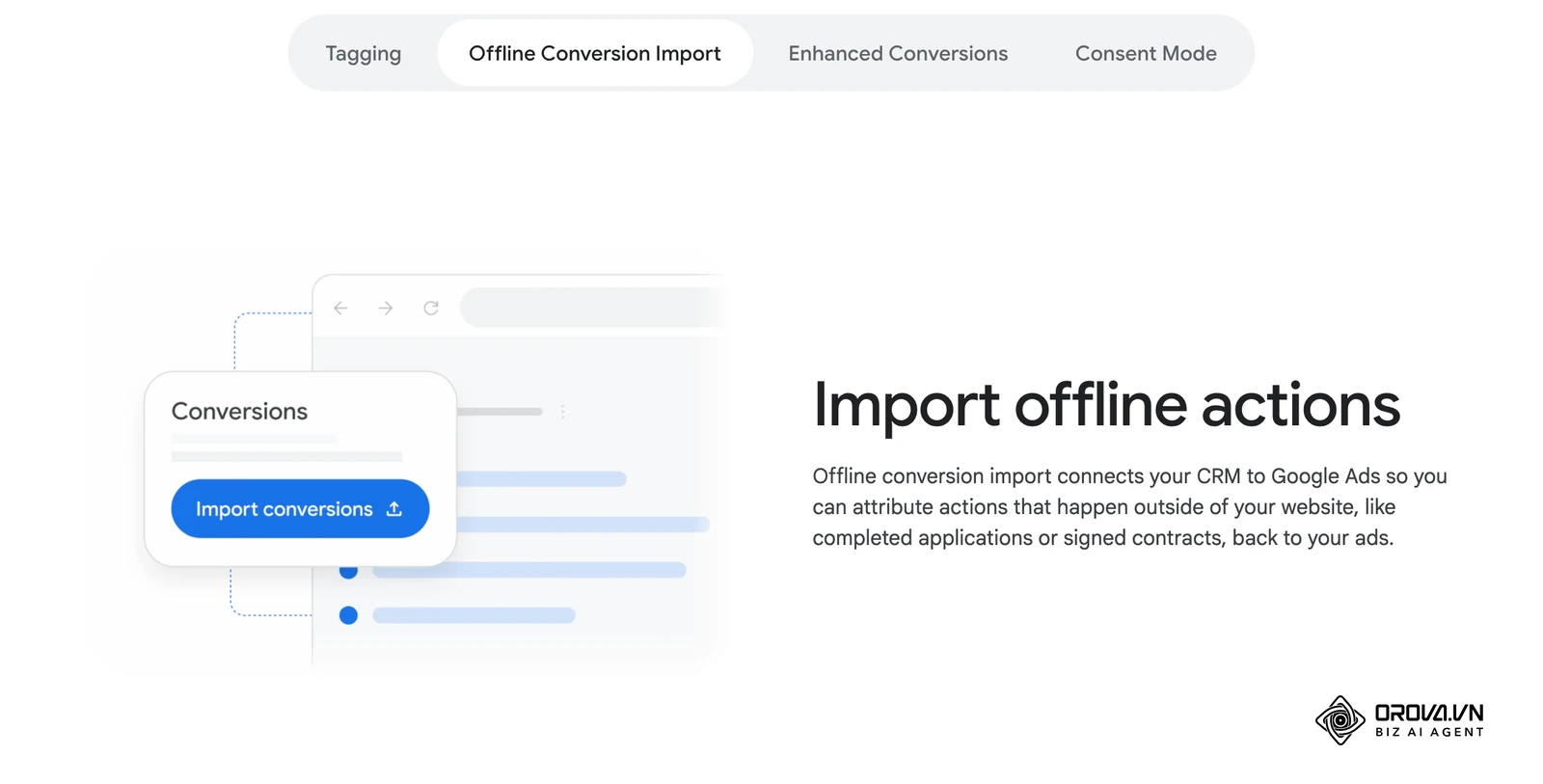
When a user clicks your ad, Google appends a unique identifier called a Google Click ID (GCLID) to the URL. Your website must capture this GCLID in a hidden field when the user submits a lead form. This GCLID is then stored in your CRM alongside the prospect's contact information. Weeks or even months later, when your sales team finally closes the deal, your CRM must use an API or webhook to send a signal back to Google Ads. This signal says, "Remember this specific GCLID? It just resulted in a 25,000-dollar contract."
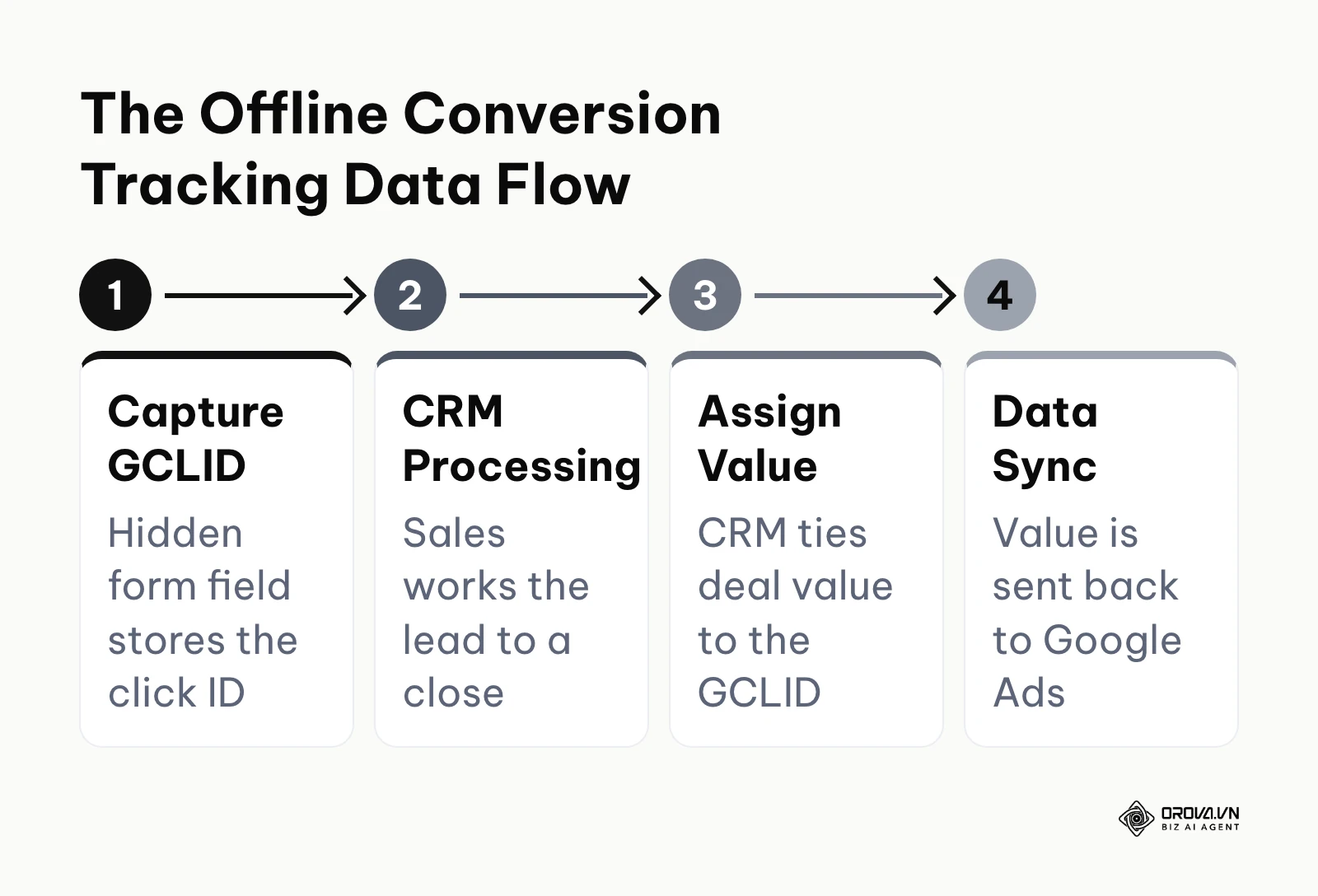
This Offline Conversion Tracking infrastructure is what feeds the Target ROAS algorithm the data it needs to differentiate between a tire-kicker and a highly qualified enterprise buyer. Ensuring precise click tracking 101 protocols are in place before building this CRM bridge is absolutely essential to maintain data integrity.
Budget Scaling and Campaign Stability
Scaling an account—increasing the budget without destroying profitability—requires different tactics depending on your strategy. Target CPA is generally easier to scale. If you want more volume, you incrementally increase your daily budget by 10-15% every few days. If you are restricted by ad rank, you may also need to slightly increase your Target CPA to allow the algorithm to enter more expensive auctions.
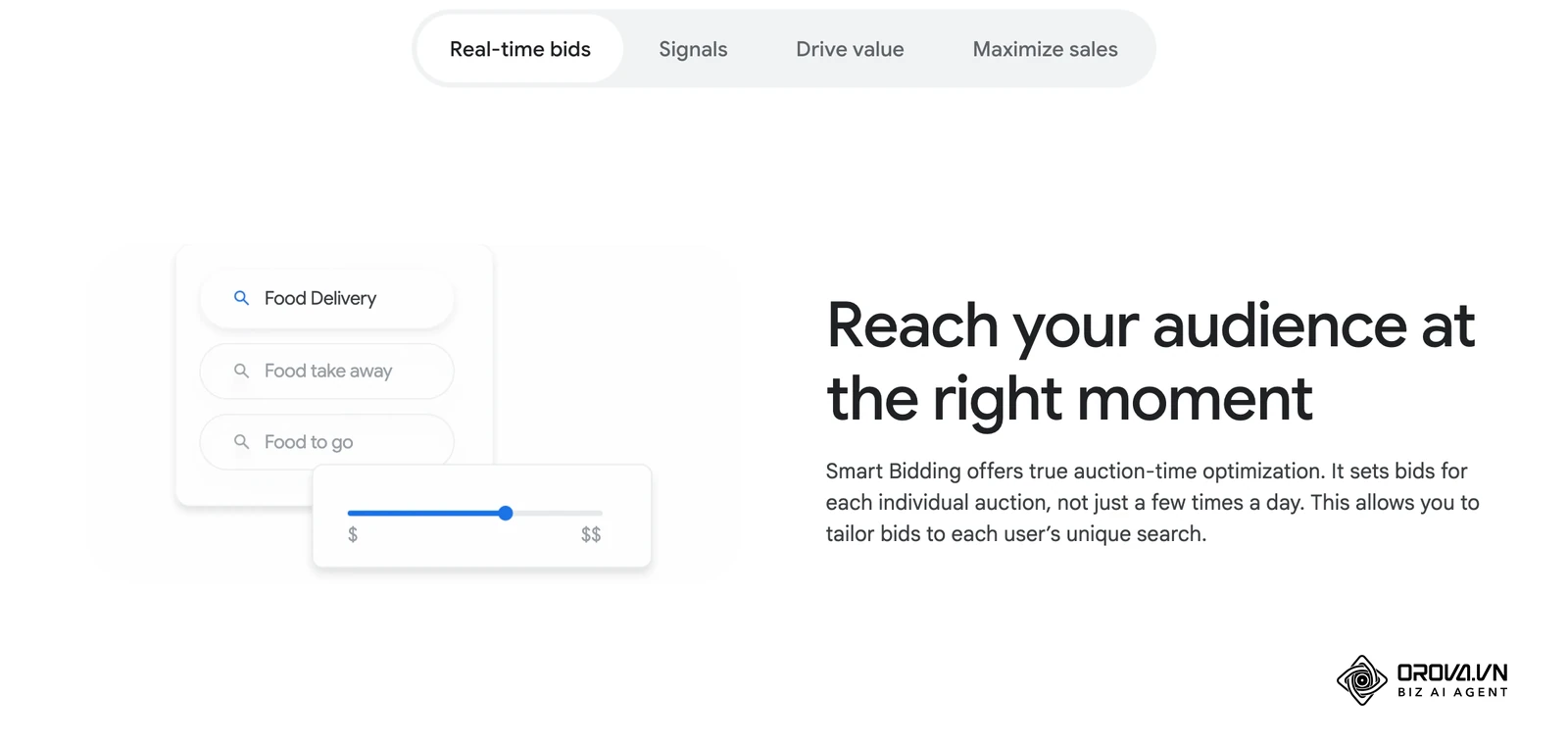
Target ROAS scaling is highly counterintuitive. If you want the algorithm to spend more money and drive more volume, you must actually lower your Target ROAS setting. By demanding a lower return on investment, you are giving the algorithm permission to bid on slightly less qualified users or enter more expensive, competitive auctions that it previously avoided because they wouldn't meet your strict profitability requirements.
Illustrative example:
- Context: A hypothetical mid-sized SaaS company wants to scale lead volume for a new product launch. Its media buyer runs Target CPA at a 100-dollar target and is asked to grow demo requests within a month.
- What they do: Instead of doubling the budget overnight, the media buyer raises the daily budget by 15% every four days and lifts the Target CPA by 5% to open up new auction opportunities.
- Where it stumbles and the fix: After the second budget bump, the actual cost per lead spikes by 35%, to about 135, dollars and the executive team wants to revert the changes. The media buyer holds firm, explains that the algorithm is exploring new territory, and pauses non-essential ad group tests so data consolidates into the main campaign.
- Outcome: Once the algorithm adapts to the new budget level, the CPA settles back to around the original 100-dollar target while demo request volume is higher than before the scale-up.
Risk Tolerance and Performance Drops
The failure modes for these two strategies are distinctly different. When Target CPA fails, it usually does so by spending your entire daily budget on garbage traffic. It finds a pocket of cheap clicks that trigger your conversion pixel (perhaps bot traffic or highly unqualified users filling out forms with fake information) and aggressively scales that traffic because it successfully meets your cost mandate.
When Target ROAS fails, it typically does so by completely choking your campaign. If you set your ROAS target too high (e.g., demanding a 1000% return when your historical data suggests a 300% return is realistic), the algorithm will look at the available auctions, determine that none of them can guarantee that level of profitability, and simply refuse to bid. Your impressions will drop to near zero, and your campaign will stop spending entirely.
Illustrative example:
- Context: A hypothetical boutique e-commerce furniture brand switches its highest-performing Search campaign to Target ROAS to maximize Q4 profit.
- What they do: The account strategist verifies that dynamic value tracking works, then sets the Target ROAS to 600% on the CEO's request, even though the historical average sits closer to 350%.
- Where it stumbles and the fix: Within a couple of days, impressions collapse and daily spend falls from around 1,000 dollars to almost nothing, because the target is unrealistic for that auction landscape. The strategist lowers the target to 300%, below the historical average, so the algorithm re-enters auctions and gathers data.
- Outcome: Spending resumes. Over the following weeks, the strategist raises the target in small steps and stops where volume stays steady, at a return that is still above the original historical average.
Decision Framework: Choosing Based on Your Scenario
To eliminate the guesswork, you must rely on a mathematical foundation rather than gut feeling. You should build a simple calculator in a spreadsheet to define your exact thresholds before you ever touch the settings in Google Ads. This custom calculator framework will dictate your entire bidding strategy.
To determine your ideal Target CPA, you must define your Gross Profit Margin and your acceptable Customer Acquisition Cost (CAC). For example, if your software sells for 2,000 dollars annually, and your cost of delivery is 500, dollars your gross profit is 1,500 dollars. If business rules dictate you can spend one-third of your profit to acquire a user, your target CAC is 500 dollars. However, Target CPA governs the cost per lead. You must multiply your target CAC by your sales team's close rate. If your team closes 20% of leads, your absolute maximum Target CPA is 100 dollars (500 × 20%).
Calculating your ideal Target ROAS requires understanding your breakeven point. You calculate breakeven ROAS using the formula: 1 / Gross Profit Margin. In the example above, your margin is 75% (1,500 dollars profit / 2,000 dollars revenue). Therefore, your breakeven ROAS is 1 / 0.75 = 1.33, or 133%. This means for every 1 dollar spent, you must generate 1.33 dollars just to cover costs. Your actual Target ROAS configured in the platform must be set significantly higher than this (e.g., 300% or 400%) to ensure net profitability. Fully grasping the nuances of the roas formula is non-negotiable for anyone managing significant ad spend.
Once you have your numbers, use this framework to determine your strategy based on your specific business scenario:
| Business Scenario | Recommended Strategy | Primary Reason |
|---|---|---|
| E-commerce with varied product pricing | Target ROAS | Maximizes profit on diverse cart sizes |
| B2B SaaS with a single standard tier | Target CPA | Values are uniform; volume is the priority |
| Local service with standard call-out fee | Target CPA | Predictable lead cost required for dispatch |
| High-ticket B2B consulting with varied deals | Target ROAS | Prevents overspending on small-tier clients |
| New account with zero historical data | Maximize Conversions | Needs to build initial data before targets apply |
Illustrative example:
- Context: A hypothetical corporate training provider generates leads through Google Ads, but its sales cycle is about 90 days and contract values range from 5,000 dollars to 150,000 dollars. Sales reps spend too much time on low-value prospects.
- What they do: Waiting 90 days for revenue data is too slow, so the team assigns proxy values to earlier pipeline stages in the CRM: a brochure download gets 0, dollars a booked consultation (MQL) gets 200, dollars and a completed demo with a qualified decision-maker (SQL) gets 1,500 dollars. The campaigns then move from Target CPA to Target ROAS based on these proxy values.
- Where it stumbles and the fix: At first the algorithm struggles to tell the 200 dollars and 1,500 dollars signals apart because the search queries look similar. The team adds audience segments in observation mode so the campaign has more contextual signals.
- Outcome: Total lead volume drops, but a larger share of leads reach the SQL stage, which is the trade-off value-based bidding is designed to make.
Want to scale your budget but afraid of breaking performance?
Integrate OROVA ADS now - an AI Agent that automatically monitors and optimizes Google, Meta, TikTok ads 24/7. Now, expanding and replicating your Performance Ads team is just one click away.
Try it now at: orova.vn/ads
How to Switch from Target CPA to Target ROAS Safely
One of the most dangerous maneuvers in ppc ad management is blindly changing the bidding strategy of a mature, performing campaign. Switching directly from CPA to ROAS can shock the algorithm, resetting its historical learnings and throwing your account into a chaotic, highly inefficient learning phase that could last weeks.
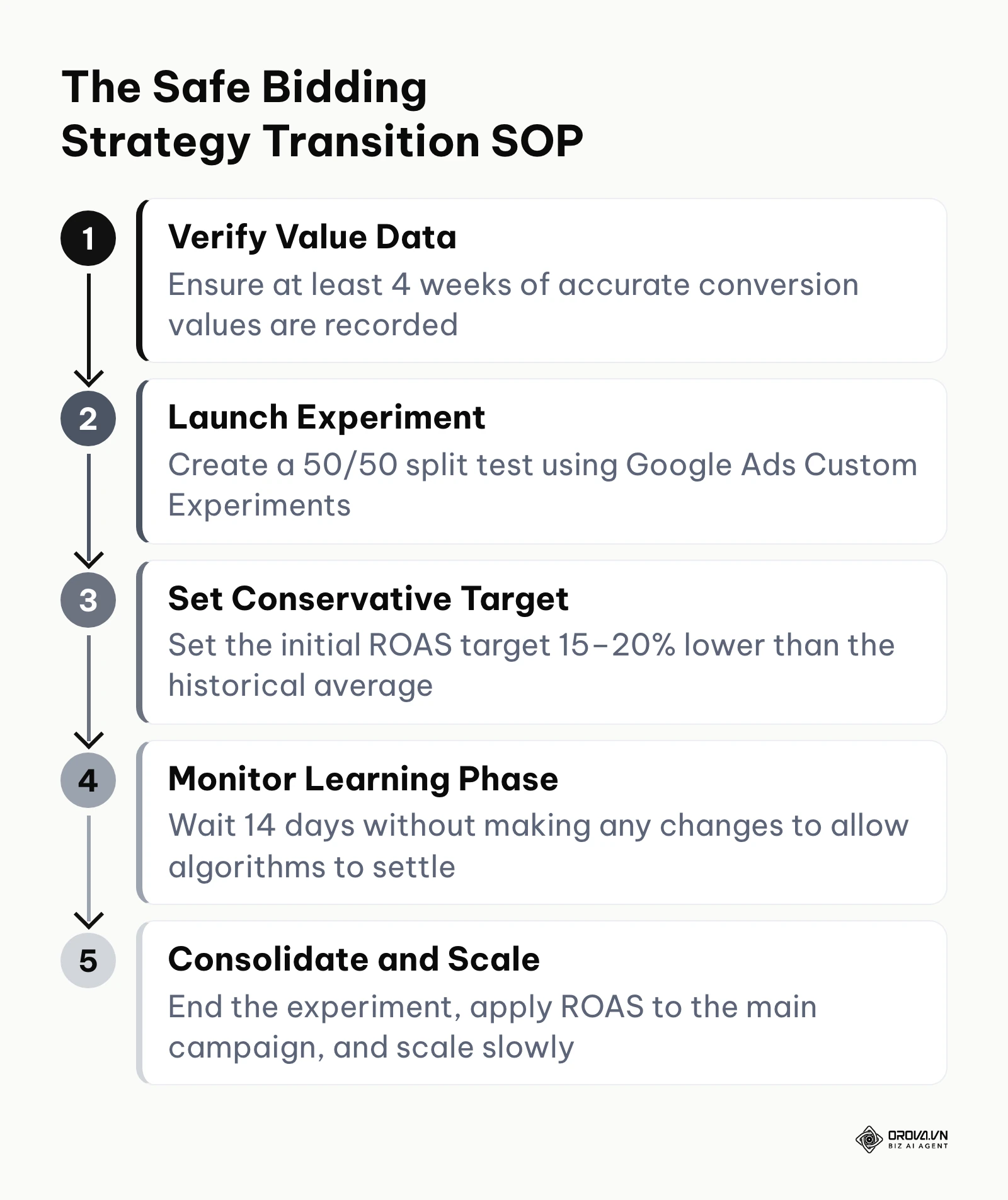
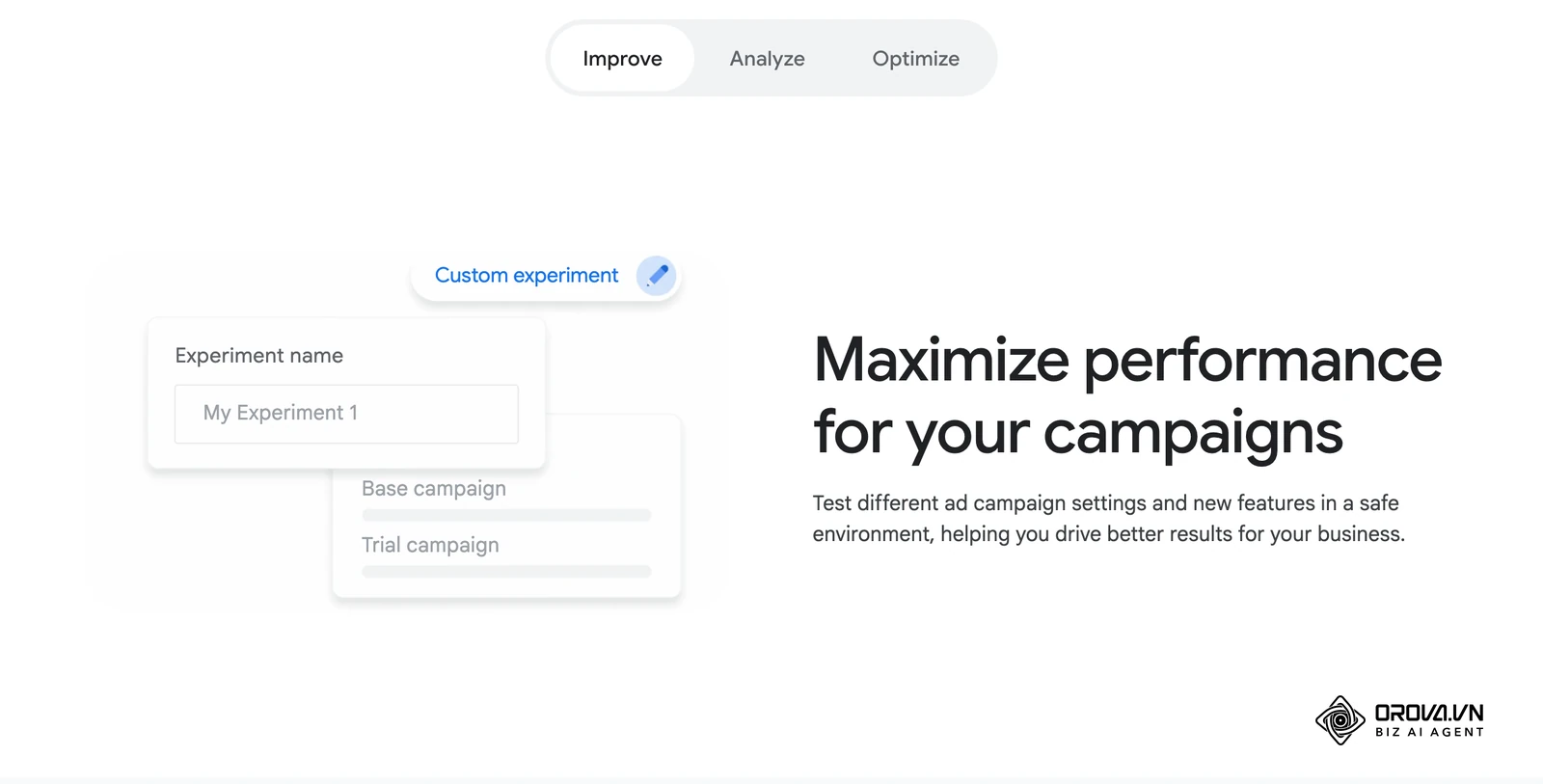
To mitigate this risk, you must follow a strict Standard Operating Procedure (SOP) utilizing Google Ads Custom Experiments. This allows you to test the new strategy on a portion of your traffic without destroying the baseline performance of your original campaign.
Step 1: Verify Pristine Value Data
Do not attempt this transition unless you have a minimum of 4 consecutive weeks of highly accurate conversion value data flowing into the specific campaign you intend to switch. If you are relying on Offline Conversion Tracking, audit the API logs to ensure no data drops occurred. The Target ROAS algorithm is entirely dependent on the integrity of this historical data.
Step 2: Create a Custom Experiment
Navigate to the Experiments tab in Google Ads and create a new Custom Experiment. Select your target campaign as the base. Set the experiment split to 50/50. This ensures that half of your eligible auctions will continue to be governed by your proven Target CPA strategy, while the other half will test the new Target ROAS algorithm.
Step 3: Set a Conservative Initial Target
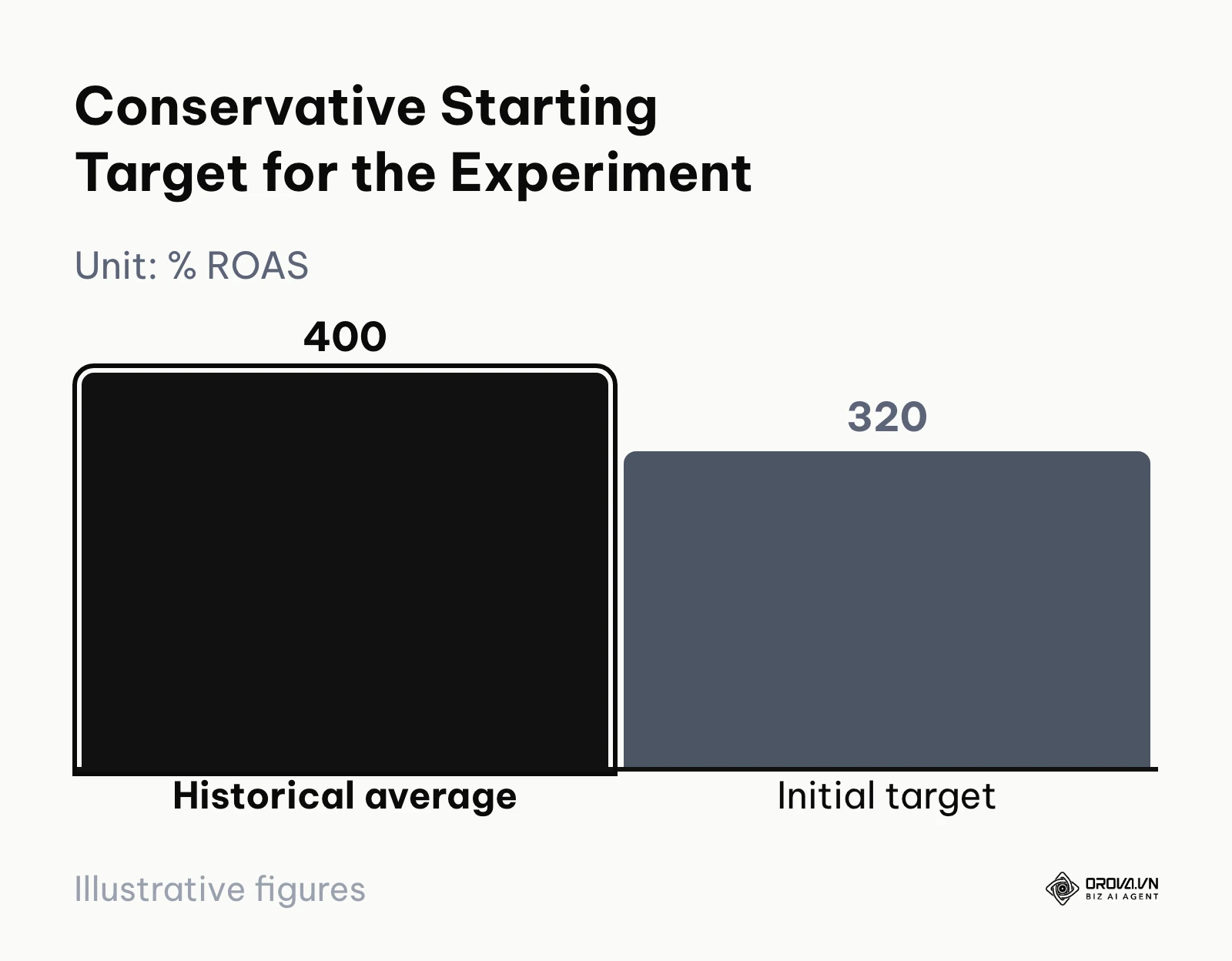
When configuring the experimental arm, Google will often suggest a Target ROAS based on your historical average. Do not use this exact number. Set your initial target approximately 15% to 20% lower than your historical 30-day average. If your historical ROAS is 400%, set the experiment target to 320%. This artificially low target gives the algorithm "breathing room" to aggressively enter auctions, win clicks, and gather the data it needs to build its predictive models quickly.
Step 4: Endure the Learning Phase
Launch the experiment and do absolutely nothing for 14 days. Do not change the budget. Do not adjust the target. Do not add negative keywords. The performance in the experimental arm will likely look terrible for the first week. CPA will spike, and volume will fluctuate. You must have the discipline to wait for the algorithm to stabilize and exit the learning phase.
Step 5: Consolidate and Scale
After 14 to 21 days, evaluate the performance. If the experimental Target ROAS arm is generating a higher total conversion value at an acceptable return compared to the base campaign, it is time to transition. Apply the experiment to the base campaign. Once applied, you can begin the slow process of inching your Target ROAS up by 10% increments every few days until you reach your ultimate profitability goal.
Managing these transitions manually, constantly monitoring learning phases, and checking CRM sync statuses can be tedious and prone to human error, so write each step into a checklist and keep a change log for every adjustment you make.
Target CPA and Target ROAS Trends in the Next Few Years: My Predictions
The landscape of automated bidding is evolving at a breakneck pace. Based on the current trajectory of platform updates and privacy regulations as of 2026, the traditional distinctions between these strategies are fundamentally shifting. Here is how I see the ecosystem developing over the next few years.
The Blurring of Bidding Lines via Value-Based Default
I believe Google will keep nudging advertisers toward value-based bidding, and I would not be surprised if Target CPA gradually becomes the secondary option rather than the default. The platform already encourages advertisers to assign values even to standard lead forms. My guess is that more of the bidding setup will start to assume some form of value input, whether advertisers provide it or not. Marketers can prepare by mapping out how much each micro-conversion (newsletter signups, video views) is worth to their bottom line today.
First-Party Data Becomes the Only Algorithmic Differentiator
As privacy regulations strip away third-party cookies and limit cross-site tracking, Google's algorithms will lose visibility into user behavior outside of its owned properties. I think first-party data will become the main lever for making Target ROAS work well. Companies that feed reliable customer lifetime value data back into the ad platforms are likely to have an edge in auctions, while those relying only on standard pixel tracking may find the algorithm working with weaker signals.
AI Agents Will Replace Manual Target Adjustments
Currently, media buyers spend countless hours calculating margins and manually adjusting ROAS targets to throttle spend or push volume. I expect more teams to hand routine target adjustments to a Google Ads agent powered by AI, working within rules the team sets. In my view, the human role will lean further away from bid management and toward creative strategy, offer design, and keeping the data pipelines clean.
Frequently Asked Questions about Target CPA vs Target ROAS
What should I do if my Target ROAS campaign suddenly stops spending?
If your impressions drop to zero after a target change, the algorithm has determined your goal is mathematically impossible given the current auction landscape. You must immediately lower your Target ROAS by 20% to 30% to re-enter the auctions. Once spending resumes and data accumulates for a week, you can slowly raise the target back up in small increments.
Can I use Target ROAS for lead generation if all my leads have the exact same value?
Technically yes, but it is highly inefficient. If you assign a static value of 100 dollars to every single lead, Target ROAS will essentially function exactly like Target CPA, but with a more complex computational overhead. If your conversion values are truly uniform and do not vary by product line or lead quality, you should stick to Target CPA for simplicity and stability.
Should I start a brand new Google Ads account with Target CPA immediately?
No. Machine learning models require historical data to build predictions. A brand new account has no data. You should always start new campaigns with Maximize Conversions (without setting a target CPA) to force the algorithm to spend your budget and aggressively gather conversion data. Once the campaign has a steady history of conversions, you can calculate your actual historical average and apply that number as your initial Target CPA.
How does AI impact the choice between these bidding strategies?
AI fundamentally powers both strategies, but its impact is most profound on Target ROAS. Advanced AI can now process massive datasets to predict long-term customer lifetime value from initial click signals. As AI models become more sophisticated, they require richer data inputs. Therefore, mastering the technical setup required for Target ROAS today ensures your account is prepared to leverage the next generation of AI-driven value optimization.
Where to Start?
Reading about algorithmic theory is useless without execution. Your immediate next steps depend entirely on the current state of your tracking infrastructure and campaign performance. Identify your current situation below and take the singular recommended action today.
Situation 1: You are tracking conversions, but no financial values are recorded in Google Ads. Your only priority today is data infrastructure. Do not touch your bidding settings. If you are e-commerce, ensure dynamic revenue tracking is firing correctly via Google Tag Manager. If you are B2B, schedule a meeting with your CRM administrator to map out how you will pass closed-won deal values back to the platform. If this technical hurdle is too high for your internal team, consider whether you should hire an external ai marketing agency to architect this pipeline for you. Without values, you are stuck with volume-based bidding forever.
Situation 2: You track values perfectly, but you are currently running Target CPA. Do not switch your main campaign today. Your action step is to navigate to the "Experiments" tab in Google Ads and build a Custom Experiment. Set a 50/50 budget split, configure the experimental arm to Target ROAS, and calculate an initial target that is 20% lower than your historical average. Launch the experiment and prepare to ignore the metrics for the next 14 days.
Situation 3: You are already using Target ROAS, but your conversion volume is stagnant. You have likely set your target too aggressively, suffocating the algorithm's ability to participate in slightly more expensive but necessary auctions. Your action step today is to lower your Target ROAS setting by 15%. Document the change, monitor the impression share over the next five days, and watch how the algorithm responds to the loosened constraints.
About the author

Builder of Orova
Nguyễn Đỗ Trọng Ân has 8 years of experience in marketing, including 6 years managing market development across Asia. He builds Orova, a Biz AI Agent that never sleeps: it plans, runs and optimizes work for businesses.
Run your business with AI Agents
Orova is the always-on Biz AI Agent — it plans, runs, and optimizes the work for you.
Save time, unlock productivity.