
Off page SEO: how to build authority and AI citations in 8 steps (2026)

Executing off page SEO correctly gives your business a resilient digital reputation, high-tier editorial backlinks, and verified entity citations that search engines and AI answer engines cite as primary sources. By following this guide, you will build an end-to-end authority engine: an audited entity footprint across the web, original research that attracts passive links, an expert outreach pipeline, and custom Google Search Console filters to track branded search growth. Before you begin, ensure you have administrative access to your website, an active Google Search Console property, a verified company email domain, and roughly four to six hours per week dedicated to outreach and content distribution. If your site currently suffers from critical indexing errors or lacks core commercial content, pause this guide. Fix technical crawlability first, as external signals cannot rescue pages that search bots cannot index.
What Is Off Page SEO and What Does It Take to Succeed?
Executing off page seo builds topical authority, external brand trust, and verified digital signals outside your own website so search engines recognize you as an industry authority. Completing this end-to-end process requires eight sequential steps and typically takes three to six months to yield measurable ranking lifts and referral growth.
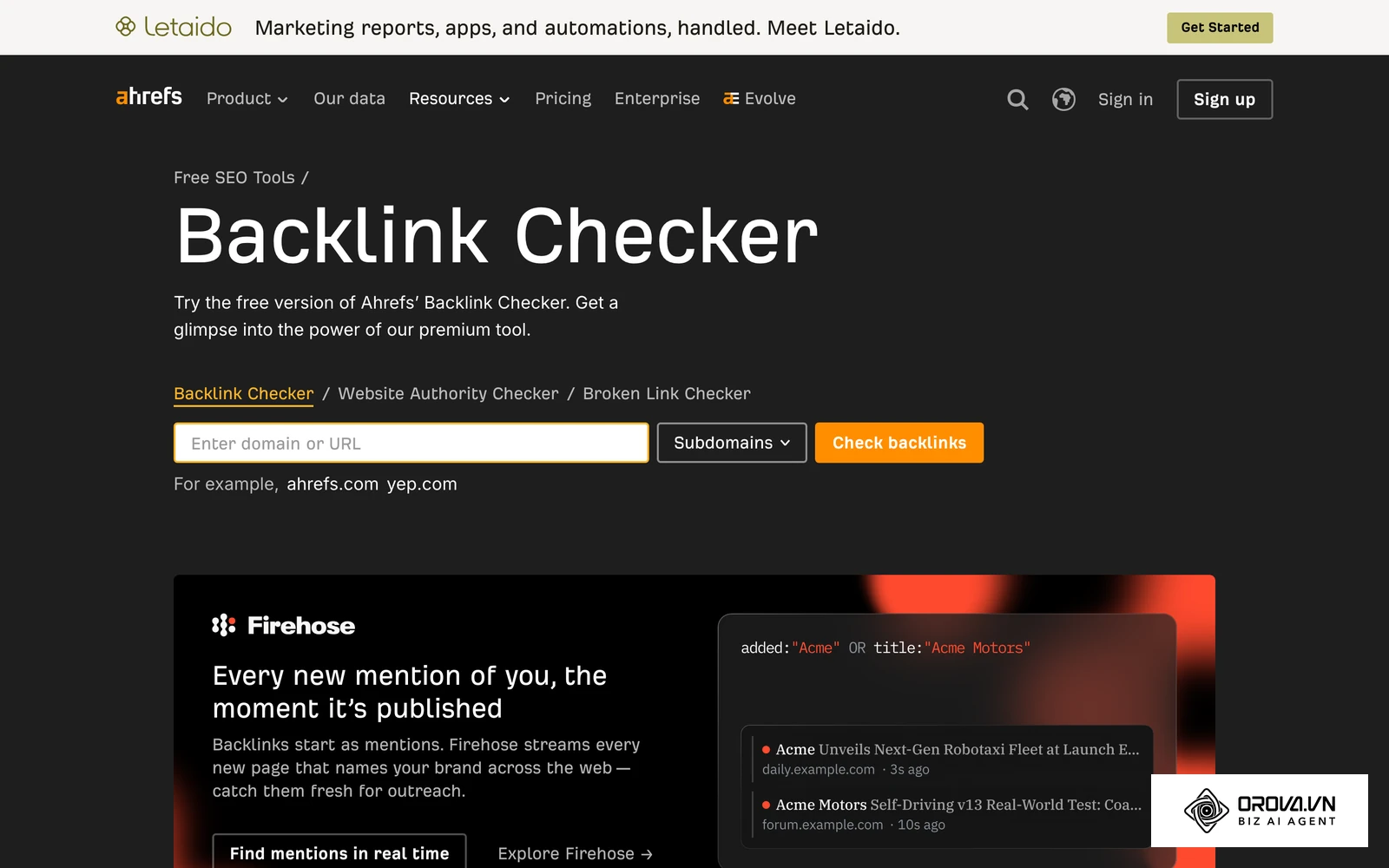
Off-page optimization encompasses every external signal that influences your search visibility. While on-page optimization refines your code, internal architecture, and textual content, off-page strategies signal to algorithms that independent third parties validate your expertise. As of 2026, modern off-page optimization reaches far beyond counting hyperlinks. Major search algorithms evaluate entity consensus, unlinked brand mentions, editorial citations, and training inclusions inside large language models. A single contextual mention in a reputable trade journal often carries more ranking weight than hundreds of forum profile links.
What to Prepare Before Starting Off Page SEO
Executing external campaigns without proper operational preparation leads to wasted outreach pitches and unindexed digital assets. Assemble the assets outlined below before initiating external campaigns.
| Preparation Item | Where to Source or Generate | Estimated Time Required | Consequence if Missing |
|---|---|---|---|
| Domain email address | Your corporate Google Workspace or Microsoft 365 tenant | 15–30 minutes | Outreach emails sent from free email providers get flagged as spam by journalists. |
| Google Search Console access | Search Console administrative settings panel | 10 minutes | Inability to track branded search impressions, crawl diagnostics, or inbound referring URLs. |
| Verified entity profiles | Crunchbase, LinkedIn Company Directory, official trade registries | 2–3 hours | Search engines fail to reconcile your brand name with a distinct Knowledge Graph entity. |
| Original data or proprietary insight | Internal product telemetry, anonymized user surveys, pricing audits | 1–2 weeks | Outreach lacks newsworthy angles, causing pitching response rates to drop sharply. |
| Media kit and author biographies | Public sub-page on your primary website (/about and /press) | 1–2 hours | Editors cannot verify credentials, preventing attribution under Google E-E-A-T guidelines. |
Step 1: Establish Your Off Page SEO Entity Footprint Across Authoritative Platforms
To establish your entity footprint, align your digital profile across canonical registries so search engine algorithms identify your business as an unambiguous corporate entity.
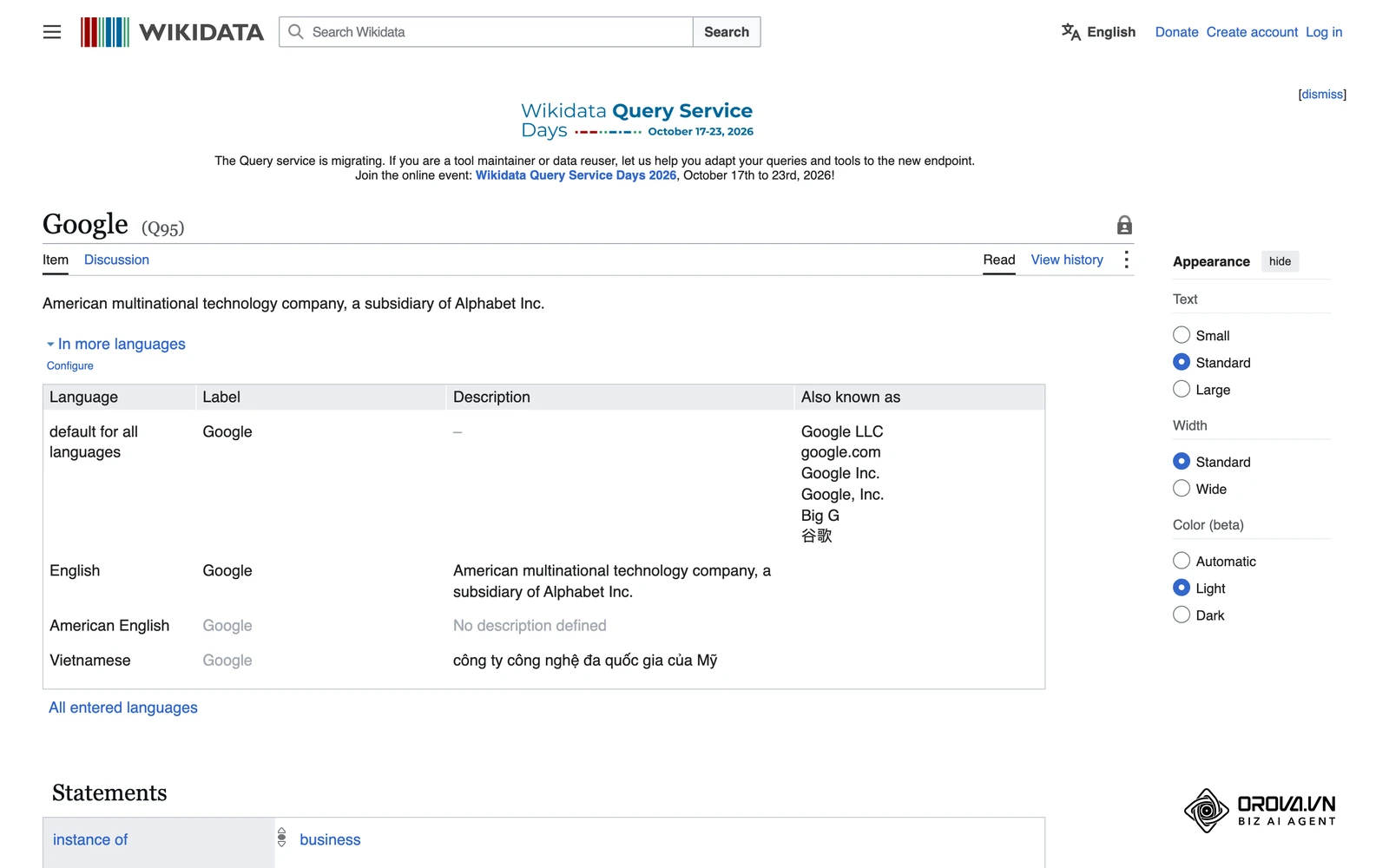
Begin inside your company's core web properties and primary social directories. Open your content management system and navigate to your primary About page and homepage header settings. Implement structured entity markup using standard schemas. To ensure search engines parse your corporate entity without ambiguity, implement structured JSON-LD schema markup on your homepage and About page. Ensure the properties for legal name, official URL, address, and social links match your commercial registrations verbatim. Next, log into major industry data registries: Crunchbase, LinkedIn Company Directory, Google Business Profile (for geographic or regional relevance), and your relevant trade association registries. Populate every profile field identically, maintaining exact character-by-character consistency in your business name, operating address, phone number, and core service descriptions.
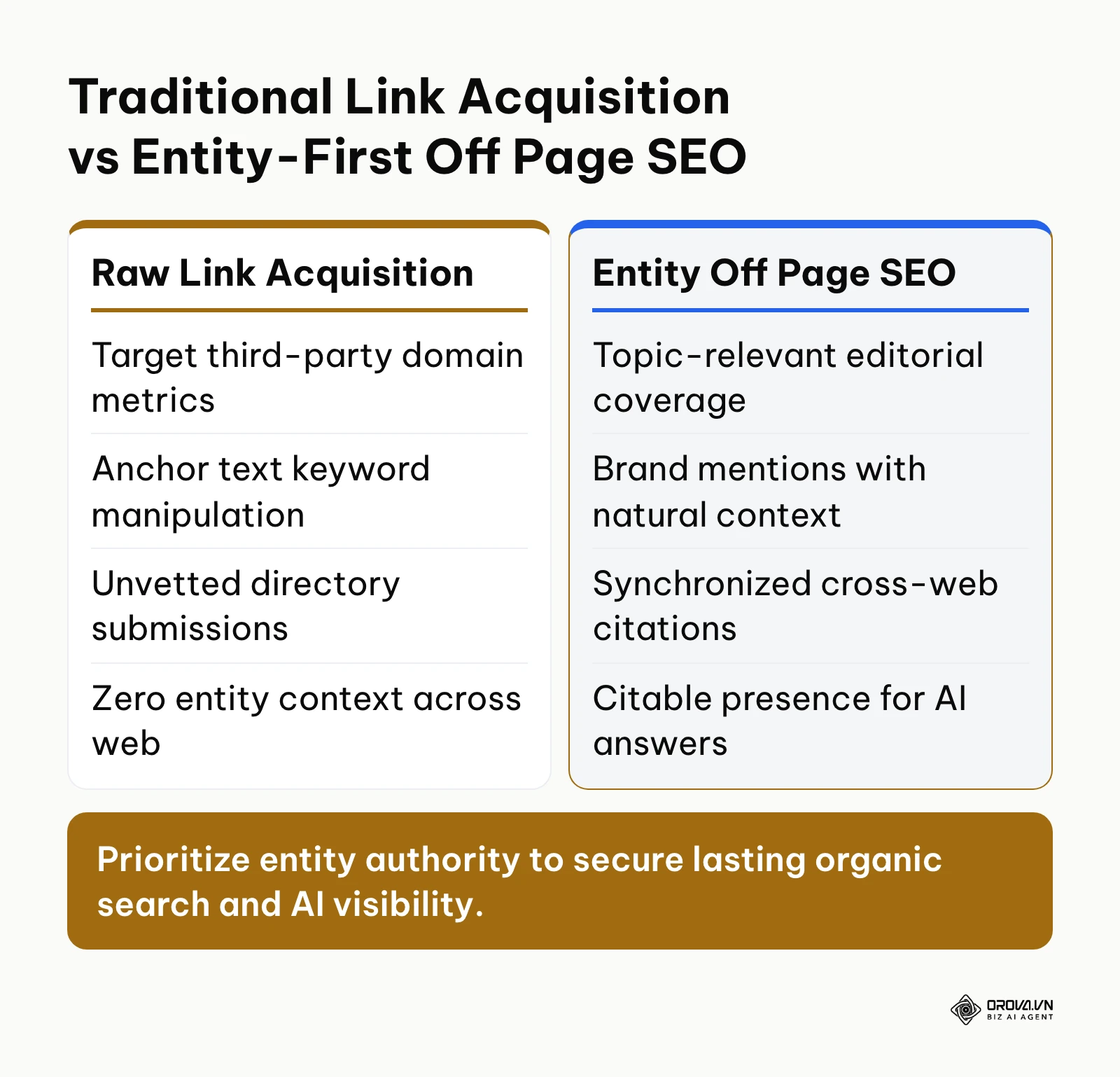
The diagram below summarizes the contrast between legacy link-building tactics and an entity-first off-page strategy.
The 12-Point Entity Footprint Checklist
Use this structured 12-point checklist to confirm that search algorithms can resolve your brand entity across independent databases:
- [ ] Official corporate homepage containing valid Organization JSON-LD markup.
- [ ] Active and claimed Google Business Profile with verified operational categories.
- [ ] Verified LinkedIn Company Page featuring official executive leadership profiles.
- [ ] Populated Crunchbase profile linked directly to founders and funding history.
- [ ] Active X (formerly Twitter) corporate handle cross-referenced on your website footer.
- [ ] Dedicated GitHub organization profile (for software, engineering, and technical businesses).
- [ ] Active listing in your national or regional chamber of commerce business directory.
- [ ] Claimed profile on tier-one consumer review platforms (Trustpilot or G2 Crowd).
- [ ] Verified corporate entry on Wikidata or regional open corporate registers.
- [ ] Dedicated press page (/press or /media) hosting downloadable logos and executive bios.
- [ ] Consistent author profile pages on your own domain with outbound links to verified social handles.
- [ ] Cross-referenced author profiles on major industry publishing platforms where your team writes.
Before scaling external outreach, ensure your comprehensive on-page SEO foundation is cleanly structured with relevant headings and schema.
Verify your entity synchronization by entering your brand name into Google Search inside an incognito window. You should see a consolidated Search Engine Results Page (SERP) containing your official site in position one, accompanied by rich sitelinks, an operational Knowledge Panel on the right rail, and verified social profile icons directly beneath your snippet.
| Profile field | Keep identical across | Typical mismatch to fix |
|---|---|---|
| Brand or legal name | Website schema, LinkedIn, Crunchbase, Google Business Profile, Wikidata | Acronym on one profile, full legal name on another |
| Address and phone | Website footer, Google Business Profile, chamber of commerce listing | Old office address left on a directory |
| Official website URL | Every profile and author bio | Mix of www and non-www, or an old domain |
| Category and short description | Registries, review platforms, About page | Different service categories on each platform |
A common pitfall at this stage is inconsistent naming conventions, such as using an abbreviated acronym on LinkedIn while listing a registered legal entity on Crunchbase. This discrepancy fragments your entity graph, forcing algorithms to treat the profiles as unrelated businesses. Standardize your brand string across every registry.
Step 2: Screen Prospects with the Off Page SEO Site Reputation Abuse Checklist
Screen every publication and partner domain against algorithmic risk factors to ensure you do not earn links from websites vulnerable to Google penalties.
According to Google Search Central in the Spam Policies for Google Web Search documentation published in 2024, third-party content published with little or no site-owner oversight aimed at manipulating search rankings constitutes site reputation abuse. When an established news publication or authority website hosts unvetted third-party commercial articles on a hidden subfolder or subdomain, search algorithms can demote or strip indexing privileges from that section. If you acquire links on compromised pages, that link equity evaporates overnight.
Open your link prospecting spreadsheet alongside an independent web evaluation tool. Inspect the prospective host domain's URL structure, historical organic traffic curve, and editorial review standards.
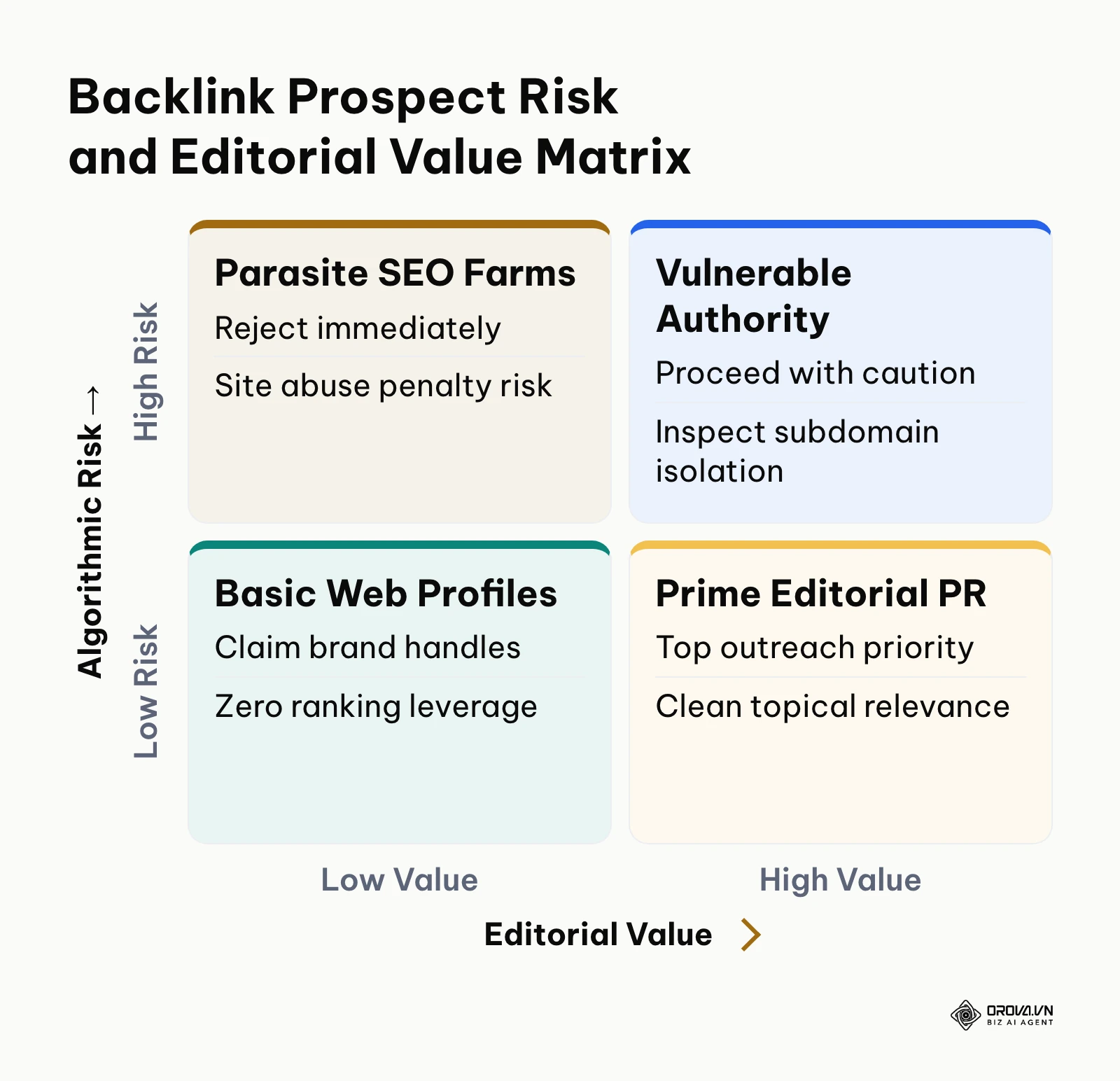
The diagram below summarizes how link candidates map across editorial authority and algorithmic risk dimensions.
The 10-Point Site Reputation Abuse Checklist
Review prospective publishing domains against these ten warning signs before proposing guest articles, syndication, or digital PR partnerships:
- Subdomain isolation: The blog or review directory is hosted on an isolated subdomain that shares zero internal navigation links with the parent brand.
- Thematic mismatch: The prospective host is a mainstream sports or news portal, but the target section publishes content exclusively on unrelated commercial topics such as student loans, offshore gambling, or no-prescription pharmaceuticals.
- Obscured authorship: Articles feature pseudonyms, generic designations like "Editorial Staff", or stock-photo headshots with empty author biography pages.
- Editorial pay-to-play signals: The site openly advertises sponsored posts, paid dofollow links, or instant publishing without editorial revisions.
- Inbound link velocity anomalies: The host domain exhibits erratic backlink spikes originating from unrelated foreign language domains or link networks.
- Volatile organic traffic drops: Third-party visibility estimates indicate sudden 70% or greater drops coinciding with recent core or spam updates.
- Uncontrolled outbound linking: Target pages contain 10 or more outbound dofollow links pointing toward aggressive commercial landing pages using exact-match commercial anchors.
- Recent domain ownership transfer: WHOIS lookup records indicate the domain expired and was acquired recently by a secondary holding entity to exploit historical authority.
- Missing editorial standards: The publication lacks public editorial guidelines, corrections policies, or physical corporate contact details.
- Robots.txt exclusions: The publication proactively disallows search engine indexing across its sponsored or contributor subfolders.
The 5-Level Link Risk Scoring Matrix
Classify your prospective backlinks using this standardized 5-level risk rubric:
| Risk Level | Category Classification | Identifying Characteristics | Algorithmic Safety Profile | Strategic Recommendation |
|---|---|---|---|---|
| Level 1 | Tier-One Editorial | Accredited newsrooms, university domains, recognized industry associations, strict editorial gatekeeping. | Lowest exposure to link spam filters; high algorithmic trust. | Primary outreach target; allocate maximum research and pitch effort. |
| Level 2 | Niche Authority Blogs | Legitimate trade publications with verified practitioners, authentic readership, transparent authorship. | Safe; builds contextual relevance and direct referral visits. | Highly valuable for contextual relevance and middle-funnel traffic. |
| Level 3 | Commercial Trade Portals | Active corporate blogs and vendor resource centers; moderate editorial scrutiny. | Safe if anchor text remains branded or natural; low standalone risk. | Maintain natural branded anchors; avoid commercial anchor saturation. |
| Level 4 | Scaled Guest Networks | Sites accepting open submissions with minimal review; multi-niche articles sharing the same blog feed. | Vulnerable to automated link devaluation and algorithmic filtering. | Reject pitches; zero long-term equity; high potential for link devaluation. |
| Level 5 | Parasite and PBN Farms | Expired domains hosting scraped content, covert subdomains renting authority to commercial affiliates. | High risk of manual action or algorithmic Site Reputation Abuse penalty. | Strict exclusion; never associate your brand or domain with these URLs. |
Hypothetical example: A mid-market B2B logistics SaaS company with 15 team members was offered a contributor placement on an established national news site's coupon subdomain. Rather than accepting the offer based on the parent site's high domain authority, the marketing manager checked the URL structure against the 10-point checklist. They noted that the subdomain had zero internal navigation links from the parent homepage and had lost 80% of its organic visibility over the preceding quarter. The manager rejected the offer and redirected the budget toward an original industry benchmark survey, which subsequently earned four genuine editorial citations from trade publications.
Step 3: Produce Data-Led Assets for Natural Off Page SEO Link Acquisition
To attract natural links passively, produce proprietary data studies and original benchmark reports that journalists, researchers, and content creators cite as definitive industry references.
As outlined by the World Wide Web Consortium (W3C) in the Data Catalog Vocabulary (DCAT) Version 3 standard released in 2024, datasets should carry clear provenance and creator attributes, which makes them easier to cite reliably. When content creators search Google for industry statistics, benchmarks, and trends, they link to the primary publisher of that data rather than secondary commentary.
Open your internal reporting tools, business databases, or customer survey platforms. Identify a recurring operational metric that your audience frequently debates. Aggregate at least 500 anonymized data points. Clean the findings, calculate percentiles, and generate clean visual charts. Build a dedicated report page titled with the primary concept and publication year (for example: "Enterprise B2B Onboarding Benchmarks (2026)").
When designing data assets, create a structured SEO content outline that highlights primary findings, methodology notes, and reusable chart snippets so journalists find quick answers.
Strategic Cost, Payoff, and Algorithmic Risk Comparison
Compare the resource commitments, expected payoff horizons, and risk profiles of common off-page tactics before allocating your quarterly budget. Cost levels below are relative, not market benchmarks; replace them with quotes from your own vendors:
| Off-Page Strategy | Relative Monthly Cost | Time to Noticeable Impact | Implementation Difficulty | Algorithmic Risk Level | Primary Value Driver |
|---|---|---|---|---|---|
| Original Data Reports | Medium to high (survey and analysis) | 3 – 5 months | High (data analysis & design) | Minimal (zero penalty risk) | Passive, ongoing editorial backlinks from writers and journalists. |
| Digital PR Outreach | High (agency or media tools) | 2 – 4 months | High (pitching & media lists) | Minimal (earned editorial trust) | High-authority brand mentions and prominent publication features. |
| Targeted Guest Articles | Low to medium (writer production) | 2 – 3 months | Moderate (content production) | Low (if placed on relevant sites) | Direct referral audiences and contextually aligned topical links. |
| Unlinked Brand Reclamation | Low (monitoring tools) | 1 – 2 months | Low (templated follow-ups) | Zero (existing brand mentions) | Rapid conversion of earned sentiment into live hyperlink equity. |
| Transactional Link Purchases | Medium (broker fees) | 1 month (temporary) | Low (purely transactional) | Severe (SpamBrain demotion) | Artificial short-term lift followed by permanent devaluation. |
Confirm that your data report is structured correctly by checking the live URL. The page must display an executive summary box at the top with three key statistical findings, high-resolution downloadable SVG or PNG charts with embed codes, and an explicit methodology note detailing sample size and data collection dates.
A frequent error is publishing research as an unindexable PDF or locking the findings behind a mandatory lead-capture form. If journalists must submit their email and wait for a sales representative to access your charts, they will close the tab and cite an open competitor instead. Make your core statistics publicly accessible and indexable.
Discover Orova.vn – a Biz AI Agent platform with OROVA SEO, a complete solution for every website. The system supports search engine optimization from A to Z with features including keyword research, writing new SEO-ready articles, optimizing existing content, rank tracking, plus competitor analysis and in-depth technical analysis. Sign up today to experience OROVA SEO completely free (offer valid through July 7, 2027).
Step 4: Run Targeted Digital PR Outreach for High-Authority Off Page SEO
Execute digital PR outreach by pitching relevant journalists and editors with concise, insight-driven emails that deliver immediate editorial value without promotional language.
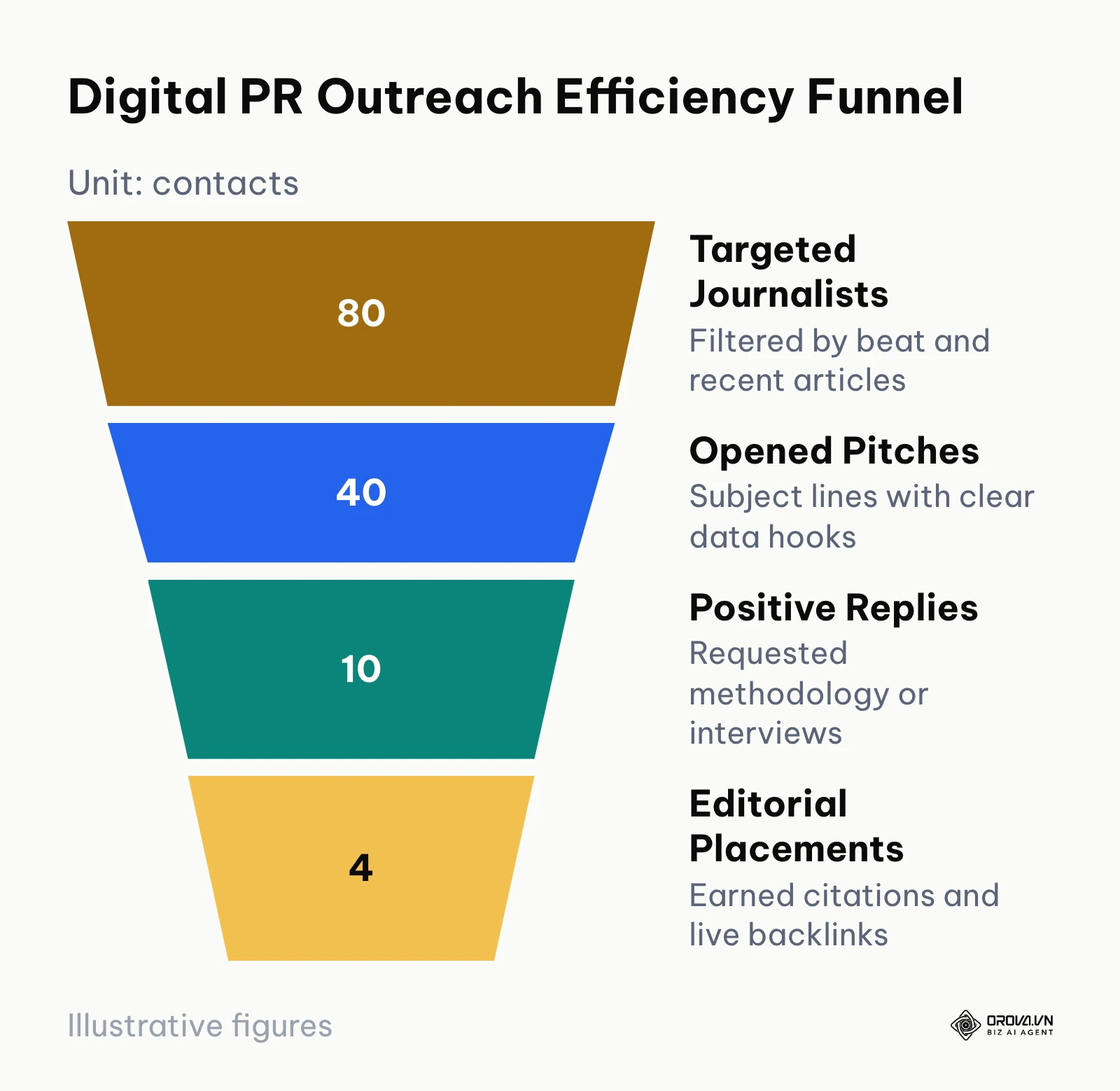
Open your media database or professional social network. Locate reporters who actively cover your specific niche and have published articles on related topics within the past 30 days. Do not compile broad lists of general news desks. Select 40 to 80 targeted journalists who write about your specific industry sector.
The diagram below illustrates the stages of a focused digital PR campaign, using hypothetical numbers.
The Lean 3-Step Expert Outreach Framework
Deploy this proven 3-step pitching framework designed for industry practitioners. It avoids marketing jargon and keeps every message focused on value for the journalist:
| Phase | When to send | Goal | Length |
|---|---|---|---|
| 1. Initial insight pitch | Day 1 | Lead with one surprising finding from your data | Under 150 words |
| 2. Value-add follow-up | Day 4, only if no reply | Add one new data point, then step back | 2–3 sentences |
| 3. Asset delivery and citation request | After a positive reply | Send charts and raw data, ask for a citation to the report page | Short and practical |
Phase 1: The Initial Insight Pitch (Day 1)
Draft a personalized email under 150 words. State the core finding in your subject line and lead with the statistical anomaly:
Subject: Data: [Key Stat] of [Industry Role] struggle with [Core Problem]

Hi [Journalist First Name],

I noticed your recent coverage of [Specific Topic] in [Publication Name], particularly your point regarding [Specific Angle from Their Recent Article].

We recently analyzed [Sample Size, e.g., 620 anonymized enterprise workflows] to benchmark how [Target Audience] is handling [Problem] in 2026.

Three notable findings from the dataset:
- [Stat 1]: [Brief 1-sentence finding with concrete number]
- [Stat 2]: [Brief 1-sentence unexpected contrast or anomaly]
- [Stat 3]: [Brief 1-sentence forward-looking implication]

The full methodology, raw data tables, and high-res chart embeds are published here: [Direct Clean URL].

Would you like access to the underlying raw dataset or an exclusive commentary from our lead researcher on this trend?

Best regards,

[Your Name]
[Your Title, e.g., Head of Research]
[Company Name] | [Clean Website URL]
Phase 2: The Value-Add Follow-Up (Day 4)
If the recipient has not opened or replied after three business days, send a single brief follow-up message adding one contextual insight:
Hi [Journalist First Name],

Following up with one additional data point that surfaced during our analysis: [Insert 1 short, intriguing stat or quote].

Let me know if you would like me to unpack this for any upcoming pieces you are developing. If this falls outside your current editorial beat, no need to reply.

Best,

[Your Name]
Phase 3: The Asset Delivery and Link Anchor Request (Upon Positive Reply)
When the journalist expresses interest in incorporating your findings, provide the requested quotes, raw CSV data, and image assets cleanly:
Hi [Journalist First Name],

Thank you for the note. Here is the direct link to download the high-resolution charts and the raw CSV dataset: [Clean Drive/Folder URL].

If you reference the study in your piece, our research team would appreciate a direct citation pointing to the primary report page ([Report URL]) so your readers can review the full statistical methodology.

Please let me know if you need any additional charts adjusted to fit your editorial formatting.

Best regards,

[Your Name]
Hypothetical example: A mid-market fintech advisory firm with 40 employees sought media coverage for its annual SaaS treasury management study. The marketing team prepared a 50-journalist media list, personalizing each pitch by referencing specific articles published in the preceding three weeks. When three financial editors requested quotes, the firm delivered custom commentary within two hours. This responsive, value-first approach resulted in three Level 1 editorial citations in national financial publications and a noticeable increase in qualified inbound demo requests over the subsequent two months.
Step 5: Secure Entity Citations to Maximize Off Page SEO for AI Overviews
Systematically secure entity citations across conversational forums, technical repositories, and niche platforms so large language models and search engines cite your brand inside AI-generated answers.
In alignment with recommendations from Google Search Central in their Creating helpful, reliable, people-first content guidelines updated in 2024, clear creator background and external validation across third-party sources demonstrate genuine experience and subject-matter expertise. AI answer features retrieve and summarize web sources, and they tend to surface sources that display cross-platform consensus and authentic practitioner discussions across community platforms like Reddit, GitHub, Stack Overflow, and authoritative trade publications.
The AI Entity Presence Framework (AEPF)
To build a persistent entity presence that AI models reference, execute this three-pillar framework:
| Pillar | Where to act | What to publish or update | How to check progress |
|---|---|---|---|
| A. Community consensus | Relevant subreddits, niche forums, Q&A sites | Detailed, non-promotional answers from your subject matter experts | Your brand is mentioned by other members in balanced discussions |
| B. Structured knowledge bases | Wikidata, Crunchbase, trade registries | Factual company profile with independent citations | Facts match across every profile and your About page |
| C. Glossary and definitions | Your own site and trade journals | Objective definitions of emerging concepts in your niche | Trade publications reuse or cite your definitions |
Pillar A: Community Consensus and Forum Citations
Search algorithms frequently retrieve community discussions from Reddit and niche forums to validate whether real humans recommend a software solution or service. Identify the top 10 subreddits and professional forums where your target buyers troubleshoot operational problems. Task your internal technical subject matter experts with contributing in-depth, non-promotional solutions to active threads. Provide thorough architectural explanations, workflow templates, and troubleshooting steps without promotional links. When community members mention your solution as an organic alternative within balanced discussions, search engine crawlers log that co-occurrence as an unbiased sentiment signal.
Pillar B: Structured Knowledge Base Inclusion
Large language models undergo pre-training and fine-tuning on structured open knowledge bases. Ensure your company maintains an updated, factual profile on Wikidata, Crunchbase, and relevant open repository collections. Every assertion regarding your founding date, headquarters, executive leadership, and primary product category must be supported by an outbound citation linking to an independent third-party publication or regulatory filing.
Pillar C: Niche Glossary and Definition Seeding
When generative search systems answer definitional queries (e.g., "What is [Industry Metric]?"), they retrieve synthesized definitions from recognized domain experts. Publish comprehensive, objective definitions of emerging industry concepts on your site, and contribute thought-leadership essays to trade journals clarifying those definitions. As industry publications adopt your terminology, AI engines link your brand entity to the topical cluster.
Verify your AI visibility by prompting Google Search (with AI Overviews enabled) and dedicated AI answer engines with core comparative queries (such as "What are the primary platforms for [Your Niche Category]?"). Over time, check whether your brand name or your research starts appearing among the cited sources. AI answers change often, so treat this as a directional signal rather than a guaranteed outcome.
A common mistake is tasking marketing teams with posting disguised promotional links in forums. Community moderators routinely ban accounts that engage in self-promotion, deleting the threads and generating negative sentiment signals that can harm your brand reputation. Contribute objective technical analysis only.
Step 6: Convert Unlinked Mentions into Measurable Off Page SEO Equity
Identify instances where journalists, bloggers, or conference organizers have referenced your brand or proprietary research without an active hyperlink, and secure a live citation where appropriate.
Open your media monitoring software or set up targeted Google Alerts using boolean search strings: "Brand Name" -site:yourdomain.com and "Executive Name" -site:yourdomain.com. Run this check weekly to catch newly indexed mentions across news sites, podcasts, and digital magazines.
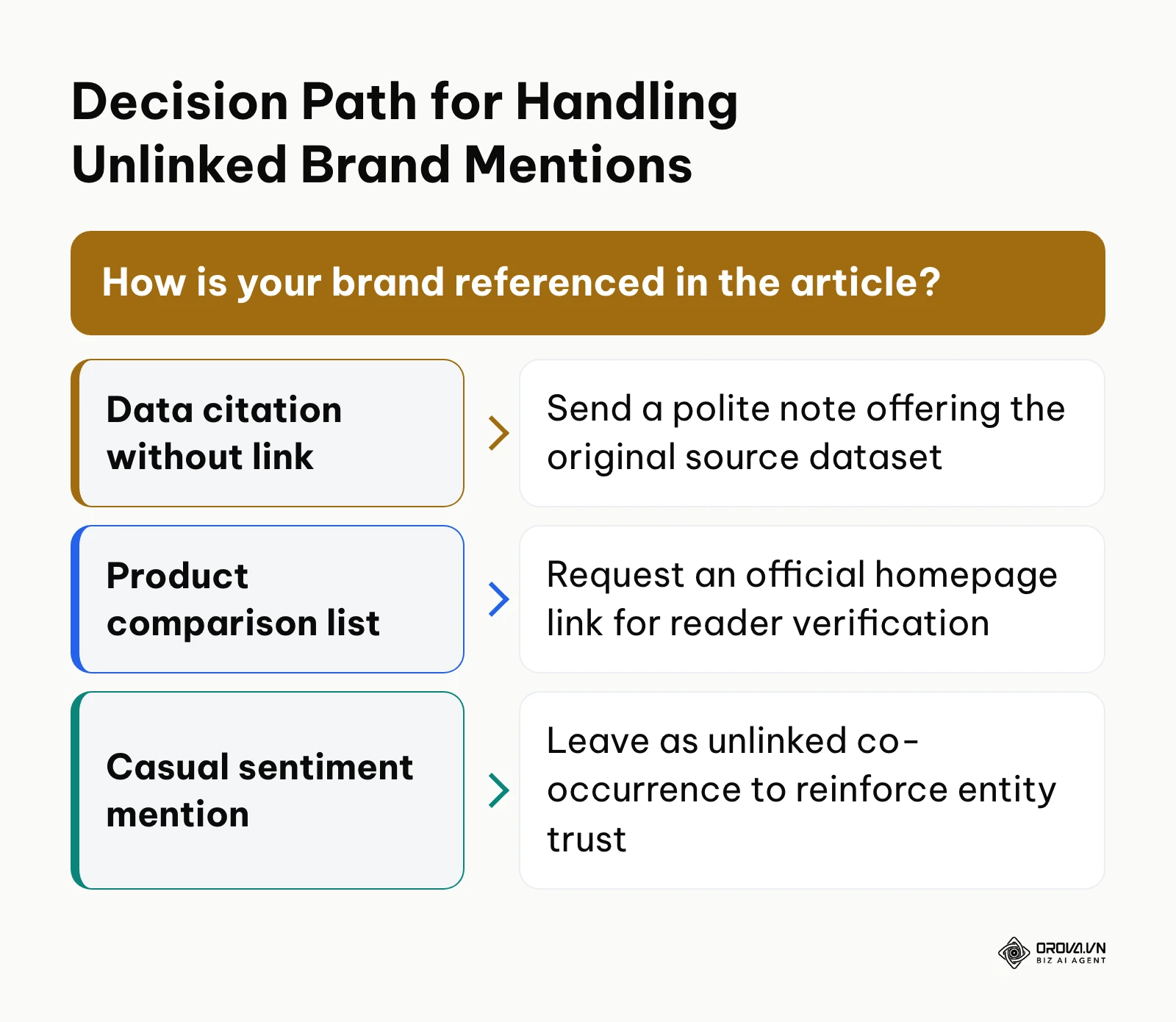
The decision path below outlines how to evaluate and handle different types of unlinked brand mentions.
Inspect the context of each unlinked mention. If an author references your original research or quotes your team member directly, find the author's contact information. Send a short, appreciative message thanking them for the reference. Note that a direct link to the primary data source helps their readers verify the underlying methodology.
Verify the conversion by re-crawling the target URL. The previous plain-text mention should now feature a clean, functional hyperlink pointing to your primary research asset or homepage.
A common pitfall is aggressively demanding links on casual brand mentions where adding a link would disrupt the natural flow of the sentence. If an editor references your company name casually in a broad list, demanding an immediate hyperlink can damage the editorial relationship. In such cases, let the mention remain unlinked. Modern search engines still recognize unlinked co-occurrences as positive entity associations.
Step 7: Configure GSC Regex to Track Off Page SEO Branded Query Growth
Configure custom Regular Expression (Regex) filters inside Google Search Console to monitor increases in branded search volume resulting from your off-page campaigns.
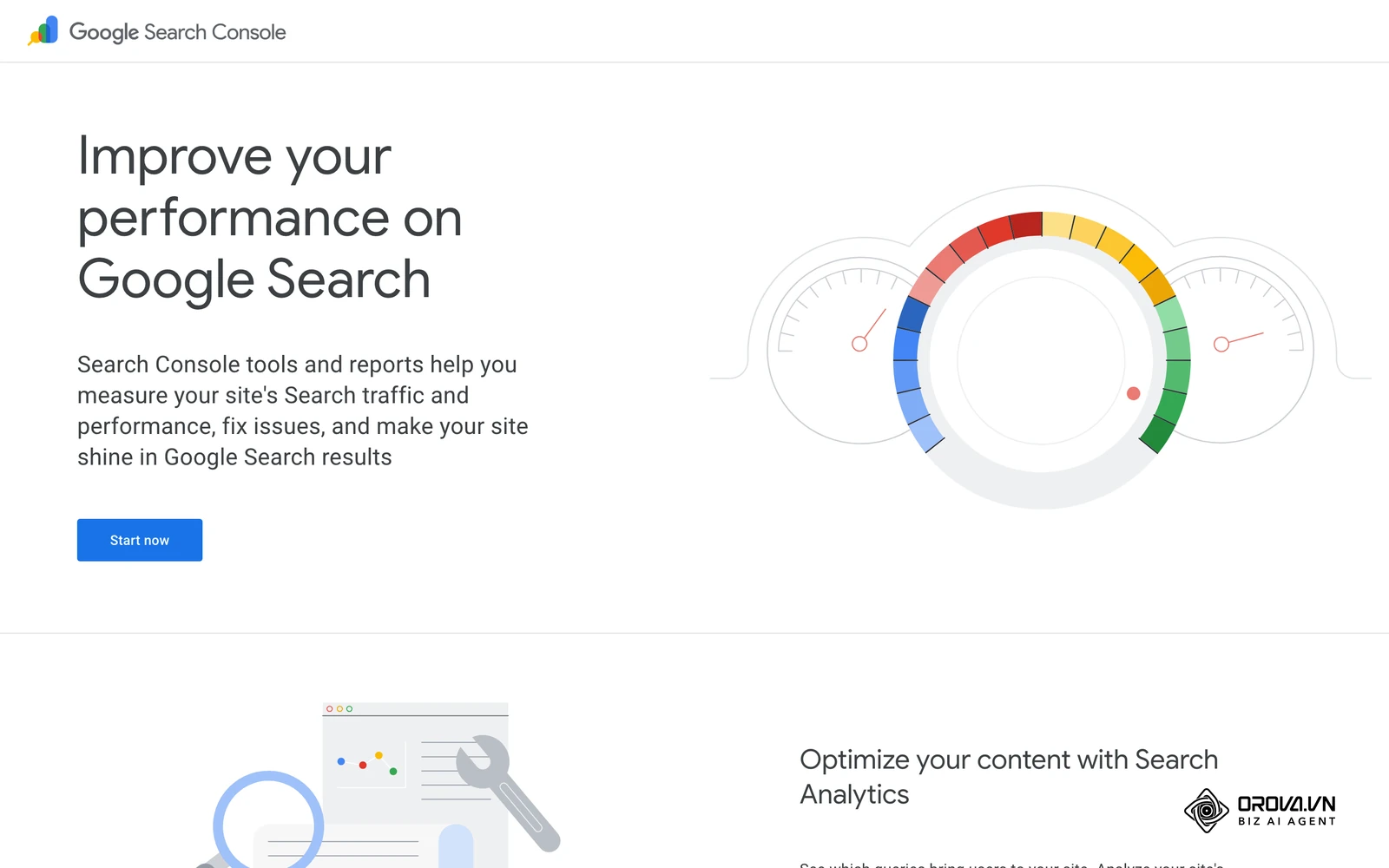
Log into your Google Search Console administrative dashboard. From the left navigation menu, navigate to the Performance section and click on Search results.
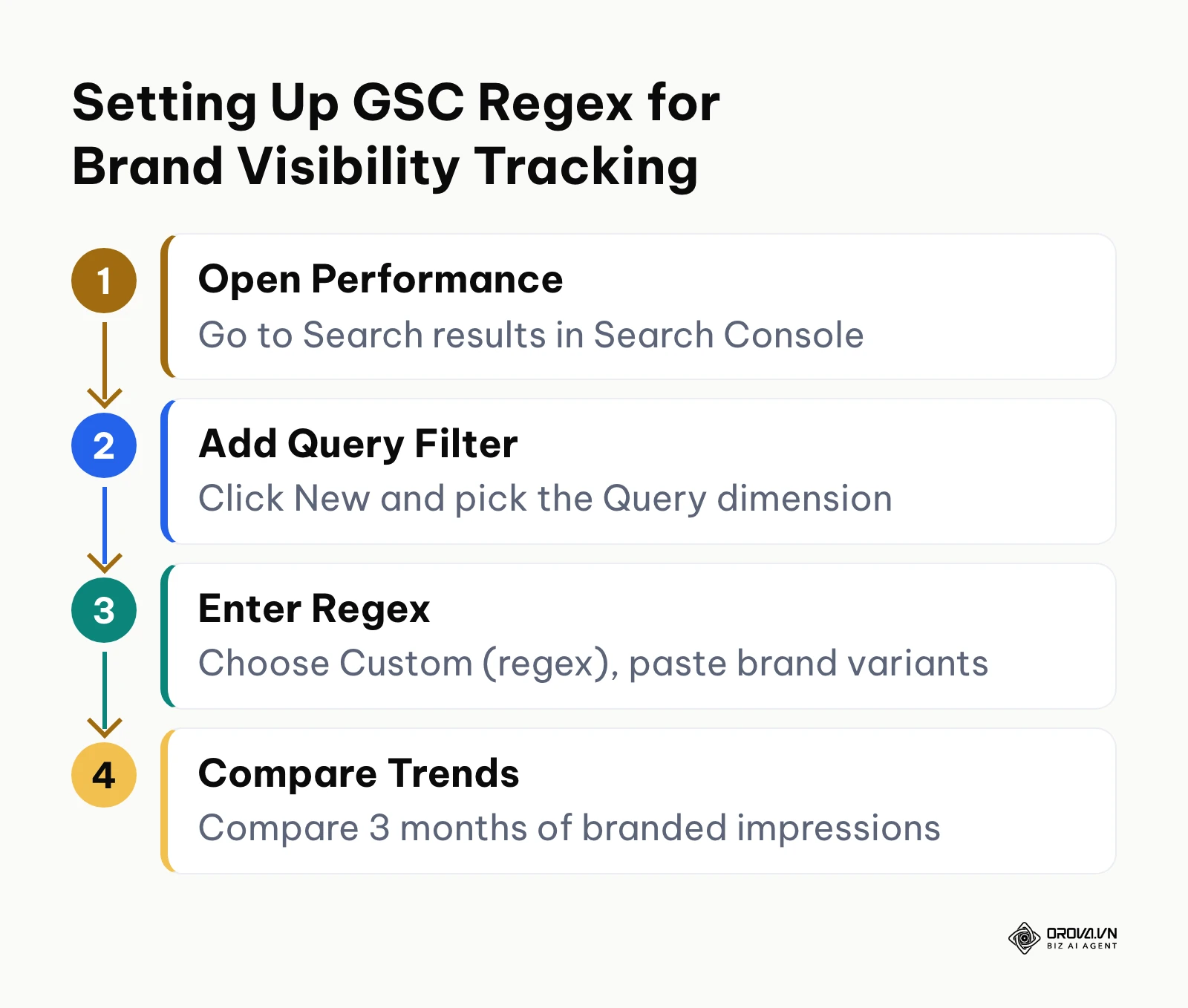
The diagram below outlines the four-step workflow for configuring regular expression filters to track branded search queries.
Setting Up the Branded Performance Filter
Follow these four steps to isolate and monitor branded search query impressions:
- Locate the filter bar at the top of the performance report (adjacent to the Date Range selector) and click the + New button.
- Select the Query dimension from the dropdown menu.
- In the query configuration modal, click the operator dropdown (which defaults to Queries containing) and select Custom (regex). Ensure the matching condition is set to Matches regex.
- In the text input field, enter your brand variations, common misspellings, and product names separated by the vertical bar character, as in the example below. Prepend the case-insensitive flag (?i):
(?i)brandname|brand name|brandname app|brandname software|brand mispelling
Click Apply in the bottom right corner of the modal. Check the boxes for Total clicks, Total impressions, and Average position above the performance chart. Select a comparative date range (such as Compare last 3 months to previous period).
Hypothetical example: A cloud hosting infrastructure provider with 25 employees launched a targeted digital PR campaign promoting its annual server latency benchmark study. Over the subsequent 90 days, the marketing lead monitored the branded query regex filter in Search Console. The report showed a clear rise in total branded impressions and a steady rise in non-branded impressions across related technical keywords. This provided unambiguous proof to executive leadership that the external PR placements were driving measurable commercial interest.
If your technical site health is neglected, external link equity will leak through crawl traps and redirect chains. You can audit a website for SEO without paid tools to resolve internal bottlenecks before initiating link acquisition.
A common error when creating regex filters in Search Console is entering unescaped special characters or failing to account for common spelling variations of your brand name. If your company name includes spaces or hyphens, verify your regex syntax in a text editor to prevent query exclusion errors.
Step 8: Audit Backlink Health to Protect Your Off Page SEO from Algorithmic Penalties
Conduct bi-monthly backlink audits to identify and neutralize negative SEO attempts, scraper syndication footprints, and spam networks before automated spam detection systems devalue your domain.
Open your preferred backlink analysis tool and download your complete inbound referring domains list into a spreadsheet. Filter the list to isolate domains with zero organic search traffic, excessive foreign-language anchor text, or domain names containing known spam patterns.
| Link type you find | Typical example | Recommended action |
|---|---|---|
| Natural editorial link | Trade article citing your research | Keep; no action needed |
| Small or local site link | Local directory, niche hobby blog | Keep; low authority is not a reason to disavow |
| Automated scraper copy | Auto-generated page copying your content | Usually ignore; Google's systems tend to discount these |
| Link you or a past agency paid for | Sponsored post with exact-match anchor, link network | Ask for removal; disavow if removal fails |
Cross-reference suspicious URLs against Google's link spam guidelines. If you detect thousands of low-tier links originating from automated scraping sites, review your Search Console Manual Actions report to verify whether your site remains in good standing. In modern search environments, Google's automated systems typically ignore low-quality scraper links without requiring manual disavow submissions. However, if your domain was previously subjected to aggressive manual link-building schemes or paid link networks, prepare a clean, formatted disavow text file and submit it via the official Google Disavow Tool.
Verify that your link profile is clean by inspecting your anchor text distribution. Your anchor profile should consist predominantly of branded terms, naked URLs, and natural editorial phrases, with exact-match commercial anchors kept to a small minority. Google publishes no target ratios, so use your own historical profile as the baseline.
A frequent mistake is routinely disavowing legitimate small blogs or local business directories simply because they have lower third-party authority scores. Indiscriminately disavowing natural links strips your site of authentic referral diversity. Reserve disavow actions strictly for clear link schemes, automated spam networks, and manipulative paid links.
With OROVA.VN and the OROVA SEO module, you put an end to the exhausting days of manual work for good. Instead of struggling for hours to write articles and compile reports, the entire process is now optimized and completed in just 5 minutes.
Master Checklist for Off Page SEO Execution
Use this master checklist to review and execute your off-page optimization program across your quarterly sprints:
| Implementation Step | Primary Operational Task | Completion Signal | Estimated Time Required |
|---|---|---|---|
| Step 1: Entity Setup | Audit Organization schema, claim Crunchbase, LinkedIn, and G2 profiles. | Branded Search results display Knowledge Panel and verified sitelinks. | 3–5 hours |
| Step 2: Risk Screening | Screen prospective domains against the 10-point Site Reputation Abuse checklist. | Prospective domains categorized cleanly within the 5-Level Link Risk Matrix. | 1–2 hours per batch |
| Step 3: Data Assets | Publish an original industry survey or statistical benchmark study with embeddable charts. | Public study URL live with downloadable assets, charts, and methodology box. | 2–3 weeks |
| Step 4: Digital PR | Pitch personalized insights to 50 targeted niche reporters using the 3-step framework. | Positive replies from relevant journalists and at least one editorial placement. | 4–6 hours weekly |
| Step 5: AI Entity Seeding | Contribute non-promotional technical solutions to relevant subreddits and forums. | Brand entity listed inside Google AI Overviews and conversational AI responses. | 2–3 hours weekly |
| Step 6: Unlinked Mentions | Identify plain-text brand citations using search alerts and request editorial links. | Target webmasters convert plain-text brand mentions into live hyperlinks. | 1–2 hours weekly |
| Step 7: GSC Regex Tracking | Build and apply custom brand regex filters in Google Search Console. | Search Console performance report displays branded impression growth curve. | 30 minutes |
| Step 8: Backlink Audit | Audit referring domains and evaluate anchor text distribution ratios. | Anchor profile dominated by branded and natural anchors. | 2 hours bi-monthly |
Common Off Page SEO Mistakes and How to Fix Them
Review these five common operational mistakes that derail external SEO campaigns, along with their root causes and remediation steps:
| Operational Mistake | Root Cause | Remediation Procedure |
|---|---|---|
| Chasing third-party authority metrics over relevance | Over-reliance on third-party domain rating scores without reviewing topical alignment. | Discontinue pitches to generic multi-topic sites. Focus exclusively on topically relevant domains within your specific industry niche. |
| Over-optimizing external anchor text | Forcing commercial exact-match keywords into guest article links and directory submissions. | Revert external anchor targets to brand names, executive names, or natural navigational phrases to avoid algorithmic link spam penalties. |
| Neglecting unlinked brand mentions | Assuming an unlinked mention provides zero search value and ignoring the publishing publication. | Run recurring media monitoring queries. Pitch authors with supplementary data and methodology resources to convert citations into active links. |
| Pitching mass email blasts to generic press desks | Using automated scraping software to send identical templates to hundreds of unvetted journalists. | Refine outreach lists to 40–80 targeted journalists who actively cover your specific niche. Personalize every subject line and opening hook. |
| Buying commercial links on parasite subdomains | Attempting to bypass authority timelines by renting space on news coupon and review directories. | Audit prospects against the 10-point Site Reputation Abuse checklist. Prioritize original data assets and digital PR over transactional links. |
Off-page work itself is hands-on relationship building, and no software replaces it. For the on-site side, Orova SEO connects to your Google Search Console data in its Reports and Analysis tabs to organize query performance and rank Golden Opportunity keywords (P1 to P5), refreshed daily. Separately, the Orova SEO Check tool scores 92 technical criteria across 12 categories and lists up to 50 referring domains pointing to your site, sorted by strength. That backlink view is domain-level only and updated in periodic batches, so use it as a quick sanity check rather than a full backlink audit.
How to Measure Off Page SEO Results Accurately
Measuring external SEO performance requires tracking branded demand, referral acquisition, and organic keyword trajectory over multiple quarters rather than expecting overnight shifts.
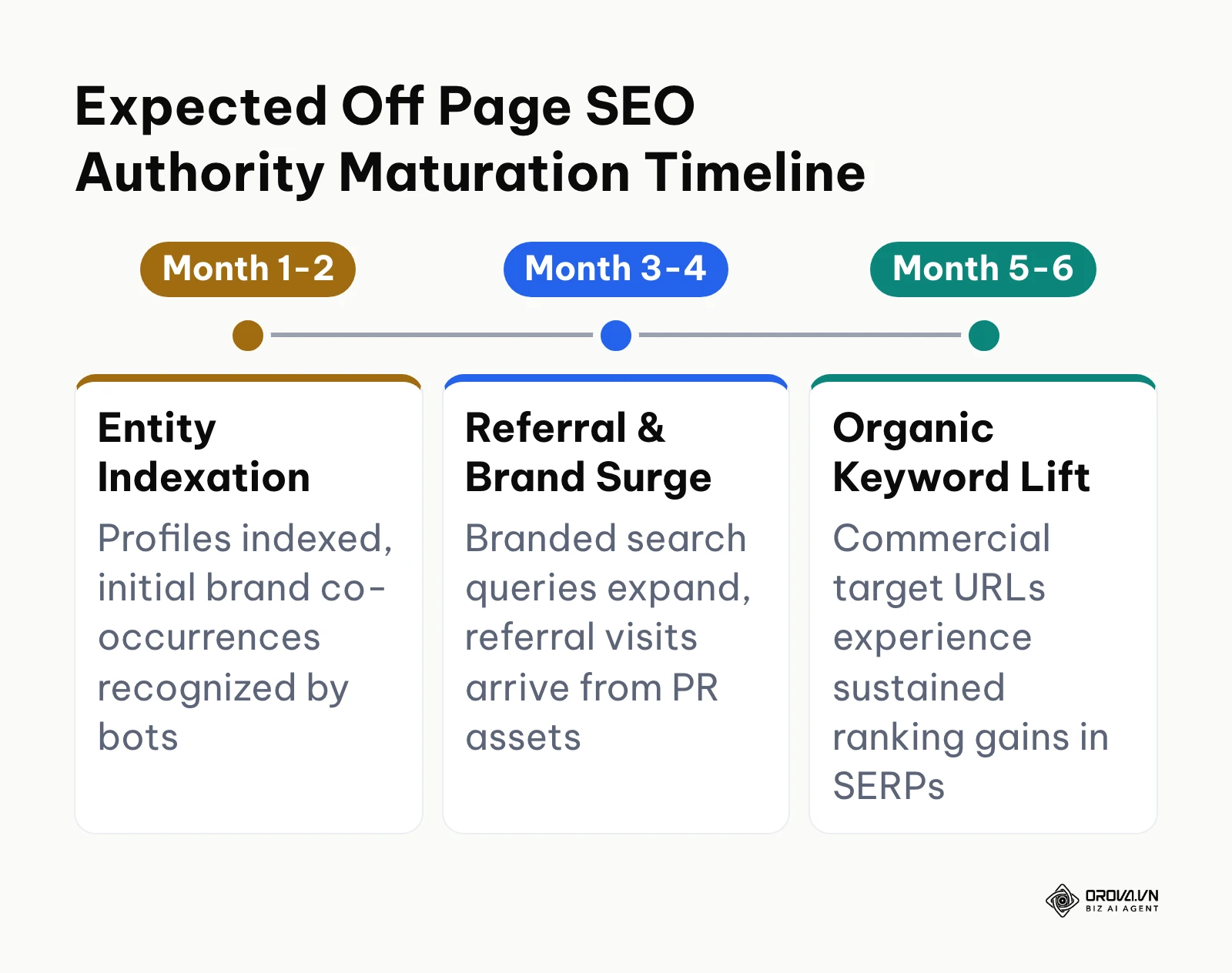
The timeline below illustrates the typical maturation trajectory of off-page authority across search engines and AI knowledge graphs.
Tracking authority velocity requires alignment with your broader business goals. Establish critical SEO KPIs that measure non-branded search impressions, referring domain velocity, and assisted conversion value.
Review your performance across these core reporting views:
| Metric | Where to find it | What a healthy trend looks like |
|---|---|---|
| Branded search impressions | Google Search Console, Performance report with your branded regex filter | A rising impression curve quarter over quarter as PR and community work expands your brand footprint |
| Referring domain velocity | Your backlink monitoring tool, referring domains list | Steady acquisition of unique, relevant root domains each month, without sudden unnatural spikes |
| Referral traffic quality | Google Analytics 4, Reports > Acquisition > Traffic acquisition, filtered to the referral medium | Engaged sessions and key events coming from your digital PR placements |
| Topical keyword visibility | Google Search Console, Performance report filtered to your core commercial pages | Core commercial URLs climbing for competitive, non-branded queries as authority compounds |
Off page SEO trends in the next few years: author's perspective
As of 2026, I see a structural shift in how search algorithms evaluate external brand authority. Search engines increasingly devalue isolated, transactional links while expanding their reliance on multi-platform entity consensus and direct brand queries. In my view, the traditional practice of counting raw backlinks as the primary measure of off-page authority will continue to diminish over the next two to three years. Search engines and AI-driven retrieval systems are evolving into semantic reasoning engines that evaluate whether an organization is discussed, cited, and recommended by authentic subject-matter experts across independent digital platforms.
I believe this transition will make traditional, unvetted guest post networks and commercial link syndication far less effective. As neural search engines rely more on retrieval-augmented generation to summarize direct answers, an unlinked brand citation inside an authoritative industry report or a high-engagement Reddit discussion may carry more weight than a standard followed link on a generic blog. If search algorithms prioritize verified source attribution, organizations that invest in primary research and active community engagement will secure durable competitive advantages in both organic SERPs and conversational AI answers.
However, this shift could unfold more slowly if major search engines continue to rely on legacy link-graph weighting to preserve algorithmic stability across technical query categories. Webmasters should prepare today by building a cohesive entity footprint. Focus your team's energy on producing original data assets, engaging authentically with professional communities, and establishing verified author profiles that algorithms can connect across the web.
Frequently asked questions about off page SEO
How does artificial intelligence influence off page SEO in modern search?
AI engines and conversational answer engines evaluate off-page authority by cross-referencing your brand entity across training data, authoritative trade publications, and authentic community discussions. Rather than merely calculating PageRank via hyperlinks, AI models assess contextual consensus to determine whether your brand is an acknowledged authority in its field.
What is the difference between on-page and off-page SEO?
On-page SEO encompasses internal optimizations executed directly on your website, including content quality, internal linking, meta tags, and URL structure. Off-page SEO focuses entirely on external signals that occur outside your domain, such as digital PR coverage, editorial backlinks, brand mentions, and third-party entity verification.
Can a new website build off-page authority without a dedicated link-building budget?
Yes. A new website can build initial authority by synchronizing its entity footprint across standard registries, contributing authoritative, non-promotional insights to relevant professional forums, and publishing proprietary research that naturally attracts passive citations from industry journalists.
Are unlinked brand mentions valuable for search engine rankings?
Yes. Modern search algorithms evaluate unlinked brand mentions and co-occurrences as positive entity associations. When authoritative publications cite your brand alongside relevant industry concepts, search engines register those citations as validation of your expertise even without an active hyperlink.
How do I distinguish between a natural link exchange and a manipulative link scheme?
A natural link exchange occurs when two relevant businesses occasionally cite each other's research or tools to provide genuine context for their readers. A manipulative link scheme, prohibited by Google's spam policies, involves systematic, programmatic, or paid reciprocal linking designed solely to manipulate search rankings without regard for reader value.
Where should you start with off page SEO?
If you are launching off page SEO for a brand-new website with zero external authority, focus your first afternoon on foundational entity synchronization. Claim your profiles on Crunchbase, LinkedIn, and your primary trade directories, ensuring that your official legal name, address, and primary service categories match your corporate registrations exactly.
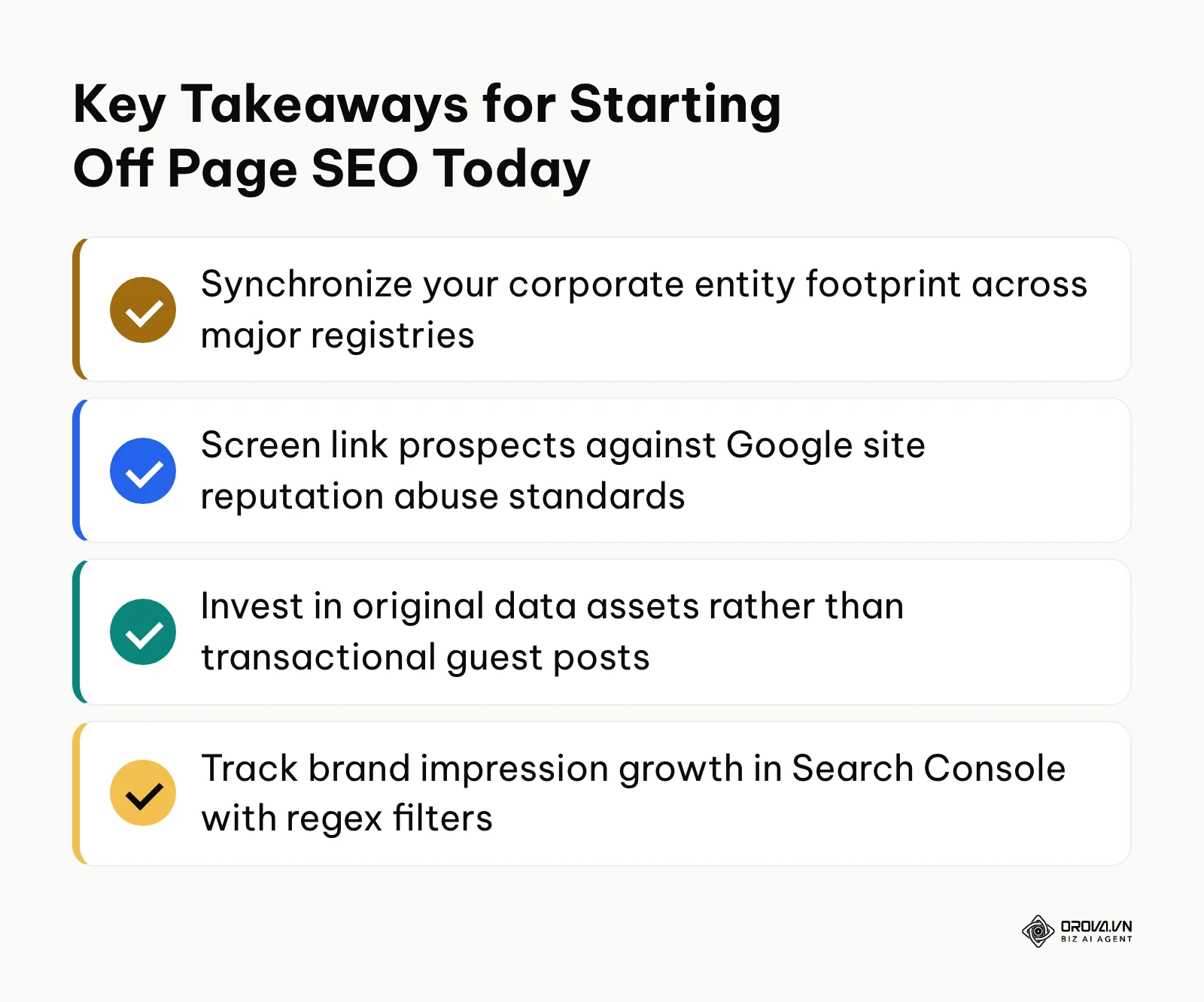
If you operate an established website that has plateaued in search rankings despite thorough on-page optimization, dedicate your next session to an outreach audit. Identify your two most popular informational guides, extract the underlying data or workflow insights, and draft an introductory outreach pitch targeting five industry journalists who covered that exact topic in the past month.
If your website was previously impacted by algorithmic updates or questionable third-party link building, spend an afternoon conducting a backlink risk assessment. Screen your top 100 referring domains against the 10-point Site Reputation Abuse checklist, isolate any manipulative link networks or low-quality directories, and establish a clean baseline for your future off page SEO.
About the author

Builder of Orova
Nguyễn Đỗ Trọng Ân has 8 years of experience in marketing, including 6 years managing market development across Asia. He builds Orova, a Biz AI Agent that never sleeps: it plans, runs and optimizes work for businesses.
Run your business with AI Agents
Orova is the always-on Biz AI Agent — it plans, runs, and optimizes the work for you.
Save time, unlock productivity.