
SEO and SEM: Key Differences and Which to Choose in 2026

Choosing between seo and sem is one of the most critical budget decisions any business faces when entering digital channels. Marketers and founders frequently debate whether to invest capital into long-term organic search rankings or buy immediate placement at the top of Google search results pages. If you need to validate an unproven offer or capture urgent customer demand this week, choose SEM; if you want sustainable unit economics that reduce acquisition costs over time, choose SEO.
Every growth channel carries explicit trade-offs in cash flow, risk, and asset ownership. Treating search marketing as a binary choice often causes companies to overspend on high-friction keywords or wait months for organic traffic that never converts. This guide examines how organic search optimization and search engine marketing differ across financial return timelines, real estate changes caused by modern search features, search query intent, and long-term asset value.
SEO and SEM: Core Differences at a Glance
The core difference between search engine optimization (SEO) and search engine marketing (SEM) lies in the monetization model and asset ownership. SEO earns organic visibility by aligning technical infrastructure, relevant content, and domain authority with search engine ranking systems without paying for individual clicks. SEM, by contrast, buys immediate sponsored visibility at the top of search result pages through an auction model where you pay for each visitor who clicks your advertisement.
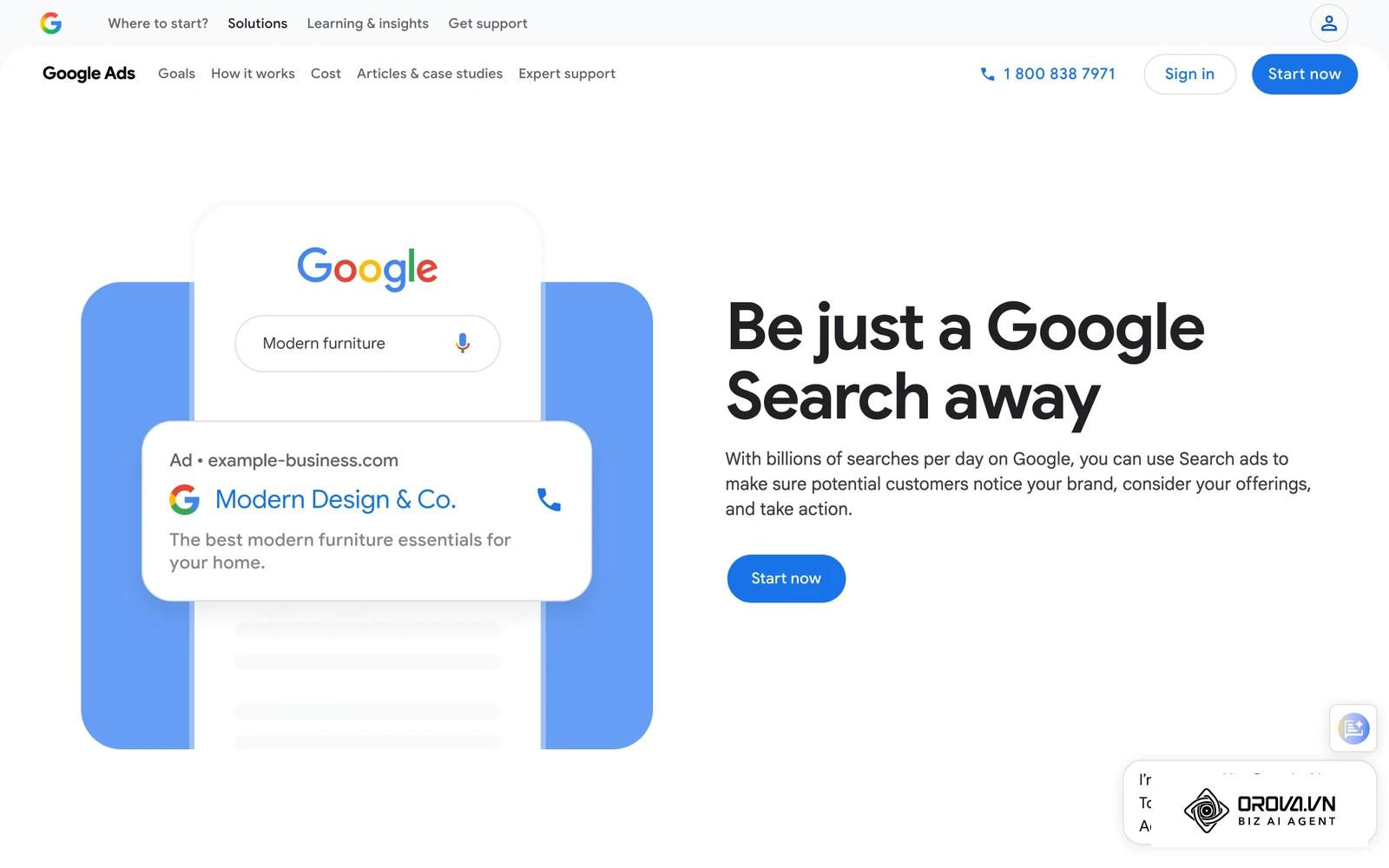
The screenshot from Google's own Search ads page shows the paid side in practice: a sponsored result labelled "Ad" that sits above the ordinary results.
The following comparative table breaks down the fundamental criteria separating both channels across budget mechanics, operational control, and performance risk.
| Criterion | Search Engine Optimization (SEO) | Search Engine Marketing (SEM / PPC) | Advantage |
|---|---|---|---|
| Direct Click Cost | Free (no fee per click) | Paid per click (CPC auction model) | SEO |
| Speed to Results | 3 to 9 months for significant traction | Instant upon campaign activation | SEM |
| Traffic Longevity | Sustained traffic after initial production | Ceases immediately when spend stops | SEO |
| Targeting Control | Algorithmic matching based on content relevance | Precise keyword, demographic, and device control | SEM |
| SERP Position | Organic listings below sponsored ads and AI tools | Top positions above organic listings | SEM |
| Asset Equity | Compounding digital asset owned by the business | Rented temporary placement | SEO |
| Conversion Predictability | Variable based on query intent and page match | Highly predictable with controlled landing pages | SEM |
| Upfront Capital Risk | Delayed return on editorial and technical resources | Immediate cash outlay with direct conversion feedback | SEM |
| Algorithmic Volatility | Vulnerable to search core algorithm updates | Immune to organic ranking algorithm shifts | SEM |
| Scalability | Non-linear; incremental traffic costs approach zero | Linear; scaling clicks requires proportional budget | SEO |
What Are SEO and SEM?
Understanding the technical boundaries of each discipline prevents budget waste and misaligned team expectations.
What Is SEO and What Problem Does It Solve?
SEO, or search engine optimization, is the systematic practice of configuring web pages, technical website architecture, and authoritative references so search engines index and rank your content organically. It exists to solve the problem of recurring customer acquisition costs by creating permanent, indexable digital property that attracts qualified prospective buyers repeatedly without direct media expenses.
What Is SEM and What Problem Does It Solve?
SEM, or search engine marketing, encompasses paid advertising campaigns run across search engine result networks, primarily operated through platforms like Google Ads and Microsoft Advertising. It solves the critical problem of market entry speed by allowing advertisers to bypass search algorithmic ranking delays and position targeted messages in front of high-intent searchers within minutes of campaign deployment.
Cost Structure and Financial Break-Even: SEO vs SEM Across 12 Months
The financial mechanics of paid advertising versus organic optimization diverge sharply over an extended operating cycle. With SEM, cost-per-click (CPC) rates remain constant or inflate over time as competitor auction density increases. Every visitor acquired in month twelve costs roughly the same as a visitor acquired in month one. SEO requires substantial upfront capital for technical development and editorial creation, but the incremental cost of each subsequent visitor approaches zero as content matures.
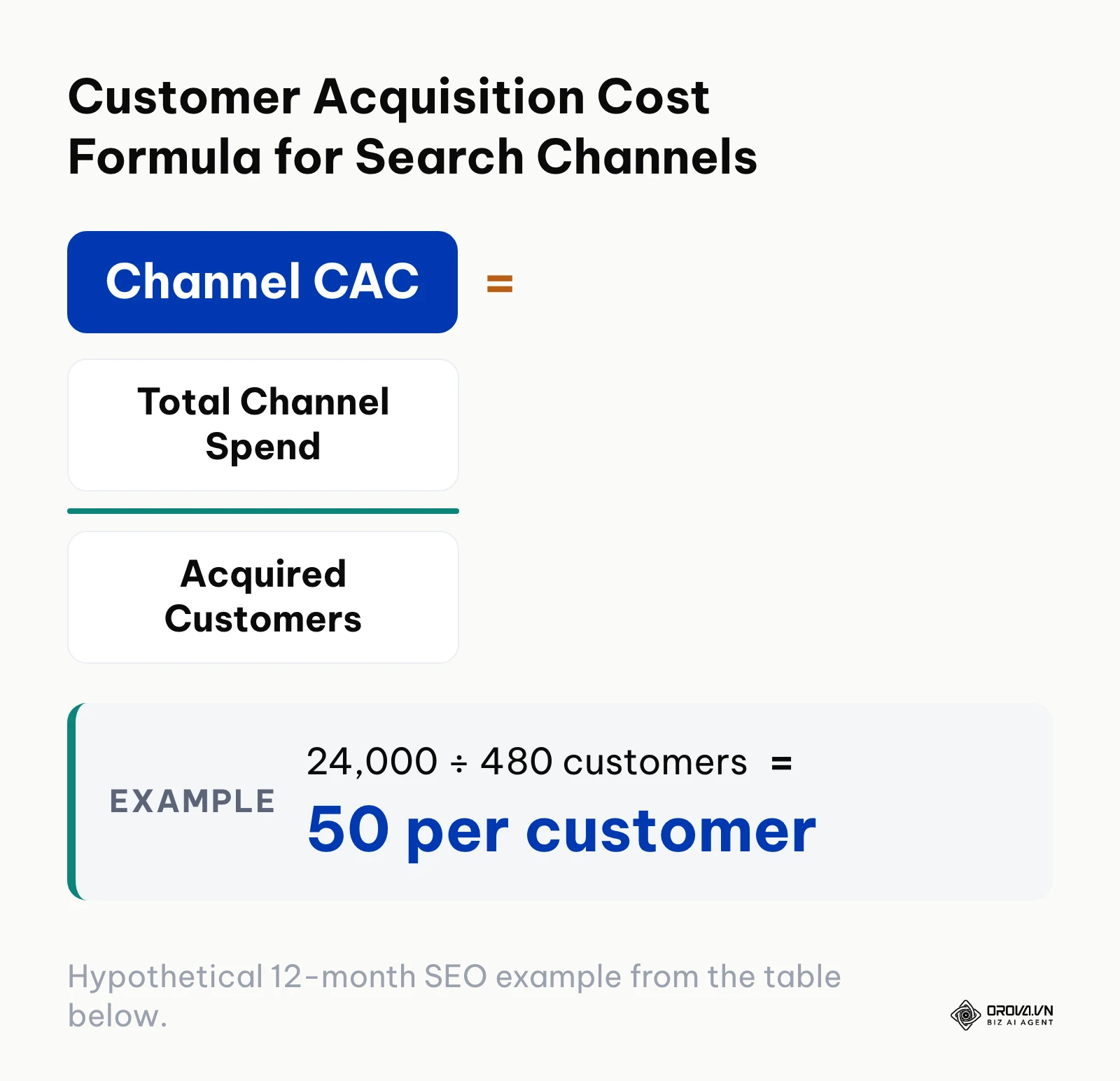
The diagram below summarizes the formula used to calculate blended customer acquisition costs across both acquisition channels.
The mathematical cross-over point where organic acquisition becomes more capital-efficient than paid search advertising is a predictable operational milestone.
Hypothetical example: to illustrate this transition, consider a B2B software company operating with an acquisition budget of 2,000 dollars per month across a 12-month evaluation horizon. In this scenario, the company compares deploying the entire 2,000 dollars monthly allocation into paid search versus investing that same 2,000 dollars monthly budget into technical SEO, content architecture, and authority building. For this model, we assume a search advertising cost-per-click of 1.80 dollars and a consistent visitor-to-customer conversion rate of 2.0% across both channels.
The 12-month financial comparison below tracks monthly spend, traffic volume, customer conversions, and the resulting cumulative Customer Acquisition Cost (CAC: total spend to date divided by total customers to date) for both approaches. All figures are assumptions for illustration, not benchmarks.
| Month | SEM Monthly Spend (dollars) | SEM Monthly Clicks | SEM Monthly Customers | Cumulative SEM CAC (dollars) | SEO Monthly Spend (dollars) | SEO Monthly Clicks | SEO Monthly Customers | Cumulative SEO CAC (dollars) |
|---|---|---|---|---|---|---|---|---|
| M1 | 2,000 | 1,111 | 22 | 90.91 | 2,000 | 30 | 0 | Undefined |
| M2 | 2,000 | 1,111 | 22 | 90.91 | 2,000 | 75 | 1 | 4,000.00 |
| M3 | 2,000 | 1,111 | 22 | 90.91 | 2,000 | 180 | 3 | 1,500.00 |
| M4 | 2,000 | 1,111 | 22 | 90.91 | 2,000 | 390 | 7 | 727.27 |
| M5 | 2,000 | 1,111 | 22 | 90.91 | 2,000 | 720 | 14 | 400.00 |
| M6 | 2,000 | 1,111 | 22 | 90.91 | 2,000 | 1,150 | 23 | 250.00 |
| M7 | 2,000 | 1,111 | 22 | 90.91 | 2,000 | 1,680 | 33 | 172.84 |
| M8 | 2,000 | 1,111 | 22 | 90.91 | 2,000 | 2,300 | 46 | 125.98 |
| M9 | 2,000 | 1,111 | 22 | 90.91 | 2,000 | 3,100 | 62 | 95.24 |
| M10 | 2,000 | 1,111 | 22 | 90.91 | 2,000 | 3,950 | 79 | 74.63 |
| M11 | 2,000 | 1,111 | 22 | 90.91 | 2,000 | 4,800 | 96 | 60.44 |
| M12 | 2,000 | 1,111 | 22 | 90.91 | 2,000 | 5,800 | 116 | 50.00 |
During the initial four months, paid search appears vastly superior from a capital return perspective. By month three, SEM has delivered 66 customers at a steady CAC of 90.91 dollars, while SEO has generated only four customers, yielding an alarming cumulative acquisition cost of 1,500 dollars per customer.
However, month six marks the operational break-even threshold: it is the first month in which organic acquires customers more cheaply than paid (2,000 dollars for 23 customers, about 86.96 dollars each, versus 90.91 dollars). The cumulative figure lags behind; at month nine it is still 95.24 dollars, and only in month ten does the cumulative organic CAC (74.63 dollars) overtake paid search. In month twelve, the organic channel generates 116 customers from the same baseline 2,000 dollars monthly investment, bringing the cumulative organic acquisition cost down to 50.00 dollars. Accurate financial forecasting requires measuring organic SEO ROI across multi-quarter windows rather than 30-day reporting cycles.
Hypothetical example: A mid-market logistics consultancy with four sales consultants decided to transition from pure pay-per-click advertising to an integrated search model. The operational team performed three specific steps: they audited their historical CRM opportunities to isolate 14 high-margin search topics, reallocated 1,800 dollars of their 5,000 dollars monthly advertising budget toward technical site remediation, and published eight comprehensive service guides. During month two, lead volume dropped by 18% because paid click volume had decreased before organic pages indexed, prompting executive pressure to restore the full ad budget. The team held course by building direct internal links from their highest-authority pages to their new service guides. By month seven, organic inquiries outpaced previous paid lead volume, establishing a steady pipeline of enterprise quote requests while maintaining the reduced ad spend.
In financial terms, SEM wins decisively for businesses requiring cash conversion inside 90 days, while SEO wins decisively for organizations with six or more months of capital runway seeking permanent unit-economic leverage.
Speed to Results and Predictability: How SEO and SEM Deliver Traffic
The primary advantage of paid search marketing is temporal velocity and traffic predictability. A marketer can configure a Google Ads account at 9:00 AM, construct high-intent search ad copy by lunch, establish landing page tracking parameters, and record qualified visitors and conversion actions by mid-afternoon. If an executive demands 500 visitors this weekend to test a pricing adjustment, SEM provides the mechanical levers to fulfill that requirement.
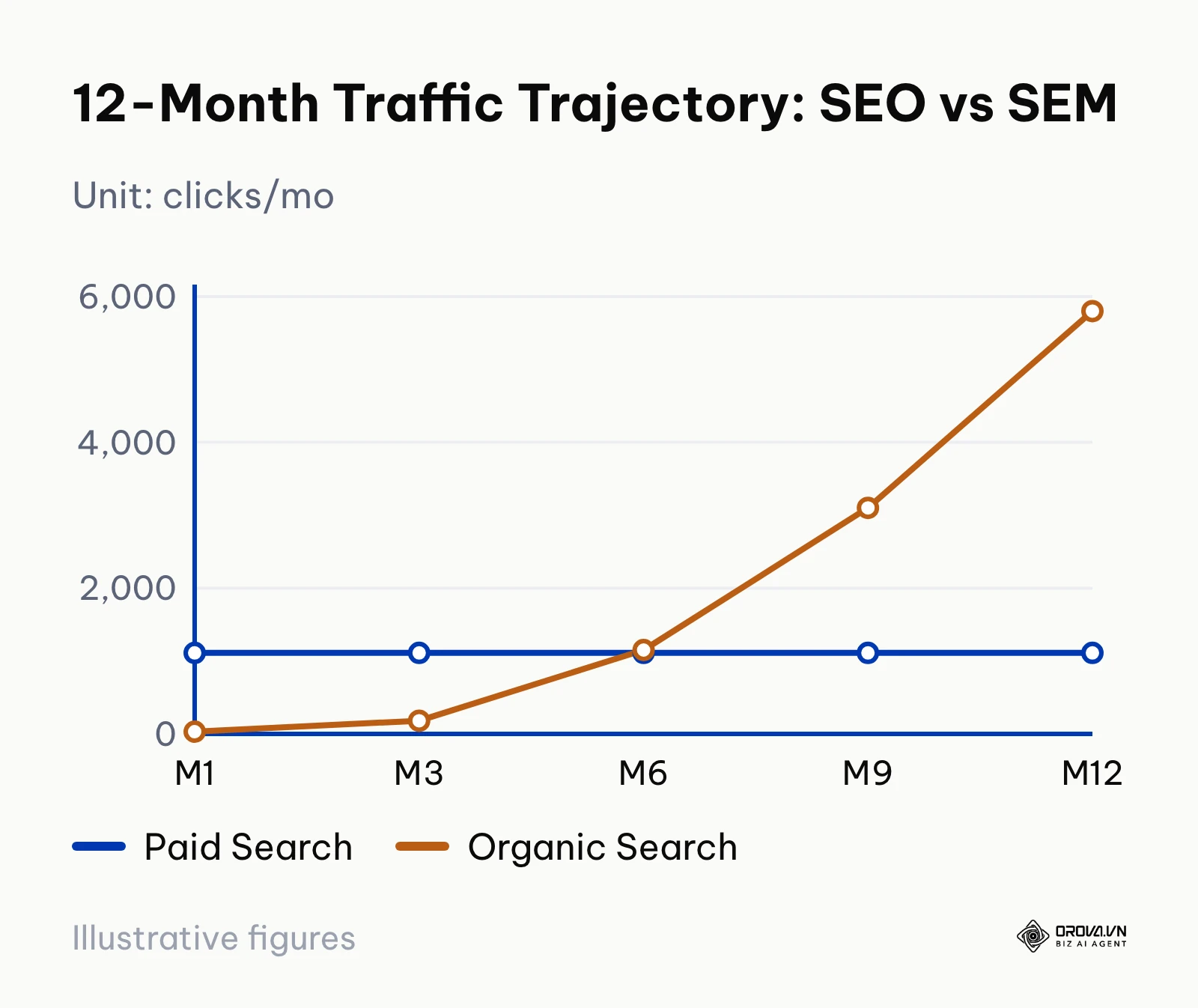
The diagram below summarizes the contrasting traffic development timelines between immediate paid clicks and compounding organic search growth.
Organic search optimization functions on algorithmic evaluation cycles outside your immediate control. When new content publishes, search engine spiders must discover the URL, render technical assets, interpret semantic relationships, evaluate domain trust, and test user engagement over weeks or months. While paid campaigns allow advertisers to purchase guaranteed traffic at known conversion rates, organic search schedules remain fluid.
For businesses launching time-sensitive promotions, event ticketing, or seasonal inventory clear-outs, SEO is structurally incapable of delivering visibility before the business opportunity expires. Conversely, organizations relying solely on paid channels suffer immediate revenue interruption if credit card authorizations fail or ad accounts face review suspensions.
SEM wins unequivocally on time-to-market speed and throughput predictability; SEO offers superior durability once ranking momentum is established.
SERP Real Estate and Click-Through Rates in the Age of AI Overviews
Search engine result pages (SERPs) have undergone profound spatial restructuring. Historically, organic search results captured the overwhelming majority of above-the-fold visual attention. As of 2026, the proliferation of paid shopping carousels, expandable sponsored listings, localized map packs, and algorithmic answer engines has compressed traditional organic click distributions.
According to Google's Google Search Central Documentation: AI Overviews and Your Website (2024), AI-generated summaries synthesize top-ranking web documents directly onto the results page, fundamentally reshaping organic visibility. When an AI Overview triggers for an informational search query, it occupies the dominant screen space above traditional blue links, pushing organic results below the fold on desktop and mobile screens alike.
Findings from SparkToro's 2024 Zero-Click Search Study demonstrate that 58.5% of mobile searches and 59.7% of desktop queries terminate without a click to an external website, increasing pressure on top-of-page real estate. This zero-click trend affects search channels differently:
- Impact on SEO Click-Through Rates: Organic rankings at positions one through three for broad informational terms face significant click attrition because searchers read synthesized AI answers without clicking source links. However, websites cited as reference cards within the AI summary capture qualified, high-intent traffic from users seeking comprehensive source material. Understanding balancing GEO vs SEO priorities is now essential to maintaining brand visibility across both AI answer modules and standard organic rankings.
- Impact on SEM Positioning: Sponsored search advertisements maintain resilient visibility because auction formats adapt to SERP real estate shifts. Google frequently positions sponsored links directly adjacent to or immediately preceding generative overviews for commercial queries, preserving high visual prominence.
The table below is a hypothetical example of how click share can divide across SERP elements; the ranges are illustrative assumptions, not measured benchmarks, and vary widely by query.
| SERP Element | Typical Visual Placement | Illustrative Desktop Click Share | Vulnerability to AI Overviews |
|---|---|---|---|
| Top Sponsored Ads (SEM) | Absolute top of page | 15% to 30% on commercial terms | Low (displayed above or within AI modules) |
| Google AI Overview | Directly below ads, above organic | Absorbs 40% to 60% of quick informational intent | Not applicable (it is the generative module) |
| Local Map Pack | Mid-page for geo-specific queries | 25% to 35% on local searches | Moderate (AI frequently incorporates local data) |
| Position 1 Organic (SEO) | Below AI Overviews and ads | Dropped from historical 30%+ to 12%-18% | High on informational queries; Low on brand queries |
| Positions 4-10 Organic | Bottom of page | Under 5% cumulative click share | Extreme (rarely viewed on mobile devices) |
SEM maintains an advantage in securing immediate visual prominence for high-stakes commercial queries; SEO wins when content achieves inclusion as trusted informational source citations within AI Overviews.
Discover Orova.vn – a Biz AI Agent platform with OROVA SEO, a complete solution for every website. The system supports search engine optimization from A to Z with features including keyword research, writing new SEO-ready articles, optimizing existing content, rank tracking, plus competitor analysis and in-depth technical analysis. Sign up today to experience OROVA SEO completely free (offer valid through July 7, 2027).
Search Intent Alignment: How Keyword Targeting Differs
Keyword targeting without strict classification creates budget waste. Allocating paid search budget to high-volume informational queries like "what is enterprise resource planning" burns capital on searchers seeking educational definitions without purchase intent. Conversely, relying solely on organic search for urgent transactional queries like "emergency plumbing repair near me" risks losing prospects to competitors purchasing sponsored top spots.
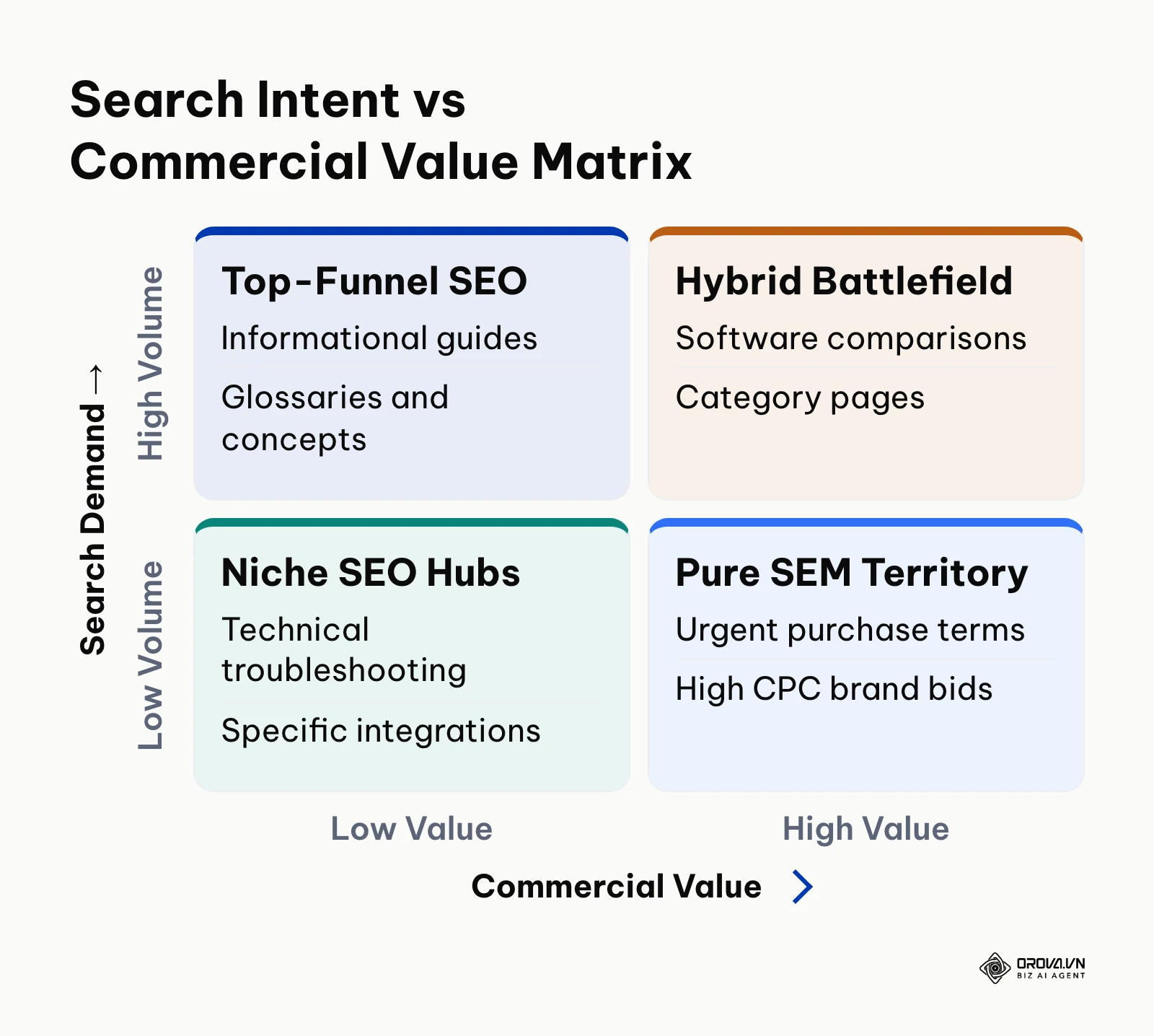
The diagram below summarizes how keyword opportunities plot across search demand and commercial value to determine channel allocation.
To prevent misallocation, search queries must be segmented across four distinct intent categories, balancing search volume against auction cost-per-click.
The decision matrix below establishes clear operational rules for routing search queries to the appropriate search channel (CPC ranges are hypothetical examples; check Keyword Planner for your own market).
| Search Intent Group | Typical Keyword Patterns | Illustrative CPC Range | Primary Channel Assignment | Operational Action |
|---|---|---|---|---|
| Informational | "how to...", "what is...", "guide", "examples" | Low (0.30 to 1.50 dollars) | Pure SEO | Build comprehensive editorial guides, structured glossaries, and topical hub pages. |
| Navigational | "[Brand name]", "[Product] login", "[Platform] portal" | Moderate (1.00 to 3.50 dollars) | Hybrid (Defensive) | Rank #1 organically; deploy exact-match SEM ads only if competitors bid on your brand terms. |
| Commercial Investigation | "best...", "[Brand A] vs [Brand B]", "reviews", "pricing" | High (3.00 to 8.00 dollars) | Shared SEO & SEM | Run paid ads on high-margin comparisons while building objective organic comparison assets. |
| Transactional | "buy...", "hire...", "demo", "trial", "service near me" | Very High (5.00 to 25.00+ dollars) | Pure SEM | Direct traffic to tightly optimized, high-converting landing pages with direct sales offers. |
Hypothetical example: An enterprise cybersecurity firm offering compliance automation software was spending 12,000 dollars monthly on Google Ads. The marketing specialist conducted an intent audit: they extracted their last 180 days of search query data, categorized search terms by commercial intent, and reviewed their Google Search Console landing page coverage. They discovered that 42% of their paid ad spend was being consumed by broad queries like "soc 2 certification requirements checklist," which had a high cost-per-click but a low demo booking rate. The team paused paid ad groups targeting those informational phrases and created a comprehensive, ungated technical guide targeting that specific topic organically. The freed advertising capital was redirected into high-intent transactional search keywords like "automated soc 2 compliance software demo." Within five months, the organic guide ranked on page one, generating steady top-of-funnel leads at zero marginal cost, while the reallocated paid search budget produced a visible increase in sales demo bookings.
SEM wins decisively for transactional queries requiring immediate commercial conversion; SEO wins decisively for informational discovery and category education.
Asset Longevity and Compounding ROI: What Happens When the Budget Stops
The most profound operational distinction between organic and paid search is the residual value of the investment. Pay-per-click search advertising is a cash-for-traffic transaction. When your daily media budget exhausts or your campaign pauses, your web presence vanishes instantly from search results. Traffic drops to zero, lead flow terminates, and no residual brand equity remains within the advertising platform.
Search engine optimization functions as capital expenditure that constructs long-lasting digital assets. An in-depth technical analysis, an interactive calculation tool, or an authoritative market guide retains its indexed ranking for months or years after publication. Maintaining high-performing organic assets requires periodic updates and technical maintenance, but does not require paying a fee each time a prospective customer clicks your link.
Integrating search activities into a structured SaaS SEO funnel transforms standard content into an evergreen acquisition asset that supports pipeline generation through multiple quarters. When an economic contraction forces marketing budget reductions, an organization with established organic rankings preserves its inbound lead generation baseline. An organization dependent solely on paid search faces an immediate collapse in customer acquisition the moment paid campaigns halt.
SEO wins decisively on balance-sheet asset creation and compounding return on investment; SEM provides temporary market access without equity retention.
When to Choose SEO
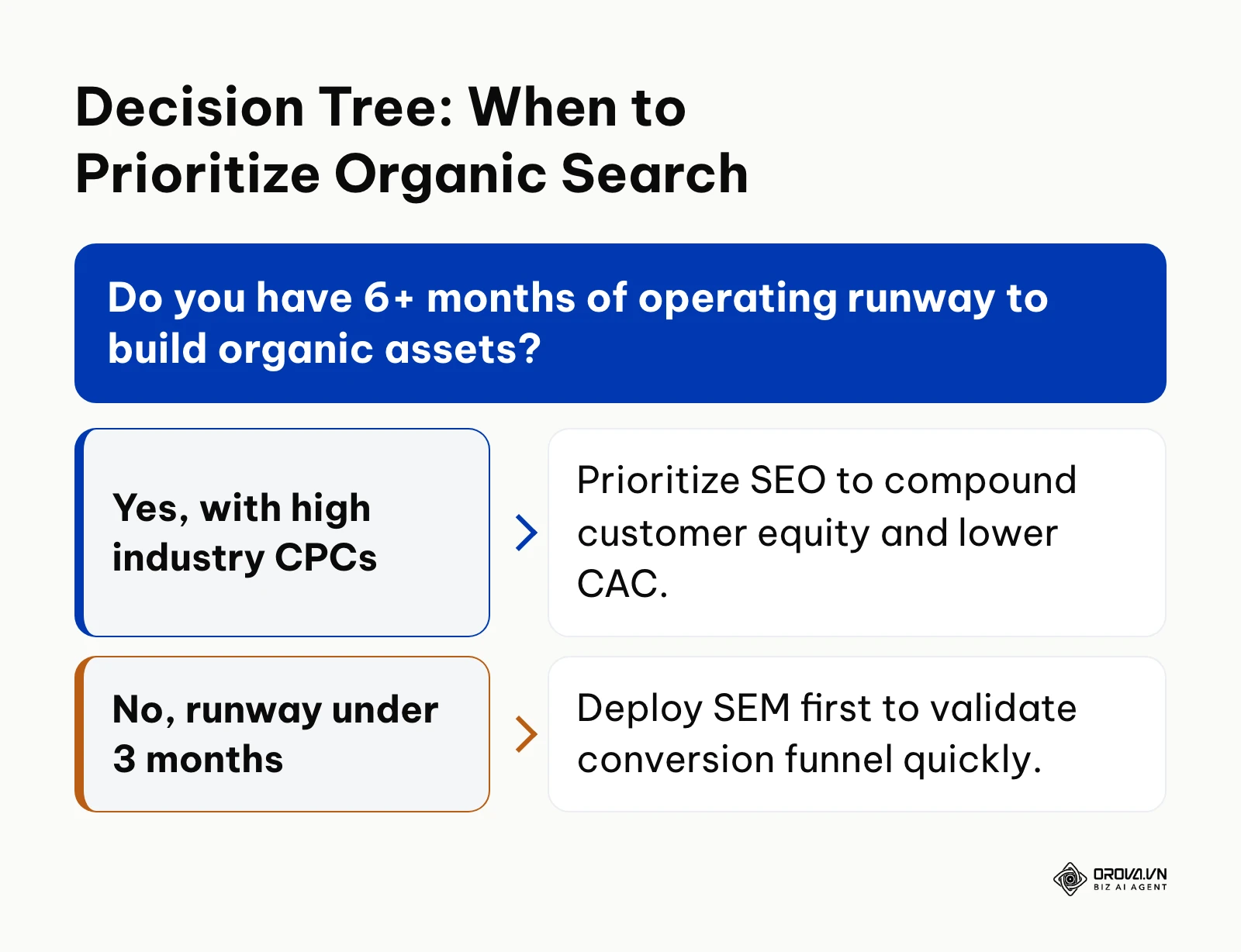
Prioritizing organic search optimization is the correct strategic path when specific organizational conditions and business models align with long-term asset building:
- High-volume informational market demand: Your prospective customers perform extensive research across the buying journey, requiring educational articles, process explanations, and evaluation criteria before selecting a vendor.
- Prohibitive commercial advertising costs: Your industry features hyper-competitive cost-per-click rates (often the case in legal, enterprise software, and commercial insurance), making paid search unsustainable without massive customer lifetime values.
- Sufficient capital runway: Your business maintains at least six to twelve months of operating capital to support content production, technical optimization, and backlink development before requiring organic revenue contributions.
- In-house editorial and subject matter expertise: You possess domain specialists capable of authoring differentiated, authoritative content that satisfies search engine quality standards and user expectations.
The diagram below outlines the core decision points for determining whether your organization should focus resources on organic search development.
When these conditions exist, building organic search dominance insulates your operating margins from recurring media inflation.
When to Choose SEM
Allocating resources toward paid search engine marketing is the preferred strategic move when immediate commercial execution is required:
- Urgent customer acquisition requirements: You are launching a new product, validating product-market fit, or operating under strict investor milestones that demand verified revenue within 30 to 60 days.
- High-urgency transactional service offerings: Your business delivers emergency services, localized physical repairs, or impulse purchases where consumers click the top sponsored link and convert immediately.
- Limited organic domain authority: Your website is brand new with a low authority footprint, meaning competitive organic keywords will require up to a year of backlink acquisition before achieving first-page rankings.
- Precise conversion testing and message refinement: You need to split-test sales copy, value propositions, and landing page conversion funnels with clean, segmented traffic before committing resources to permanent organic content architecture.
The quick reference below maps common business situations to the channel that should lead.
| Situation | Lead channel | Why |
|---|---|---|
| New offer, no conversion data yet | SEM | Validates demand and messaging in days |
| Seasonal promotion or event with a fixed end date | SEM | Organic rankings arrive after the window closes |
| High-CPC industry with six or more months of runway | SEO | Lowers acquisition cost as content compounds |
| Buyers research for weeks before contacting a vendor | SEO | Informational queries rarely justify paid clicks |
| Proven paid keywords you already rank 8 to 30 for organically | Both | Use paid data to pick the next organic pages |
Executing a disciplined paid search campaign under these circumstances delivers immediate market intelligence and cash flow that organic efforts cannot match in the short term.
Can You Use Both SEO and SEM Together?
Deploying search engine optimization and search engine marketing in concert delivers competitive advantages that neither channel achieves in isolation. The primary failure mode for growing businesses is managing SEO and SEM as isolated departments with separate reporting lines, divergent agency retainers, and siloed data repositories.
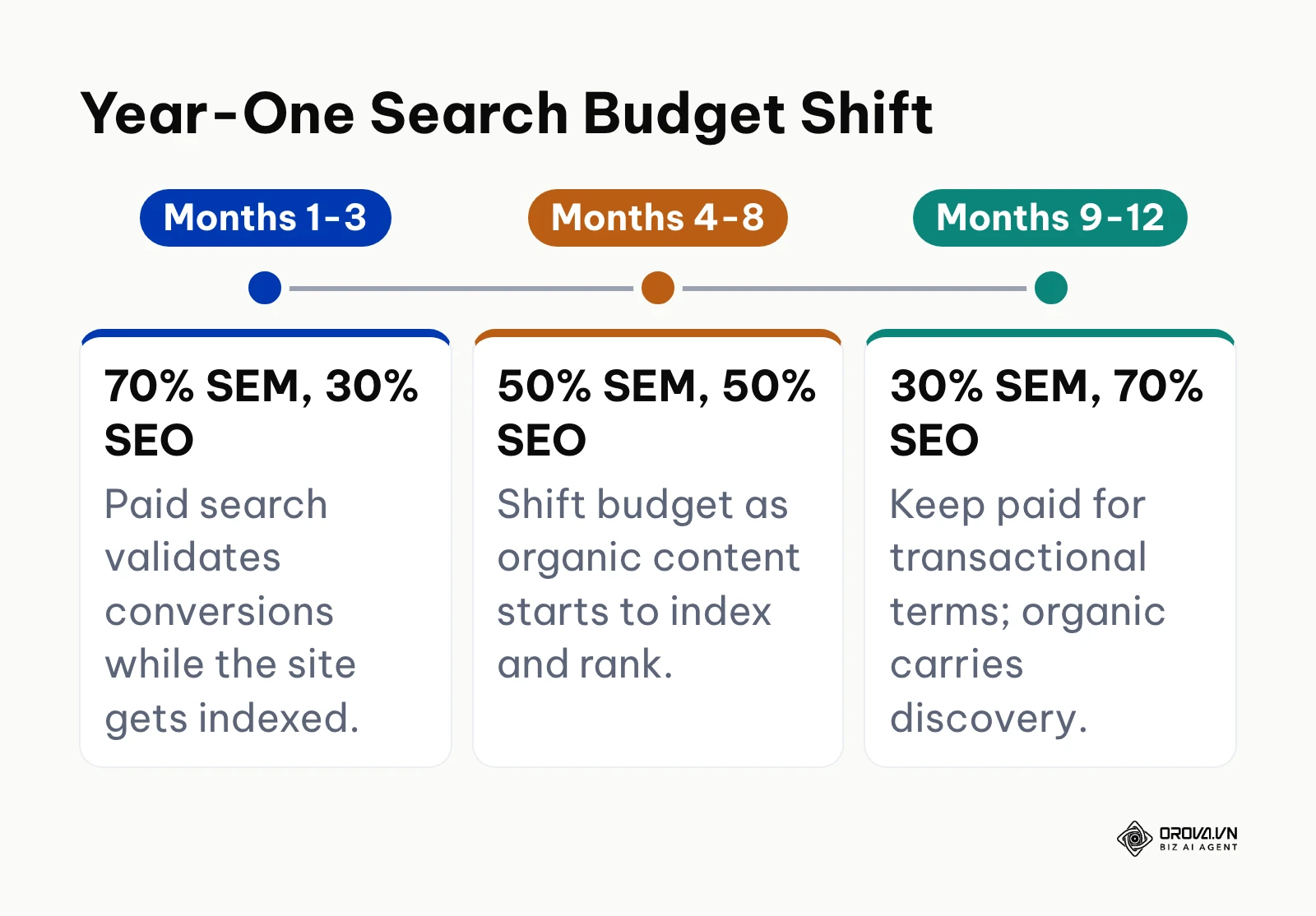
The diagram below illustrates how an organization can rebalance its search budget over the first twelve months of an integrated campaign.
Integrating both channels creates an operating flywheel where paid advertising data de-risks organic editorial investments, while organic authority reduces reliance on high-cost paid search terms.
A recurring operational concern for marketing leaders is keyword cannibalization: does bidding on a branded or commercial term where your domain already ranks number one organically waste advertising budget? Bidding on your own high-intent branded queries captures incremental clicks that would otherwise leak to competitor ads placed above your organic listing. However, for non-branded commercial terms, running paid ads alongside a number-one organic position often yields diminishing returns. To verify true incrementality, marketing teams should employ a multi-touch attribution model to evaluate whether combined listings produce higher overall net revenue.
How to Mine High-Converting Queries from Google Ads into SEO Content
The most profitable synergy between both channels is using Google Ads as a rapid testing sandbox to discover proven conversion keywords before investing in long-form organic content development.
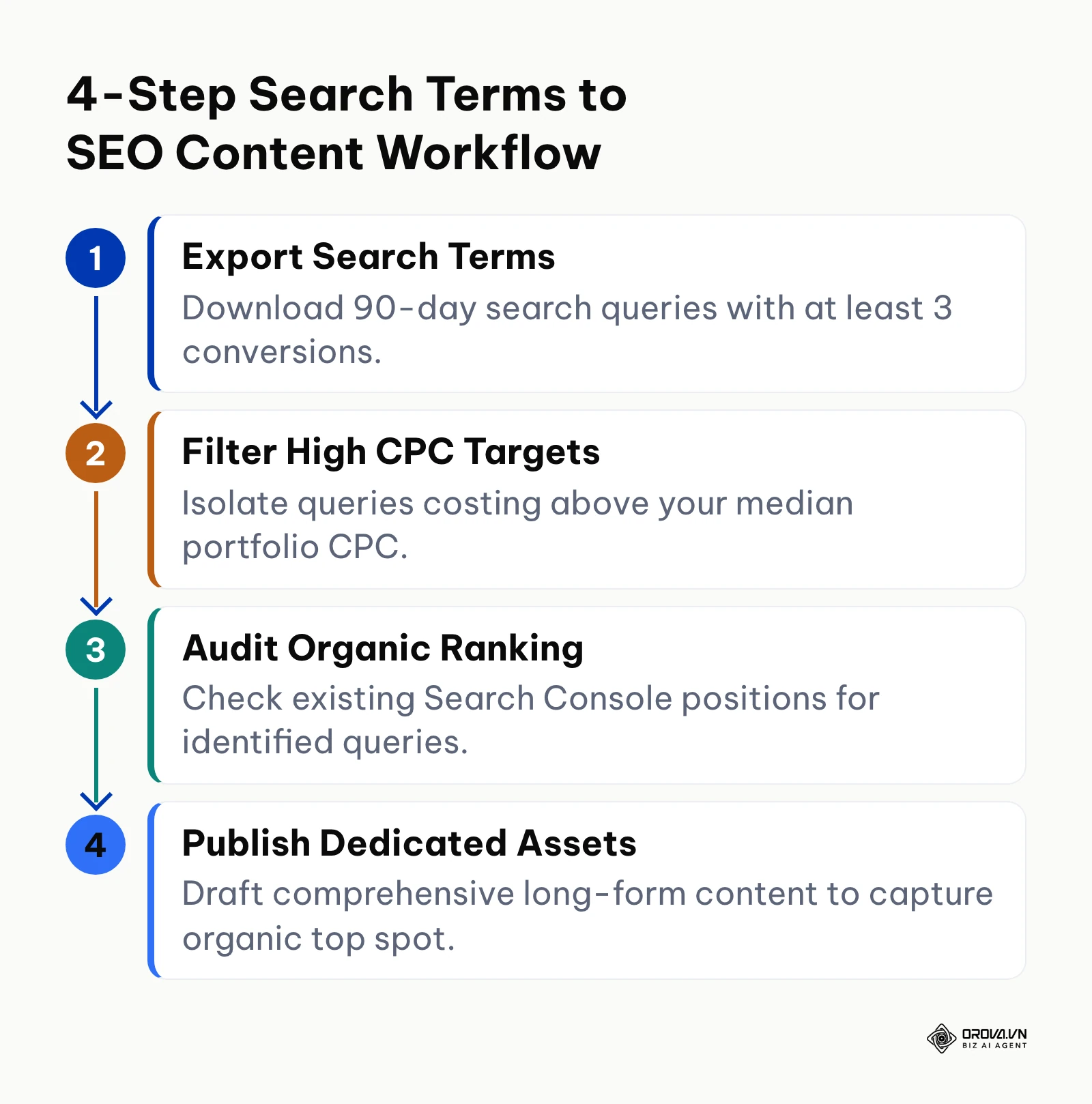
The workflow diagram below outlines the sequential 4-step process for extracting high-converting search queries and turning them into organic assets.
Follow this systematic 4-step workflow to operationalize paid search data for organic publishing:
- Export the Search Terms report from Google Ads: Navigate to your active search campaigns, select the Search Terms report (which displays the actual user queries triggering your ads, rather than your targeted keywords), and set a 90-day historical window. Filter the report for search queries that generated at least three verified conversions.
- Filter by high-cost and high-intent thresholds: Sort the exported queries by average cost-per-click in descending order. Identify terms with above-average conversion rates where you are spending substantial media budget every week to maintain visibility.
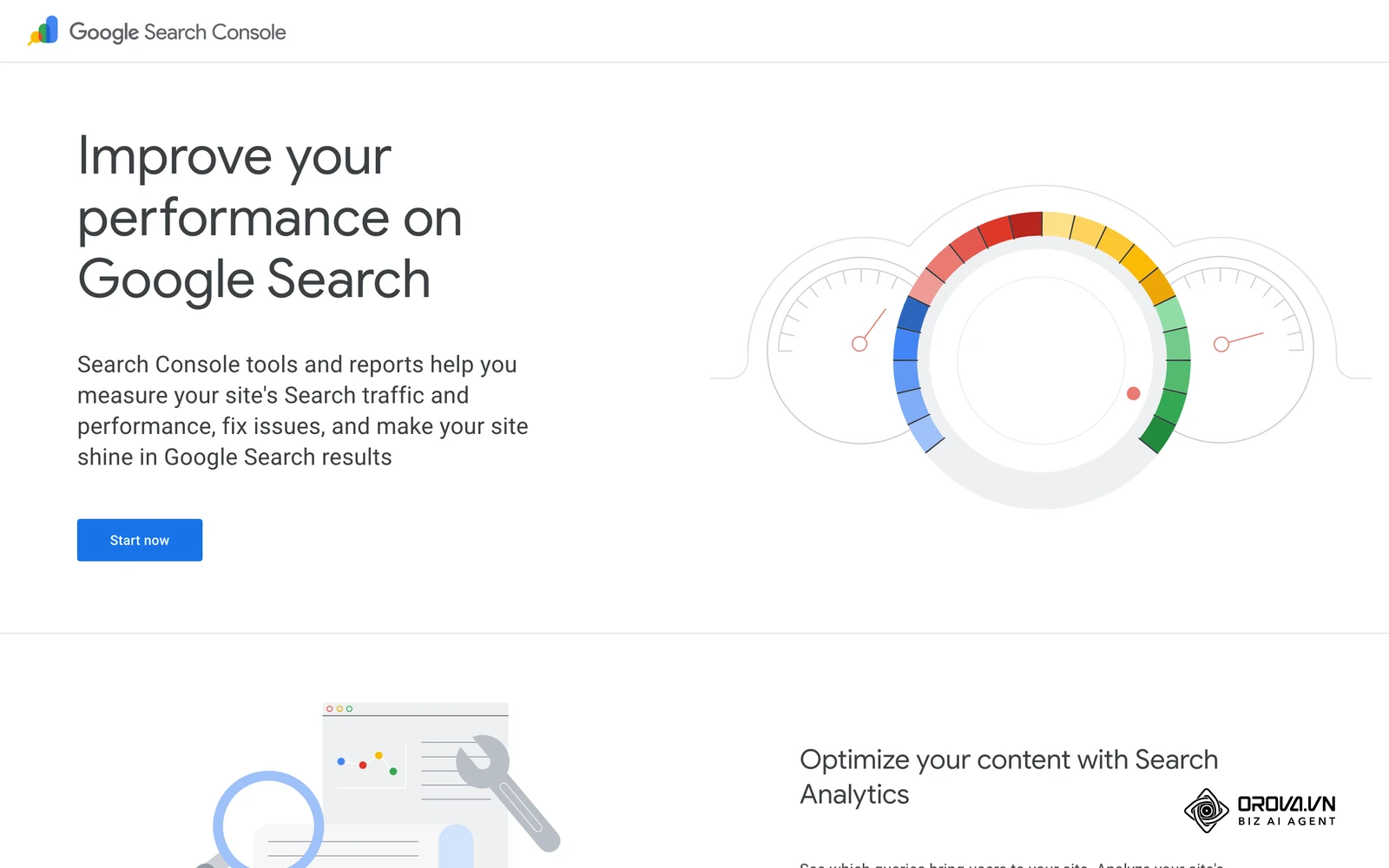
- Cross-reference existing organic rankings in Google Search Console: Check where your domain currently ranks organically for each high-cost, high-converting query. Highlight queries where your domain ranks between positions eight and thirty (pages two and three of Google search results).
- Produce targeted long-form organic content: Create dedicated, comprehensive content tailored precisely to the search intent of those queries. Once your new organic asset ranks in the top three organic positions, you can reduce your paid search bids on those specific terms, reallocating advertising dollars to new testing grounds while retaining customer conversions at zero marginal cost per click.
Hypothetical example: An online education provider selling enterprise management training courses was spending 8,500 dollars per month on Google Search campaigns. The digital marketing manager executed the following steps: they exported the 90-day Search Terms report, isolated 23 specific search queries related to "scrum master certification study guide" that had produced 48 paid course sign-ups at an expensive CPC of 6.20 dollars, and cross-referenced their Google Search Console data. The analysis revealed that their domain had no dedicated page targeting this phrase, ranking on page four purely through a passing mention on a broad course catalogue page. When the team published a comprehensive 3,500-word study guide and practice exam page, the initial indexing was delayed because the page lacked internal links from relevant blog posts. The team resolved this by adding contextual links from five established project management articles. Within twelve weeks, the dedicated guide attained organic position two on Google, generating over 1,200 monthly visits and steady course purchases, allowing the team to pause the expensive paid ad group and save over 1,400 dollars monthly in ad spend.
To execute this integrated workflow without technical complexity, Orova SEO streamlines the entire organic production loop. The platform connects directly with your Google Search Console and incorporates Google Keyword Planner data when your Google Ads account is linked, uncovering golden keyword opportunities positioned between ranks 8 and 30. Its AI writing engine crafts in-depth, multi-round articles containing relevant visuals, embeds internal links, and publishes directly to WordPress via Application Password, enabling teams to transform paid keyword insights into organic search assets within a single workspace.
With OROVA.VN and the OROVA SEO module, you put an end to the exhausting days of manual work for good. Instead of struggling for hours to write articles and compile reports, the entire process is now optimized and completed in just 5 minutes.
Future Trends in SEO and SEM: Author's Perspective
Looking at the search marketing landscape as of 2026, the convergence between paid and organic discovery is accelerating rapidly. The lines separating algorithmic crawling from paid ad auctions are blurring under the weight of generative artificial intelligence and shifting consumer browsing habits.
AI Search Engines and the Shift to Generative Visibility
In my view, traditional click-through volume for top-of-funnel informational queries will continue to decline over the next two to three years as conversational answer engines satisfy user intent directly within the search interface. I believe search engine optimization will split into two distinct specializations: Generative Engine Optimization (GEO), focused on positioning brand entities and research data as primary citation sources for AI models, and Technical Conversion Architecture, focused on capturing bottom-of-funnel users ready to transact. I lean towards advising marketers to stop producing shallow definitional content; instead, publish original research, proprietary datasets, and verified case studies that AI models must cite as primary authorities. What could invalidate this assessment is if major search engines face copyright litigation that forces them to restore prominent outbound link mechanics within generative interfaces.
Auction Inflation and the Death of Low-Margin Paid Search
I expect search advertising cost-per-click rates across competitive industries to keep climbing before they stabilize, driven by automated bidding algorithms maximizing network revenue. In my opinion, businesses operating with customer lifetime values under 500 dollars will find standalone search advertising economically unfeasible on non-branded commercial keywords. I believe companies must adapt now by building strong first-party data capture systems, email nurture sequences, and retention mechanics to elevate customer lifetime value above rising acquisition thresholds. Marketers who rely on immediate same-session purchase margins to fund paid search campaigns will likely be priced out of the auction by enterprise competitors with multi-year monetization models. If macroeconomic conditions trigger widespread marketing budget cuts that lower bidding density, this cost inflation could temporarily reverse.
Autonomous Data Syndication Between Paid and Organic Channels
According to my assessment, the practice of manually comparing Google Ads search term spreadsheets with Google Search Console reports will largely disappear within the next three years. I believe autonomous marketing software will automatically detect when a paid search keyword demonstrates reliable conversion metrics, immediately commission and publish an authoritative organic landing page, monitor its indexing progress, and dynamically throttle paid search bidding as organic rankings ascend. Marketers should prepare today by centralizing their search data infrastructure, auditing site architecture, and breaking down organizational silos separating paid media teams from organic content creators. If search platforms restrict query-level reporting data under the guise of user privacy protections, fully automated cross-channel data syndication could become significantly more difficult to implement.
Frequently Asked Questions About SEO and SEM
Does bidding on keywords where you already rank #1 organically waste ad budget?
Bidding on keywords where you hold the top organic position is not necessarily wasteful, especially for branded search queries. If aggressive competitors bid on your brand terms, running paid ads ensures your business captures the absolute top visual space on the page, preventing customer deflection. For non-branded commercial terms, however, running simultaneous paid ads often produces marginal returns; you should conduct incrementality tests by pausing the paid ad group for two weeks to determine if total conversion volume remains stable through your number-one organic listing alone.
How should you split your budget between SEO and SEM during your first year?
During the first three months of launching a search strategy, allocate approximately 70% of your search budget to SEM and 30% to foundational SEO setup. This initial paid focus validates customer conversion rates, identifies winning keyword phrases, and generates immediate revenue while your site establishes technical indexation. Between months four and eight, shift toward a 50/50 allocation as organic content begins indexing. By months nine through twelve, move to a 30% SEM and 70% SEO split, preserving paid ads primarily for high-converting transactional terms while organic search carries top-of-funnel discovery.
How does Google AI Overviews impact organic CTR compared to paid search ads?
Google AI Overviews compress organic click-through rates significantly on informational searches by providing direct on-page answers, which can sharply reduce traditional position-one clicks. Conversely, paid search ads retain resilient visibility because ad networks prioritize sponsored placements above or integrated cleanly around generative answer modules for commercial queries. To capture traffic in an AI Overview environment, organic content must be structured with clear semantic answers, factual tables, and unique data that search models extract and link as citation sources.
How can you find high-converting search queries in Google Ads to build SEO content?
Open your Google Ads campaign dashboard, navigate to Insights and Reports, and select the Search Terms report. Filter the query list to show terms that have produced at least three verified conversions over the prior 90 days. Export these search terms and isolate those with high conversion rates but expensive costs per click. Compare this list against your Google Search Console performance data to find queries where your domain ranks on page two or three, and create dedicated, authoritative organic articles targeting those specific topics.
What is the role of generative AI in balancing SEO and SEM campaigns?
Generative artificial intelligence accelerates both search channels by automating time-consuming research and execution workflows. In SEM, machine learning models optimize real-time bidding, assemble dynamic search ad variations, and test headline combinations across audience segments. In SEO, generative platforms assist with topic clustering, schema markup structuring, and initial draft generation. The primary operational risk is relying on automated AI text without human verification; sustainable search performance requires proprietary data, brand voice governance, and accurate technical insight that generic language models cannot replicate independently.
Where Should You Start?
Determining your immediate implementation priorities depends on the current maturity of your business and marketing infrastructure. Assess your organization against the following three operational situations to execute a single, high-impact action today.
If you run an early-stage company with a newly launched website and an unproven conversion funnel, do not spend months writing informational blog posts that will struggle to index without domain authority. Dedicate your first afternoon to configuring a tightly targeted Google Ads campaign covering exactly three high-intent transactional search queries, routing traffic to a streamlined landing page with active conversion tracking. This single test will validate whether search traffic converts into paying customers within 72 hours.
If you manage an established business with steady organic rankings that is spending thousands of dollars monthly on paid search without clear channel coordination, your immediate task is data consolidation. Open your Google Ads account, export the last 90 days of your Search Terms report, and highlight the top ten search queries consuming your advertising budget. Cross-reference those ten phrases against your Google Search Console queries; identifying overlapping targets will reveal which paid ad groups can be dialed back immediately because your organic pages already capture that commercial demand.
If you operate an established domain with strong technical authority but have relied exclusively on word-of-mouth or paid channels, unlock your existing latent search potential. Access your Google Search Console, filter your performance report for queries currently ranking in positions eight through twenty, and select three pages demonstrating high search impressions but low click-through rates. Spend three hours enriching those existing URLs with updated research, dedicated FAQ sections, and refined title tags to propel those pages onto page one of Google without building a single new URL.
By aligning your unit economics with the appropriate search channel today, you can master both seo and sem to build a compounding acquisition engine.
About the author

Builder of Orova
Nguyễn Đỗ Trọng Ân has 8 years of experience in marketing, including 6 years managing market development across Asia. He builds Orova, a Biz AI Agent that never sleeps: it plans, runs and optimizes work for businesses.
Run your business with AI Agents
Orova is the always-on Biz AI Agent — it plans, runs, and optimizes the work for you.
Save time, unlock productivity.