
Inclusive hiring practices: how to build a fair hiring process in 7 steps

Implementing inclusive hiring practices ensures your talent pipeline evaluates candidates on measurable competencies rather than unexamined pedigree or personal affinity. By the time you complete this guide, you will have an audit-ready recruitment workflow: a de-biased job description, an active blind screening protocol, a Behaviorally Anchored Rating Scale (BARS) interview rubric, and a mathematical verification model for your hiring funnel.
To execute this setup, you need access to your active job requisitions, an administrative seat in your applicant tracking system or a secure shared spreadsheet, and approximately four to six hours distributed across one working week. You do not need an enterprise budget or expensive consulting retainers. Organizations seeking symbolic diversity pledges or informal gut-feel shortcuts without operational rigor can skip this guide, as every step below requires procedural discipline and objective record-keeping.
Inclusive hiring practices: core framework and expected outcomes
Adopting inclusive hiring practices replaces subjective recruiter intuition with structured, verifiable evaluation milestones across the entire talent lifecycle. This seven-step operational framework takes four to six hours to configure for your first open requisition, producing an objective selection engine that widens qualified applicant reach, eliminates systemic screening filters, and withstands regulatory employment audits.
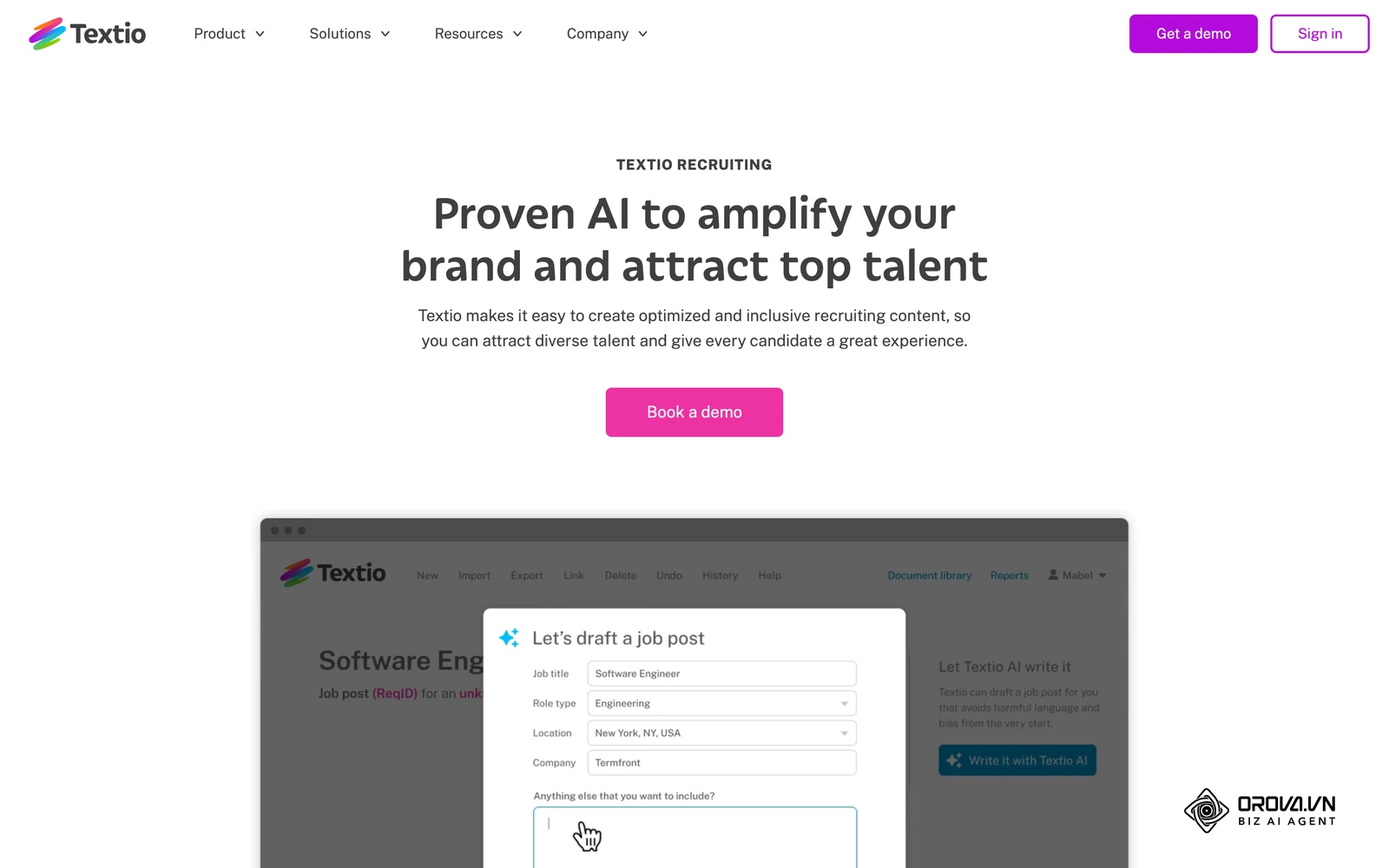
At its foundation, this methodology treats recruitment as a structured measurement science. When hiring teams rely on casual conversational interviews or informal resume browsing, cognitive shortcuts like affinity bias (favoring people similar to oneself) and halo effects (letting one positive trait overshadow relevant skill gaps) dictate hiring outcomes. Correspondence field experiments, in which researchers send otherwise identical resumes that differ only in demographic signals, have repeatedly found gaps in employer callback rates. Operationalizing inclusive hiring practices dismantles these systemic barriers by defining explicit performance rubrics before a single resume enters your pipeline.
Prerequisites before implementing inclusive hiring practices
Before adjusting active job postings or scheduling candidate interviews, your talent team must assemble foundational assets and secure specific operational permissions. The table below lists the prerequisite resources, where to locate them, and the failure modes that occur if you proceed without them.
| Required Asset | Source Location | Setup Time | Consequence if Missing |
|---|---|---|---|
| Core Competency Matrix | Role hiring manager and department lead | 60–90 minutes | Job descriptions retain inflated, irrelevant credential requirements |
| ATS Field Redaction Access | Systems administrator settings in your recruitment platform | 30 minutes | Reviewers see candidate names, schools, and dates, invalidating blind screening |
| Voluntary Demographic Survey | Standard Equal Employment Opportunity (EEO) template | 20 minutes | Inability to calculate stage conversion metrics or detect adverse impact |
| Calibrated Evaluation Panel | Cross-functional colleagues and trained interviewers | 45 minutes | Interviewers ask ad-hoc questions and evaluate candidates on personal rapport |
| Locked BARS Scoring Rubric | Shared document or ATS scorecard builder | 60 minutes | Subjective scoring leads to halo effects and inconsistent hiring debriefs |
Setting up these assets safeguards your hiring pipeline from common compliance pitfalls while ensuring candidate data remains confidential and secure throughout the selection process.
Step 1: Audit job descriptions using inclusive hiring practices
The objective of this step is to eliminate coded language, arbitrary educational thresholds, and physical assumptions from your job descriptions, replacing them with verifiable competency milestones.
Open your draft job requisition in your document editor or text analysis software. Begin by auditing the required qualifications section. Distinguish between non-negotiable core competencies (skills without which the employee cannot perform the day-to-day duties) and preferred attributes. Strip out rigid degree requirements unless mandated by legal licensing, and replace multi-year tenure demands with specific outcome capabilities. For instance, rather than asking for "8+ years of B2B SaaS sales experience," state "demonstrated track record of closing six-figure enterprise contracts with six-month sales cycles."
Next, audit the text for gendered wording and cultural idioms. Academic studies of gendered wording in job advertisements have found that heavily masculine-coded wording (such as "dominant," "aggressive," or "rockstar") can make a role feel less appealing to some applicants, whereas neutral, cooperative language tends to invite a broader cross-section of candidates.
The table below outlines twenty common exclusionary terms across gender, age, ability, and socioeconomic background, alongside their objective, competency-based replacements.
| Biased Term or Phrasing to Eliminate | Exclusion Barrier and Demographic Impact | Competency-Based Inclusive Alternative |
|---|---|---|
| Rockstar / Ninja | Coded masculine terminology; discourages collaborative contributors | High-performing subject matter specialist |
| Aggressive / Dominant | Discourages candidates from collaborative or modest cultural backgrounds | Resolute and goal-oriented under pressure |
| Crush the competition | Hyper-competitive language that alienates team-oriented applicants | Consistently achieve quarterly enterprise milestones |
| Nurturing / Supportive caretaker | Stereotypically feminine coding that can pigeonhole support roles | Facilitates cross-functional team alignment |
| Strong, decisive leader | Masculine leadership stereotype favoring extroverted styles | Makes documented, evidence-based team decisions |
| Digital native | Ageist phrasing excluding qualified applicants over forty | Proficient in modern cloud platforms and SaaS tools |
| Energetic go-getter | Implicit age bias signaling a preference for youthful stamina | Proactive contributor with proven task execution |
| Recent college graduate | Excludes older workers, career changers, and self-taught talent | Entry-level professional possessing foundational skills |
| Mature executive presence | Ageist proxy that penalizes younger or non-traditional leaders | Effective governance and executive communication |
| Fast-paced startup endurance | Signals potential burnout culture; deters caregivers and disabled talent | Prioritizes competing deadlines across shifting projects |
| Clean-cut appearance | Vague proxy that can disadvantage candidates with natural or cultural hairstyles | Professional presentation during client engagements |
| Native English speaker | Discriminates against multilingual talent with full professional fluency | Fluent professional written and spoken English skills |
| Top-tier university degree | Creates socioeconomic filter excluding self-taught or community college talent | Relevant degree or equivalent practical work experience |
| Unbroken career progression | Penalizes parents, caregivers, and those impacted by medical leaves | Demonstrated ability to deliver target project outcomes |
| Cultural fit / Beer test | Breeds affinity bias, leading teams to hire mirror images of themselves | Alignment with operating values and cultural contribution |
| Must lift 50 lbs (desk roles) | Arbitrary ableist filter irrelevant to software and office functions | Manages daily desktop equipment and work materials |
| Must hold driver's license | Excludes individuals with visual or mobility disabilities unnecessarily | Able to travel to designated client sites as required |
| Strong visual presentation skills | Can exclude visually impaired applicants from non-design functions | Communicates complex strategic findings clearly |
| Articulate communicator | Historically loaded term often applied patronizingly to minority groups | Delivers clear, structured technical explanations |
| Works well under high stress | Masks poor organizational scoping; deters neurodivergent applicants | Manages project delivery across defined sprint timelines |
A completed job description audit produces a clean, neutral requisition where every listed requirement correlates directly with on-the-job deliverables. When run through a language analyzer, the posting no longer flags coded terms, it lists a salary range where you are able to publish one, and it includes an explicit statement welcoming candidates from non-linear professional paths.
A frequent error during this step is replacing exclusionary jargon with vague corporate buzzwords that obscure role responsibilities. If you replace "fast-paced multitasker" with "dynamic agile synergist," candidates remain equally confused about actual role expectations. Resolve this by anchoring every requirement to a tangible deliverable, such as "maintains customer response times under two hours across three support channels."
Hypothetical example:
- Context: A 75-person logistics software firm sought a Lead Product Manager but saw zero female applicants over six weeks.
- Steps taken: The talent lead pasted the job description into a text analyzer, identified twelve masculine-coded words (including "command," "relentless," and "ninja"), removed an arbitrary computer science degree requirement, and restructured requirements around three 90-day deliverables.
- Stumbling block and fix: The engineering director initially resisted removing the computer science degree; the recruiter resolved this by adding a practical technical architecture review scenario to the interview stage instead.
- Observable outcome: Within fourteen days of reposting the neutral job description, qualified applications increased by 42 percent, and the finalist pool included two non-traditional candidates who advanced to final offers.
Step 2: Implement blind screening in your inclusive hiring practices
The objective of this step is to decouple candidate qualifications from demographic identifiers, ensuring that initial screening decisions rest entirely on demonstrable experience and skills.
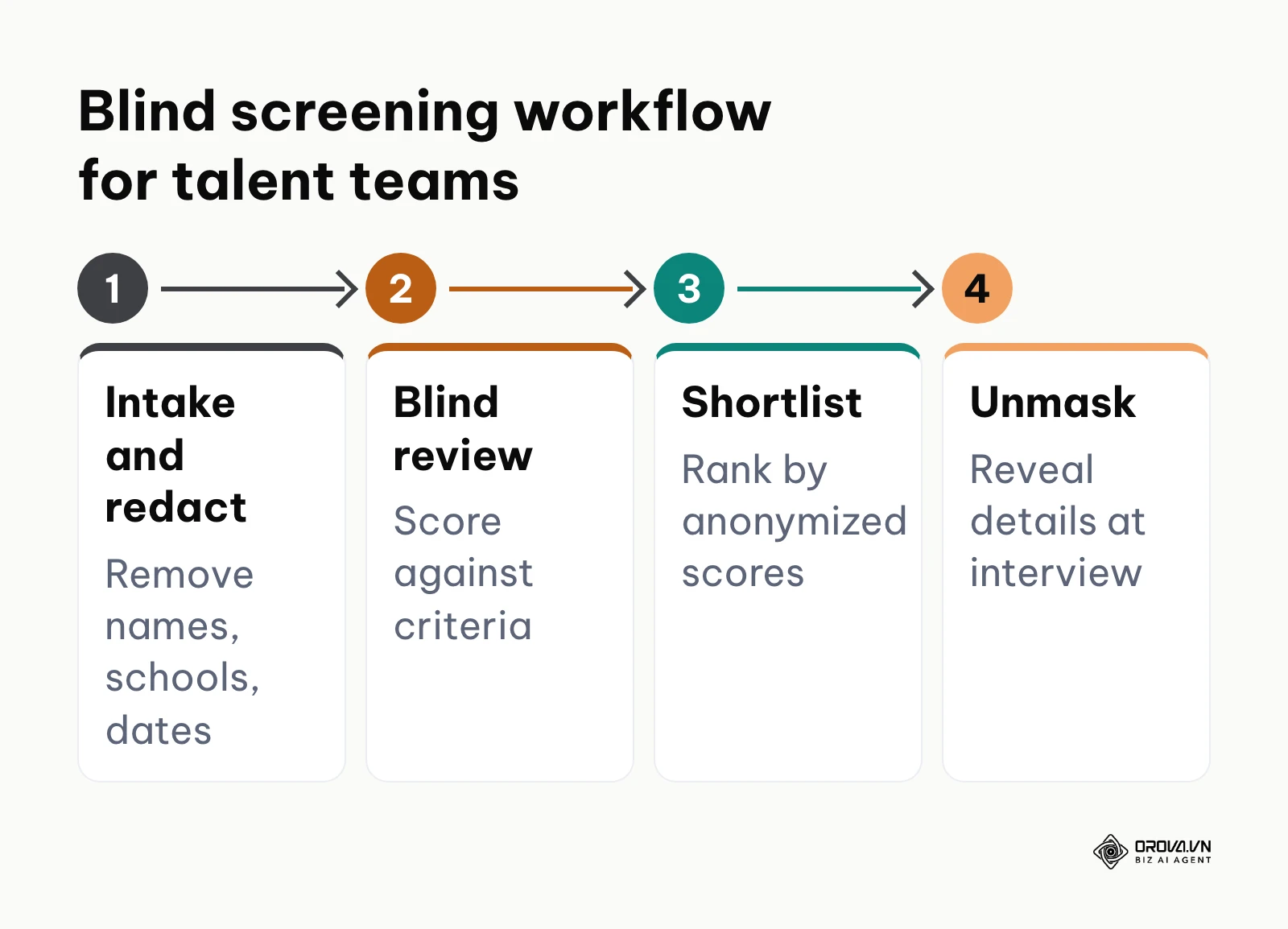
Navigate to the administration portal of your applicant tracking software. Locate the pipeline configuration menu for your target job requisition and select the resume screening settings. Enable automated field redaction. If your recruitment platform lacks an automated blind hiring toggle, establish a manual two-person workflow: a recruiting coordinator strips identifying data before handing the file to the hiring manager for evaluation.
The diagram below summarizes the four sequential phases of an effective blind screening pipeline.
Ensure your redaction rule covers the six fields in the table below.
| Field to redact | Bias it can trigger | What reviewers still see |
|---|---|---|
| Legal name and pronouns | Gender, ethnicity, and national-origin assumptions | Candidate ID number |
| Home address and postal code | Neighborhood and socioeconomic assumptions | Country or time zone only, if the role requires it |
| School names and graduation dates | Pedigree and age assumptions | Degree field, such as "B.S. in Mechanical Engineering" |
| Employer names for internships or entry-level roles | Personal-network and prestige signals | Role title, scope, and outcomes |
| Personal websites, headshots, and social profile links | Appearance and age assumptions | Work samples shared through a neutral link |
| Clubs, fraternity or sorority memberships, athletic teams | Affinity bias and class signals | Relevant skills gained, written neutrally |
The visual result of an effective blind screening configuration is an anonymized evaluation view. When a hiring manager opens a candidate file, they see a standardized skills summary, an employment chronology with redacted company brands, and answers to initial technical screening questions, completely devoid of demographic markers.
A common pitfall during blind screening is leaving personal contact details inside uploaded portfolio attachments or resume headers. PDF resumes often embed the candidate's name in file metadata or header blocks that bypass basic software redactions. To remedy this, establish a pre-flight checklist where the recruiting coordinator validates that all candidate attachments render as clean, anonymized text before routing them to reviewers.
Step 3: Establish accommodation protocols for inclusive hiring practices
The objective of this step is to build an equitable assessment process by providing reasonable accommodations to candidates with disabilities and neurodivergent needs without introducing social stigma or evaluation penalties.
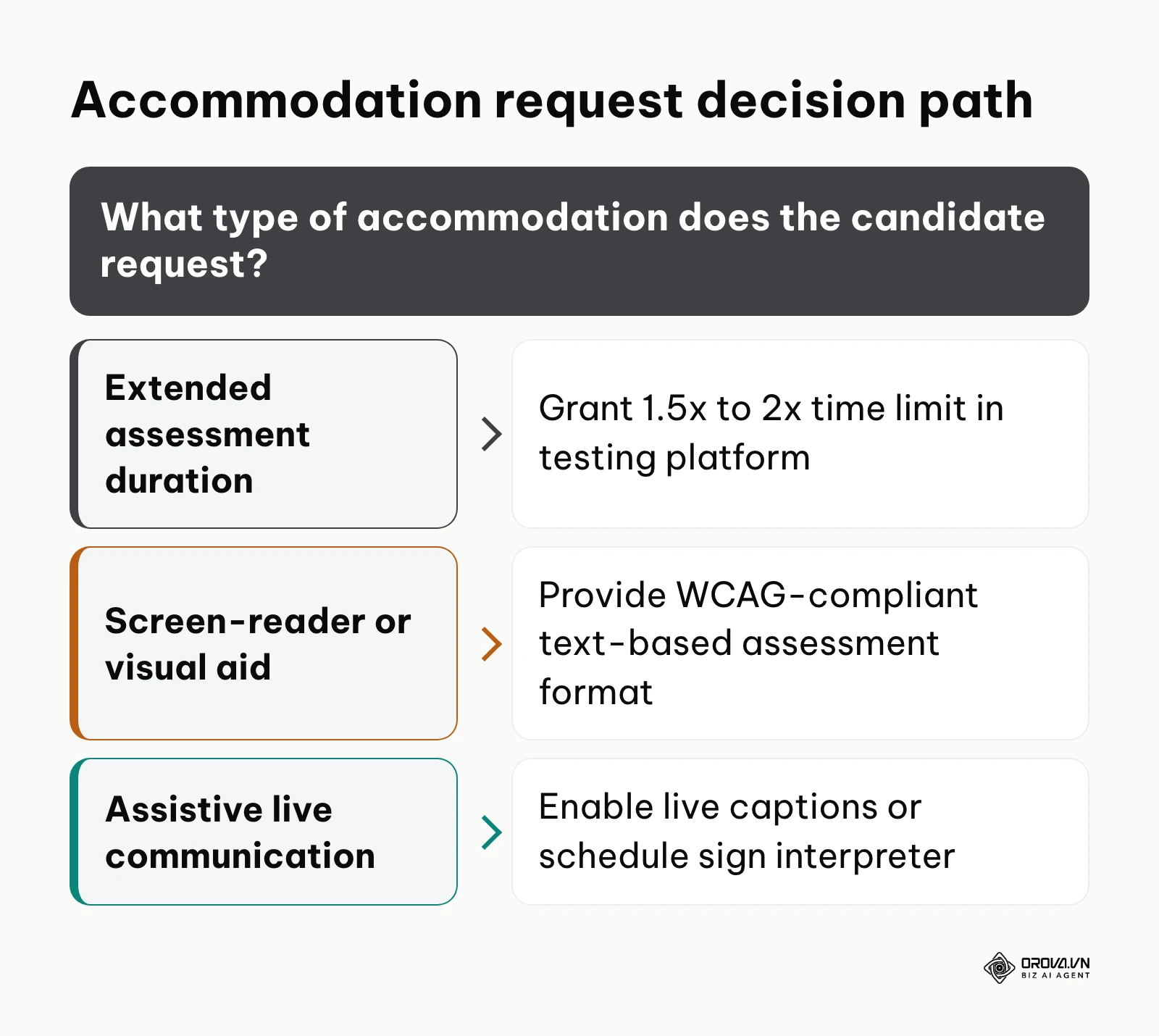
Open your candidate email templates and open your automated interview invitation templates. Insert an explicit, welcoming accessibility statement into every interview confirmation message. This message should state clearly: "Our team is committed to providing an accessible interview experience. If you require accommodations, such as extended time for technical exercises, real-time captioning, screen-reader compatible materials, or alternative assessment formats, please let us know. Requesting accommodations is entirely confidential and has zero impact on your evaluation."
The diagram below illustrates the decision path for routing and fulfilling candidate accommodation requests.
Follow a strict three-tier protocol when a candidate requests an accommodation:
- Intake: The talent coordinator logs the request in a confidential compliance field completely separate from the hiring manager's evaluation view.
- Operational adjustment: For timed assessments, adjust the testing platform configuration to grant 1.5x or 2.0x time limits. For live technical interviews, verify that coding environments comply with Web Content Accessibility Guidelines (WCAG) 2.2 AA standards and support screen readers.
- Panel briefing: Inform interviewers of the logistical adjustments (e.g., "This candidate will complete the exercise in an asynchronous written format") without disclosing medical diagnoses or personal accommodation rationales.
The visual result of this step is a confirmed accommodation tracking ticket in your HR portal, paired with a customized candidate invitation link that reflects the agreed-upon technical parameters (such as an extended countdown timer on assessment software).
A frequent error during accommodation setup is requiring candidates to submit formal medical documentation or physician notes for basic adjustments like extra assessment time. Demanding medical paperwork creates an unnecessary administrative hurdle that drives qualified candidates out of your pipeline. Fix this by adopting a trust-based policy for standard digital accommodations, reserving formal verification exclusively for complex physical workplace alterations.
Step 4: Standardize scorecards to support inclusive hiring practices
The objective of this step is to replace open-ended interviewer feedback with a standardized Behaviorally Anchored Rating Scale (BARS) tied directly to role competencies.
Open your ATS interview setup tab or create a locked evaluation spreadsheet. Construct a standardized scorecard featuring four to six core competencies identified during your job description audit. For every competency, draft a single structured behavioral interview question using the STAR methodology (Situation, Task, Action, Result).
Configure a five-point evaluation scale where each rating level is anchored by observable candidate behaviors rather than subjective labels like "good," "average," or "poor." Industrial-organizational psychology research has long found that structured interviews with predefined rating anchors produce more consistent evaluations than unstructured conversations.
The table below illustrates a complete, audit-ready five-column BARS interview scorecard template across core professional competencies.
| Core Competency | Standardized Situational Question | Below Standard (Score 1) | Meets Standard (Score 3) | Exceeds Standard (Score 5) |
|---|---|---|---|---|
| Technical Problem Solving | Describe a complex technical failure you diagnosed under tight project deadlines. What was your process? | Blames external factors; offers vague steps; cannot explain root-cause analysis or debugging logic | Follows structured diagnosis; identifies root cause; implements fix and documents preventive steps | Pinpoints systemic root cause; implements permanent fix; builds automated tests to prevent recurrence |
| Cross-Functional Collaboration | Tell me about a time you had to align competing priorities with a stakeholder outside your department. | Insists on personal viewpoint; dismisses partner constraints; escalates conflict without attempting resolution | Listens to stakeholder constraints; articulates trade-offs; negotiates a mutually acceptable compromise | Proactively identifies conflicting goals early; structures shared KPIs; builds lasting inter-departmental trust |
| Adaptability and Resilience | Describe a project where primary business requirements changed halfway through execution. How did you react? | Expresses frustration; resists changing workflows; misses subsequent milestones due to inertia | Acknowledges shifting requirements; reorganizes sprint backlog; reprioritizes deliverables calmly | Anticipates secondary risks; realigns cross-functional resources rapidly; mentors junior team through transition |
| Inclusive Leadership | Give an example of how you ensured quieter or dissenting team members contributed to a critical project decision. | Dominates discussion; ignores dissenting views; equates vocal participation with capability | Actively invites input from all attendees; pauses meetings to solicit written or asynchronous feedback | Creates multi-channel input mechanisms; normalizes dissent; credits minority contributors publicly |
Underneath each competency row, include a mandatory "Verifiable Behavioral Evidence" text box. Require interviewers to transcribe direct quotes and factual actions described by the candidate rather than personal impressions.
The visual proof of an active BARS scorecard is a locked submission form in your recruitment portal. The system prevents interviewers from submitting a final recommendation until they have recorded numerical scores and evidentiary notes for every mandatory competency.
A common mistake in scorecard deployment is the "halo effect," where an interviewer awards high scores across all technical competencies simply because the candidate attended a prestigious university or communicated with exceptional charismatic polish. Overcome this by instructing interviewers to score each question immediately after it is answered, preventing early impressions from skewing subsequent competency evaluations.
Hypothetical example:
- Context: A mid-sized fintech company experienced wide variance in engineering hiring decisions, with debrief meetings regularly devolving into debates over candidate "sharpness."
- Steps taken: The VP of Engineering mandated a four-competency BARS scorecard across all technical interviews, configured the ATS to lock scores after submission, and required verbatim behavioral notes for any rating above 3 or below 2.
- Stumbling block and fix: Several senior engineers complained that writing behavioral evidence notes slowed down their evaluation process; the talent lead resolved this by dedicating the final eight minutes of each interview slot exclusively to scorecard completion.
- Observable outcome: Evaluation variance between interviewers dropped from 44 percent to under 12 percent, and post-interview hiring consensus was achieved within a single fifteen-minute debrief session.
Consistent criteria only work when every open role uses them. Orova Recruit turns a job description into weighted criteria you can edit, checks each resume item by item with quoted evidence, and drafts structured interview questions for each candidate. Start your free trial, no credit card required.
Step 5: Train evaluation panels to uphold inclusive hiring practices
The objective of this step is to calibrate your interview panel, eliminating conversational wandering and mitigating unconscious affinity bias before interviewers interact with candidates.
Convene your evaluation panel for a mandatory 30-minute calibration session prior to launching interviews. Ensure the panel includes multi-disciplinary perspectives across different functional levels and backgrounds. Assign exactly one competency and its corresponding structured question to each interviewer. For example, Interviewer A evaluates Technical Problem Solving, Interviewer B evaluates Cross-Functional Collaboration, and Interviewer C assesses Adaptability. This division of labor prevents repetitive questioning and ensures comprehensive competency coverage.
Enforce the four interview conduct rules in the table below during the calibration briefing.
| Conduct rule | What interviewers do | What to avoid |
|---|---|---|
| Stick to the script | Ask the predetermined questions verbatim to every candidate | Small talk about hometowns, mutual acquaintances, or hobbies, which triggers affinity bias |
| Standardize note-taking | Record what the candidate did and said: actions, metrics, tools used, trade-offs made | Interpretations such as "seemed nervous" or "lacked confidence" |
| No cross-talk before submission | Submit individual scorecards independently before seeing colleagues' ratings | Discussing the candidate in chat or hallway conversations before scores are in |
| Appoint an Equity Advocate | One panelist monitors the debrief for biased language | Comments about age, parental status, or personality quirks going unchallenged |
The visual result of this step is a completed interview schedule matrix showing assigned competencies per interviewer, accompanied by an audit trail of independently submitted scorecards timestamped prior to the group debrief.
A frequent error during panel interviews is allowing the most senior executive in the room to share their opinion first during debrief sessions, which anchors the entire group's perception. Prevent this by conducting silent scorecard reviews at the start of debriefs, displaying all submitted BARS ratings simultaneously on a shared screen before any verbal discussion occurs.
Step 6: Evaluate cultural add to strengthen inclusive hiring practices
The objective of this step is to systematically replace subjective "cultural fit" screenings with an objective assessment of "cultural add" during post-interview debriefs.
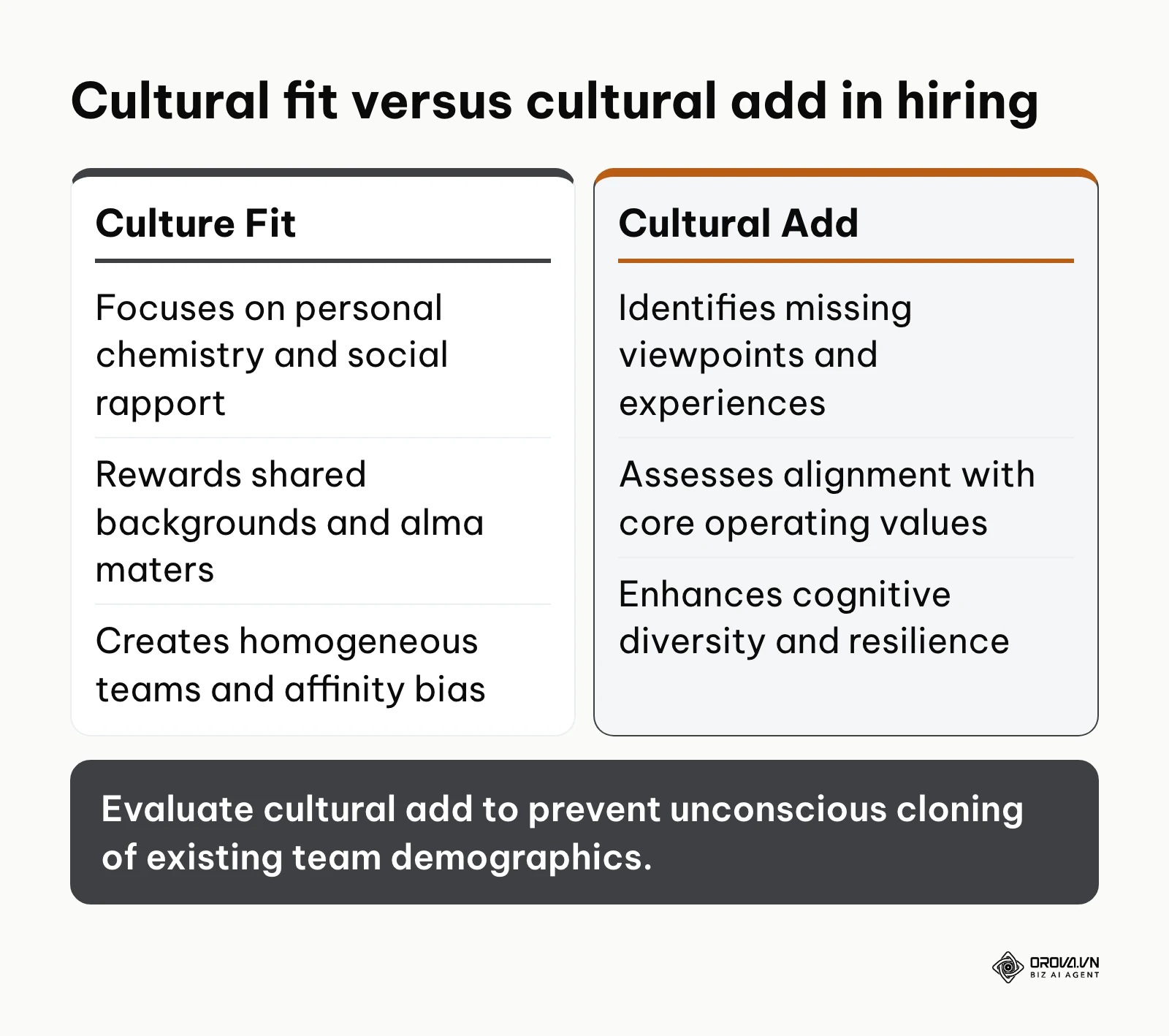
Access your interview debrief agenda and review the criteria your team uses to evaluate organizational contribution. Traditional "cultural fit" evaluations often function as a coded mechanism for affinity bias, rewarding candidates who share the existing team's educational background, social interests, or communication cadence. Cultural add, conversely, evaluates what novel perspectives, problem-solving styles, and functional experiences a candidate contributes to expand the organization's collective capabilities.
The comparison diagram below outlines the operational differences between cultural fit and cultural add evaluation models.
To operationalize cultural add, evaluate candidates against the four criteria in the table below.
| Cultural add criterion | Question for the panel | Evidence to look for |
|---|---|---|
| Perspective expansion | Does the candidate bring experience in markets, business models, or workflows the current team lacks? | Specific past projects in a context the team has not worked in |
| Values alignment | Does the candidate show your operating principles (such as transparent documentation and customer empathy) through past actions, regardless of personality type? | Described actions that match a documented company value |
| Constructive challenge | Has the candidate respectfully challenged assumptions and proposed alternative solutions? | An example where they questioned a plan and what changed as a result |
| Problem-solving diversity | Does the candidate approach ambiguous problems with methods that complement the team's defaults? | A walkthrough of how they framed and solved an unclear problem |
During debrief discussions, require interviewers who raise cultural objections to cite specific company operating values. If an interviewer remarks, "I'm not sure they would fit into our team culture," the Equity Advocate must ask: "Which documented company operating value did their behavioral evidence violate, and what specific answer demonstrated that violation?" If the interviewer cannot tie their critique to an objective behavioral anchor, the comment is stricken from the evaluation record.
The visual result of this step is an audit log of debrief notes where all candidate evaluations cite documented values and functional contributions, with zero references to social compatibility, shared leisure interests, or gut-feel chemistry.
A common pitfall is mistaking communication style differences, such as a reserved demeanor or neurodivergent eye contact patterns, for an inability to collaborate. Mitigate this by evaluating the substance and clarity of the candidate's answers rather than their performative charisma or social extroversion.
Hypothetical example:
- Context: A high-growth enterprise SaaS team of 150 employees was hiring a Senior Solutions Architect but consistently rejected qualified candidates for "failing the culture fit test."
- Steps taken: The head of talent acquisition removed the open-ended culture fit interview, replaced it with a structured cultural add scorecard tied to three company values, and trained interviewers to identify complementary problem-solving methodologies.
- Stumbling block and fix: Interviewers initially struggled to score candidates who did not display traditional high-energy sales enthusiasm; the recruiter resolved this by creating clear BARS anchors showing that methodical, quiet problem solvers scored high on technical accuracy and client trust.
- Observable outcome: The team successfully hired an architect from a non-traditional enterprise background who reorganized their client deployment framework, reducing enterprise onboarding errors by 28 percent over their first six months.
Step 7: Audit adverse impact to validate inclusive hiring practices
The objective of this step is to mathematically verify whether your hiring funnel treats all candidate demographic groups equitably, using the four-fifths rule of thumb from U.S. federal selection guidelines.
Open your talent analytics dashboard or export your anonymized stage-by-stage candidate pipeline data into a secure spreadsheet. To safeguard candidate privacy while maintaining compliance, collect demographic information only where local law permits, through voluntary, self-reported questionnaires stored separately from candidate application profiles. Recruiters and hiring managers must never view individual demographic responses during the screening or selection process.
Under the Uniform Guidelines on Employee Selection Procedures adopted in 1978 by the U.S. Equal Employment Opportunity Commission (EEOC) and other federal agencies, a selection rate for any race, sex, or ethnic group which is less than four-fifths (80%) of the rate for the group with the highest rate is generally regarded as evidence of adverse impact. The four-fifths rule is a screening signal, not a legal conclusion; if you hire outside the United States, check the guidance that applies in your jurisdiction.
To calculate adverse impact across any stage of your hiring pipeline (such as resume screening to technical interview, or interview to job offer), execute the following four calculations:
- Selection rate of the reference group (the group with the highest pass-through rate) = candidates selected in that group ÷ applicants in that group.
- Selection rate of the focal group = candidates selected in that group ÷ applicants in that group.
- Impact ratio = focal group selection rate ÷ reference group selection rate.
- Compare against the 0.80 threshold: if the impact ratio is below 0.80 (80%), the stage shows potential adverse impact and your screening criteria for that stage need a closer review.
Mathematical calculation scenario
Hypothetical example: an engineering hiring campaign with 200 total applicants.
| Calculation | Group A (reference) | Group B (focal) |
|---|---|---|
| Applicants entering the pipeline | 120 | 80 |
| Final job offers | 24 | 8 |
| Selection rate | 24 ÷ 120 = 0.20 (20.0%) | 8 ÷ 80 = 0.10 (10.0%) |
| Impact ratio | Reference = 1.00 | 0.10 ÷ 0.20 = 0.50 (50.0%) |
The impact ratio of 0.50 is well below the 0.80 threshold. Group B is advancing at half the rate of Group A, which signals potential adverse impact under the four-fifths rule and calls for a stage-by-stage review of where the gap opens.
When your mathematical audit reveals an adverse impact ratio below 0.80, analyze your stage-by-stage drop-off rates immediately. Identify whether the disparity occurred during initial resume screening (indicating biased pedigree filters), asynchronous technical assessments (indicating inaccessible testing formats), or panel interviews (indicating unstructured scoring).
The visual result of this step is a dynamic adverse impact calculation spreadsheet featuring stage conversion percentages and automated conditional formatting that flags any cohort ratio falling below 0.80 in red.
A common pitfall is calculating adverse impact across tiny sample sizes (such as a single requisition with five total applicants), where a single hiring decision skews percentages dramatically. For low-volume requisitions, aggregate hiring data across rolling quarterly periods or apply a statistical significance test (such as Fisher's exact test or the two-standard-deviation test) to check whether observed differences are statistically significant.
Complete checklist for executing inclusive hiring practices
The table below consolidates the entire seven-step implementation framework into an actionable operational checklist. Talent acquisition teams can print or copy this table to verify every stage of their recruitment pipeline before making candidate selections.
| Implementation Step | Primary Operational Action | Completion Verification Indicator | Estimated Time |
|---|---|---|---|
| Step 1: Job Description Audit | Strip gendered words and non-essential degree requirements | Language analyzer flags no coded terms | 60 minutes |
| Step 2: Blind Resume Screening | Redact candidate names, schools, graduation years, and addresses | Anonymized candidate review view active in ATS | 45 minutes |
| Step 3: Accommodation Protocol | Embed standard accessibility statement and request workflow in emails | Pre-configured accommodation options active in platform | 30 minutes |
| Step 4: BARS Scorecard Setup | Build 5-point behavioral anchor rubrics for all core competencies | Locked digital scorecard requiring evidence notes | 60 minutes |
| Step 5: Panel Calibration | Assign distinct competencies to interviewers and brief panel | Interview schedule matrix with zero overlapping questions | 45 minutes |
| Step 6: Cultural Add Evaluation | Replace cultural fit discussions with values-aligned contributions | Debrief notes reference explicit company operating values | 30 minutes |
| Step 7: Adverse Impact Audit | Calculate four-fifths selection ratios across pipeline stages | Impact ratio at or above 0.80 for every stage, or a documented review | 45 minutes |
Reviewing these checkpoints prior to candidate outreach ensures every requisition adheres to consistent, defensible evaluation standards.
Common mistakes in inclusive hiring practices and troubleshooting
Even well-intentioned talent teams frequently encounter procedural friction when introducing inclusive hiring practices. The table below outlines five common failure modes, their underlying causes, and practical corrective actions.
| Common Implementation Mistake | Frequent Root Cause | Recommended Corrective Action |
|---|---|---|
| Over-indexing on elite school credentials during resume reviews | Reviewers use university pedigree as a cognitive proxy for baseline intelligence | Strip university names in blind screening; require standardized work-sample tests |
| Interviewers asking unscripted conversational warm-up questions | Natural urge to build rapport and put candidates at ease during opening minutes | Mandate that all interviewers start directly with standardized question scripts |
| Lowering competency bars under the guise of diversity hiring | Misunderstanding inclusive hiring as lowering standards rather than expanding reach | Maintain strict, non-negotiable BARS benchmarks while widening sourcing channels |
| Treating accommodation requests as exceptional logistical burdens | Lack of standardized, pre-approved assessment alternatives for disabled talent | Build default 1.5x time options and text-only formats into standard assessment tools |
| Failing to document factual evidence in interview scorecard notes | Interviewers rely on memory and impressions after conducting multiple interviews | Dedicate the final eight minutes of every interview block to immediate note logging |
Software can help keep these standards consistent when reviewers are tired or rushed. Orova Recruit supports the criteria-first part of this method: it accepts job descriptions in eleven file formats up to 10MB, uses AI to extract eight to sixteen weighted evaluation criteria across five distinct categories with two to five verifiable check items each, and enabling talent teams to customize up to sixty manual criteria.
When resumes arrive, the platform supports up to 500 candidate files per requisition, checking each criterion item as met or not met with a quoted line from the resume as evidence, and returning one of four labels: Pass, Consider, Fail, or Unreadable. Recruiters record their own assessment side by side with the AI result, generate eight to twelve standardized interview questions tailored to specific resume gaps, record interview notes via multi-language dictation across 56 languages, and transcribe audio recordings up to 300MB, while the final hiring decision stays with people. Orova Recruit does not anonymize resumes, so keep the redaction step from Step 2 in place if you run blind screening.
Understanding the distinction between legacy software and AI-driven platforms is essential when upgrading your stack, as explored in our comparison of Recruitee software vs AI hiring platforms.
Keep evaluations evidence-based without slowing down hiring. Orova Recruit extracts criteria from your job description, lets recruiters review side by side with the AI result, and scores interviews with quoted evidence while people make the final call. Free until July 7, 2027. Sign up in minutes.
How to measure the long-term success of inclusive hiring practices
Tracking the performance of your inclusive hiring framework requires examining post-hire retention and funnel equity metrics rather than vanity applicant numbers. Access your HRIS reporting module and ATS analytics dashboard to monitor three primary indicators across rolling quarterly intervals.
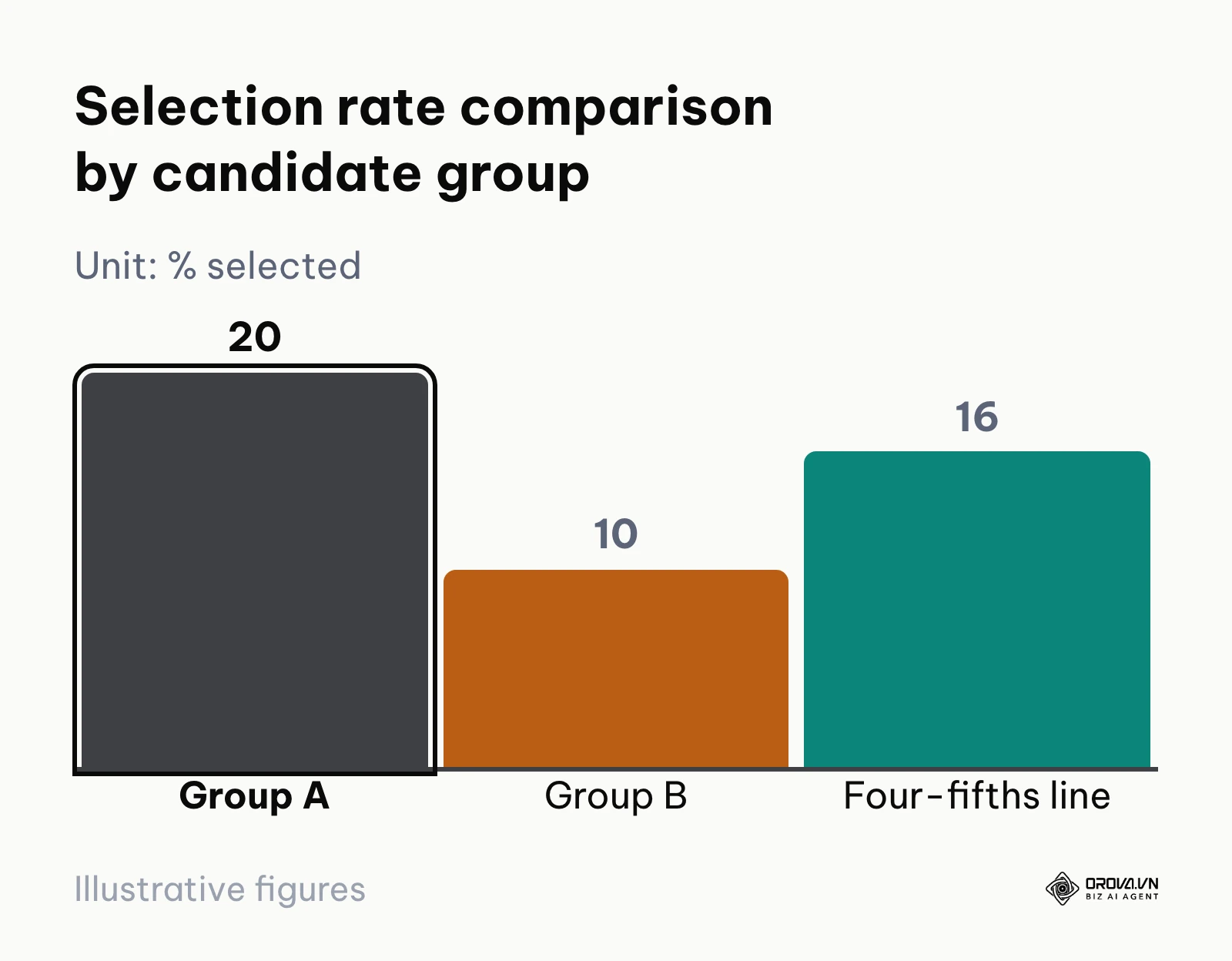
The bar chart below reuses the hypothetical Step 7 numbers to show how a selection-rate audit compares two candidate groups against the four-fifths threshold.
The diagram above demonstrates how tracking pass-through percentages highlights systemic pipeline leaks. First, evaluate Stage Conversion Parity: monitor the ratio of underrepresented candidates advancing from application to screen, screen to technical interview, and interview to final offer. If the impact ratio stays at or above 0.80 at every funnel stage over consecutive quarters, that stage is not showing a four-fifths warning signal, although small samples still call for caution.
Second, examine 90-Day and First-Year Retention Parity: compare turnover rates across demographic cohorts in your HRIS. High turnover among specific groups within the first year signals an onboarding breakdown or an inaccurate job preview during the selection process.
Third, monitor Performance Rating Equity: evaluate whether employees hired through structured BARS rubrics achieve equivalent or superior performance ratings during their initial six-month reviews compared to historical cohorts hired through unstructured interviews. Give the process several hiring cycles before judging retention and performance trends, since these indicators move slowly.
Teams modernizing their hiring architecture can discover additional workflow efficiencies by exploring what is recruitment automation to streamline repetitive administrative tasks without compromising procedural equity.
Future trends in inclusive hiring practices: author's outlook
Evaluating employment equity developments as of 2026 reveals significant structural shifts in how organizations assess talent. In my view, the coming two to three years will fundamentally reshape how hiring teams design evaluation systems, driven by regulatory pressure, skills shortages, and algorithmic evolution.
First, I believe that opaque resume-parsing algorithms will be largely abandoned in favor of deterministic, auditable skills evaluation models. Some jurisdictions have already introduced rules on automated hiring tools, and scrutiny of black-box screening that can replicate historical disparities is growing. Over the next two to three years, I anticipate that enterprises will mandate transparent AI tools that provide verifiable, citation-backed evidence for every candidate qualification. Hiring teams should prepare now by establishing explicit competency rubrics and maintaining comprehensive audit logs of all automated screening criteria. However, this shift could be delayed if regulatory enforcement weakens or if proprietary closed-model platforms monopolize enterprise software procurement.
Second, I expect verified work-sample assessments to largely replace traditional educational credentials across technical and knowledge-work roles. We are already witnessing enterprise employers eliminating four-year degree requirements from job descriptions to tap into broader talent pools. In my view, the next phase of this evolution will see standardized, asynchronous work simulations become the default primary gating mechanism for knowledge workers. Organizations should begin auditing their job postings today, stripping legacy degree requirements and constructing practical, job-related assessment rubrics. This projection could prove incorrect if credential inflation accelerates or if industry bodies fail to establish trusted verification standards for self-taught skills.
Third, I anticipate that reasonable accommodations will transition from exceptional, manual requests into default, user-configurable interview parameters. Currently, candidates must navigate awkward administrative channels to request basic accommodations like extended test times or closed captioning. In the coming years, progressive assessment platforms will embed universal design principles directly into candidate portals, allowing applicants to select their preferred assessment modalities anonymously without human intervention. Talent leaders should prepare immediately by auditing their recruitment software vendors for strict WCAG 2.2 AA accessibility compliance. This trend could stall if return-to-office mandates enforce rigid, in-person testing regimens that restrict digital flexibility.
Understanding how machine learning models impact candidate evaluation is critical for talent leaders navigating these shifts; explore our comprehensive analysis on what is AI in recruitment to align your technological roadmap with emerging standards.
Frequently asked questions about inclusive hiring practices
What is the difference between diversity hiring and inclusive hiring practices?
Diversity hiring focuses on the demographic composition of your workforce, often tracking representation metrics across race, gender, and background. Inclusive hiring practices, by contrast, focus on the systemic architecture of your recruitment process, implementing objective, bias-mitigating procedures (such as blind screening, de-biased job descriptions, and BARS scorecards) to ensure every candidate is evaluated equitably on verified competence.
How does artificial intelligence affect inclusive hiring practices?
Artificial intelligence can either amplify historical hiring disparities or help eliminate them, depending entirely on its architectural design. Legacy pattern-matching machine learning models trained on historical company hiring data inevitably replicate past biases by favoring traditional resumes. Conversely, modern deterministic AI systems that evaluate candidates strictly against explicit, human-defined rubrics and provide exact textual evidence citations help recruiters objectively identify qualified talent from non-traditional backgrounds.
How can small businesses implement inclusive hiring practices on a zero budget?
Small businesses can build an audit-ready inclusive hiring process using existing office software and free resources. Talent teams can audit job descriptions using free online text analyzers, conduct blind resume screening by assigning a team member to manually redact personal details before sharing files, create structured BARS scorecards in standard spreadsheets, and audit funnel equity using standard mathematical formulas.
Does blind screening completely eliminate unconscious bias from the hiring process?
Blind screening does not eliminate unconscious bias entirely; it specifically mitigates pedigree, gender, and ethnic bias during the initial resume review stage. Once candidates advance to live technical evaluations and panel interviews, interpersonal biases like affinity bias and accent bias can resurface. To maintain equity, blind screening must be paired with structured BARS interview scorecards and panel calibration.
How do you handle candidates who request reasonable accommodations during live technical coding rounds?
Establish a pre-approved accommodation catalog before opening the role. When a candidate requests an accommodation (such as a screen-reader compatible environment, extended time, or an asynchronous take-home task), grant the request immediately through your testing platform. Brief interviewers on the logistical format without disclosing medical details, and evaluate the final submission using your standard BARS technical rubric.
What should an interview panel do if an interviewer submits a vague "bad vibe" evaluation?
The designated Equity Advocate must immediately challenge the subjective assessment during the debrief meeting. Ask the interviewer to identify the specific question asked, the candidate's exact behavioral response, and which documented company operating value that response violated. If the interviewer cannot provide concrete behavioral evidence tied to a BARS anchor, strike the evaluation from the selection record and rely on calibrated panel scores.
Structuring your talent pipeline end-to-end requires rigorous coordination across all evaluation stages; review our blueprint on the modern hiring process to align your recruitment workflows.
Where should you start with inclusive hiring practices?
Implementing comprehensive recruitment equity across an entire enterprise can feel overwhelming, but successful transformation begins with a single, contained operational action. Identify which of the following three scenarios matches your organization's current operational state and execute its designated first step this afternoon.
If you are a solo recruiter or hiring manager operating with zero budget and basic software tools, begin by auditing your single most critical active job description. Copy the text into your document editor, open the 20-term de-biasing matrix in Step 1 of this guide, and systematically replace every masculine-coded phrase, arbitrary multi-year tenure demand, and non-essential degree requirement with concrete 90-day deliverable milestones.
If you lead a talent acquisition team at a high-growth mid-market company experiencing high interview variance, focus on standardizing your evaluation rubrics. Select your highest-volume open role and spend ninety minutes building a locked 5-column BARS interview scorecard for two core competencies, utilizing the template in Step 4. Mandate that interviewers record verbatim behavioral evidence before submitting scores, eliminating unstructured conversational banter from your debriefs.
If you are an enterprise talent director preparing for compliance scrutiny or executive reporting, audit your existing funnel mathematics. Pull your stage-by-stage candidate conversion data for the past two quarters, apply the EEOC Four-Fifths Adverse Impact formula detailed in Step 7, and identify the exact funnel stage where demographic pass-through rates drop below 0.80.
Take that single operational step today to permanently embed fair, measurable, and defensible inclusive hiring practices into your talent acquisition engine.
About the author

Builder of Orova
Nguyễn Đỗ Trọng Ân has 8 years of experience in marketing, including 6 years managing market development across Asia. He builds Orova, a Biz AI Agent that never sleeps: it plans, runs and optimizes work for businesses.
Run your business with AI Agents
Orova is the always-on Biz AI Agent — it plans, runs, and optimizes the work for you.
Save time, unlock productivity.